
ENDOMETRIAL PREPARATION
IN FROZEN EMBRYO
TRANSFER CYCLES
Aboubakr Elnashar
Benha university, Egypt
AboubakrElnashar
CONTENTS
INTRODUCTION
I. NATURAL CYCLE
II. ARTIFICIAL (HORMONE
REPLACEMENT) CYCLE
III. OVULATION INDUCTION
CONCLUSION
AboubakrElnashar
INTRODUCTION
1st successful pregnancy following FET:
1983 Trounson and Mohr
(Trounson, 1983).
 Cryopreservation of embryos has become an
integral part of ART programs.
 Increased dramatically
 1.Ttrend towards transferring fewer embryos
after a fresh IVF cycle
 2. Improved laboratory techniques
 (Skovmand 1997; Diniz, 2002; Fineschi et al., 2005; Gordts et
al., 2005; Thompson, 2005; Le Lannou et al., 2006; JOINT
SOGC-CFAS, 2008; Min et al., 2010).
AboubakrElnashar
Success= keypoints in performing FET
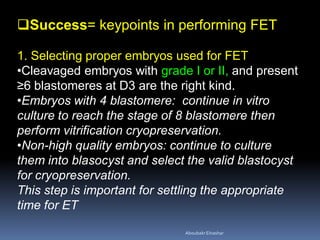
1. Selecting proper embryos used for FET
•Cleavaged embryos with grade I or II, and present
≥6 blastomeres at D3 are the right kind.
•Embryos with 4 blastomere: continue in vitro
culture to reach the stage of 8 blastomere then
perform vitrification cryopreservation.
•Non-high quality embryos: continue to culture
them into blasocyst and select the valid blastocyst
for cryopreservation.
This step is important for settling the appropriate
time for ET
AboubakrElnashar
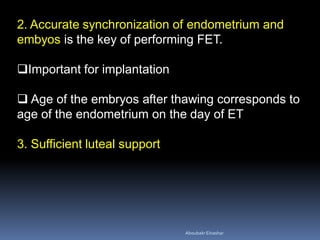
2. Accurate synchronization of endometrium and
embyos is the key of performing FET.
Important for implantation
 Age of the embryos after thawing corresponds to
age of the endometrium on the day of ET
3. Sufficient luteal support
AboubakrElnashar
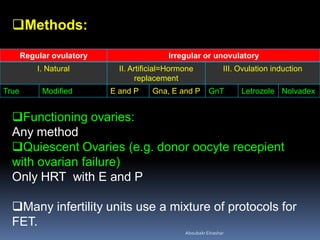
Methods:
Regular ovulatory Irregular or unovulatory
I. Natural II. Artificial=Hormone
replacement
III. Ovulation induction
True Modified E and P Gna, E and P GnT Letrozole Nolvadex
Functioning ovaries:
Any method
Quiescent Ovaries (e.g. donor oocyte recepient
with ovarian failure)
Only HRT with E and P
Many infertility units use a mixture of protocols for
FET.
AboubakrElnashar
Best method:
Little agreement in ovulatory women
(Ghobara and Vandekerckhove, 2008;Weissman et al., 2009).
AboubakrElnashar
I. NATURAL CYCLE NC-FET
 Indication
It is only feasible for women with regular cycles and
proven ovulation.
In normally ovulating women: protocol of choice
 The simplest method
 Endocrine preparation of the endometrium is
achieved by endogenous sex steroid production
from a developing follicle.
AboubakrElnashar
A. True Natural cycle
 Timing of ET is determined by detecting the
spontaneous LH surge
Method:
1. D10-12 (3-5 d prior to estimated ovulation day)
 Serial US: E thickness, follicular development
and to time the commencement of testing for LH
 LH (urine or blood) for detection of the LH surge ,
 P levels
When a rise in serum LH levels is observed, it is assumed that ovulation will occur
36–40 h later (Andersen et al., 1995).
LH surges in urine lag up to 21 h behind the appearance of the surge in blood
(Hoff et al., 1983; Frydman et al., 1984; Miller and Soules 1996).
The day when LH exceeds 180% of baseline (calculated as the mean of the 3
previous morning samples) corresponds to a day prior to OPU/ovulation.
2. US for evidence of ovulation.
AboubakrElnashar
3. FET
3–5 days after ovulation depending on the stage
of the embryo when frozen
The day of ovulation corresponds to the day of
egg retrieval.
If embryos were frozen at 72h, ovulation day+3 is
the right time to transfer.
(Nawroth and Ludwig, 2005; Paulson,2011).
4. LPS:
progesterone
AboubakrElnashar
Advantage
no medications are used: preferable to many
women.
AboubakrElnashar
Disadvantages:
1. Even in women having regular menstrual cycles,
ovulation may not always occur
2. Problem associated with the detection of
spontaneous LH surges
A. variation in timing of its occurrence between
cycles and between patients (Park et al., 2007).
B. In order to assess the LH levels correctly,
determination should be performed at least daily,
and preferably twice a day.
C. LH urine kits have a large variation in thresholds,
which involve the risk of up to 30% of false-
negative testing, and are often reported by
patients as being difficult to interpret
(Miller and Soules, 1996; Guermandi et al., 2001; O’Connor et al., 2006).
AboubakrElnashar
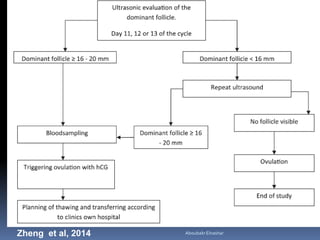
B. Modified natural cycle
To overcome the disadvantages of LH monitoring:
Administering hCG to initiate luteinization
Method:
1. Regular US:
2. HCG
5000 IU when dominant follicle (16 or 17or 18 mm):
ovulation 36–38 h later
(Andersen et al., 1995).
Combined with E2 levels of (450-550 pmol/L), 600-700 or 800-900 respectively
HCG administration correspond to the HCG
administration day of the source cycle
AboubakrElnashar
Zheng et al, 2014 AboubakrElnashar
Advantages:
less US evaluation due to the hCG administration
compared with true NC-FET: less burden on
patients and doctors
(Weissman et al., 2011).
AboubakrElnashar
Risks
1. unexpected ovulation
: accurate planning of embryo thawing and transfer
is not possible: cycle cancellation (7–12%)
(Fatemi et al., 2010; Hill et al., 2010).
2. Difficulty in ensuring timely thawing and ET.
AboubakrElnashar
LPS in NC-FET.
Not required
(Kyrou et al, 2010)
similar result in patients receiving true NC-FET
(Lee et al., 2013).
{CL formation is not hampered by inadequate LH
secretion}
higher LBR in patients undergoing true NC-FET
with LPS.
(Bjuresten et al. 2011)
Too little evidence supporting a positive effect of
LPS in patients undergoing NC-FET
(Groenewoud et al, 2013, MA)
AboubakrElnashar
True NC-FET Vs modified NC-FET:
no difference in outcome
AboubakrElnashar
II. ARTIFICIAL (HORMONE
REPLACEMENT) CYCLE
In patients with irregular cycles HRT is best used.
Aims
To mimic the endocrine exposure of the
endometrium in the normal cycle.
AboubakrElnashar
Key points:
1.An endometrial thickness 6 and showing triple line is
favorable for ET
2.Endometrial development is unaffected by the length
of the follicular phase. No adverse effects of reduction
the duration of exposure to E to 6 days or an increase
up to 35 days. However receptivity is best preserved
when the follicular phase is kept between 12 and 19
days
3.The endometrium is affected by either incremental or
fixed E levels , even in supraphysiologic range
AboubakrElnashar
A. Estrogens and progesterones without
GnRHa.
used in women with remaining ovarian function
(Jaroudi 1991; Lelaidier 1992).
Method:
1. Oestrogen
Effect:
proliferation of the endometrium, while suppressing the
development of the dominant follicle
 Form and dose
 Oral E2 (progynova or Trisequence (Blue tab) or Cycloprogenova (White tab))
4-6 mg/d or 2 mg/d with an increasing doses
 Transdermal patches (estrofem/estrace)
 subcutaneous implants
 vaginal rings or tablets.
AboubakrElnashar
 When:
 D1 of cycle: prevents follicular recruitment by
suppressing FSH: spontaneous ovulation is
avoided.
 D3
before D4.
AboubakrElnashar
2. Progesterone
Aim:
initiate secretory changes
Form
oral tablets
IM 40-60 mg in oil
vaginal suppositories, gel or rings (Devroey 1998).
When
Once the lining endometrium: 7–9 mm on US
Not duration of E2 supplementation but the
endometrium thickness should be the leading factor
in determining the start of progesterone
(Nawroth and Ludwig, 2005; El-Toukhy et al., 2008).
AboubakrElnashar
Route:
No difference in PR between vaginal and IM
progesterone.
(Glujovsky et al., 2010, SR)
based on patient and doctor preference.
AboubakrElnashar
Timing of embryo thawing and ET:
Planned according to the moment of progesterone
supplementation.
The day P is started is considered ovulation/opu
day, and the time of thaw/transfer is determined
accordingly.
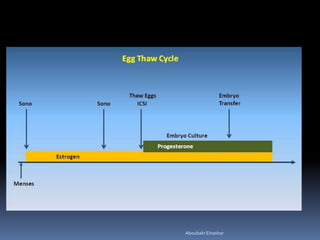
AboubakrElnashar
1. E2
From D2 or 3 of cycle:
3 or 4 tab (acc to wt of pt) (for 7 or 8 days)
2. US:
When endometrial thickness 9 mm
3. Prontogest 400 mg twice daily or
duphaston 10 mg tds
4. ET
If you are freezing
Blastocyst: transfer on 6th or 7th day of progesterone
D3 or Morula: transfer on day 4 of progesterone
(some say D 5 for all, no difference)
4. LPS
Estrogen and progesterone
AboubakrElnashar
Cases of amenorrhea (after induction by lutone
or lutofolon or cycloprognova or pills)
1. E2
1 Tab x 3 day from D3 of the cycle
2 Tab x 3 day
3 Tab x (2 – 5 day )
2. TVS monitoring
till endometrial lining is 9 – 10 mm.
3. Uterogestan1 tab of utrogestan/d
E2: 2 Tab/d till pregnancy test
4. ET
5. LPS:
if preg test positive: utrogestan 2X3
AboubakrElnashar
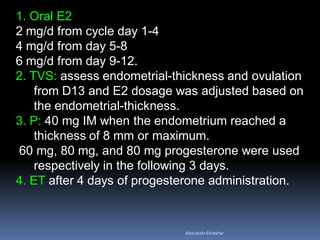
1. Oral E2
2 mg/d from cycle day 1-4
4 mg/d from day 5-8
6 mg/d from day 9-12.
2. TVS: assess endometrial-thickness and ovulation
from D13 and E2 dosage was adjusted based on
the endometrial-thickness.
3. P: 40 mg IM when the endometrium reached a
thickness of 8 mm or maximum.
60 mg, 80 mg, and 80 mg progesterone were used
respectively in the following 3 days.
4. ET after 4 days of progesterone administration.
AboubakrElnashar
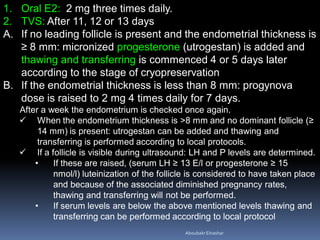
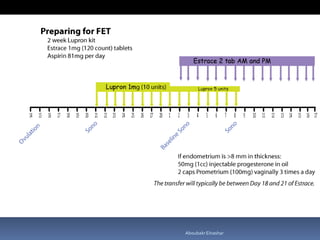
1. Oral E2: 2 mg three times daily.
2. TVS: After 11, 12 or 13 days
A. If no leading follicle is present and the endometrial thickness is
≥ 8 mm: micronized progesterone (utrogestan) is added and
thawing and transferring is commenced 4 or 5 days later
according to the stage of cryopreservation
B. If the endometrial thickness is less than 8 mm: progynova
dose is raised to 2 mg 4 times daily for 7 days.
After a week the endometrium is checked once again.
 When the endometrium thickness is >8 mm and no dominant follicle (≥
14 mm) is present: utrogestan can be added and thawing and
transferring is performed according to local protocols.
 If a follicle is visible during ultrasound: LH and P levels are determined.
• If these are raised, (serum LH ≥ 13 E/l or progesterone ≥ 15
nmol/l) luteinization of the follicle is considered to have taken place
and because of the associated diminished pregnancy rates,
thawing and transferring will not be performed.
• If serum levels are below the above mentioned levels thawing and
transferring can be performed according to local protocol
AboubakrElnashar
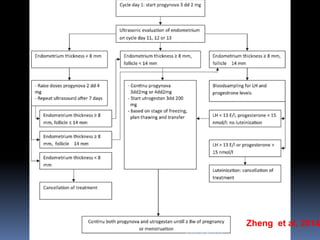
Zheng et al, 2014
AboubakrElnashar
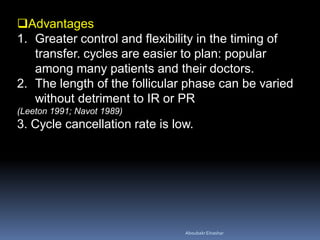
Advantages
1. Greater control and flexibility in the timing of
transfer. cycles are easier to plan: popular
among many patients and their doctors.
2. The length of the follicular phase can be varied
without detriment to IR or PR
(Leeton 1991; Navot 1989)
3. Cycle cancellation rate is low.
AboubakrElnashar
4. Higher IR and PR than patients with natural
cycles
IR and PR was higher in patients without ovulation
than ovulatory patients
ovulation in HRT cycle has a detrimental effect on
pregnancy.
HRT should be used in FET cycles, and ovulation of
patients should be evaluated during the treatment.
Zheng et al, 2014
AboubakrElnashar
Risks:
1. The administration of E and P does not guarantee
complete pituitary suppression: a dominant follicle
may occur. luteinization may occur in 5%
(El Toukhy et al., 2004).
2. Should the follicle undergo spontaneous
luteinization: endometrium may be exposed to
progesterone earlier: incorrect timing of thawing and
transferring.
From a cost-efficiency perspective, this aspect is of
great importance and should be taken into account
GnRHa co-treatment may be used to down-
regulate the pituitary and prevent follicular growth
(AC-FET with GnRH-FET). AboubakrElnashar
3. Both of these AC-FET approaches require
medication and are therefore less ‘physiological’
AboubakrElnashar
AboubakrElnashar
LPS:
If a pregnancy occurs, E and P must be continued
until placental autonomy is established to replace
the absent corpus luteum.
No difference in PR between different methods of
LPS in patients undergoing ‘fresh’ IVF or ICSI
(Chocrane SR, van der Linden et al., 2011).
The use of synthetic progesterone in patients
undergoing IVF or ICSI did lead to higher PR
compared with natural progesterone.
AboubakrElnashar
B. Estrogens and progesterones with
GnRHa.
Indication:
In women with remaining ovarian function
Aim:
GnRHa is used to suppress temporarily ovarian function and
render the patient functionally agonadal prior to inducing an
artificial cycle with E and P.
Method:
1. GnRHa (Decapeptyl CR, 3.75 mg)
in regularly menstruating it is given on D21 of the cycle
in oligomenorrhic from D1 of the cycle.
2. After 14 days:
E2 is determined
E2 is started as before
AboubakrElnashar
AboubakrElnashar
Disadvantages:
1. More expensive
2. GnRHa can have side effects
3. Delay the resumption of spontaneous ovulation
if FET fails.
AboubakrElnashar
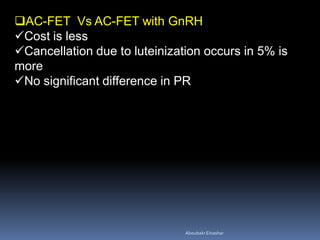
AC-FET Vs AC-FET with GnRH
Cost is less
Cancellation due to luteinization occurs in 5% is
more
No significant difference in PR
AboubakrElnashar
NC-FET Vs AC-FET.
No difference in PR.
AboubakrElnashar
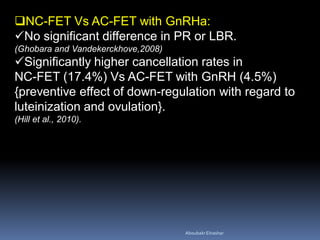
NC-FET Vs AC-FET with GnRHa:
No significant difference in PR or LBR.
(Ghobara and Vandekerckhove,2008)
Significantly higher cancellation rates in
NC-FET (17.4%) Vs AC-FET with GnRH (4.5%)
{preventive effect of down-regulation with regard to
luteinization and ovulation}.
(Hill et al., 2010).
AboubakrElnashar
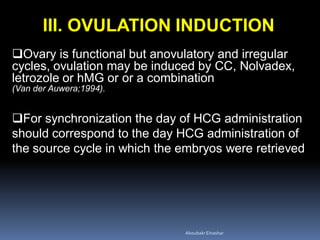
III. OVULATION INDUCTION
Ovary is functional but anovulatory and irregular
cycles, ovulation may be induced by CC, Nolvadex,
letrozole or hMG or or a combination
(Van der Auwera;1994).
For synchronization the day of HCG administration
should correspond to the day HCG administration of
the source cycle in which the embryos were retrieved
AboubakrElnashar
A. Letrozole, GNT
In patients with irregular cycles Letrozole is 1st
choice for endometrium preparation for FET
1. Letrozole:
2.5-5mg on cycle D3 to 7, in order to promote monofollicular development
2. TVS:
if follicles growth is not ideal: mild stimulation (HMG 150 IU)
3. HCG:
10000: when the follicles reach the criteria of mature
4. ET
Embryos were frozen at 72h: ETAfter 4 or 5 days
Blastocyst transfer is performed after 7 days.
AboubakrElnashar
1. Letrozole
2.5mg,once daily from D3 to D7 of cycle
2. TVS
D10 of cycle: IM Gnt 37.5~75 IU/d until there is
LH surge or ovulation
3. HCG
 On the day appearing LH surge: IM HCG10000
IU.
 If there is sill no LH surge when the follicle is 20-
24mm: ovulation is induced by HCG.
4. ET
3 days after ovulation is observed.
4. LPS:
HCG 2000-2500 IU/3d.
AboubakrElnashar
B. Letrozole or nolvadex, E2
1. Letrozole:
1x1 x 5 or
Nolvadex
1x3x5 from D3 of the period
2. E2
1x2x3 from D 8 - 9th day of period (follicle 12-14mm)
1x3x3
3. TVS:
from D10-11 till endometrial lining 9-11 mm
4. HCG
4. ET
after 3.5 Days for the 2 days frozen embryo or after 4.5 Days for the 3 days
frozen embryo
5. LPS:
E2: 1x2x12 w of pregnancy.
Cyclogest 200mg 2 days before E.T
Then Cyclogest 400mg after E.T. till 12w
AboubakrElnashar
C. CC, E2
1.CC
Start D 3 to 5 of menstruation or withdrawal for 5
days
2. E2
2mg/d until D of HCG administration to overcome
detrimental effect of CC on endometrium.
3. HCG
Repeated testing of P with US
P within follicular levels
adequate follicular size (20-24 mm) and
E thickness ≥8mm: HCG 10000
AboubakrElnashar
D. Chronic low dose GnT
Anovulatory patients resistant to CC:
1.FSH
37.5 -75 U /d for up to 14 days
2. TVS
if no dominant F is recruited , the dose is increased
at increments 37.5 U every week to a maximum
225 U/d
When single dominant F of 10-12 mm the dose is
maintained
3. Monitor by US and E2 and P
AboubakrElnashar
CONCLUSION
It is not possible, to recommend one endometrial
preparation method in FET over another
Future RCTs should not only address PR but also
consider convenience and cost efficiency.
No significant advantage of one specific approach
to prepare the endometrium for FET in terms of PR
or LBR.
(Ghobara and Vandekerckhove, 2008; Groenewoud et al, 2013, MA)
AboubakrElnashar
Choice for either NC or AC should be made based
upon other factors:
1. number of canceled cycles
2. number of hospital visits to plan FET
3. possible serious adverse events and side-effects
4. hospital and IVF laboratory logistics
5. patient or doctor preference.
No publications that address these factors
AboubakrElnashar
Thank you
AboubakrElnashar
For the patients with thin endometrium or multiple
ET failures, HRT
1. Oral E2
(ethinyloestradiol) is given 75ug/day for 14-28 days.
Once the lining is greater than 8
mm, Femonston (estace and dydrogesterone)
8mg/d can be started.
1. The day femonston is started is considered
ovulation/opu day, and the time of thaw/transfer is
determined accordingly.
2. If oral E2 is not sufficient, E2 can also be given
through vaginal routes. Femonston (estrace)
1mg/d by vaginal route has good effects for the
patients with thin endometrium.
AboubakrElnashar
For the patients with menstrual cycle more than 40
days: dose of letrozole is 5mg qd for 5 days.
for the patients with cycle 35-40 days, the dose of
letrozole commonly use 5mg for 3 days.
for the patients with cycle less than 28 days, the
dose of letrozole is recommended 2.5mg for 3-5
days.
For purpose of synchronization day of HCG
administration correspond to the HCG administration
day of the source cycle in which the Embryos were
retrived
AboubakrElnashar
For the patients can not build the lining with the
above methods
1. office hysterscopy before FET.
2. if the endometrium is present pale mucous and
insufficiency bloold flow, docotors will scissor
endometrium gently.
3. Intrauterine scar tissue canbe removed with hyste
roscopy, intrauterine device will be placed for a
few months to prevent further adhesion formation
when necessary.
(Yanping Kuang)
AboubakrElnashar

ENDOMETRIAL PREPARATION IN FROZEN EMBRYO TRANSFER CYCLES

  • 1.
    ENDOMETRIAL PREPARATION IN FROZENEMBRYO TRANSFER CYCLES Aboubakr Elnashar Benha university, Egypt AboubakrElnashar
  • 2.
    CONTENTS INTRODUCTION I. NATURAL CYCLE II.ARTIFICIAL (HORMONE REPLACEMENT) CYCLE III. OVULATION INDUCTION CONCLUSION AboubakrElnashar
  • 3.
    INTRODUCTION 1st successful pregnancyfollowing FET: 1983 Trounson and Mohr (Trounson, 1983).  Cryopreservation of embryos has become an integral part of ART programs.  Increased dramatically  1.Ttrend towards transferring fewer embryos after a fresh IVF cycle  2. Improved laboratory techniques  (Skovmand 1997; Diniz, 2002; Fineschi et al., 2005; Gordts et al., 2005; Thompson, 2005; Le Lannou et al., 2006; JOINT SOGC-CFAS, 2008; Min et al., 2010). AboubakrElnashar
  • 4.
    Success= keypoints inperforming FET 1. Selecting proper embryos used for FET •Cleavaged embryos with grade I or II, and present ≥6 blastomeres at D3 are the right kind. •Embryos with 4 blastomere: continue in vitro culture to reach the stage of 8 blastomere then perform vitrification cryopreservation. •Non-high quality embryos: continue to culture them into blasocyst and select the valid blastocyst for cryopreservation. This step is important for settling the appropriate time for ET AboubakrElnashar
  • 5.
    2. Accurate synchronizationof endometrium and embyos is the key of performing FET. Important for implantation  Age of the embryos after thawing corresponds to age of the endometrium on the day of ET 3. Sufficient luteal support AboubakrElnashar
  • 6.
    Methods: Regular ovulatory Irregularor unovulatory I. Natural II. Artificial=Hormone replacement III. Ovulation induction True Modified E and P Gna, E and P GnT Letrozole Nolvadex Functioning ovaries: Any method Quiescent Ovaries (e.g. donor oocyte recepient with ovarian failure) Only HRT with E and P Many infertility units use a mixture of protocols for FET. AboubakrElnashar
  • 7.
    Best method: Little agreementin ovulatory women (Ghobara and Vandekerckhove, 2008;Weissman et al., 2009). AboubakrElnashar
  • 8.
    I. NATURAL CYCLENC-FET  Indication It is only feasible for women with regular cycles and proven ovulation. In normally ovulating women: protocol of choice  The simplest method  Endocrine preparation of the endometrium is achieved by endogenous sex steroid production from a developing follicle. AboubakrElnashar
  • 9.
    A. True Naturalcycle  Timing of ET is determined by detecting the spontaneous LH surge Method: 1. D10-12 (3-5 d prior to estimated ovulation day)  Serial US: E thickness, follicular development and to time the commencement of testing for LH  LH (urine or blood) for detection of the LH surge ,  P levels When a rise in serum LH levels is observed, it is assumed that ovulation will occur 36–40 h later (Andersen et al., 1995). LH surges in urine lag up to 21 h behind the appearance of the surge in blood (Hoff et al., 1983; Frydman et al., 1984; Miller and Soules 1996). The day when LH exceeds 180% of baseline (calculated as the mean of the 3 previous morning samples) corresponds to a day prior to OPU/ovulation. 2. US for evidence of ovulation. AboubakrElnashar
  • 10.
    3. FET 3–5 daysafter ovulation depending on the stage of the embryo when frozen The day of ovulation corresponds to the day of egg retrieval. If embryos were frozen at 72h, ovulation day+3 is the right time to transfer. (Nawroth and Ludwig, 2005; Paulson,2011). 4. LPS: progesterone AboubakrElnashar
  • 11.
    Advantage no medications areused: preferable to many women. AboubakrElnashar
  • 12.
    Disadvantages: 1. Even inwomen having regular menstrual cycles, ovulation may not always occur 2. Problem associated with the detection of spontaneous LH surges A. variation in timing of its occurrence between cycles and between patients (Park et al., 2007). B. In order to assess the LH levels correctly, determination should be performed at least daily, and preferably twice a day. C. LH urine kits have a large variation in thresholds, which involve the risk of up to 30% of false- negative testing, and are often reported by patients as being difficult to interpret (Miller and Soules, 1996; Guermandi et al., 2001; O’Connor et al., 2006). AboubakrElnashar
  • 13.
    B. Modified naturalcycle To overcome the disadvantages of LH monitoring: Administering hCG to initiate luteinization Method: 1. Regular US: 2. HCG 5000 IU when dominant follicle (16 or 17or 18 mm): ovulation 36–38 h later (Andersen et al., 1995). Combined with E2 levels of (450-550 pmol/L), 600-700 or 800-900 respectively HCG administration correspond to the HCG administration day of the source cycle AboubakrElnashar
  • 14.
    Zheng et al,2014 AboubakrElnashar
  • 15.
    Advantages: less US evaluationdue to the hCG administration compared with true NC-FET: less burden on patients and doctors (Weissman et al., 2011). AboubakrElnashar
  • 16.
    Risks 1. unexpected ovulation :accurate planning of embryo thawing and transfer is not possible: cycle cancellation (7–12%) (Fatemi et al., 2010; Hill et al., 2010). 2. Difficulty in ensuring timely thawing and ET. AboubakrElnashar
  • 17.
    LPS in NC-FET. Notrequired (Kyrou et al, 2010) similar result in patients receiving true NC-FET (Lee et al., 2013). {CL formation is not hampered by inadequate LH secretion} higher LBR in patients undergoing true NC-FET with LPS. (Bjuresten et al. 2011) Too little evidence supporting a positive effect of LPS in patients undergoing NC-FET (Groenewoud et al, 2013, MA) AboubakrElnashar
  • 18.
    True NC-FET Vsmodified NC-FET: no difference in outcome AboubakrElnashar
  • 19.
    II. ARTIFICIAL (HORMONE REPLACEMENT)CYCLE In patients with irregular cycles HRT is best used. Aims To mimic the endocrine exposure of the endometrium in the normal cycle. AboubakrElnashar
  • 20.
    Key points: 1.An endometrialthickness 6 and showing triple line is favorable for ET 2.Endometrial development is unaffected by the length of the follicular phase. No adverse effects of reduction the duration of exposure to E to 6 days or an increase up to 35 days. However receptivity is best preserved when the follicular phase is kept between 12 and 19 days 3.The endometrium is affected by either incremental or fixed E levels , even in supraphysiologic range AboubakrElnashar
  • 21.
    A. Estrogens andprogesterones without GnRHa. used in women with remaining ovarian function (Jaroudi 1991; Lelaidier 1992). Method: 1. Oestrogen Effect: proliferation of the endometrium, while suppressing the development of the dominant follicle  Form and dose  Oral E2 (progynova or Trisequence (Blue tab) or Cycloprogenova (White tab)) 4-6 mg/d or 2 mg/d with an increasing doses  Transdermal patches (estrofem/estrace)  subcutaneous implants  vaginal rings or tablets. AboubakrElnashar
  • 22.
     When:  D1of cycle: prevents follicular recruitment by suppressing FSH: spontaneous ovulation is avoided.  D3 before D4. AboubakrElnashar
  • 23.
    2. Progesterone Aim: initiate secretorychanges Form oral tablets IM 40-60 mg in oil vaginal suppositories, gel or rings (Devroey 1998). When Once the lining endometrium: 7–9 mm on US Not duration of E2 supplementation but the endometrium thickness should be the leading factor in determining the start of progesterone (Nawroth and Ludwig, 2005; El-Toukhy et al., 2008). AboubakrElnashar
  • 24.
    Route: No difference inPR between vaginal and IM progesterone. (Glujovsky et al., 2010, SR) based on patient and doctor preference. AboubakrElnashar
  • 25.
    Timing of embryothawing and ET: Planned according to the moment of progesterone supplementation. The day P is started is considered ovulation/opu day, and the time of thaw/transfer is determined accordingly. AboubakrElnashar
  • 26.
    1. E2 From D2or 3 of cycle: 3 or 4 tab (acc to wt of pt) (for 7 or 8 days) 2. US: When endometrial thickness 9 mm 3. Prontogest 400 mg twice daily or duphaston 10 mg tds 4. ET If you are freezing Blastocyst: transfer on 6th or 7th day of progesterone D3 or Morula: transfer on day 4 of progesterone (some say D 5 for all, no difference) 4. LPS Estrogen and progesterone AboubakrElnashar
  • 27.
    Cases of amenorrhea(after induction by lutone or lutofolon or cycloprognova or pills) 1. E2 1 Tab x 3 day from D3 of the cycle 2 Tab x 3 day 3 Tab x (2 – 5 day ) 2. TVS monitoring till endometrial lining is 9 – 10 mm. 3. Uterogestan1 tab of utrogestan/d E2: 2 Tab/d till pregnancy test 4. ET 5. LPS: if preg test positive: utrogestan 2X3 AboubakrElnashar
  • 28.
    1. Oral E2 2mg/d from cycle day 1-4 4 mg/d from day 5-8 6 mg/d from day 9-12. 2. TVS: assess endometrial-thickness and ovulation from D13 and E2 dosage was adjusted based on the endometrial-thickness. 3. P: 40 mg IM when the endometrium reached a thickness of 8 mm or maximum. 60 mg, 80 mg, and 80 mg progesterone were used respectively in the following 3 days. 4. ET after 4 days of progesterone administration. AboubakrElnashar
  • 29.
    1. Oral E2:2 mg three times daily. 2. TVS: After 11, 12 or 13 days A. If no leading follicle is present and the endometrial thickness is ≥ 8 mm: micronized progesterone (utrogestan) is added and thawing and transferring is commenced 4 or 5 days later according to the stage of cryopreservation B. If the endometrial thickness is less than 8 mm: progynova dose is raised to 2 mg 4 times daily for 7 days. After a week the endometrium is checked once again.  When the endometrium thickness is >8 mm and no dominant follicle (≥ 14 mm) is present: utrogestan can be added and thawing and transferring is performed according to local protocols.  If a follicle is visible during ultrasound: LH and P levels are determined. • If these are raised, (serum LH ≥ 13 E/l or progesterone ≥ 15 nmol/l) luteinization of the follicle is considered to have taken place and because of the associated diminished pregnancy rates, thawing and transferring will not be performed. • If serum levels are below the above mentioned levels thawing and transferring can be performed according to local protocol AboubakrElnashar
  • 30.
    Zheng et al,2014 AboubakrElnashar
  • 31.
    Advantages 1. Greater controland flexibility in the timing of transfer. cycles are easier to plan: popular among many patients and their doctors. 2. The length of the follicular phase can be varied without detriment to IR or PR (Leeton 1991; Navot 1989) 3. Cycle cancellation rate is low. AboubakrElnashar
  • 32.
    4. Higher IRand PR than patients with natural cycles IR and PR was higher in patients without ovulation than ovulatory patients ovulation in HRT cycle has a detrimental effect on pregnancy. HRT should be used in FET cycles, and ovulation of patients should be evaluated during the treatment. Zheng et al, 2014 AboubakrElnashar
  • 33.
    Risks: 1. The administrationof E and P does not guarantee complete pituitary suppression: a dominant follicle may occur. luteinization may occur in 5% (El Toukhy et al., 2004). 2. Should the follicle undergo spontaneous luteinization: endometrium may be exposed to progesterone earlier: incorrect timing of thawing and transferring. From a cost-efficiency perspective, this aspect is of great importance and should be taken into account GnRHa co-treatment may be used to down- regulate the pituitary and prevent follicular growth (AC-FET with GnRH-FET). AboubakrElnashar
  • 34.
    3. Both ofthese AC-FET approaches require medication and are therefore less ‘physiological’ AboubakrElnashar
  • 35.
  • 36.
    LPS: If a pregnancyoccurs, E and P must be continued until placental autonomy is established to replace the absent corpus luteum. No difference in PR between different methods of LPS in patients undergoing ‘fresh’ IVF or ICSI (Chocrane SR, van der Linden et al., 2011). The use of synthetic progesterone in patients undergoing IVF or ICSI did lead to higher PR compared with natural progesterone. AboubakrElnashar
  • 37.
    B. Estrogens andprogesterones with GnRHa. Indication: In women with remaining ovarian function Aim: GnRHa is used to suppress temporarily ovarian function and render the patient functionally agonadal prior to inducing an artificial cycle with E and P. Method: 1. GnRHa (Decapeptyl CR, 3.75 mg) in regularly menstruating it is given on D21 of the cycle in oligomenorrhic from D1 of the cycle. 2. After 14 days: E2 is determined E2 is started as before AboubakrElnashar
  • 38.
  • 39.
    Disadvantages: 1. More expensive 2.GnRHa can have side effects 3. Delay the resumption of spontaneous ovulation if FET fails. AboubakrElnashar
  • 40.
    AC-FET Vs AC-FETwith GnRH Cost is less Cancellation due to luteinization occurs in 5% is more No significant difference in PR AboubakrElnashar
  • 41.
    NC-FET Vs AC-FET. Nodifference in PR. AboubakrElnashar
  • 42.
    NC-FET Vs AC-FETwith GnRHa: No significant difference in PR or LBR. (Ghobara and Vandekerckhove,2008) Significantly higher cancellation rates in NC-FET (17.4%) Vs AC-FET with GnRH (4.5%) {preventive effect of down-regulation with regard to luteinization and ovulation}. (Hill et al., 2010). AboubakrElnashar
  • 43.
    III. OVULATION INDUCTION Ovaryis functional but anovulatory and irregular cycles, ovulation may be induced by CC, Nolvadex, letrozole or hMG or or a combination (Van der Auwera;1994). For synchronization the day of HCG administration should correspond to the day HCG administration of the source cycle in which the embryos were retrieved AboubakrElnashar
  • 44.
    A. Letrozole, GNT Inpatients with irregular cycles Letrozole is 1st choice for endometrium preparation for FET 1. Letrozole: 2.5-5mg on cycle D3 to 7, in order to promote monofollicular development 2. TVS: if follicles growth is not ideal: mild stimulation (HMG 150 IU) 3. HCG: 10000: when the follicles reach the criteria of mature 4. ET Embryos were frozen at 72h: ETAfter 4 or 5 days Blastocyst transfer is performed after 7 days. AboubakrElnashar
  • 45.
    1. Letrozole 2.5mg,once dailyfrom D3 to D7 of cycle 2. TVS D10 of cycle: IM Gnt 37.5~75 IU/d until there is LH surge or ovulation 3. HCG  On the day appearing LH surge: IM HCG10000 IU.  If there is sill no LH surge when the follicle is 20- 24mm: ovulation is induced by HCG. 4. ET 3 days after ovulation is observed. 4. LPS: HCG 2000-2500 IU/3d. AboubakrElnashar
  • 46.
    B. Letrozole ornolvadex, E2 1. Letrozole: 1x1 x 5 or Nolvadex 1x3x5 from D3 of the period 2. E2 1x2x3 from D 8 - 9th day of period (follicle 12-14mm) 1x3x3 3. TVS: from D10-11 till endometrial lining 9-11 mm 4. HCG 4. ET after 3.5 Days for the 2 days frozen embryo or after 4.5 Days for the 3 days frozen embryo 5. LPS: E2: 1x2x12 w of pregnancy. Cyclogest 200mg 2 days before E.T Then Cyclogest 400mg after E.T. till 12w AboubakrElnashar
  • 47.
    C. CC, E2 1.CC StartD 3 to 5 of menstruation or withdrawal for 5 days 2. E2 2mg/d until D of HCG administration to overcome detrimental effect of CC on endometrium. 3. HCG Repeated testing of P with US P within follicular levels adequate follicular size (20-24 mm) and E thickness ≥8mm: HCG 10000 AboubakrElnashar
  • 48.
    D. Chronic lowdose GnT Anovulatory patients resistant to CC: 1.FSH 37.5 -75 U /d for up to 14 days 2. TVS if no dominant F is recruited , the dose is increased at increments 37.5 U every week to a maximum 225 U/d When single dominant F of 10-12 mm the dose is maintained 3. Monitor by US and E2 and P AboubakrElnashar
  • 49.
    CONCLUSION It is notpossible, to recommend one endometrial preparation method in FET over another Future RCTs should not only address PR but also consider convenience and cost efficiency. No significant advantage of one specific approach to prepare the endometrium for FET in terms of PR or LBR. (Ghobara and Vandekerckhove, 2008; Groenewoud et al, 2013, MA) AboubakrElnashar
  • 50.
    Choice for eitherNC or AC should be made based upon other factors: 1. number of canceled cycles 2. number of hospital visits to plan FET 3. possible serious adverse events and side-effects 4. hospital and IVF laboratory logistics 5. patient or doctor preference. No publications that address these factors AboubakrElnashar
  • 51.
  • 52.
    For the patientswith thin endometrium or multiple ET failures, HRT 1. Oral E2 (ethinyloestradiol) is given 75ug/day for 14-28 days. Once the lining is greater than 8 mm, Femonston (estace and dydrogesterone) 8mg/d can be started. 1. The day femonston is started is considered ovulation/opu day, and the time of thaw/transfer is determined accordingly. 2. If oral E2 is not sufficient, E2 can also be given through vaginal routes. Femonston (estrace) 1mg/d by vaginal route has good effects for the patients with thin endometrium. AboubakrElnashar
  • 53.
    For the patientswith menstrual cycle more than 40 days: dose of letrozole is 5mg qd for 5 days. for the patients with cycle 35-40 days, the dose of letrozole commonly use 5mg for 3 days. for the patients with cycle less than 28 days, the dose of letrozole is recommended 2.5mg for 3-5 days. For purpose of synchronization day of HCG administration correspond to the HCG administration day of the source cycle in which the Embryos were retrived AboubakrElnashar
  • 54.
    For the patientscan not build the lining with the above methods 1. office hysterscopy before FET. 2. if the endometrium is present pale mucous and insufficiency bloold flow, docotors will scissor endometrium gently. 3. Intrauterine scar tissue canbe removed with hyste roscopy, intrauterine device will be placed for a few months to prevent further adhesion formation when necessary. (Yanping Kuang) AboubakrElnashar