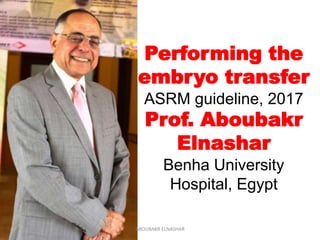
Performing the
embryo transfer
ASRM guideline, 2017
Prof. Aboubakr
Elnashar
Benha University
Hospital, Egypt
ABOUBAKR ELNASHAR
INTRODUCTION
ET:
One of the most critical steps in the process of IVF
pregnancy rates differ depending upon the clinician
performing the procedure.
The purpose of this guideline
 systematic review of the literature to determine
which of the steps, if any, are supported by sufficient
data.
ABOUBAKR ELNASHAR
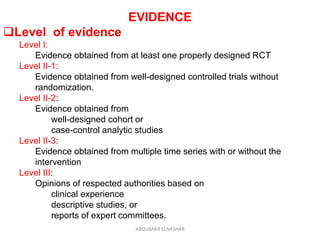
EVIDENCE
Level of evidence
Level I:
Evidence obtained from at least one properly designed RCT
Level II-1:
Evidence obtained from well-designed controlled trials without
randomization.
Level II-2:
Evidence obtained from
well-designed cohort or
case-control analytic studies
Level II-3:
Evidence obtained from multiple time series with or without the
intervention
Level III:
Opinions of respected authorities based on
clinical experience
descriptive studies, or
reports of expert committees.
ABOUBAKR ELNASHAR
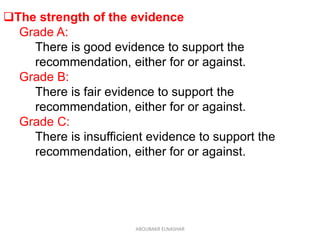
The strength of the evidence
Grade A:
There is good evidence to support the
recommendation, either for or against.
Grade B:
There is fair evidence to support the
recommendation, either for or against.
Grade C:
There is insufficient evidence to support the
recommendation, either for or against.
ABOUBAKR ELNASHAR
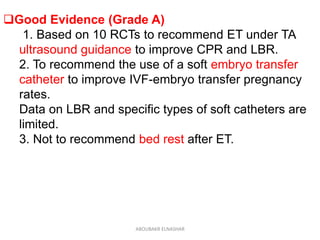
Good Evidence (Grade A)
1. Based on 10 RCTs to recommend ET under TA
ultrasound guidance to improve CPR and LBR.
2. To recommend the use of a soft embryo transfer
catheter to improve IVF-embryo transfer pregnancy
rates.
Data on LBR and specific types of soft catheters are
limited.
3. Not to recommend bed rest after ET.
ABOUBAKR ELNASHAR
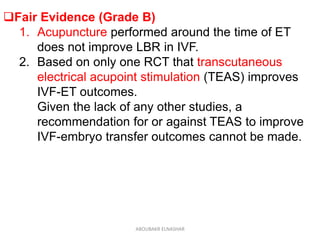
Fair Evidence (Grade B)
1. Acupuncture performed around the time of ET
does not improve LBR in IVF.
2. Based on only one RCT that transcutaneous
electrical acupoint stimulation (TEAS) improves
IVF-ET outcomes.
Given the lack of any other studies, a
recommendation for or against TEAS to improve
IVF-embryo transfer outcomes cannot be made.
ABOUBAKR ELNASHAR
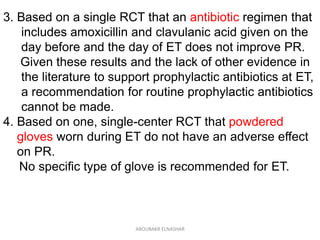
3. Based on a single RCT that an antibiotic regimen that
includes amoxicillin and clavulanic acid given on the
day before and the day of ET does not improve PR.
Given these results and the lack of other evidence in
the literature to support prophylactic antibiotics at ET,
a recommendation for routine prophylactic antibiotics
cannot be made.
4. Based on one, single-center RCT that powdered
gloves worn during ET do not have an adverse effect
on PR.
No specific type of glove is recommended for ET.
ABOUBAKR ELNASHAR
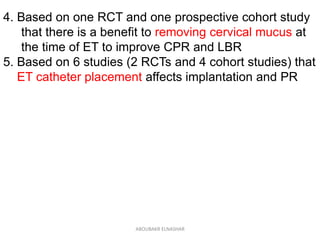
4. Based on one RCT and one prospective cohort study
that there is a benefit to removing cervical mucus at
the time of ET to improve CPR and LBR
5. Based on 6 studies (2 RCTs and 4 cohort studies) that
ET catheter placement affects implantation and PR
ABOUBAKR ELNASHAR
6. Based on 7 studies (3RCTs and 4 cohort studies) that
placement of the catheter tip in the upper or middle
(central) area of the uterine cavity, greater than 1 cm
from the fundus for embryo expulsion, optimizes PR.
7. Based on one RCT and one cohort study to
recommend immediate withdrawal of the ET catheter
after embryo expulsion.
ABOUBAKR ELNASHAR
8. Based on 7 cohort studies that the presence of mucus
on the embryo transfer catheter, once it is withdrawn,
is not associated with a lower CPR or LBR
9. Based on the secondary outcome of one RCT,9
cohort studies, and one series that retained embryos
in the transfer catheter and immediate retransfer do
not affect implantation, CP, or spontaneous abortion
rates
ABOUBAKR ELNASHAR
Insufficient Evidence (Grade C)
1. To recommend for or against analgesics to
improve IVF-ET outcomes.
2. That anesthesia during ET improves pregnancy
rates.
Given that there is no clear benefit and that there
are inherent risks associated with anesthesia,
routine anesthesia is not recommended to
improve IVF ET outcomes.
ABOUBAKR ELNASHAR
3. To recommend for or against massage therapy to
improve IVF-ET outcomes.
4. To recommend for or against whole systems–
traditional Chinese medicine to improve IVF-ET
outcomes.
*Massage therapy is proposed as a way to relieve physical and psychological
discomfort and has been suggested as a therapeutic modality without
significant risk or side effects in an IVF cycle prior to embryo transfer. Only one
study—a retrospective, observational analysis—assessed
massage therapy before blastocyst transfer in cryopreservation cycles and
demonstrated evidence of improved pregnancy and live-birth rates
ABOUBAKR ELNASHAR
5. While selected ultrasound guidance for an anticipated
difficult embryo transfer may be an alternative to
routine ultrasound guidance, there is insufficient
evidence to recommend for or against this practice.
6. There is insufficient evidence for more specific
recommendations regarding the positioning of the
catheter at the time of embryo transfer.
*One cohort study: PR were significantly better when the outer
sheath did not go beyond the internal os (57.3% Vs 43.1%)
ABOUBAKR ELNASHAR
6. Given the mixed results of studies, there is insufficient
evidence to conclusively state that the presence of
blood on the catheter, once it is withdrawn, is
associated with lower implantation or PR.
7. Given the paucity of data, there is insufficient
evidence to recommend any specific injection speed
of the catheter at the time of ET.
ABOUBAKR ELNASHAR
*The earliest attempt at assessing the ideal velocity of injection was in 2003
when a computational model suggested that high injection speeds may lead to
ectopic pregnancies .
This hypothesis was corroborated by several studies using both mathematical
and simulated in vitro models. These studies all suggested that the injection
velocity of the embryo could impact the trajectory of the placement, and
therefore potentially impact implantation rate and the risk of ectopic pregnancy
if a fast speed was used too near the fundus.
 A 2012 simulation study assessed standardization of injection speed by
evaluating a pump-regulated embryo transfer (PRET) device compared with
manual injection. The PRET device generated reliable and reproducible
injection speeds, whereas manual injection showed large variation in speed
even with a standardized protocol.
A non blinded randomized trial also utilizing the same PRET device resulted in
less variance in embryo positioning as assessed by ultrasound measurement
compared with manual injection.
ABOUBAKR ELNASHAR
RECOMMENDATIONS
1. ET is considered a critical step in the IVF process.
2. Extensive literature exists regarding all aspects of ET,
which supports its importance to overall IVF success.
3. While there are insufficient data to provide guidance
on a number of techniques used during ET, the literature
does provide guidance for many aspects of this critical
component of IVF.
ABOUBAKR ELNASHAR
4. The following interventions are supported by the
literature for improving PR:
1. Abdominal ultrasound guidance for ET
2. Removal of cervical mucus
3. Use of soft ET catheters
4. Placement of ET tip in the upper or middle
(central) area of the uterine cavity, greater than 1
cm from the fundus, for embryo expulsion
5. Immediate ambulation once the embryo transfer
procedure is completed
ABOUBAKR ELNASHAR
5. The following interventions have been shown not to
be beneficial for improving PR:
1. Acupuncture
2. Analgesics, massage, general anesthesia, whole
systems–traditional Chinese medicine
3. Prophylactic antibiotics to improve ET outcomes
4. Waiting after expulsion of embryos for any
specific period of time before withdrawing ET
catheter
ABOUBAKR ELNASHAR
CONCLUSIONS
1. A systematic review of the literature allowed the
development of this guideline for standardization of
ET process.
2. Many, but not all, of the current techniques employed
are supported by the literature as evidenced by the
recommendations made above.
3. For other techniques used to enhance pregnancy
rates during ET, such as TEAS, more studies are
needed.
ABOUBAKR ELNASHAR

PERFORMING EMBRYO TRANSFER. ABOUBAKR ELNASHAR

  • 1.
    Performing the embryo transfer ASRMguideline, 2017 Prof. Aboubakr Elnashar Benha University Hospital, Egypt ABOUBAKR ELNASHAR
  • 2.
    INTRODUCTION ET: One of themost critical steps in the process of IVF pregnancy rates differ depending upon the clinician performing the procedure. The purpose of this guideline  systematic review of the literature to determine which of the steps, if any, are supported by sufficient data. ABOUBAKR ELNASHAR
  • 3.
    EVIDENCE Level of evidence LevelI: Evidence obtained from at least one properly designed RCT Level II-1: Evidence obtained from well-designed controlled trials without randomization. Level II-2: Evidence obtained from well-designed cohort or case-control analytic studies Level II-3: Evidence obtained from multiple time series with or without the intervention Level III: Opinions of respected authorities based on clinical experience descriptive studies, or reports of expert committees. ABOUBAKR ELNASHAR
  • 4.
    The strength ofthe evidence Grade A: There is good evidence to support the recommendation, either for or against. Grade B: There is fair evidence to support the recommendation, either for or against. Grade C: There is insufficient evidence to support the recommendation, either for or against. ABOUBAKR ELNASHAR
  • 5.
    Good Evidence (GradeA) 1. Based on 10 RCTs to recommend ET under TA ultrasound guidance to improve CPR and LBR. 2. To recommend the use of a soft embryo transfer catheter to improve IVF-embryo transfer pregnancy rates. Data on LBR and specific types of soft catheters are limited. 3. Not to recommend bed rest after ET. ABOUBAKR ELNASHAR
  • 6.
    Fair Evidence (GradeB) 1. Acupuncture performed around the time of ET does not improve LBR in IVF. 2. Based on only one RCT that transcutaneous electrical acupoint stimulation (TEAS) improves IVF-ET outcomes. Given the lack of any other studies, a recommendation for or against TEAS to improve IVF-embryo transfer outcomes cannot be made. ABOUBAKR ELNASHAR
  • 7.
    3. Based ona single RCT that an antibiotic regimen that includes amoxicillin and clavulanic acid given on the day before and the day of ET does not improve PR. Given these results and the lack of other evidence in the literature to support prophylactic antibiotics at ET, a recommendation for routine prophylactic antibiotics cannot be made. 4. Based on one, single-center RCT that powdered gloves worn during ET do not have an adverse effect on PR. No specific type of glove is recommended for ET. ABOUBAKR ELNASHAR
  • 8.
    4. Based onone RCT and one prospective cohort study that there is a benefit to removing cervical mucus at the time of ET to improve CPR and LBR 5. Based on 6 studies (2 RCTs and 4 cohort studies) that ET catheter placement affects implantation and PR ABOUBAKR ELNASHAR
  • 9.
    6. Based on7 studies (3RCTs and 4 cohort studies) that placement of the catheter tip in the upper or middle (central) area of the uterine cavity, greater than 1 cm from the fundus for embryo expulsion, optimizes PR. 7. Based on one RCT and one cohort study to recommend immediate withdrawal of the ET catheter after embryo expulsion. ABOUBAKR ELNASHAR
  • 10.
    8. Based on7 cohort studies that the presence of mucus on the embryo transfer catheter, once it is withdrawn, is not associated with a lower CPR or LBR 9. Based on the secondary outcome of one RCT,9 cohort studies, and one series that retained embryos in the transfer catheter and immediate retransfer do not affect implantation, CP, or spontaneous abortion rates ABOUBAKR ELNASHAR
  • 11.
    Insufficient Evidence (GradeC) 1. To recommend for or against analgesics to improve IVF-ET outcomes. 2. That anesthesia during ET improves pregnancy rates. Given that there is no clear benefit and that there are inherent risks associated with anesthesia, routine anesthesia is not recommended to improve IVF ET outcomes. ABOUBAKR ELNASHAR
  • 12.
    3. To recommendfor or against massage therapy to improve IVF-ET outcomes. 4. To recommend for or against whole systems– traditional Chinese medicine to improve IVF-ET outcomes. *Massage therapy is proposed as a way to relieve physical and psychological discomfort and has been suggested as a therapeutic modality without significant risk or side effects in an IVF cycle prior to embryo transfer. Only one study—a retrospective, observational analysis—assessed massage therapy before blastocyst transfer in cryopreservation cycles and demonstrated evidence of improved pregnancy and live-birth rates ABOUBAKR ELNASHAR
  • 13.
    5. While selectedultrasound guidance for an anticipated difficult embryo transfer may be an alternative to routine ultrasound guidance, there is insufficient evidence to recommend for or against this practice. 6. There is insufficient evidence for more specific recommendations regarding the positioning of the catheter at the time of embryo transfer. *One cohort study: PR were significantly better when the outer sheath did not go beyond the internal os (57.3% Vs 43.1%) ABOUBAKR ELNASHAR
  • 14.
    6. Given themixed results of studies, there is insufficient evidence to conclusively state that the presence of blood on the catheter, once it is withdrawn, is associated with lower implantation or PR. 7. Given the paucity of data, there is insufficient evidence to recommend any specific injection speed of the catheter at the time of ET. ABOUBAKR ELNASHAR
  • 15.
    *The earliest attemptat assessing the ideal velocity of injection was in 2003 when a computational model suggested that high injection speeds may lead to ectopic pregnancies . This hypothesis was corroborated by several studies using both mathematical and simulated in vitro models. These studies all suggested that the injection velocity of the embryo could impact the trajectory of the placement, and therefore potentially impact implantation rate and the risk of ectopic pregnancy if a fast speed was used too near the fundus.  A 2012 simulation study assessed standardization of injection speed by evaluating a pump-regulated embryo transfer (PRET) device compared with manual injection. The PRET device generated reliable and reproducible injection speeds, whereas manual injection showed large variation in speed even with a standardized protocol. A non blinded randomized trial also utilizing the same PRET device resulted in less variance in embryo positioning as assessed by ultrasound measurement compared with manual injection. ABOUBAKR ELNASHAR
  • 16.
    RECOMMENDATIONS 1. ET isconsidered a critical step in the IVF process. 2. Extensive literature exists regarding all aspects of ET, which supports its importance to overall IVF success. 3. While there are insufficient data to provide guidance on a number of techniques used during ET, the literature does provide guidance for many aspects of this critical component of IVF. ABOUBAKR ELNASHAR
  • 17.
    4. The followinginterventions are supported by the literature for improving PR: 1. Abdominal ultrasound guidance for ET 2. Removal of cervical mucus 3. Use of soft ET catheters 4. Placement of ET tip in the upper or middle (central) area of the uterine cavity, greater than 1 cm from the fundus, for embryo expulsion 5. Immediate ambulation once the embryo transfer procedure is completed ABOUBAKR ELNASHAR
  • 18.
    5. The followinginterventions have been shown not to be beneficial for improving PR: 1. Acupuncture 2. Analgesics, massage, general anesthesia, whole systems–traditional Chinese medicine 3. Prophylactic antibiotics to improve ET outcomes 4. Waiting after expulsion of embryos for any specific period of time before withdrawing ET catheter ABOUBAKR ELNASHAR
  • 19.
    CONCLUSIONS 1. A systematicreview of the literature allowed the development of this guideline for standardization of ET process. 2. Many, but not all, of the current techniques employed are supported by the literature as evidenced by the recommendations made above. 3. For other techniques used to enhance pregnancy rates during ET, such as TEAS, more studies are needed. ABOUBAKR ELNASHAR