Time lapse observations of
pre-implantation embryos
Giles Palmer, Mitera ACU, Athens
gpalmer@mitera.gr
There are no commercial relationships or other
activities that might be perceived as a
potential conflict of interest
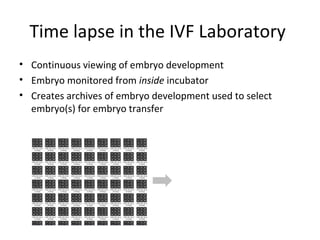
Time lapse in the IVF Laboratory
• Continuous viewing of embryo development
• Embryo monitored from inside incubator
• Creates archives of embryo development used to select
embryo(s) for embryo transfer
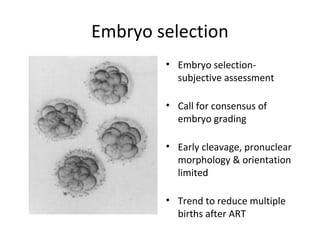
Embryo selection
• Embryo selection-
subjective assessment
• Call for consensus of
embryo grading
• Early cleavage, pronuclear
morphology & orientation
limited
• Trend to reduce multiple
births after ART
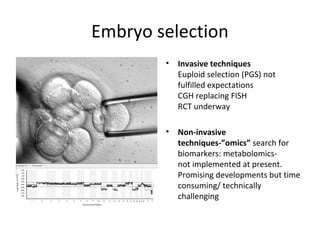
Embryo selection
• Invasive techniques
Euploid selection (PGS) not
fulfilled expectations
CGH replacing FISH
RCT underway
• Non-invasive
techniques-”omics” search for
biomarkers: metabolomics-
not implemented at present.
Promising developments but time
consuming/ technically
challenging
The (Short) History of Time lapse
monitoring
• Payne (1997) Preliminary observations on polar body extrusion and
pronuclear formation in human oocytes using time lapse
cinematography
• Pribenszky (2010) Pregnancy achieved by transfer of a single blastocyst
selected by time lapse monitoring
• Wong (2010) Non-invasive imaging of human embryos before
embryonic genome activation predicts development to blastocyst stage
• Meseguer (2011) The use of morphokinetics as a predictor of embryo
implantation
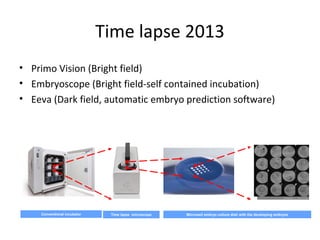
Time lapse 2013
• Primo Vision (Bright field)
• Embryoscope (Bright field-self contained incubation)
• Eeva (Dark field, automatic embryo prediction software)
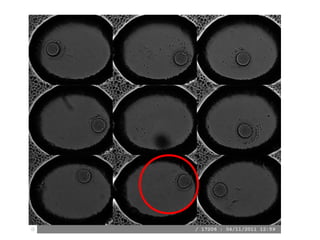
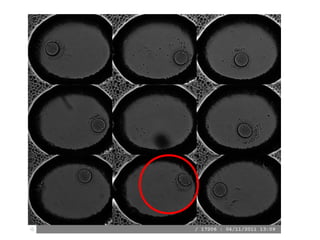
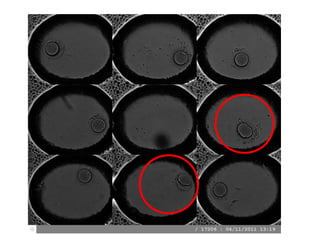
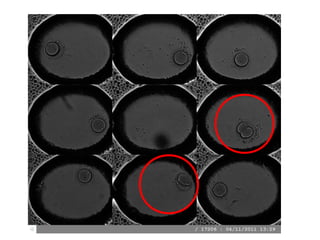
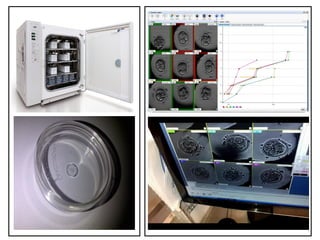
Conventional incubator Time lapse microscope Microwell embryo culture dish with the developing embryos
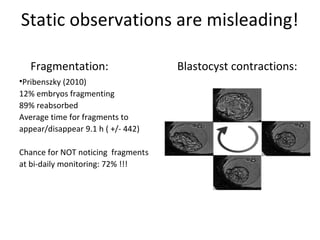
Static observations are misleading!
Fragmentation:
•Pribenszky (2010)
12% embryos fragmenting
89% reabsorbed
Average time for fragments to
appear/disappear 9.1 h ( +/- 442)
Chance for NOT noticing fragments
at bi-daily monitoring: 72% !!!
Blastocyst contractions:
videos
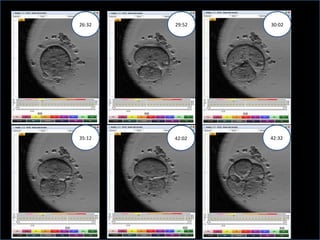
Which embryo
would you
transfer?
Static observations are misleading!
Ww
26:32 29:52 30:02
35:12 42:02 42:32
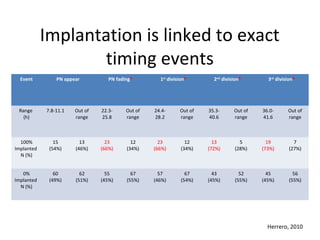
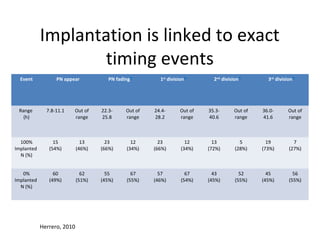
Implantation is linked to exact
timing events
Event PN appear PN fading* 1st
division* 2nd
division* 3rd
division*
Range
(h)
7.8-11.1 Out of
range
22.3-
25.8
Out of
range
24.4-
28.2
Out of
range
35.3-
40.6
Out of
range
36.0-
41.6
Out of
range
100%
Implanted
N (%)
15
(54%)
13
(46%)
23
(66%)
12
(34%)
23
(66%)
12
(34%)
13
(72%)
5
(28%)
19
(73%)
7
(27%)
0%
Implanted
N (%)
60
(49%)
62
(51%)
55
(45%)
67
(55%)
57
(46%)
67
(54%)
43
(45%)
52
(55%)
45
(45%)
56
(55%)
Herrero, 2010
5-8cc
30-50
min
9-16cc
40-70
min
3-4cc
10-20
min
8-9cc
22-24
hrs
4-5cc
14-16
hrs
2-3cc
10-12
hrs
Interphase
1-2cc
20-26 hrs
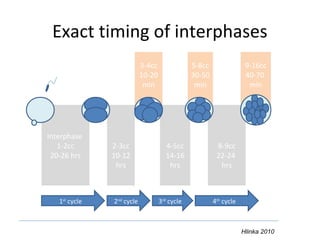
Exact timing of interphases
1st
cycle 2nd
cycle 3rd
cycle 4th
cycle
Hlinka 2010
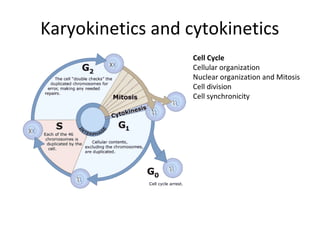
Cell Cycle
Cellular organization
Nuclear organization and Mitosis
Cell division
Cell synchronicity
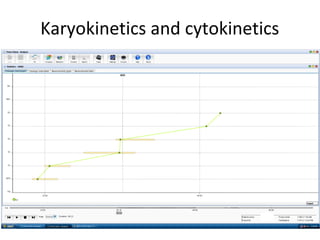
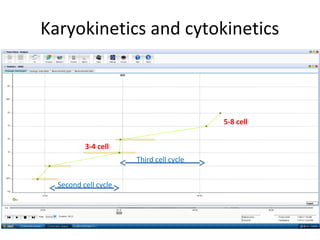
Karyokinetics and cytokinetics
Second cell cycle
Third cell cycle
3-4 cell
5-8 cell
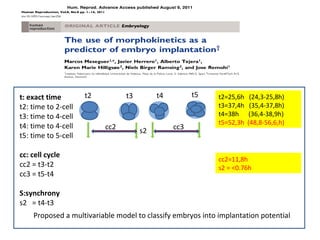
t2 t3 t4 t5
cc2 cc3s2
t: exact time
t2: time to 2-cell
t3: time to 4-cell
t4: time to 4-cell
t5: time to 5-cell
cc: cell cycle
cc2 = t3-t2
cc3 = t5-t4
S:synchrony
s2 = t4-t3
cc2=11,8h
s2 = <0.76h
t2=25,6h (24,3-25,8h)
t3=37,4h (35,4-37,8h)
t4=38h (36,4-38,9h)
t5=52,3h (48,8-56,6,h)
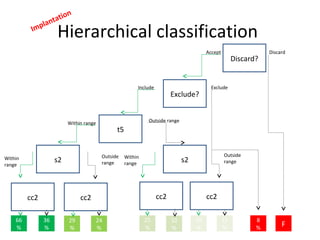
Proposed a multivariable model to classify embryos into implantation potential
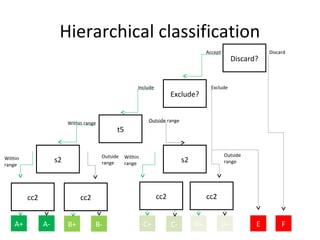
t5
Hierarchical classification
Discard?
Exclude?
s2s2
cc2cc2cc2cc2
A+ A- B+ B- C+ C- D+ D- E F
Accept Discard
ExcludeInclude
Within range Outside range
Outside
range
Outside
range
Within
range
Within
range
t5
Hierarchical classification
Discard?
Exclude?
s2s2
cc2cc2cc2cc2
66
%
36
%
29
%
24
%
25
%
10
%
10
%
15
%
8
% F
Accept Discard
ExcludeInclude
Within range Outside range
Outside
range
Outside
range
Within
range
Within
range
Implantation
HDHDGHGDGHHHHHHHHHHHHHHH
JJJJJJJJJJJJJJJJJJJJJJJJJJJJJJJJ
JJJJJJJJJJJJJJJJJJ
JJJJJJJJJJJJJJJJ
JJJJJJJJJJJJJJJJJJJJJ
JJJJJJJJJJJJJJJJJJJJJJ
JJJJJJJJJJJJJJJJJJJJJJJJJJ
JJJJJJJJJJJJJJJJJJJJ
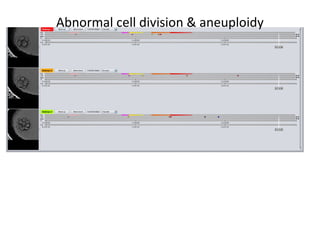
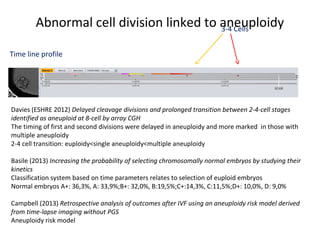
Abnormal cell division & aneuploidy
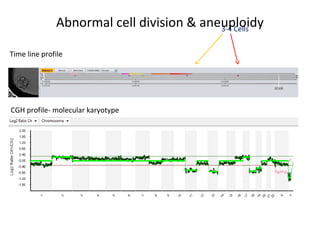
Time line profile
e
Time line profile
e
eCGH profile- molecular karyotype
3-4 Cells
Abnormal cell division & aneuploidy
Time line profile
e
Time line profile
e
e
3-4 Cells
Davies (ESHRE 2012) Delayed cleavage divisions and prolonged transition between 2-4-cell stages
identified as aneuploid at 8-cell by array CGH
The timing of first and second divisions were delayed in aneuploidy and more marked in those with
multiple aneuploidy
2-4 cell transition: euploidy<single aneuploidy<multiple aneuploidy
Basile (2013) Increasing the probability of selecting chromosomally normal embryos by studying their
kinetics
Classification system based on time parameters relates to selection of euploid embryos
Normal embryos A+: 36,3%, A: 33,9%;B+: 32,0%, B:19,5%;C+:14,3%, C:11,5%;D+: 10,0%, D: 9,0%
Campbell (2013) Retrospective analysis of outcomes after IVF using an aneuploidy risk model derived
from time-lapse imaging without PGS
Aneuploidy risk model
Abnormal cell division linked to aneuploidy
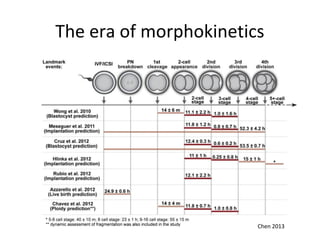
The era of morphokinetics
Chen 2013
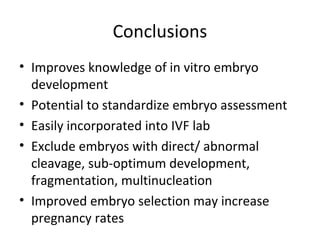
Conclusions
• Improves knowledge of in vitro embryo
development
• Potential to standardize embryo assessment
• Easily incorporated into IVF lab
• Exclude embryos with direct/ abnormal
cleavage, sub-optimum development,
fragmentation, multinucleation
• Improved embryo selection may increase
pregnancy rates
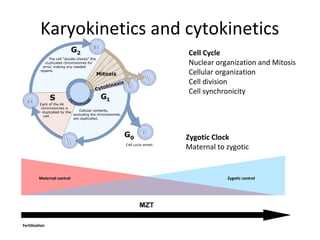
Cell Cycle
Nuclear organization and Mitosis
Cellular organization
Cell division
Cell synchronicity
Zygotic Clock
Maternal to zygotic
Fertilization
Maternal control Zygotic control
Karyokinetics and cytokinetics
Implantation is linked to exact
timing events
Herrero, 2010
Event PN appear PN fading* 1st
division* 2nd
division* 3rd
division*
Range
(h)
7.8-11.1 Out of
range
22.3-
25.8
Out of
range
24.4-
28.2
Out of
range
35.3-
40.6
Out of
range
36.0-
41.6
Out of
range
100%
Implanted
N (%)
15
(54%)
13
(46%)
23
(66%)
12
(34%)
23
(66%)
12
(34%)
13
(72%)
5
(28%)
19
(73%)
7
(27%)
0%
Implanted
N (%)
60
(49%)
62
(51%)
55
(45%)
67
(55%)
57
(46%)
67
(54%)
43
(45%)
52
(55%)
45
(45%)
56
(55%)

Time lapse observations

  • 1.
    Time lapse observationsof pre-implantation embryos Giles Palmer, Mitera ACU, Athens gpalmer@mitera.gr
  • 2.
    There are nocommercial relationships or other activities that might be perceived as a potential conflict of interest
  • 3.
    Time lapse inthe IVF Laboratory • Continuous viewing of embryo development • Embryo monitored from inside incubator • Creates archives of embryo development used to select embryo(s) for embryo transfer
  • 4.
    Embryo selection • Embryoselection- subjective assessment • Call for consensus of embryo grading • Early cleavage, pronuclear morphology & orientation limited • Trend to reduce multiple births after ART
  • 5.
    Embryo selection • Invasivetechniques Euploid selection (PGS) not fulfilled expectations CGH replacing FISH RCT underway • Non-invasive techniques-”omics” search for biomarkers: metabolomics- not implemented at present. Promising developments but time consuming/ technically challenging
  • 6.
    The (Short) Historyof Time lapse monitoring • Payne (1997) Preliminary observations on polar body extrusion and pronuclear formation in human oocytes using time lapse cinematography • Pribenszky (2010) Pregnancy achieved by transfer of a single blastocyst selected by time lapse monitoring • Wong (2010) Non-invasive imaging of human embryos before embryonic genome activation predicts development to blastocyst stage • Meseguer (2011) The use of morphokinetics as a predictor of embryo implantation
  • 7.
    Time lapse 2013 •Primo Vision (Bright field) • Embryoscope (Bright field-self contained incubation) • Eeva (Dark field, automatic embryo prediction software) Conventional incubator Time lapse microscope Microwell embryo culture dish with the developing embryos
  • 8.
    Static observations aremisleading! Fragmentation: •Pribenszky (2010) 12% embryos fragmenting 89% reabsorbed Average time for fragments to appear/disappear 9.1 h ( +/- 442) Chance for NOT noticing fragments at bi-daily monitoring: 72% !!! Blastocyst contractions:
  • 9.
  • 10.
  • 15.
    Implantation is linkedto exact timing events Event PN appear PN fading* 1st division* 2nd division* 3rd division* Range (h) 7.8-11.1 Out of range 22.3- 25.8 Out of range 24.4- 28.2 Out of range 35.3- 40.6 Out of range 36.0- 41.6 Out of range 100% Implanted N (%) 15 (54%) 13 (46%) 23 (66%) 12 (34%) 23 (66%) 12 (34%) 13 (72%) 5 (28%) 19 (73%) 7 (27%) 0% Implanted N (%) 60 (49%) 62 (51%) 55 (45%) 67 (55%) 57 (46%) 67 (54%) 43 (45%) 52 (55%) 45 (45%) 56 (55%) Herrero, 2010
  • 16.
  • 17.
    Cell Cycle Cellular organization Nuclearorganization and Mitosis Cell division Cell synchronicity Karyokinetics and cytokinetics
  • 18.
  • 19.
    Karyokinetics and cytokinetics Secondcell cycle Third cell cycle 3-4 cell 5-8 cell
  • 20.
    t2 t3 t4t5 cc2 cc3s2 t: exact time t2: time to 2-cell t3: time to 4-cell t4: time to 4-cell t5: time to 5-cell cc: cell cycle cc2 = t3-t2 cc3 = t5-t4 S:synchrony s2 = t4-t3 cc2=11,8h s2 = <0.76h t2=25,6h (24,3-25,8h) t3=37,4h (35,4-37,8h) t4=38h (36,4-38,9h) t5=52,3h (48,8-56,6,h) Proposed a multivariable model to classify embryos into implantation potential
  • 21.
    t5 Hierarchical classification Discard? Exclude? s2s2 cc2cc2cc2cc2 A+ A-B+ B- C+ C- D+ D- E F Accept Discard ExcludeInclude Within range Outside range Outside range Outside range Within range Within range
  • 22.
    t5 Hierarchical classification Discard? Exclude? s2s2 cc2cc2cc2cc2 66 % 36 % 29 % 24 % 25 % 10 % 10 % 15 % 8 % F AcceptDiscard ExcludeInclude Within range Outside range Outside range Outside range Within range Within range Implantation
  • 23.
  • 24.
  • 25.
    Time line profile e Timeline profile e eCGH profile- molecular karyotype 3-4 Cells Abnormal cell division & aneuploidy
  • 26.
    Time line profile e Timeline profile e e 3-4 Cells Davies (ESHRE 2012) Delayed cleavage divisions and prolonged transition between 2-4-cell stages identified as aneuploid at 8-cell by array CGH The timing of first and second divisions were delayed in aneuploidy and more marked in those with multiple aneuploidy 2-4 cell transition: euploidy<single aneuploidy<multiple aneuploidy Basile (2013) Increasing the probability of selecting chromosomally normal embryos by studying their kinetics Classification system based on time parameters relates to selection of euploid embryos Normal embryos A+: 36,3%, A: 33,9%;B+: 32,0%, B:19,5%;C+:14,3%, C:11,5%;D+: 10,0%, D: 9,0% Campbell (2013) Retrospective analysis of outcomes after IVF using an aneuploidy risk model derived from time-lapse imaging without PGS Aneuploidy risk model Abnormal cell division linked to aneuploidy
  • 27.
    The era ofmorphokinetics Chen 2013
  • 28.
    Conclusions • Improves knowledgeof in vitro embryo development • Potential to standardize embryo assessment • Easily incorporated into IVF lab • Exclude embryos with direct/ abnormal cleavage, sub-optimum development, fragmentation, multinucleation • Improved embryo selection may increase pregnancy rates
  • 29.
    Cell Cycle Nuclear organizationand Mitosis Cellular organization Cell division Cell synchronicity Zygotic Clock Maternal to zygotic Fertilization Maternal control Zygotic control Karyokinetics and cytokinetics
  • 30.
    Implantation is linkedto exact timing events Herrero, 2010 Event PN appear PN fading* 1st division* 2nd division* 3rd division* Range (h) 7.8-11.1 Out of range 22.3- 25.8 Out of range 24.4- 28.2 Out of range 35.3- 40.6 Out of range 36.0- 41.6 Out of range 100% Implanted N (%) 15 (54%) 13 (46%) 23 (66%) 12 (34%) 23 (66%) 12 (34%) 13 (72%) 5 (28%) 19 (73%) 7 (27%) 0% Implanted N (%) 60 (49%) 62 (51%) 55 (45%) 67 (55%) 57 (46%) 67 (54%) 43 (45%) 52 (55%) 45 (45%) 56 (55%)

Editor's Notes

  • #5 22% multiple births Success rate rel. low Tendency in N. European countries to reduce multiple pregnancies/ SET Public health concern Andersen (ESHRE) 2009, Seli 2011
  • #6 include culture to bc LINK TH Global view- array CGH, SNP, Next generation sequencing EN TO SELECTION..MAYBE DON’T WANT TO GO TH BC..THEREFORE PREDICT EARLY
  • #8 Autonomous incubation unit, stand alone Others fit inside existing cabinate incubators The first two you can programm what parametres you want
  • #9 Single time point is misleading Positive factors PN formation Embryo cleavage Symmetry of cleavage Synchrony of cells Compaction/cavitation
  • #17 (ID, interval division) Interphase division
  • #24 Complicated no!!!!Improved culture system Embryos are cultured in a group (“group effect”) Embryos can develop their own microenvironment Embryos’ cross talk Vajta et al., 2008 See new paper on improved embryos
  • #26 Morphokinetics link to aneuploidy detection (Davies 2012) Classification system based on time parameters relates to selection of euploidy embryo ( Basile 2013)
  • #27 Morphokinetics link to aneuploidy detection (Davies 2012) Classification system based on time parameters relates to selection of euploidy embryo ( Basile 2013) Useful cost effected tool to select optimum embryo selection The timing of first and second divisions were delayed in aneuploidy and more marked when in those with multiple aneuploidy 2-4 cell transition was prolonged in Important to link this to aneu because represents largest cause of failed implantation and miscarraige after IVF Yang CGH shows BC can have aneuploidy
  • #28 Overall time lapse markers have exhibited remarkable correlation wth human embryo devstudies shoe remarkable reproducibility across different clinics and labs..clustering on early stages before 5 cell stage Timing from later stages a bit more subject/diff to define but may give us addition help Dark red =at least three publications
  • #29 Objective assessment Allows for a flexible/ dynamic scoring viewed at the embryologist leisure Insight into developing embryo Allowing morphological analysis and temporal analysis Kinetic markers for embryo quality a) early cleavage b) 2,3,5 cell Exclusion factors: 1-3 cell division, abnormal timing, fragmentation, multinucleiation