Dr. Yasmin Magdi Abd-Elkereem
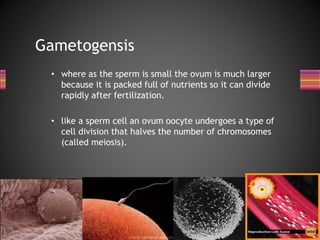
• where as the sperm is small the ovum is much larger
because it is packed full of nutrients so it can divide
rapidly after fertilization.
• like a sperm cell an ovum oocyte undergoes a type of
cell division that halves the number of chromosomes
(called meiosis).
Gametogensis
Oogenesis
• Oogenesis is the creation of an ovum (an egg cell).
• It is the female process of gametogenesis.
• occurs in specialized cells in the ovaries called follicles.
– a follicle contains two types of cells
» a primary oocyte
» cells of the granulosa
~ the granulosa is the layer of cells that form
the follicle wall. They provide nutrients for the
developing oocytes.
• Paired, almond shaped
• lenghth: 3-4 Cm.
• next to the fimbria of the oviduct.
• Site of Oogenesis, Folliculogensis, Corpora luteal (CL)
formation and luteolysis (CL regression).
• The major structure of the ovary:
1- Follicle 2- Corpus luteum (CL)
3- Stroma (connective tissue network of outer cortex and inner
medulla).
4- Blood vessels 5- Lymphatic vessels
6- Nerves
Ovary
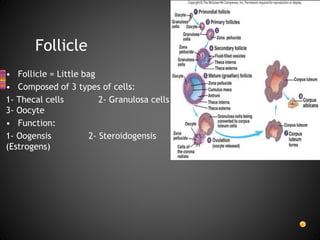
• Follicle = Little bag
• Composed of 3 types of cells:
1- Thecal cells 2- Granulosa cells
3- Oocyte
• Function:
1- Oogensis 2- Steroidogensis
(Estrogens)
Follicle
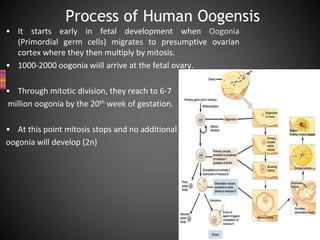
• It starts early in fetal development when Oogonia
(Primordial germ cells) migrates to presumptive ovarian
cortex where they then multiply by mitosis.
• 1000-2000 oogonia wiill arrive at the fetal ovary.
• Through mitotic division, they reach to 6-7
million oogonia by the 20th week of gestation.
• At this point mitosis stops and no additional
oogonia will develop (2n)
Process of Human Oogensis
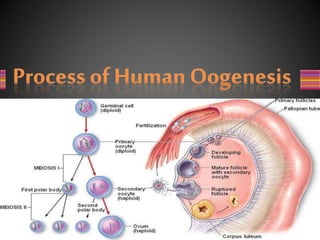
• At the start of the menstrual cycle some 12 to 20 primary
follicles begin to develop under the influence of elevated FSH
to form secondary follicles.
• By around day 9 of the cycle only one healthy secondary
follicle is remaining, with the rest having undergone atresia.
• The remaining follicle is called the dominant follicle and is
responsible for producing large amounts of oestradiol during
the late follicular phase. Oestradiol production depends on co-
operation between the theca and granulosa cells.
Process of human oogenesis
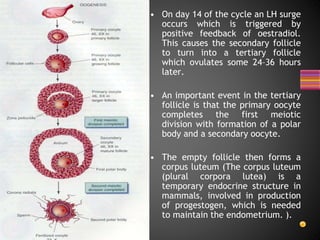
• On day 14 of the cycle an LH surge
occurs which is triggered by
positive feedback of oestradiol.
This causes the secondary follicle
to turn into a tertiary follicle
which ovulates some 24–36 hours
later.
• An important event in the tertiary
follicle is that the primary oocyte
completes the first meiotic
division with formation of a polar
body and a secondary oocyte.
• The empty follicle then forms a
corpus luteum (The corpus luteum
(plural corpora lutea) is a
temporary endocrine structure in
mammals, involved in production
of progestogen, which is needed
to maintain the endometrium. ).
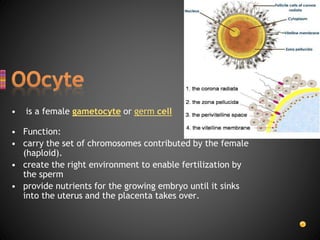
• Function:
• carry the set of chromosomes contributed by the female
(haploid).
• create the right environment to enable fertilization by
the sperm
• provide nutrients for the growing embryo until it sinks
into the uterus and the placenta takes over.
• is a female gametocyte or germ cell
• Application of ovary stimulation in human reproduction
further complicates the situation.
• In contrast to the in vivo process, where oocyte maturation
occurs as the result of a long and meticulous natural
selection procedure, common ovary stimulation procedures
suppress this selection and allow seemingly successful
maturation of oocytes with ;
inherently compromised quality,
destined to fertilization failure,
compromised embryo development
Ovarian stimulation protocol
• The quality of the oocytes is determined not only by the
nuclear and mitochondrial genome, but the
microenvironment provided by the ovary and the pre-
ovulatory follicle that can modify transcription and
translation.
• Owing to the complex picture it is highly unlikely that a
single factor, characteristic or mechanism can adequately
indicate the proper developmental competence of oocytes.
• Accordingly, to obtain full information about oocyte quality,
a detailed and non-invasive analysis of key markers would
be required.
Oocyte quality assessment
• Morphological oocyte assessment is based on the aspects of :
1- Cumulus-corona cells
2- if denudation is performed
3- Oocyte morphology : a rapid evaluation using an inverted microscopic is
also performed after denudation;
the cytoplasm,
the perivitelline space,
the first polar body,
the zona pellucida.
provides very superficial and approximate information about;
the stage of development [germinal vesicle, metaphase I (MI) or MII phase]
the quality [degenerative signs in the cytoplasm, polar body (PB) or zona
pellucida]
Oocyte quality assessment
• Importance:
1- gives important information with regard to the subsequent developmental
ability of the driving embryo
2- help to reduce the no. of inseminated oocytes and the amount of
supernumerary embryos
3- help to avoid inseminating “bad quality oocytes” potentially at risk of
carrying chromosomal abnormaities
4- help to choose the appropriate no. of oocytes in egg donation programs.
Oocyte quality assessment
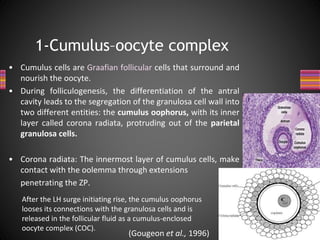
• Cumulus cells are Graafian follicular cells that surround and
nourish the oocyte.
• During folliculogenesis, the differentiation of the antral
cavity leads to the segregation of the granulosa cell wall into
two different entities: the cumulus oophorus, with its inner
layer called corona radiata, protruding out of the parietal
granulosa cells.
• Corona radiata: The innermost layer of cumulus cells, make
contact with the oolemma through extensions
penetrating the ZP.
1-Cumulus–oocyte complex
(Gougeon et al., 1996)
After the LH surge initiating rise, the cumulus oophorus
looses its connections with the granulosa cells and is
released in the follicular fluid as a cumulus-enclosed
oocyte complex (COC).
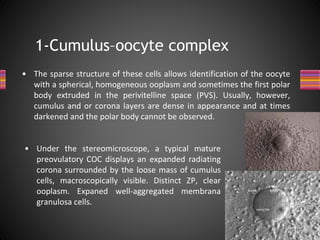
• The sparse structure of these cells allows identification of the oocyte
with a spherical, homogeneous ooplasm and sometimes the first polar
body extruded in the perivitelline space (PVS). Usually, however,
cumulus and or corona layers are dense in appearance and at times
darkened and the polar body cannot be observed.
1-Cumulus–oocyte complex
• Under the stereomicroscope, a typical mature
preovulatory COC displays an expanded radiating
corona surrounded by the loose mass of cumulus
cells, macroscopically visible. Distinct ZP, clear
ooplasm. Expaned well-aggregated membrana
granulosa cells.
1-Cumulus–oocyte complex
• Approximately mature COC: Expanded cumulus mass. Slightly
compact corona radiata. Expanded well-aggregated membrana
granulosa cells.
• Immature COC: Dense compact cumulus if present. Adherent
compact layer of corona cells. Ooplasm if visible with the presence
of germinal vesicle. Compact and non-aggregated membrana
granulosa cells.
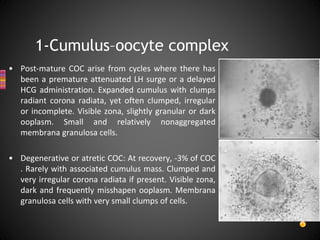
• Post-mature COC arise from cycles where there has
been a premature attenuated LH surge or a delayed
HCG administration. Expanded cumulus with clumps
radiant corona radiata, yet often clumped, irregular
or incomplete. Visible zona, slightly granular or dark
ooplasm. Small and relatively nonaggregated
membrana granulosa cells.
• Degenerative or atretic COC: At recovery, -3% of COC
. Rarely with associated cumulus mass. Clumped and
very irregular corona radiata if present. Visible zona,
dark and frequently misshapen ooplasm. Membrana
granulosa cells with very small clumps of cells.
1-Cumulus–oocyte complex
• Rattanachaiyanont et al. (1999)
• Grading of expansion of both cumulus and corona radiata individually.
• no correlation between the morphology of COCs and the fertilization,
cleavage and clinical pregnancy rates.
• Ebner et al. (2008a)
• have performed similar grading and had a similar conclusion; however,
they found that presence of blood clots were associated with dense
central granulation of oocytes and had a negative effect on fertilization
and blastocyst rates.
• Both studies have found a correlation between a very dense corona
radiata layer and decreased maturity of oocytes.
1-Cumulus–oocyte complex
In contrast,
• Lin et al. (2003) ;
• by using a 5-scale scoring system based mostly on the morphology
of the cumulus–corona radiata cells, have found a correlation of the
in vitro developmental potential and blastocyst quality.
• Ng et al. (1999) ;
• Another scoring system of the quality of the COCs found
associations between the observed quality and both fertilization
and subsequent pregnancy rates, but not cleavage rates.
• Salumets et al. (2002) ;
• In an oocyte donation program have found a strong correlation
between the oocyte source and embryo quality whereas cleavage
rate was determined by both oocyte and sperm factors.
1-Cumulus–oocyte complex
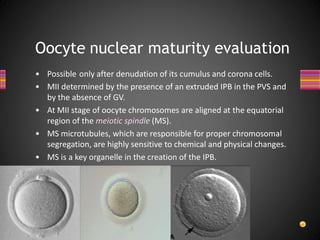
• Possible only after denudation of its cumulus and corona cells.
• MII determined by the presence of an extruded IPB in the PVS and
by the absence of GV.
• At MII stage of oocyte chromosomes are aligned at the equatorial
region of the meiotic spindle (MS).
• MS microtubules, which are responsible for proper chromosomal
segregation, are highly sensitive to chemical and physical changes.
• MS is a key organelle in the creation of the IPB.
Oocyte nuclear maturity evaluation
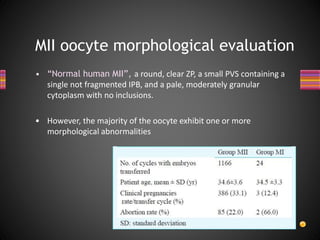
• “Normal human MII”, a round, clear ZP, a small PVS containing a
single not fragmented IPB, and a pale, moderately granular
cytoplasm with no inclusions.
• However, the majority of the oocyte exhibit one or more
morphological abnormalities
MII oocyte morphological evaluation
• A critical oocyte size is necessary for resumption of meiosis.
• At the beginning of oocyte growth, size is determined by strong
adhesion between the oolemma and the inner zona surface.
• The mean ovarian diameter of MII oocytes is 100 may vary
substantially but it is not related to fertilization or developmental
quality of human ICSI embryos at the cleavage stage of
development.
Oocyte size and shape
(Tartia et al., 2009).
(Roma˜o et al., 2010)
Shape of the oocyte
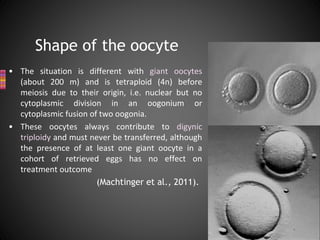
• The situation is different with giant oocytes
(about 200 m) and is tetraploid (4n) before
meiosis due to their origin, i.e. nuclear but no
cytoplasmic division in an oogonium or
cytoplasmic fusion of two oogonia.
• These oocytes always contribute to digynic
triploidy and must never be transferred, although
the presence of at least one giant oocyte in a
cohort of retrieved eggs has no effect on
treatment outcome
(Machtinger et al., 2011).
Shape of the oocyte
• A special feature, ovoid shape of the oocyte, was
reported to be associated with delays in in vitro
parameters .
• Rarely, two oocytes can be found within the one
follicular complex. Each oocyte is usually
surrounded by a ZP but the ZP immediately
between the two oocytes is commonly shared
rather than duplicated. It is not uncommon for
these conjoined oocytes to show different
nuclear maturational states. It has been
suggested that such oocytes may play a role in
producing dizygotic twins; however, even when
both of the conjoined oocytes are mature it is
rare that both fertilize and no pregnancies have
been reported from such oocytes
(Rosenbusch and Hancke, 2012)
• irregular shape or fragmentation of the first polar body;
• was not related to subsequent embryo quality, blastocyst development,
implantation rates or aneuploidies.
• Similar characteristics, including also the size of the PB1, were
investigated by Ciotti et al. (2004), and no effect on the fertilization,
cleavage, pregnancy and implantation rate, or embryo quality was
reported.
• De Santis et al. (2005) did not find any correlation between surface
characteristics, fragmentation and fertilization rate, embryo quality and
blastocyst formation.
• Fertilization rates and embryo quality were not related to the shape
(normal, fragmented or irregular) of PB1 in the study of Ten et al. (2007) .
Morphology of first polar body
• In contrast;
• Ebner et al. (2000) have found a strong correlation between all observed
morphological features of PB1 (intact versus rough surface, fragmented
or enlarged) and fertilization rates/embryo quality.
•
• According to Rienzi et al. (2008), abnormal (large or degenerated) PB1
was related to decreased fertilization rates, but did not show any
correlation with pronuclear morphology or embryo quality, whereas
fragmentation was not associated with any of these outcomes.
• Navarro et al. (2009) have found correlation between large PB1 and
decreased fertilization, cleavage rates as well as compromised embryo
quality.
Morphology of first polar body
• Surprisingly,
• Fancsovits et al. (2006) found that fragmentation or degeneration
of PB1 was related to higher fertilization rates and lower level of
fragmentation of embryos, although large PB1s were associated
with compromised fertilization and low embryo quality.
Morphology of first polar body
• a glycoprotein membrane surrounding the plasma membrane of
an oocyte.
• The zona pellucida has a role in oocyte development and
protection, fertilization, spermatozoa binding,
preventing polyspermy, blastocyst development and
preventing premature implantation (ectopic pregnancy).
Zona pellucida
• Darkness of the zona;
• did not influence fertilization rates, embryo quality and
implantation rates or cryosurvival of embryos and subsequent
blastocyst and hatching rate.
• Thickness and thickness associated with darkness;
• there was no correlation between the thickness and thickness
associated with darkness on fertilization, pronuclear morphology,
embryo development and clinical pregnancy.
• Thinner zona pellucidae ;
• have found that oocytes with thinner zonae pellucidae had higher
fertilization rates.
Zona pellucida
Bertrand et al. (1995)
• In contrast,
• increased inner layer thickness was reported to correlate with
increased blastocyst rates (Rama Raju et al., 2007), and higher
embryo development and clinical pregnancy rates (Shen et al.,
2005).
• Increased zona pellucida thickness variation was associated with
increased embryo quality (Høst et al., 2002).
Zona pellucida
• Elevated birefringence of the zona pellucida's inner layer was
found to be correlated with increased in vitro efficiency, including
fertilization and embryo development (Shen et al., 2005; Rama
Raju et al., 2007; Montag et al., 2008),
• On the other hand, the clinical outcome was found improved
when oocytes with high birefringence of the zona pellucida were
used (Shen et al., 2005; Rama Raju et al., 2007; Montag et al.,
2008; Madaschi et al., 2009), and low birefringence was correlated
with higher miscarriage rates (Madaschi et al., 2009).
Zona pellucida
• in contrast;
• to the recent publication of Madaschi et al. (2009), where no
association between high or low zona birefringence and
fertilization rates or embryo quality was found.
• Only drastic morphological alterations (broken or empty
zona pellucidae) were regarded as unsuitable for ICSI
(Loutradis et al., 1999).
Zona pellucida
• increased perivitelline space
• No correlation between increased perivitelline space and further
developmental characteristics were reported by Balaban et al.
(1998, 2008) and De Sutter et al. (1996).
• Size of perivitelline space, presence of granulation ;
• Chamayou et al. (2006) have found a correlation between the size
of perivitelline space, presence of granulation and subsequent
embryo quality, but not with clinical pregnancy and implantation
rates.
• Farhi et al. (2002) found the presence of coarse granules
associated with lower pregnancy and implantation rates.
Perivitelline space
• In sharp contrast;
• No correlation between the presence of perivitelline debris and
further in vitro or in vivo development was found by Hassan-Ali et
al. (1998) and Ten et al. (2007); however, according to the latter
investigation the increased perivitelline space was associated with
increased embryo quality.
• According to Rienzi et al. (2008) large perivitelline space
correlated with low fertilization rates and compromised
pronuclear morphology, but had no further effect on embryo
quality.
Perivitelline space
• Different names and groupings included;
• ‘dark cytoplasm’ (De Sutter et al., 1996; Loutradis et al., 1999; Ten et al., 2007),
• ‘dark cytoplasm–granular cytoplasm’ (Balaban et al., 1998)
• ‘dark cytoplasm with slight granulation’ (Balaban et al., 2008),
• ‘dark granular appearance of the cytoplasm’ (Esfandiari et al., 2006)
‘diffused cytoplasmic granularity’ (Rienzi et al. 2008).
Appearance of the whole ooplasm
• The dark cytoplasm, when analysed as an individual feature
was found not to be a predictive factor in most investigated
in vitro or in vivo parameters.
• Diffuse peripheral granulation was found to be associated
with compromised pronuclear morphology (Rienzi et al.,
2008).
• According to Wilding et al. (2007), however, any type of
cytoplasmic granulation was associated with higher
fertilization rates than in oocytes with total absence of
granularity.
Appearance of the whole ooplasm
• vacuoles;
saccules
smooth endoplasmic reticulum clusters
• inclusions;
refractile bodies,
dark Incorporations,
fragments, spots, dense granules;
lipid droplets;
lipofuchsin
Presence of vacuoles and/or
cytoplasmic inclusions
• the presence of vacuoles in oocytes was negatively correlated
with cryosurvival and developmental competence of embryos
after fertilization.
• Increased biochemical pregnancy rates were followed by
decreased clinical pregnancy rates after transfer of embryos
derived from oocytes with vacuoles.
• cytoplasmic inclusions did not appear to affect fertilization,
embryo quality and implantation rates.
Presence of vacuoles and/or
cytoplasmic inclusions
• In contrast;
• The presence of both vacuoles and inclusions was related to
compromised clinical pregnancy rates .
• these oocytes also had lower fertilization, embryo developmental
and higher aneuploidy rates.
Presence of vacuoles and/or
cytoplasmic inclusions
Thank You !
For contact: Yas.magdi@hotmail.com

Oocyte Morphology assessment

  • 1.
    Dr. Yasmin MagdiAbd-Elkereem
  • 2.
    • where asthe sperm is small the ovum is much larger because it is packed full of nutrients so it can divide rapidly after fertilization. • like a sperm cell an ovum oocyte undergoes a type of cell division that halves the number of chromosomes (called meiosis). Gametogensis
  • 3.
    Oogenesis • Oogenesis isthe creation of an ovum (an egg cell). • It is the female process of gametogenesis. • occurs in specialized cells in the ovaries called follicles. – a follicle contains two types of cells » a primary oocyte » cells of the granulosa ~ the granulosa is the layer of cells that form the follicle wall. They provide nutrients for the developing oocytes.
  • 4.
    • Paired, almondshaped • lenghth: 3-4 Cm. • next to the fimbria of the oviduct. • Site of Oogenesis, Folliculogensis, Corpora luteal (CL) formation and luteolysis (CL regression). • The major structure of the ovary: 1- Follicle 2- Corpus luteum (CL) 3- Stroma (connective tissue network of outer cortex and inner medulla). 4- Blood vessels 5- Lymphatic vessels 6- Nerves Ovary
  • 5.
    • Follicle =Little bag • Composed of 3 types of cells: 1- Thecal cells 2- Granulosa cells 3- Oocyte • Function: 1- Oogensis 2- Steroidogensis (Estrogens) Follicle
  • 7.
    • It startsearly in fetal development when Oogonia (Primordial germ cells) migrates to presumptive ovarian cortex where they then multiply by mitosis. • 1000-2000 oogonia wiill arrive at the fetal ovary. • Through mitotic division, they reach to 6-7 million oogonia by the 20th week of gestation. • At this point mitosis stops and no additional oogonia will develop (2n) Process of Human Oogensis
  • 8.
    • At thestart of the menstrual cycle some 12 to 20 primary follicles begin to develop under the influence of elevated FSH to form secondary follicles. • By around day 9 of the cycle only one healthy secondary follicle is remaining, with the rest having undergone atresia. • The remaining follicle is called the dominant follicle and is responsible for producing large amounts of oestradiol during the late follicular phase. Oestradiol production depends on co- operation between the theca and granulosa cells. Process of human oogenesis
  • 9.
    • On day14 of the cycle an LH surge occurs which is triggered by positive feedback of oestradiol. This causes the secondary follicle to turn into a tertiary follicle which ovulates some 24–36 hours later. • An important event in the tertiary follicle is that the primary oocyte completes the first meiotic division with formation of a polar body and a secondary oocyte. • The empty follicle then forms a corpus luteum (The corpus luteum (plural corpora lutea) is a temporary endocrine structure in mammals, involved in production of progestogen, which is needed to maintain the endometrium. ).
  • 10.
    • Function: • carrythe set of chromosomes contributed by the female (haploid). • create the right environment to enable fertilization by the sperm • provide nutrients for the growing embryo until it sinks into the uterus and the placenta takes over. • is a female gametocyte or germ cell
  • 12.
    • Application ofovary stimulation in human reproduction further complicates the situation. • In contrast to the in vivo process, where oocyte maturation occurs as the result of a long and meticulous natural selection procedure, common ovary stimulation procedures suppress this selection and allow seemingly successful maturation of oocytes with ; inherently compromised quality, destined to fertilization failure, compromised embryo development Ovarian stimulation protocol
  • 13.
    • The qualityof the oocytes is determined not only by the nuclear and mitochondrial genome, but the microenvironment provided by the ovary and the pre- ovulatory follicle that can modify transcription and translation. • Owing to the complex picture it is highly unlikely that a single factor, characteristic or mechanism can adequately indicate the proper developmental competence of oocytes. • Accordingly, to obtain full information about oocyte quality, a detailed and non-invasive analysis of key markers would be required. Oocyte quality assessment
  • 14.
    • Morphological oocyteassessment is based on the aspects of : 1- Cumulus-corona cells 2- if denudation is performed 3- Oocyte morphology : a rapid evaluation using an inverted microscopic is also performed after denudation; the cytoplasm, the perivitelline space, the first polar body, the zona pellucida. provides very superficial and approximate information about; the stage of development [germinal vesicle, metaphase I (MI) or MII phase] the quality [degenerative signs in the cytoplasm, polar body (PB) or zona pellucida] Oocyte quality assessment
  • 15.
    • Importance: 1- givesimportant information with regard to the subsequent developmental ability of the driving embryo 2- help to reduce the no. of inseminated oocytes and the amount of supernumerary embryos 3- help to avoid inseminating “bad quality oocytes” potentially at risk of carrying chromosomal abnormaities 4- help to choose the appropriate no. of oocytes in egg donation programs. Oocyte quality assessment
  • 16.
    • Cumulus cellsare Graafian follicular cells that surround and nourish the oocyte. • During folliculogenesis, the differentiation of the antral cavity leads to the segregation of the granulosa cell wall into two different entities: the cumulus oophorus, with its inner layer called corona radiata, protruding out of the parietal granulosa cells. • Corona radiata: The innermost layer of cumulus cells, make contact with the oolemma through extensions penetrating the ZP. 1-Cumulus–oocyte complex (Gougeon et al., 1996) After the LH surge initiating rise, the cumulus oophorus looses its connections with the granulosa cells and is released in the follicular fluid as a cumulus-enclosed oocyte complex (COC).
  • 17.
    • The sparsestructure of these cells allows identification of the oocyte with a spherical, homogeneous ooplasm and sometimes the first polar body extruded in the perivitelline space (PVS). Usually, however, cumulus and or corona layers are dense in appearance and at times darkened and the polar body cannot be observed. 1-Cumulus–oocyte complex • Under the stereomicroscope, a typical mature preovulatory COC displays an expanded radiating corona surrounded by the loose mass of cumulus cells, macroscopically visible. Distinct ZP, clear ooplasm. Expaned well-aggregated membrana granulosa cells.
  • 18.
    1-Cumulus–oocyte complex • Approximatelymature COC: Expanded cumulus mass. Slightly compact corona radiata. Expanded well-aggregated membrana granulosa cells. • Immature COC: Dense compact cumulus if present. Adherent compact layer of corona cells. Ooplasm if visible with the presence of germinal vesicle. Compact and non-aggregated membrana granulosa cells.
  • 19.
    • Post-mature COCarise from cycles where there has been a premature attenuated LH surge or a delayed HCG administration. Expanded cumulus with clumps radiant corona radiata, yet often clumped, irregular or incomplete. Visible zona, slightly granular or dark ooplasm. Small and relatively nonaggregated membrana granulosa cells. • Degenerative or atretic COC: At recovery, -3% of COC . Rarely with associated cumulus mass. Clumped and very irregular corona radiata if present. Visible zona, dark and frequently misshapen ooplasm. Membrana granulosa cells with very small clumps of cells. 1-Cumulus–oocyte complex
  • 20.
    • Rattanachaiyanont etal. (1999) • Grading of expansion of both cumulus and corona radiata individually. • no correlation between the morphology of COCs and the fertilization, cleavage and clinical pregnancy rates. • Ebner et al. (2008a) • have performed similar grading and had a similar conclusion; however, they found that presence of blood clots were associated with dense central granulation of oocytes and had a negative effect on fertilization and blastocyst rates. • Both studies have found a correlation between a very dense corona radiata layer and decreased maturity of oocytes. 1-Cumulus–oocyte complex
  • 21.
    In contrast, • Linet al. (2003) ; • by using a 5-scale scoring system based mostly on the morphology of the cumulus–corona radiata cells, have found a correlation of the in vitro developmental potential and blastocyst quality. • Ng et al. (1999) ; • Another scoring system of the quality of the COCs found associations between the observed quality and both fertilization and subsequent pregnancy rates, but not cleavage rates. • Salumets et al. (2002) ; • In an oocyte donation program have found a strong correlation between the oocyte source and embryo quality whereas cleavage rate was determined by both oocyte and sperm factors. 1-Cumulus–oocyte complex
  • 22.
    • Possible onlyafter denudation of its cumulus and corona cells. • MII determined by the presence of an extruded IPB in the PVS and by the absence of GV. • At MII stage of oocyte chromosomes are aligned at the equatorial region of the meiotic spindle (MS). • MS microtubules, which are responsible for proper chromosomal segregation, are highly sensitive to chemical and physical changes. • MS is a key organelle in the creation of the IPB. Oocyte nuclear maturity evaluation
  • 23.
    • “Normal humanMII”, a round, clear ZP, a small PVS containing a single not fragmented IPB, and a pale, moderately granular cytoplasm with no inclusions. • However, the majority of the oocyte exhibit one or more morphological abnormalities MII oocyte morphological evaluation
  • 24.
    • A criticaloocyte size is necessary for resumption of meiosis. • At the beginning of oocyte growth, size is determined by strong adhesion between the oolemma and the inner zona surface. • The mean ovarian diameter of MII oocytes is 100 may vary substantially but it is not related to fertilization or developmental quality of human ICSI embryos at the cleavage stage of development. Oocyte size and shape (Tartia et al., 2009). (Roma˜o et al., 2010)
  • 25.
    Shape of theoocyte • The situation is different with giant oocytes (about 200 m) and is tetraploid (4n) before meiosis due to their origin, i.e. nuclear but no cytoplasmic division in an oogonium or cytoplasmic fusion of two oogonia. • These oocytes always contribute to digynic triploidy and must never be transferred, although the presence of at least one giant oocyte in a cohort of retrieved eggs has no effect on treatment outcome (Machtinger et al., 2011).
  • 26.
    Shape of theoocyte • A special feature, ovoid shape of the oocyte, was reported to be associated with delays in in vitro parameters . • Rarely, two oocytes can be found within the one follicular complex. Each oocyte is usually surrounded by a ZP but the ZP immediately between the two oocytes is commonly shared rather than duplicated. It is not uncommon for these conjoined oocytes to show different nuclear maturational states. It has been suggested that such oocytes may play a role in producing dizygotic twins; however, even when both of the conjoined oocytes are mature it is rare that both fertilize and no pregnancies have been reported from such oocytes (Rosenbusch and Hancke, 2012)
  • 27.
    • irregular shapeor fragmentation of the first polar body; • was not related to subsequent embryo quality, blastocyst development, implantation rates or aneuploidies. • Similar characteristics, including also the size of the PB1, were investigated by Ciotti et al. (2004), and no effect on the fertilization, cleavage, pregnancy and implantation rate, or embryo quality was reported. • De Santis et al. (2005) did not find any correlation between surface characteristics, fragmentation and fertilization rate, embryo quality and blastocyst formation. • Fertilization rates and embryo quality were not related to the shape (normal, fragmented or irregular) of PB1 in the study of Ten et al. (2007) . Morphology of first polar body
  • 28.
    • In contrast; •Ebner et al. (2000) have found a strong correlation between all observed morphological features of PB1 (intact versus rough surface, fragmented or enlarged) and fertilization rates/embryo quality. • • According to Rienzi et al. (2008), abnormal (large or degenerated) PB1 was related to decreased fertilization rates, but did not show any correlation with pronuclear morphology or embryo quality, whereas fragmentation was not associated with any of these outcomes. • Navarro et al. (2009) have found correlation between large PB1 and decreased fertilization, cleavage rates as well as compromised embryo quality. Morphology of first polar body
  • 29.
    • Surprisingly, • Fancsovitset al. (2006) found that fragmentation or degeneration of PB1 was related to higher fertilization rates and lower level of fragmentation of embryos, although large PB1s were associated with compromised fertilization and low embryo quality. Morphology of first polar body
  • 30.
    • a glycoproteinmembrane surrounding the plasma membrane of an oocyte. • The zona pellucida has a role in oocyte development and protection, fertilization, spermatozoa binding, preventing polyspermy, blastocyst development and preventing premature implantation (ectopic pregnancy). Zona pellucida
  • 31.
    • Darkness ofthe zona; • did not influence fertilization rates, embryo quality and implantation rates or cryosurvival of embryos and subsequent blastocyst and hatching rate. • Thickness and thickness associated with darkness; • there was no correlation between the thickness and thickness associated with darkness on fertilization, pronuclear morphology, embryo development and clinical pregnancy. • Thinner zona pellucidae ; • have found that oocytes with thinner zonae pellucidae had higher fertilization rates. Zona pellucida Bertrand et al. (1995)
  • 32.
    • In contrast, •increased inner layer thickness was reported to correlate with increased blastocyst rates (Rama Raju et al., 2007), and higher embryo development and clinical pregnancy rates (Shen et al., 2005). • Increased zona pellucida thickness variation was associated with increased embryo quality (Høst et al., 2002). Zona pellucida
  • 33.
    • Elevated birefringenceof the zona pellucida's inner layer was found to be correlated with increased in vitro efficiency, including fertilization and embryo development (Shen et al., 2005; Rama Raju et al., 2007; Montag et al., 2008), • On the other hand, the clinical outcome was found improved when oocytes with high birefringence of the zona pellucida were used (Shen et al., 2005; Rama Raju et al., 2007; Montag et al., 2008; Madaschi et al., 2009), and low birefringence was correlated with higher miscarriage rates (Madaschi et al., 2009). Zona pellucida
  • 34.
    • in contrast; •to the recent publication of Madaschi et al. (2009), where no association between high or low zona birefringence and fertilization rates or embryo quality was found. • Only drastic morphological alterations (broken or empty zona pellucidae) were regarded as unsuitable for ICSI (Loutradis et al., 1999). Zona pellucida
  • 35.
    • increased perivitellinespace • No correlation between increased perivitelline space and further developmental characteristics were reported by Balaban et al. (1998, 2008) and De Sutter et al. (1996). • Size of perivitelline space, presence of granulation ; • Chamayou et al. (2006) have found a correlation between the size of perivitelline space, presence of granulation and subsequent embryo quality, but not with clinical pregnancy and implantation rates. • Farhi et al. (2002) found the presence of coarse granules associated with lower pregnancy and implantation rates. Perivitelline space
  • 36.
    • In sharpcontrast; • No correlation between the presence of perivitelline debris and further in vitro or in vivo development was found by Hassan-Ali et al. (1998) and Ten et al. (2007); however, according to the latter investigation the increased perivitelline space was associated with increased embryo quality. • According to Rienzi et al. (2008) large perivitelline space correlated with low fertilization rates and compromised pronuclear morphology, but had no further effect on embryo quality. Perivitelline space
  • 37.
    • Different namesand groupings included; • ‘dark cytoplasm’ (De Sutter et al., 1996; Loutradis et al., 1999; Ten et al., 2007), • ‘dark cytoplasm–granular cytoplasm’ (Balaban et al., 1998) • ‘dark cytoplasm with slight granulation’ (Balaban et al., 2008), • ‘dark granular appearance of the cytoplasm’ (Esfandiari et al., 2006) ‘diffused cytoplasmic granularity’ (Rienzi et al. 2008). Appearance of the whole ooplasm
  • 38.
    • The darkcytoplasm, when analysed as an individual feature was found not to be a predictive factor in most investigated in vitro or in vivo parameters. • Diffuse peripheral granulation was found to be associated with compromised pronuclear morphology (Rienzi et al., 2008). • According to Wilding et al. (2007), however, any type of cytoplasmic granulation was associated with higher fertilization rates than in oocytes with total absence of granularity. Appearance of the whole ooplasm
  • 39.
    • vacuoles; saccules smooth endoplasmicreticulum clusters • inclusions; refractile bodies, dark Incorporations, fragments, spots, dense granules; lipid droplets; lipofuchsin Presence of vacuoles and/or cytoplasmic inclusions
  • 40.
    • the presenceof vacuoles in oocytes was negatively correlated with cryosurvival and developmental competence of embryos after fertilization. • Increased biochemical pregnancy rates were followed by decreased clinical pregnancy rates after transfer of embryos derived from oocytes with vacuoles. • cytoplasmic inclusions did not appear to affect fertilization, embryo quality and implantation rates. Presence of vacuoles and/or cytoplasmic inclusions
  • 41.
    • In contrast; •The presence of both vacuoles and inclusions was related to compromised clinical pregnancy rates . • these oocytes also had lower fertilization, embryo developmental and higher aneuploidy rates. Presence of vacuoles and/or cytoplasmic inclusions
  • 42.
    Thank You ! Forcontact: Yas.magdi@hotmail.com