Andrology Laboratory…..
Is it important ?
Dr. Yasmin Magdi Abd-Elkreem
Andrology Laboratory
• Andrology: The science of male reproduction including sperm production and
diseases and abnormalities thereof.
• The Andrology Laboratory offers a full range of specialized tests and services
for the evaluation and treatment (IUI) of male infertility by highly skilled
laboratory personnel, all of whom have completed specialized training in
infertility laboratory techniques.
Andrology Laboratory
• convenient, same-site andrology services in an atmosphere that is attractive, private, and
comfortable.
1. Semen analysis.
2. specialized tests (Sperm Morphology Classification using Kruger’s Strict Criteria, Sperm
Viability Testing, Hypo-osmotic Swelling Test (HOS) , Testing for Anti-sperm antibodies,
Testing for Leukocytospermia.
3. Sperm function test (Sperm-mucus Interaction Tests, Capacitation, Acrosome Reaction,
Zona Binding assays).
4. Semen cryopreservation.
5. Sperm DNA fragmentation.
6. Intrauterine inseminations.
7. Sperm preparation for in vitro fertilization (IVF) procedures and intracytoplasmic sperm
injection (ICSI).
8. provide counseling and options for cryopreservation before initiating chemotherapy,
radiation, ICSI or surgery.
9. Testicular and epididymal sperm processing and cryopreservation.
What is semen analysis??!!
• Is a test on the fluid that is released when a man has an orgasm.
• Inflects the quality and quantity of spermatogenesis, spermiogensis, sperm
transportation and maturation process.
• is usually one of the first tests done to help determine whether a man has a
problem fathering a child (infertility).
• Modern approach is to interpret with regard to:
• diagnosis of specific lesions; and
• indicators of dysfunctional and/or functional potential.
• Requires understanding of the relevance of sperm patho-physiology.
• In any case, the results must be accurate and reliable.
Why perform semen analysis?
• Diagnosis of sterility
• Diagnosis of infertility (as part of a couple's infertility investigation)
• Prognosis for fertility
• Effectiveness of vasectomy
• Identify treatment options:
• surgical treatment
• medical treatment
• assisted conception treatment
• Cryopersvation
Therefore = a screening test to help direct management.
How is semen analysis done?
• Analysis is done through two steps
-Sample collection
-Sample analysis
According to
World Health Organization: Department of Reproductive Health and Research
WHO laboratory manual for the examination and processing of human semen. 5th
edition. 2010.
• International minimum standards are, by consensus,
the World Health Organization’s Lab Manual.
• Focus is on standardization with expanded
section on quality control.
• Basic infertility work-up.
1. Sexual abstinence
- 2- 7 days -No “ejaculation” not just “No intercourse”
2. Specimen collection (Ways to collect semen)
- Masturbation (Optimal specimen for analysis)
- Coitus interrupts (often lost a part)
- Split ejaculate (2 containers)
- Accepted lubricants (non sperm toxic)
3. Specimen containers
-non sperm toxic ( containers, condoms) only provided by the laboratory.
-Tested for every type or lot.
4. Specimen Transport
- In the laboratory location (Ideal)
- Off site ( within 1 hour), avoid excess heat or container damage, instruct in the
semen report, patient assignment
Semen collection
Semen collection
Retrograde ejaculation
• In some men, the semen passes back into the bladder at
ejaculation - this is confirmed by examination of a sample of
post-ejaculatory urine.
• The man must take sodium bicarbonate the day before, and the
day of, his appointment – to alkalinize his urine or FNA is
recommended.
• Before collection, he should pass urine and then wait until he
feels there is some urine in his bladder before masturbating
• Assess volume and pH of the urine.
• Centrifuge, resuspend pellets Perform a standard semen analysis
with this suspension
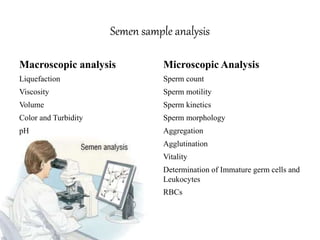
Semen sample analysis
Microscopic AnalysisMacroscopic analysis
Sperm countLiquefaction
Sperm motilityViscosity
Sperm kineticsVolume
Sperm morphologyColor and Turbidity
AggregationpH
Agglutination
Vitality
Determination of Immature germ cells and
Leukocytes
RBCs
Macroscopic examination
Liquefaction:
• Liquefaction is the breakdown of the gel portion of the seminal plasma – the
enzymes for this are in the prostatic fluid
• Semen is normally ejaculated as a coagulum and liquefied within 20 minutes
after ejaculation (37 °C).
• Non liquefied semen is a fairly rare occurrence, may indicate prostatic
dysfunction, and should be noted.
• Aspirate the specimen into plastic pasture pipette and observe it
If homogeneous and quite watery Liquefaction is complete
If heterogeneous mixture Liquefaction is not complete
• Note: Normal liquefied semen samples may contain jelly-like granules
(gelatinous bodies) which do not liquefy.
• If after 2 hours the specimen has not liquified proteolytic enzymes such as
alpha-chymotrypsin may be added to allow the rest of the analysis to be
performed.
Viscosity :
Measured by drawing and releasing semen from a pipet and noting viscosity
using a subjective scale.
- If viscosity is high repeat gently passage of specimen into pipette several
times.
- If viscosity is very high add equal volume of sperm media following by
repeating pipetting.
Macroscopic examination
Leaves the Pipette in small discrete drops.Normal Sample
The drop will form a thread about 2 cm long.( + )
The drop will form a thread more than 2 cm long.( ++ )
No drops formed, shows a continuous filament.( +++ )
Not aspirated into the plastic pasture pipette.( + +++ )
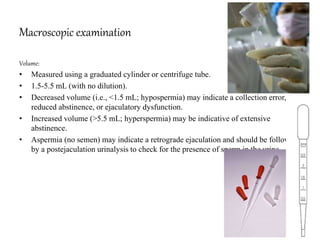
Volume:
• Measured using a graduated cylinder or centrifuge tube.
• 1.5-5.5 mL (with no dilution).
• Decreased volume (i.e., <1.5 mL; hypospermia) may indicate a collection error,
reduced abstinence, or ejaculatory dysfunction.
• Increased volume (>5.5 mL; hyperspermia) may be indicative of extensive
abstinence.
• Aspermia (no semen) may indicate a retrograde ejaculation and should be followed
by a postejaculation urinalysis to check for the presence of sperm in the urine.
Macroscopic examination
Color:
-The presence of gross macroscopic particles or debris should be noted.
pH:
- Secretions from the prostate and seminal vesicles contribute to seminal pH.
- Measured using litmus paper.
- The pH of the semen is normally (7.2-7.8)
- Abnormal pH may be indicative of secondary
sex gland dysfunction).
Macroscopic examination
Grey-opalescentNormal
Less OpaqueLow sperm Count
Red-brown or pinkishRBCs present
YellowDrugs or vitamins
Microscopic examination
 In Case of Presence of Sperm:
• Sample should be examined to determine the motility classification, aggregation,
agglutination and the dilution required for accurate assessment of sperm
concentration.
Aggregation
• adherence either of immotile spermatozoa to each other.
• or of motile spermatozoa to mucus strands, non-sperm cells or debris is considered
to be nonspecific aggregation.
Agglutination
• Motile spermatozoa are attached to each other Head-to-Head, Tail-to-Tail or in a
mixed way. (Immunological cause of infertility)
isolated <10 spermatozoa per agglutinate, many free
spermatozoa
Grade 1(+):
moderate 10–50 spermatozoa per agglutinate, free
spermatozoa
Grade 2(++):
large agglutinates of >50 spermatozoa, some spermatozoaGrade 3(+++):
Head-to-Head
Tail-to-Tail
Tail-tip-to-tail-tip
Mixed
Tangle
Microscopic examination
Motility
Different categories of sperm motility:
•Progressive motility (PR): Spermatozoa moving actively, either linearly or in a large
circle, regardless of speed. (Represents the quality of sperm).
a. Rapid b. Slow
•Non-progressive motility (NP): all other patterns of motility with an absence of
progression, e.g: swimming in small circles, the flagellar force hardly displacing the
head, or when only a flagellar beat can be observed.
• Immotility (IM): no movement.
If the motility is less than 50% then vital test must be done.
If motility is Zero , then pentoxyphillene stimulation test is required
Microscopic examination
Vitality
- Stained (red=Dead) sperm and unstained (Vital) sperm.
-Viable do not take up the stain
- Eosin +/- Nigrosin
Immature germ cells and Leukocytes
- Peroxidase positive cells appear with yellow to brown stained cells while pink
stained cells are other cells.
- Formation of small air-bubbles is normal (The higher the concentration of
peroxidase positive cells, the more air bubbles will form).
Microscopic examination
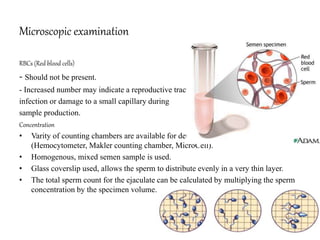
RBCs (Red blood cells)
- Should not be present.
- Increased number may indicate a reproductive tract
infection or damage to a small capillary during
sample production.
Concentration
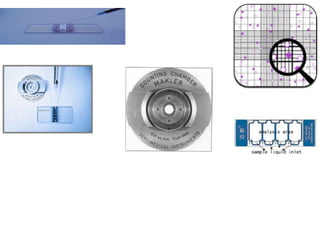
• Varity of counting chambers are available for determining sperm concentration.
(Hemocytometer, Makler counting chamber, MicroCell).
• Homogenous, mixed semen sample is used.
• Glass coverslip used, allows the sperm to distribute evenly in a very thin layer.
• The total sperm count for the ejaculate can be calculated by multiplying the sperm
concentration by the specimen volume.
Microscopic examination
 If No Sperm seen:
• First scan the whole slide and record if there are any motile and immotile
spermatozoa
• If no sperm ,then add to semen specimen equal volume of Ham ̀s F10 media
and centrifuge it at 1500 rpm for 10 minutes.
• Concentrate the sample in 250 micron and mix it well then Scan 10 micron at
x400 magnification ……. record presence of any sperm.
• Second sample is useful.
• If azospermia: fructose level must be ordered to verify the integrity of the vas
and seminal vesicles
Microscopic examination
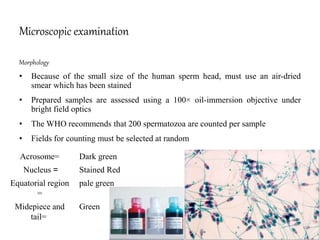
Morphology
• Because of the small size of the human sperm head, must use an air-dried
smear which has been stained
• Prepared samples are assessed using a 100× oil-immersion objective under
bright field optics
• The WHO recommends that 200 spermatozoa are counted per sample
• Fields for counting must be selected at random
Dark greenAcrosome=
Stained Red=Nucleus
pale greenEquatorial region
=
GreenMidepiece and
tail=
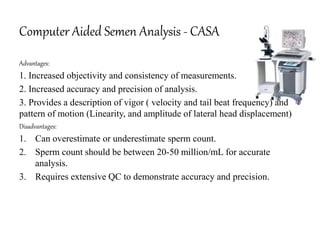
Computer Aided Semen Analysis - CASA
Advantages:
1. Increased objectivity and consistency of measurements.
2. Increased accuracy and precision of analysis.
3. Provides a description of vigor ( velocity and tail beat frequency) and
pattern of motion (Linearity, and amplitude of lateral head displacement)
Disadvantages:
1. Can overestimate or underestimate sperm count.
2. Sperm count should be between 20-50 million/mL for accurate
analysis.
3. Requires extensive QC to demonstrate accuracy and precision.
Computer Aided Semen Analysis - CASA
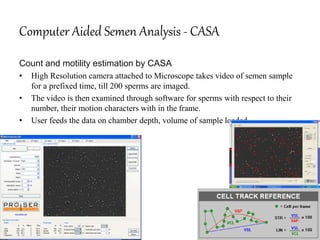
Count and motility estimation by CASA
• High Resolution camera attached to Microscope takes video of semen sample
for a prefixed time, till 200 sperms are imaged.
• The video is then examined through software for sperms with respect to their
number, their motion characters with in the frame.
• User feeds the data on chamber depth, volume of sample loaded.
Count and motility estimation by CASA
• The sperm tracks are analyzed and a number of kinematic parameters are
derived, including:
– Velocity (VCL, VSL and VAP)
– Velocity ratios (expression of the path shape and regularity)
– Amplitude of lateral head displacement
– Beat/cross frequency
• The proportion of sperm in a sample which meet particular kinematic criteria is
used to predict (failure) of:
– Mucus-penetrating ability
– Hyperactivation (a marker of sperm function)
• Able to assess the kinematics of hundreds of sperm in a couple of minutes
Computer Aided Semen Analysis - CASA
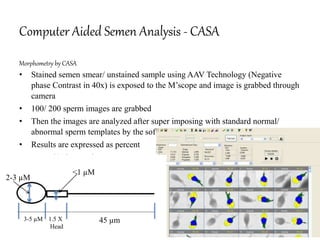
Morphometry by CASA
• Stained semen smear/ unstained sample using AAV Technology (Negative
phase Contrast in 40x) is exposed to the M’scope and image is grabbed through
camera
• 100/ 200 sperm images are grabbed
• Then the images are analyzed after super imposing with standard normal/
abnormal sperm templates by the software
• Results are expressed as percent
normal/ Abnormal.
Computer Aided Semen Analysis - CASA
2-3 µM
<1 µM
3-5 µM 1.5 X
Head
45 µm
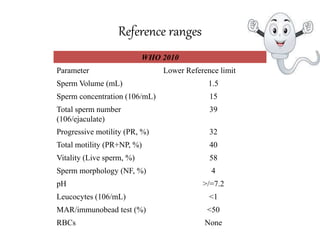
Reference ranges
WHO 2010
Lower Reference limitParameter
1.5Sperm Volume (mL)
15Sperm concentration (106/mL)
39Total sperm number
(106/ejaculate)
32Progressive motility (PR, %)
40Total motility (PR+NP, %)
58Vitality (Live sperm, %)
4Sperm morphology (NF, %)
>/=7.2pH
<1Leucocytes (106/mL)
<50MAR/immunobead test (%)
NoneRBCs
Semen nomenclature
-Spermia Refers to Semen
-Aspermia
-Hyperspermia
-Hypospermia
-Leucocytospermia
-Hematospermia
-Pyospermia
-Azoospermia
-Cryptozoospermia
- Oligozoospermia
- Asthenozoospermia
- Teratozoospermia
-Normozoospermia
-Globozoospermia
- No Ejaculate Volume.
-Increased Ejaculate Volume.
-Decreased Ejaculate Volume.
-Increased Pus cells in Ejaculate.
-Presence of RBCs in semen.
-Presence of WBCs in semen.
-No Sperm present.
-No Sperm in wet Prepration…. Found Sperm after Conc.
-If Count <15 million/ml
-If PR motile Sperm is <35%
-If Abnormal Forms >4%
-If Sample with Normal Parameters of Count, Motility and Normal forms.
-Sperm with Rounded Head
Thank You!

Andrology lab

  • 1.
    Andrology Laboratory….. Is itimportant ? Dr. Yasmin Magdi Abd-Elkreem
  • 2.
    Andrology Laboratory • Andrology:The science of male reproduction including sperm production and diseases and abnormalities thereof. • The Andrology Laboratory offers a full range of specialized tests and services for the evaluation and treatment (IUI) of male infertility by highly skilled laboratory personnel, all of whom have completed specialized training in infertility laboratory techniques.
  • 3.
    Andrology Laboratory • convenient,same-site andrology services in an atmosphere that is attractive, private, and comfortable. 1. Semen analysis. 2. specialized tests (Sperm Morphology Classification using Kruger’s Strict Criteria, Sperm Viability Testing, Hypo-osmotic Swelling Test (HOS) , Testing for Anti-sperm antibodies, Testing for Leukocytospermia. 3. Sperm function test (Sperm-mucus Interaction Tests, Capacitation, Acrosome Reaction, Zona Binding assays). 4. Semen cryopreservation. 5. Sperm DNA fragmentation. 6. Intrauterine inseminations. 7. Sperm preparation for in vitro fertilization (IVF) procedures and intracytoplasmic sperm injection (ICSI). 8. provide counseling and options for cryopreservation before initiating chemotherapy, radiation, ICSI or surgery. 9. Testicular and epididymal sperm processing and cryopreservation.
  • 4.
    What is semenanalysis??!! • Is a test on the fluid that is released when a man has an orgasm. • Inflects the quality and quantity of spermatogenesis, spermiogensis, sperm transportation and maturation process. • is usually one of the first tests done to help determine whether a man has a problem fathering a child (infertility). • Modern approach is to interpret with regard to: • diagnosis of specific lesions; and • indicators of dysfunctional and/or functional potential. • Requires understanding of the relevance of sperm patho-physiology. • In any case, the results must be accurate and reliable.
  • 5.
    Why perform semenanalysis? • Diagnosis of sterility • Diagnosis of infertility (as part of a couple's infertility investigation) • Prognosis for fertility • Effectiveness of vasectomy • Identify treatment options: • surgical treatment • medical treatment • assisted conception treatment • Cryopersvation Therefore = a screening test to help direct management.
  • 6.
    How is semenanalysis done? • Analysis is done through two steps -Sample collection -Sample analysis According to World Health Organization: Department of Reproductive Health and Research WHO laboratory manual for the examination and processing of human semen. 5th edition. 2010. • International minimum standards are, by consensus, the World Health Organization’s Lab Manual. • Focus is on standardization with expanded section on quality control. • Basic infertility work-up.
  • 7.
    1. Sexual abstinence -2- 7 days -No “ejaculation” not just “No intercourse” 2. Specimen collection (Ways to collect semen) - Masturbation (Optimal specimen for analysis) - Coitus interrupts (often lost a part) - Split ejaculate (2 containers) - Accepted lubricants (non sperm toxic) 3. Specimen containers -non sperm toxic ( containers, condoms) only provided by the laboratory. -Tested for every type or lot. 4. Specimen Transport - In the laboratory location (Ideal) - Off site ( within 1 hour), avoid excess heat or container damage, instruct in the semen report, patient assignment Semen collection
  • 8.
    Semen collection Retrograde ejaculation •In some men, the semen passes back into the bladder at ejaculation - this is confirmed by examination of a sample of post-ejaculatory urine. • The man must take sodium bicarbonate the day before, and the day of, his appointment – to alkalinize his urine or FNA is recommended. • Before collection, he should pass urine and then wait until he feels there is some urine in his bladder before masturbating • Assess volume and pH of the urine. • Centrifuge, resuspend pellets Perform a standard semen analysis with this suspension
  • 9.
    Semen sample analysis MicroscopicAnalysisMacroscopic analysis Sperm countLiquefaction Sperm motilityViscosity Sperm kineticsVolume Sperm morphologyColor and Turbidity AggregationpH Agglutination Vitality Determination of Immature germ cells and Leukocytes RBCs
  • 10.
    Macroscopic examination Liquefaction: • Liquefactionis the breakdown of the gel portion of the seminal plasma – the enzymes for this are in the prostatic fluid • Semen is normally ejaculated as a coagulum and liquefied within 20 minutes after ejaculation (37 °C). • Non liquefied semen is a fairly rare occurrence, may indicate prostatic dysfunction, and should be noted. • Aspirate the specimen into plastic pasture pipette and observe it If homogeneous and quite watery Liquefaction is complete If heterogeneous mixture Liquefaction is not complete • Note: Normal liquefied semen samples may contain jelly-like granules (gelatinous bodies) which do not liquefy. • If after 2 hours the specimen has not liquified proteolytic enzymes such as alpha-chymotrypsin may be added to allow the rest of the analysis to be performed.
  • 11.
    Viscosity : Measured bydrawing and releasing semen from a pipet and noting viscosity using a subjective scale. - If viscosity is high repeat gently passage of specimen into pipette several times. - If viscosity is very high add equal volume of sperm media following by repeating pipetting. Macroscopic examination Leaves the Pipette in small discrete drops.Normal Sample The drop will form a thread about 2 cm long.( + ) The drop will form a thread more than 2 cm long.( ++ ) No drops formed, shows a continuous filament.( +++ ) Not aspirated into the plastic pasture pipette.( + +++ )
  • 12.
    Volume: • Measured usinga graduated cylinder or centrifuge tube. • 1.5-5.5 mL (with no dilution). • Decreased volume (i.e., <1.5 mL; hypospermia) may indicate a collection error, reduced abstinence, or ejaculatory dysfunction. • Increased volume (>5.5 mL; hyperspermia) may be indicative of extensive abstinence. • Aspermia (no semen) may indicate a retrograde ejaculation and should be followed by a postejaculation urinalysis to check for the presence of sperm in the urine. Macroscopic examination
  • 13.
    Color: -The presence ofgross macroscopic particles or debris should be noted. pH: - Secretions from the prostate and seminal vesicles contribute to seminal pH. - Measured using litmus paper. - The pH of the semen is normally (7.2-7.8) - Abnormal pH may be indicative of secondary sex gland dysfunction). Macroscopic examination Grey-opalescentNormal Less OpaqueLow sperm Count Red-brown or pinkishRBCs present YellowDrugs or vitamins
  • 14.
    Microscopic examination  InCase of Presence of Sperm: • Sample should be examined to determine the motility classification, aggregation, agglutination and the dilution required for accurate assessment of sperm concentration. Aggregation • adherence either of immotile spermatozoa to each other. • or of motile spermatozoa to mucus strands, non-sperm cells or debris is considered to be nonspecific aggregation. Agglutination • Motile spermatozoa are attached to each other Head-to-Head, Tail-to-Tail or in a mixed way. (Immunological cause of infertility) isolated <10 spermatozoa per agglutinate, many free spermatozoa Grade 1(+): moderate 10–50 spermatozoa per agglutinate, free spermatozoa Grade 2(++): large agglutinates of >50 spermatozoa, some spermatozoaGrade 3(+++):
  • 15.
  • 16.
    Microscopic examination Motility Different categoriesof sperm motility: •Progressive motility (PR): Spermatozoa moving actively, either linearly or in a large circle, regardless of speed. (Represents the quality of sperm). a. Rapid b. Slow •Non-progressive motility (NP): all other patterns of motility with an absence of progression, e.g: swimming in small circles, the flagellar force hardly displacing the head, or when only a flagellar beat can be observed. • Immotility (IM): no movement. If the motility is less than 50% then vital test must be done. If motility is Zero , then pentoxyphillene stimulation test is required
  • 17.
    Microscopic examination Vitality - Stained(red=Dead) sperm and unstained (Vital) sperm. -Viable do not take up the stain - Eosin +/- Nigrosin Immature germ cells and Leukocytes - Peroxidase positive cells appear with yellow to brown stained cells while pink stained cells are other cells. - Formation of small air-bubbles is normal (The higher the concentration of peroxidase positive cells, the more air bubbles will form).
  • 18.
    Microscopic examination RBCs (Redblood cells) - Should not be present. - Increased number may indicate a reproductive tract infection or damage to a small capillary during sample production. Concentration • Varity of counting chambers are available for determining sperm concentration. (Hemocytometer, Makler counting chamber, MicroCell). • Homogenous, mixed semen sample is used. • Glass coverslip used, allows the sperm to distribute evenly in a very thin layer. • The total sperm count for the ejaculate can be calculated by multiplying the sperm concentration by the specimen volume.
  • 20.
    Microscopic examination  IfNo Sperm seen: • First scan the whole slide and record if there are any motile and immotile spermatozoa • If no sperm ,then add to semen specimen equal volume of Ham ̀s F10 media and centrifuge it at 1500 rpm for 10 minutes. • Concentrate the sample in 250 micron and mix it well then Scan 10 micron at x400 magnification ……. record presence of any sperm. • Second sample is useful. • If azospermia: fructose level must be ordered to verify the integrity of the vas and seminal vesicles
  • 21.
    Microscopic examination Morphology • Becauseof the small size of the human sperm head, must use an air-dried smear which has been stained • Prepared samples are assessed using a 100× oil-immersion objective under bright field optics • The WHO recommends that 200 spermatozoa are counted per sample • Fields for counting must be selected at random Dark greenAcrosome= Stained Red=Nucleus pale greenEquatorial region = GreenMidepiece and tail=
  • 23.
    Computer Aided SemenAnalysis - CASA Advantages: 1. Increased objectivity and consistency of measurements. 2. Increased accuracy and precision of analysis. 3. Provides a description of vigor ( velocity and tail beat frequency) and pattern of motion (Linearity, and amplitude of lateral head displacement) Disadvantages: 1. Can overestimate or underestimate sperm count. 2. Sperm count should be between 20-50 million/mL for accurate analysis. 3. Requires extensive QC to demonstrate accuracy and precision.
  • 24.
    Computer Aided SemenAnalysis - CASA Count and motility estimation by CASA • High Resolution camera attached to Microscope takes video of semen sample for a prefixed time, till 200 sperms are imaged. • The video is then examined through software for sperms with respect to their number, their motion characters with in the frame. • User feeds the data on chamber depth, volume of sample loaded.
  • 25.
    Count and motilityestimation by CASA • The sperm tracks are analyzed and a number of kinematic parameters are derived, including: – Velocity (VCL, VSL and VAP) – Velocity ratios (expression of the path shape and regularity) – Amplitude of lateral head displacement – Beat/cross frequency • The proportion of sperm in a sample which meet particular kinematic criteria is used to predict (failure) of: – Mucus-penetrating ability – Hyperactivation (a marker of sperm function) • Able to assess the kinematics of hundreds of sperm in a couple of minutes Computer Aided Semen Analysis - CASA
  • 26.
    Morphometry by CASA •Stained semen smear/ unstained sample using AAV Technology (Negative phase Contrast in 40x) is exposed to the M’scope and image is grabbed through camera • 100/ 200 sperm images are grabbed • Then the images are analyzed after super imposing with standard normal/ abnormal sperm templates by the software • Results are expressed as percent normal/ Abnormal. Computer Aided Semen Analysis - CASA 2-3 µM <1 µM 3-5 µM 1.5 X Head 45 µm
  • 27.
    Reference ranges WHO 2010 LowerReference limitParameter 1.5Sperm Volume (mL) 15Sperm concentration (106/mL) 39Total sperm number (106/ejaculate) 32Progressive motility (PR, %) 40Total motility (PR+NP, %) 58Vitality (Live sperm, %) 4Sperm morphology (NF, %) >/=7.2pH <1Leucocytes (106/mL) <50MAR/immunobead test (%) NoneRBCs
  • 28.
    Semen nomenclature -Spermia Refersto Semen -Aspermia -Hyperspermia -Hypospermia -Leucocytospermia -Hematospermia -Pyospermia -Azoospermia -Cryptozoospermia - Oligozoospermia - Asthenozoospermia - Teratozoospermia -Normozoospermia -Globozoospermia - No Ejaculate Volume. -Increased Ejaculate Volume. -Decreased Ejaculate Volume. -Increased Pus cells in Ejaculate. -Presence of RBCs in semen. -Presence of WBCs in semen. -No Sperm present. -No Sperm in wet Prepration…. Found Sperm after Conc. -If Count <15 million/ml -If PR motile Sperm is <35% -If Abnormal Forms >4% -If Sample with Normal Parameters of Count, Motility and Normal forms. -Sperm with Rounded Head
  • 29.

Editor's Notes

  • #6 Occasionally a man will have a semen analysis done as part of routine pre-marraige . The characteristics measured by semen analysis are only some of the factors in semen quality. One source states that 30% of men with a normal semen analysis actually have abnormal sperm function. Conversely, men with poor semen analysis results may go on to father children.
  • #8 1- Check all data about patient from the file 2- Give him the lab. Sterile Cup (write on it patient’s name , number of abstinence days, time) 3– Ask the patient if he take any medications 4-Ask patient not to use water, soap or cream while bringing semen sample. 5 – When receiving the sample write on the cup time of receiving sample and check file number, then put it in incubator for (20) min. 6 – Ask the patient if there is any part that lost from sample. 7-Write down sample information in semen analysis index. For a meaningful result, semen samples must always be collected under standardized conditions: the container has to be sterile and known NOT to be spermotoxic (i.e. provided by the lab) the man must have had 2-7days of abstinence the man must have washed his hands before collection (particularly if microbiological analysis is requested) the man must NOT have used lubricants (except for Pre~Seed or His~Seed, the only “sperm-friendly” ones) the sample must be kept at 37°C until analysis, which begins ideally within 30 min, but absolutely within 60 min, of ejaculation
  • #12 The sample should NEVER be “needled” – if it is too viscous to work with, a known volume of sperm buffer (not PBS) should be added and the sample mixed gently. The added volume must be included in the sperm concentration calculation
  • #17 Assess approximately 200 spermatozoa per replicate in the fields around the central one for the percentage different motile categories.
  • #18 -Count the numbre of WBCs and the numbre of spermatozoa ,and calculate the concentration of WBCs based on the formula if only Count ≥ 5 mill/ml: (Numbre of WBCs /Numbre of spermcells)xSperm concentration (mill/ml) -In case the count is < 5 mill/ml: The concentration of WBCs can be determined by multipling the numbre of WBC with a known factor based on the size of microscope Field and height between the object glass and cover slide (or the depth of semen sample). Surface Area(S)= π r2 Square of the radius multiplied with pi Height = Volume of sample (Micron)/ (length x width of cover slide) Factor = 1000000/(Surface Areax height)