M.Phool Badshah
 The term embryo culture means excision of embryos regardless of age,
size and development stage from their natural environment and growing
them under artificial environmental conditions.
 Laibach in 1925 isolated inter specific hybrid embryos of Linum perenne
X Linum austriacum,seeds are greatly shrivled very light and incapable of
germination when planted in soil.
 By excising embryo from such seed and growing them in a moist filter
paper or cotton soaked in 15% glucose solution , he was able to rise the
hybrid plants.
 Isolation and growth of an immature, mature embryo in vitro, with the
goal obtaining a viable plant.
Types of Embryo Culture
 Mature Embryo Culture
 Immature embryo culture.
 Mature Embryo Culture:
I. it is the culture of mature embryos derived from ripe seeds. It requires simple medium.
 This is done when embryos…
I. Do not survive in-vivo.
II. Become dormant for longer periods of time.
III. To eliminate the inhibition of seed germination.
 Seed dormancy of many species is due to chemical inhibitors (e.g., bearded iris) or
mechanical resistance (e.g., American basswood) present in the structures covering the
embryo.
 Some species produce sterile seeds which may be due to incomplete embryo development. Such
embryos can be cultured and viable seedlings can be produced.
 Example: Orchids etc.
Reasons for carrying Mature Embryo culture:
 When the embryos remain dormant for long periods.
Low survival of embryos in vivo.
 To avoid inhibition in the seed for germination.
 For converting sterile seeds to viable seedlings.
 Immature Embryo Culture:
I. It is the culture on immature embryos to rescue the embryos of wide crosses.
II. This type of culture is mainly used to avoid embryo abortion with the
purpose of producing a viable plant.
III. It requires complex media which includes special amino acids, hormones ,
endosperm extract like coconut milk etc.
IV. In less than optimum medium, the immature embryos may fail to
survive, turn into undifferentiated callus, or germinate prematurely
(precocious germination)
z
Nutritional Requirements:
Culture-medium Factors:
I. Most important mineral salts- Potassium, Calcium, Nitrogen.
II. Require carbohydrates and osmotic pressure.
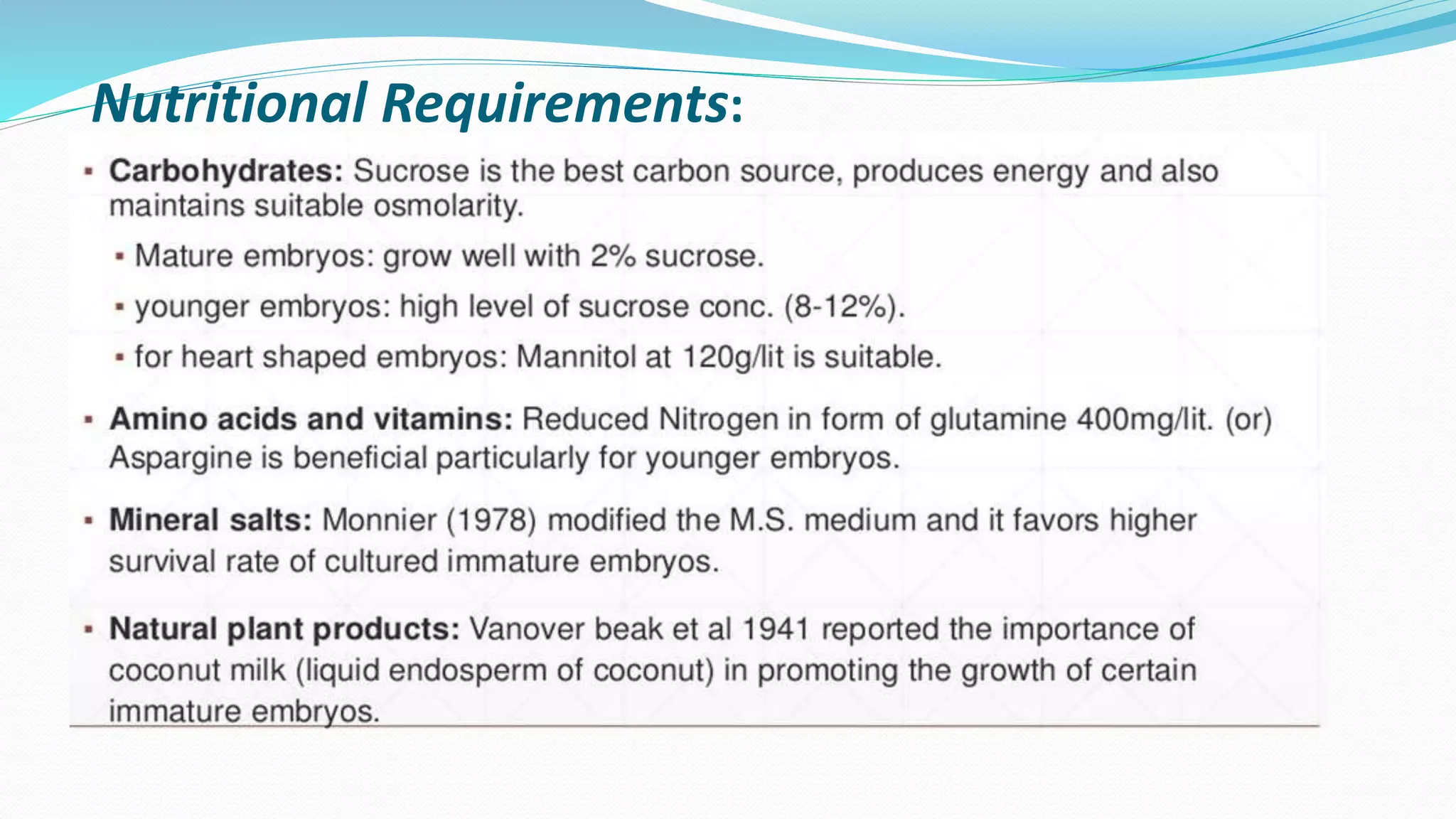
 2% sucrose works well for mature embryo.
 8-12% for immature embryo.
 transfer to progressively lower levels as embryo grows.
:For immature embryo
 Amino acids:
I. It reduced N is often helpful.
II. Up to 10 amino acids can be added to replace N salts, including
glutamine, alanine, arginine, aspartic acid etc.
 Plant growth regulators:
I. Globular embryos – require low concentration of auxin and cytokinin.
 Auxins play role in coordination of many growth and behavioral processes in plant
life cycles and are essential for plant body development.
I. Heart stage and later – moderate level of auxin and low level of cytokinen.
 Cytokinins are a class of plant hormones that promote cell division, or cytokinesis,
in plant roots and shoots. They are involved primarily in cell growth and
differentiation
Embryo Culture of Maize:
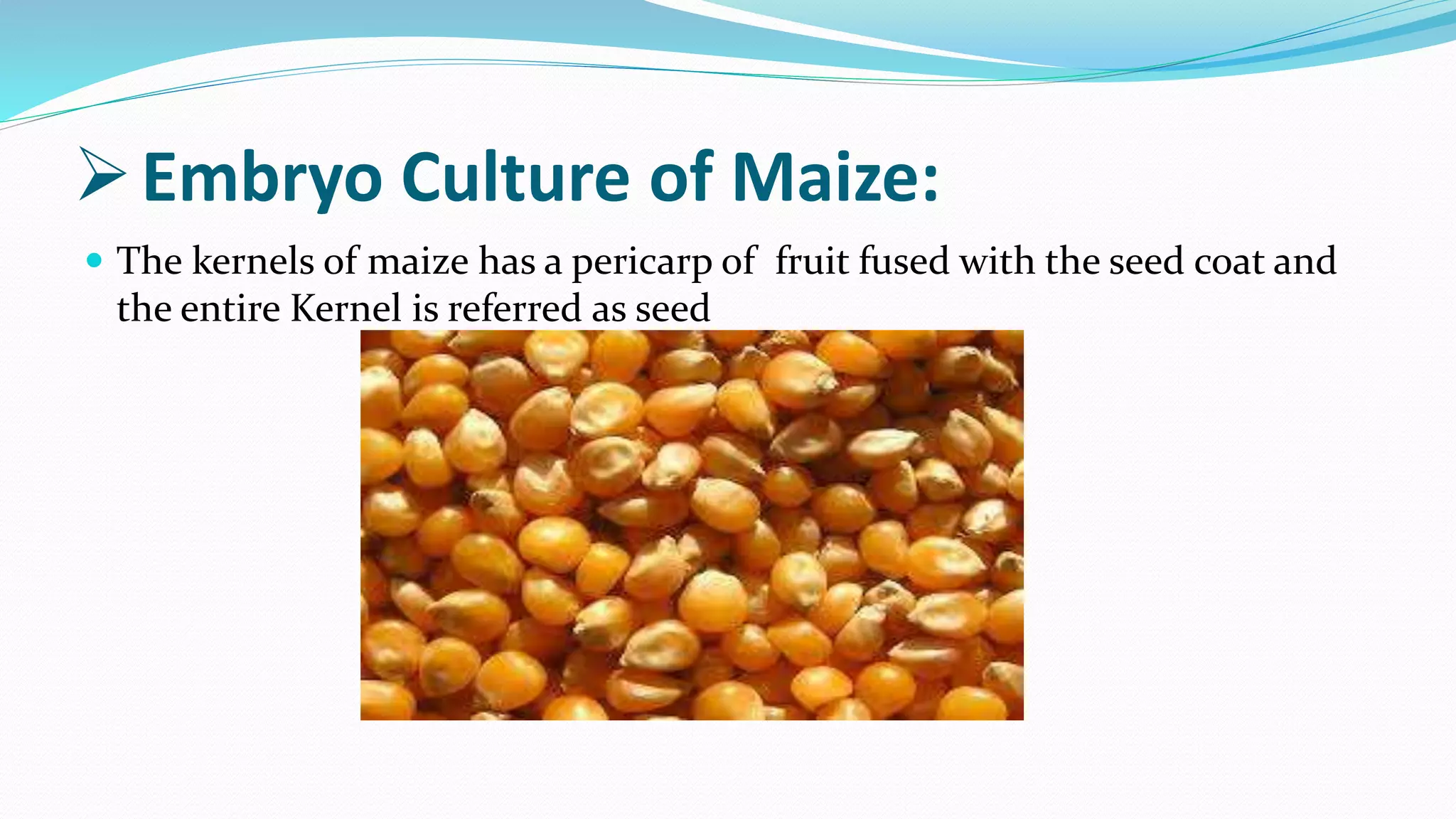
 The kernels of maize has a pericarp of fruit fused with the seed coat and
the entire Kernel is referred as seed
Procedure for Maize:
I. Take immature cob is taken from the healthy field.
II. Its immature seeds were extracted out.
III. Surface sterilize the immature seeds by treating them with 0.1%
mercuric chloride solution for 7 minutes.
IV. Give 3-washings with autoclaved distilled water.
V. Dissect out the embryo from the seed under totally aseptic conditions.
VI. Culture the embryo in the jars containing MS media.
VII. Incubate the jars at temperature 28’-30’C.
Equipment and Materials:
 Plant Material:
 Overcoming Seed Dormancy: Japanese holly is used because of the rudimentary nature of
the embryo in mature fruit, its ready availability, ease of dissecting, and the simplicity in its one-
step culture procedure. Japanese holly can be found in gardens and parks around the world.
 Hybrid Embryo Rescue: Because hybrid embryos are difficult to obtain, the immature
embryos of cultivated soybean can be used. Mature seeds of many cultivars can be obtained
from food markets or seed companies (e.g., Agway Inc., see also Chap. 8 for seed sources). Plants
can be grown from seeds in the field or in greenhouse pots to maturity. Embryos at the heart
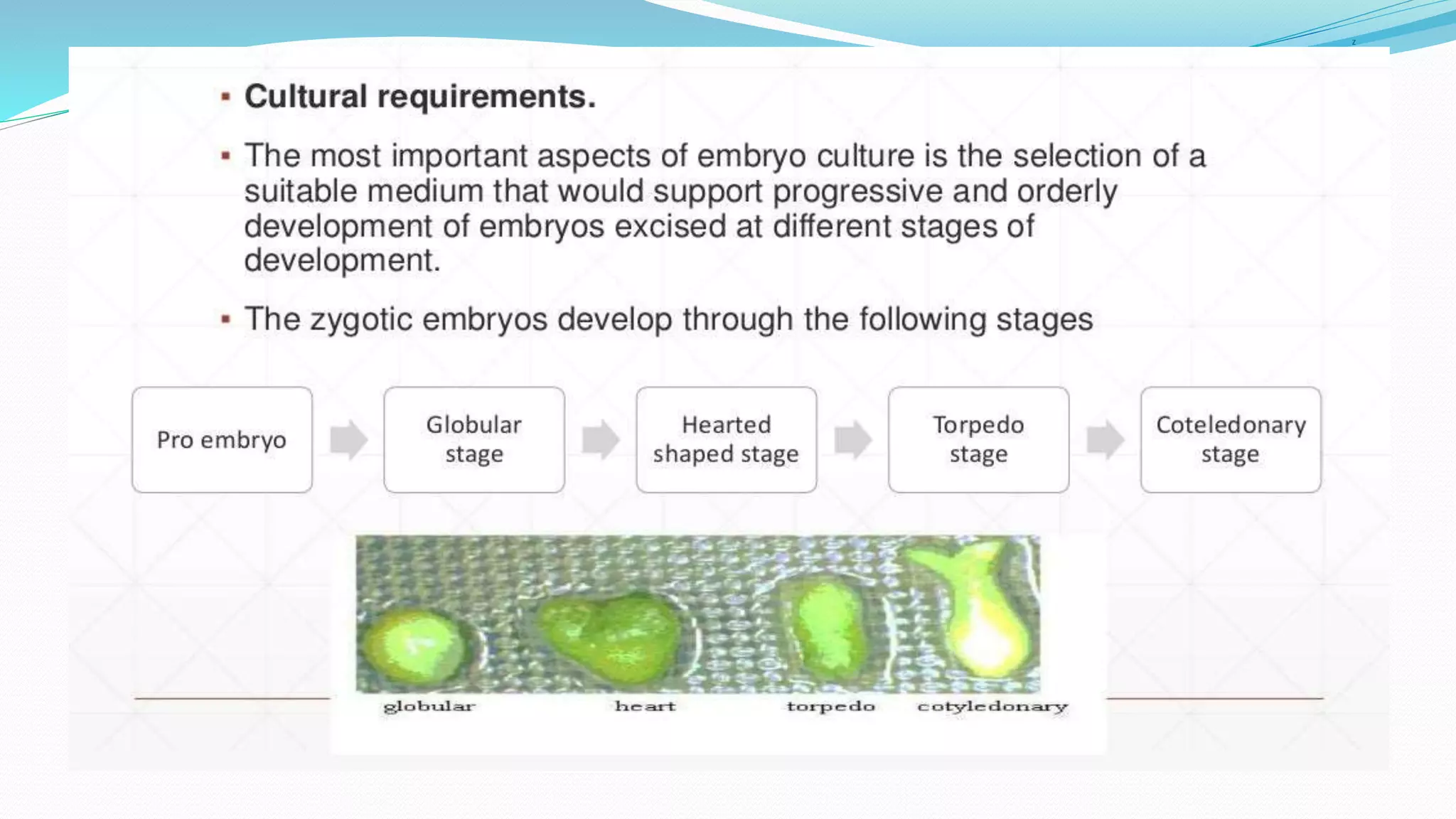
stage and the beginning of the cotyledon stage, 0.2- 0.4 mm in length, are ideal.
Equipments:
 Laminar flow hood.
 Stereo-microscope.
 fluorescent lamp.
 Forceps, dissection needles, single-edged razor blades.
 Micro-dissection needles, prepared by electrical etching of tungsten wire.
 Glass vials, 20 ml.
 Baby food jars, 200 ml.
 Petri dishes, 100 X 15 mm.
 24-well plastic culture plates, such as Costar.
 Incubating area equipped with temperature and light controls .
 - Greenhouse.
 Procedure:
 11.4.1 Treatment of Materials:
I. Unless stated otherwise, the incubation conditions for both exercises are at a constant
temperature of 25°C with 16-h photoperiod of 10.9Wm-2 from cool white fluorescent tubes.
 11.4.2 Dissection :
I. Soak hard-coated seeds, such as Iris, Ta-xus , and Cyclamen, in water for a few hours to a few days
to make dissection task easier. These seeds are generally surface sterilized before soaking as well
as after soaking, just before dissection.
II. The excision of an immature embryo imbedded in liquid endosperm frequently involves an
incision at the micropylar end of the young ovule, and the application of pressure at the opposite
end to force the embryo out through the incision opening. Take care that the pressure does not
injure the fragile embryonic tissue . After excision, large embryos are transferred into the culture
vessels with a pair of forceps. Small embryos are handled with a dissection needle with its tip
moistened. Embryos will tend to stick onto the surface-moisture of the needle.
 Protocols:
 Separate the seeds from the pulps of the fruits by smashing the fruits in a plastic (window) screen
under running water..
 Surface sterilize the seeds with 0.5% sodium hypochlorite (10% Clorox) for 5 min and rinse 3 X in
sterile distilled water. Keep the seeds in sterile water until dissection.
 Dissect the seeds on a sheet of sterile filter paper under a stereo microscope in a laminar flow hood.
Begin by locating the micropylar-plug indentation at the less pointed end of the seed (Fig. lA). The
embryo, which is at heart-stage with an average length of 476 ± 57 !lm, is located very close to the
micropylar plug.
 With a sterile single-edged razor blade, make a longitudinal incision through 3/4 of the median line
of the pointed end of the seed with the cut end pointing toward the micropylar-plug. The remaining
114 of the uncut portion can be split open.
 With a sterile dissection needle transfer the embryo, which becomes exposed at the newly split
surface, onto the surface of MS medium.
a
 Incubate the cultures in darkness for the 1st week, then in light thereafter. Take weekly data on in vitro
embryonic development during the 1st month of incubation. Also record the percentage of embryos
showing developmental abnormalities.
 Take monthly data on seedling development for 3 months.
 After 3 months' growth, transplant seedlings with four or more leaves ex vitro into soil mix in pots.
Place them under greenhouse intermittent mist for 1 week, then move out of the mist.
 Record the percentage of seedlings surviving the ex vitro environment for 1 month.
Application of Embryo Culture:
I. Production of haploid plants.
II. Prevention of embryo abortion in wide crosses.
III. Overcoming seed dormancy.
IV. Prevention of embryo abortion with early ripening stone fruits.
V. Useful for obtaining “Haploids” of Barley, wheat .

Embryo culture.pptx

  • 1.
  • 2.
     The termembryo culture means excision of embryos regardless of age, size and development stage from their natural environment and growing them under artificial environmental conditions.  Laibach in 1925 isolated inter specific hybrid embryos of Linum perenne X Linum austriacum,seeds are greatly shrivled very light and incapable of germination when planted in soil.  By excising embryo from such seed and growing them in a moist filter paper or cotton soaked in 15% glucose solution , he was able to rise the hybrid plants.  Isolation and growth of an immature, mature embryo in vitro, with the goal obtaining a viable plant.
  • 3.
    Types of EmbryoCulture  Mature Embryo Culture  Immature embryo culture.  Mature Embryo Culture: I. it is the culture of mature embryos derived from ripe seeds. It requires simple medium.  This is done when embryos… I. Do not survive in-vivo. II. Become dormant for longer periods of time. III. To eliminate the inhibition of seed germination.  Seed dormancy of many species is due to chemical inhibitors (e.g., bearded iris) or mechanical resistance (e.g., American basswood) present in the structures covering the embryo.  Some species produce sterile seeds which may be due to incomplete embryo development. Such embryos can be cultured and viable seedlings can be produced.  Example: Orchids etc.
  • 5.
    Reasons for carryingMature Embryo culture:  When the embryos remain dormant for long periods. Low survival of embryos in vivo.  To avoid inhibition in the seed for germination.  For converting sterile seeds to viable seedlings.
  • 6.
     Immature EmbryoCulture: I. It is the culture on immature embryos to rescue the embryos of wide crosses. II. This type of culture is mainly used to avoid embryo abortion with the purpose of producing a viable plant. III. It requires complex media which includes special amino acids, hormones , endosperm extract like coconut milk etc. IV. In less than optimum medium, the immature embryos may fail to survive, turn into undifferentiated callus, or germinate prematurely (precocious germination)
  • 7.
  • 8.
  • 9.
    Culture-medium Factors: I. Mostimportant mineral salts- Potassium, Calcium, Nitrogen. II. Require carbohydrates and osmotic pressure.  2% sucrose works well for mature embryo.  8-12% for immature embryo.  transfer to progressively lower levels as embryo grows. :For immature embryo  Amino acids: I. It reduced N is often helpful. II. Up to 10 amino acids can be added to replace N salts, including glutamine, alanine, arginine, aspartic acid etc.
  • 10.
     Plant growthregulators: I. Globular embryos – require low concentration of auxin and cytokinin.  Auxins play role in coordination of many growth and behavioral processes in plant life cycles and are essential for plant body development. I. Heart stage and later – moderate level of auxin and low level of cytokinen.  Cytokinins are a class of plant hormones that promote cell division, or cytokinesis, in plant roots and shoots. They are involved primarily in cell growth and differentiation
  • 11.
    Embryo Culture ofMaize:  The kernels of maize has a pericarp of fruit fused with the seed coat and the entire Kernel is referred as seed
  • 12.
    Procedure for Maize: I.Take immature cob is taken from the healthy field. II. Its immature seeds were extracted out. III. Surface sterilize the immature seeds by treating them with 0.1% mercuric chloride solution for 7 minutes. IV. Give 3-washings with autoclaved distilled water. V. Dissect out the embryo from the seed under totally aseptic conditions. VI. Culture the embryo in the jars containing MS media. VII. Incubate the jars at temperature 28’-30’C.
  • 13.
    Equipment and Materials: Plant Material:  Overcoming Seed Dormancy: Japanese holly is used because of the rudimentary nature of the embryo in mature fruit, its ready availability, ease of dissecting, and the simplicity in its one- step culture procedure. Japanese holly can be found in gardens and parks around the world.  Hybrid Embryo Rescue: Because hybrid embryos are difficult to obtain, the immature embryos of cultivated soybean can be used. Mature seeds of many cultivars can be obtained from food markets or seed companies (e.g., Agway Inc., see also Chap. 8 for seed sources). Plants can be grown from seeds in the field or in greenhouse pots to maturity. Embryos at the heart stage and the beginning of the cotyledon stage, 0.2- 0.4 mm in length, are ideal.
  • 14.
    Equipments:  Laminar flowhood.  Stereo-microscope.  fluorescent lamp.  Forceps, dissection needles, single-edged razor blades.  Micro-dissection needles, prepared by electrical etching of tungsten wire.  Glass vials, 20 ml.  Baby food jars, 200 ml.  Petri dishes, 100 X 15 mm.  24-well plastic culture plates, such as Costar.  Incubating area equipped with temperature and light controls .  - Greenhouse.
  • 15.
     Procedure:  11.4.1Treatment of Materials: I. Unless stated otherwise, the incubation conditions for both exercises are at a constant temperature of 25°C with 16-h photoperiod of 10.9Wm-2 from cool white fluorescent tubes.  11.4.2 Dissection : I. Soak hard-coated seeds, such as Iris, Ta-xus , and Cyclamen, in water for a few hours to a few days to make dissection task easier. These seeds are generally surface sterilized before soaking as well as after soaking, just before dissection. II. The excision of an immature embryo imbedded in liquid endosperm frequently involves an incision at the micropylar end of the young ovule, and the application of pressure at the opposite end to force the embryo out through the incision opening. Take care that the pressure does not injure the fragile embryonic tissue . After excision, large embryos are transferred into the culture vessels with a pair of forceps. Small embryos are handled with a dissection needle with its tip moistened. Embryos will tend to stick onto the surface-moisture of the needle.
  • 16.
     Protocols:  Separatethe seeds from the pulps of the fruits by smashing the fruits in a plastic (window) screen under running water..  Surface sterilize the seeds with 0.5% sodium hypochlorite (10% Clorox) for 5 min and rinse 3 X in sterile distilled water. Keep the seeds in sterile water until dissection.  Dissect the seeds on a sheet of sterile filter paper under a stereo microscope in a laminar flow hood. Begin by locating the micropylar-plug indentation at the less pointed end of the seed (Fig. lA). The embryo, which is at heart-stage with an average length of 476 ± 57 !lm, is located very close to the micropylar plug.  With a sterile single-edged razor blade, make a longitudinal incision through 3/4 of the median line of the pointed end of the seed with the cut end pointing toward the micropylar-plug. The remaining 114 of the uncut portion can be split open.  With a sterile dissection needle transfer the embryo, which becomes exposed at the newly split surface, onto the surface of MS medium.
  • 17.
    a  Incubate thecultures in darkness for the 1st week, then in light thereafter. Take weekly data on in vitro embryonic development during the 1st month of incubation. Also record the percentage of embryos showing developmental abnormalities.  Take monthly data on seedling development for 3 months.  After 3 months' growth, transplant seedlings with four or more leaves ex vitro into soil mix in pots. Place them under greenhouse intermittent mist for 1 week, then move out of the mist.  Record the percentage of seedlings surviving the ex vitro environment for 1 month.
  • 19.
    Application of EmbryoCulture: I. Production of haploid plants. II. Prevention of embryo abortion in wide crosses. III. Overcoming seed dormancy. IV. Prevention of embryo abortion with early ripening stone fruits. V. Useful for obtaining “Haploids” of Barley, wheat .