ZYGOTIC
EMBYOGENESIS
Zygotic embryogenesis or
Embryo rescue
An embryo can be defined as the earliest
recognizable multi-cellular stage of an individual
that occurs before it has developed the
structures or organs characteristic of a given
species
Types of embryos:
Zygotic Embryos: Embryos formed by fusion of sperm nuclei and egg cell (fertilized
egg/zygote)
Non-Zygotic embryos: Formed from cells other than zygote. further grouped inio
a) Somatic embryos: Formed by the sporophytic cells either in vivo or in vitro.
Somatic embryos directly arising from embryos or organs are called Adventive
embryos
b) Psrtbenoge»etic embryos: Formed by unfertilized egg
c) Aiidrogenic embryos: Formed by the male gametophyte tmicrospore pollen
grains).
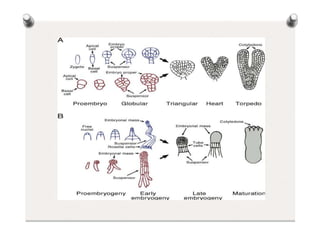
Embryogenmis process by which the zygote
undergoes a series of differentiation events, resulting in
the formation of a mature embryo with cotyledons,
shoot apical merislem (SAM}. hypocotyl, root, root
apical merisiem (RAM) and three embryonic tissue
systems.
An embryo can be defined as the earliest recognizable multi-cellular stage of
an individual
that occurs before it has developed the structures or organs characteristic of a
given species
Types of embrvos:
1. Zygotic Embryos: Embryos formed by fusion of sperm nuclei and egg cell
(fertilized
egg/zygote)
2. Non-Zygotic embryos: Formed from cells other than zygote. Further
grouped into
a. Somatic embryos: Formed by the sporophytic cells either in vivo or in vitro.
Somatic embryos directly arising from embryos or organs are called
Adventive embryos
b. Parthenogenetic embryos: Formed by unfertilized egg
c. Androgenic embryos: Formed by the male gametophyte (microspore pollen
grains).
In vitro Embryogenesis:
In wide crosses (Inter specific and integeneric), the hybrids do not
develop due to pre or post
fertilization barriers.
Pre-fertilization barriers
1. Differences in flowering time of two parents.
2. Lack of stigma receptivity and pollen viability.
3. Inability of pollen to germinate
4. Failure of pollen tube to reach the ovule due to slow growth
5. Cross incompatibility due to any other reason
Post-fertilization barriers
1. Degeneration of endosperm leading to starvation and abortion of
Post-fertilization barriers
1. Degeneration of endosperm leading to starvation and abortion of
hybrid embryo
2. Endosperm incompatibility, where the endosperm produces toxic
substances that kill
embryo
3. Malfunctioning of endosperm due to abnormal behaviour of
antipodal cells, nucellues, and
integuments around the embryo.
The problem of post fertilization barriers can be resolved by excising
and culturing of young
hybrid embryos (embryo culture. Embryo rescue) while some of the
pre-fertilization barriers
may be overcome by in vitro pollination and in vitro fertilization
The hybrid embryos between intergeneric and interspecific crosses
can be cultured by
following any of the technique mentioned below
Embryo culture
Embryo Implantation
Ovule culture
Ovary culture
Post – Fertilization barriers
l. Degeneration of endosperm leading to starvation and abortion of hybid embryo
Endosperm incompatibility, where the endosperm produces toxic substances that
kill embryo Malfunctioning of endosperm due to abnormal behaviour of antipodal
cells, nucellues, and integuments around the embryo.
The problem ol’ post fertilization barriers can be resolved by excising and culturing
of young hybrid embryos (embryo culture. Embryo rescue) while some of the pre-
fertilization barriers may be overcome by in › iiro pollination and in i'itro fertilization
The hybrid embryos between iniergeneric and interspecific crosses can be
cultured by
following any of’the technique mentioned below
Embryogensis process by which zygote undergoes a series of differentition events
resulting in the formation of mature embryo with cotyledons, shoot apical meristan
(SAM) hypocotyl root, root apical meristem (RAM) and three embryotic tissue
systems.
Embryo culture
Embryo Implantation
Ovule culture
Ovary culture
Embryo culture/in vitro embryogenesis: The term embryo culture
means excision of embryos regardless of age. size and
developmental stage from their natural environment and growing
them under artificial environment al conditions. The embryo forms
the beginning of new sporophytic generation of plant. The embryo is
formed from fertilization of egg and sperm.
In vitro embryogenesis could be used to rescue such abortive embryos and also to
study the
developmental and physiological aspects of embryogenesis.
Hannig (1904): Cultured excised mature embryos of Brassicaceae
( Cochleariada nica, Ra phanuscaudatus, R, landra and R. sativus) on a mineral
salt medium supplemented with
sucrose for the first time.
Laibach(I925, 1929- Successfully cultured immature embryo of interspecific hybrid
LiriiiniperenneX L. auslriacumon synthetic media
1) Mature Embryo culture
2) Immature embryo culture
1) Mature embryo culture: It is culture of mature embryo derived Tom ripe seeds.
It requires simple medium. This is done when embryos
i) Do not survive in vitro
ii) Become dormant for longer periods of time
iii) To eliminate the inhibition of seed germination
Some species produce sterile seeds, which may he due to incomplete embryo
development. Such embryos can be cultured, and viable seedlings can be produced.
Eg: Iris, orchids
2) Immature embryo culture (or) embryo rescue technique: - Culture of immature
embryos to rescue the embryos of wild crosses is use d io avoid embryo abortion and
produce viable planis. II requires complex media, which includes special amino acids,
hormones, endosperm extract like coconut milk eic.
i) Composition of the culture medium and
ii) Excision and culture of the embryo
O
1. Composition of the culture medium:The composition of the culture medium
varies with the material and the age of the embryo to be cultured. Culture of isolated
zygotes and young proembryos require co-cultivation with feeder cells/nurse tissue,
such as actively growing suspension cell aggregates or embryogenic microspores.
O
Mineral Salts: Inorganic nutrients of MS, B5 and White’s media with modifications are
the most widely used basal media for embryo culture. Monnier ( 1978) modified MS
medium with higher concentrations of K" and Ca2° and lower level of NH ions that
promoted higher survival rate of embryos. Since immature embryos lack nitrate
reductase enzyme to reduce NOT’ ammonium form (NHS*) is either essential or a
preferred source of inorganic nitrogen the early stage of embryo development.
O
Carbohydrates: Sucrose is the common source that act as carbon source as well as
maintain a suitable osmolarity which is extremely important for immature embryos.
Sucrose at 2% is adequate for mature embryos, while proembryos require 8— 12%
O
Amino Acids and Vitamins: Generally. glutamine has proved to he the most
effective amino acid for the groMh of excised embryos. Asparagine is also clTective
in enhancing the embryo groMh. Natural plant extracts from coconut milk and Casein
hydrolysate, a complex mixture ol"amino acids, has been widely used as an additive
to embryo culture media, especially for young embryos. Vitamins have been used in
embryo culture media, but their presence is nol always necessary.
O
Growth regulators: Growth regulators are not always necessary for the normal
development of embryo. Addition ot” hormones may cause structural abnormalities.
Gibbcrlic acid and ABA at low concentrations (0.01 mg/L) promotes embryogenesis.
pH of the medium: pH of ovular sap is 6.0, excised embryos grow well in a
O medium with pH 5.0-7.5
Changing Growth Requirements of the Embryos: Media constituents for in »/mo
groMh ol” young or immature embryos (heterotrophic) JifYcr mom mature
embryos (autotrophic). During their growth period it is necessary to transfer
embryos from one medium to other. However, embryos arc very delicate and
might be damaged Juring transfer.
O Applications of’ Zt gotic embryo ciiltii i e
Embryo rexcue/ production of rnre hybrids Studying fundamental
problems of embryogenesis.
Shortening of Breeding Cycle:
Rapid Seed Viability:
S. Propagation of rare plants Transformation/genetic engineering:
Overcoming seed dormancy
O . inlii yo i esciie/ pi odiiction of rai e liybi ids:
O In inter-specific and inter-genie hybridization programmes,
incompatibility barriers often prevent normal seed development
and production of hybrids. Although there is normal l’ertilization,
embryo abortion results in the formation of shriveled seeds.
Isolation of hybrids embryos before abortion and ia vitro culture
may avoid strong post zygotic barriers Eg. t’ereals:
Hordeumi•ulgare x secalecerealel.cgumes: -
Arachishypogaea x Arachismonticolo
O Fegetnblm: Solonummelongena X Solanummacrocorpon
lj'copersicanesculenmm
1onnier (1976) developed a unique method (Fig.), which allows complete development of
,'ounger embryos up to germination without moving them Tom their original positions.
Excision of embryo: The embryo excision is
performed aseptically in a laminas airflow hood. A stereomicroscope equipped with a
cool-ray fluorescent lamp or fiberglass illuminator is required for excision of small
embryos. Soaking a hard seed coat in water for a few hours to few days before sterilization
make excision easier.
•Embryo-Endosperm transplant: Finding nutritional requirements for the growth of
•embryos, which abort ai very early stages of development, is common problem in embryo
•culture. Implantation of immature embryo on endosperm isolated from healthy embryo
•(nune tissue) of the same species enhances success rate of endosperm.
Precocious germination: Embryo development is a linear
progression from zygoie formation to germination classified into five stages; 1. Cleavage
and differentiation, 2. (irowth Rapid cell expansion and division, 3. Maturation, 4. Dormancy, 5.
Germination I:xcised immature embryos on a nutrient tend to bypass stage of dormancy and cease to
undergo the linear embryogenic mode of development. Such embryos develop into weak seedlings.
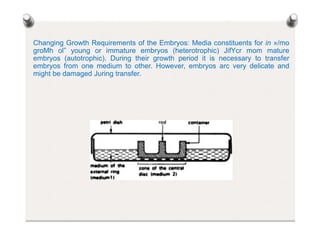
Monnier (1976) developed a unique method (Fig.), which allows
complete development of
vounger embryos up to germination without moving them from their
original positions.
Excision and culture of the embryo:
a. Surface disinfection: Embryos of seed plants normally develop
inside the ovules, which in tum, are covered by ovaries. Since they
already exist in a sterile environment, disinfection of embryo surface
is unnecessary unless the seed coat is injured or systemic infection
is present. Instead of embryo sterilization, mature seeds, entire
ovules, or fruits are surface sterilized and embryos are aseptically
removed and cultured.
b. Excision of embryo: The embryo excision is performed aseptically
in a laminar airflow hood. A stereomicroscope equipped with a cool-
ray fluorescent lamp or fiberglass illuminator is required for excision
of small embryos. Soaking a hard seed coat in water for a few hours
to few days before sterilization make excision easier.
c. Embryo-Endosperm transplant: Finding nutritional requirements
for the growth of
embryos, which abort at very early stages of development, is
common problem in embryo
culture. Implantation of immature embryo on endosperm isolated
from healthy embryo
(nurse tissue) of the same species enhances success rate of
endosperm.
Precocious germination: Embryo development is a linear progression
from zygote
formation to germination classified into five stages; 1. Cleavage and
differentiation, 2.
Growth Rapid cell expansion and division, 3. Maturation, 4. Dormancy,
5. Germination
Excised immature embryos on a nutrient tend to bypass stage of
dormancy and cease to
undergo the linear embryogenic mode of development. Such embryos
develop into weak
seedlings.
The phenomenon of seedling formation without complete normal
embryogenic development
is called precocious germination. It can be overcome by
a. Adding casein hydrolyaste to the medium: Casein hydrolyaste
promote embryogenic
development and delays germination
b. Addition of high concentration of sucrose (8-12%)
C. Reduced 02 tension
d. High temperature
e. High Light Intensity
f. Addition of ABA
Applications of Zygotic embryo culture
1. Embryo rescue/ production of rare hybrids
2. Studying fundamental problems of embryogenesis.
3. Shortening of Breeding Cycle:
4. Rapid Seed Viability:
5. Propagation of rare plants
6. Transformation/genetic engineering:
7. Overcoming seed dormancy
Embryo rescue/ production of rare hybrids:
In inter-specific and inter-genic hybridization programmes,
incompatibility barriers often
prevent normal seed development and production of hybrids.
Although there is normal
fertilization, embryo abortion results in the formation of shriveled
seeds. Isolation of hybrids
embryos before abortion and in vitro culture may avoid strong post
zygotic barriers Eg.
Cereals: Hordeumvulgare x secalecereale
Legumes: - Arachishypogaea x Arachismonticola
Vegetables: Solanummelongena X Solanummacrocarpon
Lycopersicanesculentum x L peruvianum
CLOUD final-1.ppt

CLOUD final-1.ppt

  • 1.
  • 2.
    Zygotic embryogenesis or Embryorescue An embryo can be defined as the earliest recognizable multi-cellular stage of an individual that occurs before it has developed the structures or organs characteristic of a given species Types of embryos: Zygotic Embryos: Embryos formed by fusion of sperm nuclei and egg cell (fertilized egg/zygote) Non-Zygotic embryos: Formed from cells other than zygote. further grouped inio a) Somatic embryos: Formed by the sporophytic cells either in vivo or in vitro. Somatic embryos directly arising from embryos or organs are called Adventive embryos b) Psrtbenoge»etic embryos: Formed by unfertilized egg c) Aiidrogenic embryos: Formed by the male gametophyte tmicrospore pollen grains).
  • 3.
    Embryogenmis process bywhich the zygote undergoes a series of differentiation events, resulting in the formation of a mature embryo with cotyledons, shoot apical merislem (SAM}. hypocotyl, root, root apical merisiem (RAM) and three embryonic tissue systems.
  • 4.
    An embryo canbe defined as the earliest recognizable multi-cellular stage of an individual that occurs before it has developed the structures or organs characteristic of a given species Types of embrvos: 1. Zygotic Embryos: Embryos formed by fusion of sperm nuclei and egg cell (fertilized egg/zygote) 2. Non-Zygotic embryos: Formed from cells other than zygote. Further grouped into a. Somatic embryos: Formed by the sporophytic cells either in vivo or in vitro. Somatic embryos directly arising from embryos or organs are called Adventive embryos b. Parthenogenetic embryos: Formed by unfertilized egg c. Androgenic embryos: Formed by the male gametophyte (microspore pollen grains).
  • 5.
    In vitro Embryogenesis: Inwide crosses (Inter specific and integeneric), the hybrids do not develop due to pre or post fertilization barriers. Pre-fertilization barriers 1. Differences in flowering time of two parents. 2. Lack of stigma receptivity and pollen viability. 3. Inability of pollen to germinate 4. Failure of pollen tube to reach the ovule due to slow growth 5. Cross incompatibility due to any other reason Post-fertilization barriers 1. Degeneration of endosperm leading to starvation and abortion of
  • 6.
    Post-fertilization barriers 1. Degenerationof endosperm leading to starvation and abortion of hybrid embryo 2. Endosperm incompatibility, where the endosperm produces toxic substances that kill embryo 3. Malfunctioning of endosperm due to abnormal behaviour of antipodal cells, nucellues, and integuments around the embryo. The problem of post fertilization barriers can be resolved by excising and culturing of young hybrid embryos (embryo culture. Embryo rescue) while some of the pre-fertilization barriers may be overcome by in vitro pollination and in vitro fertilization The hybrid embryos between intergeneric and interspecific crosses can be cultured by following any of the technique mentioned below Embryo culture Embryo Implantation Ovule culture Ovary culture
  • 7.
    Post – Fertilizationbarriers l. Degeneration of endosperm leading to starvation and abortion of hybid embryo Endosperm incompatibility, where the endosperm produces toxic substances that kill embryo Malfunctioning of endosperm due to abnormal behaviour of antipodal cells, nucellues, and integuments around the embryo. The problem ol’ post fertilization barriers can be resolved by excising and culturing of young hybrid embryos (embryo culture. Embryo rescue) while some of the pre- fertilization barriers may be overcome by in › iiro pollination and in i'itro fertilization The hybrid embryos between iniergeneric and interspecific crosses can be cultured by following any of’the technique mentioned below Embryogensis process by which zygote undergoes a series of differentition events resulting in the formation of mature embryo with cotyledons, shoot apical meristan (SAM) hypocotyl root, root apical meristem (RAM) and three embryotic tissue systems.
  • 8.
    Embryo culture Embryo Implantation Ovuleculture Ovary culture Embryo culture/in vitro embryogenesis: The term embryo culture means excision of embryos regardless of age. size and developmental stage from their natural environment and growing them under artificial environment al conditions. The embryo forms the beginning of new sporophytic generation of plant. The embryo is formed from fertilization of egg and sperm. In vitro embryogenesis could be used to rescue such abortive embryos and also to study the developmental and physiological aspects of embryogenesis. Hannig (1904): Cultured excised mature embryos of Brassicaceae ( Cochleariada nica, Ra phanuscaudatus, R, landra and R. sativus) on a mineral salt medium supplemented with sucrose for the first time. Laibach(I925, 1929- Successfully cultured immature embryo of interspecific hybrid LiriiiniperenneX L. auslriacumon synthetic media
  • 9.
    1) Mature Embryoculture 2) Immature embryo culture 1) Mature embryo culture: It is culture of mature embryo derived Tom ripe seeds. It requires simple medium. This is done when embryos i) Do not survive in vitro ii) Become dormant for longer periods of time iii) To eliminate the inhibition of seed germination Some species produce sterile seeds, which may he due to incomplete embryo development. Such embryos can be cultured, and viable seedlings can be produced. Eg: Iris, orchids 2) Immature embryo culture (or) embryo rescue technique: - Culture of immature embryos to rescue the embryos of wild crosses is use d io avoid embryo abortion and produce viable planis. II requires complex media, which includes special amino acids, hormones, endosperm extract like coconut milk eic. i) Composition of the culture medium and ii) Excision and culture of the embryo
  • 10.
    O 1. Composition ofthe culture medium:The composition of the culture medium varies with the material and the age of the embryo to be cultured. Culture of isolated zygotes and young proembryos require co-cultivation with feeder cells/nurse tissue, such as actively growing suspension cell aggregates or embryogenic microspores. O Mineral Salts: Inorganic nutrients of MS, B5 and White’s media with modifications are the most widely used basal media for embryo culture. Monnier ( 1978) modified MS medium with higher concentrations of K" and Ca2° and lower level of NH ions that promoted higher survival rate of embryos. Since immature embryos lack nitrate reductase enzyme to reduce NOT’ ammonium form (NHS*) is either essential or a preferred source of inorganic nitrogen the early stage of embryo development. O Carbohydrates: Sucrose is the common source that act as carbon source as well as maintain a suitable osmolarity which is extremely important for immature embryos. Sucrose at 2% is adequate for mature embryos, while proembryos require 8— 12% O Amino Acids and Vitamins: Generally. glutamine has proved to he the most effective amino acid for the groMh of excised embryos. Asparagine is also clTective in enhancing the embryo groMh. Natural plant extracts from coconut milk and Casein hydrolysate, a complex mixture ol"amino acids, has been widely used as an additive to embryo culture media, especially for young embryos. Vitamins have been used in embryo culture media, but their presence is nol always necessary. O Growth regulators: Growth regulators are not always necessary for the normal development of embryo. Addition ot” hormones may cause structural abnormalities. Gibbcrlic acid and ABA at low concentrations (0.01 mg/L) promotes embryogenesis. pH of the medium: pH of ovular sap is 6.0, excised embryos grow well in a O medium with pH 5.0-7.5
  • 11.
    Changing Growth Requirementsof the Embryos: Media constituents for in »/mo groMh ol” young or immature embryos (heterotrophic) JifYcr mom mature embryos (autotrophic). During their growth period it is necessary to transfer embryos from one medium to other. However, embryos arc very delicate and might be damaged Juring transfer.
  • 12.
    O Applications of’Zt gotic embryo ciiltii i e Embryo rexcue/ production of rnre hybrids Studying fundamental problems of embryogenesis. Shortening of Breeding Cycle: Rapid Seed Viability: S. Propagation of rare plants Transformation/genetic engineering: Overcoming seed dormancy O . inlii yo i esciie/ pi odiiction of rai e liybi ids: O In inter-specific and inter-genie hybridization programmes, incompatibility barriers often prevent normal seed development and production of hybrids. Although there is normal l’ertilization, embryo abortion results in the formation of shriveled seeds. Isolation of hybrids embryos before abortion and ia vitro culture may avoid strong post zygotic barriers Eg. t’ereals: Hordeumi•ulgare x secalecerealel.cgumes: - Arachishypogaea x Arachismonticolo O Fegetnblm: Solonummelongena X Solanummacrocorpon lj'copersicanesculenmm
  • 13.
    1onnier (1976) developeda unique method (Fig.), which allows complete development of ,'ounger embryos up to germination without moving them Tom their original positions. Excision of embryo: The embryo excision is performed aseptically in a laminas airflow hood. A stereomicroscope equipped with a cool-ray fluorescent lamp or fiberglass illuminator is required for excision of small embryos. Soaking a hard seed coat in water for a few hours to few days before sterilization make excision easier. •Embryo-Endosperm transplant: Finding nutritional requirements for the growth of •embryos, which abort ai very early stages of development, is common problem in embryo •culture. Implantation of immature embryo on endosperm isolated from healthy embryo •(nune tissue) of the same species enhances success rate of endosperm. Precocious germination: Embryo development is a linear progression from zygoie formation to germination classified into five stages; 1. Cleavage and differentiation, 2. (irowth Rapid cell expansion and division, 3. Maturation, 4. Dormancy, 5. Germination I:xcised immature embryos on a nutrient tend to bypass stage of dormancy and cease to undergo the linear embryogenic mode of development. Such embryos develop into weak seedlings.
  • 14.
    Monnier (1976) developeda unique method (Fig.), which allows complete development of vounger embryos up to germination without moving them from their original positions. Excision and culture of the embryo: a. Surface disinfection: Embryos of seed plants normally develop inside the ovules, which in tum, are covered by ovaries. Since they already exist in a sterile environment, disinfection of embryo surface is unnecessary unless the seed coat is injured or systemic infection is present. Instead of embryo sterilization, mature seeds, entire ovules, or fruits are surface sterilized and embryos are aseptically removed and cultured. b. Excision of embryo: The embryo excision is performed aseptically in a laminar airflow hood. A stereomicroscope equipped with a cool- ray fluorescent lamp or fiberglass illuminator is required for excision of small embryos. Soaking a hard seed coat in water for a few hours to few days before sterilization make excision easier.
  • 15.
    c. Embryo-Endosperm transplant:Finding nutritional requirements for the growth of embryos, which abort at very early stages of development, is common problem in embryo culture. Implantation of immature embryo on endosperm isolated from healthy embryo (nurse tissue) of the same species enhances success rate of endosperm. Precocious germination: Embryo development is a linear progression from zygote formation to germination classified into five stages; 1. Cleavage and differentiation, 2. Growth Rapid cell expansion and division, 3. Maturation, 4. Dormancy, 5. Germination Excised immature embryos on a nutrient tend to bypass stage of dormancy and cease to undergo the linear embryogenic mode of development. Such embryos develop into weak seedlings.
  • 16.
    The phenomenon ofseedling formation without complete normal embryogenic development is called precocious germination. It can be overcome by a. Adding casein hydrolyaste to the medium: Casein hydrolyaste promote embryogenic development and delays germination b. Addition of high concentration of sucrose (8-12%) C. Reduced 02 tension d. High temperature e. High Light Intensity f. Addition of ABA Applications of Zygotic embryo culture 1. Embryo rescue/ production of rare hybrids 2. Studying fundamental problems of embryogenesis. 3. Shortening of Breeding Cycle: 4. Rapid Seed Viability: 5. Propagation of rare plants 6. Transformation/genetic engineering: 7. Overcoming seed dormancy
  • 17.
    Embryo rescue/ productionof rare hybrids: In inter-specific and inter-genic hybridization programmes, incompatibility barriers often prevent normal seed development and production of hybrids. Although there is normal fertilization, embryo abortion results in the formation of shriveled seeds. Isolation of hybrids embryos before abortion and in vitro culture may avoid strong post zygotic barriers Eg. Cereals: Hordeumvulgare x secalecereale Legumes: - Arachishypogaea x Arachismonticola Vegetables: Solanummelongena X Solanummacrocarpon Lycopersicanesculentum x L peruvianum