Callus Culture
Whylgreen Jose
Assistant Professor
Department of Botany
St. Mary’s College Thrissur
Callus culture,Whylgreen Jose,St.Mary’s College
Meaning of Callus Culture
Callus is formed by the proliferation of the parent tissue.
Cells are parenchymatous, amorphous and unorganised. Callus is
formed as a result of injury at the cut ends of a stem or a root.
 When tissues on culture produce unorganised mass of callus with no
regular form then it is called callus culture.
First observed by Rechinger in 1893.
Callus may initiate from explants of any multicellular plant.
 Explants from stem, root, leaf, flower, fruit or seed etc. may be
taken for culture.
 Callus formation has been recorded from storage parenchyma,
pericyclic cells of roots, cambial cells of vascular bundles, provascular
cells, secondary phloem, pith cells, mesophyll cells and cotyledons.
MATERIALS
Callus culture,Whylgreen Jose,St.Mary’s College
The callus is sub-cultured because:
(a) The nutrient may be exhausted,
(b) Agar may be desiccated,
(c) Cell metabolites may accumulate and cause toxicity
Callus culture,Whylgreen Jose,St.Mary’s College
Nutrient Medium of Callus Culture
Standard media, such as, Murashige and Skoog’s medium.
For initiation and maintaining callus kinetin is used.
For callus initiation usually an exogenous supply of hormone is
required
According to hormone requirements callus culture may be of five
types.
These are:
(a) Auxin (b) Cytokinin (c) Cultures requiring both auxin and
cytokinin, (d) Gibberellin
Callus culture,Whylgreen Jose,St.Mary’s College
Callus growth can be monitored by:
 Fresh weight measurement (most convenient)
 Dry weight measurement (more accurate)
 Mitotic index measurement (for cell divisional rate).
Callus culture,Whylgreen Jose,St.Mary’s College
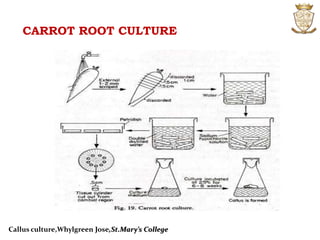
CARROT ROOT CULTURE
Callus culture,Whylgreen Jose,St.Mary’s College
DEVELOPMENT OF A CALLUS CULTURE
Callus formation from an explants occurs in three stages:
(a) Induction stage:
Metabolism is stimulated and the cells prepare to divide. Cell
size remains unchanged.
(b) Cell division stage:
Cells divide actively and the cell size decreases. Cell division
is mainly periclinal and occurs towards the periphery giving
rise to wound cambial cells.
Callus culture,Whylgreen Jose,St.Mary’s College
(c) Differentiation:
Cells differentiate by expansion and maturation.
Rapidly growing calluses are more or less alike but as the
growth rate decreases the calluses show their characteristic
structures and forms.
 But all calluses have some similarities.
They all contain nodular or sheet meristems in groups or
scattered throughout the tissue
Callus culture,Whylgreen Jose,St.Mary’s College
NATURE OF CALLUS TISSUE:
Some cultures are hard, consists of compactly arranged small
cells without intercellular spaces, composed of lignified cells.
Other callus friable consists of large loosely arranged cells with
intercellular spaces.
Friable callus is fragile and easily breaks up.
These are suitable for suspension culture, where the tissue can
be dispersed by mechanical agitation
Callus culture,Whylgreen Jose,St.Mary’s College
The colour of the callus also varies and usually depends on the
colour of the tissue from which it is taken.
 The callus may be colourless or green containing chlorophyll
or yellow having carotenoids or flavonoids or it may be purple
due to the presence of anthocyanin.
 Callus may be uniformly or partially coloured.
Callus culture,Whylgreen Jose,St.Mary’s College
SIGNIFICANCE OF CALLUS CULTURE
Determine the total amount of nucleic acids (i.e., DNA and
RNA) rapidly from callus culture.
 By using tracer elements in callus culture the path of various
metabolic processes has been determined)
Friable callus is suitable for cell suspension culture.
Callus culture,Whylgreen Jose,St.Mary’s College
Dr. Mahipal Singh Shekhwat. Plant cell and tissue culture, Saras
publishers
Razdan M.K. Plant tissue culture.Science publishers Inc.,USA
REFERENCES
Callus culture,Whylgreen Jose,St.Mary’s College

Botany:Callus Culture

  • 1.
    Callus Culture Whylgreen Jose AssistantProfessor Department of Botany St. Mary’s College Thrissur
  • 2.
    Callus culture,Whylgreen Jose,St.Mary’sCollege Meaning of Callus Culture Callus is formed by the proliferation of the parent tissue. Cells are parenchymatous, amorphous and unorganised. Callus is formed as a result of injury at the cut ends of a stem or a root.  When tissues on culture produce unorganised mass of callus with no regular form then it is called callus culture. First observed by Rechinger in 1893.
  • 3.
    Callus may initiatefrom explants of any multicellular plant.  Explants from stem, root, leaf, flower, fruit or seed etc. may be taken for culture.  Callus formation has been recorded from storage parenchyma, pericyclic cells of roots, cambial cells of vascular bundles, provascular cells, secondary phloem, pith cells, mesophyll cells and cotyledons. MATERIALS Callus culture,Whylgreen Jose,St.Mary’s College
  • 4.
    The callus issub-cultured because: (a) The nutrient may be exhausted, (b) Agar may be desiccated, (c) Cell metabolites may accumulate and cause toxicity Callus culture,Whylgreen Jose,St.Mary’s College
  • 5.
    Nutrient Medium ofCallus Culture Standard media, such as, Murashige and Skoog’s medium. For initiation and maintaining callus kinetin is used. For callus initiation usually an exogenous supply of hormone is required According to hormone requirements callus culture may be of five types. These are: (a) Auxin (b) Cytokinin (c) Cultures requiring both auxin and cytokinin, (d) Gibberellin Callus culture,Whylgreen Jose,St.Mary’s College
  • 6.
    Callus growth canbe monitored by:  Fresh weight measurement (most convenient)  Dry weight measurement (more accurate)  Mitotic index measurement (for cell divisional rate). Callus culture,Whylgreen Jose,St.Mary’s College
  • 7.
    CARROT ROOT CULTURE Callusculture,Whylgreen Jose,St.Mary’s College
  • 8.
    DEVELOPMENT OF ACALLUS CULTURE Callus formation from an explants occurs in three stages: (a) Induction stage: Metabolism is stimulated and the cells prepare to divide. Cell size remains unchanged. (b) Cell division stage: Cells divide actively and the cell size decreases. Cell division is mainly periclinal and occurs towards the periphery giving rise to wound cambial cells. Callus culture,Whylgreen Jose,St.Mary’s College
  • 9.
    (c) Differentiation: Cells differentiateby expansion and maturation. Rapidly growing calluses are more or less alike but as the growth rate decreases the calluses show their characteristic structures and forms.  But all calluses have some similarities. They all contain nodular or sheet meristems in groups or scattered throughout the tissue Callus culture,Whylgreen Jose,St.Mary’s College
  • 10.
    NATURE OF CALLUSTISSUE: Some cultures are hard, consists of compactly arranged small cells without intercellular spaces, composed of lignified cells. Other callus friable consists of large loosely arranged cells with intercellular spaces. Friable callus is fragile and easily breaks up. These are suitable for suspension culture, where the tissue can be dispersed by mechanical agitation Callus culture,Whylgreen Jose,St.Mary’s College
  • 11.
    The colour ofthe callus also varies and usually depends on the colour of the tissue from which it is taken.  The callus may be colourless or green containing chlorophyll or yellow having carotenoids or flavonoids or it may be purple due to the presence of anthocyanin.  Callus may be uniformly or partially coloured. Callus culture,Whylgreen Jose,St.Mary’s College
  • 12.
    SIGNIFICANCE OF CALLUSCULTURE Determine the total amount of nucleic acids (i.e., DNA and RNA) rapidly from callus culture.  By using tracer elements in callus culture the path of various metabolic processes has been determined) Friable callus is suitable for cell suspension culture. Callus culture,Whylgreen Jose,St.Mary’s College
  • 13.
    Dr. Mahipal SinghShekhwat. Plant cell and tissue culture, Saras publishers Razdan M.K. Plant tissue culture.Science publishers Inc.,USA REFERENCES Callus culture,Whylgreen Jose,St.Mary’s College