Dhananjaysinh Jhala
SY CE-1, Batch B
170410107027
E - MAIL
•E-mail is an asynchronous
communication medium—
people send and read
messages when it is
convenient for them.
•It has three major
components: user agents,
mail servers, and the simple
mail transfer protocol
(SMTP).
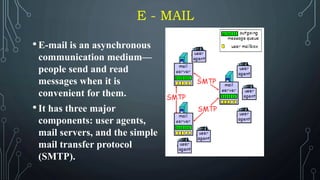
User agents allow users to read, reply to, forward, save, and
compose messages. Microsoft Outlook and Apple Mail are
examples of user agents for e-mail.
After a message has been composed, user agent sends the
message to the mail server, where the message is placed in the
mail server’s outgoing message queue.
Mail servers form the core of the e-mail infrastructure.
Each recipient has a mailbox located in one of the mail servers.
A typical message starts its journey in the sender’s user agent,
travels to the sender’s mail server, and travels to the recipient’s
mail server, where it is deposited in the recipient’s mailbox.
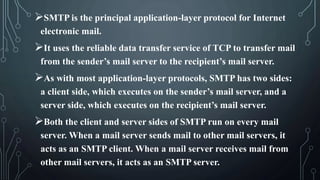
SMTP is the principal application-layer protocol for Internet
electronic mail.
It uses the reliable data transfer service of TCP to transfer mail
from the sender’s mail server to the recipient’s mail server.
As with most application-layer protocols, SMTP has two sides:
a client side, which executes on the sender’s mail server, and a
server side, which executes on the recipient’s mail server.
Both the client and server sides of SMTP run on every mail
server. When a mail server sends mail to other mail servers, it
acts as an SMTP client. When a mail server receives mail from
other mail servers, it acts as an SMTP server.
SCENARIO: ALICE SENDS MESSAGE TO BOB
HTTP VS SMTP, MAIL FORMAT
• HTTP is mainly a pull
protocol—someone loads
information on a Web server
and users use HTTP to pull
the information from the
server at their convenience.
• On the other hand, SMTP is
primarily a push
protocol—the sending mail
server pushes the file to the
receiving mail server.
DNS
• Hosts can be identified using hostname (E.g. www.yahoo.com,
cnn.com...), using IP addresses (E.g. 100.100.100.1).
• DNS is (1) a distributed database implemented in a hierarchy
of DNS servers, and (2) an application-layer protocol that
allows hosts to query the distributed database.
• The main task of the Internet’s domain name system (DNS) is
to translate the hostnames to IP addresses
Host aliasing:
 A host with a complicated hostname can have one or more alias names.
 For example, a hostname such as relay1.west-coast.enterprise.com could have, say, two
aliases such as enterprise.com and www.enterprise.com.
 In this case, the hostname relay1.west-coast. enterprise.com is said to be a canonical
hostname.
 DNS can be invoked by an application to obtain the canonical hostname for a supplied
alias hostname as well as the IP address of the host.
 Mail server aliasing:
 If Bob has an account with Hotmail, Bob’s e-mail address might be as simple as
bob@hotmail.com.
 However, the hostname of the Hotmail mail server is more complicated and much less
mnemonic than simply hotmail.com (for example, the canonical hostname might be
something like relay1.west-coast.hotmail.com).
 DNS can be invoked by a mail application to obtain the canonical hostname for a
supplied alias hostname as well as the IP address of the host.
DNS SERVICES
 Load distribution:
 DNS is also used to perform load distribution among
replicate servers, such as replicated Web servers.
 Busy sites, such as cnn.com, are replicated over multiple
servers, with each server running on a different end system
and each having a different IP address.
 For replicated Web servers, a set of IP addresses is thus
associated with one canonical hostname.
 The DNS database contains this set of IP addresses.
 When clients make a DNS query for a name mapped to a
set of addresses, the server responds with the entire set of
IP addresses.
ISSUES WITH CENTRALIZED DNS
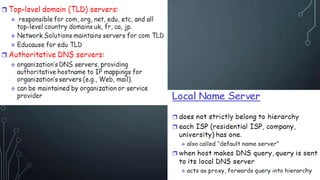
So, we have distributed hierarchical database of DNS
servers.
DNS: DISTRIBUTED DATABASE
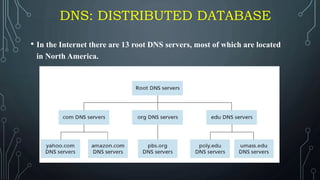
• In the Internet there are 13 root DNS servers, most of which are located
in North America.
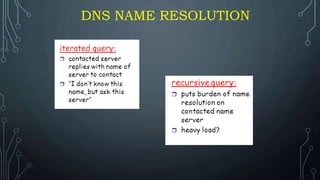
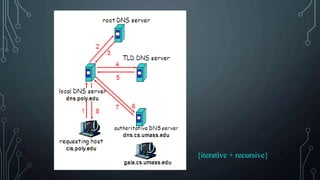
DNS NAME RESOLUTION
{iterative + recursive}
Email and DNS

Email and DNS

  • 1.
    Dhananjaysinh Jhala SY CE-1,Batch B 170410107027
  • 2.
    E - MAIL •E-mailis an asynchronous communication medium— people send and read messages when it is convenient for them. •It has three major components: user agents, mail servers, and the simple mail transfer protocol (SMTP).
  • 3.
    User agents allowusers to read, reply to, forward, save, and compose messages. Microsoft Outlook and Apple Mail are examples of user agents for e-mail. After a message has been composed, user agent sends the message to the mail server, where the message is placed in the mail server’s outgoing message queue. Mail servers form the core of the e-mail infrastructure. Each recipient has a mailbox located in one of the mail servers. A typical message starts its journey in the sender’s user agent, travels to the sender’s mail server, and travels to the recipient’s mail server, where it is deposited in the recipient’s mailbox.
  • 4.
    SMTP is theprincipal application-layer protocol for Internet electronic mail. It uses the reliable data transfer service of TCP to transfer mail from the sender’s mail server to the recipient’s mail server. As with most application-layer protocols, SMTP has two sides: a client side, which executes on the sender’s mail server, and a server side, which executes on the recipient’s mail server. Both the client and server sides of SMTP run on every mail server. When a mail server sends mail to other mail servers, it acts as an SMTP client. When a mail server receives mail from other mail servers, it acts as an SMTP server.
  • 5.
    SCENARIO: ALICE SENDSMESSAGE TO BOB
  • 6.
    HTTP VS SMTP,MAIL FORMAT • HTTP is mainly a pull protocol—someone loads information on a Web server and users use HTTP to pull the information from the server at their convenience. • On the other hand, SMTP is primarily a push protocol—the sending mail server pushes the file to the receiving mail server.
  • 7.
    DNS • Hosts canbe identified using hostname (E.g. www.yahoo.com, cnn.com...), using IP addresses (E.g. 100.100.100.1). • DNS is (1) a distributed database implemented in a hierarchy of DNS servers, and (2) an application-layer protocol that allows hosts to query the distributed database. • The main task of the Internet’s domain name system (DNS) is to translate the hostnames to IP addresses
  • 8.
    Host aliasing:  Ahost with a complicated hostname can have one or more alias names.  For example, a hostname such as relay1.west-coast.enterprise.com could have, say, two aliases such as enterprise.com and www.enterprise.com.  In this case, the hostname relay1.west-coast. enterprise.com is said to be a canonical hostname.  DNS can be invoked by an application to obtain the canonical hostname for a supplied alias hostname as well as the IP address of the host.  Mail server aliasing:  If Bob has an account with Hotmail, Bob’s e-mail address might be as simple as bob@hotmail.com.  However, the hostname of the Hotmail mail server is more complicated and much less mnemonic than simply hotmail.com (for example, the canonical hostname might be something like relay1.west-coast.hotmail.com).  DNS can be invoked by a mail application to obtain the canonical hostname for a supplied alias hostname as well as the IP address of the host. DNS SERVICES
  • 9.
     Load distribution: DNS is also used to perform load distribution among replicate servers, such as replicated Web servers.  Busy sites, such as cnn.com, are replicated over multiple servers, with each server running on a different end system and each having a different IP address.  For replicated Web servers, a set of IP addresses is thus associated with one canonical hostname.  The DNS database contains this set of IP addresses.  When clients make a DNS query for a name mapped to a set of addresses, the server responds with the entire set of IP addresses.
  • 10.
    ISSUES WITH CENTRALIZEDDNS So, we have distributed hierarchical database of DNS servers.
  • 11.
    DNS: DISTRIBUTED DATABASE •In the Internet there are 13 root DNS servers, most of which are located in North America.
  • 13.
  • 14.