SOCIOLINGUISTIC AND
PSYCHOLINGUISTIC FOUNDATIONS OF
LANGUAGE TEACHING
Prepared by:
Prof. Elena A. Navas, Ph.D.
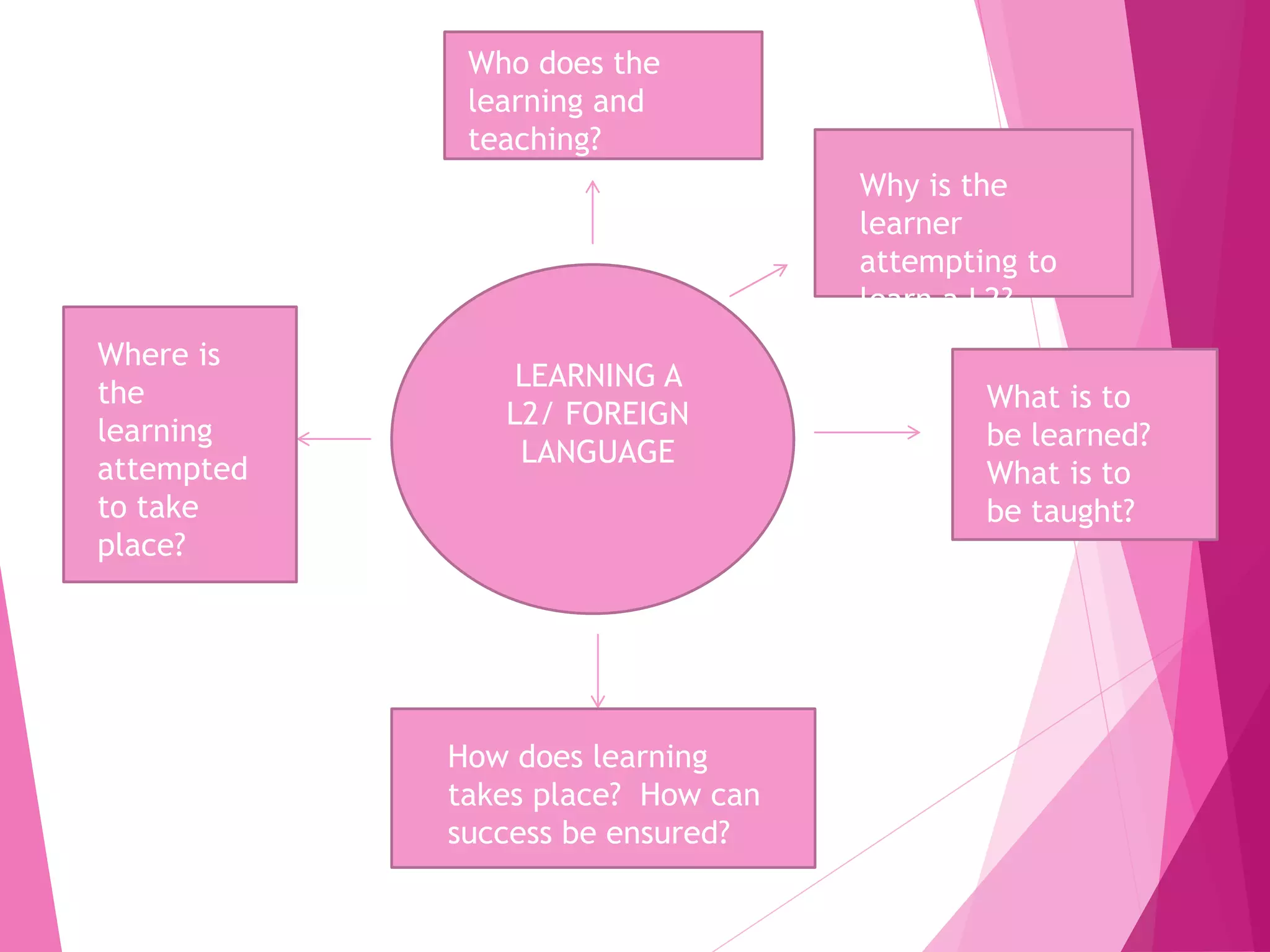
LEARNING A
L2/ FOREIGN
LANGUAGE
Who does the
learning and
teaching?
What is to
be learned?
What is to
be taught?
How does learning
takes place? How can
success be ensured?
Where is
the
learning
attempted
to take
place?
Why is the
learner
attempting to
learn a L2?
What a Language teacher
should have
 A teacher should have an integrated understanding of
the many aspects of the process of second language
learning.
 What is language?
 How do persons learn and teach a language?
What is language?
 Language is systematic—possibly a generative—system
 Language is a set of arbitrary symbols.
 Those symbols are primarily vocal, but may also be
visual.
 The symbols have conventionalized meanings to which
they refer.
 Language is used for communication.
 Language operates in a speech community or culture.
 Language is essentially human, although possibly not
human.
 Language is acquired by all people in much the same
way—language and language learning both have universal
characteristics.
Subfields or categories
 1. Explicit or formal accounts of the system of language on several
possible levels (most commonly syntactic, semantic and
phonological).
 2. The symbolic nature of language; the relationship between
language and reality; the philosophy of language; the history of
language.
Subfields or categories
 3. Phonetics; Phonology; Writing systems; kinesics, proxemics and
other “paralinguistic” features of language.
 4. Semantics; language and cognition; psycholinguistics.
 5. Communication systems; speaker-hearer interaction; sentence
processing.
 6. Dialectology;sociolinguistics; language and culture;
bilingualism and second language acquisition.
Subfields or categories
 7. Human language and nonhuman
communication; the physiology of language.
 8. Language universals; first language
acquisition.
A successful language
teacher
 Understands the nature of language, the fact of
language varieties—social, regional, and functional,
the structure and development of the English
language system…
Concepts in learning and
teaching a second language?
 1. Learning is acquisition or “getting”.
 2. Learning is retention of information or skill.
 3. Retention implies storage systems, memory, cognitive
organization.
 4. Learning involves active, conscious focus on and acting
upon events outside or inside the organism.
 5. Learning is relatively permanent, but subject to
forgetting.
 6. Learning involves some form of practice, perhaps
reinforced practice.
 7. Learning is a change in behavior.
Learning and Teaching
 1. Learning is acquisition or “getting”.
 2. Learning is retention of information or skill.
 3. Retention implies storage systems, memory, cognitive
organizations.
 4. Learning involves active, conscious focus on and
acting upon events outside or inside the organism.
Learning and Teaching a
second/foreign language
 5. Learning is relatively permanent, but subject to forgetting.
 6. Learning involves some forms of practice, perhaps reinforced
practice.
 7. Learning is a change in behavior.
 Subfields: memory system, recall, conscious and subconscious,
learning, learning styles and strategies, theories of forgetting,
reinforcement, role of practice.
Teaching is …
 Guiding and facilitating, enabling the learner to learn,
setting the conditions for learning.
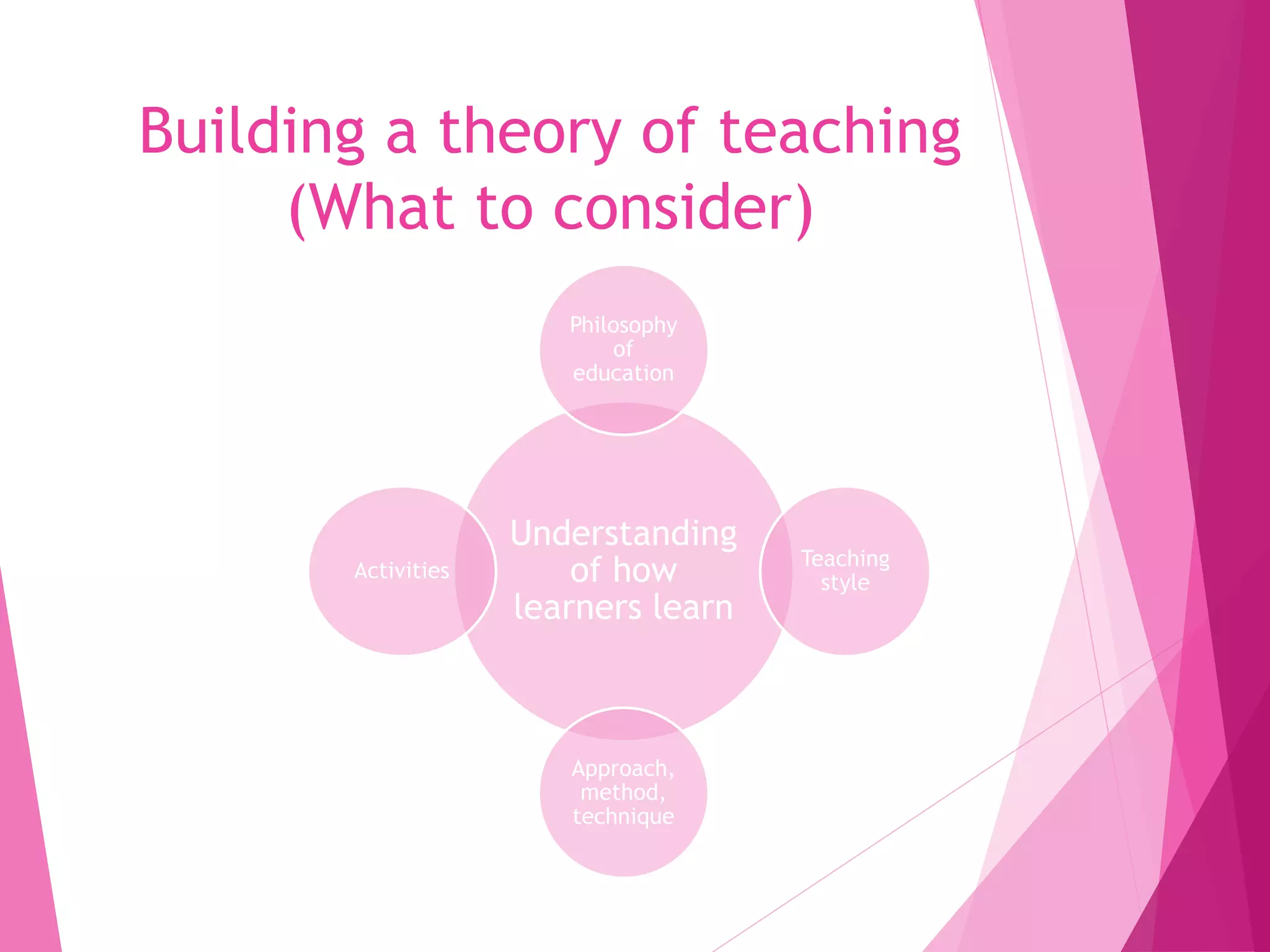
Building a theory of teaching
(What to consider)
Understanding
of how
learners learn
Philosophy
of
education
Teaching
style
Approach,
method,
technique
Activities
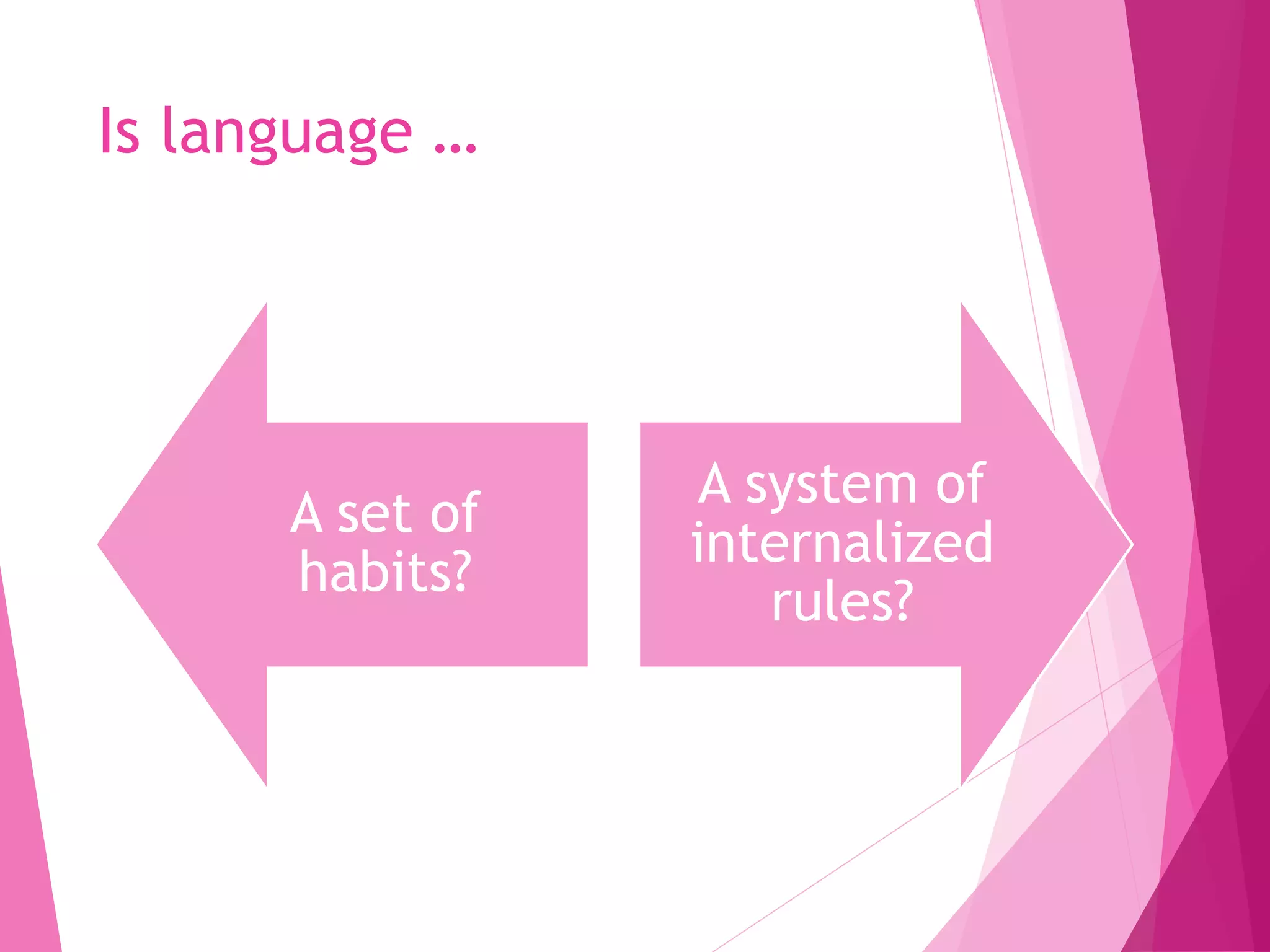
Is language …
A set of
habits?
A system of
internalized
rules?
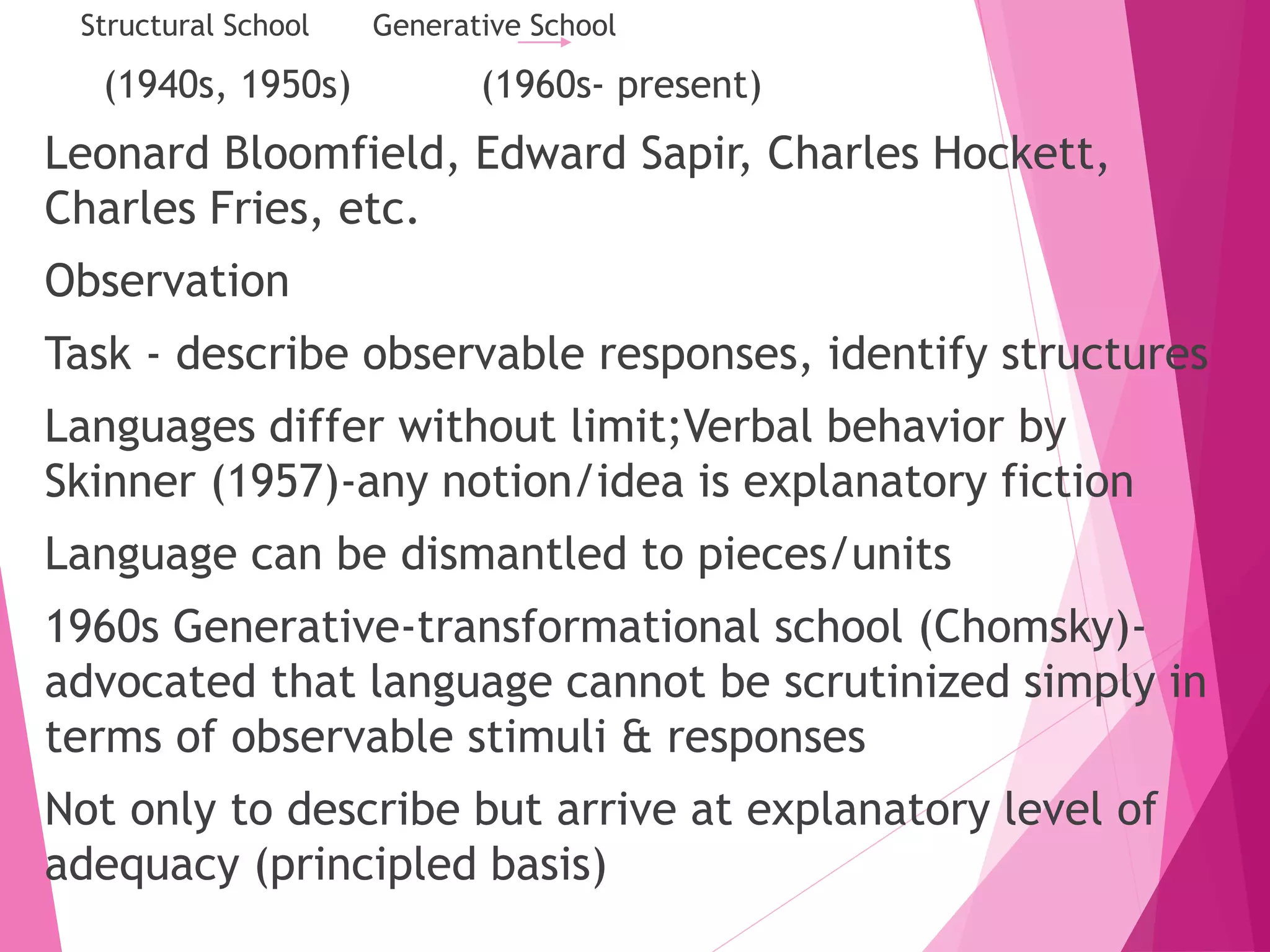
Structural School Generative School
(1940s, 1950s) (1960s- present)
Leonard Bloomfield, Edward Sapir, Charles Hockett,
Charles Fries, etc.
Observation
Task - describe observable responses, identify structures
Languages differ without limit;Verbal behavior by
Skinner (1957)-any notion/idea is explanatory fiction
Language can be dismantled to pieces/units
1960s Generative-transformational school (Chomsky)-
advocated that language cannot be scrutinized simply in
terms of observable stimuli & responses
Not only to describe but arrive at explanatory level of
adequacy (principled basis)
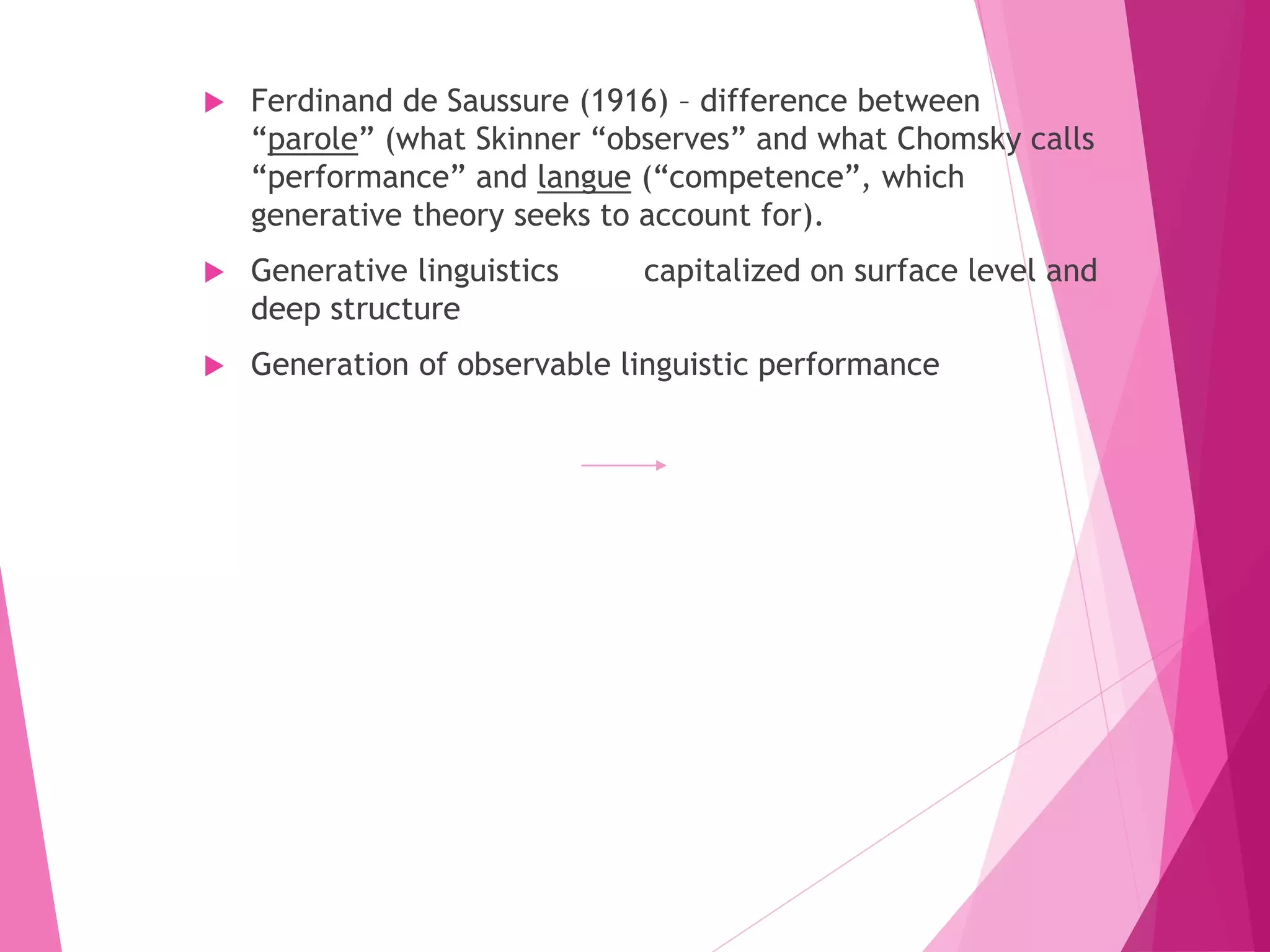
 Ferdinand de Saussure (1916) – difference between
“parole” (what Skinner “observes” and what Chomsky calls
“performance” and langue (“competence”, which
generative theory seeks to account for).
 Generative linguistics capitalized on surface level and
deep structure
 Generation of observable linguistic performance
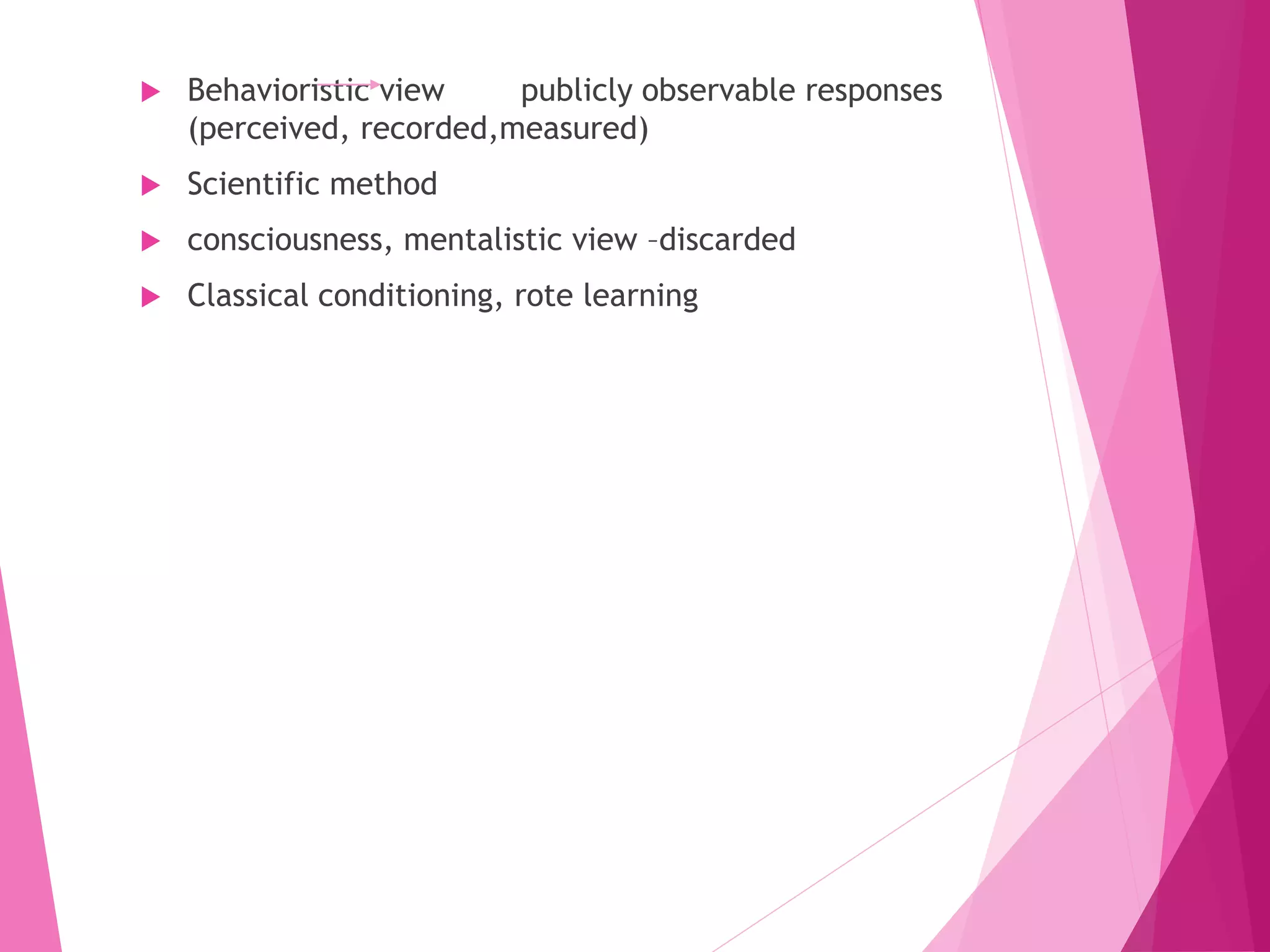
 Behavioristic view publicly observable responses
(perceived, recorded,measured)
 Scientific method
 consciousness, mentalistic view –discarded
 Classical conditioning, rote learning
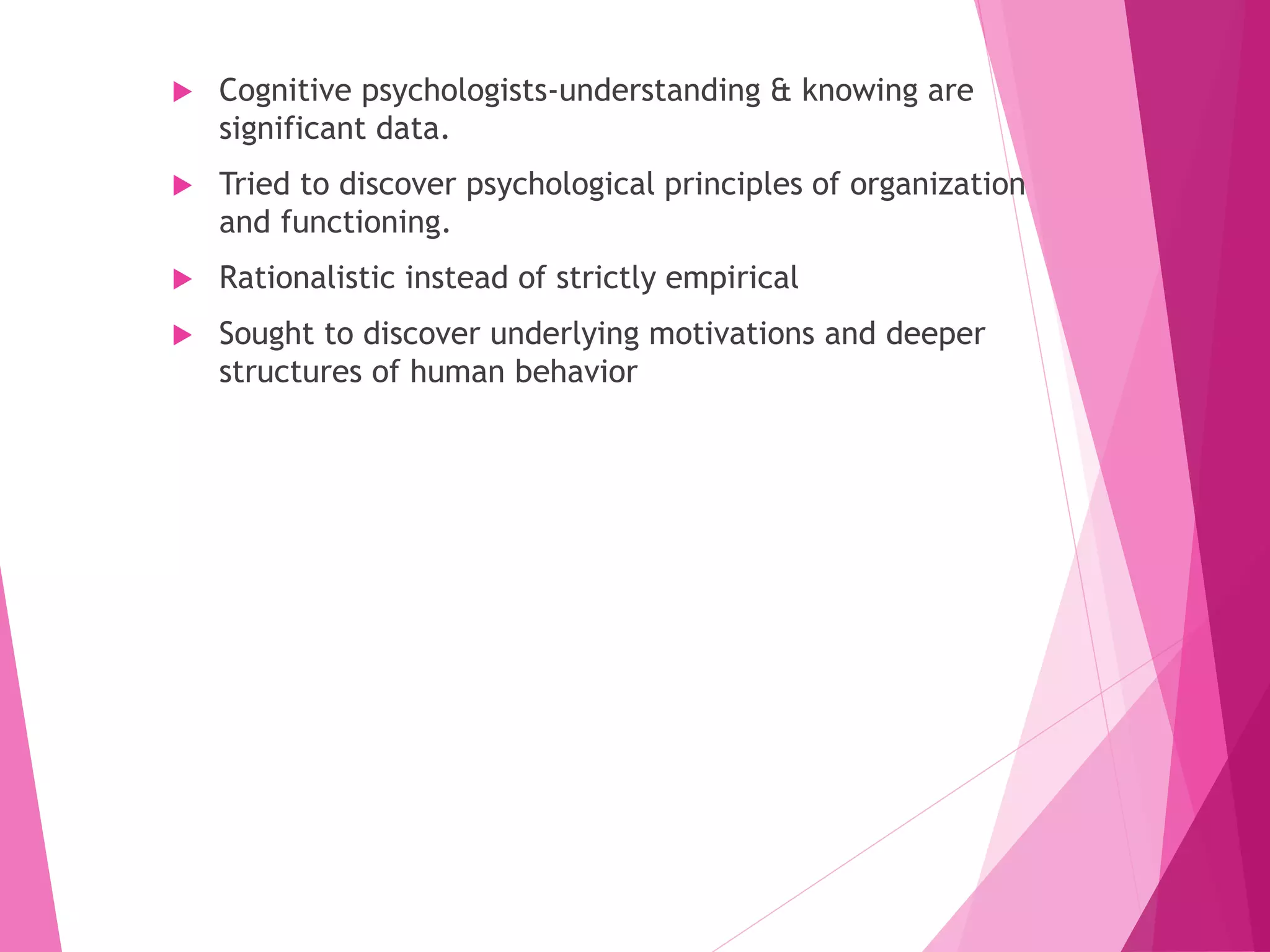
 Cognitive psychologists-understanding & knowing are
significant data.
 Tried to discover psychological principles of organization
and functioning.
 Rationalistic instead of strictly empirical
 Sought to discover underlying motivations and deeper
structures of human behavior
 Is there difference?
 Structural and behavioral – interest in description,
answering “what”
 Generative linguist and cognitive psychologist – interest in
what and why – underlying reasons and circumstances
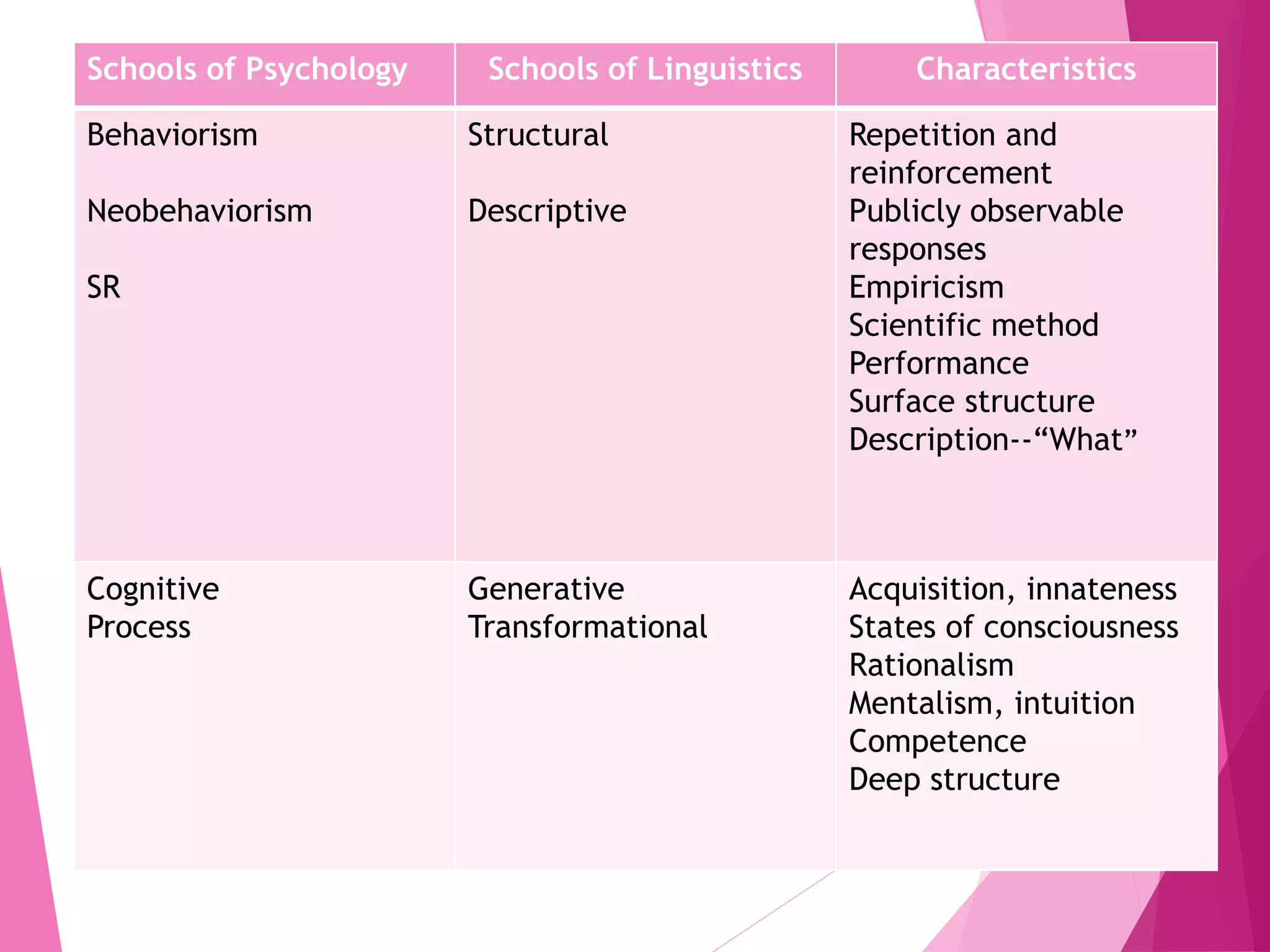
Schools of Psychology Schools of Linguistics Characteristics
Behaviorism
Neobehaviorism
SR
Structural
Descriptive
Repetition and
reinforcement
Publicly observable
responses
Empiricism
Scientific method
Performance
Surface structure
Description--“What”
Cognitive
Process
Generative
Transformational
Acquisition, innateness
States of consciousness
Rationalism
Mentalism, intuition
Competence
Deep structure
 References:
 Brown, Douglas. Principles of Language
Learning and Teaching. Prentice-Hall

Foundations of Language Teaching

  • 1.
    SOCIOLINGUISTIC AND PSYCHOLINGUISTIC FOUNDATIONSOF LANGUAGE TEACHING Prepared by: Prof. Elena A. Navas, Ph.D.
  • 2.
    LEARNING A L2/ FOREIGN LANGUAGE Whodoes the learning and teaching? What is to be learned? What is to be taught? How does learning takes place? How can success be ensured? Where is the learning attempted to take place? Why is the learner attempting to learn a L2?
  • 3.
    What a Languageteacher should have  A teacher should have an integrated understanding of the many aspects of the process of second language learning.  What is language?  How do persons learn and teach a language?
  • 4.
    What is language? Language is systematic—possibly a generative—system  Language is a set of arbitrary symbols.  Those symbols are primarily vocal, but may also be visual.  The symbols have conventionalized meanings to which they refer.  Language is used for communication.
  • 5.
     Language operatesin a speech community or culture.  Language is essentially human, although possibly not human.  Language is acquired by all people in much the same way—language and language learning both have universal characteristics.
  • 6.
    Subfields or categories 1. Explicit or formal accounts of the system of language on several possible levels (most commonly syntactic, semantic and phonological).  2. The symbolic nature of language; the relationship between language and reality; the philosophy of language; the history of language.
  • 7.
    Subfields or categories 3. Phonetics; Phonology; Writing systems; kinesics, proxemics and other “paralinguistic” features of language.  4. Semantics; language and cognition; psycholinguistics.  5. Communication systems; speaker-hearer interaction; sentence processing.  6. Dialectology;sociolinguistics; language and culture; bilingualism and second language acquisition.
  • 8.
    Subfields or categories 7. Human language and nonhuman communication; the physiology of language.  8. Language universals; first language acquisition.
  • 9.
    A successful language teacher Understands the nature of language, the fact of language varieties—social, regional, and functional, the structure and development of the English language system…
  • 10.
    Concepts in learningand teaching a second language?  1. Learning is acquisition or “getting”.  2. Learning is retention of information or skill.  3. Retention implies storage systems, memory, cognitive organization.  4. Learning involves active, conscious focus on and acting upon events outside or inside the organism.  5. Learning is relatively permanent, but subject to forgetting.
  • 11.
     6. Learninginvolves some form of practice, perhaps reinforced practice.  7. Learning is a change in behavior.
  • 12.
    Learning and Teaching 1. Learning is acquisition or “getting”.  2. Learning is retention of information or skill.  3. Retention implies storage systems, memory, cognitive organizations.  4. Learning involves active, conscious focus on and acting upon events outside or inside the organism.
  • 13.
    Learning and Teachinga second/foreign language  5. Learning is relatively permanent, but subject to forgetting.  6. Learning involves some forms of practice, perhaps reinforced practice.  7. Learning is a change in behavior.  Subfields: memory system, recall, conscious and subconscious, learning, learning styles and strategies, theories of forgetting, reinforcement, role of practice.
  • 14.
    Teaching is … Guiding and facilitating, enabling the learner to learn, setting the conditions for learning.
  • 15.
    Building a theoryof teaching (What to consider) Understanding of how learners learn Philosophy of education Teaching style Approach, method, technique Activities
  • 16.
    Is language … Aset of habits? A system of internalized rules?
  • 17.
    Structural School GenerativeSchool (1940s, 1950s) (1960s- present) Leonard Bloomfield, Edward Sapir, Charles Hockett, Charles Fries, etc. Observation Task - describe observable responses, identify structures Languages differ without limit;Verbal behavior by Skinner (1957)-any notion/idea is explanatory fiction Language can be dismantled to pieces/units 1960s Generative-transformational school (Chomsky)- advocated that language cannot be scrutinized simply in terms of observable stimuli & responses Not only to describe but arrive at explanatory level of adequacy (principled basis)
  • 18.
     Ferdinand deSaussure (1916) – difference between “parole” (what Skinner “observes” and what Chomsky calls “performance” and langue (“competence”, which generative theory seeks to account for).  Generative linguistics capitalized on surface level and deep structure  Generation of observable linguistic performance
  • 19.
     Behavioristic viewpublicly observable responses (perceived, recorded,measured)  Scientific method  consciousness, mentalistic view –discarded  Classical conditioning, rote learning
  • 20.
     Cognitive psychologists-understanding& knowing are significant data.  Tried to discover psychological principles of organization and functioning.  Rationalistic instead of strictly empirical  Sought to discover underlying motivations and deeper structures of human behavior
  • 21.
     Is theredifference?  Structural and behavioral – interest in description, answering “what”  Generative linguist and cognitive psychologist – interest in what and why – underlying reasons and circumstances
  • 22.
    Schools of PsychologySchools of Linguistics Characteristics Behaviorism Neobehaviorism SR Structural Descriptive Repetition and reinforcement Publicly observable responses Empiricism Scientific method Performance Surface structure Description--“What” Cognitive Process Generative Transformational Acquisition, innateness States of consciousness Rationalism Mentalism, intuition Competence Deep structure
  • 23.
     References:  Brown,Douglas. Principles of Language Learning and Teaching. Prentice-Hall

Editor's Notes

  • #2 Becoming bilingual is common, new culture, thinking, feeling. Total commitment, intellectual, physical, emotional. Inadequate training grounds. TEACHER should know the intricacies of the web – learn or fail to learn
  • #3 L1, come from, educ level, socioeconomic, parents, intellectual capacity. Teacher- L1, experience, training, knowledge of L2 & culture, philosophy of educ, personality char, what is it that a learner shld learn, tchr shld teach, linguistic differences of L1 and target language, diff to understand and