October 28, 2020 @ 5:00pm
Reminders!
•
•
•
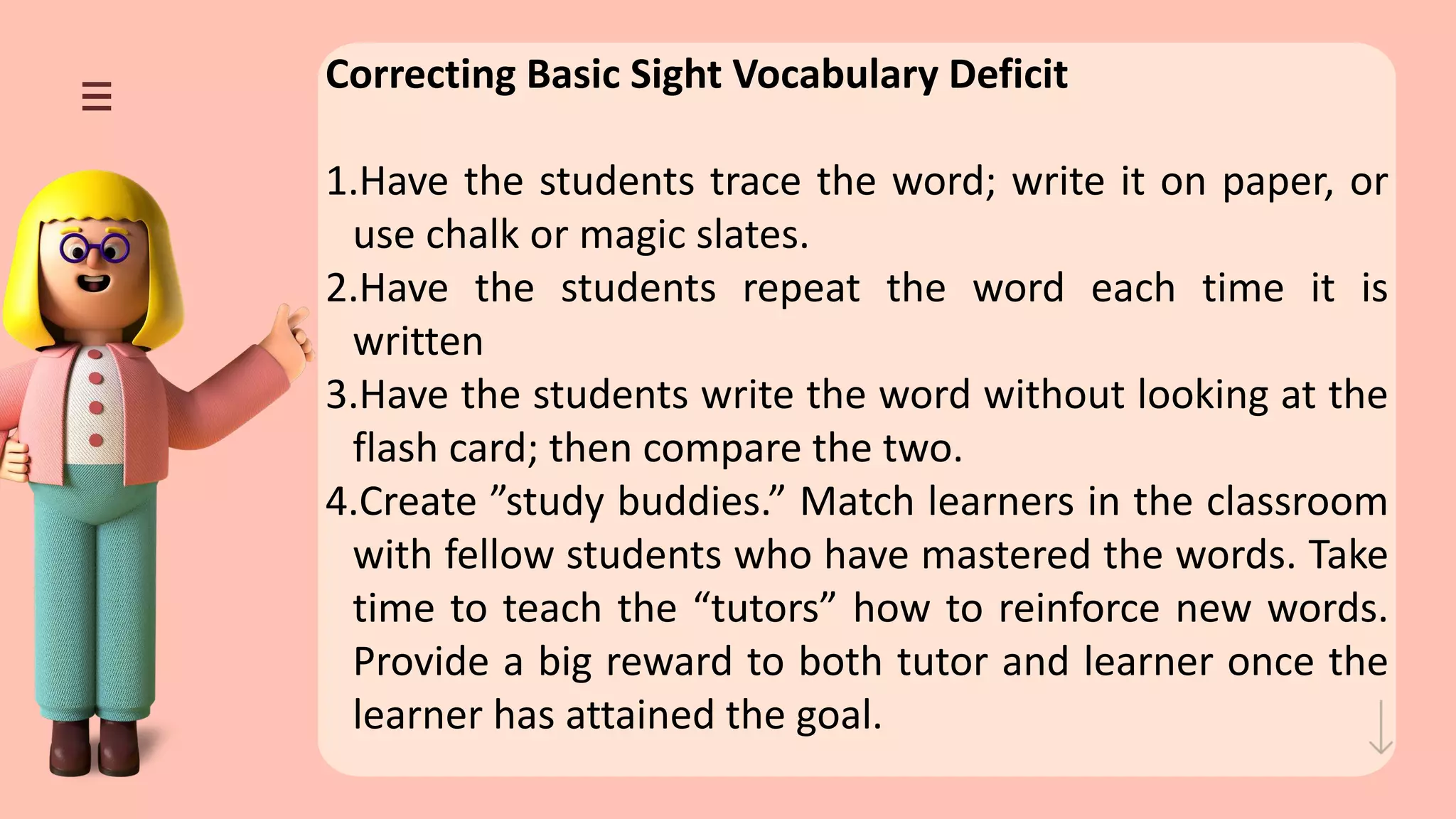
Correcting Basic Sight Vocabulary Deficit
1.Have the students trace the word; write it on paper, or
use chalk or magic slates.
2.Have the students repeat the word each time it is
written
3.Have the students write the word without looking at the
flash card; then compare the two.
4.Create ”study buddies.” Match learners in the classroom
with fellow students who have mastered the words. Take
time to teach the “tutors” how to reinforce new words.
Provide a big reward to both tutor and learner once the
learner has attained the goal.
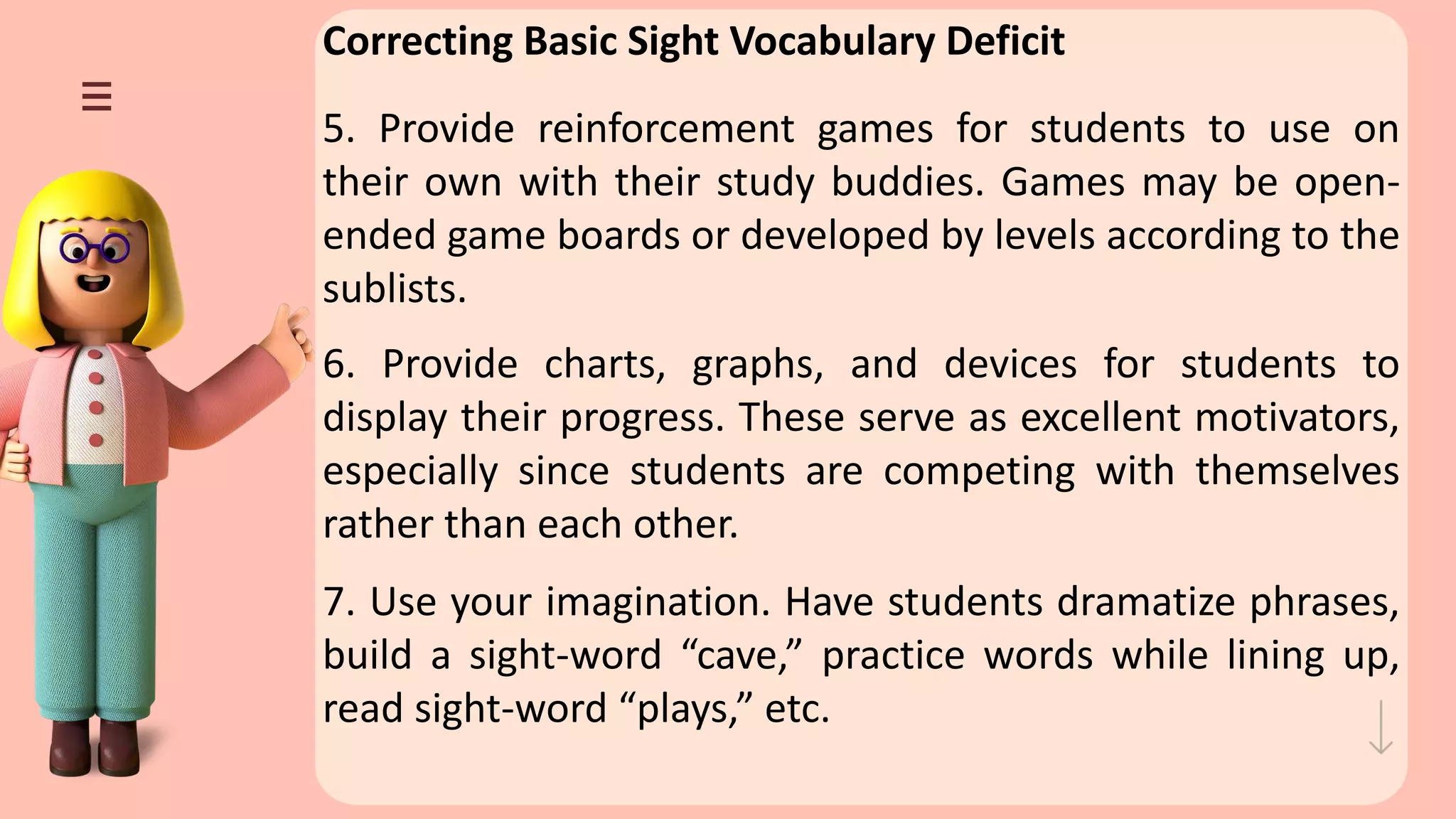
Correcting Basic Sight Vocabulary Deficit
5. Provide reinforcement games for students to use on
their own with their study buddies. Games may be open-
ended game boards or developed by levels according to the
sublists.
6. Provide charts, graphs, and devices for students to
display their progress. These serve as excellent motivators,
especially since students are competing with themselves
rather than each other.
7. Use your imagination. Have students dramatize phrases,
build a sight-word “cave,” practice words while lining up,
read sight-word “plays,” etc.
Correcting Knowledge on Sound-Symbol Correspondence
Vowel Rules or Principles and Accent Generalizations
1. In words containing a single vowel letter at the end of the
word, the vowel letter usually has the long vowel sound. (Note
that this rule refers to words and not just syllables.) There is a
similar rule for single word letters at the end of syllables.
2. In syllables containing a single vowel letter at the end of the
syllable, the vowel letter may have either the long or short
vowel sound. Try the long sound first. (Note that this has the
same effect as rule 1.)
Correcting Knowledge on Sound-Symbol Correspondence
Vowel Rules or Principles and Accent Generalizations
3. A single vowel in a syllable usually has the short vowel sound if t is not
the last letter or is not followed by r, w, or l. When explaining this to
students it is often helpful to indicate that a single vowel in a closed
syllable is usually short. Students should be taught that a closed syllable
is one in which there is a consonant on the right-hand side. They will also
need to know, as indicated above, the r, w, and l control rules.
4. Vowels followed by r usually have a sound that is neither long nor
short.
5. A y at the beginning of a word has the “y” consonant sound; y at the
end of a single-syllable word, when preceded by a consonant, usually has
the long l sound; and y at the end of a multisyllable word, when
preceded by a consonant, usually has the long e sound. (Some people
hear it as short i).
Correcting Knowledge on Sound-Symbol Correspondence
Vowel Rules or Principles and Accent Generalizations
5. A y at the beginning of a word has the “y” consonant sound; y at the
end of a single-syllable word, when preceded by a consonant, usually has
the long l sound; and y at the end of a multisyllable word, when
preceded by a consonant, usually has the long e sound. (Some people
hear it as short i).
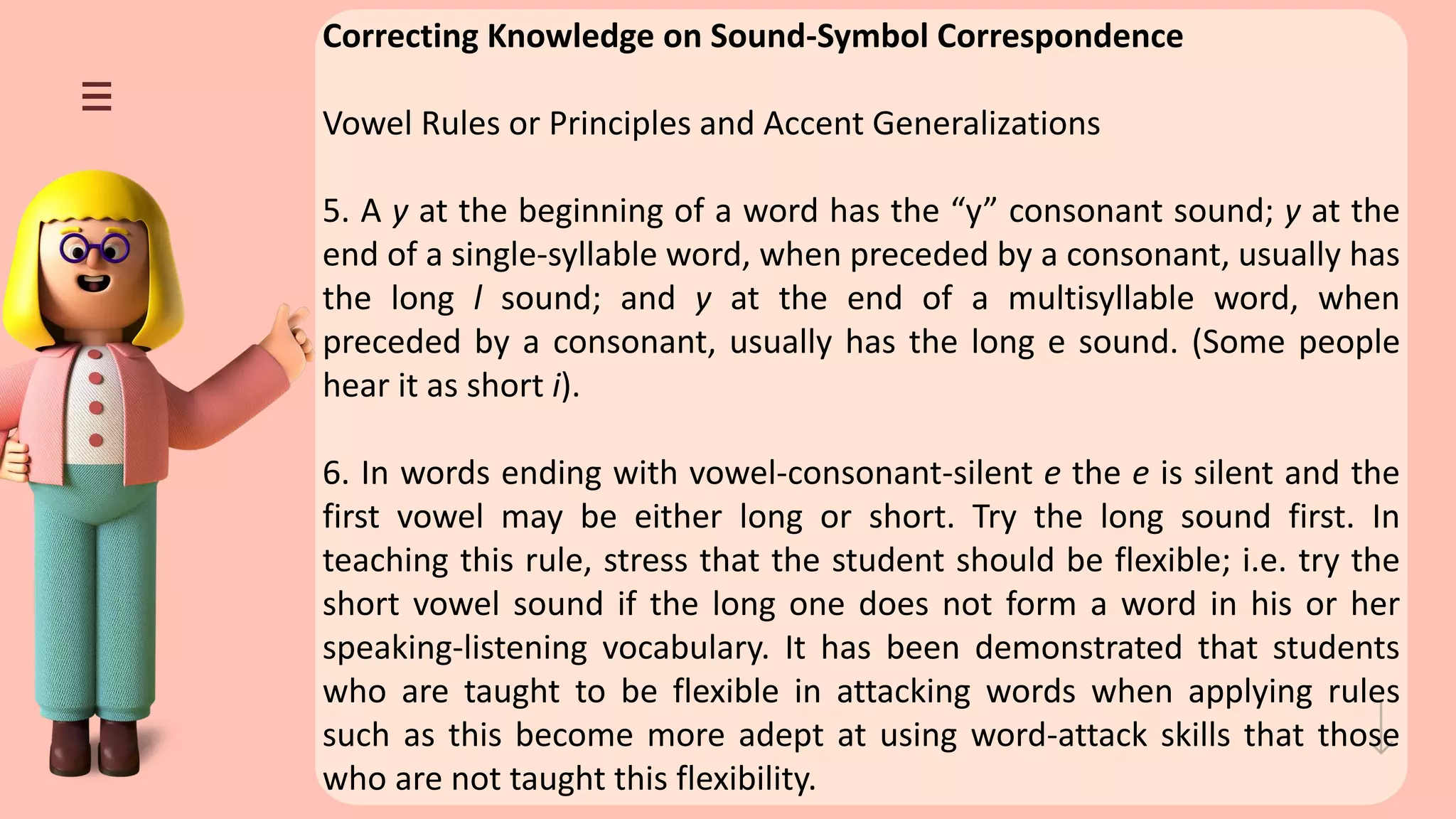
6. In words ending with vowel-consonant-silent e the e is silent and the
first vowel may be either long or short. Try the long sound first. In
teaching this rule, stress that the student should be flexible; i.e. try the
short vowel sound if the long one does not form a word in his or her
speaking-listening vocabulary. It has been demonstrated that students
who are taught to be flexible in attacking words when applying rules
such as this become more adept at using word-attack skills that those
who are not taught this flexibility.
Correcting Knowledge on Sound-Symbol Correspondence
Vowel Rules or Principles and Accent Generalizations
7. When aj, ay, ea, ee, and oa are found together, the first vowel
is usually long and the second is usually silent.
8. The vowel pair ow may have either the sound heard in cow or
the sound heard in crow.
9. When au, aw, ou, oi, and oy are found together, they usually
blend to form a diphthong.
10. The oo sound is either long as in moon or short as in book.
11.If a is the only vowel in a syllable and is followed by l or w,
then the a is usually neither long nor short.
Correcting Knowledge on Sound-Symbol Correspondence
Thank you
and
keep safe!
From:
SHERILYN E. NUESCA, PhD

Correcting Basic Sight Vocabulary Deficit

  • 1.
  • 2.
  • 7.
    Correcting Basic SightVocabulary Deficit 1.Have the students trace the word; write it on paper, or use chalk or magic slates. 2.Have the students repeat the word each time it is written 3.Have the students write the word without looking at the flash card; then compare the two. 4.Create ”study buddies.” Match learners in the classroom with fellow students who have mastered the words. Take time to teach the “tutors” how to reinforce new words. Provide a big reward to both tutor and learner once the learner has attained the goal.
  • 8.
    Correcting Basic SightVocabulary Deficit 5. Provide reinforcement games for students to use on their own with their study buddies. Games may be open- ended game boards or developed by levels according to the sublists. 6. Provide charts, graphs, and devices for students to display their progress. These serve as excellent motivators, especially since students are competing with themselves rather than each other. 7. Use your imagination. Have students dramatize phrases, build a sight-word “cave,” practice words while lining up, read sight-word “plays,” etc.
  • 9.
    Correcting Knowledge onSound-Symbol Correspondence Vowel Rules or Principles and Accent Generalizations 1. In words containing a single vowel letter at the end of the word, the vowel letter usually has the long vowel sound. (Note that this rule refers to words and not just syllables.) There is a similar rule for single word letters at the end of syllables. 2. In syllables containing a single vowel letter at the end of the syllable, the vowel letter may have either the long or short vowel sound. Try the long sound first. (Note that this has the same effect as rule 1.)
  • 10.
    Correcting Knowledge onSound-Symbol Correspondence Vowel Rules or Principles and Accent Generalizations 3. A single vowel in a syllable usually has the short vowel sound if t is not the last letter or is not followed by r, w, or l. When explaining this to students it is often helpful to indicate that a single vowel in a closed syllable is usually short. Students should be taught that a closed syllable is one in which there is a consonant on the right-hand side. They will also need to know, as indicated above, the r, w, and l control rules. 4. Vowels followed by r usually have a sound that is neither long nor short. 5. A y at the beginning of a word has the “y” consonant sound; y at the end of a single-syllable word, when preceded by a consonant, usually has the long l sound; and y at the end of a multisyllable word, when preceded by a consonant, usually has the long e sound. (Some people hear it as short i).
  • 11.
    Correcting Knowledge onSound-Symbol Correspondence Vowel Rules or Principles and Accent Generalizations 5. A y at the beginning of a word has the “y” consonant sound; y at the end of a single-syllable word, when preceded by a consonant, usually has the long l sound; and y at the end of a multisyllable word, when preceded by a consonant, usually has the long e sound. (Some people hear it as short i). 6. In words ending with vowel-consonant-silent e the e is silent and the first vowel may be either long or short. Try the long sound first. In teaching this rule, stress that the student should be flexible; i.e. try the short vowel sound if the long one does not form a word in his or her speaking-listening vocabulary. It has been demonstrated that students who are taught to be flexible in attacking words when applying rules such as this become more adept at using word-attack skills that those who are not taught this flexibility.
  • 12.
    Correcting Knowledge onSound-Symbol Correspondence Vowel Rules or Principles and Accent Generalizations 7. When aj, ay, ea, ee, and oa are found together, the first vowel is usually long and the second is usually silent. 8. The vowel pair ow may have either the sound heard in cow or the sound heard in crow. 9. When au, aw, ou, oi, and oy are found together, they usually blend to form a diphthong. 10. The oo sound is either long as in moon or short as in book. 11.If a is the only vowel in a syllable and is followed by l or w, then the a is usually neither long nor short.
  • 13.
    Correcting Knowledge onSound-Symbol Correspondence
  • 14.
    Correcting Knowledge onSound-Symbol Correspondence
  • 15.