Developing
Principled
Frameworks
for Materials
Development
By:
Hadija Rahmona Marasabessy
What does
‘Materials
development’
mean?
○‘Materials development’ refers to
all the processes made use of by
practitioners who produce and/or
use materials for language learning,
including materials evaluation, their
adaptation, design, production,
exploitation and research. Ideally,
all of these processes should be
given consideration and should
interact in the making of language-
learning materials.
○Materials development is both a field of
study and a practical undertaking. As a field
it studies the principles and procedures of
the design, implementation and evaluation
of language teaching materials
2
Frameworks for materials
development
 Richards (1995:102-103) describes frameworks as the process of
designing a “design or frame for a unit in a textbook” which can
“serve as a formulae which the author can use in writing the book
3
Flores (1995:60-62) also
describes frameworks
that outline a lesson
format with the
following basic stage:
“
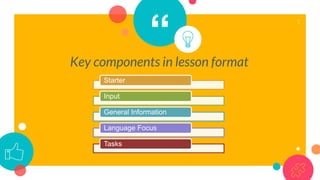
Key components in lesson format
5
Starter
Input
General Information
Language Focus
Tasks
Basic stages
in outlining a
lesson format
○ Listening with Understanding
○ Using Grammar in Oral Interaction
○ Reading for Understanding
○ Writing
○ Literature
6
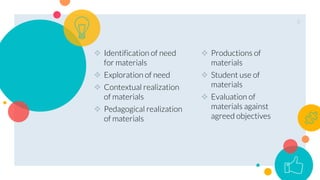
○ Jolly and Bolitho (1998:97-98) have an interestingly
different approach to frameworks and focus not on a
unit frameworks but on a framework for developing
materials, which involves the following procedures:
7
 Identification of need
for materials
 Exploration of need
 Contextual realization
of materials
 Pedagogical realization
of materials
 Productions of
materials
 Student use of
materials
 Evaluation of
materials against
agreed objectives
8
Most writers on the process of the
materials development focus on
needs analysis as starting point. And
some writers report starting by
articulating their principles.
Principles in
Materials
Development
9
Bell and Gower
(1998:122-125) started by
articulating principles
which they wanted to
guide their writing:
○ Flexibility
○ From text to language
○ Engaging content
○ Natural language
○ Analytic approaches
○ Emphasis on review
○ Personalized practice
○ Integrated skills
○ Balance of approaches
○ Learner development
○ Professional respect
10
11
Tomlinson (1999b) describes a principled and
flexible framework designed to help teachers to
develop materials efficiently and effectively.
Penaflorida
(1995:172-179)
reports her use of
the six principles of
materials design
identified by Nunan
(1988):
1. Materials should be clearly
linked to the curriculum they
serve.
2. Materials should be authentic
in terms of text and task
3. Materials should be authentic
in terms of text and task
12
4. Materials should allow learners
to focus on formal aspects of the
language
5. Materials should encourage
learners to develop learning skills,
and skills in learning
6. Materials should encourage
learners to apply their developing
skills to the world beyond the
classroom.
A Text-driven Approach to Materials Development
Tomlinson’s own preference is the text-driven approach, in which an
engaging written or spoken text drives a unit of materials in which
readiness activities activate the learners’ minds in relation to the text,
initial response activities stimulate engagement whilst experiencing
the text, intake response activities encourage articulation of personal
responses, input response activities invite exploration of features of
the text and development activities encourage learner production
(Tomlinson 2003c).
13
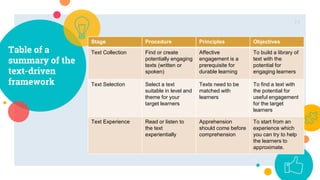
Table of a
summary of the
text-driven
framework
14
Stage Procedure Principles Objectives
Text Collection Find or create
potentially engaging
texts (written or
spoken)
Affective
engagement is a
prerequisite for
durable learning
To build a library of
text with the
potential for
engaging learners
Text Selection Select a text
suitable in level and
theme for your
target learners
Texts need to be
matched with
learners
To find a text with
the potential for
useful engagement
for the target
learners
Text Experience Read or listen to
the text
experientially
Apprehension
should come before
comprehension
To start from an
experience which
you can try to help
the learners to
approximate.
15
Readiness
Activities
Devise activities which
could help the learners
achieve mental readiness
for experiencing the text
Inner speech and the
establishment of
affective and cognitive
connections
Multidimensional way
they would automatically
use when experiencing
an L1 text.
Experiential
Activities
Devise whilst-reading or
listening activities which will
help the learners to
process the text in an
experiential way
L2 learners tend to
process a text in a
studies way in an
insecure attempt to
achieve total
comprehension
To help the learners to
move away from their
tendency to study texts
so that they can engage
with the text instead
experientially
Intake
Response
Activities
Devise activities which help
learners to articulate and
develop their mental
representation of the text
Learning is facilitated
by starting positively
from what the learners
do know and
understand
To encourage learners to
process their
representation of a text
rather than the text itself
and to encourage them
to be relaxed and
confident in their
response to texts.
16
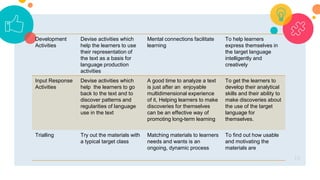
Development
Activities
Devise activities which
help the learners to use
their representation of
the text as a basis for
language production
activities
Mental connections facilitate
learning
To help learners
express themselves in
the target language
intelligently and
creatively
Input Response
Activities
Devise activities which
help the learners to go
back to the text and to
discover patterns and
regularities of language
use in the text
A good time to analyze a text
is just after an enjoyable
multidimensional experience
of it, Helping learners to make
discoveries for themselves
can be an effective way of
promoting long-term learning
To get the learners to
develop their analytical
skills and their ability to
make discoveries about
the use of the target
language for
themselves.
Trialling Try out the materials with
a typical target class
Matching materials to learners
needs and wants is an
ongoing, dynamic process
To find out how usable
and motivating the
materials are
17
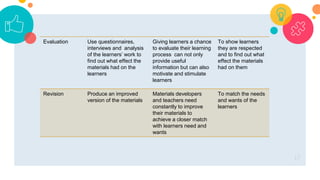
Evaluation Use questionnaires,
interviews and analysis
of the learners’ work to
find out what effect the
materials had on the
learners
Giving learners a chance
to evaluate their learning
process can not only
provide useful
information but can also
motivate and stimulate
learners
To show learners
they are respected
and to find out what
effect the materials
had on them
Revision Produce an improved
version of the materials
Materials developers
and teachers need
constantly to improve
their materials to
achieve a closer match
with learners need and
wants
To match the needs
and wants of the
learners
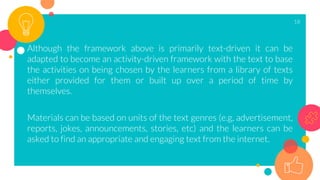
Although the framework above is primarily text-driven it can be
adapted to become an activity-driven framework with the text to base
the activities on being chosen by the learners from a library of texts
either provided for them or built up over a period of time by
themselves.
Materials can be based on units of the text genres (e.g, advertisement,
reports, jokes, announcements, stories, etc) and the learners can be
asked to find an appropriate and engaging text from the internet.
18
1. Tomlinson’s argument
is that the activities in a
course should match with
learner needs and wants
and with principles of
language learning, and
that they should be
developed in ways which
provide flexibility of use as
well as coherence of
connection.
2. Consideration: target
context of use for the
materials and principles;
experience of the writers;
developing a flexible
framework.
3. The writing process
will start with the
learner as the focus
and with principles in
mind.
Conclusion
19
Thanks!
Any questions?
20

Developing principled frameworks for material development

  • 1.
  • 2.
    What does ‘Materials development’ mean? ○‘Materials development’refers to all the processes made use of by practitioners who produce and/or use materials for language learning, including materials evaluation, their adaptation, design, production, exploitation and research. Ideally, all of these processes should be given consideration and should interact in the making of language- learning materials. ○Materials development is both a field of study and a practical undertaking. As a field it studies the principles and procedures of the design, implementation and evaluation of language teaching materials 2
  • 3.
    Frameworks for materials development Richards (1995:102-103) describes frameworks as the process of designing a “design or frame for a unit in a textbook” which can “serve as a formulae which the author can use in writing the book 3
  • 4.
    Flores (1995:60-62) also describesframeworks that outline a lesson format with the following basic stage:
  • 5.
    “ Key components inlesson format 5 Starter Input General Information Language Focus Tasks
  • 6.
    Basic stages in outlininga lesson format ○ Listening with Understanding ○ Using Grammar in Oral Interaction ○ Reading for Understanding ○ Writing ○ Literature 6
  • 7.
    ○ Jolly andBolitho (1998:97-98) have an interestingly different approach to frameworks and focus not on a unit frameworks but on a framework for developing materials, which involves the following procedures: 7
  • 8.
     Identification ofneed for materials  Exploration of need  Contextual realization of materials  Pedagogical realization of materials  Productions of materials  Student use of materials  Evaluation of materials against agreed objectives 8
  • 9.
    Most writers onthe process of the materials development focus on needs analysis as starting point. And some writers report starting by articulating their principles. Principles in Materials Development 9
  • 10.
    Bell and Gower (1998:122-125)started by articulating principles which they wanted to guide their writing: ○ Flexibility ○ From text to language ○ Engaging content ○ Natural language ○ Analytic approaches ○ Emphasis on review ○ Personalized practice ○ Integrated skills ○ Balance of approaches ○ Learner development ○ Professional respect 10
  • 11.
    11 Tomlinson (1999b) describesa principled and flexible framework designed to help teachers to develop materials efficiently and effectively.
  • 12.
    Penaflorida (1995:172-179) reports her useof the six principles of materials design identified by Nunan (1988): 1. Materials should be clearly linked to the curriculum they serve. 2. Materials should be authentic in terms of text and task 3. Materials should be authentic in terms of text and task 12 4. Materials should allow learners to focus on formal aspects of the language 5. Materials should encourage learners to develop learning skills, and skills in learning 6. Materials should encourage learners to apply their developing skills to the world beyond the classroom.
  • 13.
    A Text-driven Approachto Materials Development Tomlinson’s own preference is the text-driven approach, in which an engaging written or spoken text drives a unit of materials in which readiness activities activate the learners’ minds in relation to the text, initial response activities stimulate engagement whilst experiencing the text, intake response activities encourage articulation of personal responses, input response activities invite exploration of features of the text and development activities encourage learner production (Tomlinson 2003c). 13
  • 14.
    Table of a summaryof the text-driven framework 14 Stage Procedure Principles Objectives Text Collection Find or create potentially engaging texts (written or spoken) Affective engagement is a prerequisite for durable learning To build a library of text with the potential for engaging learners Text Selection Select a text suitable in level and theme for your target learners Texts need to be matched with learners To find a text with the potential for useful engagement for the target learners Text Experience Read or listen to the text experientially Apprehension should come before comprehension To start from an experience which you can try to help the learners to approximate.
  • 15.
    15 Readiness Activities Devise activities which couldhelp the learners achieve mental readiness for experiencing the text Inner speech and the establishment of affective and cognitive connections Multidimensional way they would automatically use when experiencing an L1 text. Experiential Activities Devise whilst-reading or listening activities which will help the learners to process the text in an experiential way L2 learners tend to process a text in a studies way in an insecure attempt to achieve total comprehension To help the learners to move away from their tendency to study texts so that they can engage with the text instead experientially Intake Response Activities Devise activities which help learners to articulate and develop their mental representation of the text Learning is facilitated by starting positively from what the learners do know and understand To encourage learners to process their representation of a text rather than the text itself and to encourage them to be relaxed and confident in their response to texts.
  • 16.
    16 Development Activities Devise activities which helpthe learners to use their representation of the text as a basis for language production activities Mental connections facilitate learning To help learners express themselves in the target language intelligently and creatively Input Response Activities Devise activities which help the learners to go back to the text and to discover patterns and regularities of language use in the text A good time to analyze a text is just after an enjoyable multidimensional experience of it, Helping learners to make discoveries for themselves can be an effective way of promoting long-term learning To get the learners to develop their analytical skills and their ability to make discoveries about the use of the target language for themselves. Trialling Try out the materials with a typical target class Matching materials to learners needs and wants is an ongoing, dynamic process To find out how usable and motivating the materials are
  • 17.
    17 Evaluation Use questionnaires, interviewsand analysis of the learners’ work to find out what effect the materials had on the learners Giving learners a chance to evaluate their learning process can not only provide useful information but can also motivate and stimulate learners To show learners they are respected and to find out what effect the materials had on them Revision Produce an improved version of the materials Materials developers and teachers need constantly to improve their materials to achieve a closer match with learners need and wants To match the needs and wants of the learners
  • 18.
    Although the frameworkabove is primarily text-driven it can be adapted to become an activity-driven framework with the text to base the activities on being chosen by the learners from a library of texts either provided for them or built up over a period of time by themselves. Materials can be based on units of the text genres (e.g, advertisement, reports, jokes, announcements, stories, etc) and the learners can be asked to find an appropriate and engaging text from the internet. 18
  • 19.
    1. Tomlinson’s argument isthat the activities in a course should match with learner needs and wants and with principles of language learning, and that they should be developed in ways which provide flexibility of use as well as coherence of connection. 2. Consideration: target context of use for the materials and principles; experience of the writers; developing a flexible framework. 3. The writing process will start with the learner as the focus and with principles in mind. Conclusion 19
  • 20.