CORRECTING
PERCEPTUAL &
DECODING DEFICITS
in WORD
RECOGNITION
Define
Title
Perceptual
ADJECTIVE
Of or relating to the ability to
interpret or become aware of
something through the senses
- Oxford Dictionary
Perceptual
adjective
of, relating to, or
involving perception especially in
relation to immediate sensory
experience
- Merriam Webster Dictionary
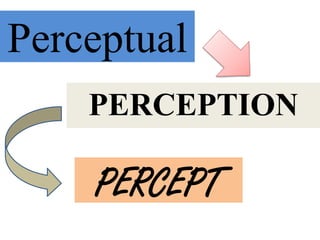
Perceptual
PERCEPTION
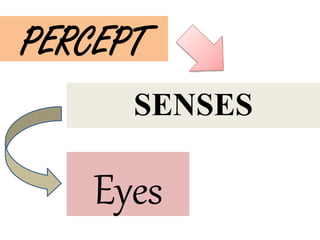
PERCEPT
SENSES
PERCEPT
Eyes
Deficit
NOUN
TECHNICAL A deficiency or failing,
especially in a neurological or
psychological function
- Oxford Dictionary
Deficit
Noun
a problem that causes a decrease
in some ability
- Merriam Webster Dictionary
Word Recognition
Ability of a reader to recognize
written words correctly and
virtually effortlessly.
sometimes referred to as
“Isolated Word Recognition"
Therefore…
The topic deals with
correcting and identifying
the disabilities of the eyes in
word recognition.
Ekwall & Shanker, 1988
Visual analysis of an unfamiliar
word must precede the
application of knowledge of
word parts. Both of these come
before the final synthesis of the
parts into recognition of words.
Two Ways of
Identifying whether a
Student Has Insufficient
Competence in the
Visual Analysis of Words
The student when
pronouncing words verbally
selects inappropriate
elements to sound out
he/she tries again and again
to use the same analysis
even when it does not work.
When the teacher shows
him/her the word covering
up parts of it, if the
student is able to
recognize it, then at least
one of his/her problems in
word recognition is faulty
visual analysis.
Definition of
Terms
ALPHABETIC
KNOWLEDGE
It is the ability to name,
distinguish shapes, write, and
identify the sounds of the
alphabet.
(Mason, 1984)
ALPHABETIC KNOWLEDGE
Also known as Letter sound
knowledge
It is defined as "the relationship
between phonology (sounds in
speech) and orthography (spelling
patterns of written language)"
2 3
ALPHABETIC KNOWLEDGE
Refers to the matching of
phonemes (smallest units of
sound) with their respective
graphemes (the written
symbols in a language)
4
ALPHABETIC KNOWLEDGE
It includes knowing
letter names and their
respective sounds.
http://literacyreferenceproject6.weebly.com/alphab
et-knowledge-and-word-recognition.html
5
ALPHABETIC KNOWLEDGE
Understanding that letters
represent sound so that:
• words may be read by saying
sounds represented by the
letters,
•words may be spelled by
writing the letters that
represent the sounds in a word.
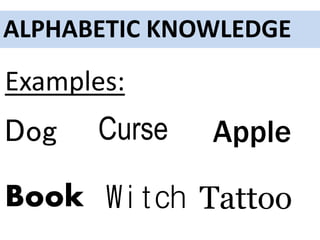
ALPHABETIC KNOWLEDGE
Understanding that letters
represent sound so that:
Examples:
Dog Apple
Book Witch
Curse
Tattoo
ALPHABETIC KNOWLEDGE
SIGHT-WORD KNOWLEDGE
All words any one reader
can recognize easily (with
automaticity) not
necessarily with meaning.
SIGHT WORDS
Refer to words that the reader
can read automatically, without
decoding, due to the word
being stored in memory.
KNOWLEDGE ON SOUND-
SYMBOL CORRESPONDENCE
Also called graphophonic
knowledge
KNOWLEDGE ON SOUND-
SYMBOL CORRESPONDENCE
The ability to listen to the
sounds in words and then
write down letters for those
sounds.
for
Listening

Em8 correcting perceptual & decoding deficits