APPLIED LINGUISTICS
DIFFERENT APPROACHES
AND METHODS
“A thousand teachers,
a thousand methods.”
-Chinese Proverb
Linguistics v/s Applied
Linguistics
 Linguistics is the
scientific study of
language.
 It endeavors to
answer the question--
what is language and
how is represented in
the mind?
• Oriented to the
Oriented to the
solution of linguistic
problems.
problems.
• It puts linguistic
It puts linguistic
theories into practice
in areas such as
in areas such as
foreign language
foreign language
teaching, speech
teaching, speech
therapy, translation,
and speech pathology
Dr. Jack Richards says…
 All instructional designs for the teaching of a second
or foreign language draw on a number of sources for
the principles and practices they advocate.
Applied Linguistics: The Twentieth
Century
 Language teaching came into its own as a
profession in the twentieth century.
 The whole foundation on contemporary language
teaching was developed during the early part of the
twentieth century, as applied linguistic and others
sought to develop principles and procedures for the
design of teaching methods and materials, drawing
on the developing fields of linguistics and
psychology to support a succession of proposals
for the more effective and theoretically sound
teaching methods.
They generally make explicit or
implicit use of:
 A theory of language: An account of what the essential components of
language are and what proficiency or competence in a language entails.
 A theory of learning: An account of the psycholinguistic, cognitive and
social processes involved in learning a language and the conditions that
need to be present for these processes to be activated.
 The theory of language and language learning underlying an
instructional design results in the development of principles that can
serve to guide the process of teaching and learning. Different
instructional designs in language teaching often reflect very different
understandings of the nature of language and of language learning. The
particular theory of language and language learning underlying an
instructional design, in turn, leads to further levels of specification
For example:
Learning objectives: What the goals of teaching and learning will be.
The syllabus: What the primary units of organization for a language course
will consist of.
Teacher and learner roles: What roles teachers and learners are expected to
play in the classroom.
Activities: The kinds of classroom activities and techniques that are
recommended.
When an instructional design is quite explicit at the level of theory of language
and learning, but can be applied in many different ways at the level of
objectives, teacher and learner roles and activities, it is usually referred to as an
approach.
 The difference between a philosophy of
language teaching at the level of theory
and principles, and a set of derived
procedures for teaching a language, is
central.
 Edward Anthony in 1963
Identified three levels of conceptualization and
organization, which he termed approach,
method, and technique.
Edward Anthony (1965)
An approach is a set of correlative
assumptions dealing with the
nature of language and the nature
of language learning and teaching.
• According to Edward Anthony’s model
(1965)
Approach is the level at which
assumptions and beliefs about language
and language learning are specified
Method is the level at which theory is
put into practice and at which choices are
made about the particular skills to be
taught, the content to be taught, and the
order in which the content will be
presented
Technique is the level at which
classroom procedures are described.
 Approach
a set of correlative assumptions dealing
with the nature of language teaching and
learning.
Axiomatic (self-evident)
describes the nature of the subject matter
to be taught
 Method
an overall plan for the orderly presentation
of language material based on the
selected approach.
within one approach, there can be many
methods
 Technique
implementational – that which actually
takes place in a classroom
a particular trick, stratagem, or gadget used
to accomplish an immediate objective.
must be consistent with a method, and
therefore in harmony with an approach as
well.
(Anthony, 1963: 63-67)
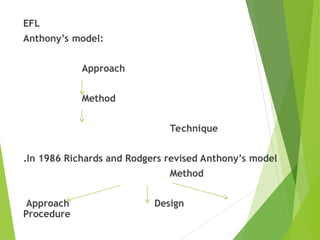
EFL
Anthony’s model:
Approach
Method
Technique
.In 1986 Richards and Rodgers revised Anthony’s model
Method
Approach Design
Procedure
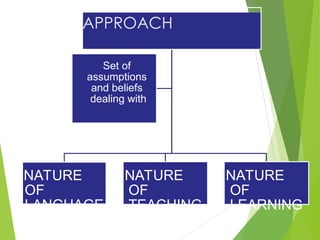
APPROACH
NATURE
OF
LANGUAGE
NATURE
OF
TEACHING
NATURE
OF
LEARNING
Set of
assumptions
and beliefs
dealing with
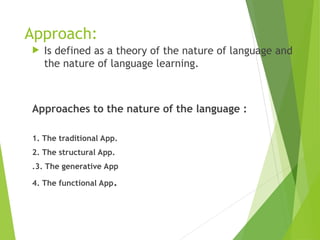
Approach:
 Is defined as a theory of the nature of language and
the nature of language learning.
Approaches to the nature of the language :
1. The traditional App.
2. The structural App.
.3. The generative App
4. The functional App.
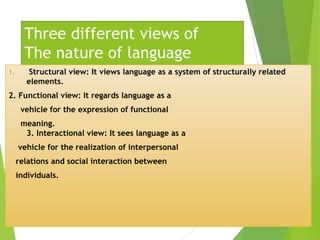
Three different views of
The nature of language
1. Structural view: It views language as a system of structurally related
elements.
2. Functional view: It regards language as a
vehicle for the expression of functional
meaning.
3. Interactional view: It sees language as a
vehicle for the realization of interpersonal
relations and social interaction between
individuals.
The common assumptions about the nature
of the language
1. Language is a group of sounds with specific meaning
and organized by grammatical rules (The Silent Way).
2. Language is the everyday spoken utterance of the
average person at normal speed (Audio Lingual
Method).
3. Language is a system for the expression of meaning
(Communicative Language Teaching).
4. Language is a set of grammatical rules and language
consists of language chunks (Total Physical
Responses)
Definitions of learning
1. A change in behavior as a result of experience or practice.
2. The acquisition of knowledge.
3. Knowledge gained through study.
4. To gain knowledge of , or skill in, through study, teaching,
instruction or experience.
5. The process of gaining knowledge.
6. A process by which behaviour is changed, shaped, or
controlled.
7. The individual process of constructing understanding based
on experience from a wide range of sources.
(Alan Prichard 2009:2)
The nature of language learning:
1. Behaviorism: Stimulus- Response-
Reinforcement.- Drilling, exercise,
repetition.
2. Nativism: A child naturally has a language
acquisition device.
(Kodrati and Chomsky).
3. Constructivism: A child acquired a
language through interaction between the
child and environment. (Jean Piaget).
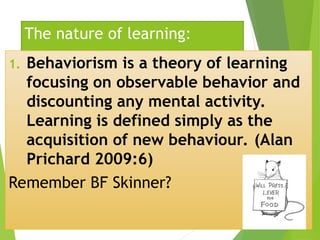
The nature of learning:
1. Behaviorism is a theory of learning
focusing on observable behavior and
discounting any mental activity.
Learning is defined simply as the
acquisition of new behaviour. (Alan
Prichard 2009:6)
Remember BF Skinner?
Cognitive, constructivist learning
Constructivists view learning as the result of
mental construction. That is, learning takes place
when new information is built into and added onto
an individual’s current structure of knowledge,
understanding and skills. We learn best when we
actively construct our own understanding (Alan
Prichard 2009:17)
Remember Lev Vygotsky
The following assumptions relate to theories of learning and
teaching
1. Learning is facilitated if language learners
discover rather than repeat and remember
without understanding what is to be learned
(Silent Way).
2. Learning involves the unconscious functions, as
well as the conscious functions (Suggestopedia).
3. The norms of the society often block the process
of learning (Suggestopedia)
4. Language learning will take place if language
learners maintain their feeling of security
(Community Language Learning).
5. Language learning is a process of habit formation
(Audio Lingual Method)
Assumptions about learning and
teaching, which have been
developed from theories in
psychology, seem to develop faster
than those about the nature of
language.
What links theory
with practice
(or approach with
procedure) is
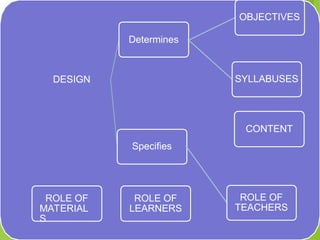
DESIGN
DESIGN
Determines
OBJECTIVES
SYLLABUSES
Specifies
ROLE OF
TEACHERS
CONTENT
ROLE OF
LEARNERS
ROLE OF
MATERIAL
S
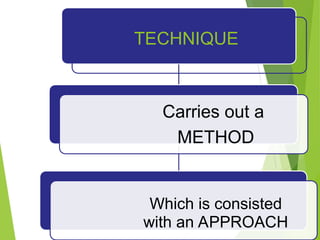
TECHNIQUE
Carries out a
METHOD
Which is consisted
with an APPROACH
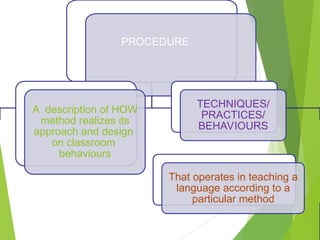
PROCEDURE
A description of HOW
method realizes its
approach and design
on classroom
behaviours
TECHNIQUES/
PRACTICES/
BEHAVIOURS
That operates in teaching a
language according to a
particular method
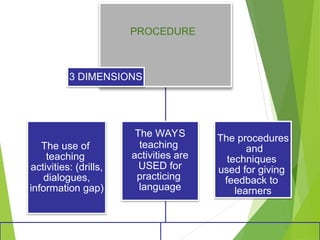
PROCEDURE
The use of
teaching
activities: (drills,
dialogues,
information gap)
The WAYS
teaching
activities are
USED for
practicing
language
The procedures
and
techniques
used for giving
feedback to
learners
3 DIMENSIONS
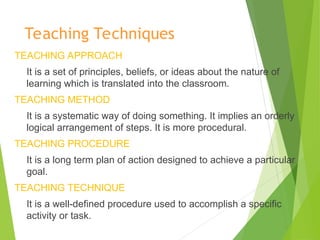
Teaching Techniques
TEACHING APPROACH
It is a set of principles, beliefs, or ideas about the nature of
learning which is translated into the classroom.
TEACHING METHOD
It is a systematic way of doing something. It implies an orderly
logical arrangement of steps. It is more procedural.
TEACHING PROCEDURE
It is a long term plan of action designed to achieve a particular
goal.
TEACHING TECHNIQUE
It is a well-defined procedure used to accomplish a specific
activity or task.
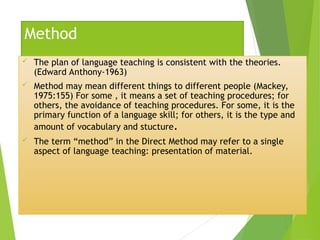
Method
 The plan of language teaching is consistent with the theories.
(Edward Anthony-1963)
 Method may mean different things to different people (Mackey,
1975:155) For some , it means a set of teaching procedures; for
others, the avoidance of teaching procedures. For some, it is the
primary function of a language skill; for others, it is the type and
amount of vocabulary and stucture.
 The term “method” in the Direct Method may refer to a single
aspect of language teaching: presentation of material.
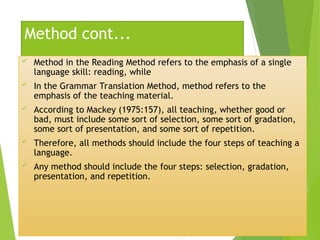
Method cont...
 Method in the Reading Method refers to the emphasis of a single
language skill: reading, while
 In the Grammar Translation Method, method refers to the
emphasis of the teaching material.
 According to Mackey (1975:157), all teaching, whether good or
bad, must include some sort of selection, some sort of gradation,
some sort of presentation, and some sort of repetition.
 Therefore, all methods should include the four steps of teaching a
language.
 Any method should include the four steps: selection, gradation,
presentation, and repetition.
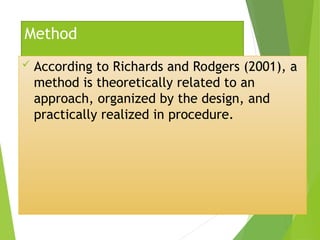
Method
 According to Richards and Rodgers (2001), a
method is theoretically related to an
approach, organized by the design, and
practically realized in procedure.
The Terms of Task, Procedure and Technique
(H.D. Brown 2007:180)
1. Task. Task usually refers to a specialized form of technique or series of techniques
closely allied with communicative curricula, and as such must minimally have
communicative goals. It focuses on the authentic use of language for meaningful
communicative purpose beyond the language classroom
2. Activity. Activity may refer to virtually anything that learners do in the classroom.
 We usually refer to a reasonably unified set of student behavior, limited in time,
preceded by some direction from the teacher, with a particular objective.
 Activities include role plays, drills, games, peer-editing, small-group information-
gap exercise, and much more.
 Because an activity implies some sort of active performance on the part of
learners, it is generally not used to refer to certain teacher behaviors like saying
“good morning,” maintaining eye contact with students, explaining a grammar
point, or writing a list of words on the chalkboard.
Such teacher behavior, however can indeed be referred to as
technique.
The Term of Technique
3. Procedure. Richards and Rodgers (2001) used the term
procedure to encompass “the actual moment-to-
moment techniques, practices, and behavior that
operate in teaching a language according to a particular
method” (p.26)
 Procedures from this definition, include techniques.
Thus, for Richards and Rodgers, this appears to be a
catch-all term, a thing for holding many small objects
or a group or description that includes different things
and that does not state clearly what is included or not.
4. Practice, behavior, exercise, strategy... In the language-
teaching literature, these terms, and perhaps some
others, all appear to refer , in varying degrees of
intensity, to what is defined as technique.
The Term of Technique
5. Technique
 Even before Anthony (1963) discussed and defined the
term, the language teaching literature generally
accepted technique as a super-ordinate term to refer
to various activities that either teachers or learners
perform in the classroom.
 In other words, technique include all tasks and
activities.
 They are, almost always, planned and deliberate,
done on purpose rather than by accident.They are the
product of a choice made by the teacher. And they
can, for your purposes as a language teacher,
comfortably refer to the pedagogical units or
components of a classroom session
Taxonomy of language-teaching Techniques (adapted from
Crookes & Chaudron,1991 pp.52-54)
Controlled Techniques
1.Warm-up: Mimes, dance, songs, jokes, play. This activity gets the students
stimulated, relaxed, motivated, attentive, or otherwise engage and ready for
the lesson. It does not necessarily involves use of the target language.
2.Setting: Focusing on lesson topic. Teacher directs attention to the topic by
verbal or nonverbal evocation of the context relevant to the lesson by
questioning or miming or picture presentation, possibly by tape recording of
situations and peole.
3.Organizational: Structuring of lesson or class activities includes disciplinary
action, organization of class furniture and seating, general procedures for
class interaction and performance, structure and purpose of lesson, etc.
Taxonomy of language-teaching Techniques (adapted
from Crookes & Chaudron,1991 pp.52-54)
Controlled Techniques
4.Content Explanation: Grammatical, phonological, lexical (vocabulary),
sociolinguistic, pragmatic, or any other aspect of language.
5.Role-play demonstration: Selected students or teacher illustrate the
procedure(s) to be applied in the lesson segment to follow. Includes brief
illustration of language or other content to be incorporated.
6.Dialogue/Narrative presentation: Reading or listening passage presented for
passive reception. No implication of student production or other
identification of specific target forms or functions (students may be asked to
“understand”)
7.Dialogue/Narrative recitation: Reciting a previously known or prepared text,
either in unison or individually.
Taxonomy of language-teaching Techniques (adapted
from Crookes & Chaudron,1991 pp.52-54)
Controlled Techniques
8.Reading aloud: Reading directly from a given text.
9.Checking: Teacher either circulating or guiding the correction of students’
work, providing feedback as an activity rather than within another activity.
10.Question-answer display: Activity involving prompting of students
responses by means of display questions (i.e. teacher or questioner already
knows the response or has a very limited set of expectations for the
appropriate response). Distinguished from referential questions by the
likelihood of the questioner’s knowledge of the response and the speaker’s
awareness of that fact.
11.Drill: Typical language activity involving fixed patterns of teacher
prompting and student responding, usually with repetition, substitution, and
other mechanical alterations. Typically with little meaning attached.
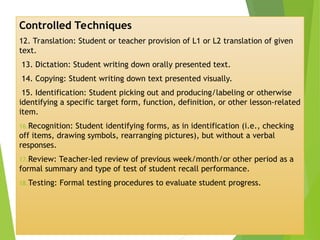
Controlled Techniques
12. Translation: Student or teacher provision of L1 or L2 translation of given
text.
13. Dictation: Student writing down orally presented text.
14. Copying: Student writing down text presented visually.
15. Identification: Student picking out and producing/labeling or otherwise
identifying a specific target form, function, definition, or other lesson-related
item.
16.Recognition: Student identifying forms, as in identification (i.e., checking
off items, drawing symbols, rearranging pictures), but without a verbal
responses.
17.Review: Teacher-led review of previous week/month/or other period as a
formal summary and type of test of student recall performance.
18.Testing: Formal testing procedures to evaluate student progress.
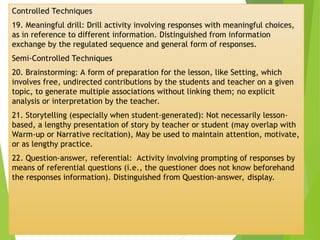
Controlled Techniques
19. Meaningful drill: Drill activity involving responses with meaningful choices,
as in reference to different information. Distinguished from information
exchange by the regulated sequence and general form of responses.
Semi-Controlled Techniques
20. Brainstorming: A form of preparation for the lesson, like Setting, which
involves free, undirected contributions by the students and teacher on a given
topic, to generate multiple associations without linking them; no explicit
analysis or interpretation by the teacher.
21. Storytelling (especially when student-generated): Not necessarily lesson-
based, a lengthy presentation of story by teacher or student (may overlap with
Warm-up or Narrative recitation), May be used to maintain attention, motivate,
or as lengthy practice.
22. Question-answer, referential: Activity involving prompting of responses by
means of referential questions (i.e., the questioner does not know beforehand
the responses information). Distinguished from Question-answer, display.
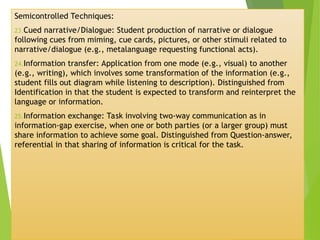
Semicontrolled Techniques:
23.Cued narrative/Dialogue: Student production of narrative or dialogue
following cues from miming, cue cards, pictures, or other stimuli related to
narrative/dialogue (e.g., metalanguage requesting functional acts).
24.Information transfer: Application from one mode (e.g., visual) to another
(e.g., writing), which involves some transformation of the information (e.g.,
student fills out diagram while listening to description). Distinguished from
Identification in that the student is expected to transform and reinterpret the
language or information.
25.Information exchange: Task involving two-way communication as in
information-gap exercise, when one or both parties (or a larger group) must
share information to achieve some goal. Distinguished from Question-answer,
referential in that sharing of information is critical for the task.
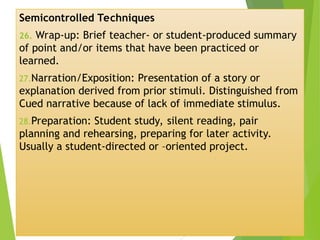
Semicontrolled Techniques
26. Wrap-up: Brief teacher- or student-produced summary
of point and/or items that have been practiced or
learned.
27.Narration/Exposition: Presentation of a story or
explanation derived from prior stimuli. Distinguished from
Cued narrative because of lack of immediate stimulus.
28.Preparation: Student study, silent reading, pair
planning and rehearsing, preparing for later activity.
Usually a student-directed or –oriented project.
Free Techniques
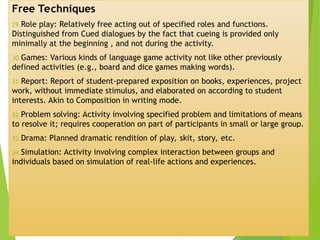
29.Role play: Relatively free acting out of specified roles and functions.
Distinguished from Cued dialogues by the fact that cueing is provided only
minimally at the beginning , and not during the activity.
30.Games: Various kinds of language game activity not like other previously
defined activities (e.g., board and dice games making words).
31.Report: Report of student-prepared exposition on books, experiences, project
work, without immediate stimulus, and elaborated on according to student
interests. Akin to Composition in writing mode.
32.Problem solving: Activity involving specified problem and limitations of means
to resolve it; requires cooperation on part of participants in small or large group.
33.Drama: Planned dramatic rendition of play, skit, story, etc.
34.Simulation: Activity involving complex interaction between groups and
individuals based on simulation of real-life actions and experiences.
Free Techniques
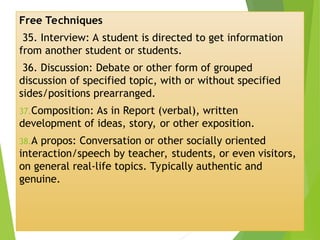
35. Interview: A student is directed to get information
from another student or students.
36. Discussion: Debate or other form of grouped
discussion of specified topic, with or without specified
sides/positions prearranged.
37.Composition: As in Report (verbal), written
development of ideas, story, or other exposition.
38.A propos: Conversation or other socially oriented
interaction/speech by teacher, students, or even visitors,
on general real-life topics. Typically authentic and
genuine.
Methods of Teaching English
What Is Teaching Method?
Teaching method is a way of teaching a language which is based on
systematic principles and procedures, i.e., which is an application of
views on how a language is best taught and learned.
Teaching Methodologies
 Grammar Translation Method
 Direct Method
 Audio-lingual Method
 Communicative Language Teaching
 Task-based Teaching
The Grammar Translation Method
Background
 This approach was historically used in teaching Greek and Latin.
The approach was generalized to teaching modern languages.
 Whereas today English is the world’s most widely studied foreign
language, 500 years ago it was Latin for it was the dominant
language of education,commerce, religion, and government in
the Western world.
 The political changes in Europe gave French, Italian, and English
importance thus Latin was displaced as a language of spoken and
written communicatión.
Main Objectives
• Helping students read and appreciate foreign
language literature.
• Students can become more familiar with the
grammar of their native language also write and
speak their native language better.
• Helpful for mental exercise.
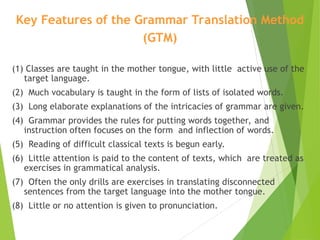
Key Features of the Grammar Translation Method
(GTM)
(1) Classes are taught in the mother tongue, with little active use of the
target language.
(2) Much vocabulary is taught in the form of lists of isolated words.
(3) Long elaborate explanations of the intricacies of grammar are given.
(4) Grammar provides the rules for putting words together, and
instruction often focuses on the form and inflection of words.
(5) Reading of difficult classical texts is begun early.
(6) Little attention is paid to the content of texts, which are treated as
exercises in grammatical analysis.
(7) Often the only drills are exercises in translating disconnected
sentences from the target language into the mother tongue.
(8) Little or no attention is given to pronunciation.
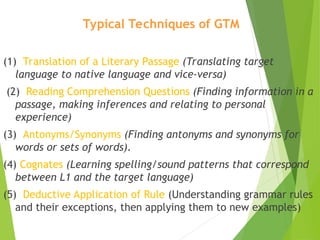
Typical Techniques of GTM
(1) Translation of a Literary Passage (Translating target
language to native language and vice-versa)
(2) Reading Comprehension Questions (Finding information in a
passage, making inferences and relating to personal
experience)
(3) Antonyms/Synonyms (Finding antonyms and synonyms for
words or sets of words).
(4) Cognates (Learning spelling/sound patterns that correspond
between L1 and the target language)
(5) Deductive Application of Rule (Understanding grammar rules
and their exceptions, then applying them to new examples)
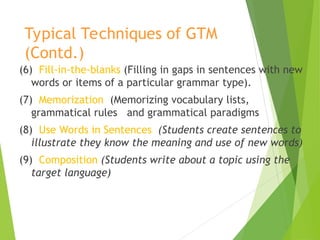
Typical Techniques of GTM
(Contd.)
(6) Fill-in-the-blanks (Filling in gaps in sentences with new
words or items of a particular grammar type).
(7) Memorization (Memorizing vocabulary lists,
grammatical rules and grammatical paradigms
(8) Use Words in Sentences (Students create sentences to
illustrate they know the meaning and use of new words)
(9) Composition (Students write about a topic using the
target language)
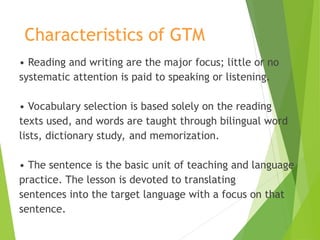
Characteristics of GTM
• Reading and writing are the major focus; little or no
systematic attention is paid to speaking or listening.
• Vocabulary selection is based solely on the reading
texts used, and words are taught through bilingual word
lists, dictionary study, and memorization.
• The sentence is the basic unit of teaching and language
practice. The lesson is devoted to translating
sentences into the target language with a focus on that
sentence.
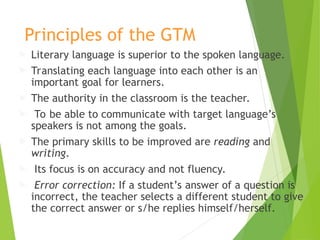
Principles of the GTM
 Literary language is superior to the spoken language.
 Translating each language into each other is an
important goal for learners.
 The authority in the classroom is the teacher.
 To be able to communicate with target language’s
speakers is not among the goals.
 The primary skills to be improved are reading and
writing.
 Its focus is on accuracy and not fluency.
 Error correction: If a student’s answer of a question is
incorrect, the teacher selects a different student to give
the correct answer or s/he replies himself/herself.
Some Advantages of GTM
 Translation is the easiest way of explaining
meanings from one language into another.
 Less stressful for the students.
 Familiarity with other nations’ culture.
 Even non-fluent teachers in the target language
can teach by using GTM.
 An effective way for application of grammar and
sentence structure.
 Few demands on teachers.
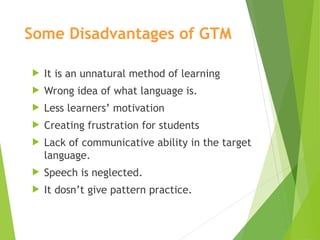
Some Disadvantages of GTM
 It is an unnatural method of learning
 Wrong idea of what language is.
 Less learners’ motivation
 Creating frustration for students
 Lack of communicative ability in the target
language.
 Speech is neglected.
 It dosn’t give pattern practice.
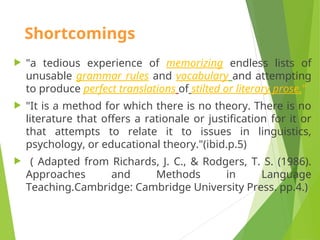
Shortcomings
 "a tedious experience of memorizing endless lists of
unusable grammar rules and vocabulary and attempting
to produce perfect translations of stilted or literary prose."
 "It is a method for which there is no theory. There is no
literature that offers a rationale or justification for it or
that attempts to relate it to issues in linguistics,
psychology, or educational theory."(ibid.p.5)
 ( Adapted from Richards, J. C., & Rodgers, T. S. (1986).
Approaches and Methods in Language
Teaching.Cambridge: Cambridge University Press. pp.4.)
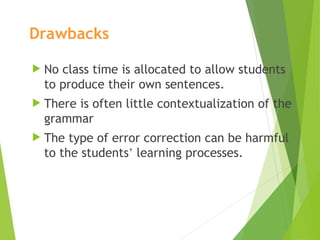
Drawbacks
 No class time is allocated to allow students
to produce their own sentences.
 There is often little contextualization of the
grammar
 The type of error correction can be harmful
to the students’ learning processes.
Conclusion
 GTM was frequently used at the begining of the 20th
century but today, many consider it as an unnatural
method. The natural order of learning a language is
listening, speaking, reading and writing. That is the
way how the child learns his mother tongue in
natural surroundings. But GTM doesn’t focus on all 4
skills needed for learning a language.
So, this causes problems and doesn’t let GTM to be
a perfect and natural method and makes it
incomplete for language learners who like to learn
L2 at the best level.
Conclusion
 A typical lesson consists of the presentation of a
grammatical rules, a study of lists of vocabulary, and a
translation exercise
 A lesson= grammatical rules+vocabulary+translation
 Because the Grammar Translation Method emphasizes
reading rather than the ability to communicate in a
language, there was a reaction to it in the 19th century
(see NATURAL APPROACH, DIRECT METHOD), and there
was later a greater emphasis on the teaching of spoken
language.

Applied Linguistics Approaches and Methods.ppt

  • 1.
    APPLIED LINGUISTICS DIFFERENT APPROACHES ANDMETHODS “A thousand teachers, a thousand methods.” -Chinese Proverb
  • 2.
    Linguistics v/s Applied Linguistics Linguistics is the scientific study of language.  It endeavors to answer the question-- what is language and how is represented in the mind? • Oriented to the Oriented to the solution of linguistic solution of linguistic problems. problems. • It puts linguistic It puts linguistic theories into practice theories into practice in areas such as in areas such as foreign language foreign language teaching, speech teaching, speech therapy, translation, therapy, translation, and speech pathology and speech pathology
  • 3.
    Dr. Jack Richardssays…  All instructional designs for the teaching of a second or foreign language draw on a number of sources for the principles and practices they advocate.
  • 4.
    Applied Linguistics: TheTwentieth Century  Language teaching came into its own as a profession in the twentieth century.  The whole foundation on contemporary language teaching was developed during the early part of the twentieth century, as applied linguistic and others sought to develop principles and procedures for the design of teaching methods and materials, drawing on the developing fields of linguistics and psychology to support a succession of proposals for the more effective and theoretically sound teaching methods.
  • 5.
    They generally makeexplicit or implicit use of:  A theory of language: An account of what the essential components of language are and what proficiency or competence in a language entails.  A theory of learning: An account of the psycholinguistic, cognitive and social processes involved in learning a language and the conditions that need to be present for these processes to be activated.  The theory of language and language learning underlying an instructional design results in the development of principles that can serve to guide the process of teaching and learning. Different instructional designs in language teaching often reflect very different understandings of the nature of language and of language learning. The particular theory of language and language learning underlying an instructional design, in turn, leads to further levels of specification
  • 6.
    For example: Learning objectives:What the goals of teaching and learning will be. The syllabus: What the primary units of organization for a language course will consist of. Teacher and learner roles: What roles teachers and learners are expected to play in the classroom. Activities: The kinds of classroom activities and techniques that are recommended. When an instructional design is quite explicit at the level of theory of language and learning, but can be applied in many different ways at the level of objectives, teacher and learner roles and activities, it is usually referred to as an approach.
  • 7.
     The differencebetween a philosophy of language teaching at the level of theory and principles, and a set of derived procedures for teaching a language, is central.  Edward Anthony in 1963 Identified three levels of conceptualization and organization, which he termed approach, method, and technique.
  • 8.
    Edward Anthony (1965) Anapproach is a set of correlative assumptions dealing with the nature of language and the nature of language learning and teaching.
  • 9.
    • According toEdward Anthony’s model (1965) Approach is the level at which assumptions and beliefs about language and language learning are specified Method is the level at which theory is put into practice and at which choices are made about the particular skills to be taught, the content to be taught, and the order in which the content will be presented Technique is the level at which classroom procedures are described.
  • 10.
     Approach a setof correlative assumptions dealing with the nature of language teaching and learning. Axiomatic (self-evident) describes the nature of the subject matter to be taught
  • 11.
     Method an overallplan for the orderly presentation of language material based on the selected approach. within one approach, there can be many methods
  • 12.
     Technique implementational –that which actually takes place in a classroom a particular trick, stratagem, or gadget used to accomplish an immediate objective. must be consistent with a method, and therefore in harmony with an approach as well. (Anthony, 1963: 63-67)
  • 13.
    EFL Anthony’s model: Approach Method Technique .In 1986Richards and Rodgers revised Anthony’s model Method Approach Design Procedure
  • 14.
  • 15.
    Approach:  Is definedas a theory of the nature of language and the nature of language learning. Approaches to the nature of the language : 1. The traditional App. 2. The structural App. .3. The generative App 4. The functional App.
  • 16.
    Three different viewsof The nature of language 1. Structural view: It views language as a system of structurally related elements. 2. Functional view: It regards language as a vehicle for the expression of functional meaning. 3. Interactional view: It sees language as a vehicle for the realization of interpersonal relations and social interaction between individuals.
  • 17.
    The common assumptionsabout the nature of the language 1. Language is a group of sounds with specific meaning and organized by grammatical rules (The Silent Way). 2. Language is the everyday spoken utterance of the average person at normal speed (Audio Lingual Method). 3. Language is a system for the expression of meaning (Communicative Language Teaching). 4. Language is a set of grammatical rules and language consists of language chunks (Total Physical Responses)
  • 18.
    Definitions of learning 1.A change in behavior as a result of experience or practice. 2. The acquisition of knowledge. 3. Knowledge gained through study. 4. To gain knowledge of , or skill in, through study, teaching, instruction or experience. 5. The process of gaining knowledge. 6. A process by which behaviour is changed, shaped, or controlled. 7. The individual process of constructing understanding based on experience from a wide range of sources. (Alan Prichard 2009:2)
  • 19.
    The nature oflanguage learning: 1. Behaviorism: Stimulus- Response- Reinforcement.- Drilling, exercise, repetition. 2. Nativism: A child naturally has a language acquisition device. (Kodrati and Chomsky). 3. Constructivism: A child acquired a language through interaction between the child and environment. (Jean Piaget).
  • 20.
    The nature oflearning: 1. Behaviorism is a theory of learning focusing on observable behavior and discounting any mental activity. Learning is defined simply as the acquisition of new behaviour. (Alan Prichard 2009:6) Remember BF Skinner?
  • 21.
    Cognitive, constructivist learning Constructivistsview learning as the result of mental construction. That is, learning takes place when new information is built into and added onto an individual’s current structure of knowledge, understanding and skills. We learn best when we actively construct our own understanding (Alan Prichard 2009:17) Remember Lev Vygotsky
  • 22.
    The following assumptionsrelate to theories of learning and teaching 1. Learning is facilitated if language learners discover rather than repeat and remember without understanding what is to be learned (Silent Way). 2. Learning involves the unconscious functions, as well as the conscious functions (Suggestopedia). 3. The norms of the society often block the process of learning (Suggestopedia) 4. Language learning will take place if language learners maintain their feeling of security (Community Language Learning). 5. Language learning is a process of habit formation (Audio Lingual Method)
  • 23.
    Assumptions about learningand teaching, which have been developed from theories in psychology, seem to develop faster than those about the nature of language.
  • 24.
    What links theory withpractice (or approach with procedure) is DESIGN
  • 25.
  • 26.
    TECHNIQUE Carries out a METHOD Whichis consisted with an APPROACH
  • 27.
    PROCEDURE A description ofHOW method realizes its approach and design on classroom behaviours TECHNIQUES/ PRACTICES/ BEHAVIOURS That operates in teaching a language according to a particular method
  • 28.
    PROCEDURE The use of teaching activities:(drills, dialogues, information gap) The WAYS teaching activities are USED for practicing language The procedures and techniques used for giving feedback to learners 3 DIMENSIONS
  • 29.
    Teaching Techniques TEACHING APPROACH Itis a set of principles, beliefs, or ideas about the nature of learning which is translated into the classroom. TEACHING METHOD It is a systematic way of doing something. It implies an orderly logical arrangement of steps. It is more procedural. TEACHING PROCEDURE It is a long term plan of action designed to achieve a particular goal. TEACHING TECHNIQUE It is a well-defined procedure used to accomplish a specific activity or task.
  • 30.
    Method  The planof language teaching is consistent with the theories. (Edward Anthony-1963)  Method may mean different things to different people (Mackey, 1975:155) For some , it means a set of teaching procedures; for others, the avoidance of teaching procedures. For some, it is the primary function of a language skill; for others, it is the type and amount of vocabulary and stucture.  The term “method” in the Direct Method may refer to a single aspect of language teaching: presentation of material.
  • 31.
    Method cont...  Methodin the Reading Method refers to the emphasis of a single language skill: reading, while  In the Grammar Translation Method, method refers to the emphasis of the teaching material.  According to Mackey (1975:157), all teaching, whether good or bad, must include some sort of selection, some sort of gradation, some sort of presentation, and some sort of repetition.  Therefore, all methods should include the four steps of teaching a language.  Any method should include the four steps: selection, gradation, presentation, and repetition.
  • 32.
    Method  According toRichards and Rodgers (2001), a method is theoretically related to an approach, organized by the design, and practically realized in procedure.
  • 33.
    The Terms ofTask, Procedure and Technique (H.D. Brown 2007:180) 1. Task. Task usually refers to a specialized form of technique or series of techniques closely allied with communicative curricula, and as such must minimally have communicative goals. It focuses on the authentic use of language for meaningful communicative purpose beyond the language classroom 2. Activity. Activity may refer to virtually anything that learners do in the classroom.  We usually refer to a reasonably unified set of student behavior, limited in time, preceded by some direction from the teacher, with a particular objective.  Activities include role plays, drills, games, peer-editing, small-group information- gap exercise, and much more.  Because an activity implies some sort of active performance on the part of learners, it is generally not used to refer to certain teacher behaviors like saying “good morning,” maintaining eye contact with students, explaining a grammar point, or writing a list of words on the chalkboard. Such teacher behavior, however can indeed be referred to as technique.
  • 34.
    The Term ofTechnique 3. Procedure. Richards and Rodgers (2001) used the term procedure to encompass “the actual moment-to- moment techniques, practices, and behavior that operate in teaching a language according to a particular method” (p.26)  Procedures from this definition, include techniques. Thus, for Richards and Rodgers, this appears to be a catch-all term, a thing for holding many small objects or a group or description that includes different things and that does not state clearly what is included or not. 4. Practice, behavior, exercise, strategy... In the language- teaching literature, these terms, and perhaps some others, all appear to refer , in varying degrees of intensity, to what is defined as technique.
  • 35.
    The Term ofTechnique 5. Technique  Even before Anthony (1963) discussed and defined the term, the language teaching literature generally accepted technique as a super-ordinate term to refer to various activities that either teachers or learners perform in the classroom.  In other words, technique include all tasks and activities.  They are, almost always, planned and deliberate, done on purpose rather than by accident.They are the product of a choice made by the teacher. And they can, for your purposes as a language teacher, comfortably refer to the pedagogical units or components of a classroom session
  • 36.
    Taxonomy of language-teachingTechniques (adapted from Crookes & Chaudron,1991 pp.52-54) Controlled Techniques 1.Warm-up: Mimes, dance, songs, jokes, play. This activity gets the students stimulated, relaxed, motivated, attentive, or otherwise engage and ready for the lesson. It does not necessarily involves use of the target language. 2.Setting: Focusing on lesson topic. Teacher directs attention to the topic by verbal or nonverbal evocation of the context relevant to the lesson by questioning or miming or picture presentation, possibly by tape recording of situations and peole. 3.Organizational: Structuring of lesson or class activities includes disciplinary action, organization of class furniture and seating, general procedures for class interaction and performance, structure and purpose of lesson, etc.
  • 37.
    Taxonomy of language-teachingTechniques (adapted from Crookes & Chaudron,1991 pp.52-54) Controlled Techniques 4.Content Explanation: Grammatical, phonological, lexical (vocabulary), sociolinguistic, pragmatic, or any other aspect of language. 5.Role-play demonstration: Selected students or teacher illustrate the procedure(s) to be applied in the lesson segment to follow. Includes brief illustration of language or other content to be incorporated. 6.Dialogue/Narrative presentation: Reading or listening passage presented for passive reception. No implication of student production or other identification of specific target forms or functions (students may be asked to “understand”) 7.Dialogue/Narrative recitation: Reciting a previously known or prepared text, either in unison or individually.
  • 38.
    Taxonomy of language-teachingTechniques (adapted from Crookes & Chaudron,1991 pp.52-54) Controlled Techniques 8.Reading aloud: Reading directly from a given text. 9.Checking: Teacher either circulating or guiding the correction of students’ work, providing feedback as an activity rather than within another activity. 10.Question-answer display: Activity involving prompting of students responses by means of display questions (i.e. teacher or questioner already knows the response or has a very limited set of expectations for the appropriate response). Distinguished from referential questions by the likelihood of the questioner’s knowledge of the response and the speaker’s awareness of that fact. 11.Drill: Typical language activity involving fixed patterns of teacher prompting and student responding, usually with repetition, substitution, and other mechanical alterations. Typically with little meaning attached.
  • 39.
    Controlled Techniques 12. Translation:Student or teacher provision of L1 or L2 translation of given text. 13. Dictation: Student writing down orally presented text. 14. Copying: Student writing down text presented visually. 15. Identification: Student picking out and producing/labeling or otherwise identifying a specific target form, function, definition, or other lesson-related item. 16.Recognition: Student identifying forms, as in identification (i.e., checking off items, drawing symbols, rearranging pictures), but without a verbal responses. 17.Review: Teacher-led review of previous week/month/or other period as a formal summary and type of test of student recall performance. 18.Testing: Formal testing procedures to evaluate student progress.
  • 40.
    Controlled Techniques 19. Meaningfuldrill: Drill activity involving responses with meaningful choices, as in reference to different information. Distinguished from information exchange by the regulated sequence and general form of responses. Semi-Controlled Techniques 20. Brainstorming: A form of preparation for the lesson, like Setting, which involves free, undirected contributions by the students and teacher on a given topic, to generate multiple associations without linking them; no explicit analysis or interpretation by the teacher. 21. Storytelling (especially when student-generated): Not necessarily lesson- based, a lengthy presentation of story by teacher or student (may overlap with Warm-up or Narrative recitation), May be used to maintain attention, motivate, or as lengthy practice. 22. Question-answer, referential: Activity involving prompting of responses by means of referential questions (i.e., the questioner does not know beforehand the responses information). Distinguished from Question-answer, display.
  • 41.
    Semicontrolled Techniques: 23.Cued narrative/Dialogue:Student production of narrative or dialogue following cues from miming, cue cards, pictures, or other stimuli related to narrative/dialogue (e.g., metalanguage requesting functional acts). 24.Information transfer: Application from one mode (e.g., visual) to another (e.g., writing), which involves some transformation of the information (e.g., student fills out diagram while listening to description). Distinguished from Identification in that the student is expected to transform and reinterpret the language or information. 25.Information exchange: Task involving two-way communication as in information-gap exercise, when one or both parties (or a larger group) must share information to achieve some goal. Distinguished from Question-answer, referential in that sharing of information is critical for the task.
  • 42.
    Semicontrolled Techniques 26. Wrap-up:Brief teacher- or student-produced summary of point and/or items that have been practiced or learned. 27.Narration/Exposition: Presentation of a story or explanation derived from prior stimuli. Distinguished from Cued narrative because of lack of immediate stimulus. 28.Preparation: Student study, silent reading, pair planning and rehearsing, preparing for later activity. Usually a student-directed or –oriented project.
  • 43.
    Free Techniques 29.Role play:Relatively free acting out of specified roles and functions. Distinguished from Cued dialogues by the fact that cueing is provided only minimally at the beginning , and not during the activity. 30.Games: Various kinds of language game activity not like other previously defined activities (e.g., board and dice games making words). 31.Report: Report of student-prepared exposition on books, experiences, project work, without immediate stimulus, and elaborated on according to student interests. Akin to Composition in writing mode. 32.Problem solving: Activity involving specified problem and limitations of means to resolve it; requires cooperation on part of participants in small or large group. 33.Drama: Planned dramatic rendition of play, skit, story, etc. 34.Simulation: Activity involving complex interaction between groups and individuals based on simulation of real-life actions and experiences.
  • 44.
    Free Techniques 35. Interview:A student is directed to get information from another student or students. 36. Discussion: Debate or other form of grouped discussion of specified topic, with or without specified sides/positions prearranged. 37.Composition: As in Report (verbal), written development of ideas, story, or other exposition. 38.A propos: Conversation or other socially oriented interaction/speech by teacher, students, or even visitors, on general real-life topics. Typically authentic and genuine.
  • 45.
    Methods of TeachingEnglish What Is Teaching Method? Teaching method is a way of teaching a language which is based on systematic principles and procedures, i.e., which is an application of views on how a language is best taught and learned. Teaching Methodologies  Grammar Translation Method  Direct Method  Audio-lingual Method  Communicative Language Teaching  Task-based Teaching
  • 46.
    The Grammar TranslationMethod Background  This approach was historically used in teaching Greek and Latin. The approach was generalized to teaching modern languages.  Whereas today English is the world’s most widely studied foreign language, 500 years ago it was Latin for it was the dominant language of education,commerce, religion, and government in the Western world.  The political changes in Europe gave French, Italian, and English importance thus Latin was displaced as a language of spoken and written communicatión.
  • 47.
    Main Objectives • Helpingstudents read and appreciate foreign language literature. • Students can become more familiar with the grammar of their native language also write and speak their native language better. • Helpful for mental exercise.
  • 48.
    Key Features ofthe Grammar Translation Method (GTM) (1) Classes are taught in the mother tongue, with little active use of the target language. (2) Much vocabulary is taught in the form of lists of isolated words. (3) Long elaborate explanations of the intricacies of grammar are given. (4) Grammar provides the rules for putting words together, and instruction often focuses on the form and inflection of words. (5) Reading of difficult classical texts is begun early. (6) Little attention is paid to the content of texts, which are treated as exercises in grammatical analysis. (7) Often the only drills are exercises in translating disconnected sentences from the target language into the mother tongue. (8) Little or no attention is given to pronunciation.
  • 49.
    Typical Techniques ofGTM (1) Translation of a Literary Passage (Translating target language to native language and vice-versa) (2) Reading Comprehension Questions (Finding information in a passage, making inferences and relating to personal experience) (3) Antonyms/Synonyms (Finding antonyms and synonyms for words or sets of words). (4) Cognates (Learning spelling/sound patterns that correspond between L1 and the target language) (5) Deductive Application of Rule (Understanding grammar rules and their exceptions, then applying them to new examples)
  • 50.
    Typical Techniques ofGTM (Contd.) (6) Fill-in-the-blanks (Filling in gaps in sentences with new words or items of a particular grammar type). (7) Memorization (Memorizing vocabulary lists, grammatical rules and grammatical paradigms (8) Use Words in Sentences (Students create sentences to illustrate they know the meaning and use of new words) (9) Composition (Students write about a topic using the target language)
  • 51.
    Characteristics of GTM •Reading and writing are the major focus; little or no systematic attention is paid to speaking or listening. • Vocabulary selection is based solely on the reading texts used, and words are taught through bilingual word lists, dictionary study, and memorization. • The sentence is the basic unit of teaching and language practice. The lesson is devoted to translating sentences into the target language with a focus on that sentence.
  • 52.
    Principles of theGTM  Literary language is superior to the spoken language.  Translating each language into each other is an important goal for learners.  The authority in the classroom is the teacher.  To be able to communicate with target language’s speakers is not among the goals.  The primary skills to be improved are reading and writing.  Its focus is on accuracy and not fluency.  Error correction: If a student’s answer of a question is incorrect, the teacher selects a different student to give the correct answer or s/he replies himself/herself.
  • 53.
    Some Advantages ofGTM  Translation is the easiest way of explaining meanings from one language into another.  Less stressful for the students.  Familiarity with other nations’ culture.  Even non-fluent teachers in the target language can teach by using GTM.  An effective way for application of grammar and sentence structure.  Few demands on teachers.
  • 54.
    Some Disadvantages ofGTM  It is an unnatural method of learning  Wrong idea of what language is.  Less learners’ motivation  Creating frustration for students  Lack of communicative ability in the target language.  Speech is neglected.  It dosn’t give pattern practice.
  • 55.
    Shortcomings  "a tediousexperience of memorizing endless lists of unusable grammar rules and vocabulary and attempting to produce perfect translations of stilted or literary prose."  "It is a method for which there is no theory. There is no literature that offers a rationale or justification for it or that attempts to relate it to issues in linguistics, psychology, or educational theory."(ibid.p.5)  ( Adapted from Richards, J. C., & Rodgers, T. S. (1986). Approaches and Methods in Language Teaching.Cambridge: Cambridge University Press. pp.4.)
  • 56.
    Drawbacks  No classtime is allocated to allow students to produce their own sentences.  There is often little contextualization of the grammar  The type of error correction can be harmful to the students’ learning processes.
  • 57.
    Conclusion  GTM wasfrequently used at the begining of the 20th century but today, many consider it as an unnatural method. The natural order of learning a language is listening, speaking, reading and writing. That is the way how the child learns his mother tongue in natural surroundings. But GTM doesn’t focus on all 4 skills needed for learning a language. So, this causes problems and doesn’t let GTM to be a perfect and natural method and makes it incomplete for language learners who like to learn L2 at the best level.
  • 58.
    Conclusion  A typicallesson consists of the presentation of a grammatical rules, a study of lists of vocabulary, and a translation exercise  A lesson= grammatical rules+vocabulary+translation  Because the Grammar Translation Method emphasizes reading rather than the ability to communicate in a language, there was a reaction to it in the 19th century (see NATURAL APPROACH, DIRECT METHOD), and there was later a greater emphasis on the teaching of spoken language.