LINGUISTIC PRINCIPLES
OF
TEACHING AND
LEARNING
A
FOREIGN LANGUAGE
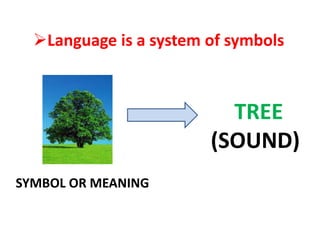
Language is a system of symbols
TREE
(SOUND)
SYMBOL OR MEANING
(SOUND)
SYMBOL OR MEANING
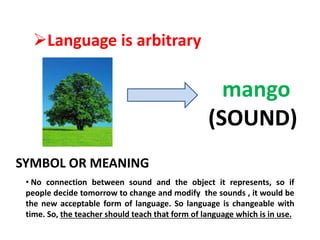
Language is arbitrary
mango
(SOUND)
SYMBOL OR MEANING
• No connection between sound and the object it represents, so if
people decide tomorrow to change and modify the sounds , it would be
the new acceptable form of language. So language is changeable with
time. So, the teacher should teach that form of language which is in use.
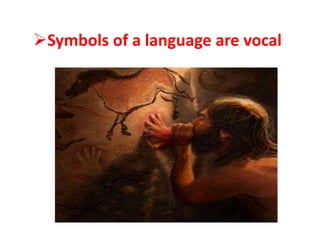
Symbols of a language are vocal
 language is primarily vocal
symbols of language are
meant for speaking
 writing is secondary
representation of language
 speech is basis of language
 Gestures, pictures, signals
etc. all have meaning only if
there is a language operating
So the teacher should teach language using oral-aural
method .
Order of skills i.e. Listening, speaking, reading and
writing, if followed in natural order can make the
learner learn a foreign language as quickly as he learns
his native language.
And teacher can make use maxims of teaching i.e
known to unknown, concrete to abstract etc. for better
learning.
 Language is unique.
 Every language has its own unique structure,
sounds and words
 No language can be learnt resorting the use of
other language
 So, learning of mother tongue may create
problem
 Mother tongue may be used to facilitate learning
of foreign language but total dependence will
hinder mastery over target language
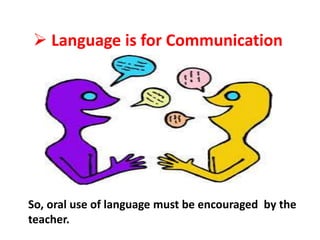
 Language is for Communication
So, oral use of language must be encouraged by the
teacher.
 Language grows out of a culture
Every language has its validity only in its
culture
The words and sounds of a particular
culture has its value, only in its own
atmosphere
If the individuals need some change in
language they can reshape and remodel the
language
 Language grows and changes
Language is not static
 It is dynamic and living as it is
dependent upon cultural change
With new words, sounds and
pronunciation a language is enriched
and a new form
GENERAL PRINCIPLES
FOR
TEACHING
A
FOREIGN LANGUAGE
 Follow the Natural Way
 Fundamental order of Listening,
speaking, reading and writing should
be followed
 providing natural environment in
family and friend circle
It can be done in following ways:
1) Encouraging the students to converse
only in the target language
2) Talking to the students in foreign language
3) Arranging language activities and group
discussions
4) Giving opportunities of practical usage
5)Reading aloud developing into national
sense
6) Following three way process:
1) drill and repetition
2) thinking in foreign language
3) continuous opportunities of usage
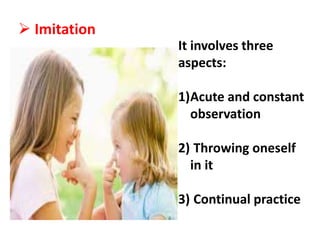
 Imitation
It involves three
aspects:
1)Acute and constant
observation
2) Throwing oneself
in it
3) Continual practice
 Accuracy and correctness
Those words are to be used which impart meaning to
context
Eg: Hurry
Haste
Quickly
And child must be exact in matters of sound ,
expression, intonation ,spellings, sentence patterns
and structures etc.
 Principle of habit formation
•Language is a skill subject
•Can be picked up easily, if we establish
it as a habit
• learner must form habits of speaking,
reading and writing the target language
often
 Principle of controlled vocabulary
•The vocabulary taught and practiced should
only be in the context of real life situations
• efforts should be made to bring the words
from passive vocabulary to child’s active
vocabulary
• Once the learner gets working knowledge of
vocabulary, language patterns should be taught
 Principle of selection
The material should be in accordance with mental age
and should have relevance in real life situations.
 The selection of language items should be based on
the following principles:
1) Frequency of language(how often)
2) Range of applicability(No. of situations)
3) Coverage (How many meaning it conveys)
4) Availability (items convenient to teach and useful)
5) Teachability
6) Learnability
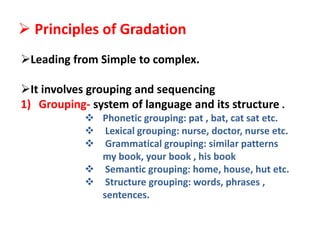
 Principles of Gradation
Leading from Simple to complex.
It involves grouping and sequencing
1) Grouping- system of language and its structure .
 Phonetic grouping: pat , bat, cat sat etc.
 Lexical grouping: nurse, doctor, nurse etc.
 Grammatical grouping: similar patterns
my book, your book , his book
 Semantic grouping: home, house, hut etc.
 Structure grouping: words, phrases ,
sentences.
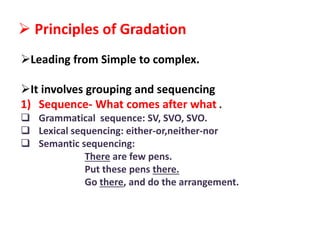
 Principles of Gradation
Leading from Simple to complex.
It involves grouping and sequencing
1) Sequence- What comes after what .
 Grammatical sequence: SV, SVO, SVO.
 Lexical sequencing: either-or,neither-nor
 Semantic sequencing:
There are few pens.
Put these pens there.
Go there, and do the arrangement.
 Multiple line approach: using a variety
of methods
 Intelligent use of mother tongue
 Principle of co-ordination and
proportion
 Principle of language using

Linguistic principles of teaching english

  • 1.
  • 2.
    Language is asystem of symbols TREE (SOUND) SYMBOL OR MEANING
  • 3.
  • 4.
    Language is arbitrary mango (SOUND) SYMBOLOR MEANING • No connection between sound and the object it represents, so if people decide tomorrow to change and modify the sounds , it would be the new acceptable form of language. So language is changeable with time. So, the teacher should teach that form of language which is in use.
  • 5.
    Symbols of alanguage are vocal
  • 6.
     language isprimarily vocal symbols of language are meant for speaking  writing is secondary representation of language  speech is basis of language  Gestures, pictures, signals etc. all have meaning only if there is a language operating
  • 7.
    So the teachershould teach language using oral-aural method . Order of skills i.e. Listening, speaking, reading and writing, if followed in natural order can make the learner learn a foreign language as quickly as he learns his native language. And teacher can make use maxims of teaching i.e known to unknown, concrete to abstract etc. for better learning.
  • 8.
  • 9.
     Every languagehas its own unique structure, sounds and words  No language can be learnt resorting the use of other language  So, learning of mother tongue may create problem  Mother tongue may be used to facilitate learning of foreign language but total dependence will hinder mastery over target language
  • 10.
     Language isfor Communication So, oral use of language must be encouraged by the teacher.
  • 11.
     Language growsout of a culture
  • 12.
    Every language hasits validity only in its culture The words and sounds of a particular culture has its value, only in its own atmosphere If the individuals need some change in language they can reshape and remodel the language
  • 13.
     Language growsand changes Language is not static  It is dynamic and living as it is dependent upon cultural change With new words, sounds and pronunciation a language is enriched and a new form
  • 14.
  • 15.
     Follow theNatural Way  Fundamental order of Listening, speaking, reading and writing should be followed  providing natural environment in family and friend circle It can be done in following ways:
  • 16.
    1) Encouraging thestudents to converse only in the target language 2) Talking to the students in foreign language
  • 17.
    3) Arranging languageactivities and group discussions
  • 18.
    4) Giving opportunitiesof practical usage 5)Reading aloud developing into national sense 6) Following three way process: 1) drill and repetition 2) thinking in foreign language 3) continuous opportunities of usage
  • 19.
     Imitation It involvesthree aspects: 1)Acute and constant observation 2) Throwing oneself in it 3) Continual practice
  • 20.
     Accuracy andcorrectness Those words are to be used which impart meaning to context Eg: Hurry Haste Quickly And child must be exact in matters of sound , expression, intonation ,spellings, sentence patterns and structures etc.
  • 21.
     Principle ofhabit formation •Language is a skill subject •Can be picked up easily, if we establish it as a habit • learner must form habits of speaking, reading and writing the target language often
  • 22.
     Principle ofcontrolled vocabulary •The vocabulary taught and practiced should only be in the context of real life situations • efforts should be made to bring the words from passive vocabulary to child’s active vocabulary • Once the learner gets working knowledge of vocabulary, language patterns should be taught
  • 23.
     Principle ofselection The material should be in accordance with mental age and should have relevance in real life situations.  The selection of language items should be based on the following principles: 1) Frequency of language(how often) 2) Range of applicability(No. of situations) 3) Coverage (How many meaning it conveys) 4) Availability (items convenient to teach and useful) 5) Teachability 6) Learnability
  • 24.
     Principles ofGradation Leading from Simple to complex. It involves grouping and sequencing 1) Grouping- system of language and its structure .  Phonetic grouping: pat , bat, cat sat etc.  Lexical grouping: nurse, doctor, nurse etc.  Grammatical grouping: similar patterns my book, your book , his book  Semantic grouping: home, house, hut etc.  Structure grouping: words, phrases , sentences.
  • 25.
     Principles ofGradation Leading from Simple to complex. It involves grouping and sequencing 1) Sequence- What comes after what .  Grammatical sequence: SV, SVO, SVO.  Lexical sequencing: either-or,neither-nor  Semantic sequencing: There are few pens. Put these pens there. Go there, and do the arrangement.
  • 26.
     Multiple lineapproach: using a variety of methods  Intelligent use of mother tongue  Principle of co-ordination and proportion  Principle of language using