UNIVERSIDAD PEDAGÓGICA EXPERIMENTAL LIBERTADOR INSTITUTO PEDAGÓGICO DE CARACAS DEPARTAMENTO DE IDIOMAS MODERNOS CÁTEDRA DE LINGÜÍSTICA METODOLOGÍA  ILE Caracas, April 2011 Prof. Mirna Quintero Prof. Carla Borges
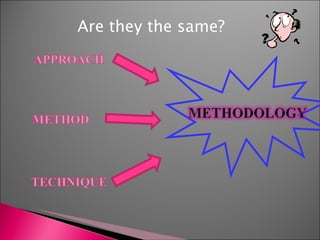
Are they the same?
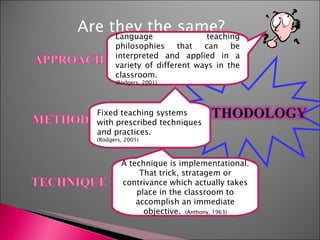
Are they the same? Language teaching philosophies that can be interpreted and applied in a variety of different ways in the classroom. (Rodgers, 2001) Fixed teaching systems with prescribed techniques and practices. (Rodgers, 2001) A technique is implementational. That trick, stratagem or contrivance which actually takes place in the classroom to accomplish an immediate objective.  (Anthony, 1963)
 
L2 is learned to read  and translate literary texts Speaking and listening skills are neglected Vocabulary: based on the texts used Sentence: basic unit of teaching and language practice Grammar: taught deductively L1: basic medium of instruction Johann Seidenstücker,  Karl Plötz,  H.S Ollendorf,  Johann Meidinger
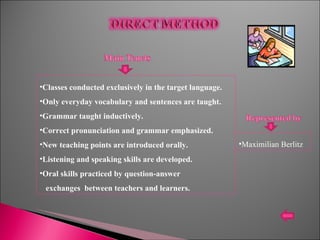
Classes conducted exclusively in the target language. Only everyday vocabulary and sentences are taught. Grammar taught inductively. Correct pronunciation and grammar emphasized. New teaching points are introduced orally. Listening and speaking skills are developed. Oral skills practiced by question-answer  exchanges  between teachers and learners. Maximilian Berlitz
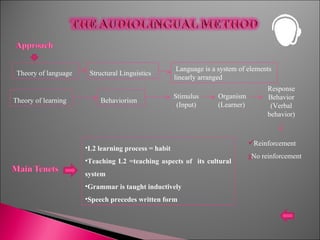
L2 learning process = habit Teaching L2 =teaching aspects of  its cultural system Grammar is taught inductively Speech precedes written form Theory of language  Structural Linguistics  Language is a system of elements linearly arranged Reinforcement No reinforcement Theory of learning  Behaviorism Stimulus (Input) Organism (Learner) Response Behavior (Verbal behavior)
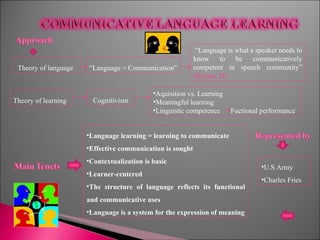
U.S Army Charles Fries “ Language is what a speaker needs to know to be communicatively competent in speech community”  (Hymes, D) Theory of language  “ Language = Communication” Theory of learning  Cognitivism Aquisition vs. Learning Meaningful learning Linguistic competence  Fuctional performance Language learning = learning to communicate Effective communication is sought Contextualization is basic Learner-centered The structure of language reflects its functional and communicative uses Language is a system for the expression of meaning
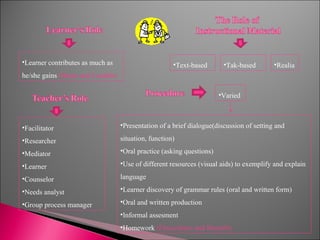
Learner contributes as much as he/she gains  (Breen and Candlin) Text-based Facilitator Researcher Mediator Learner Counselor Needs analyst Group process manager Varied Tak-based Realia Presentation of a brief dialogue(discussion of setting and situation, function) Oral practice (asking questions) Use of different resources (visual aids) to exemplify and explain language Learner discovery of grammar rules (oral and written form) Oral and written production Informal assesment Homework  (Finocchiaro and Brumfit)
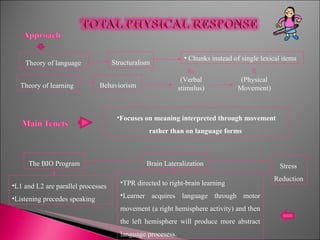
Focuses on meaning interpreted through movement rather than on language forms  L1 and L2 are parallel processes Listening precedes speaking TPR directed to right-brain learning Learner acquires language through motor movement (a right hemisphere activity) and then the left hemisphere will produce more abstract language procesess. Stress  Reduction The BIO Program Brain Lateralization Theory of language  Structuralism Chunks instead of single lexical items Theory of learning  Behaviorism Sv (Verbal stimulus) R (Physical Movement)
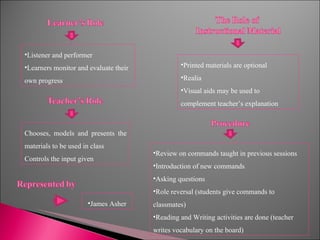
Listener and performer Learners monitor and evaluate their own progress Chooses, models and presents the materials to be used in class Controls the input given Printed materials are optional Realia Visual aids may be used to complement teacher’s explanation Review on commands taught in previous sessions Introduction of new commands Asking questions Role reversal (students give commands to classmates) Reading and Writing activities are done (teacher writes vocabulary on the board) James Asher
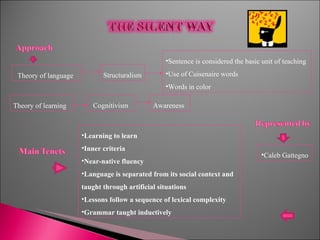
Learning to learn Inner criteria Near-native fluency Language is separated from its social context and taught through artificial situations Lessons follow a sequence of lexical complexity Grammar taught inductively Caleb Gattegno Theory of language  Structuralism Sentence is considered the basic unit of teaching Use of Cuisenaire words Words in color  Theory of learning  Cognitivism Awareness
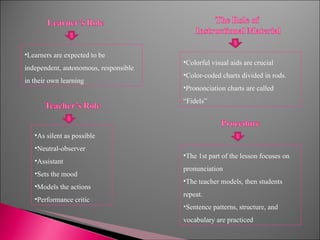
Learners are expected to be independent, autonomous, responsible in their own learning As silent as possible Neutral-observer Assistant Sets the mood Models the actions Performance critic Colorful visual aids are crucial Color-coded charts divided in rods. Prononciation charts are called “Fidels” The 1st part of the lesson focuses on pronunciation The teacher models, then students repeat. Sentence patterns, structure, and vocabulary are practiced
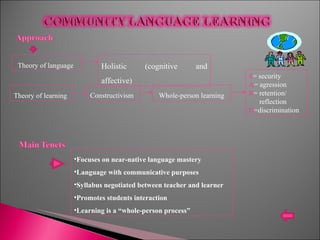
Focuses on near-native language mastery Language with communicative purposes Syllabus negotiated between teacher and learner Promotes students interaction Learning is a “whole-person process” Theory of learning  Constructivism Whole-person learning S = security A = agression R = retention/ reflection D =discrimination Theory of language  Holistic (cognitive and affective)
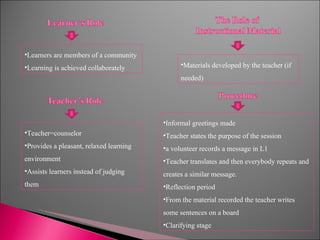
Learners are members of a community Learning is achieved collaborately Teacher=counselor Provides a pleasant, relaxed learning environment Assists learners instead of judging them Materials developed by the teacher (if needed) Informal greetings made Teacher states the purpose of the session a volunteer records a message in L1 Teacher translates and then everybody repeats and creates a similar message. Reflection period From the material recorded the teacher writes some sentences on a board Clarifying stage
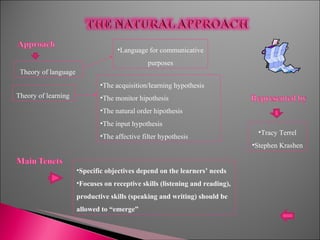
Specific objectives depend on the learners’ needs Focuses on receptive skills (listening and reading), productive skills (speaking and writing) should be allowed to “emerge” Tracy Terrel Stephen Krashen Theory of language  Language for communicative purposes Theory of learning  The acquisition/learning hypothesis The monitor hipothesis The natural order hipothesis The input hypothesis The affective filter hypothesis
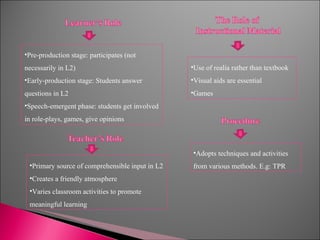
Pre-production stage: participates (not necessarily in L2) Early-production stage: Students answer questions in L2 Speech-emergent phase: students get involved in role-plays, games, give opinions Primary source of comprehensible input in L2 Creates a friendly atmosphere Varies classroom activities to promote meaningful learning Use of realia rather than textbook Visual aids are essential Games Adopts techniques and activities from various methods. E.g: TPR
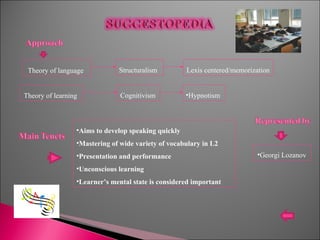
Aims to develop speaking quickly Mastering of wide variety of vocabulary in L2 Presentation and performance Unconscious learning Learner’s mental state is considered important Georgi Lozanov Theory of language  Structuralism Lexis centered/memorization Theory of learning  Cognitivism Hypnotism
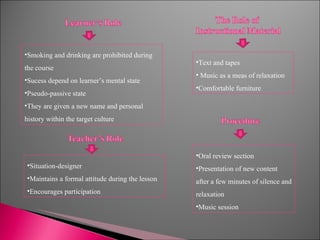
Smoking and drinking are prohibited during the course Sucess depend on learner’s mental state Pseudo-passive state They are given a new name and personal history within the target culture Situation-designer Maintains a formal attitude during the lesson Encourages participation Text and tapes Music as a meas of relaxation Comfortable furniture Oral review section Presentation of new content after a few minutes of silence and relaxation Music session
Anthony, E. (1963)  ELT Journal. XVII (2): 63-67.  Approach ,Method, and Technique . Richards, J ; Rodgers, T.  “Approaches and Methods in Language Teaching”  5th ed.1989. Melbourne. Cambridge University Press Rodgers, T.  (2001)  Language Teaching Methodology.  Online Resources. Issue Paper. Consulted on-line:  http://www.cal.org/resources/digest/rodgers.html Stern, H.  “Fundamental Concepts of Language Teaching”  2nd ed. 1984. London Oxford University Press
 

Methods and Approaches (Introduction to the course)

  • 1.
    UNIVERSIDAD PEDAGÓGICA EXPERIMENTALLIBERTADOR INSTITUTO PEDAGÓGICO DE CARACAS DEPARTAMENTO DE IDIOMAS MODERNOS CÁTEDRA DE LINGÜÍSTICA METODOLOGÍA ILE Caracas, April 2011 Prof. Mirna Quintero Prof. Carla Borges
  • 2.
  • 3.
    Are they thesame? Language teaching philosophies that can be interpreted and applied in a variety of different ways in the classroom. (Rodgers, 2001) Fixed teaching systems with prescribed techniques and practices. (Rodgers, 2001) A technique is implementational. That trick, stratagem or contrivance which actually takes place in the classroom to accomplish an immediate objective. (Anthony, 1963)
  • 4.
  • 5.
    L2 is learnedto read and translate literary texts Speaking and listening skills are neglected Vocabulary: based on the texts used Sentence: basic unit of teaching and language practice Grammar: taught deductively L1: basic medium of instruction Johann Seidenstücker, Karl Plötz, H.S Ollendorf, Johann Meidinger
  • 6.
    Classes conducted exclusivelyin the target language. Only everyday vocabulary and sentences are taught. Grammar taught inductively. Correct pronunciation and grammar emphasized. New teaching points are introduced orally. Listening and speaking skills are developed. Oral skills practiced by question-answer exchanges between teachers and learners. Maximilian Berlitz
  • 7.
    L2 learning process= habit Teaching L2 =teaching aspects of its cultural system Grammar is taught inductively Speech precedes written form Theory of language Structural Linguistics Language is a system of elements linearly arranged Reinforcement No reinforcement Theory of learning Behaviorism Stimulus (Input) Organism (Learner) Response Behavior (Verbal behavior)
  • 8.
    U.S Army CharlesFries “ Language is what a speaker needs to know to be communicatively competent in speech community” (Hymes, D) Theory of language “ Language = Communication” Theory of learning Cognitivism Aquisition vs. Learning Meaningful learning Linguistic competence Fuctional performance Language learning = learning to communicate Effective communication is sought Contextualization is basic Learner-centered The structure of language reflects its functional and communicative uses Language is a system for the expression of meaning
  • 9.
    Learner contributes asmuch as he/she gains (Breen and Candlin) Text-based Facilitator Researcher Mediator Learner Counselor Needs analyst Group process manager Varied Tak-based Realia Presentation of a brief dialogue(discussion of setting and situation, function) Oral practice (asking questions) Use of different resources (visual aids) to exemplify and explain language Learner discovery of grammar rules (oral and written form) Oral and written production Informal assesment Homework (Finocchiaro and Brumfit)
  • 10.
    Focuses on meaninginterpreted through movement rather than on language forms L1 and L2 are parallel processes Listening precedes speaking TPR directed to right-brain learning Learner acquires language through motor movement (a right hemisphere activity) and then the left hemisphere will produce more abstract language procesess. Stress Reduction The BIO Program Brain Lateralization Theory of language Structuralism Chunks instead of single lexical items Theory of learning Behaviorism Sv (Verbal stimulus) R (Physical Movement)
  • 11.
    Listener and performerLearners monitor and evaluate their own progress Chooses, models and presents the materials to be used in class Controls the input given Printed materials are optional Realia Visual aids may be used to complement teacher’s explanation Review on commands taught in previous sessions Introduction of new commands Asking questions Role reversal (students give commands to classmates) Reading and Writing activities are done (teacher writes vocabulary on the board) James Asher
  • 12.
    Learning to learnInner criteria Near-native fluency Language is separated from its social context and taught through artificial situations Lessons follow a sequence of lexical complexity Grammar taught inductively Caleb Gattegno Theory of language Structuralism Sentence is considered the basic unit of teaching Use of Cuisenaire words Words in color Theory of learning Cognitivism Awareness
  • 13.
    Learners are expectedto be independent, autonomous, responsible in their own learning As silent as possible Neutral-observer Assistant Sets the mood Models the actions Performance critic Colorful visual aids are crucial Color-coded charts divided in rods. Prononciation charts are called “Fidels” The 1st part of the lesson focuses on pronunciation The teacher models, then students repeat. Sentence patterns, structure, and vocabulary are practiced
  • 14.
    Focuses on near-nativelanguage mastery Language with communicative purposes Syllabus negotiated between teacher and learner Promotes students interaction Learning is a “whole-person process” Theory of learning Constructivism Whole-person learning S = security A = agression R = retention/ reflection D =discrimination Theory of language Holistic (cognitive and affective)
  • 15.
    Learners are membersof a community Learning is achieved collaborately Teacher=counselor Provides a pleasant, relaxed learning environment Assists learners instead of judging them Materials developed by the teacher (if needed) Informal greetings made Teacher states the purpose of the session a volunteer records a message in L1 Teacher translates and then everybody repeats and creates a similar message. Reflection period From the material recorded the teacher writes some sentences on a board Clarifying stage
  • 16.
    Specific objectives dependon the learners’ needs Focuses on receptive skills (listening and reading), productive skills (speaking and writing) should be allowed to “emerge” Tracy Terrel Stephen Krashen Theory of language Language for communicative purposes Theory of learning The acquisition/learning hypothesis The monitor hipothesis The natural order hipothesis The input hypothesis The affective filter hypothesis
  • 17.
    Pre-production stage: participates(not necessarily in L2) Early-production stage: Students answer questions in L2 Speech-emergent phase: students get involved in role-plays, games, give opinions Primary source of comprehensible input in L2 Creates a friendly atmosphere Varies classroom activities to promote meaningful learning Use of realia rather than textbook Visual aids are essential Games Adopts techniques and activities from various methods. E.g: TPR
  • 18.
    Aims to developspeaking quickly Mastering of wide variety of vocabulary in L2 Presentation and performance Unconscious learning Learner’s mental state is considered important Georgi Lozanov Theory of language Structuralism Lexis centered/memorization Theory of learning Cognitivism Hypnotism
  • 19.
    Smoking and drinkingare prohibited during the course Sucess depend on learner’s mental state Pseudo-passive state They are given a new name and personal history within the target culture Situation-designer Maintains a formal attitude during the lesson Encourages participation Text and tapes Music as a meas of relaxation Comfortable furniture Oral review section Presentation of new content after a few minutes of silence and relaxation Music session
  • 20.
    Anthony, E. (1963) ELT Journal. XVII (2): 63-67. Approach ,Method, and Technique . Richards, J ; Rodgers, T. “Approaches and Methods in Language Teaching” 5th ed.1989. Melbourne. Cambridge University Press Rodgers, T. (2001) Language Teaching Methodology. Online Resources. Issue Paper. Consulted on-line: http://www.cal.org/resources/digest/rodgers.html Stern, H. “Fundamental Concepts of Language Teaching” 2nd ed. 1984. London Oxford University Press
  • 21.