The Nature of Approaches and methods in Language.pptx
1.
The Nature ofApproaches and
methods in Language Teaching
Dyah Ayu N
2.
According to EdwardAnthony
An approach: a set of correlative assumptions dealing
with the nature of language teaching and learning
(axiomatic).
A method: an overall plan for the orderly presentation
based on an approach. It is procedural (theory put into
practice).
A technique: implementational.Techniques carry out a
method which is consistent with an approach (trick,
stratagem).
To improvethe quality of language teaching, linguists and
language specialists refer to general principles and
theories concerning on:
How language are learned
How knowledge of language is represented and organized in
memory
How language itself is structured
5.
A. Theory oflanguage
Theories of the nature of language and the nature of
language proficiency/competence explicitly or implicitly
inform current approaches and methods in language
teaching.
6.
1. Cognitive View
Based on the idea based that language reflects properties
of the mind.
Core features and assumptions (Atkinson, 2011:4- 5): a.
Mind as a computer: input, process it, and produce
output, as with a computer b. Representationalism: mind
engages in to store internal representations of external
events c. Learning: abstract knowledge acquisition - i.e.
abstracting the rules of the competence that underlies
linguistic performance, as Noam Chomsky put it.
Example:The Grammar-Translation Method
7.
2. Structural View
Language is a system of structurally related elements
for the coding of meaning.
The target of language learning: the mastery of
language elements (phonological units, e.g., phonemes;
grammatical units, e.g. clauses, phrases, sentences;
grammatical operations and lexical items, e.g. function
words and structure words).
Example: the Audio-lingual Method,Total Physical
Response, and Silent Way.
8.
3. Functional View
Language is a vehicle for the expression of functional
meaning.
This theory emphasizes the semantic and communicative
dimension, rather than grammar and structure. Meaning
and functions are important.
E.g. ESP, Notional Syllabus (topics, functions, notions)
9.
Brown (1994:227) defines that communicative purposes
are “aspect(s) of our competence which enables us to
convey and interpret messages and to negotiate meanings
interpersonally within specific contexts ... [The]
knowledge that enables a person to communicate
functionally and interactionally”.
Examples: Communicative Approach, Competency-Based
LT,Threshold Level syllabus (e.g., Common European
Framework of Reference/CEFR)
10.
4. Interactional View
Language is vehicle for the realization of interpersonal
relations and for the performance of social transactions
between individuals a tool for creation and
maintenance of social relations.
Focus on patters of moves, acts, negotiation, interaction in
conversational exchanges.
11.
Rivers (1987: 4)defined the interactive
perspective in language education:
"Students achieve facility in using a language when their
attention is focused on conveying and receiving authentic
messages (that is, messages that contain information of
interest to both speaker and listener in a situation of
importance to both).“
Thus, negotiation of meaning is believed to play a central
role in interactive views of language
12.
5. Sociocultural View
A related view of language is referred to as a sociocultural
model. Sociocultural theory views language as a
communicative activity in which the social context is
central.
Knowledge is constructed through social interaction with
others and reflects the learner's culture, customs, and
beliefs as well as the collaborative activities people are
engaged in.
Example:Task-Based Language Teaching, Content-Based
Instruction, and Cooperative Language Learning.
13.
6. Genre View
Another functional model of language is the genre
based approach.
Genre refers to an area of human activity: norms of
language usage, such as in science, business, medicine,
literature. Texts are the units of discourse that occur
in different genres such as narratives, descriptions,and
explanations
14.
The mainconcepts can be summarized as follows (Feet,1998:
5):
Language is a resource for making meaning.
The resource of language consists of a set of interrelated systems.
Language users draw on this resource each time they use language.
Language users create texts to create meaning.
Texts are shaped by the social context in which they are used.
The social context is shaped by the people using language
Examples:Text-Based Instruction, Content-Based Instruction,
English for Specific Purposes and, English for Academic
Purposes
15.
7. Lexical View
The lexical view of language prioritizes the role of lexis and
lexical chunks or phrases in language and highlights the
interrelatedness of grammar and vocabulary.
Rather than seeing lexis and grammar as discrete.They are
viewed as being intrinsically related (Schmitt 2004; O’Keefe,
McCarthy, and Carter 2007).
The role and the interrelatedness of lexis and lexical chunks
or phrases in language.
Grammatical competence arises out of phrase- and lexically-
based learning .
A greater role for vocabulary as well as lexical phrases and
chunks in language teaching.
16.
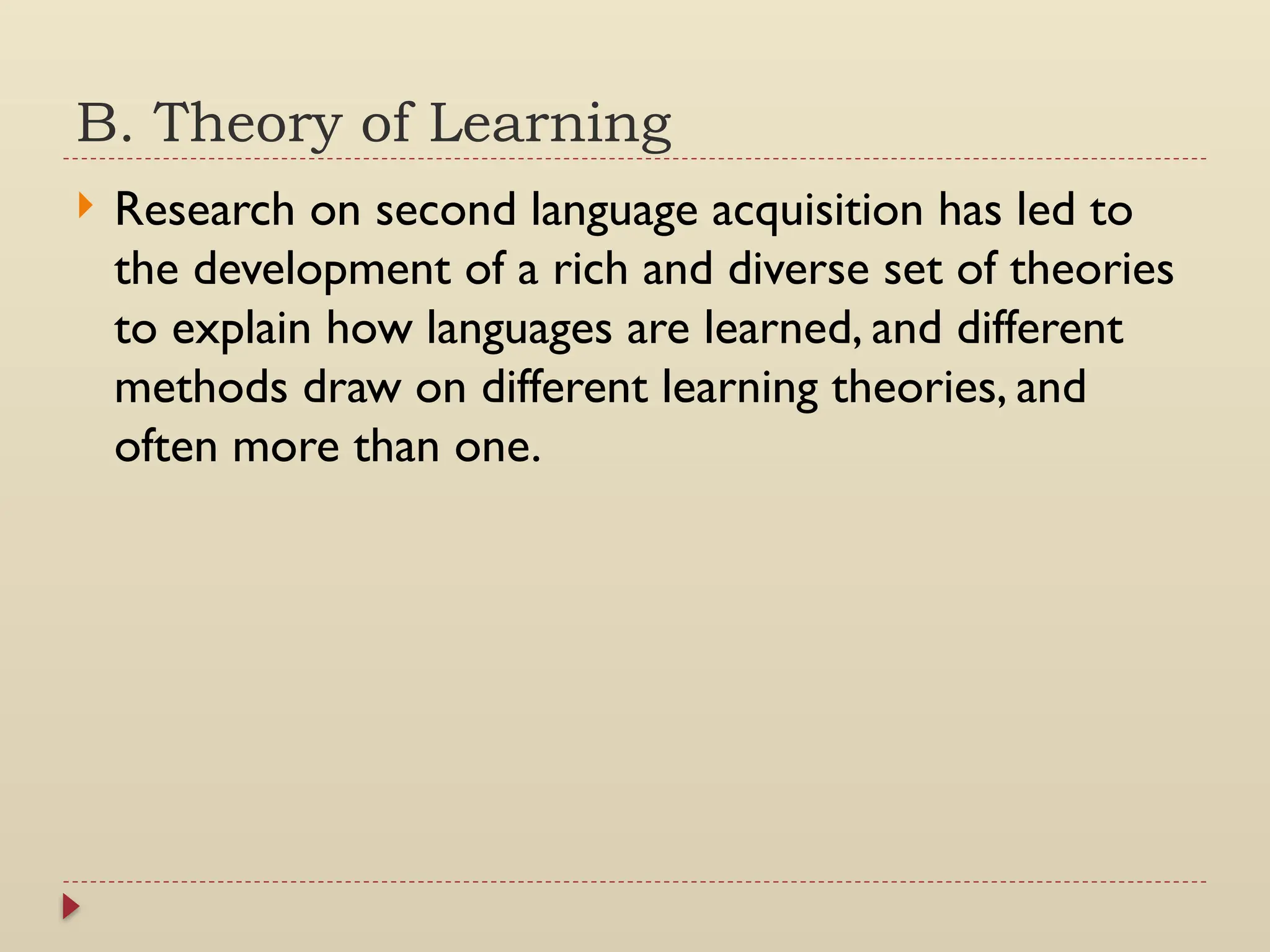
B. Theory ofLearning
Research on second language acquisition has led to
the development of a rich and diverse set of theories
to explain how languages are learned, and different
methods draw on different learning theories, and
often more than one.
17.
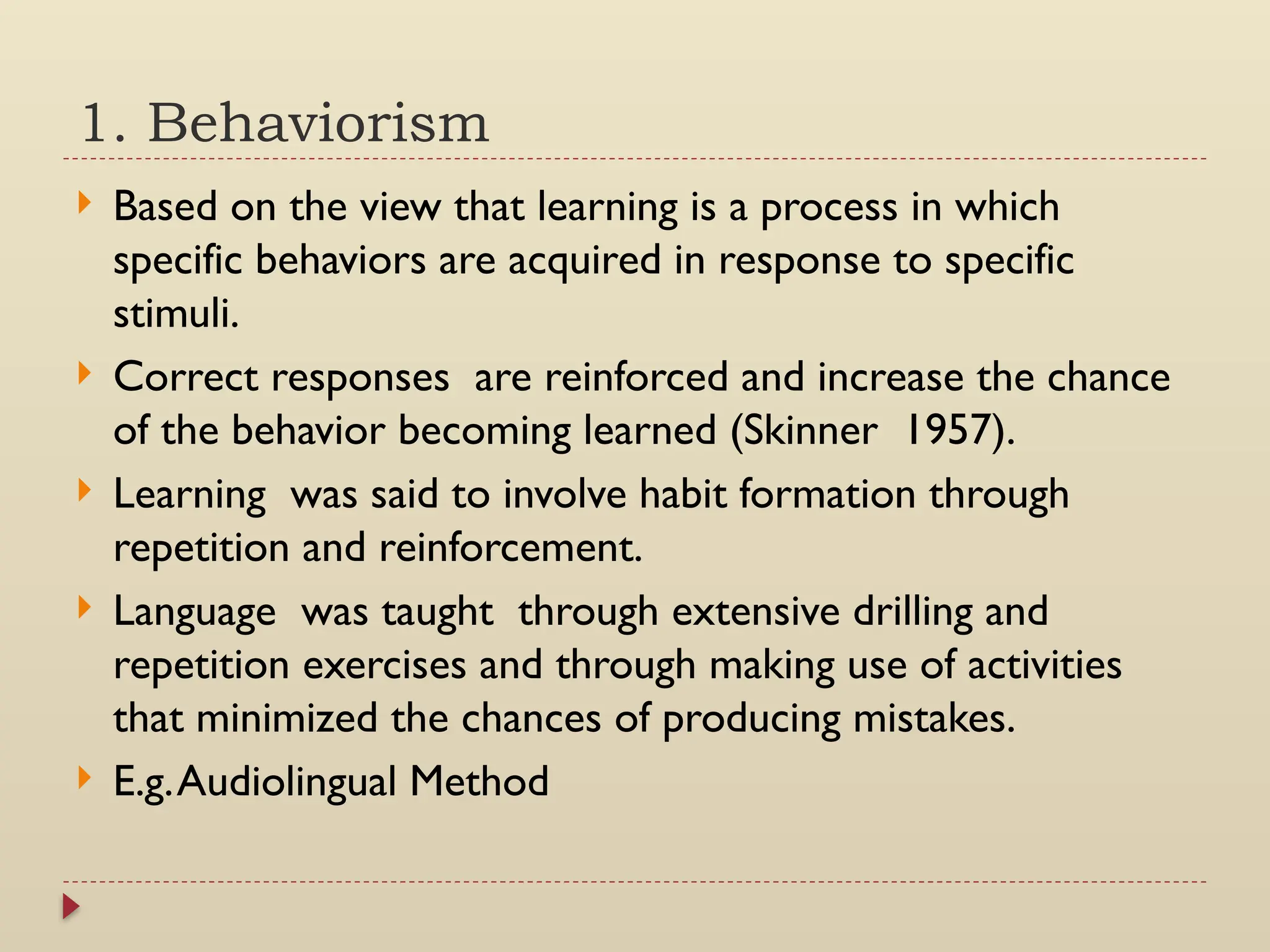
1. Behaviorism
Basedon the view that learning is a process in which
specific behaviors are acquired in response to specific
stimuli.
Correct responses are reinforced and increase the chance
of the behavior becoming learned (Skinner 1957).
Learning was said to involve habit formation through
repetition and reinforcement.
Language was taught through extensive drilling and
repetition exercises and through making use of activities
that minimized the chances of producing mistakes.
E.g.Audiolingual Method
18.
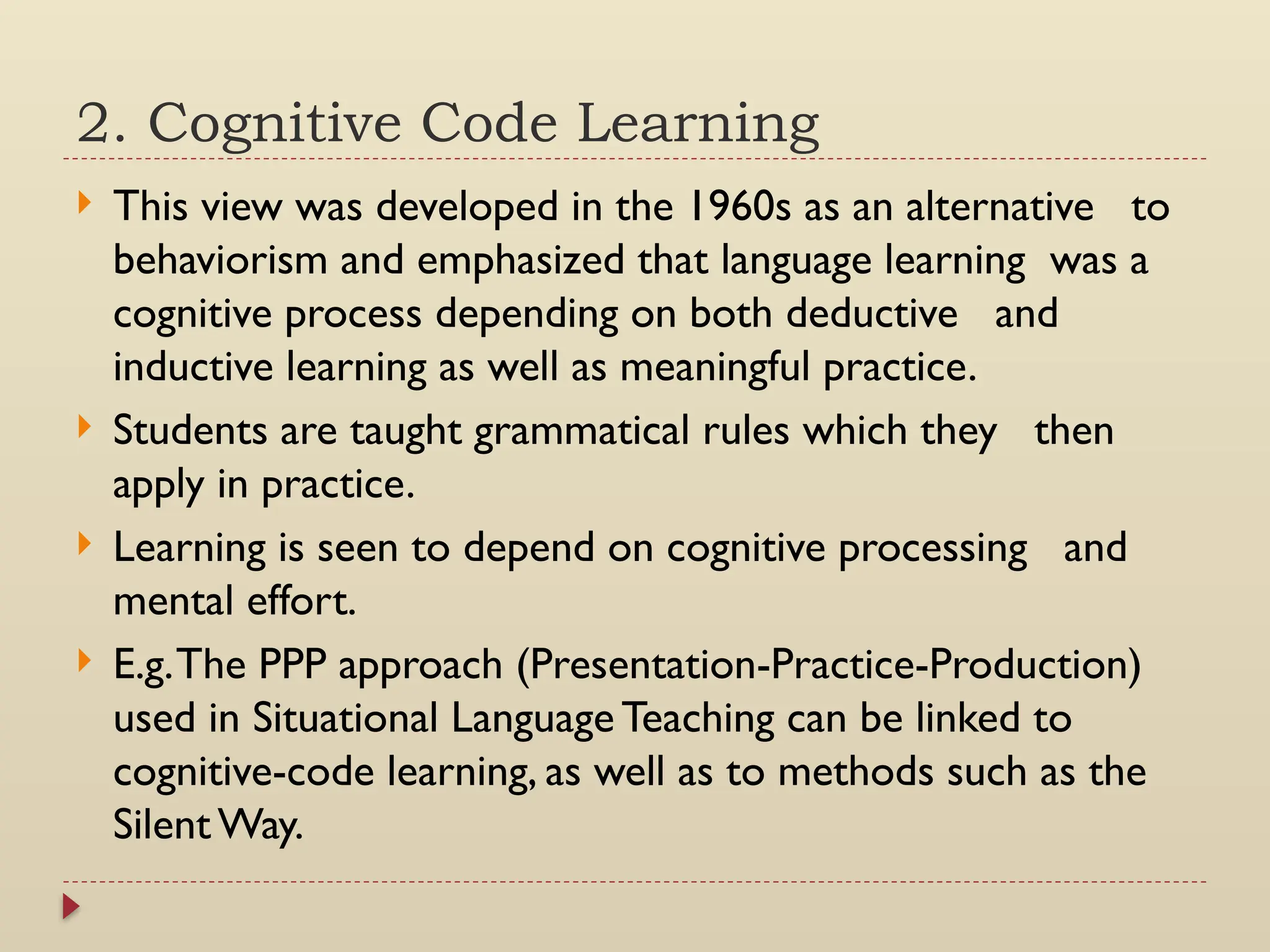
2. Cognitive CodeLearning
This view was developed in the 1960s as an alternative to
behaviorism and emphasized that language learning was a
cognitive process depending on both deductive and
inductive learning as well as meaningful practice.
Students are taught grammatical rules which they then
apply in practice.
Learning is seen to depend on cognitive processing and
mental effort.
E.g.The PPP approach (Presentation-Practice-Production)
used in Situational Language Teaching can be linked to
cognitive-code learning, as well as to methods such as the
Silent Way.
19.
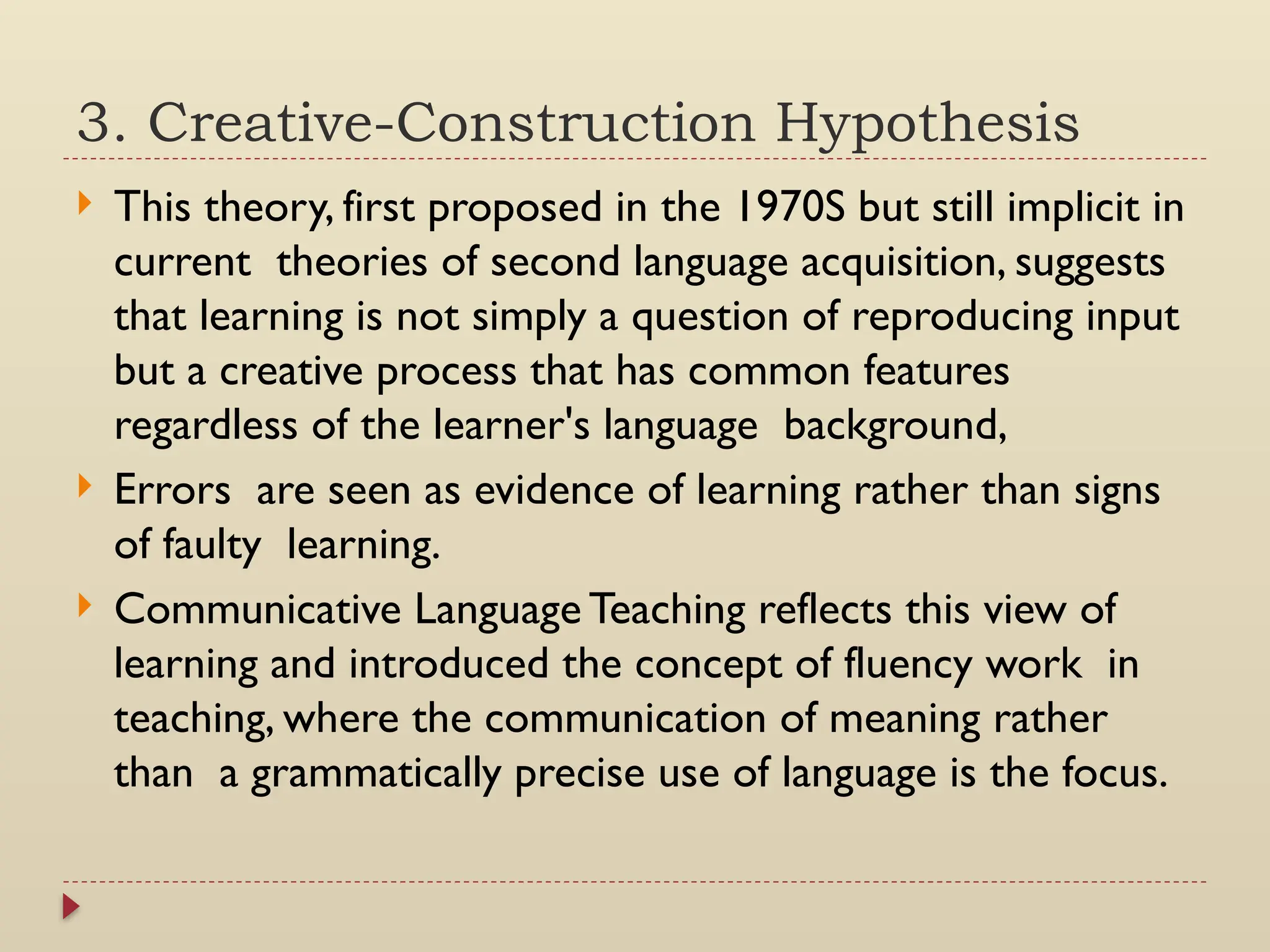
3. Creative-Construction Hypothesis
This theory, first proposed in the 1970S but still implicit in
current theories of second language acquisition, suggests
that learning is not simply a question of reproducing input
but a creative process that has common features
regardless of the learner's language background,
Errors are seen as evidence of learning rather than signs
of faulty learning.
Communicative Language Teaching reflects this view of
learning and introduced the concept of fluency work in
teaching, where the communication of meaning rather
than a grammatically precise use of language is the focus.
20.
4. Skill learning
Skills are integrated sets of behaviors that are learned
through practice.
They are made up of individual components that may be
learned separately and that come together as a whole to
constitute skilled performance.
Learning involves development from controlled to
automatic processing, that is, the cumulative learning of
skills. Many language teaching methods treat language
learning, at least in part, as skill-based learning.
21.
5. Interactional Theory
Central to this view of learning is the concept of negotiation of
meaning - the modification of input learners receive when they
communicate with more advanced learners or native speakers and the
kind of feedback they receive from their interlocutors.
More competent speakers will typically modify their input by using
known vocabulary, speaking more slowly, saying things in different
ways, adjusting the topic, avoiding idioms, using a slower rate of
speech, using stress on key words, repeating key elements, using
simpler grammatical structures, paraphrasing and elaborating, and so
on.
In this way modified input facilitates both understanding and learning.
E.g. Both Communicative Language Teaching and Task-Based Language
Teaching reflect aspects of interactional theory.
22.
6. Constructivism
Itdraws on the work of Jean Piaget and John Dewey on child development
as well as on the work of LevVygotsky.
Learning is seen as something that results from the learner's internal
construction of meaning (Williams and Burden 1997).
Constructivism emphasizes that learners are actively involved in their own
process of learning. It is a dynamic process that has both cognitive
dimensions, as the organizer reorganizes new knowledge on the basis of
existing knowledge, and social dimensions, as the learner interacts with
others and solves problems through dialogue.
Constructivist approaches to learning emphasize student-centered and
project- based learning where students pose questions, explore multiple
interpretations of meaning, and where the teacher acts as facilitator and
guide
E.g Communicative Language Teaching, Community Language Learning,
Cooperative Language Learning and Whole Language.
23.
7. Sociocultural learningtheory (also known
as social constructivism)
This theory can be seen as an extension of both constructivism
and interactional theory and views language learning as resulting
from dialogue between a learner and a more knowledgeable
other person.
The term sociocultural means that learning takes place in a
particular social setting (e.g. a classroom).
Scaffolding plays an important part in sociocultual learning
theory (Lave and Wenger 1991).
During the process, interaction proceeds as a kind of joint
problem-solving activity, collaborative dialogue between teacher
and student.
E.g. CLIL and text-based and task-based instruction, attribute an
important role to the process of scaffolded learning.
24.
8. Individual Factors
The attributes individual learners bring to language learning can also have
an important influence on learning, and teaching methods
These include learning style preferences (such as whether a learner likes
to learn in groups or prefers learning alone); affective factors such as
shyness, anxiety, enthusiasm, and other emotions that language learning
may elicit and that may influence the learner's willingness to
communicate; motivation, which refers to the learner's attitude, desire,
interest in, and willingness to invest effort in learning a second language;
learning strategies - the ways in which learners plan, manage, and evaluate
their own learning.
E.g. enhancing motivation through the choice of content (Content-Based
Instruction); by delaying speaking and focusing on comprehension skills in
an introductory language course in order to address the issue of anxiety
(Natural Approach); or by using group-based learning (Cooperative
Language Learning).
25.
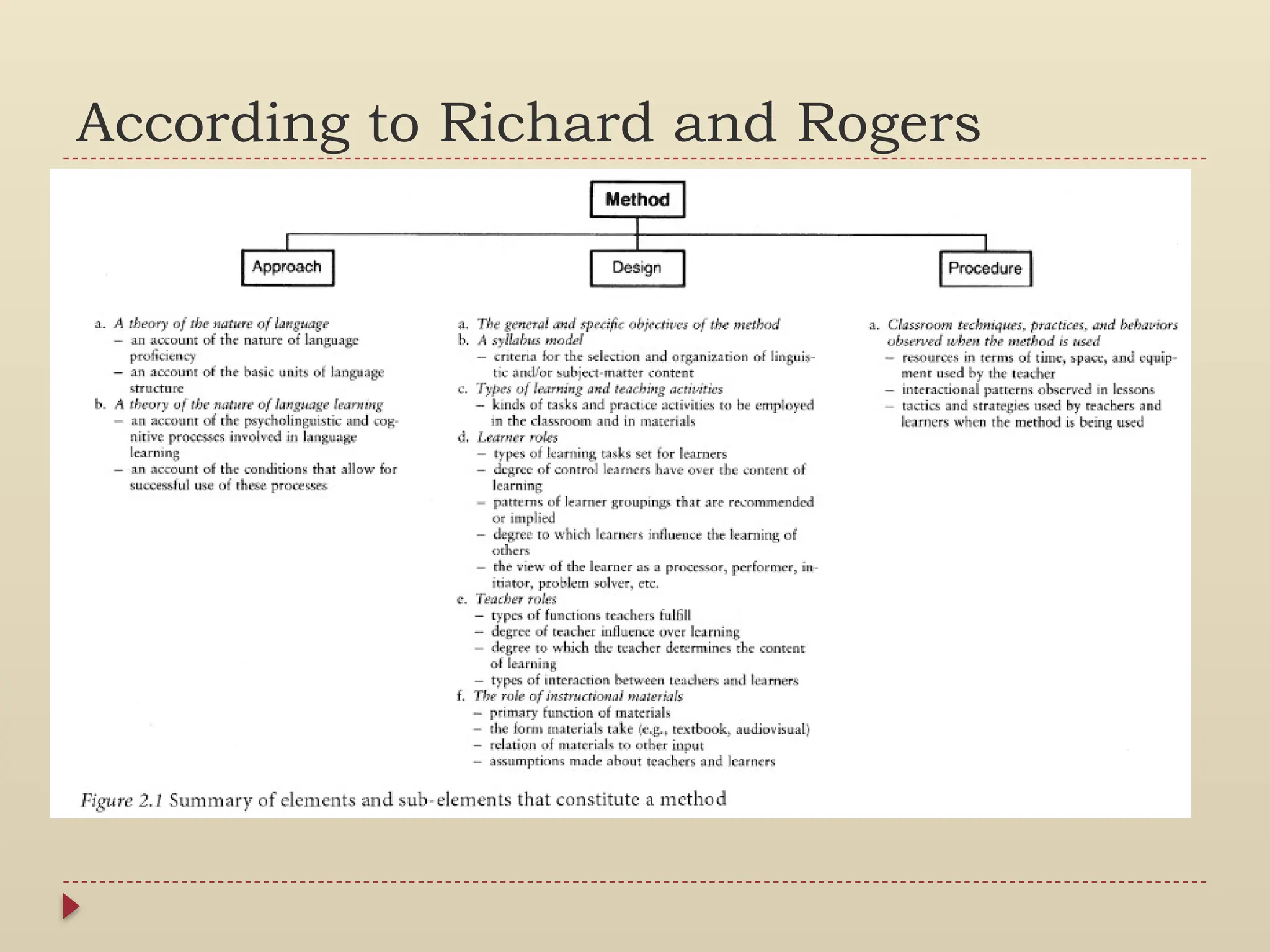
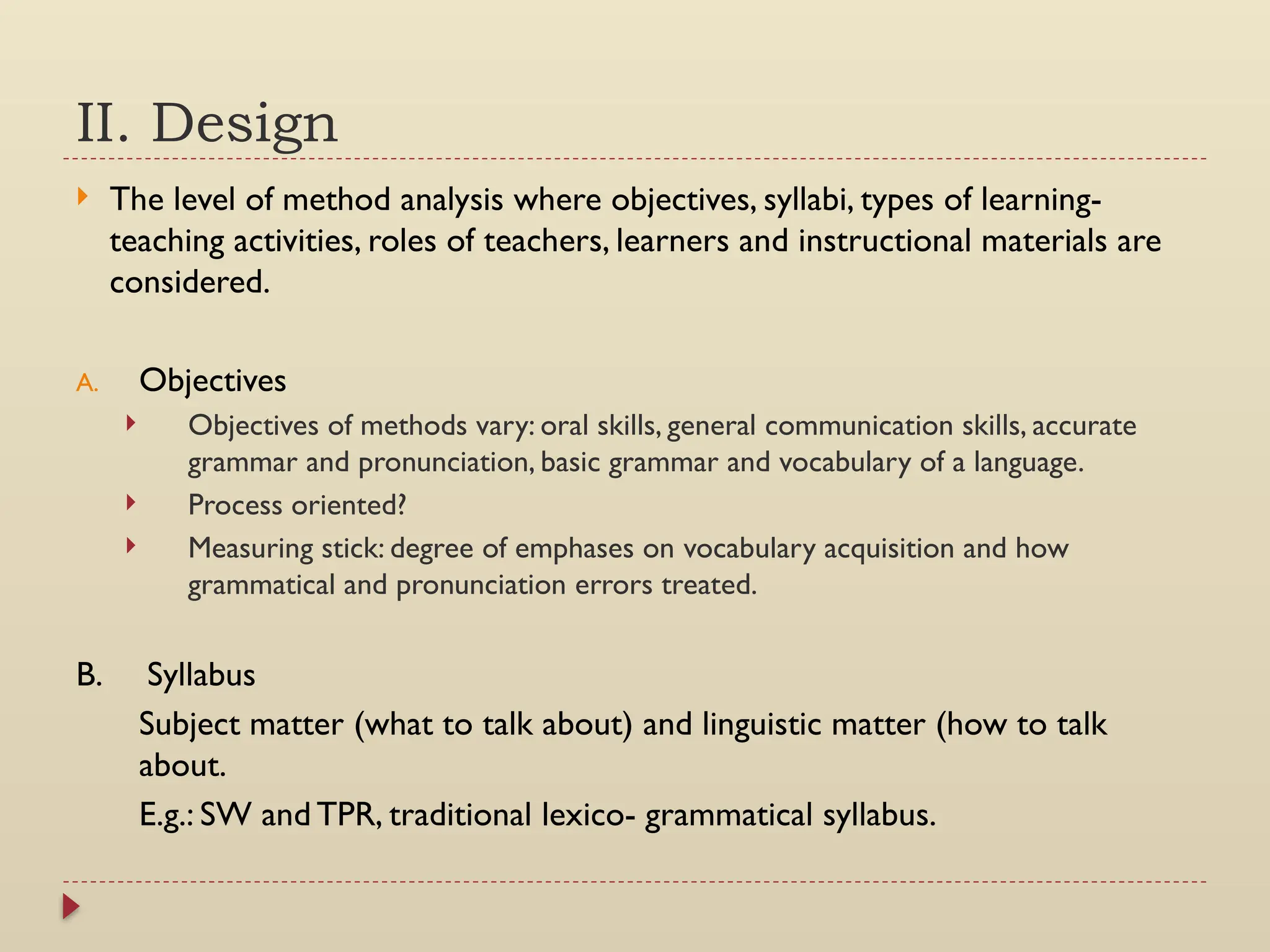
II. Design
Thelevel of method analysis where objectives, syllabi, types of learning-
teaching activities, roles of teachers, learners and instructional materials are
considered.
A. Objectives
Objectives of methods vary: oral skills, general communication skills, accurate
grammar and pronunciation, basic grammar and vocabulary of a language.
Process oriented?
Measuring stick: degree of emphases on vocabulary acquisition and how
grammatical and pronunciation errors treated.
B. Syllabus
Subject matter (what to talk about) and linguistic matter (how to talk
about.
E.g.: SW and TPR, traditional lexico- grammatical syllabus.
26.
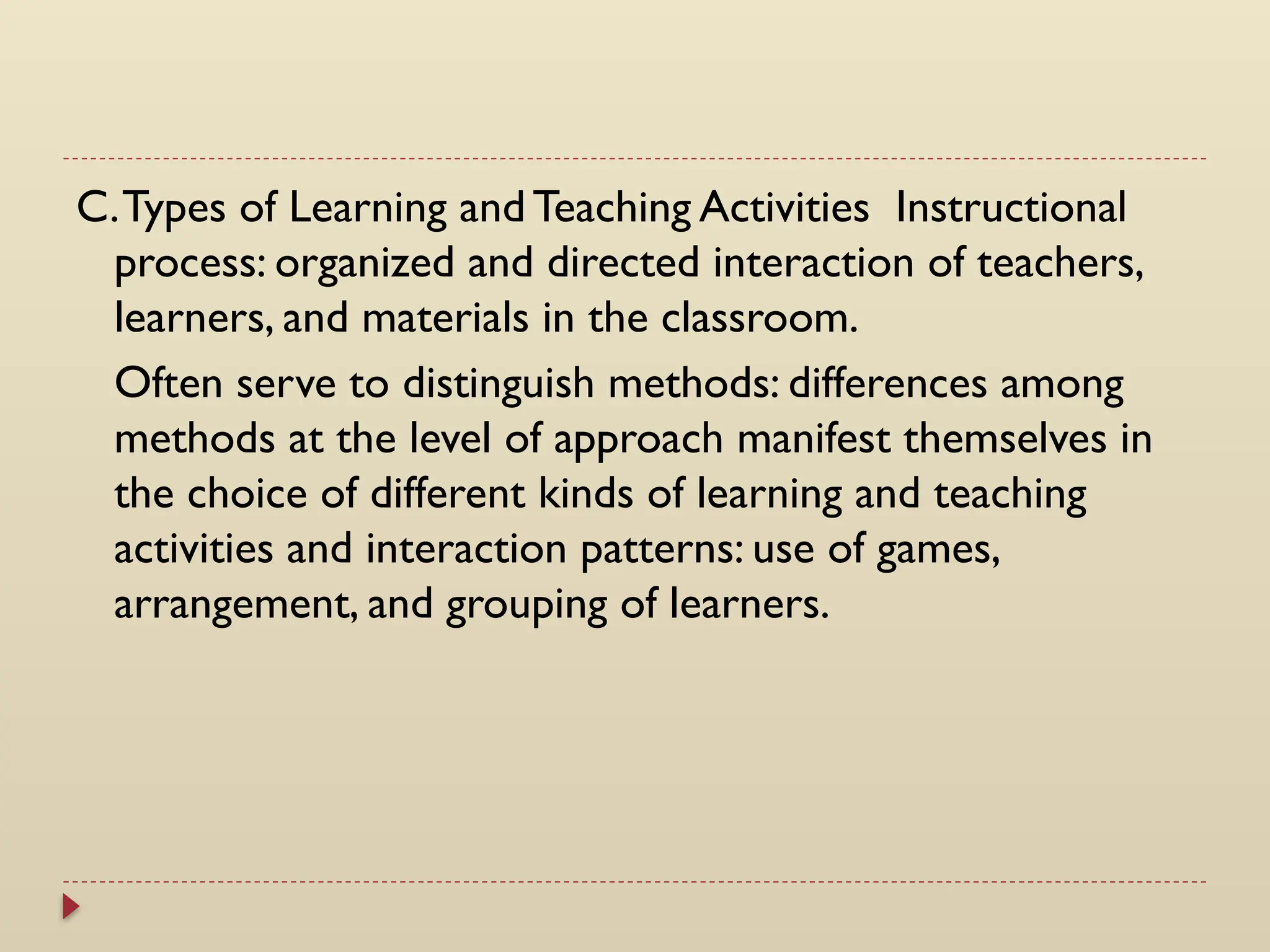
C.Types of Learningand Teaching Activities Instructional
process: organized and directed interaction of teachers,
learners, and materials in the classroom.
Often serve to distinguish methods: differences among
methods at the level of approach manifest themselves in
the choice of different kinds of learning and teaching
activities and interaction patterns: use of games,
arrangement, and grouping of learners.
27.
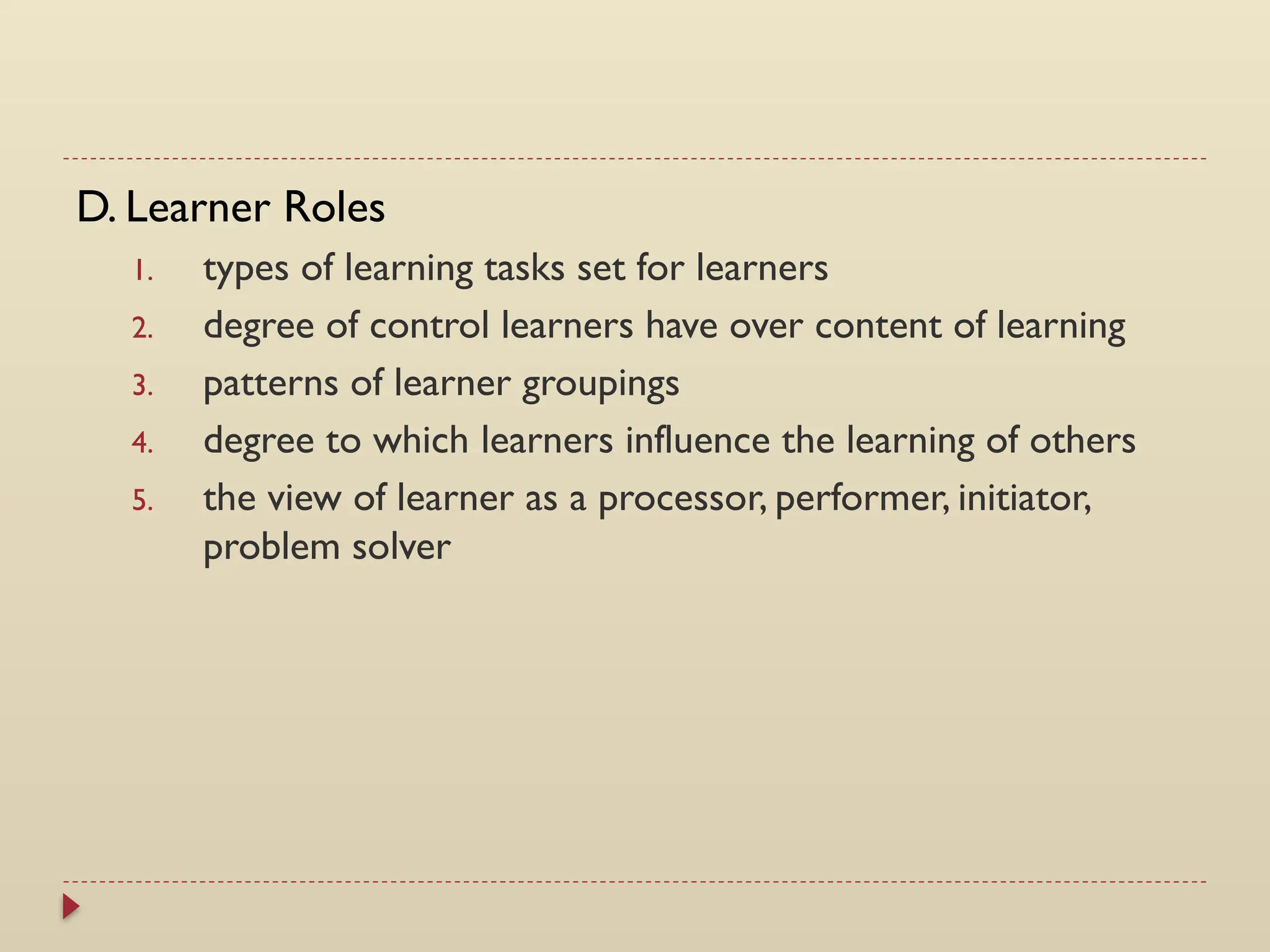
D. Learner Roles
1.types of learning tasks set for learners
2. degree of control learners have over content of learning
3. patterns of learner groupings
4. degree to which learners influence the learning of others
5. the view of learner as a processor, performer, initiator,
problem solver
28.
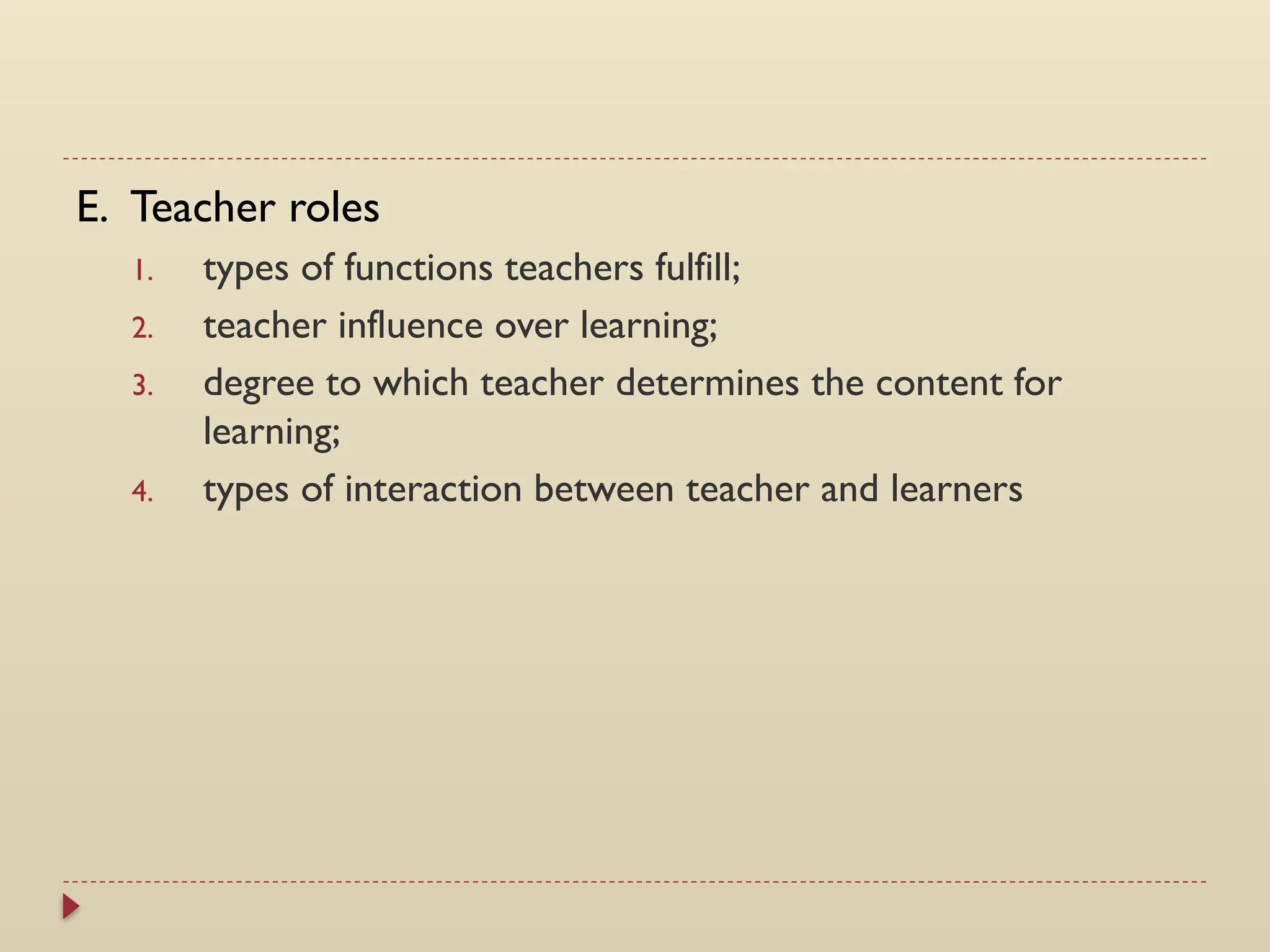
E. Teacher roles
1.types of functions teachers fulfill;
2. teacher influence over learning;
3. degree to which teacher determines the content for
learning;
4. types of interaction between teacher and learners
29.
F. The Roleof instructional Materials
primary functions of materials
the form materials take. (textbook, audiovisual)
relation of materials to other input
assumptions made about teachers and students/learners.
30.
Reference
Richard, J.C.and Rodgers,T. S. 2001 Approaches and
Methods in LanguageTeaching a Description and Analysis.
Cambridge: Cambridge University Press.


![ Brown (1994: 227) defines that communicative purposes
are “aspect(s) of our competence which enables us to
convey and interpret messages and to negotiate meanings
interpersonally within specific contexts ... [The]
knowledge that enables a person to communicate
functionally and interactionally”.
Examples: Communicative Approach, Competency-Based
LT,Threshold Level syllabus (e.g., Common European
Framework of Reference/CEFR)](https://image.slidesharecdn.com/thenatureofapproachesandmethodsinlanguage-250429011952-50f101bb/75/The-Nature-of-Approaches-and-methods-in-Language-pptx-9-2048.jpg)




![Reading Techniques [Autosaved].pptxReading Techniques [Autosaved].pptx](https://cdn.slidesharecdn.com/ss_thumbnails/readingtechniquesautosaved-251211193055-b8821f9d-thumbnail.jpg?width=640&height=640&fit=bounds)


