An Introduction to the Periodic TableBy: Jeffrey Monroe
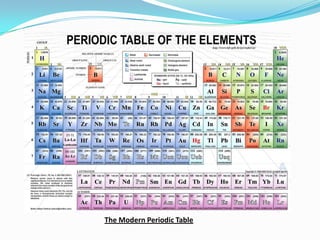
The Modern Periodic Table
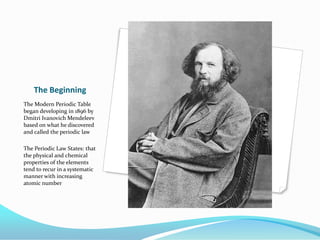
The BeginningThe Modern Periodic Table began developing in 1896 by Dmitri Ivanovich Mendeleev based on what he discovered and called the periodic lawThe Periodic Law States: that the physical and chemical properties of the elements tend to recur in a systematic manner with increasing atomic number
Properties of the TableThe Table of Elements Consists of the Following:GroupsPeriodsMetalsNonmetalsMetalloidsHalogensNoble GasesLanthanidesActinides
Groups and PeriodsGroups: There are 18 groups that are arranged from left to right horizontally across the periodic table. An observer can see the roman numerals IA – VIIIA at the top of each columnGroups 1-2 and 13-18 are called the representative elements because they are the most commonly used and studied elementsGroups 3-12 are called the transition metals because of there unusual reactive  characteristicsPeriods: There are 7 periods arranged from top to bottom vertically down the periodic tableAn observer can see the numbers 1-7 of the left side of the table that represent energy levels that are most closely studied during electron configuration
Metals, Nonmetals, & SemimetalsMetals can be seen, with the exception of hydrogen, in groups 1 and 2 of the periodic table and on our table in slide 2 are represented by the royal blue shading.Metals are defined as chemical elements that are good conductors of both electricity and heatMore specifically group 1 metals are known as the alkali metals and group 2 are known as the alkaline earth metalsNonmetals are represented by the greenish shading in groups 14-18Nonmetals are defined as chemical elements lacking typical metallic propertiesSemimetals or Metalloids are represented by the orange shading in groups 13-16Semimetals are defined as chemical elements with properties intermediate between those of typical metals and nonmetals
Halogens & Noble GasesHalogens: this group of chemical elements are observed to be in group 17 and most known because of the highly reactive characteristicsNoble Gases: this group of chemical elements are observed to be in group 18 and known for being highly unreactiveThe difference between these groups of elements reactivity has to do with the number of valence electrons each element posesses.Valence Electrons are defined as are the electrons in the last shell or energy level of an atom and thus responsible for chemical bonding
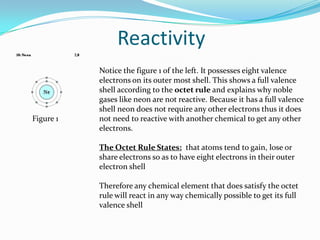
ReactivityNotice the figure 1 of the left. It possesses eight valence electrons on its outer most shell. This shows a full valence shell according to the octet rule and explains why noble gases like neon are not reactive. Because it has a full valence shell neon does not require any other electrons thus it does not need to reactive with another chemical to get any other electrons.The Octet Rule States:  that atoms tend to gain, lose or share electrons so as to have eight electrons in their outer electron shellTherefore any chemical element that does satisfy the octet rule will react in any way chemically possible to get its full valence shellFigure 1
Periodic TrendsPeriodic Trends are the tendencies of certain elemental characteristics to increase or decrease as one progresses along a row or column of the periodic table of elements.Atomic Radius:atomic radius tends to decrease as one progresses across a period from left to right and bottom to topElectron Afffinity:As one progresses from left to right across a period, the electron affinity will increaseElectronegativity:as one moves from left to right across a period the electronegativity increases
The End or is it?As we continue to study chemistry and more advancements are made in the field we never know who will be next to improve on this monument of chemical history.Maybe it will be one of you students!
Referenceswww.astro.virginia.eduReich-chemistry.wikispaces.comDingrando, Laurel. “Chemistry: Matter and Change”. Glencoe/Mcgraw-Hill 30 Jan. 2008  

An introduction to the periodic table

  • 1.
    An Introduction tothe Periodic TableBy: Jeffrey Monroe
  • 2.
  • 3.
    The BeginningThe ModernPeriodic Table began developing in 1896 by Dmitri Ivanovich Mendeleev based on what he discovered and called the periodic lawThe Periodic Law States: that the physical and chemical properties of the elements tend to recur in a systematic manner with increasing atomic number
  • 4.
    Properties of theTableThe Table of Elements Consists of the Following:GroupsPeriodsMetalsNonmetalsMetalloidsHalogensNoble GasesLanthanidesActinides
  • 5.
    Groups and PeriodsGroups:There are 18 groups that are arranged from left to right horizontally across the periodic table. An observer can see the roman numerals IA – VIIIA at the top of each columnGroups 1-2 and 13-18 are called the representative elements because they are the most commonly used and studied elementsGroups 3-12 are called the transition metals because of there unusual reactive characteristicsPeriods: There are 7 periods arranged from top to bottom vertically down the periodic tableAn observer can see the numbers 1-7 of the left side of the table that represent energy levels that are most closely studied during electron configuration
  • 6.
    Metals, Nonmetals, &SemimetalsMetals can be seen, with the exception of hydrogen, in groups 1 and 2 of the periodic table and on our table in slide 2 are represented by the royal blue shading.Metals are defined as chemical elements that are good conductors of both electricity and heatMore specifically group 1 metals are known as the alkali metals and group 2 are known as the alkaline earth metalsNonmetals are represented by the greenish shading in groups 14-18Nonmetals are defined as chemical elements lacking typical metallic propertiesSemimetals or Metalloids are represented by the orange shading in groups 13-16Semimetals are defined as chemical elements with properties intermediate between those of typical metals and nonmetals
  • 7.
    Halogens & NobleGasesHalogens: this group of chemical elements are observed to be in group 17 and most known because of the highly reactive characteristicsNoble Gases: this group of chemical elements are observed to be in group 18 and known for being highly unreactiveThe difference between these groups of elements reactivity has to do with the number of valence electrons each element posesses.Valence Electrons are defined as are the electrons in the last shell or energy level of an atom and thus responsible for chemical bonding
  • 8.
    ReactivityNotice the figure1 of the left. It possesses eight valence electrons on its outer most shell. This shows a full valence shell according to the octet rule and explains why noble gases like neon are not reactive. Because it has a full valence shell neon does not require any other electrons thus it does not need to reactive with another chemical to get any other electrons.The Octet Rule States: that atoms tend to gain, lose or share electrons so as to have eight electrons in their outer electron shellTherefore any chemical element that does satisfy the octet rule will react in any way chemically possible to get its full valence shellFigure 1
  • 9.
    Periodic TrendsPeriodic Trendsare the tendencies of certain elemental characteristics to increase or decrease as one progresses along a row or column of the periodic table of elements.Atomic Radius:atomic radius tends to decrease as one progresses across a period from left to right and bottom to topElectron Afffinity:As one progresses from left to right across a period, the electron affinity will increaseElectronegativity:as one moves from left to right across a period the electronegativity increases
  • 10.
    The End oris it?As we continue to study chemistry and more advancements are made in the field we never know who will be next to improve on this monument of chemical history.Maybe it will be one of you students!
  • 11.