Jeff TaylorCourses:Physical ScienceContact Informationjtaylor@insightfaculty.net602-476-2141Family: Wife Linda and 19-month daughter HilinaDetailing out travels and hikes on our blog: www.hikemasters.comandwww.taylorlenz.blogspot.comLiving out of our 22 ft trailer and spending the next 6 months in Desert Southwest.
Unit 2Mr. TaylorClassifying Matter
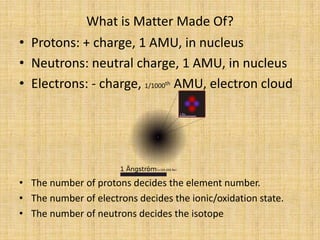
What is Matter Made Of?Protons: + charge, 1 AMU, in nucleusNeutrons: neutral charge, 1 AMU, in nucleusElectrons: - charge, 1/1000th AMU, electron cloudThe number of protons decides the element number.The number of electrons decides the ionic/oxidation state.The number of neutrons decides the isotope
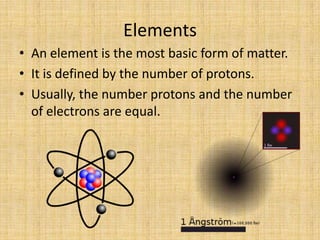
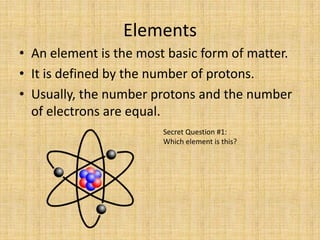
ElementsAn element is the most basic form of matter.It is defined by the number of protons.Usually, the number protons and the number of electrons are equal.
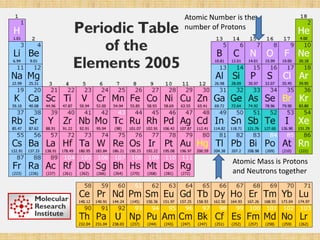
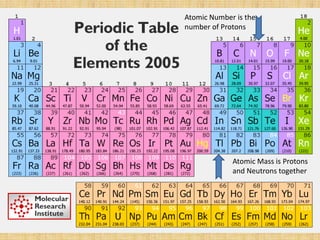
Atomic Number is the number of ProtonsAtomic Mass is Protons and Neutrons together
ElementsAn element is the most basic form of matter.It is defined by the number of protons.Usually, the number protons and the number of electrons are equal.Secret Question #1:Which element is this?
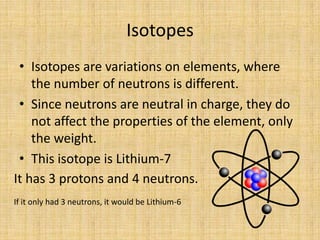
IsotopesIsotopes are variations on elements, where the number of neutrons is different.Since neutrons are neutral in charge, they do not affect the properties of the element, only the weight.This isotope is Lithium-7It has 3 protons and 4 neutrons. If it only had 3 neutrons, it would be Lithium-6
Atomic Number is the number of ProtonsAtomic Mass is Protons and Neutrons together
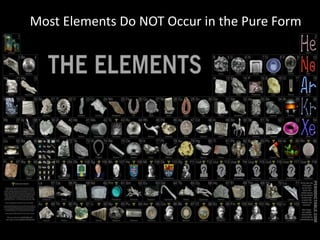
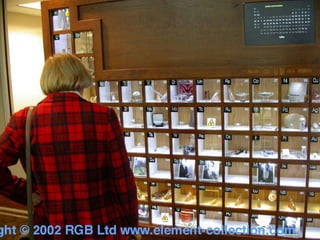
Most Elements Do NOT Occur in the Pure Form
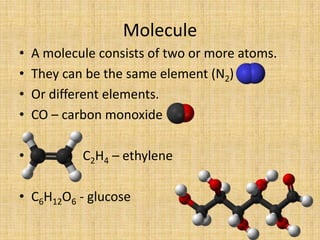
MoleculeA molecule consists of two or more atoms.They can be the same element (N2)Or different elements. CO – carbon monoxide                C2H4 – ethyleneC6H12O6 - glucose
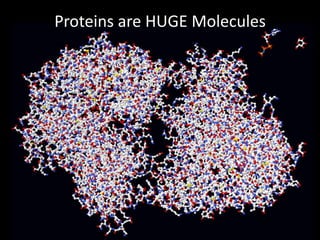
Proteins are HUGE Molecules
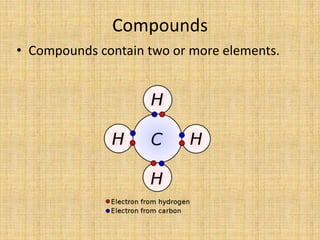
CompoundsCompounds contain two or more elements.
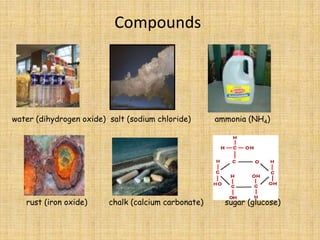
Compoundswater (dihydrogenoxide) salt (sodium chloride)          ammonia (NH4) rust (iron oxide)         chalk (calcium carbonate)         sugar (glucose)
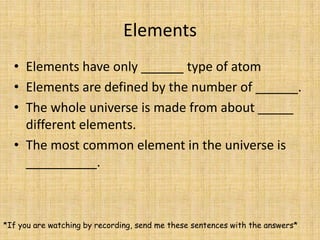
ElementsElements have only ______ type of atomElements are defined by the number of ______.The whole universe is made from about _____ different elements.The most common element in the universe is __________.*If you are watching by recording, send me these sentences with the answers*
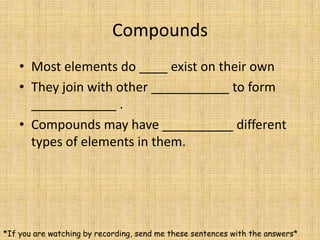
CompoundsMost elements do ____ exist on their ownThey join with other ___________ to form ____________ .Compounds may have __________ different types of elements in them.*If you are watching by recording, send me these sentences with the answers*
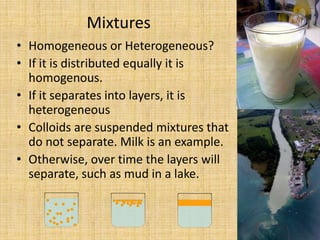
Mixtures Homogeneous or Heterogeneous?If it is distributed equally it is homogenous. If it separates into layers, it is heterogeneousColloids are suspended mixtures that do not separate. Milk is an example.Otherwise, over time the layers will separate, such as mud in a lake.
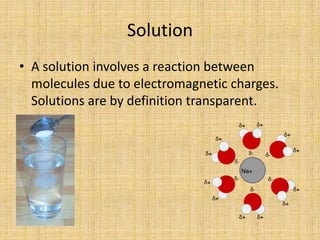
SolutionA solution involves a reaction between molecules due to electromagnetic charges. Solutions are by definition transparent.
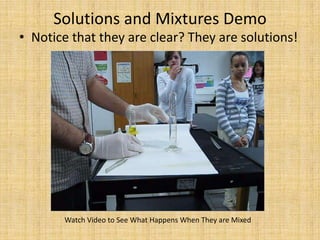
Solutions and Mixtures DemoNotice that they are clear? They are solutions!Watch Video to See What Happens When They are Mixed
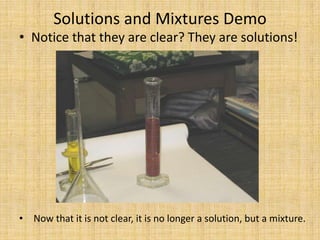
Solutions and Mixtures DemoNotice that they are clear? They are solutions! Now that it is not clear, it is no longer a solution, but a mixture.
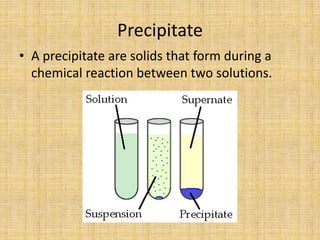
PrecipitateA precipitate are solids that form during a chemical reaction between two solutions.
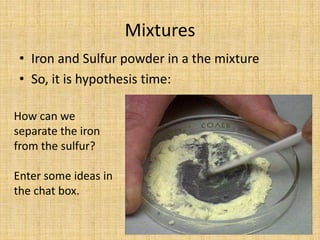
MixturesIron and Sulfur powder in a the mixtureSo, it is hypothesis time:How can we separate the iron from the sulfur?Enter some ideas in the chat box.
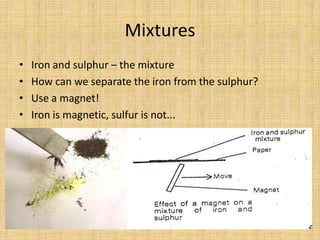
MixturesIron and sulphur – the mixtureHow can we separate the iron from the sulphur?Use a magnet!Iron is magnetic, sulfur is not...
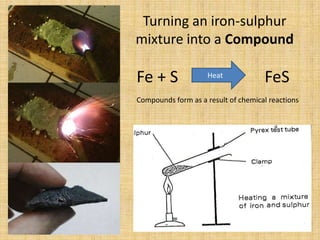
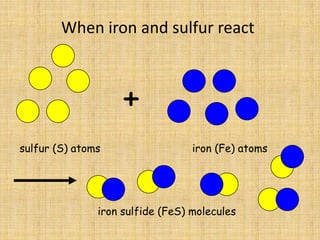
Turning an iron-sulphur mixture into a CompoundHeatFe + S			FeSCompounds form as a result of chemical reactions
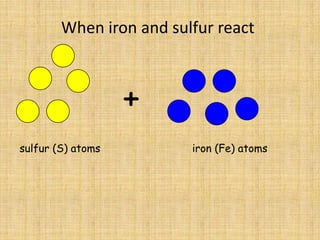
When iron and sulfur react+sulfur(S) atoms                             iron (Fe) atoms
When iron and sulfur react+sulfur(S) atoms                             iron (Fe) atomsiron sulfide(FeS) molecules
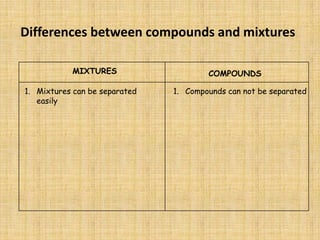
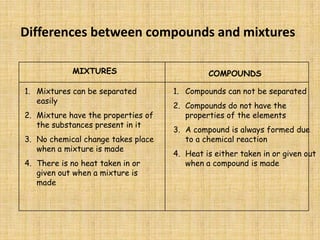
Differences between compounds and mixturesMIXTURESCOMPOUNDSMixtures can be separated easilyCompounds can not be separated
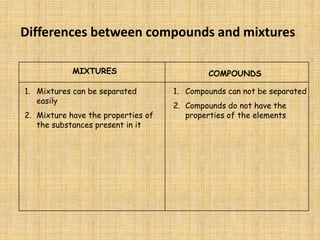
Differences between compounds and mixturesMIXTURESCOMPOUNDSMixtures can be separated easilyMixture have the properties of the substances present in itCompounds can not be separatedCompounds do not have the properties of the elements
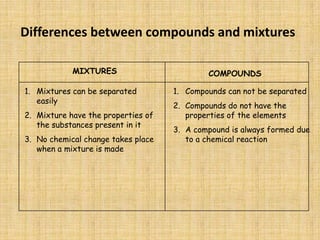
Differences between compounds and mixturesMIXTURESCOMPOUNDSMixtures can be separated easilyMixture have the properties of the substances present in itNo chemical change takes place when a mixture is madeCompounds can not be separatedCompounds do not have the properties of the elementsA compound is always formed due to a chemical reaction
Differences between compounds and mixturesMIXTURESCOMPOUNDSMixtures can be separated easilyMixture have the properties of the substances present in itNo chemical change takes place when a mixture is madeThere is no heat taken in or given out when a mixture is madeCompounds can not be separatedCompounds do not have the properties of the elementsA compound is always formed due to a chemical reactionHeat is either taken in or given out when a compound is made
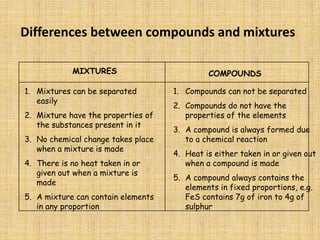
Differences between compounds and mixturesMIXTURESCOMPOUNDSMixtures can be separated easilyMixture have the properties of the substances present in itNo chemical change takes place when a mixture is madeThere is no heat taken in or given out when a mixture is madeA mixture can contain elements in any proportionCompounds can not be separatedCompounds do not have the properties of the elementsA compound is always formed due to a chemical reactionHeat is either taken in or given out when a compound is madeA compound always contains the elements in fixed proportions, e.g. FeS contains 7g of iron to 4g of sulphur
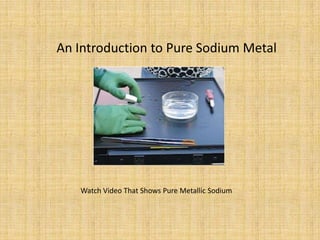
An Introduction to Pure Sodium MetalWatch Video That Shows Pure Metallic Sodium
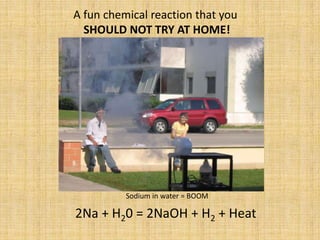
A fun chemical reaction that you SHOULD NOT TRY AT HOME!Sodium in water = BOOM2Na + H20 = 2NaOH + H2 + Heat

Unit 2 - Classifying Matter

  • 1.
    Jeff TaylorCourses:Physical ScienceContactInformationjtaylor@insightfaculty.net602-476-2141Family: Wife Linda and 19-month daughter HilinaDetailing out travels and hikes on our blog: www.hikemasters.comandwww.taylorlenz.blogspot.comLiving out of our 22 ft trailer and spending the next 6 months in Desert Southwest.
  • 2.
  • 3.
    What is MatterMade Of?Protons: + charge, 1 AMU, in nucleusNeutrons: neutral charge, 1 AMU, in nucleusElectrons: - charge, 1/1000th AMU, electron cloudThe number of protons decides the element number.The number of electrons decides the ionic/oxidation state.The number of neutrons decides the isotope
  • 4.
    ElementsAn element isthe most basic form of matter.It is defined by the number of protons.Usually, the number protons and the number of electrons are equal.
  • 5.
    Atomic Number isthe number of ProtonsAtomic Mass is Protons and Neutrons together
  • 6.
    ElementsAn element isthe most basic form of matter.It is defined by the number of protons.Usually, the number protons and the number of electrons are equal.Secret Question #1:Which element is this?
  • 7.
    IsotopesIsotopes are variationson elements, where the number of neutrons is different.Since neutrons are neutral in charge, they do not affect the properties of the element, only the weight.This isotope is Lithium-7It has 3 protons and 4 neutrons. If it only had 3 neutrons, it would be Lithium-6
  • 8.
    Atomic Number isthe number of ProtonsAtomic Mass is Protons and Neutrons together
  • 9.
    Most Elements DoNOT Occur in the Pure Form
  • 11.
    MoleculeA molecule consistsof two or more atoms.They can be the same element (N2)Or different elements. CO – carbon monoxide C2H4 – ethyleneC6H12O6 - glucose
  • 12.
  • 13.
  • 14.
    Compoundswater (dihydrogenoxide) salt(sodium chloride) ammonia (NH4) rust (iron oxide) chalk (calcium carbonate) sugar (glucose)
  • 15.
    ElementsElements have only______ type of atomElements are defined by the number of ______.The whole universe is made from about _____ different elements.The most common element in the universe is __________.*If you are watching by recording, send me these sentences with the answers*
  • 16.
    CompoundsMost elements do____ exist on their ownThey join with other ___________ to form ____________ .Compounds may have __________ different types of elements in them.*If you are watching by recording, send me these sentences with the answers*
  • 17.
    Mixtures Homogeneous orHeterogeneous?If it is distributed equally it is homogenous. If it separates into layers, it is heterogeneousColloids are suspended mixtures that do not separate. Milk is an example.Otherwise, over time the layers will separate, such as mud in a lake.
  • 18.
    SolutionA solution involvesa reaction between molecules due to electromagnetic charges. Solutions are by definition transparent.
  • 19.
    Solutions and MixturesDemoNotice that they are clear? They are solutions!Watch Video to See What Happens When They are Mixed
  • 20.
    Solutions and MixturesDemoNotice that they are clear? They are solutions! Now that it is not clear, it is no longer a solution, but a mixture.
  • 21.
    PrecipitateA precipitate aresolids that form during a chemical reaction between two solutions.
  • 22.
    MixturesIron and Sulfurpowder in a the mixtureSo, it is hypothesis time:How can we separate the iron from the sulfur?Enter some ideas in the chat box.
  • 23.
    MixturesIron and sulphur– the mixtureHow can we separate the iron from the sulphur?Use a magnet!Iron is magnetic, sulfur is not...
  • 24.
    Turning an iron-sulphurmixture into a CompoundHeatFe + S FeSCompounds form as a result of chemical reactions
  • 25.
    When iron andsulfur react+sulfur(S) atoms iron (Fe) atoms
  • 26.
    When iron andsulfur react+sulfur(S) atoms iron (Fe) atomsiron sulfide(FeS) molecules
  • 27.
    Differences between compoundsand mixturesMIXTURESCOMPOUNDSMixtures can be separated easilyCompounds can not be separated
  • 28.
    Differences between compoundsand mixturesMIXTURESCOMPOUNDSMixtures can be separated easilyMixture have the properties of the substances present in itCompounds can not be separatedCompounds do not have the properties of the elements
  • 29.
    Differences between compoundsand mixturesMIXTURESCOMPOUNDSMixtures can be separated easilyMixture have the properties of the substances present in itNo chemical change takes place when a mixture is madeCompounds can not be separatedCompounds do not have the properties of the elementsA compound is always formed due to a chemical reaction
  • 30.
    Differences between compoundsand mixturesMIXTURESCOMPOUNDSMixtures can be separated easilyMixture have the properties of the substances present in itNo chemical change takes place when a mixture is madeThere is no heat taken in or given out when a mixture is madeCompounds can not be separatedCompounds do not have the properties of the elementsA compound is always formed due to a chemical reactionHeat is either taken in or given out when a compound is made
  • 31.
    Differences between compoundsand mixturesMIXTURESCOMPOUNDSMixtures can be separated easilyMixture have the properties of the substances present in itNo chemical change takes place when a mixture is madeThere is no heat taken in or given out when a mixture is madeA mixture can contain elements in any proportionCompounds can not be separatedCompounds do not have the properties of the elementsA compound is always formed due to a chemical reactionHeat is either taken in or given out when a compound is madeA compound always contains the elements in fixed proportions, e.g. FeS contains 7g of iron to 4g of sulphur
  • 32.
    An Introduction toPure Sodium MetalWatch Video That Shows Pure Metallic Sodium
  • 33.
    A fun chemicalreaction that you SHOULD NOT TRY AT HOME!Sodium in water = BOOM2Na + H20 = 2NaOH + H2 + Heat