ELECTROPHORESIS
NIVEDITHA G
1st sem M. Pharm
Dept. of Pharmaceutics
NARGUND COLLEGE OF PHARMACY
2
Contents
 Introduction
 Electrophoretic Separation
 Types of Electrophoresis
 Capillary Electrophoresis
 Paper Electrophoresis
 2D Electrophoresis
 Gel Electrophoresis
 SDS-PAGE
3
Introduction
 Electrophoresis: It is defined as the
migration of particles under the
influence of electric field
 It is a separation method based on the
differential rate of migration of
charged species in a buffer solution
across which a DC current field has
been applied.
4
Introduction Contd…
 Separations are based on differences in
charge-to-size ratio for various analytes
in the sample.
 Larger this ratio, faster the ion migrates
in the electric field
5
Introduction Contd…
 This separation technique was first
developed by the Swedish chemist
Arne Tiselius in 1930s for the study of
serum protein
 Awarded Noble Prize in 1948
6
Electrophoretic Separation
 It is performed by injecting a small
quantity of sample into an aqueous
buffer solution that is contained in a
narrow tube or on a gel.
 A high DC potential is applied across
the length of the buffer by means of pair
of electrodes located at either end of
buffer.
7
Electrophoretic Separation Contd…
 The potential causes ions of the sample
to migrate towards one or the other
electrode.
 Rate of migration depends on its
charge & also on its size
 Separations are based on charge-to-size
ratio.
8
Types of Electrophoresis
 Slab Electrophoresis
 Capillary Electrophoresis
 Paper Electrophoresis
 Gel Electrophoresis
 2D Electrophoresis
 Alternating-field Electrophoresis
9
Types of Electrophoresis Contd..
 Continuous Electrophoresis
 Column Electrophoresis
 Crossing Electrophoresis
 Isotachophoresis
 Isoelectric Focusing
 Zone Electrophoresis
 Immuno Electrophoresis
10
Capillary Electrophoresis (CE)
 It is a high speed, high resolution
separations on exceptionally small
sample volumes (0.1 to 10nL)
 Potentials of 20,000 to 60,000 V are
commonly used in capillary
electrophoresis
11
Instrumentation for Capillary
Electrophoresis
 A buffer-filled fused-silica capillary (10
to 100µm in ID & 40 to 100 cm long),
extends between two buffer reservoirs
that also holds platinum electrodes.
 Sample introduction at one end and
detection at the other.
13
Sample Introduction
 The most common sample introduction
methods are:
 Electrokinetic Injection and
 Pressure Injection
14
Electrokinetic Injection
 One end of capillary & its electrodes are
removed and placed in small cup
containing sample
 potential is applied for measured time
15
Pressure Injection
 Pressure difference is used to drive the
sample and can be done by:
 Applying vacuum at the detector end
 By pressurizing the sample
 By elevating the sample end
16
Detection
 Absorption detection
 Indirect Absorbance detection
 Fluorescence detection
 Electrochemical detection
 Mass Spectrometric detection
18
Advantages of CE
 High separation efficiency
 Small sample size required (0.1-10 nL)
 Fast separation (1 to 45 min)
 Easy and predictable selectivity
 Automation
 Low operating cost
 Reproducibility
 Couple to mass spectrophotometer
19
Limitations of CE
 Not well suited for determination of
low molecular weight, volatile
compounds
 Not well suited for determination on
nonionic, high molecular weight
polymers
 Not as sensitive as HPLC
21
Modes of CE
 Capillary Zone Electrophoresis
 Capillary Gel Electrophoresis
 Capillary Isoelectric Focusing
 Capillary Isotachophoresis
22
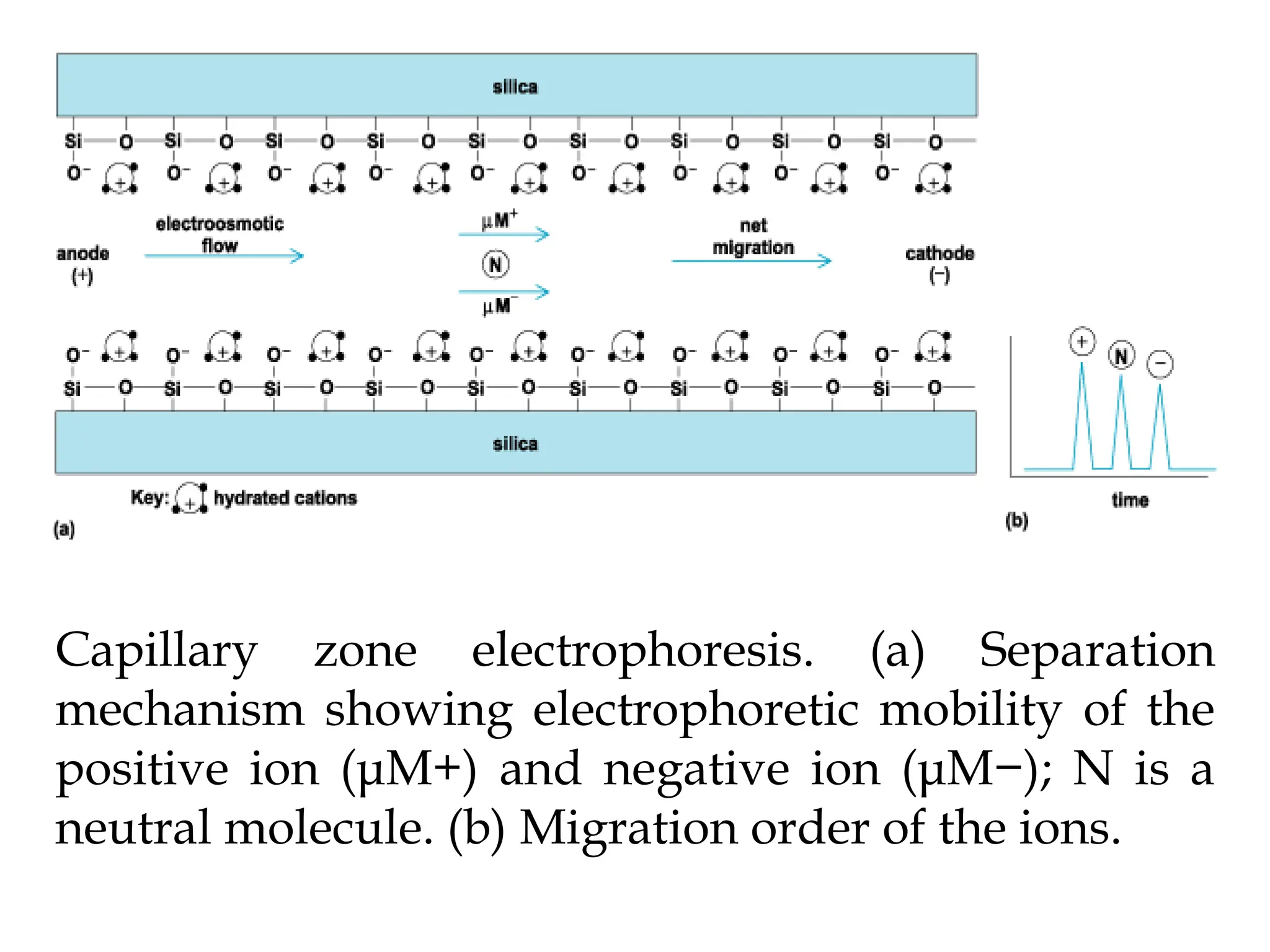
Capillary Zone Electrophoresis
 Buffer composition is constant
throughout the separation region.
 Applied potential causes the different
ionic mixture to migrate according to its
mobility to separate into zones
Capillary zone electrophoresis. (a) Separation
mechanism showing electrophoretic mobility of the
positive ion (μM+) and negative ion (μM−); N is a
neutral molecule. (b) Migration order of the ions.
24
General Uses of CE
 Separation and identification of
 Polar & non-polar
 Some elements, including non-ionic & ionic
compounds,
 Inorganic anions & cations,
 Macromulecules (proteins & oligonucleotides)
 Chiral Compounds
25
General Uses of CE Contd..
 Quantitative and qualitative determination
of compounds and some elements in
mixture
 Determination of molecular weights of
large biomolecules and isoelectric points of
proteins
 Used in biochemical, clinical,
environmental, forensic, food and
Pharmaceutical applications
26
Paper electrophoresis
Apparatus for Paper Electrophoresis
27
2D Electrophoresis (2DE)
 A separation is carried out in one direction
for a suitable time and then for an additional
time at right angles to the first separation
 Often isoelectric focusing is combined with
SDS-PAGE in two-dimensional gel
electrophoresis
 Proteins with similar isoelectric points or with
similar molecular weights can be separated
by this method
After isoelectric focusing in pH gradient of the
electric field the electrophoretic separation is
used in SDS-PAGE Electrophoresis
29
Gel Electrophoresis (GE)
 Generally performed in a porous gel
polymer matrix
 Pores contains a buffer mixture in
which the separation is carried out
 Most common type of gel used in
electrophoresis is a polyacrylamide
polymer.
32
SDS-PAGE
 SDS- Sodium Dodecyl Sulfate
 PAGE- Polyacrylamide Gel
Electrophoresis
 One of the most important
electrophoresis technique used to
measure molecular weights of proteins
33
SDS-PAGE Contd…
 SDS is a detergent which denatures
proteins by binding to the hydrophobic
regions
 It coats the linear protein sequence with
the set of SDS molecules.
 The SDS is negatively charged and thus
becomes the dominant charge of the
complex
34
SDS-PAGE Contd…
 Number of SDS molecules that bind is
proportional to size of protein
 Then run through inert polymer,
Polyacrylamide
Gel electrophoresis
being set up to run.
Plexiglass housing
holds a slab gel that is
being loaded with a
sample
Polyacrylamide Gel
Electrophoresis
Agarose Gel Electrophoresis
Pulsed Field Gel
Electrophoresis
Temperature
Gradient Gel
Electrophoresis
37
References
 Principles of Instrumental Analysis by
Skoog, Holler, Nieman, 5th Edition, 2001,
Page no. 778-792
 Handbook of Instrumental Techniques for
Analytical Chemistry by Frank Settle, 2004
Page No. 165-180
 Paper Chromatography and Electrophoresis
(Vol. I) by Gunter Zweing & John R.
Whitaker, 1967, Page No. 1-46
 www.google.com
Electrophoresis, introduction, principles, applications

Electrophoresis, introduction, principles, applications

  • 1.
    ELECTROPHORESIS NIVEDITHA G 1st semM. Pharm Dept. of Pharmaceutics NARGUND COLLEGE OF PHARMACY
  • 2.
    2 Contents  Introduction  ElectrophoreticSeparation  Types of Electrophoresis  Capillary Electrophoresis  Paper Electrophoresis  2D Electrophoresis  Gel Electrophoresis  SDS-PAGE
  • 3.
    3 Introduction  Electrophoresis: Itis defined as the migration of particles under the influence of electric field  It is a separation method based on the differential rate of migration of charged species in a buffer solution across which a DC current field has been applied.
  • 4.
    4 Introduction Contd…  Separationsare based on differences in charge-to-size ratio for various analytes in the sample.  Larger this ratio, faster the ion migrates in the electric field
  • 5.
    5 Introduction Contd…  Thisseparation technique was first developed by the Swedish chemist Arne Tiselius in 1930s for the study of serum protein  Awarded Noble Prize in 1948
  • 6.
    6 Electrophoretic Separation  Itis performed by injecting a small quantity of sample into an aqueous buffer solution that is contained in a narrow tube or on a gel.  A high DC potential is applied across the length of the buffer by means of pair of electrodes located at either end of buffer.
  • 7.
    7 Electrophoretic Separation Contd… The potential causes ions of the sample to migrate towards one or the other electrode.  Rate of migration depends on its charge & also on its size  Separations are based on charge-to-size ratio.
  • 8.
    8 Types of Electrophoresis Slab Electrophoresis  Capillary Electrophoresis  Paper Electrophoresis  Gel Electrophoresis  2D Electrophoresis  Alternating-field Electrophoresis
  • 9.
    9 Types of ElectrophoresisContd..  Continuous Electrophoresis  Column Electrophoresis  Crossing Electrophoresis  Isotachophoresis  Isoelectric Focusing  Zone Electrophoresis  Immuno Electrophoresis
  • 10.
    10 Capillary Electrophoresis (CE) It is a high speed, high resolution separations on exceptionally small sample volumes (0.1 to 10nL)  Potentials of 20,000 to 60,000 V are commonly used in capillary electrophoresis
  • 11.
    11 Instrumentation for Capillary Electrophoresis A buffer-filled fused-silica capillary (10 to 100µm in ID & 40 to 100 cm long), extends between two buffer reservoirs that also holds platinum electrodes.  Sample introduction at one end and detection at the other.
  • 13.
    13 Sample Introduction  Themost common sample introduction methods are:  Electrokinetic Injection and  Pressure Injection
  • 14.
    14 Electrokinetic Injection  Oneend of capillary & its electrodes are removed and placed in small cup containing sample  potential is applied for measured time
  • 15.
    15 Pressure Injection  Pressuredifference is used to drive the sample and can be done by:  Applying vacuum at the detector end  By pressurizing the sample  By elevating the sample end
  • 16.
    16 Detection  Absorption detection Indirect Absorbance detection  Fluorescence detection  Electrochemical detection  Mass Spectrometric detection
  • 18.
    18 Advantages of CE High separation efficiency  Small sample size required (0.1-10 nL)  Fast separation (1 to 45 min)  Easy and predictable selectivity  Automation  Low operating cost  Reproducibility  Couple to mass spectrophotometer
  • 19.
    19 Limitations of CE Not well suited for determination of low molecular weight, volatile compounds  Not well suited for determination on nonionic, high molecular weight polymers  Not as sensitive as HPLC
  • 21.
    21 Modes of CE Capillary Zone Electrophoresis  Capillary Gel Electrophoresis  Capillary Isoelectric Focusing  Capillary Isotachophoresis
  • 22.
    22 Capillary Zone Electrophoresis Buffer composition is constant throughout the separation region.  Applied potential causes the different ionic mixture to migrate according to its mobility to separate into zones
  • 23.
    Capillary zone electrophoresis.(a) Separation mechanism showing electrophoretic mobility of the positive ion (μM+) and negative ion (μM−); N is a neutral molecule. (b) Migration order of the ions.
  • 24.
    24 General Uses ofCE  Separation and identification of  Polar & non-polar  Some elements, including non-ionic & ionic compounds,  Inorganic anions & cations,  Macromulecules (proteins & oligonucleotides)  Chiral Compounds
  • 25.
    25 General Uses ofCE Contd..  Quantitative and qualitative determination of compounds and some elements in mixture  Determination of molecular weights of large biomolecules and isoelectric points of proteins  Used in biochemical, clinical, environmental, forensic, food and Pharmaceutical applications
  • 26.
  • 27.
    27 2D Electrophoresis (2DE) A separation is carried out in one direction for a suitable time and then for an additional time at right angles to the first separation  Often isoelectric focusing is combined with SDS-PAGE in two-dimensional gel electrophoresis  Proteins with similar isoelectric points or with similar molecular weights can be separated by this method
  • 28.
    After isoelectric focusingin pH gradient of the electric field the electrophoretic separation is used in SDS-PAGE Electrophoresis
  • 29.
    29 Gel Electrophoresis (GE) Generally performed in a porous gel polymer matrix  Pores contains a buffer mixture in which the separation is carried out  Most common type of gel used in electrophoresis is a polyacrylamide polymer.
  • 32.
    32 SDS-PAGE  SDS- SodiumDodecyl Sulfate  PAGE- Polyacrylamide Gel Electrophoresis  One of the most important electrophoresis technique used to measure molecular weights of proteins
  • 33.
    33 SDS-PAGE Contd…  SDSis a detergent which denatures proteins by binding to the hydrophobic regions  It coats the linear protein sequence with the set of SDS molecules.  The SDS is negatively charged and thus becomes the dominant charge of the complex
  • 34.
    34 SDS-PAGE Contd…  Numberof SDS molecules that bind is proportional to size of protein  Then run through inert polymer, Polyacrylamide
  • 35.
    Gel electrophoresis being setup to run. Plexiglass housing holds a slab gel that is being loaded with a sample
  • 36.
    Polyacrylamide Gel Electrophoresis Agarose GelElectrophoresis Pulsed Field Gel Electrophoresis Temperature Gradient Gel Electrophoresis
  • 37.
    37 References  Principles ofInstrumental Analysis by Skoog, Holler, Nieman, 5th Edition, 2001, Page no. 778-792  Handbook of Instrumental Techniques for Analytical Chemistry by Frank Settle, 2004 Page No. 165-180  Paper Chromatography and Electrophoresis (Vol. I) by Gunter Zweing & John R. Whitaker, 1967, Page No. 1-46  www.google.com