Three types of IR instruments;
 Dispersive spectrophotometers
 Fourier transform spectrophotometers
 Non- dispersive spectrophotometers
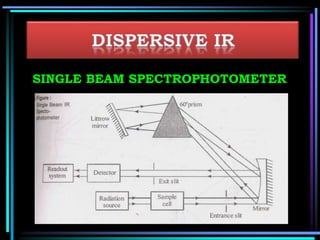
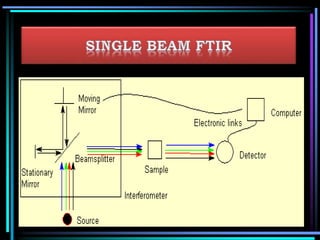
SINGLE BEAM SPECTROPHOTOMETER
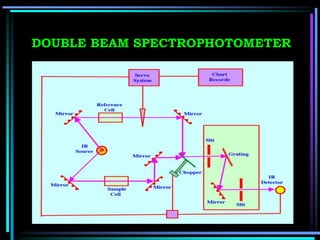
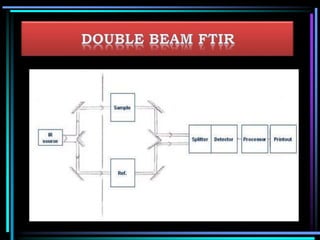
DOUBLE BEAM SPECTROPHOTOMETER
 Spurious readings
 Slow scan speeds
 Thermal effect
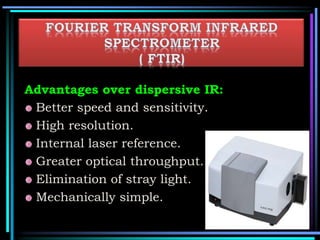
Advantages over dispersive IR:
Better speed and sensitivity.
High resolution.
Internal laser reference.
Greater optical throughput.
Elimination of stray light.
Mechanically simple.
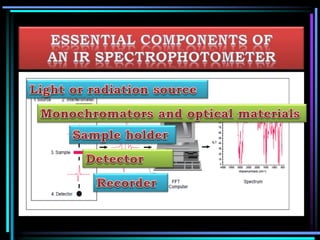
3 basic spectrometer components in an
FT system,
Radiation source
Interferometer
Detector
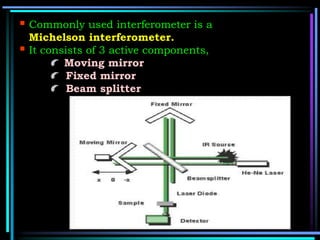
 Commonly used interferometer is a
Michelson interferometer.
 It consists of 3 active components,
Moving mirror
Fixed mirror
Beam splitter
Near IR: Tungsten filament, rhodium
wire, nichrome wire.
Mid IR: Nernst glower, globar source.
Far IR: Mercury arc lamp.
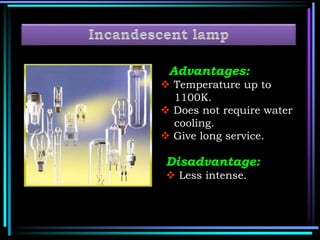
Advantages:
 Temperature up to
1100K.
 Does not require water
cooling.
 Give long service.
Disadvantage:
 Less intense.
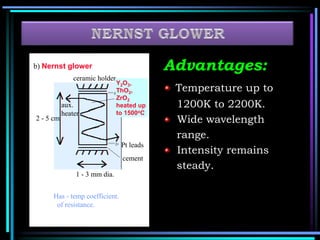
Advantages:
Temperature up to
1200K to 2200K.
Wide wavelength
range.
Intensity remains
steady.
b) Nernst glower
aux.
heater
2 - 5 cm
Has - temp coefficient.
of resistance.
1 - 3 mm dia.
ceramic holder
Y2O3,
ThO2,
ZrO2
heated up
to 1500oC
Pt leads
cement
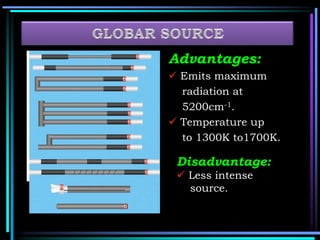
Advantages:
 Emits maximum
radiation at
5200cm-1.
 Temperature up
to 1300K to1700K.
c) Globar
5 cm
6 - 8 mm dia.
SiC rod
heated
to
1300oC
water-
cooled
brass
tube
with slot
+ temp
coeff. of
resistance
G 15 m
650 cm-1
NG
G
10 m
1000 cm-1
NG 1 m
10000 cm-1
Disadvantage:
 Less intense
source.
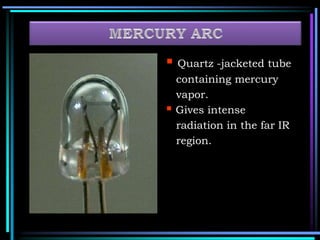
 Quartz -jacketed tube
containing mercury
vapor.
 Gives intense
radiation in the far IR
region.
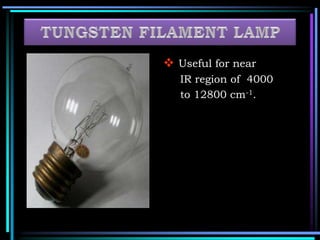
 Useful for near
IR region of 4000
to 12800 cm-1.
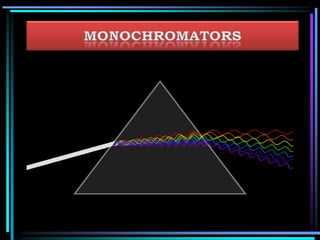
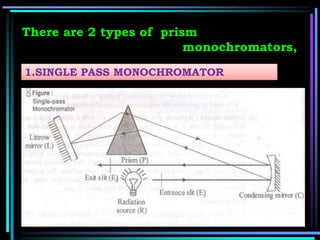
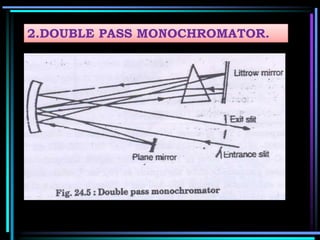
Monochromators are of two types,
 Prism Monochromators
a. Single pass monochromator
b. Double pass monochromator
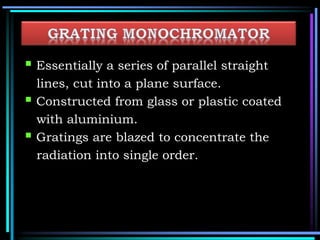
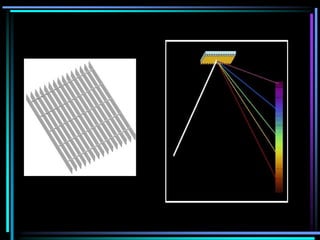
 Grating Monochromators
 Halogen salts are used in prism
monochromator, as they are transparent
to IR radiations.
 Quartz prisms are used only in the near
IR region (0.8 to 3 µ).
 Crystalline potassium bromide and
cesium bromide are used in far IR region
(15 to 40 µ).
 Focusing of radiation is achieved by using
concave mirrors rather than prisms.
 Prepared from various materials like
metals or glass coated aluminium.
There are 2 types of prism
monochromators,
1.SINGLE PASS MONOCHROMATOR.
2.DOUBLE PASS MONOCHROMATOR.
 Essentially a series of parallel straight
lines, cut into a plane surface.
 Constructed from glass or plastic coated
with aluminium.
 Gratings are blazed to concentrate the
radiation into single order.
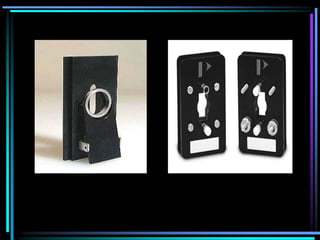
Constructed using rock salt (NaCl).
Sample cells are demountable and Teflon
spacers are used.
Sample cells must have windows that are
transparent.
Fixed path length cells are also available.
Often polished with buffing powder.
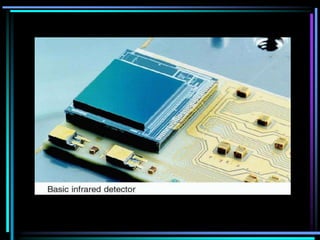
There are two main types of detectors used in IR
spectrophotometry;
Thermal detectors
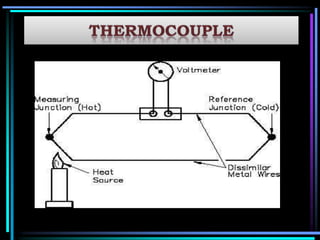
1. Thermocouple
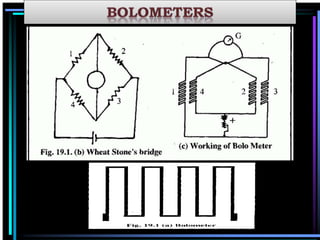
2. Bolometers
3. Thermistors
4. Golay cell / Golay detectors
Photon detectors
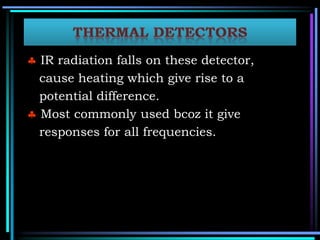
 IR radiation falls on these detector,
cause heating which give rise to a
potential difference.
 Most commonly used bcoz it give
responses for all frequencies.
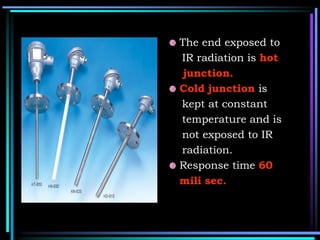
The end exposed to
IR radiation is hot
junction.
Cold junction is
kept at constant
temperature and is
not exposed to IR
radiation.
Response time 60
mili sec.
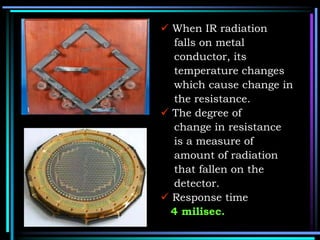
 When IR radiation
falls on metal
conductor, its
temperature changes
which cause change in
the resistance.
 The degree of
change in resistance
is a measure of
amount of radiation
that fallen on the
detector.
 Response time
4 milisec.
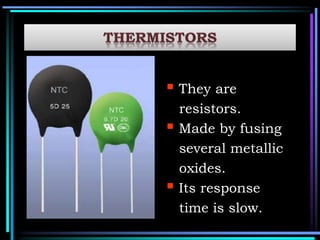
 They are
resistors.
 Made by fusing
several metallic
oxides.
 Its response
time is slow.
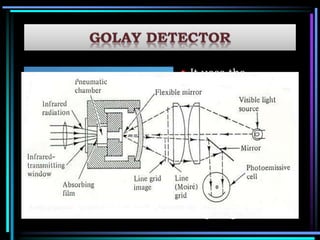
It uses the
expansion of gas
as the measuring
device.
IR radiation falls
on blackened
metal plate, get
heated, which
causes expansion
of gas and deform
the flexible
diaphragm.
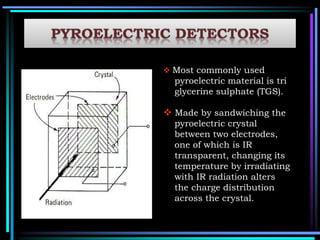
 Most commonly used
pyroelectric material is tri
glycerine sulphate (TGS).
 Made by sandwiching the
pyroelectric crystal
between two electrodes,
one of which is IR
transparent, changing its
temperature by irradiating
with IR radiation alters
the charge distribution
across the crystal.
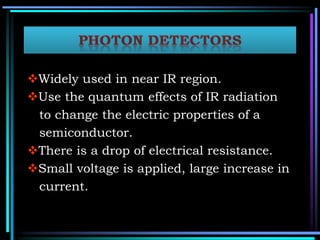
Widely used in near IR region.
Use the quantum effects of IR radiation
to change the electric properties of a
semiconductor.
There is a drop of electrical resistance.
Small voltage is applied, large increase in
current.
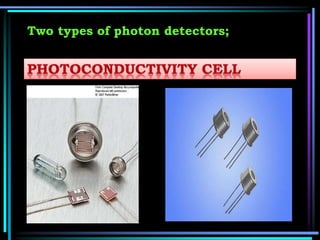
Two types of photon detectors;
 Depends upon the state of the sample
whether it is a gas, liquid or solid.
 Sample which is to be detected must be
pure and should be free from water.
41
Four techniques employed;
1.Solid dissolved in solvent :
Solid dissolved in non-aqueous solvent.
A drop of solution is placed on an alkali metal
disk and the solvent is evaporated.
This leaves a thin film of the solute.
Commonly used solvents carbon tetrachloride,
carbon disulphide.
For polar solutes;
Chloroform, methylene chloride, acetonitrile and
acetone.
42
2. As solid film:
Used for amorphous solids, polymers and
resins.
Sample is dissolved in volatile solvent.
This solution is poured onto a rock-salt
plate.
Solvent is evaporated.
Thus the solid sample forms a thin film
on the surface of cell.
43
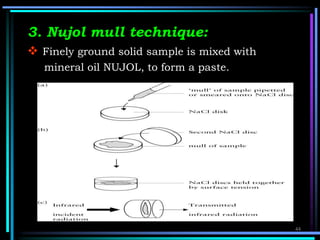
3. Nujol mull technique:
 Finely ground solid sample is mixed with
mineral oil NUJOL, to form a paste.
44
Nujol shows characteristic absorption of
C-C and C-H vibrations of hydrocarbons at
2915, 1462, 1376 and 719cm-1.
Nujol has to be used in combination with
fluorolube (a completely halogenated
polymer) or hexachlorobutadiene.
45
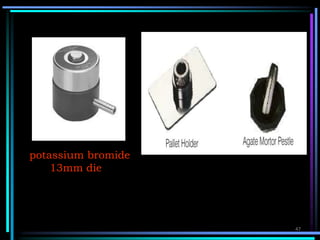
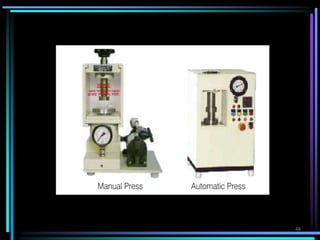
4. Pressed pellet technique (disc method):
♣ A small amount of finely ground solid
sample is mixed with about 100 times its
weight of powdered pot. bromide.
♣ Then pressed under high pressure in a
IR tablet press to form a small pellet.
46
potassium bromide
13mm die
47
48
Advantages over nujol mull technique:
 Resolution is superior.
 Stored for long period of time.
 Eliminates the problem of bands which appear in
the spectrum due to mulling agent.
Disadvantages:
 Polymeric changes in crystallinity in the sample.
 Not suitable for polymers.
 Band at 3450 cm-1 from -OH group of moisture.
49
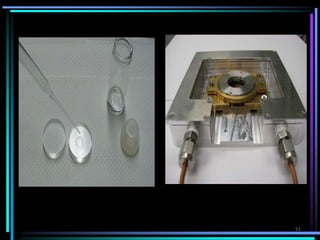
♣ Samples that are liquids at room
temperature are usually handled in the pure
form.
♣ Various types of cells like sandwich cell,
demountable cell and cavity cells are used.
♣ These cells are made up of sodium bromide,
potassium bromide or thallium bromide.
♣ Sample layer thickness of 0.01 to 0.05 mm
such that transmittance lies between 15 to
70%.
50
51
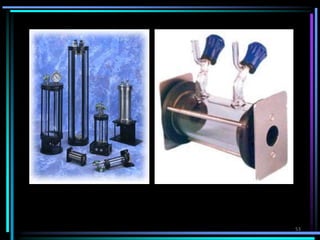
 Gas sample cell consists of metal bar glass
cylinder of 10 cm long, closed with an
appropriate window material.
 Gas samples are examined in IR region
after removing the moisture or water
vapors.
 Partial pressure of 5 to 50 mm of mercury
can be applied.
 Sometimes the GLC is coupled with IR
spectrophotometers.
52
53
Douglas A. Skoog, Instrumental analysis,
Cengage learning, India edition,488-502.
Gurudeep R. Chatwal, Instrumental
methods of chemical analysis, Himalaya
Publishing House 2.40-2.51.
Dr. A. V. Kasture, Pharmaceutical
analysis Instrumental methods, vol-2nd,
Nirali Prakashan 284-95.
Y. R. Sharma. Elementary Organic
Spectroscopy, Principles and Chemical
applications, S. Chand and Company Ltd.,
83-85.
Internet sources : www.googleimages.com
www.wikipedia.org
56

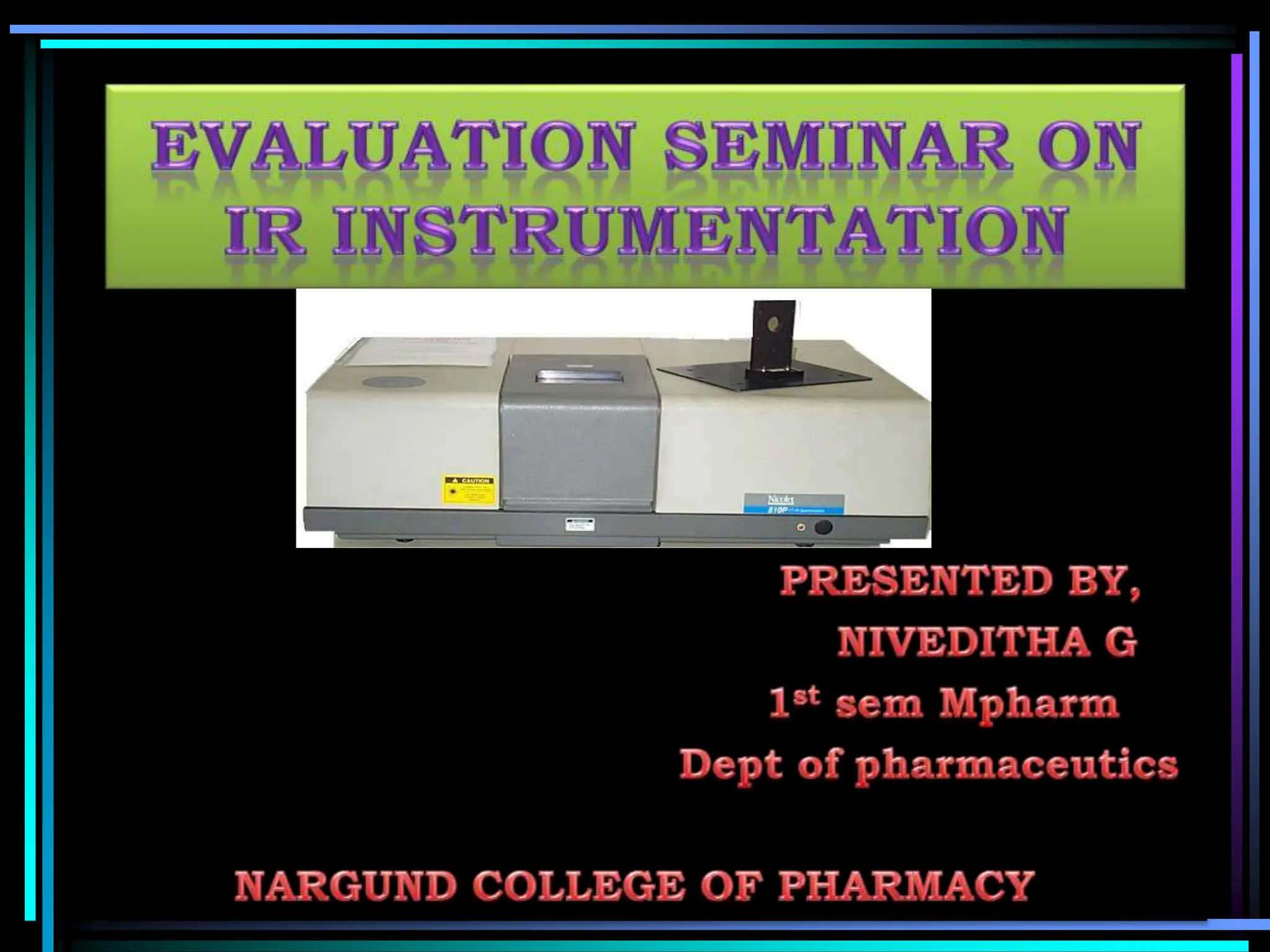
EVALUATION SEMINAR ON IR INSTRUMENTATION

  • 2.
    Three types ofIR instruments;  Dispersive spectrophotometers  Fourier transform spectrophotometers  Non- dispersive spectrophotometers
  • 3.
  • 4.
  • 5.
     Spurious readings Slow scan speeds  Thermal effect
  • 6.
    Advantages over dispersiveIR: Better speed and sensitivity. High resolution. Internal laser reference. Greater optical throughput. Elimination of stray light. Mechanically simple.
  • 7.
    3 basic spectrometercomponents in an FT system, Radiation source Interferometer Detector
  • 8.
     Commonly usedinterferometer is a Michelson interferometer.  It consists of 3 active components, Moving mirror Fixed mirror Beam splitter
  • 12.
    Near IR: Tungstenfilament, rhodium wire, nichrome wire. Mid IR: Nernst glower, globar source. Far IR: Mercury arc lamp.
  • 13.
    Advantages:  Temperature upto 1100K.  Does not require water cooling.  Give long service. Disadvantage:  Less intense.
  • 14.
    Advantages: Temperature up to 1200Kto 2200K. Wide wavelength range. Intensity remains steady. b) Nernst glower aux. heater 2 - 5 cm Has - temp coefficient. of resistance. 1 - 3 mm dia. ceramic holder Y2O3, ThO2, ZrO2 heated up to 1500oC Pt leads cement
  • 15.
    Advantages:  Emits maximum radiationat 5200cm-1.  Temperature up to 1300K to1700K. c) Globar 5 cm 6 - 8 mm dia. SiC rod heated to 1300oC water- cooled brass tube with slot + temp coeff. of resistance G 15 m 650 cm-1 NG G 10 m 1000 cm-1 NG 1 m 10000 cm-1 Disadvantage:  Less intense source.
  • 16.
     Quartz -jacketedtube containing mercury vapor.  Gives intense radiation in the far IR region.
  • 17.
     Useful fornear IR region of 4000 to 12800 cm-1.
  • 18.
    Monochromators are oftwo types,  Prism Monochromators a. Single pass monochromator b. Double pass monochromator  Grating Monochromators
  • 19.
     Halogen saltsare used in prism monochromator, as they are transparent to IR radiations.  Quartz prisms are used only in the near IR region (0.8 to 3 µ).  Crystalline potassium bromide and cesium bromide are used in far IR region (15 to 40 µ).
  • 20.
     Focusing ofradiation is achieved by using concave mirrors rather than prisms.  Prepared from various materials like metals or glass coated aluminium.
  • 21.
    There are 2types of prism monochromators, 1.SINGLE PASS MONOCHROMATOR.
  • 22.
  • 23.
     Essentially aseries of parallel straight lines, cut into a plane surface.  Constructed from glass or plastic coated with aluminium.  Gratings are blazed to concentrate the radiation into single order.
  • 25.
    Constructed using rocksalt (NaCl). Sample cells are demountable and Teflon spacers are used. Sample cells must have windows that are transparent. Fixed path length cells are also available. Often polished with buffing powder.
  • 27.
    There are twomain types of detectors used in IR spectrophotometry; Thermal detectors 1. Thermocouple 2. Bolometers 3. Thermistors 4. Golay cell / Golay detectors Photon detectors
  • 29.
     IR radiationfalls on these detector, cause heating which give rise to a potential difference.  Most commonly used bcoz it give responses for all frequencies.
  • 31.
    The end exposedto IR radiation is hot junction. Cold junction is kept at constant temperature and is not exposed to IR radiation. Response time 60 mili sec.
  • 33.
     When IRradiation falls on metal conductor, its temperature changes which cause change in the resistance.  The degree of change in resistance is a measure of amount of radiation that fallen on the detector.  Response time 4 milisec.
  • 34.
     They are resistors. Made by fusing several metallic oxides.  Its response time is slow.
  • 35.
    It uses the expansionof gas as the measuring device. IR radiation falls on blackened metal plate, get heated, which causes expansion of gas and deform the flexible diaphragm.
  • 36.
     Most commonlyused pyroelectric material is tri glycerine sulphate (TGS).  Made by sandwiching the pyroelectric crystal between two electrodes, one of which is IR transparent, changing its temperature by irradiating with IR radiation alters the charge distribution across the crystal.
  • 37.
    Widely used innear IR region. Use the quantum effects of IR radiation to change the electric properties of a semiconductor. There is a drop of electrical resistance. Small voltage is applied, large increase in current.
  • 38.
    Two types ofphoton detectors;
  • 41.
     Depends uponthe state of the sample whether it is a gas, liquid or solid.  Sample which is to be detected must be pure and should be free from water. 41
  • 42.
    Four techniques employed; 1.Soliddissolved in solvent : Solid dissolved in non-aqueous solvent. A drop of solution is placed on an alkali metal disk and the solvent is evaporated. This leaves a thin film of the solute. Commonly used solvents carbon tetrachloride, carbon disulphide. For polar solutes; Chloroform, methylene chloride, acetonitrile and acetone. 42
  • 43.
    2. As solidfilm: Used for amorphous solids, polymers and resins. Sample is dissolved in volatile solvent. This solution is poured onto a rock-salt plate. Solvent is evaporated. Thus the solid sample forms a thin film on the surface of cell. 43
  • 44.
    3. Nujol mulltechnique:  Finely ground solid sample is mixed with mineral oil NUJOL, to form a paste. 44
  • 45.
    Nujol shows characteristicabsorption of C-C and C-H vibrations of hydrocarbons at 2915, 1462, 1376 and 719cm-1. Nujol has to be used in combination with fluorolube (a completely halogenated polymer) or hexachlorobutadiene. 45
  • 46.
    4. Pressed pellettechnique (disc method): ♣ A small amount of finely ground solid sample is mixed with about 100 times its weight of powdered pot. bromide. ♣ Then pressed under high pressure in a IR tablet press to form a small pellet. 46
  • 47.
  • 48.
  • 49.
    Advantages over nujolmull technique:  Resolution is superior.  Stored for long period of time.  Eliminates the problem of bands which appear in the spectrum due to mulling agent. Disadvantages:  Polymeric changes in crystallinity in the sample.  Not suitable for polymers.  Band at 3450 cm-1 from -OH group of moisture. 49
  • 50.
    ♣ Samples thatare liquids at room temperature are usually handled in the pure form. ♣ Various types of cells like sandwich cell, demountable cell and cavity cells are used. ♣ These cells are made up of sodium bromide, potassium bromide or thallium bromide. ♣ Sample layer thickness of 0.01 to 0.05 mm such that transmittance lies between 15 to 70%. 50
  • 51.
  • 52.
     Gas samplecell consists of metal bar glass cylinder of 10 cm long, closed with an appropriate window material.  Gas samples are examined in IR region after removing the moisture or water vapors.  Partial pressure of 5 to 50 mm of mercury can be applied.  Sometimes the GLC is coupled with IR spectrophotometers. 52
  • 53.
  • 54.
    Douglas A. Skoog,Instrumental analysis, Cengage learning, India edition,488-502. Gurudeep R. Chatwal, Instrumental methods of chemical analysis, Himalaya Publishing House 2.40-2.51. Dr. A. V. Kasture, Pharmaceutical analysis Instrumental methods, vol-2nd, Nirali Prakashan 284-95.
  • 55.
    Y. R. Sharma.Elementary Organic Spectroscopy, Principles and Chemical applications, S. Chand and Company Ltd., 83-85. Internet sources : www.googleimages.com www.wikipedia.org
  • 56.