1
Adsorbents for TLC,
preparation techniques,
mobile phase selection,
reverse phase TLC
NIVEDITHA G
1st year M.Pharm
Pharmaceutics
NCP
2
Contents
• Introduction to TLC
• Technique
• Adsorbents for TLC
• Preparation techniques
• Mobile phase selection
• Reverse phase TLC
• References
3
Introduction
 TLC is simple & rapid method carried out
using thin layer of adsorbents on plates.
 Principle :
• TLC has been included under both
adsorption & partition chromatography.
• Separation may result due to adsorption
or partition or both phenomenon
depending upon nature of adsorbents &
solvent system used for development.
4
Techniques
 In TLC the separation is carried on a glass
or a plastic plate which is coated with a
thin uniform layer of finely divided inert
adsorbents such as silica gel or alumina.
 The plates are activated, in solution of the
sample in a volatile solvent is applied by
using capillary tube or micropipette to a
spot keeping 1-2cm from bottom of TLC
plate.
5
The position of the sample spot is
indicated by marking the origin line
on the plate with the lead pencil.
When spot has dried, the plate is
placed vertically in a suitable tank
with its lower edge immersed in
selected mobile phase.
Solvent rises by capillary action,
resolving the sample mixture into
discrete spots.
6
At the end of the run the solvent is
allowed to evaporate from the plate
& the separated spots are located &
identified by various physical &
chemical method.
7
Adsorbents for TLC
In the beginning of TLC method, only
few coating materials were used as
adsorbents such as silica gel,
alumina, kieselguhr, etc.
However, now a days , there is
variety of adsorbents which can be
selectively utilized.
8
Factors to be considered while
choosing the adsorbents
1. Characteristics of compound to be
separated.
2. Solubility of compounds.
3. Nature of substance to be
separated i.e. acidic, basic,
amphoteric.
4. To see whether compound is liable
to react chemically with adsorbent
(or solvent), or not.
9
 Two general properties that decide its
application are :
1. Particle size
2. Homogeneity
 Particle size of 1-25mm is generally
preferred.
 Adsorbents do not generally adhere to
glass plates & hence binders like
gypsum, starch are added.
 Gypsum (calcium sulphate) in 10-15%
w/w is widely used as binder.
10
Types of adsorbents
1. Inorganic adsorbents
2. Organic adsorbents
11
• Silica gel
• Alumina
• Kieselguhr
• Magnesia
• Magnesium silicate
• Calcium silicate
Inorganic adsorbents
12
• Cellulose & its acetylates
• Charcoal & activated carbon
Organic adsorbents
13
Inorganic adsorbents
Silica gel:
• It is prepared by the hydrolysis of
sodium silicate to polysilicic acid
which on further condensation &
polymerization yields silica gel.
• Binder (10%w/w) is added to confer
greater mechanical strength to the
layer & enhance adhesion to the
plate.
14
• Starch is another binder which has limited
use since it does not allow the use of
corrosive locating agents like 10% v/v
alcoholic sulphuric acid, 5% potassium
dichromate.
• Silica gel commonly used in TLC has mean
particle size of 15mm with a particle size
range of 5-40mm.
• Adsorption properties of the silica gel can
be modified for reverse phase by
incorporating non polar functional group
such as octadecyl siliyl (ODS).
15
• As such, surface of silica is acidic due
to presence of many silanol hydroxyl
groups therefore best suited for
analysis of acidic & polar compounds
like amino acids, fatty acids, lipids,
essential oil, terpenoids, sugar, etc.
16
Alumina (Al2O3):
• It has basic surface & is used next to
silica gel for separation of weakly
polar group.
• It often contains sodium carbonate &
bicarbonate whose presence affects
its adsorptive properties.
• Alumina can be produced with its
surface either acidic, basic, or
neutral.
17
• Neutral alumina is used with organic
eluents. It is suitable for use with
substances that are either liable or
bound to strong alkalies.
• Acidic alumina is used for separation
of neutral or acidic materials.
• Basic alumina is used to separate
alkaloids, aromatic & unsaturated
hydrocarbons.
18
Kieselguhr (Diatomceous earth):
It has neutral pH. It is available with
or without binder. It has less capacity
of resolution than alumina and silica
gel.
 Magnesia (MgO) :
Often replaces alumina. It is too
finely divided to allow filtration and
can be mixed with filter aid. It is
obtained by dehydration of the
hydroxide.
19
 Magnesium Silicate, Calcium Silicate :
These are utilised for separation of sugars
and its acetates, phenylosazones. In these
adsorptive power increases with
decreasing water content.
 Others :
Aluminum silicate, bentonites, barium
sulphate, calcium carbonate, calcium
hydroxide, calcium sulphate, dicalcium
phosphate, fuller’s earth,
zinc carbonate.
20
ORGANIC ADSORBENTS
Cellulose and its acetylates:
• These adsorbents are fibrous and can be
used with relative advantages over
paper as the flow is more even and
there is les diffusion of the dissolved
substances. The flow is also faster.
Modified cellulose powders are used to
obtain ion-exchange separations in TLC
and can be used with or without binder.
21
• Cellulose contains adsorbed water which
bring separation by partition
mechanism. And commonly used for
separating hydrophilic substances like
amino acids and sugars.
 Charcoal and activated Carbon :
• Charcoal has specific property of
adsorbing strongly aromatic substances.
Adsorptive property of activated carbon
can be modified by depositing on it a
film of a non electrolyte or a fatty acid.
22
Others :
Dextran gels, ion-exchange resins,
polyamides, polyethylene powder,
sucrose are used for variety of
separations.
23
PREPARATION OF
CHROMATOLATES
• Glass plates or flexible plates are
commonly used for adsorbent. Size used
depends on type of separation to be
carried out, the type of chromatographic
tank and spreading apparatus available.
• The standard sizes are 20 x 5 cm, 20 x 10
cm or 20 x 20 cm .
• The surface should be flat without
irregularities.
• The standard film thickness is 250um
24
Methods for application
of adsorbent.
Pouring
Dipping
Spraying
Spreading.
25
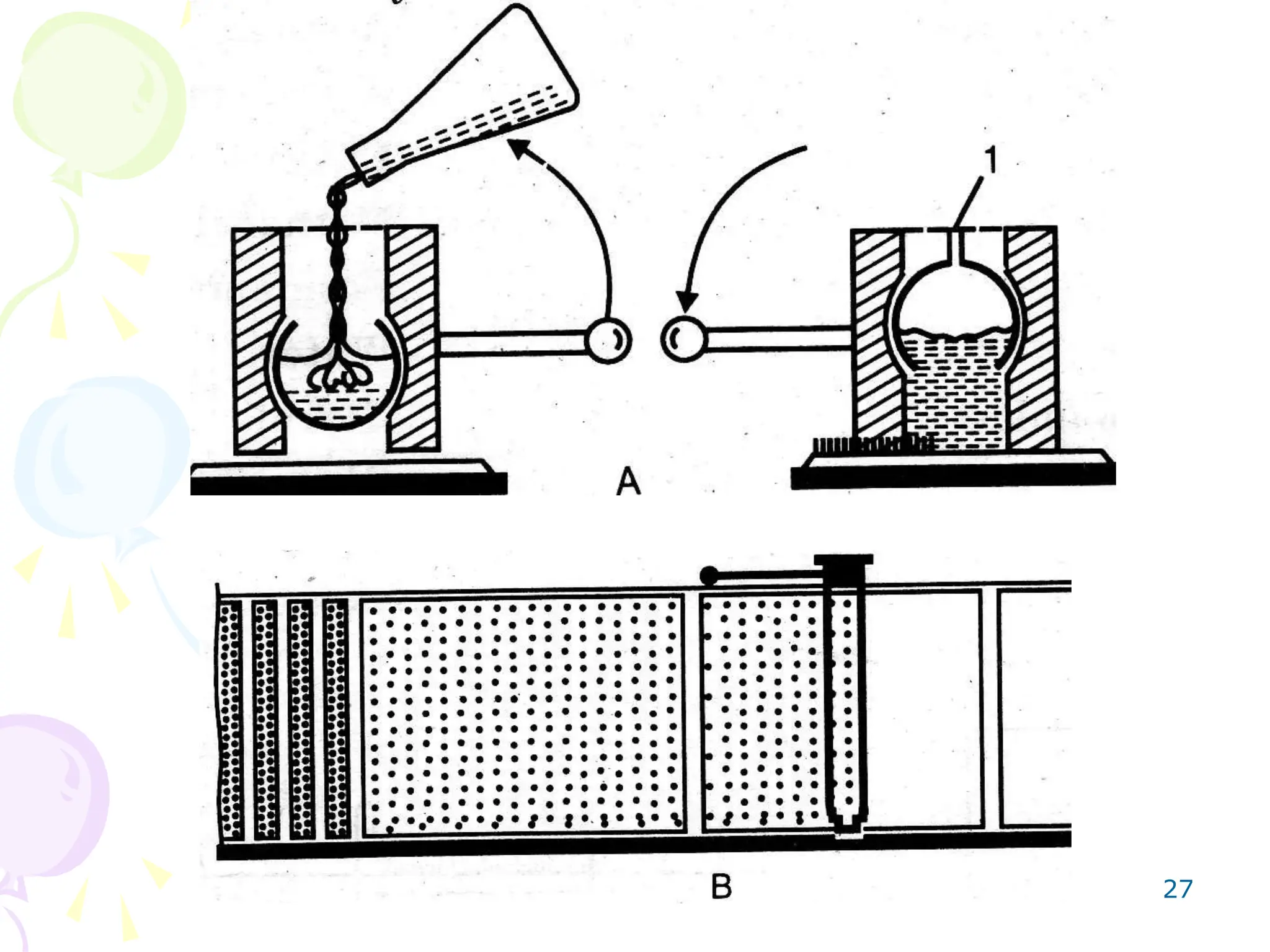
• Pouring: The adsorbent of finely divided
and homogeneous particle size is made
into slurry and is poured on a plate and
allowed to flow over it so that it is evenly
covered.
• Dipping : This technique is used for small
plates by dipping the two plates at a time,
back to back in a slurry of adsorbent in
chloroform or other volatile solvents.
Exact thickness of layer is not known and
evenness of layer may not be good.
26
• Spraying : Slurry is diluted further for the
operation of sprayer. But this technique is
not used now a days as it is difficult to get
uniform layer.
• Spreading : All the above methods fail to
give thin and uniform layers. Modern
methods utilize the spreading devices for
preparation of uniform thin layers on glass
plates. Commercial spreaders are of two
types (a) Moving spreader, (b) Moving
plate type.
• It gives layer thickness from 0.2 to 2.0
mm.
27
28
• Precoated plates of different
adsorbents either on glass or
polymeric sheets are available in
uniform and optimal layer thickness
for intended purpose and are
abrasive resistant. They can be
sprayed with almost all spraying
agents including corrosive agents.
But these are very expensive. Also
called as ready to use TLC plates.
29
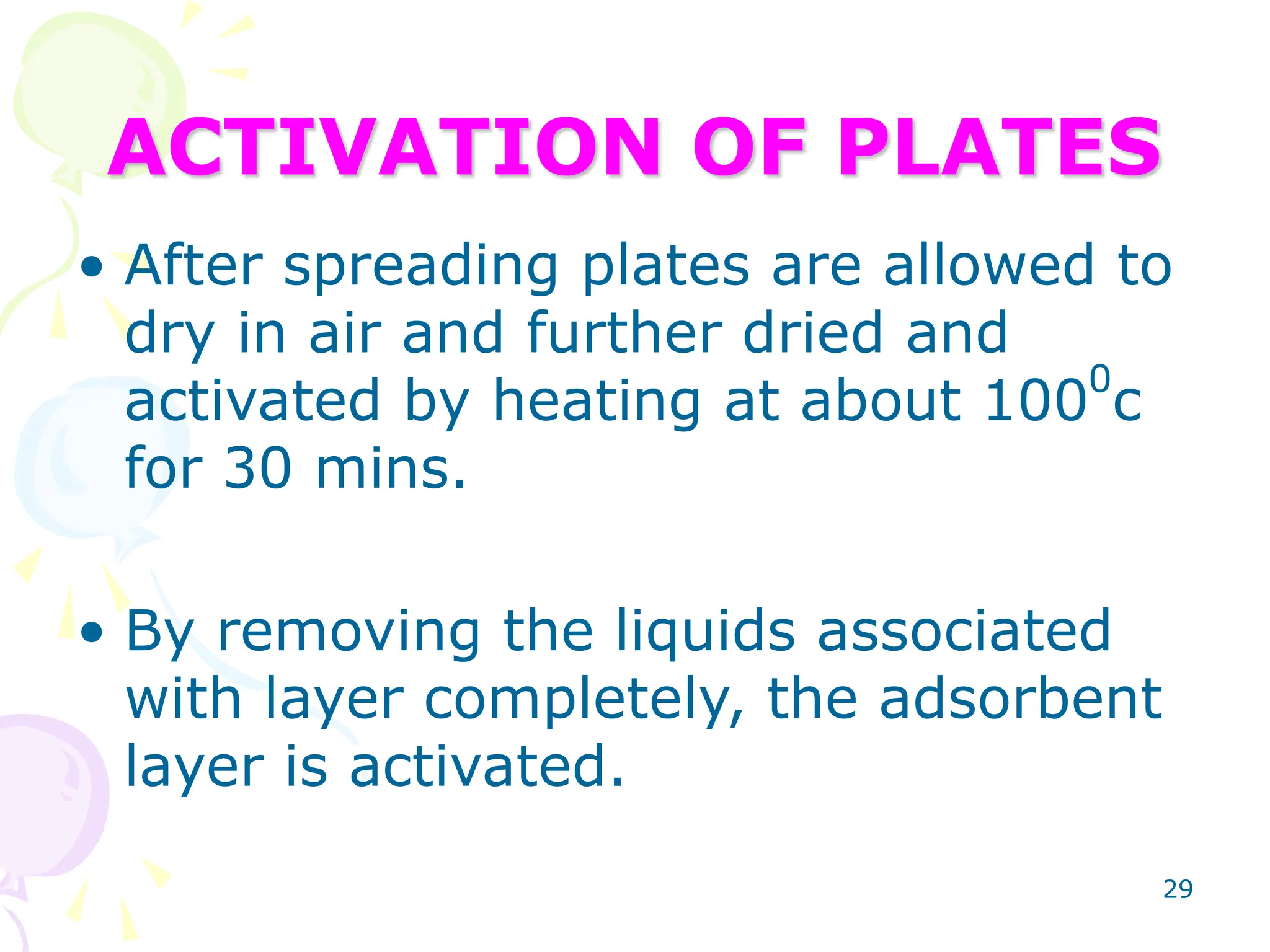
ACTIVATION OF PLATES
• After spreading plates are allowed to
dry in air and further dried and
activated by heating at about 1000
c
for 30 mins.
• By removing the liquids associated
with layer completely, the adsorbent
layer is activated.
30
SOLVENT SYSTEM
• The choice of the mobile phase is
depends upon the following factors:-
1. Nature of the substance to be separated
2. Nature of the stationary phase used
3. Mode of chromatography ( Normal phase
or reverse phase)
4. Separation to be achieved- Analytical or
preparative.
31
• The organic solvent mixture of low polarity
is used Highly polar solvents are avoided
to minimize adsorption of any components
of the solvent mixture. Use of water as a
solvent is avoided as it may loosen the
adhesion of a layer on a glass plate.
• Solvents with an increasing degree of
polarity are used in liquid-solid or
adsorption chromatography. The solvents
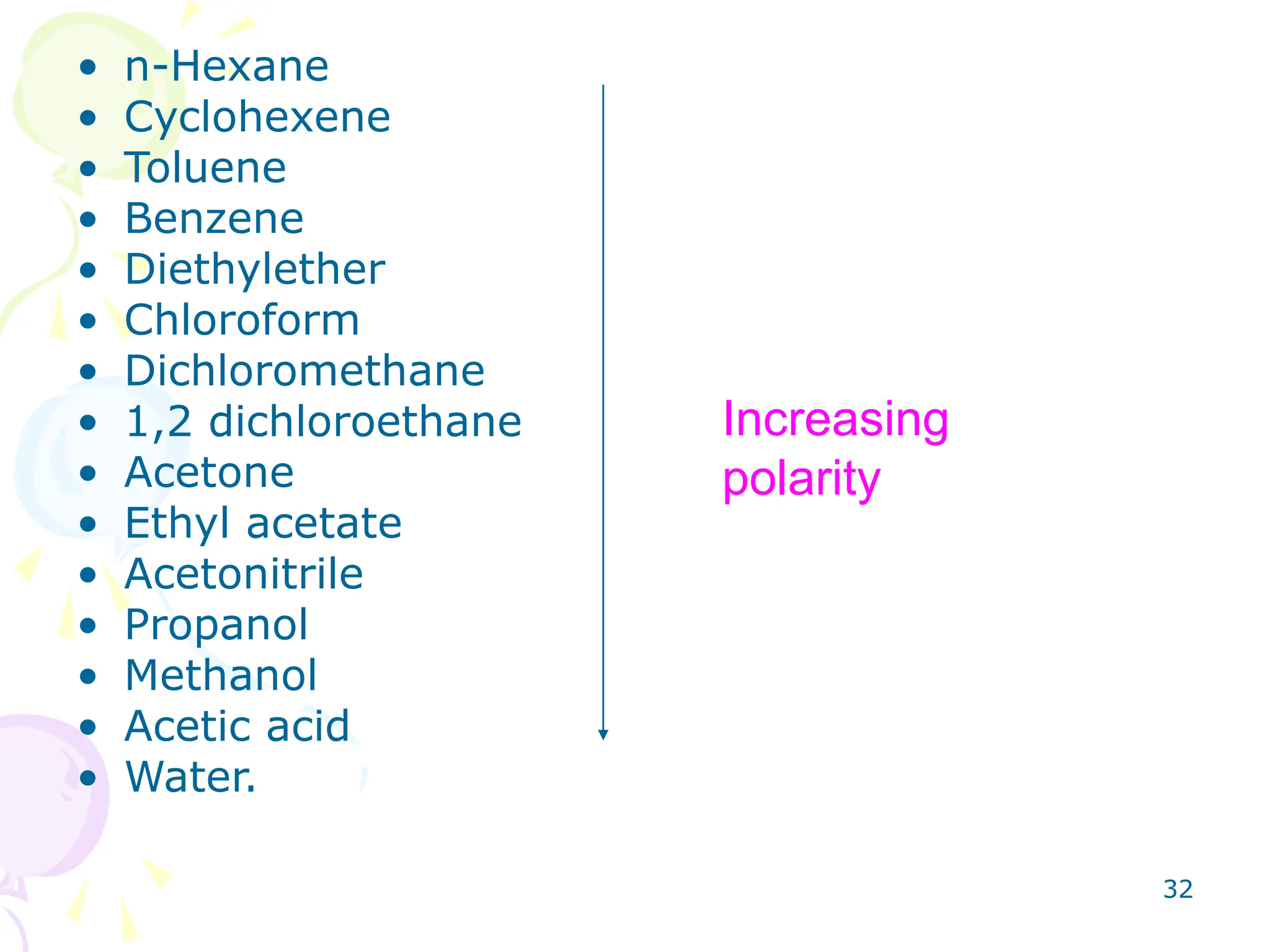
listed in elutropic series are selected.
32
• n-Hexane
• Cyclohexene
• Toluene
• Benzene
• Diethylether
• Chloroform
• Dichloromethane
• 1,2 dichloroethane
• Acetone
• Ethyl acetate
• Acetonitrile
• Propanol
• Methanol
• Acetic acid
• Water.
Increasing
polarity
33
APPLICATION OF SAMPLE
• Sample solution in a non polar solvent is
applied.
• The concentration of a sample or standard
solution has to be minimum 2-5 ul of a
1% solution of either standard or test
sample is spotted using a capillary tube or
micropipette.
• The area of application should be kept as
small as possible for sharper and greater
resolution.
34
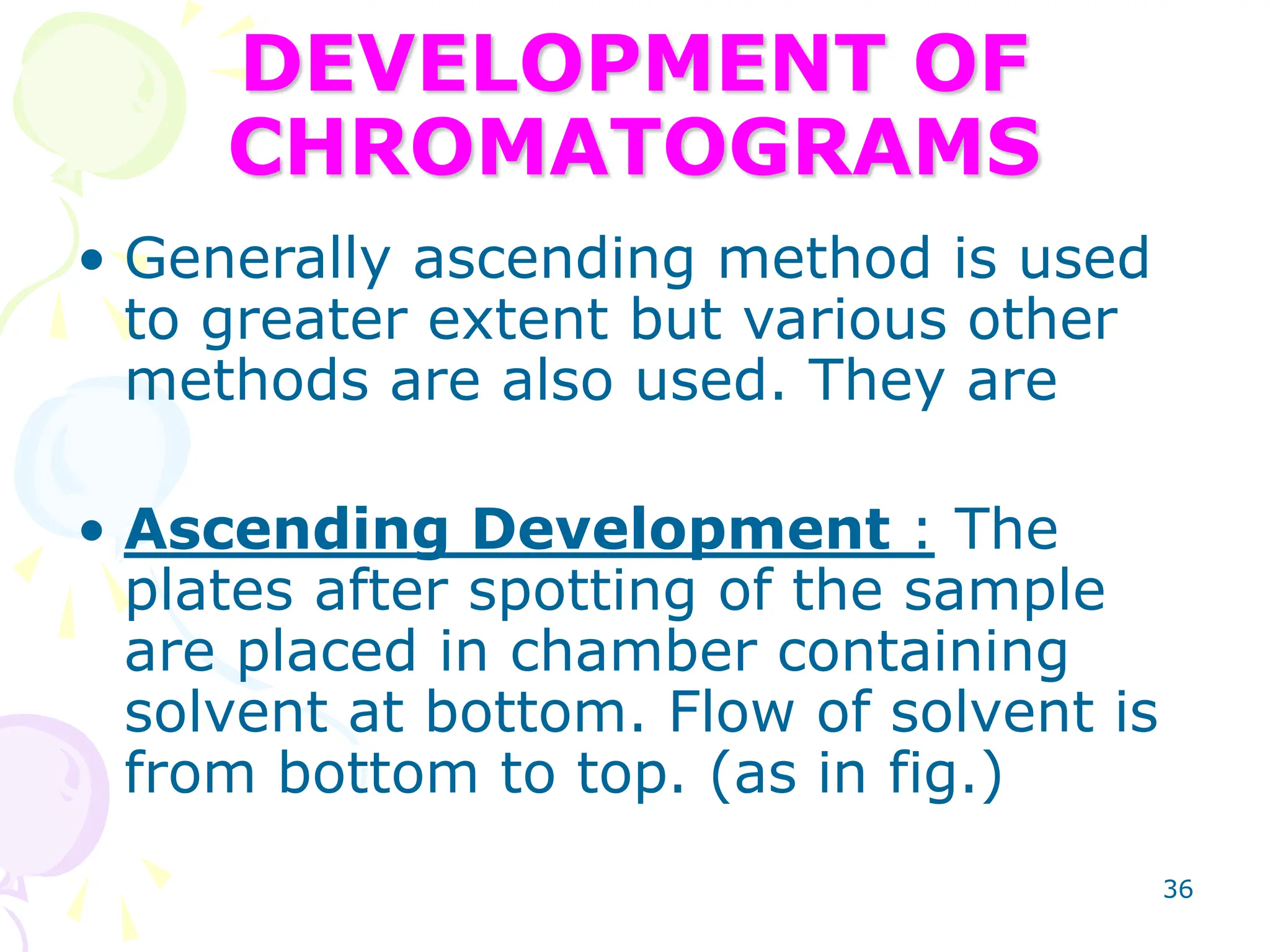
DEVELOPMENT
CHAMBERS
• TLC plates are placed vertically in a
rectangular chromatography tank
(as in fig)
35
• They are classified according to the
separation technique used.
(a) Tanks for ascending development
(b) Tanks for descending development
(c) Tanks for horizontal development
(d) Tanks for thin layer electrophoresis
• For first three methods glass or S.S is
most suitable.
• Degree of saturation will affect Rf value
36
DEVELOPMENT OF
CHROMATOGRAMS
• Generally ascending method is used
to greater extent but various other
methods are also used. They are
• Ascending Development : The
plates after spotting of the sample
are placed in chamber containing
solvent at bottom. Flow of solvent is
from bottom to top. (as in fig.)
37
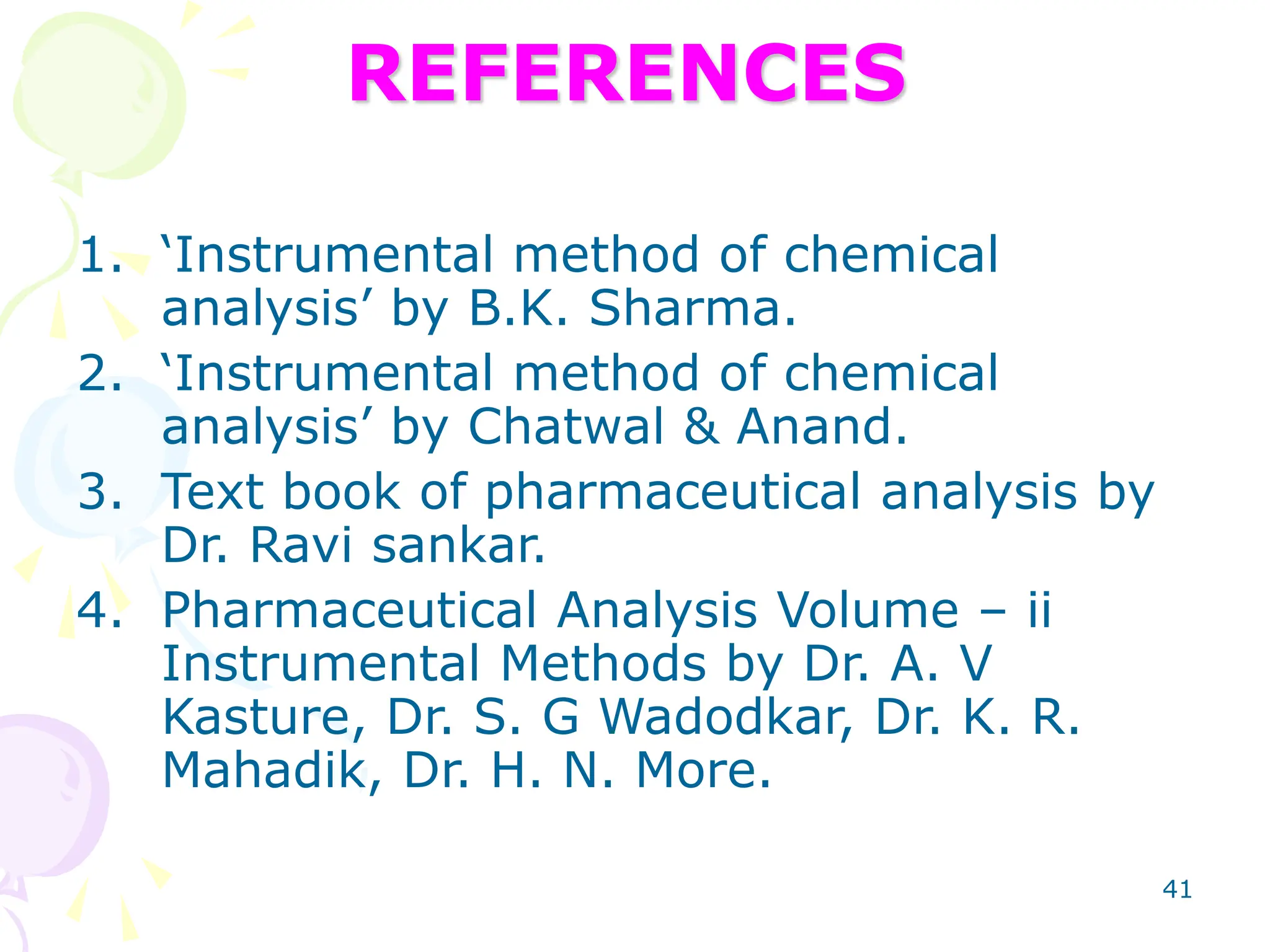
• Descending : Flow of the solvent
from reservoir to the plate is by
means of a filter paper strip. Solvent
moves from top to bottom of the
plate (as in fig.)
38
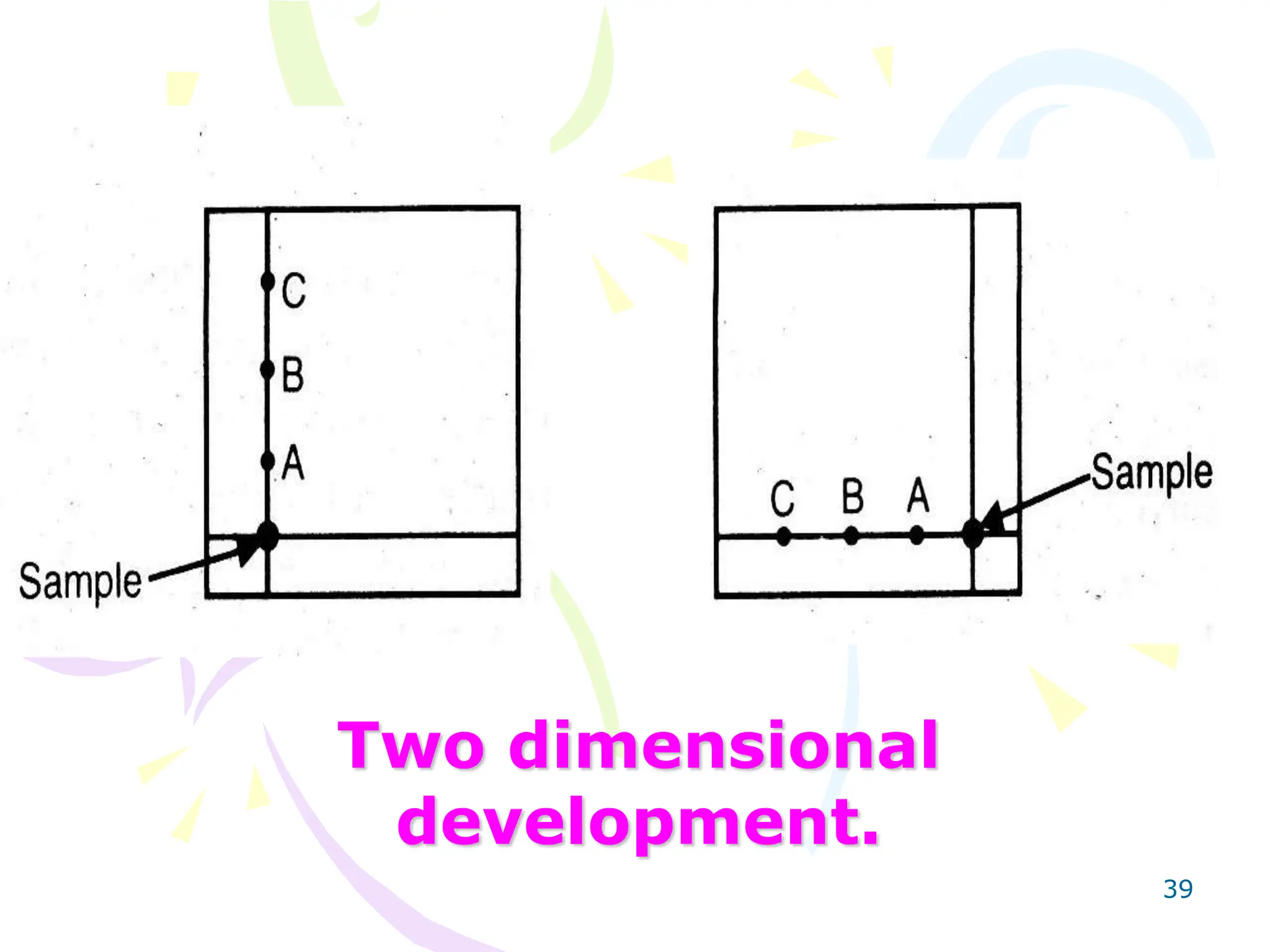
 Two dimensional development :
• It is used if the component of the mixture are not
completely separated by development in a single
direction.
• In these sample spot is applied at corner of plate.
• First development is carried out by ascending
method in one solvent. The plate is taken out,
solvent allowed to evaporate.
• second development is carried out in another
solvent by changing the edge of plate at 900
(as in
fig.)
39
Two dimensional
development.
40
REVERSE PHASE TLC
• Here stationary phase is non polar in nature
and mobile phase is polar in nature.
• These chromatoplates are prepared by immersing
the adsorbent layer very slowly in 5-10% of
paraffin, silicone oil, undecane in petroleum ether
or diethyl ether. After removing the plate and
evaporating the solvent , the plate is ready for
chromatography. Paraffin and silicon oil provides
the permanent impregnation whereas undecane
can be removed after development after heating
the plate at 1200.
41
REFERENCES
1. ‘Instrumental method of chemical
analysis’ by B.K. Sharma.
2. ‘Instrumental method of chemical
analysis’ by Chatwal & Anand.
3. Text book of pharmaceutical analysis by
Dr. Ravi sankar.
4. Pharmaceutical Analysis Volume – ii
Instrumental Methods by Dr. A. V
Kasture, Dr. S. G Wadodkar, Dr. K. R.
Mahadik, Dr. H. N. More.
42

Adsorbents for TLC, preparation techniques, mobile phase selection, reverse phase TLC

  • 1.
    1 Adsorbents for TLC, preparationtechniques, mobile phase selection, reverse phase TLC NIVEDITHA G 1st year M.Pharm Pharmaceutics NCP
  • 2.
    2 Contents • Introduction toTLC • Technique • Adsorbents for TLC • Preparation techniques • Mobile phase selection • Reverse phase TLC • References
  • 3.
    3 Introduction  TLC issimple & rapid method carried out using thin layer of adsorbents on plates.  Principle : • TLC has been included under both adsorption & partition chromatography. • Separation may result due to adsorption or partition or both phenomenon depending upon nature of adsorbents & solvent system used for development.
  • 4.
    4 Techniques  In TLCthe separation is carried on a glass or a plastic plate which is coated with a thin uniform layer of finely divided inert adsorbents such as silica gel or alumina.  The plates are activated, in solution of the sample in a volatile solvent is applied by using capillary tube or micropipette to a spot keeping 1-2cm from bottom of TLC plate.
  • 5.
    5 The position ofthe sample spot is indicated by marking the origin line on the plate with the lead pencil. When spot has dried, the plate is placed vertically in a suitable tank with its lower edge immersed in selected mobile phase. Solvent rises by capillary action, resolving the sample mixture into discrete spots.
  • 6.
    6 At the endof the run the solvent is allowed to evaporate from the plate & the separated spots are located & identified by various physical & chemical method.
  • 7.
    7 Adsorbents for TLC Inthe beginning of TLC method, only few coating materials were used as adsorbents such as silica gel, alumina, kieselguhr, etc. However, now a days , there is variety of adsorbents which can be selectively utilized.
  • 8.
    8 Factors to beconsidered while choosing the adsorbents 1. Characteristics of compound to be separated. 2. Solubility of compounds. 3. Nature of substance to be separated i.e. acidic, basic, amphoteric. 4. To see whether compound is liable to react chemically with adsorbent (or solvent), or not.
  • 9.
    9  Two generalproperties that decide its application are : 1. Particle size 2. Homogeneity  Particle size of 1-25mm is generally preferred.  Adsorbents do not generally adhere to glass plates & hence binders like gypsum, starch are added.  Gypsum (calcium sulphate) in 10-15% w/w is widely used as binder.
  • 10.
    10 Types of adsorbents 1.Inorganic adsorbents 2. Organic adsorbents
  • 11.
    11 • Silica gel •Alumina • Kieselguhr • Magnesia • Magnesium silicate • Calcium silicate Inorganic adsorbents
  • 12.
    12 • Cellulose &its acetylates • Charcoal & activated carbon Organic adsorbents
  • 13.
    13 Inorganic adsorbents Silica gel: •It is prepared by the hydrolysis of sodium silicate to polysilicic acid which on further condensation & polymerization yields silica gel. • Binder (10%w/w) is added to confer greater mechanical strength to the layer & enhance adhesion to the plate.
  • 14.
    14 • Starch isanother binder which has limited use since it does not allow the use of corrosive locating agents like 10% v/v alcoholic sulphuric acid, 5% potassium dichromate. • Silica gel commonly used in TLC has mean particle size of 15mm with a particle size range of 5-40mm. • Adsorption properties of the silica gel can be modified for reverse phase by incorporating non polar functional group such as octadecyl siliyl (ODS).
  • 15.
    15 • As such,surface of silica is acidic due to presence of many silanol hydroxyl groups therefore best suited for analysis of acidic & polar compounds like amino acids, fatty acids, lipids, essential oil, terpenoids, sugar, etc.
  • 16.
    16 Alumina (Al2O3): • Ithas basic surface & is used next to silica gel for separation of weakly polar group. • It often contains sodium carbonate & bicarbonate whose presence affects its adsorptive properties. • Alumina can be produced with its surface either acidic, basic, or neutral.
  • 17.
    17 • Neutral aluminais used with organic eluents. It is suitable for use with substances that are either liable or bound to strong alkalies. • Acidic alumina is used for separation of neutral or acidic materials. • Basic alumina is used to separate alkaloids, aromatic & unsaturated hydrocarbons.
  • 18.
    18 Kieselguhr (Diatomceous earth): Ithas neutral pH. It is available with or without binder. It has less capacity of resolution than alumina and silica gel.  Magnesia (MgO) : Often replaces alumina. It is too finely divided to allow filtration and can be mixed with filter aid. It is obtained by dehydration of the hydroxide.
  • 19.
    19  Magnesium Silicate,Calcium Silicate : These are utilised for separation of sugars and its acetates, phenylosazones. In these adsorptive power increases with decreasing water content.  Others : Aluminum silicate, bentonites, barium sulphate, calcium carbonate, calcium hydroxide, calcium sulphate, dicalcium phosphate, fuller’s earth, zinc carbonate.
  • 20.
    20 ORGANIC ADSORBENTS Cellulose andits acetylates: • These adsorbents are fibrous and can be used with relative advantages over paper as the flow is more even and there is les diffusion of the dissolved substances. The flow is also faster. Modified cellulose powders are used to obtain ion-exchange separations in TLC and can be used with or without binder.
  • 21.
    21 • Cellulose containsadsorbed water which bring separation by partition mechanism. And commonly used for separating hydrophilic substances like amino acids and sugars.  Charcoal and activated Carbon : • Charcoal has specific property of adsorbing strongly aromatic substances. Adsorptive property of activated carbon can be modified by depositing on it a film of a non electrolyte or a fatty acid.
  • 22.
    22 Others : Dextran gels,ion-exchange resins, polyamides, polyethylene powder, sucrose are used for variety of separations.
  • 23.
    23 PREPARATION OF CHROMATOLATES • Glassplates or flexible plates are commonly used for adsorbent. Size used depends on type of separation to be carried out, the type of chromatographic tank and spreading apparatus available. • The standard sizes are 20 x 5 cm, 20 x 10 cm or 20 x 20 cm . • The surface should be flat without irregularities. • The standard film thickness is 250um
  • 24.
    24 Methods for application ofadsorbent. Pouring Dipping Spraying Spreading.
  • 25.
    25 • Pouring: Theadsorbent of finely divided and homogeneous particle size is made into slurry and is poured on a plate and allowed to flow over it so that it is evenly covered. • Dipping : This technique is used for small plates by dipping the two plates at a time, back to back in a slurry of adsorbent in chloroform or other volatile solvents. Exact thickness of layer is not known and evenness of layer may not be good.
  • 26.
    26 • Spraying :Slurry is diluted further for the operation of sprayer. But this technique is not used now a days as it is difficult to get uniform layer. • Spreading : All the above methods fail to give thin and uniform layers. Modern methods utilize the spreading devices for preparation of uniform thin layers on glass plates. Commercial spreaders are of two types (a) Moving spreader, (b) Moving plate type. • It gives layer thickness from 0.2 to 2.0 mm.
  • 27.
  • 28.
    28 • Precoated platesof different adsorbents either on glass or polymeric sheets are available in uniform and optimal layer thickness for intended purpose and are abrasive resistant. They can be sprayed with almost all spraying agents including corrosive agents. But these are very expensive. Also called as ready to use TLC plates.
  • 29.
    29 ACTIVATION OF PLATES •After spreading plates are allowed to dry in air and further dried and activated by heating at about 1000 c for 30 mins. • By removing the liquids associated with layer completely, the adsorbent layer is activated.
  • 30.
    30 SOLVENT SYSTEM • Thechoice of the mobile phase is depends upon the following factors:- 1. Nature of the substance to be separated 2. Nature of the stationary phase used 3. Mode of chromatography ( Normal phase or reverse phase) 4. Separation to be achieved- Analytical or preparative.
  • 31.
    31 • The organicsolvent mixture of low polarity is used Highly polar solvents are avoided to minimize adsorption of any components of the solvent mixture. Use of water as a solvent is avoided as it may loosen the adhesion of a layer on a glass plate. • Solvents with an increasing degree of polarity are used in liquid-solid or adsorption chromatography. The solvents listed in elutropic series are selected.
  • 32.
    32 • n-Hexane • Cyclohexene •Toluene • Benzene • Diethylether • Chloroform • Dichloromethane • 1,2 dichloroethane • Acetone • Ethyl acetate • Acetonitrile • Propanol • Methanol • Acetic acid • Water. Increasing polarity
  • 33.
    33 APPLICATION OF SAMPLE •Sample solution in a non polar solvent is applied. • The concentration of a sample or standard solution has to be minimum 2-5 ul of a 1% solution of either standard or test sample is spotted using a capillary tube or micropipette. • The area of application should be kept as small as possible for sharper and greater resolution.
  • 34.
    34 DEVELOPMENT CHAMBERS • TLC platesare placed vertically in a rectangular chromatography tank (as in fig)
  • 35.
    35 • They areclassified according to the separation technique used. (a) Tanks for ascending development (b) Tanks for descending development (c) Tanks for horizontal development (d) Tanks for thin layer electrophoresis • For first three methods glass or S.S is most suitable. • Degree of saturation will affect Rf value
  • 36.
    36 DEVELOPMENT OF CHROMATOGRAMS • Generallyascending method is used to greater extent but various other methods are also used. They are • Ascending Development : The plates after spotting of the sample are placed in chamber containing solvent at bottom. Flow of solvent is from bottom to top. (as in fig.)
  • 37.
    37 • Descending :Flow of the solvent from reservoir to the plate is by means of a filter paper strip. Solvent moves from top to bottom of the plate (as in fig.)
  • 38.
    38  Two dimensionaldevelopment : • It is used if the component of the mixture are not completely separated by development in a single direction. • In these sample spot is applied at corner of plate. • First development is carried out by ascending method in one solvent. The plate is taken out, solvent allowed to evaporate. • second development is carried out in another solvent by changing the edge of plate at 900 (as in fig.)
  • 39.
  • 40.
    40 REVERSE PHASE TLC •Here stationary phase is non polar in nature and mobile phase is polar in nature. • These chromatoplates are prepared by immersing the adsorbent layer very slowly in 5-10% of paraffin, silicone oil, undecane in petroleum ether or diethyl ether. After removing the plate and evaporating the solvent , the plate is ready for chromatography. Paraffin and silicon oil provides the permanent impregnation whereas undecane can be removed after development after heating the plate at 1200.
  • 41.
    41 REFERENCES 1. ‘Instrumental methodof chemical analysis’ by B.K. Sharma. 2. ‘Instrumental method of chemical analysis’ by Chatwal & Anand. 3. Text book of pharmaceutical analysis by Dr. Ravi sankar. 4. Pharmaceutical Analysis Volume – ii Instrumental Methods by Dr. A. V Kasture, Dr. S. G Wadodkar, Dr. K. R. Mahadik, Dr. H. N. More.
  • 42.