Mrs. Nading 
Conceptual Chemistry A
What is Electron Configuration? 
 What do we know about electron 
configuration now? 
- Electron Cloud 
- Bohr Model 
- Need a more accurate way of 
diagraming/configuring where electrons 
go in an atom
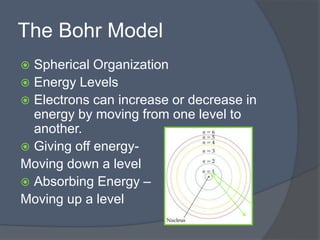
The Bohr Model 
 Spherical Organization 
 Energy Levels 
 Electrons can increase or decrease in 
energy by moving from one level to 
another. 
 Giving off energy- 
Moving down a level 
 Absorbing Energy – 
Moving up a level
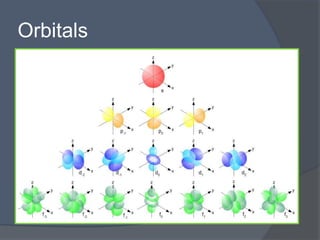
Orbitals
The Aufbau Principle 
 Aufbau – German for ‘Filling Up’ 
 Electrons fill order from low to high 
energy
Pauli Exclusion Principle 
 Each Orbital can only contain 2 
electrons 
 They must be facing opposite directions
Hunds Rule 
 If there is more than one orbital at the 
same energy level, they fill one by one 
before pairing.
What are these energy levels 
you speak of? 
 Remember: Bohr Model, the levels are 
represented spherically 
 With Orbitals, the energy levels are 
represented in different shapes and 
sizes 
 Orbitals have shapes
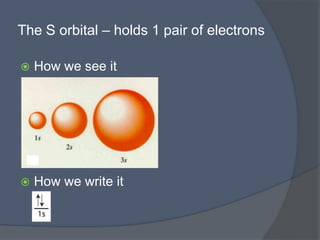
The S orbital – holds 1 pair of electrons 
 How we see it 
 How we write it
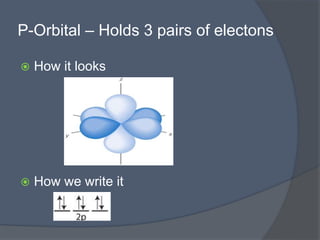
P-Orbital – Holds 3 pairs of electons 
 How it looks 
 How we write it
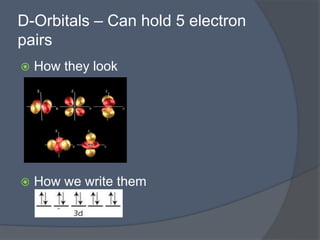
D-Orbitals – Can hold 5 electron 
pairs 
 How they look 
 How we write them
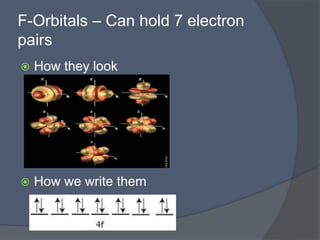
F-Orbitals – Can hold 7 electron 
pairs 
 How they look 
 How we write them
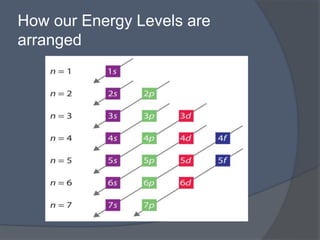
How our Energy Levels are 
arranged
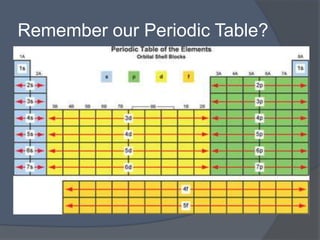
Remember our Periodic Table?
How do we apply this 
information? 
 Where do we start? 
 Step one – Pick an element 
 Step two – Figure out how many 
electrons that element has 
 Step three – draw out or refer to your 
aufbau diagram 
 Step 4 - Fill the electron shells 
systematically
We need to combine some Info 
 We need to combine our orbital notation 
with our Energy level arrangement.
Let’s try it 
 H 
 S 
 Mn

Electron configuration

  • 1.
  • 2.
    What is ElectronConfiguration?  What do we know about electron configuration now? - Electron Cloud - Bohr Model - Need a more accurate way of diagraming/configuring where electrons go in an atom
  • 3.
    The Bohr Model  Spherical Organization  Energy Levels  Electrons can increase or decrease in energy by moving from one level to another.  Giving off energy- Moving down a level  Absorbing Energy – Moving up a level
  • 4.
  • 5.
    The Aufbau Principle  Aufbau – German for ‘Filling Up’  Electrons fill order from low to high energy
  • 6.
    Pauli Exclusion Principle  Each Orbital can only contain 2 electrons  They must be facing opposite directions
  • 7.
    Hunds Rule If there is more than one orbital at the same energy level, they fill one by one before pairing.
  • 8.
    What are theseenergy levels you speak of?  Remember: Bohr Model, the levels are represented spherically  With Orbitals, the energy levels are represented in different shapes and sizes  Orbitals have shapes
  • 9.
    The S orbital– holds 1 pair of electrons  How we see it  How we write it
  • 10.
    P-Orbital – Holds3 pairs of electons  How it looks  How we write it
  • 11.
    D-Orbitals – Canhold 5 electron pairs  How they look  How we write them
  • 12.
    F-Orbitals – Canhold 7 electron pairs  How they look  How we write them
  • 13.
    How our EnergyLevels are arranged
  • 14.
  • 15.
    How do weapply this information?  Where do we start?  Step one – Pick an element  Step two – Figure out how many electrons that element has  Step three – draw out or refer to your aufbau diagram  Step 4 - Fill the electron shells systematically
  • 16.
    We need tocombine some Info  We need to combine our orbital notation with our Energy level arrangement.
  • 17.
    Let’s try it  H  S  Mn

Editor's Notes

  • #3 Until now, what do we know about electrons? We know that they are in some sort of cloud, surrounding the nucleus of an atom. What model have we been using to diagram our electrons? The bohr model. Well, the bohr model is okay for diagraming elements with less than 20 electrons, but as we pass the 3rd energy level, it starts to get a little dicey. This is why we need a more concrete way of drawing / figuring out where electrons go in the atom.
  • #5 We have since discovered that electrons are not all in a nice sphere. They are in many different configurations. Do not panic. We will go through this slowly. However, by discovering that our elements electrons are contained in what we call orbitals, we can actually now be extremely specific with where our electrons can go. We will now go through the basic rules behind orbital configuration
  • #6 The first principle that we have is the aufbau principle. Aufbau, in german, means filling up. The aufbau principle states that electrons fill an order from low to high energy. Do you remember with the bohr models, we had to do the same thing. We filled in up to two, then up to eight, then so on and so foth, but we went from lower energy to higher energy. Near the nucleus is the lowest energy and as we get further away, the energy is higher.
  • #7 The pauli exclusion principle states that orbitals can only contain 2 electrons. Why do you think that orbitals can only contain 2 electrons? Okay, who in here has a sibling? Would you like to share a room with them, if you do, does it get a little crowded sometimes? Imagine having 3 or 4 or 5 or even more siblings in that room. Its going to get a little hectic. The same is with orbitals. Electrons like keeping their rooms as little cramped as possible. Now
  • #8 Hunds rule ties in with the pauli exclusion principle. Each orbital can only have two electrons, but if there is more than one orbital on an energy level, then the electrons go one at a time. Think of the siblings metaphor again. If you live in a house with 4 rooms, one for your parents and 3 for children, if you have 2 siblings, are you all going to share a room when there are 2 more open? No, you would each get a room before you had to start sharing because again, you want to keep the cramped ness and chaos down.
  • #9 As we saw in the bohr model, the orbital model has energy levels as well, they are simply set up differently
  • #10 The s orbital can hold up to 1 pair of electrons – so 2 total, it has a spherical shape
  • #11 This is the p orbital. The thing about a p orbital is how the electrons are spaced out. It looks like there are how many different levels here – how many different ‘balloons’? There are about six baloon shapes. Each electron pair will go into a balloon as a connection so each pair of balloons represents a ‘compoartment’ for the electrons to go into
  • #12 D orbitals are very nifty, there are 4 that look pretty normal and those would be the orbitals in red – two can go in each and when we get to the final orbital, it is actually in a round formation
  • #13 F orbitals we will no see much. They are in the lanthanides and actinides and a bit more complicated. I just want you guys to remember that they exist and they can hold up to 7 electron pairs.
  • #14 This is an aufbau diagram - Our energy levels move from 1s, then to 2s then to 2p and so on and so forth
  • #15 When we look at our periodic table in relationshipt to electron configuration, it makes a whole lot more sense= this is showing where the electron configuration ends for each element, as you can see, it is carefully arranged by how the elements configuration is in the valence electron – or the outer shell.