Purpose of Strategic Intervention Material 
(SIM) This learning package is intended to 
supplement your classroom learning while 
working independently . The activities and 
exercises will widen your understanding 
of the different concepts you should learn. 
How to use this Strategic Intervention Material (SIM)? 
•Keep this material neat and clean. 
•Thoroughly read every page. 
•Follow carefully all instructions indicated in 
every activity. 
•Answer all questions independently and honestly. 
•Write all your answers on a sheet of paper. 
•Be sure to compare your answers to the KEY TO 
CORRECTIONS only after you have answered the given 
tasks. 
•If you have questions or clarifications ask your teacher.
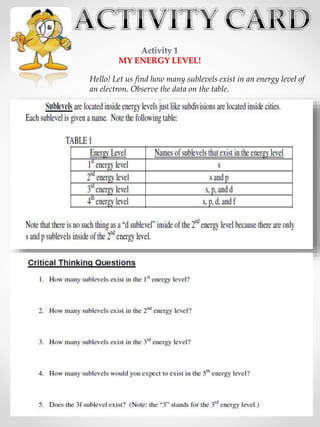
MY ENERGY LEVEL! 
Hello! Let us find how many sublevels exist in an energy level of 
an electron. Observe the data on the table.
HOW DO I FIT IN MY ORBITALS? 
Do you find it easy to do the previous activity? Now, let us do the 
next exciting one!
SPIN ME UP! SPIN ME DOWN! 
Wow! Great Job! Let’s do the spinning up and down of an 
electron as it fill the orbitals.
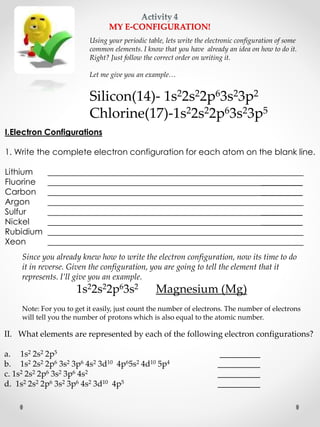
MY E-CONFIGURATION! 
Using your periodic table, lets write the electronic configuration of some 
common elements. I know that you have already an idea on how to do it. 
Right? Just follow the correct order on writing it. 
Let me give you an example… 
Silicon(14)- 1s22s22p63s23p2 
Chlorine(17)-1s22s22p63s23p5 
I.Electron Configurations 
1. Write the complete electron configuration for each atom on the blank line. 
Lithium 
Fluorine __________ 
Carbon __________ 
Argon 
Sulfur __________ 
Nickel __________ 
Rubidium 
Xeon 
Since you already knew how to write the electron configuration, now its time to do 
it in reverse. Given the configuration, you are going to tell the element that it 
represents. I’ll give you an example. 
1s22s22p63s2 Magnesium (Mg) 
Note: For you to get it easily, just count the number of electrons. The number of electrons 
will tell you the number of protons which is also equal to the atomic number. 
II. What elements are represented by each of the following electron configurations? 
a. 1s2 2s2 2p5 
b. 1s2 2s2 2p6 3s2 3p6 4s2 3d10 4p65s2 4d10 5p4 
c. 1s2 2s2 2p6 3s2 3p6 4s2 
d. 1s2 2s2 2p6 3s2 3p6 4s2 3d10 4p5
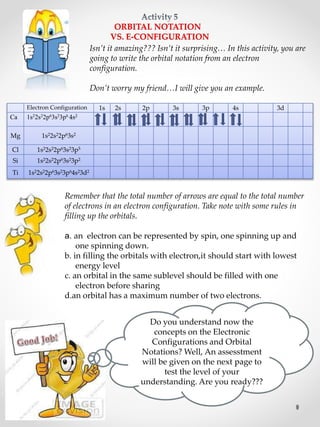
ORBITAL NOTATION 
VS. E-CONFIGURATION 
Isn’t it amazing??? Isn’t it surprising… In this activity, you are 
going to write the orbital notation from an electron 
configuration. 
Don’t worry my friend…I will give you an example. 
Electron Configuration 1s 2s 2p 3s 3p 4s 3d 
Ca 1s22s22p63s23p6 4s2 
Mg 1s22s22p63s2 
Cl 1s22s22p63s23p5 
Si 1s22s22p63s23p2 
Ti 1s22s22p63s23p64s23d2 
Remember that the total number of arrows are equal to the total number 
of electrons in an electron configuration. Take note with some rules in 
filling up the orbitals. 
a. an electron can be represented by spin, one spinning up and 
one spinning down. 
b. in filling the orbitals with electron,it should start with lowest 
energy level 
c. an orbital in the same sublevel should be filled with one 
electron before sharing 
d.an orbital has a maximum number of two electrons. 
Do you understand now the 
concepts on the Electronic 
Configurations and Orbital 
Notations? Well, An assesstment 
will be given on the next page to 
test the level of your 
understanding. Are you ready???
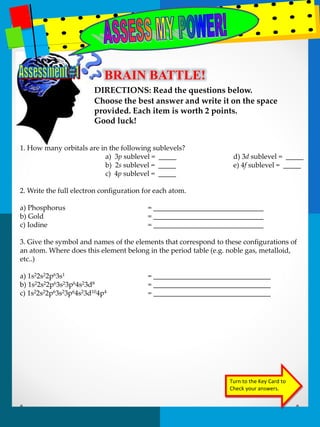
BRAIN BATTLE! 
DIRECTIONS: Read the questions below. 
Choose the best answer and write it on the space 
provided. Each item is worth 2 points. 
Good luck! 
Turn to the Key Card to 
Check your answers. 
1. How many orbitals are in the following sublevels? 
a) 3p sublevel = _____ d) 3d sublevel = _____ 
b) 2s sublevel = _____ e) 4f sublevel = _____ 
c) 4p sublevel = _____ 
2. Write the full electron configuration for each atom. 
a) Phosphorus = _______________________________ 
b) Gold = _______________________________ 
c) Iodine = _______________________________ 
3. Give the symbol and names of the elements that correspond to these configurations of 
an atom. Where does this element belong in the period table (e.g. noble gas, metalloid, 
etc..) 
a) 1s22s22p63s1 = _________________________________ 
b) 1s22s22p63s23p64s23d8 = _________________________________ 
c) 1s22s22p63s23p64s23d104p4 = _________________________________
Using a pen, encircle 10 terms related to the topic 
in the word puzzle below. Words may appear 
forwards or backwards, vertically, horizontally or 
diagonally in the grid. 
H I J L E V E L S K L M N 
A T H S N F G M O E M O S 
O M S H E L L P O Q I E L 
E L E T R O N E R T T L E 
N V L S G C D P A U A E V 
O L E L Y A B R S T M C E 
R A C O S T U O S V W T L 
T T T V P G M T P H X R Y 
U A R E I L L O N T E P G 
E B O F L E C N C I X T R 
N R N U H M A H A L P O E 
P O T S L E V E L B U S N 
C N S L A T I B R O Y Z E 
ISN’T IT COOL AND FUN??? 
Want some more??? Now, turn 
to the next page for the 
continuation. 
Turn to the Key Card to 
Check your answers.
I am a negatively 
charge particle. I get 
excited but sometimes 
are not. Who am I? 
I am a positively 
charge particle. I am 
located in the nucleus. 
Who am I? 
I am a neutral charge 
particle. I go with the 
protons all the time. 
Who am I? 
I discover the electrons 
of an atom. Who am I? 
Turn to the Key Card to 
Check your answers. 
I am the region of 
space where the 
electrons are located. 
Who am I?
How do I 
rate my 
learning on 
this page? 
What I already know about this page? 
____________________________________ 
____________________________________ 
What I still want to know about this page? 
___________________________________ 
____________________________________ 
What I have learned from this page? 
____________________________________ 
____________________________________ 
(Please Check) 
POOR 
GOOD 
EXCELLENT 
S 
T 
U 
D 
E 
N 
T 
‘S 
N 
O 
T 
E
SIM on Electronic Configurations

SIM on Electronic Configurations

  • 2.
    Purpose of StrategicIntervention Material (SIM) This learning package is intended to supplement your classroom learning while working independently . The activities and exercises will widen your understanding of the different concepts you should learn. How to use this Strategic Intervention Material (SIM)? •Keep this material neat and clean. •Thoroughly read every page. •Follow carefully all instructions indicated in every activity. •Answer all questions independently and honestly. •Write all your answers on a sheet of paper. •Be sure to compare your answers to the KEY TO CORRECTIONS only after you have answered the given tasks. •If you have questions or clarifications ask your teacher.
  • 3.
    MY ENERGY LEVEL! Hello! Let us find how many sublevels exist in an energy level of an electron. Observe the data on the table.
  • 4.
    HOW DO IFIT IN MY ORBITALS? Do you find it easy to do the previous activity? Now, let us do the next exciting one!
  • 5.
    SPIN ME UP!SPIN ME DOWN! Wow! Great Job! Let’s do the spinning up and down of an electron as it fill the orbitals.
  • 6.
    MY E-CONFIGURATION! Usingyour periodic table, lets write the electronic configuration of some common elements. I know that you have already an idea on how to do it. Right? Just follow the correct order on writing it. Let me give you an example… Silicon(14)- 1s22s22p63s23p2 Chlorine(17)-1s22s22p63s23p5 I.Electron Configurations 1. Write the complete electron configuration for each atom on the blank line. Lithium Fluorine __________ Carbon __________ Argon Sulfur __________ Nickel __________ Rubidium Xeon Since you already knew how to write the electron configuration, now its time to do it in reverse. Given the configuration, you are going to tell the element that it represents. I’ll give you an example. 1s22s22p63s2 Magnesium (Mg) Note: For you to get it easily, just count the number of electrons. The number of electrons will tell you the number of protons which is also equal to the atomic number. II. What elements are represented by each of the following electron configurations? a. 1s2 2s2 2p5 b. 1s2 2s2 2p6 3s2 3p6 4s2 3d10 4p65s2 4d10 5p4 c. 1s2 2s2 2p6 3s2 3p6 4s2 d. 1s2 2s2 2p6 3s2 3p6 4s2 3d10 4p5
  • 7.
    ORBITAL NOTATION VS.E-CONFIGURATION Isn’t it amazing??? Isn’t it surprising… In this activity, you are going to write the orbital notation from an electron configuration. Don’t worry my friend…I will give you an example. Electron Configuration 1s 2s 2p 3s 3p 4s 3d Ca 1s22s22p63s23p6 4s2 Mg 1s22s22p63s2 Cl 1s22s22p63s23p5 Si 1s22s22p63s23p2 Ti 1s22s22p63s23p64s23d2 Remember that the total number of arrows are equal to the total number of electrons in an electron configuration. Take note with some rules in filling up the orbitals. a. an electron can be represented by spin, one spinning up and one spinning down. b. in filling the orbitals with electron,it should start with lowest energy level c. an orbital in the same sublevel should be filled with one electron before sharing d.an orbital has a maximum number of two electrons. Do you understand now the concepts on the Electronic Configurations and Orbital Notations? Well, An assesstment will be given on the next page to test the level of your understanding. Are you ready???
  • 8.
    BRAIN BATTLE! DIRECTIONS:Read the questions below. Choose the best answer and write it on the space provided. Each item is worth 2 points. Good luck! Turn to the Key Card to Check your answers. 1. How many orbitals are in the following sublevels? a) 3p sublevel = _____ d) 3d sublevel = _____ b) 2s sublevel = _____ e) 4f sublevel = _____ c) 4p sublevel = _____ 2. Write the full electron configuration for each atom. a) Phosphorus = _______________________________ b) Gold = _______________________________ c) Iodine = _______________________________ 3. Give the symbol and names of the elements that correspond to these configurations of an atom. Where does this element belong in the period table (e.g. noble gas, metalloid, etc..) a) 1s22s22p63s1 = _________________________________ b) 1s22s22p63s23p64s23d8 = _________________________________ c) 1s22s22p63s23p64s23d104p4 = _________________________________
  • 9.
    Using a pen,encircle 10 terms related to the topic in the word puzzle below. Words may appear forwards or backwards, vertically, horizontally or diagonally in the grid. H I J L E V E L S K L M N A T H S N F G M O E M O S O M S H E L L P O Q I E L E L E T R O N E R T T L E N V L S G C D P A U A E V O L E L Y A B R S T M C E R A C O S T U O S V W T L T T T V P G M T P H X R Y U A R E I L L O N T E P G E B O F L E C N C I X T R N R N U H M A H A L P O E P O T S L E V E L B U S N C N S L A T I B R O Y Z E ISN’T IT COOL AND FUN??? Want some more??? Now, turn to the next page for the continuation. Turn to the Key Card to Check your answers.
  • 10.
    I am anegatively charge particle. I get excited but sometimes are not. Who am I? I am a positively charge particle. I am located in the nucleus. Who am I? I am a neutral charge particle. I go with the protons all the time. Who am I? I discover the electrons of an atom. Who am I? Turn to the Key Card to Check your answers. I am the region of space where the electrons are located. Who am I?
  • 12.
    How do I rate my learning on this page? What I already know about this page? ____________________________________ ____________________________________ What I still want to know about this page? ___________________________________ ____________________________________ What I have learned from this page? ____________________________________ ____________________________________ (Please Check) POOR GOOD EXCELLENT S T U D E N T ‘S N O T E