Electrogoniometer
Done BY :
Areej alorini
Presentation Outline
 background
 Definition
 Uses of electrogoniometer
 Type of electrogoniometer
 advantages and disadvantages
 Reliability of electrogoniometer
Background
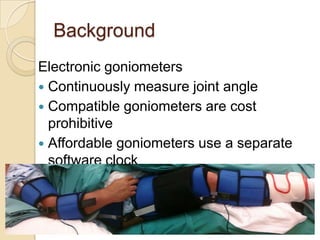
Electronic goniometers
 Continuously measure joint angle
 Compatible goniometers are cost
prohibitive
 Affordable goniometers use a separate
software clock
Background
 The subthalamic nucleus (STN) is a
common target in deep brain
stimulation (DBS) procedures for
movement disorders.
 Ascertaining the somatotopic map of
the STN requires:
◦ Microelectrode recordings
◦ Electrode position
◦ Joint velocity
Electrogoniometers are devices that convert joint angle to a
voltage. The voltage can be sampled
continuously, making electrogoniometers ideal for
measuring dynamic movement. There are basically
two designs, both of which fall under the category of
resistive transducers. These devices,
namely potentiometers and strain gauges, output a voltage
related to the angular position of the joint.
The voltage is converted to an angle by using a
manufacturer supplied scale factor specific to each
transducer. The joint angle can be displayed in real time
and/or stored on a computer equipped with
an analog-to-digital data acquisition card.
Definition
Uses of electrogoniometer
Rehabilitation engineering is the systematic
application of engineering sciences to
design, develop, adapt, test, evaluate,
apply and distribute technological
solutions to problems confronted by
individuals with disabilities. Determining
precise joint angles is extremely important
to rehabilitation and biomedical engineers
as well as physiotherapists and
ergonomics specialists. The angle data is
essential for identifying abnormal patterns
and characterizing impairments,
Cont..
Disabled patients, such as those suffering from
hemiplegia (half the body is paralyzed) or
hemiparesis (half the body is weakened but
not paralyzed), may experience limited speed
and amplitude in some body movements. For
such cases, an electrogoniometer is a useful
tool for measuring joint angles, such as those
for elbows or knees, to determine the extent
of the disability. The electrogoniometer is an
electronic device that uses angle
sensors, such as potentiometers, strain
gauges and, more recently, accelerometers to
record such measurements.
Type of
electrogoniometer
Optoelectronic systems: These are video systems that use one
or more video cameras to track bright markers placed at various
locations on the patient's body. These markers are either
infrared (IR), light emitting diodes (LEDs) or solid shapes of
reflective tape. The system keeps track of the vertical and
horizontal coordinates of each marker, and computer software
processes this information to determine the angle on the body
segments of interest. Although optoelectronic systems offer
good precision, their calibration procedures and data analysis
are time-consuming.
Potentiometers: A potentiometric element is attached to a
joint's rotation point. The potentiometer's electrical resistance
can be used to determine the angle between the joints. These
types of electrogoniometers are somewhat bulky and restrict
patient movement. The instrument's precision can also be
compromised due to its inability to follow any changes in the
joint's axis of rotation.
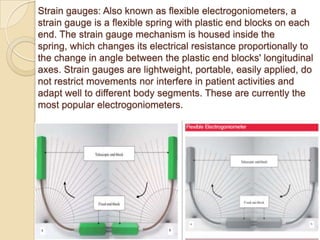
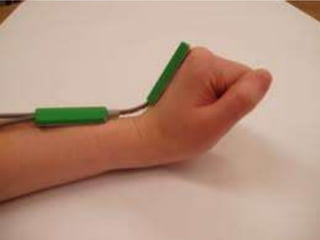
Strain gauges: Also known as flexible electrogoniometers, a
strain gauge is a flexible spring with plastic end blocks on each
end. The strain gauge mechanism is housed inside the
spring, which changes its electrical resistance proportionally to
the change in angle between the plastic end blocks' longitudinal
axes. Strain gauges are lightweight, portable, easily applied, do
not restrict movements nor interfere in patient activities and
adapt well to different body segments. These are currently the
most popular electrogoniometers.
advantages and disadvantages
There are advantages and disadvantages associated
with the use of electrogoniometers. In their
favor are ease of use and cost. On the other hand, they
are less accurate than other systems used to
record movement. In addition, both designs
(i.e., potentiometer and strain gauge) require
placement
over the joint, which may interfere with the natural
kinematics because of cumbersome cabling and/
or method of attachment. Another drawback of these
devices is that while they provide a relative
measure of joint angular position, the data do not lend
themselves to an inverse dynamics analysis in
which joint reaction forces and moments are of
interest, the computation of which requires
knowledge of the absolute positions of the body
Reliability of electrogoniometer.
The electrogoniometer
evaluated has a very high
precision when range of
motion measurements are
made. However, the accuracy
of the device is less than
acceptable.
Electrogoniometer

Electrogoniometer

  • 1.
  • 2.
    Presentation Outline  background Definition  Uses of electrogoniometer  Type of electrogoniometer  advantages and disadvantages  Reliability of electrogoniometer
  • 3.
    Background Electronic goniometers  Continuouslymeasure joint angle  Compatible goniometers are cost prohibitive  Affordable goniometers use a separate software clock
  • 4.
    Background  The subthalamicnucleus (STN) is a common target in deep brain stimulation (DBS) procedures for movement disorders.  Ascertaining the somatotopic map of the STN requires: ◦ Microelectrode recordings ◦ Electrode position ◦ Joint velocity
  • 5.
    Electrogoniometers are devicesthat convert joint angle to a voltage. The voltage can be sampled continuously, making electrogoniometers ideal for measuring dynamic movement. There are basically two designs, both of which fall under the category of resistive transducers. These devices, namely potentiometers and strain gauges, output a voltage related to the angular position of the joint. The voltage is converted to an angle by using a manufacturer supplied scale factor specific to each transducer. The joint angle can be displayed in real time and/or stored on a computer equipped with an analog-to-digital data acquisition card. Definition
  • 6.
    Uses of electrogoniometer Rehabilitationengineering is the systematic application of engineering sciences to design, develop, adapt, test, evaluate, apply and distribute technological solutions to problems confronted by individuals with disabilities. Determining precise joint angles is extremely important to rehabilitation and biomedical engineers as well as physiotherapists and ergonomics specialists. The angle data is essential for identifying abnormal patterns and characterizing impairments,
  • 7.
    Cont.. Disabled patients, suchas those suffering from hemiplegia (half the body is paralyzed) or hemiparesis (half the body is weakened but not paralyzed), may experience limited speed and amplitude in some body movements. For such cases, an electrogoniometer is a useful tool for measuring joint angles, such as those for elbows or knees, to determine the extent of the disability. The electrogoniometer is an electronic device that uses angle sensors, such as potentiometers, strain gauges and, more recently, accelerometers to record such measurements.
  • 8.
  • 9.
    Optoelectronic systems: Theseare video systems that use one or more video cameras to track bright markers placed at various locations on the patient's body. These markers are either infrared (IR), light emitting diodes (LEDs) or solid shapes of reflective tape. The system keeps track of the vertical and horizontal coordinates of each marker, and computer software processes this information to determine the angle on the body segments of interest. Although optoelectronic systems offer good precision, their calibration procedures and data analysis are time-consuming.
  • 10.
    Potentiometers: A potentiometricelement is attached to a joint's rotation point. The potentiometer's electrical resistance can be used to determine the angle between the joints. These types of electrogoniometers are somewhat bulky and restrict patient movement. The instrument's precision can also be compromised due to its inability to follow any changes in the joint's axis of rotation.
  • 11.
    Strain gauges: Alsoknown as flexible electrogoniometers, a strain gauge is a flexible spring with plastic end blocks on each end. The strain gauge mechanism is housed inside the spring, which changes its electrical resistance proportionally to the change in angle between the plastic end blocks' longitudinal axes. Strain gauges are lightweight, portable, easily applied, do not restrict movements nor interfere in patient activities and adapt well to different body segments. These are currently the most popular electrogoniometers.
  • 13.
    advantages and disadvantages Thereare advantages and disadvantages associated with the use of electrogoniometers. In their favor are ease of use and cost. On the other hand, they are less accurate than other systems used to record movement. In addition, both designs (i.e., potentiometer and strain gauge) require placement over the joint, which may interfere with the natural kinematics because of cumbersome cabling and/ or method of attachment. Another drawback of these devices is that while they provide a relative measure of joint angular position, the data do not lend themselves to an inverse dynamics analysis in which joint reaction forces and moments are of interest, the computation of which requires knowledge of the absolute positions of the body
  • 14.
    Reliability of electrogoniometer. Theelectrogoniometer evaluated has a very high precision when range of motion measurements are made. However, the accuracy of the device is less than acceptable.

Editor's Notes

  • #3 -Background-Clocksynch-Pseudorandom Binary Signals