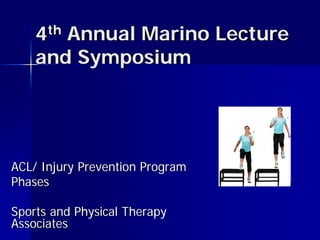
4th Annual Marino Lecture
and Symposium
ACL/ Injury Prevention Program
Phases
Sports and Physical Therapy
Associates
Cincinnati Sports Medicine
1999 Using a combination of Jump
Training/ Plyometrics
Strength Training and Flexibility
6 week preseason program Reduced
ACL injuries in the Trained Women vs.
Untrained women
Hewett 1999 AJSM
PEP Program
USC, Santa Monica California,
from 2000 to 2002 completed 3
studies
Highly specific Training session
Used to replace the
conventional warm up
Dramatic reduction in ACL
injuries from 72% to 88%
compared to the control groups
Mandelbaum AMJS 2005
Training To Reduce ACL
Injuries
Cincinnati Children’ Hospital
Timothy Hewett, Ph.D.
Jump Training
www.cincinnatichildrens.org/sportsmed
Pep Program
Dr. Bert Mandelbaum, MD
www.aclprevent.com
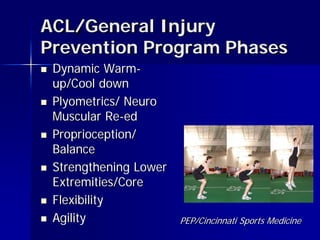
ACL/General Injury
Prevention Program Phases
Dynamic Warm-
up/Cool down
Plyometrics/ Neuro
Muscular Re-ed
Proprioception/
Balance
Strengthening Lower
Extremities/Core
Flexibility
Agility PEP/Cincinnati Sports Medicine
Dynamic Warm up
Prepares the Body for the
demands of the work out or
practice
Increases heart and respiratory
rate and blood flow to muscles
Increases core body
Temperature
Enhances Muscles elasticity
Athlete Should break a sweat
w/o excessive fatigue
Usually 10-20 minutes
NSCA
Dynamic Warm Up
Progress from low to high
intensity
Include all planes of motion, Multi
directional and Diagonal Patterns
Warm up should include exercises
for both upper and lower
extremities
Warning: May induce fatigue in
deconditioned athlete
NSCA
Dynamic Warm Up
Many Of the Components of The Injury
Prevention Program can be worked on
during this phase
DukeHealth.org: Mike Huff and Verne
Gambetta have taken Low intensity
agilities, Plyos and dynamic stretches
to act as warm up
Cool Down
Following Sport or Activity
Cool down consists of moving in same
movement patterns as warm up with
decreasing Intensity
Static Stretching Optimal Time
Rehydrate/ Refuel Carbs
Relax
Ian Jeffreys MS CSCS
NSCA
Plyometrics/Strength
Progressive Leaping and
bounding exercises
This gives Muscle pre stretch
which enhances muscle
contraction Allerheigen 1994
Jump Training/ Neuro
Muscular Control
Develop stability during the
movement patterns that seems to
put knee in most vulnerable
landing or cutting positions
Valgus landing with rotation
Co contraction of Muscles to
Stabilize Joint
Mandelbaum 2000
ACL Injury
Prior to starting Plyos
Instruct Athlete on the
stability/power position
Knees bent 25-30 degrees
Hip and Knee in Neutral
alignment
Control valgus
Greatest level of Ham to
quad co contraction
NSCA
Reps and Sets
Foot Contacts per workout:
Level Low intensity Med Intensity High Intensity
Beginner 40 60 80
Intermediate 60 80 100
Advanced 100 120 140
McNeely NSCA 2008
Criteria for Advancing
Once Athlete has
mastered each jump
for at least 2
consecutive practice
sessions , this means
good form and DOMS
has subsided you may
progress to greater
level of difficulty.
If athlete is in middle
of high volume
jumping season,
basketball, volley ball
etc. watch for signs of
overtraining NSCA
Plyometrics/Jump
Training
Higgins/Duke
Proprioception
The ability to maintain
stability and orientation
during static and dynamic
activities.
Mechano Receptors are
neuro sensory cells that
are responsible for
monitoring joint position
and movement.
6 exteroceptive senses
1 interoceptive sense
Kinetics
Proprioception
A proprioception
program should
stimulate these
mechano receptors.
The ability to know
where you are in
space
NSCA
Strengthening
Strengthening
To increase a muscles
tolerance to physical
stress. This in turn
will increase its
cross sectional area.
Progressive Resistive
means move up!!!
NSCA
Isolation Exercises
Isolates Muscle groups to address
Imbalance
post injury or surgery
+Less chance of injury during training
- Costly
- Doesn’t strengthen stabilizing
muscles
NATA
Multi Muscle Group
Training
Sports Specific
Training
– Training muscle
groups to work
together in concert.
Training the body to
work per the
required needs to
the specific
demands of a sport.
NATA
Multi Muscle Group
Examples
Field exercises
Squats
Diagonal Patterns
NATA
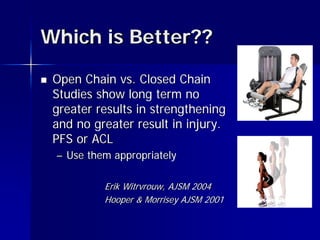
Open Chain Exercises
Open Chain : Foot is
free to move
– SLR, SAQ, LAQ
– Leg Extension machines
– Leg Curl machines
Hamstring /Quad Ratio
+great for isolating muscle
groups
Closed Chain Exercises
Closed chain: Foot is Fixed
– Wall slides, squats, lunges
– Leg Press Machine
– Hack Squat Machine
+ co-contraction of leg and hip muscles
- don’t isolate muscles as well
Which is Better??
Open Chain vs. Closed Chain
Studies show long term no
greater results in strengthening
and no greater result in injury.
PFS or ACL
– Use them appropriately
Erik Witrvrouw, AJSM 2004
Hooper & Morrisey AJSM 2001
Repetitions How Many?
Science of Repetitions
– Physiologically higher
repetitions give the joints and
tendons better blood flow
– Used better for post-season or
rehabilitating an injury 15-20
reps
– Lower reps better for
strength/power, used better
during power cycles and pre-
season
Grimsby
Frequency of Training?
How often to train the
same
movements/muscles?
– It depends on similar
variables
In-season, pre-season,
off-season, age and
sport of the athlete
– Typically the same
muscle group no more
than 2 x/week
NSCA
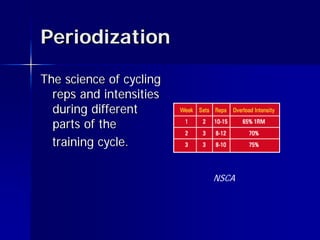
Periodization
The science of cycling
reps and intensities
during different
parts of the
training cycle.
NSCA
Flexibility:Improving a
Joints Range of Motion
Types of Stretching
– Active- Hold 2-3 sec
repeat 20 times
– Static – hold 30
seconds repeat 2
times
– Dynamic -Active
Movements through
exaggerated ranges NSCA
ACL Injuries/
Patellofemoral Pain
The age group that
ACL injuries occur 13-
17:
Also age group
marked decrease in
flexibility which can
lead to Patellar
Tendinitis and or PFS
Witvrouw AJSM 2001
Stretches to decrease
Patella Tendinitis Witvrouw AJSM 2001
Stretches
– Rectus/Quadriceps
- Hamstring
Time to stretch?
Optimal time to stretch
– After warm-up
– At end of Cool
Down
Ian Jeffreys, MS CSCS
NSCA
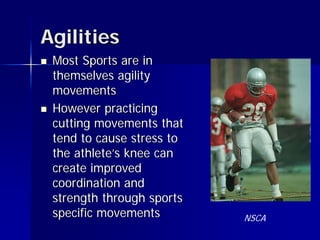
Agilities
Most Sports are in
themselves agility
movements
However practicing
cutting movements that
tend to cause stress to
the athlete’s knee can
create improved
coordination and
strength through sports
specific movements NSCA
Pick Agilities to Fit Sport
Agility Patterns that
mimic sports
movements
– Grapevines
Side to side
– Run ,plant and cut
NSCA
ACL Prevention Today
Although the Pep program and
Cincinnati prevention
programs reduced ACL
injuries significantly.
Both groups readily admit it is
unclear which aspect of their
programs were responsible
for the reduction in injuries
USC/Cincinnati Sports Medicine
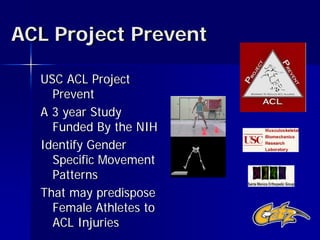
ACL Project Prevent
USC ACL Project
Prevent
A 3 year Study
Funded By the NIH
Identify Gender
Specific Movement
Patterns
That may predispose
Female Athletes to
ACL Injuries
As Athletic Trainers and
Physical Therapists
Utilize evidence based
Medicine as the backbone of
your rehab!
Develop a program that
works for your coaches,
teams and patients !
Achieve participation with
resources and time available !
One Size doesn’t Fit All
FIELD DRILL FOR Injury
PREVENTION
Run Back Peddle Run Back Peddle
Cut
and
Run
Plyometrics,
Squats, Side
to Side, etc.
Raise level
of difficulty
as season
progresses
Side to Side, Carioca, etc
30 yards x 30 yards
If Budget is really Bad
1 piece of Chalk
1 pebble
4 single Leg Jumps
2 Double leg Jumps
1 180 Degree Jump
1 Single Leg Squat
Make the Squares
Bigger
Start Again

ACL Injury Prevention Program

  • 1.
    4th Annual MarinoLecture and Symposium ACL/ Injury Prevention Program Phases Sports and Physical Therapy Associates
  • 2.
    Cincinnati Sports Medicine 1999Using a combination of Jump Training/ Plyometrics Strength Training and Flexibility 6 week preseason program Reduced ACL injuries in the Trained Women vs. Untrained women Hewett 1999 AJSM
  • 3.
    PEP Program USC, SantaMonica California, from 2000 to 2002 completed 3 studies Highly specific Training session Used to replace the conventional warm up Dramatic reduction in ACL injuries from 72% to 88% compared to the control groups Mandelbaum AMJS 2005
  • 4.
    Training To ReduceACL Injuries Cincinnati Children’ Hospital Timothy Hewett, Ph.D. Jump Training www.cincinnatichildrens.org/sportsmed Pep Program Dr. Bert Mandelbaum, MD www.aclprevent.com
  • 5.
    ACL/General Injury Prevention ProgramPhases Dynamic Warm- up/Cool down Plyometrics/ Neuro Muscular Re-ed Proprioception/ Balance Strengthening Lower Extremities/Core Flexibility Agility PEP/Cincinnati Sports Medicine
  • 6.
    Dynamic Warm up Preparesthe Body for the demands of the work out or practice Increases heart and respiratory rate and blood flow to muscles Increases core body Temperature Enhances Muscles elasticity Athlete Should break a sweat w/o excessive fatigue Usually 10-20 minutes NSCA
  • 7.
    Dynamic Warm Up Progressfrom low to high intensity Include all planes of motion, Multi directional and Diagonal Patterns Warm up should include exercises for both upper and lower extremities Warning: May induce fatigue in deconditioned athlete NSCA
  • 8.
    Dynamic Warm Up ManyOf the Components of The Injury Prevention Program can be worked on during this phase DukeHealth.org: Mike Huff and Verne Gambetta have taken Low intensity agilities, Plyos and dynamic stretches to act as warm up
  • 9.
    Cool Down Following Sportor Activity Cool down consists of moving in same movement patterns as warm up with decreasing Intensity Static Stretching Optimal Time Rehydrate/ Refuel Carbs Relax Ian Jeffreys MS CSCS NSCA
  • 10.
    Plyometrics/Strength Progressive Leaping and boundingexercises This gives Muscle pre stretch which enhances muscle contraction Allerheigen 1994 Jump Training/ Neuro Muscular Control Develop stability during the movement patterns that seems to put knee in most vulnerable landing or cutting positions Valgus landing with rotation Co contraction of Muscles to Stabilize Joint Mandelbaum 2000
  • 11.
  • 12.
    Prior to startingPlyos Instruct Athlete on the stability/power position Knees bent 25-30 degrees Hip and Knee in Neutral alignment Control valgus Greatest level of Ham to quad co contraction NSCA
  • 13.
    Reps and Sets FootContacts per workout: Level Low intensity Med Intensity High Intensity Beginner 40 60 80 Intermediate 60 80 100 Advanced 100 120 140 McNeely NSCA 2008
  • 14.
    Criteria for Advancing OnceAthlete has mastered each jump for at least 2 consecutive practice sessions , this means good form and DOMS has subsided you may progress to greater level of difficulty. If athlete is in middle of high volume jumping season, basketball, volley ball etc. watch for signs of overtraining NSCA
  • 15.
  • 16.
    Proprioception The ability tomaintain stability and orientation during static and dynamic activities. Mechano Receptors are neuro sensory cells that are responsible for monitoring joint position and movement. 6 exteroceptive senses 1 interoceptive sense Kinetics
  • 17.
    Proprioception A proprioception program should stimulatethese mechano receptors. The ability to know where you are in space NSCA
  • 18.
    Strengthening Strengthening To increase amuscles tolerance to physical stress. This in turn will increase its cross sectional area. Progressive Resistive means move up!!! NSCA
  • 19.
    Isolation Exercises Isolates Musclegroups to address Imbalance post injury or surgery +Less chance of injury during training - Costly - Doesn’t strengthen stabilizing muscles NATA
  • 20.
    Multi Muscle Group Training SportsSpecific Training – Training muscle groups to work together in concert. Training the body to work per the required needs to the specific demands of a sport. NATA
  • 21.
    Multi Muscle Group Examples Fieldexercises Squats Diagonal Patterns NATA
  • 22.
    Open Chain Exercises OpenChain : Foot is free to move – SLR, SAQ, LAQ – Leg Extension machines – Leg Curl machines Hamstring /Quad Ratio +great for isolating muscle groups
  • 23.
    Closed Chain Exercises Closedchain: Foot is Fixed – Wall slides, squats, lunges – Leg Press Machine – Hack Squat Machine + co-contraction of leg and hip muscles - don’t isolate muscles as well
  • 24.
    Which is Better?? OpenChain vs. Closed Chain Studies show long term no greater results in strengthening and no greater result in injury. PFS or ACL – Use them appropriately Erik Witrvrouw, AJSM 2004 Hooper & Morrisey AJSM 2001
  • 25.
    Repetitions How Many? Scienceof Repetitions – Physiologically higher repetitions give the joints and tendons better blood flow – Used better for post-season or rehabilitating an injury 15-20 reps – Lower reps better for strength/power, used better during power cycles and pre- season Grimsby
  • 26.
    Frequency of Training? Howoften to train the same movements/muscles? – It depends on similar variables In-season, pre-season, off-season, age and sport of the athlete – Typically the same muscle group no more than 2 x/week NSCA
  • 27.
    Periodization The science ofcycling reps and intensities during different parts of the training cycle. NSCA
  • 28.
    Flexibility:Improving a Joints Rangeof Motion Types of Stretching – Active- Hold 2-3 sec repeat 20 times – Static – hold 30 seconds repeat 2 times – Dynamic -Active Movements through exaggerated ranges NSCA
  • 29.
    ACL Injuries/ Patellofemoral Pain Theage group that ACL injuries occur 13- 17: Also age group marked decrease in flexibility which can lead to Patellar Tendinitis and or PFS Witvrouw AJSM 2001
  • 30.
    Stretches to decrease PatellaTendinitis Witvrouw AJSM 2001 Stretches – Rectus/Quadriceps - Hamstring
  • 31.
    Time to stretch? Optimaltime to stretch – After warm-up – At end of Cool Down Ian Jeffreys, MS CSCS NSCA
  • 32.
    Agilities Most Sports arein themselves agility movements However practicing cutting movements that tend to cause stress to the athlete’s knee can create improved coordination and strength through sports specific movements NSCA
  • 33.
    Pick Agilities toFit Sport Agility Patterns that mimic sports movements – Grapevines Side to side – Run ,plant and cut NSCA
  • 34.
    ACL Prevention Today Althoughthe Pep program and Cincinnati prevention programs reduced ACL injuries significantly. Both groups readily admit it is unclear which aspect of their programs were responsible for the reduction in injuries USC/Cincinnati Sports Medicine
  • 35.
    ACL Project Prevent USCACL Project Prevent A 3 year Study Funded By the NIH Identify Gender Specific Movement Patterns That may predispose Female Athletes to ACL Injuries
  • 36.
    As Athletic Trainersand Physical Therapists Utilize evidence based Medicine as the backbone of your rehab! Develop a program that works for your coaches, teams and patients ! Achieve participation with resources and time available ! One Size doesn’t Fit All
  • 37.
    FIELD DRILL FORInjury PREVENTION Run Back Peddle Run Back Peddle Cut and Run Plyometrics, Squats, Side to Side, etc. Raise level of difficulty as season progresses Side to Side, Carioca, etc 30 yards x 30 yards
  • 38.
    If Budget isreally Bad 1 piece of Chalk 1 pebble 4 single Leg Jumps 2 Double leg Jumps 1 180 Degree Jump 1 Single Leg Squat Make the Squares Bigger Start Again