


Angular Kinematics of Human
Movement
Dr Aliya Achak
Observing the
Angular Kinematics
 Clinicians, coaches, and teachers of
physical activities routinely analyze human
movement
 Based on observation of timing and range
of motion
 Developmental stages of motor skills are
based on analysis of angular kinematics
Angular Kinematics Measuring Angles
 Biomechanics use projection of images of body with dots marking joint centers and dots
connected with segmental lines representing longitudinal axes of body segments. These
can be filmed and converted to computer generated representation of motion.
 An angle is composed of two sides that intersect at a vertex.
 Explanation:
◦ Filmed images
◦ Quantitative kinematic analysis can be achieved by projecting filmed images of the
human body onto a piece of paper, with joint centers then marked with dots and the
dots connected with lines representing the longitudinal axes of the body segments.
◦ A protractor can be used to make hand measurements of angle of interest from this
representation, with the joint centers forming the vertices of the angles between
adjacent body segments.
◦ Videotapes and films of human movement can also be analyzed using this same basic
procedure to evaluate the angle present at the joints of the human body and the
angular orientations of the body segments.
 Computer software
◦ The angle assessments are usually done with computer software from stick-figure representations of the
human body constructed in computer memory.
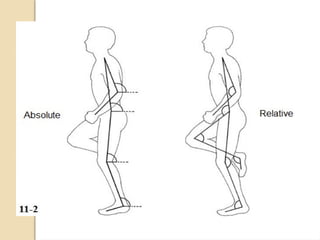
Relative versus
Absolute Angles
Assessing the angle at a joint involves measuring the angle of one body
segment relative to the other body segment articulating at the joint.
Relative angle: the angle formed between two adjacent body segments.
Relative angles should consistently be measured on the same side of
a given joint.
 Anatomical reference position – relative angles are zero
Absolute angle: angular orientation of a single body segment with
respect to a fixed line of reference. Absolute angles should
consistently be measured in the same direction form a single
reference
 Horizontal reference
 Vertical reference
Tools for Measuring Body Angles
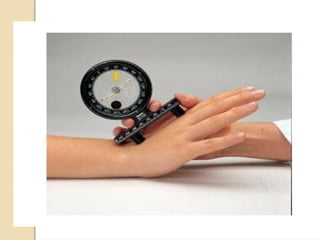
 Goniometer are commonly used by clinicians for direct
measurement of relative joint angles on a live human subject.
 Goniometer: is essentially a protractor with two long arms
attaches.
• One arm is fixed so that it extends from the protractor at
angle of 00
.
• The other arm extends from the center of the protractor and
is free to rotate.
• The center of the protractor is aligned over the joint center,
and the two arms are aligned over the longitudinal axes of the
two body segments that connect at the joint.
• Accuracy depends on positioning of Goniometer
• Place marks on the skin
Conti…
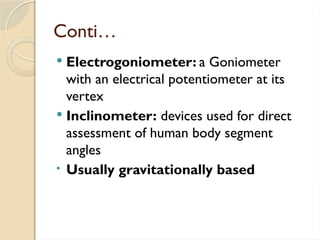
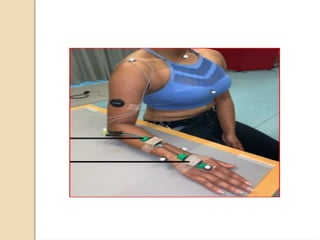
 Electrogoniometer: a Goniometer
with an electrical potentiometer at its
vertex
 Inclinometer: devices used for direct
assessment of human body segment
angles
• Usually gravitationally based
Instant Center of Rotation
 Quantification of joint angles is
complicated by the fact that joint motion is
often accompanied by displacement of one
bone with respect to the articulating bone
at the joint.
 As a result, the location of the exact center
of rotation at a given joint angle, or at a
given instant of time during a dynamic
movement, is called the instant center.
Conti….
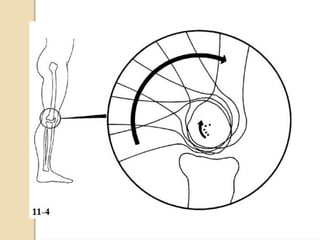
 Instant center: Precisely located center of rotation at a
joint at a given instant in time
 The exact location of the instant center for a given joint
may be determined through measurements taken from x
rays, which are usually taken at 100
intervals throughout
the range of motion at the joint.
 Example:
 The instant center at the knee shifts during angular
movement due to accompanying linear displacements
between the femur and the tibia in all three planes.
Thanks for your attention

Angular Kinematics of Human Movement.pptx

  • 1.
    Angular Kinematics ofHuman Movement Dr Aliya Achak
  • 2.
    Observing the Angular Kinematics Clinicians, coaches, and teachers of physical activities routinely analyze human movement  Based on observation of timing and range of motion  Developmental stages of motor skills are based on analysis of angular kinematics
  • 3.
    Angular Kinematics MeasuringAngles  Biomechanics use projection of images of body with dots marking joint centers and dots connected with segmental lines representing longitudinal axes of body segments. These can be filmed and converted to computer generated representation of motion.  An angle is composed of two sides that intersect at a vertex.  Explanation: ◦ Filmed images ◦ Quantitative kinematic analysis can be achieved by projecting filmed images of the human body onto a piece of paper, with joint centers then marked with dots and the dots connected with lines representing the longitudinal axes of the body segments. ◦ A protractor can be used to make hand measurements of angle of interest from this representation, with the joint centers forming the vertices of the angles between adjacent body segments. ◦ Videotapes and films of human movement can also be analyzed using this same basic procedure to evaluate the angle present at the joints of the human body and the angular orientations of the body segments.  Computer software ◦ The angle assessments are usually done with computer software from stick-figure representations of the human body constructed in computer memory.
  • 4.
    Relative versus Absolute Angles Assessingthe angle at a joint involves measuring the angle of one body segment relative to the other body segment articulating at the joint. Relative angle: the angle formed between two adjacent body segments. Relative angles should consistently be measured on the same side of a given joint.  Anatomical reference position – relative angles are zero Absolute angle: angular orientation of a single body segment with respect to a fixed line of reference. Absolute angles should consistently be measured in the same direction form a single reference  Horizontal reference  Vertical reference
  • 6.
    Tools for MeasuringBody Angles  Goniometer are commonly used by clinicians for direct measurement of relative joint angles on a live human subject.  Goniometer: is essentially a protractor with two long arms attaches. • One arm is fixed so that it extends from the protractor at angle of 00 . • The other arm extends from the center of the protractor and is free to rotate. • The center of the protractor is aligned over the joint center, and the two arms are aligned over the longitudinal axes of the two body segments that connect at the joint. • Accuracy depends on positioning of Goniometer • Place marks on the skin
  • 7.
    Conti…  Electrogoniometer: aGoniometer with an electrical potentiometer at its vertex  Inclinometer: devices used for direct assessment of human body segment angles • Usually gravitationally based
  • 10.
    Instant Center ofRotation  Quantification of joint angles is complicated by the fact that joint motion is often accompanied by displacement of one bone with respect to the articulating bone at the joint.  As a result, the location of the exact center of rotation at a given joint angle, or at a given instant of time during a dynamic movement, is called the instant center.
  • 11.
    Conti….  Instant center:Precisely located center of rotation at a joint at a given instant in time  The exact location of the instant center for a given joint may be determined through measurements taken from x rays, which are usually taken at 100 intervals throughout the range of motion at the joint.  Example:  The instant center at the knee shifts during angular movement due to accompanying linear displacements between the femur and the tibia in all three planes.
  • 13.
    Thanks for yourattention

Editor's Notes

  • #2 Understand angular motion is particularly important for the student of human movement, because most volitional human movement involves rotation of one or more body segments around the joints at which they articulate. The experience analyst can make inferences about the coordination of muscle activity producing the joint actions and the forces resulting from those joint actions.
  • #4 Relative angle: angle at a joint formed between the longitudinal axes of adjacent body segments The convention used for measuring relative joint angles is that in anatomical reference position, all joint angles are at 00. Absolute angle: angular orientation of a body segment with respect to a fixed line of reference. – either horizontal or vertical