Measurements Project for Semester 1
2016-2017
Construction, Working and Usage of a Permanent Magnet
Moving Coil (PMMC) Meter.
Submitted by:
160070390
160070391
160070392
WHAT IS A PMMC?
• The permanent magnet moving coil instruments are most accurate type for direct current
measurements.
• The action of these instruments is based on the motoring principle.
• When a current carrying coil is placed in the magnetic field produced by permanent magnet, the
coil experiences a force and moves.
• As the coil is moving and the magnet is permanent, the instrument is called permanent magnet
moving coil instrument.
• This basic principle is called D’Arsonval principle.
• The amount of force experienced by the coil is proportional to the current passing through the coil.
WORKING PRINCIPLE OF PMMC-
EXPLANATION:
• D’Arsonval Movement Principle :
• An action caused by electromagnetic deflection, using a coil of wire and a magnetized field.
When current passes through the coil, a needle is deflected.
• Whenever electrons flow through a conductor, a magnetic field proportional to the current is
created. This effect is useful for measuring current and is employed in many practical meters.
• The basic dc meter movement is known as the D’Arsonval meter movement because it was
first employed by the French scientist, Jacques Arsene d'Arsonval, in making electrical
measurement.
• This type of meter movement is a current measuring device which is used in the ammeter,
voltmeter, and ohmmeter. Basically, both the ammeter and the voltmeter are current
measuring instruments, the principal difference being the method in which they are connected
in a circuit..
REQUIRED APPARATUS:
• Permanent magnets (horse-shoe recommended)
• Copper wire (3 meter gauge for the rotating coil and a half meter for connections etc.)
• Batteries (9V,12V) (TESTING PURPOSE ONLY)
• 10k POTENTIOMETER
• 12V ELIMINATOR
• DIGITAL Multimeter
• Pointer (NEEDLE)
• Graduated scale (CURRENT READINGS)
CONSTRUCTION OF A PMMC METER:
• First, we take an eliminator and attach one of its ends to the bread board.
• We attach one end of the 10k Potentiometer to the end of the eliminator in series.
• The other end of the 10k Potentiometer goes to the rotating coil.
• The other end of the rotating coil is attached to the eliminator.
• An ammeter is attached in series to note the current readings.The ammeter is
placed between the potentiometer and coil.
• A needle is fixed at one end of the coil which moves over a graduated scale and
gives the dc current reading .
ADVANTAGES/DISADVANTAGES OF USING
PMMC:
PROS:
• The PMMC consumes less power and has great
accuracy.
• It has uniformly divided scale and can cover arc of 270
degree.
• The PMMC has a high torque to weight ratio.
• It can be modified as ammeter or voltmeter with
suitable resistance.
• It has efficient damping characteristics and is not
affected by stray magnetic field.
• It produces no losses due to hysteresis.
CONS:
• The moving coil instrument can only be used on
D.C supply as the reversal of current produces
reversal of torque on the coil.
• It’s very delicate.
• It’s costly as compared to moving coil iron
instruments.
• It may show error due to loss of magnetism of
permanent magnet.
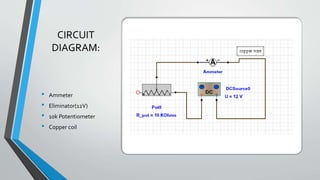
CIRCUIT
DIAGRAM:
• Ammeter
• Eliminator(12V)
• 10k Potentiometer
• Copper coil
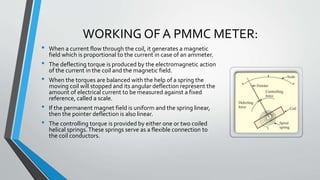
WORKING OF A PMMC METER:
• When a current flow through the coil, it generates a magnetic
field which is proportional to the current in case of an ammeter.
• The deflecting torque is produced by the electromagnetic action
of the current in the coil and the magnetic field.
• When the torques are balanced with the help of a spring the
moving coil will stopped and its angular deflection represent the
amount of electrical current to be measured against a fixed
reference, called a scale.
• If the permanent magnet field is uniform and the spring linear,
then the pointer deflection is also linear.
• The controlling torque is provided by either one or two coiled
helical springs.These springs serve as a flexible connection to
the coil conductors.
Reference:
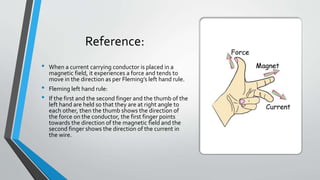
• When a current carrying conductor is placed in a
magnetic field, it experiences a force and tends to
move in the direction as per Fleming’s left hand rule.
• Fleming left hand rule:
• If the first and the second finger and the thumb of the
left hand are held so that they are at right angle to
each other, then the thumb shows the direction of
the force on the conductor, the first finger points
towards the direction of the magnetic field and the
second finger shows the direction of the current in
the wire.
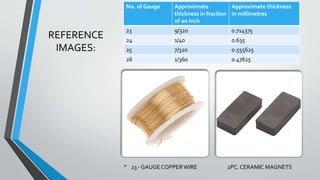
REFERENCE
IMAGES:
• 23 - GAUGE COPPERWIRE 2PC. CERAMIC MAGNETS
No. of Gauge Approximate
thickness in fraction
of an Inch
Approximate thickness
in millimetres
23 9/320 0.714375
24 1/40 0.635
25 7/320 0.555625
26 1/360 0.47625
D’arsonval Principle:
• D’Arsonval Movement Principle :
• An action caused by electromagnetic deflection, using a coil of wire and a
magnetized field.When current passes through the coil, a needle is
deflected.
• Whenever electrons flow through a conductor, a magnetic field proportional
to the current is created.This effect is useful for measuring current and is
employed in many practical meters.
Since most of the meters in use have D’Arsonval movements, which operate
because of the magnetic effect, only this type will be discussed in detail.The
basic dc meter movement is known as the D’Arsonval meter movement
because it was first employed by the French scientist, Jacques-Arsène
d'Arsonval, in making electrical measurement.
• This type of meter movement is a current measuring device which is used in
the ammeter, voltmeter, and ohmmeter. Basically, both the ammeter and
the voltmeter are current measuring instruments, the principal difference
being the method in which they are connected in a circuit.

Permanent Magnet Moving Coil (PPMC)

  • 1.
    Measurements Project forSemester 1 2016-2017 Construction, Working and Usage of a Permanent Magnet Moving Coil (PMMC) Meter. Submitted by: 160070390 160070391 160070392
  • 2.
    WHAT IS APMMC? • The permanent magnet moving coil instruments are most accurate type for direct current measurements. • The action of these instruments is based on the motoring principle. • When a current carrying coil is placed in the magnetic field produced by permanent magnet, the coil experiences a force and moves. • As the coil is moving and the magnet is permanent, the instrument is called permanent magnet moving coil instrument. • This basic principle is called D’Arsonval principle. • The amount of force experienced by the coil is proportional to the current passing through the coil.
  • 3.
    WORKING PRINCIPLE OFPMMC- EXPLANATION: • D’Arsonval Movement Principle : • An action caused by electromagnetic deflection, using a coil of wire and a magnetized field. When current passes through the coil, a needle is deflected. • Whenever electrons flow through a conductor, a magnetic field proportional to the current is created. This effect is useful for measuring current and is employed in many practical meters. • The basic dc meter movement is known as the D’Arsonval meter movement because it was first employed by the French scientist, Jacques Arsene d'Arsonval, in making electrical measurement. • This type of meter movement is a current measuring device which is used in the ammeter, voltmeter, and ohmmeter. Basically, both the ammeter and the voltmeter are current measuring instruments, the principal difference being the method in which they are connected in a circuit..
  • 4.
    REQUIRED APPARATUS: • Permanentmagnets (horse-shoe recommended) • Copper wire (3 meter gauge for the rotating coil and a half meter for connections etc.) • Batteries (9V,12V) (TESTING PURPOSE ONLY) • 10k POTENTIOMETER • 12V ELIMINATOR • DIGITAL Multimeter • Pointer (NEEDLE) • Graduated scale (CURRENT READINGS)
  • 5.
    CONSTRUCTION OF APMMC METER: • First, we take an eliminator and attach one of its ends to the bread board. • We attach one end of the 10k Potentiometer to the end of the eliminator in series. • The other end of the 10k Potentiometer goes to the rotating coil. • The other end of the rotating coil is attached to the eliminator. • An ammeter is attached in series to note the current readings.The ammeter is placed between the potentiometer and coil. • A needle is fixed at one end of the coil which moves over a graduated scale and gives the dc current reading .
  • 6.
    ADVANTAGES/DISADVANTAGES OF USING PMMC: PROS: •The PMMC consumes less power and has great accuracy. • It has uniformly divided scale and can cover arc of 270 degree. • The PMMC has a high torque to weight ratio. • It can be modified as ammeter or voltmeter with suitable resistance. • It has efficient damping characteristics and is not affected by stray magnetic field. • It produces no losses due to hysteresis. CONS: • The moving coil instrument can only be used on D.C supply as the reversal of current produces reversal of torque on the coil. • It’s very delicate. • It’s costly as compared to moving coil iron instruments. • It may show error due to loss of magnetism of permanent magnet.
  • 7.
  • 8.
    WORKING OF APMMC METER: • When a current flow through the coil, it generates a magnetic field which is proportional to the current in case of an ammeter. • The deflecting torque is produced by the electromagnetic action of the current in the coil and the magnetic field. • When the torques are balanced with the help of a spring the moving coil will stopped and its angular deflection represent the amount of electrical current to be measured against a fixed reference, called a scale. • If the permanent magnet field is uniform and the spring linear, then the pointer deflection is also linear. • The controlling torque is provided by either one or two coiled helical springs.These springs serve as a flexible connection to the coil conductors.
  • 9.
    Reference: • When acurrent carrying conductor is placed in a magnetic field, it experiences a force and tends to move in the direction as per Fleming’s left hand rule. • Fleming left hand rule: • If the first and the second finger and the thumb of the left hand are held so that they are at right angle to each other, then the thumb shows the direction of the force on the conductor, the first finger points towards the direction of the magnetic field and the second finger shows the direction of the current in the wire.
  • 10.
    REFERENCE IMAGES: • 23 -GAUGE COPPERWIRE 2PC. CERAMIC MAGNETS No. of Gauge Approximate thickness in fraction of an Inch Approximate thickness in millimetres 23 9/320 0.714375 24 1/40 0.635 25 7/320 0.555625 26 1/360 0.47625
  • 11.
    D’arsonval Principle: • D’ArsonvalMovement Principle : • An action caused by electromagnetic deflection, using a coil of wire and a magnetized field.When current passes through the coil, a needle is deflected. • Whenever electrons flow through a conductor, a magnetic field proportional to the current is created.This effect is useful for measuring current and is employed in many practical meters. Since most of the meters in use have D’Arsonval movements, which operate because of the magnetic effect, only this type will be discussed in detail.The basic dc meter movement is known as the D’Arsonval meter movement because it was first employed by the French scientist, Jacques-Arsène d'Arsonval, in making electrical measurement. • This type of meter movement is a current measuring device which is used in the ammeter, voltmeter, and ohmmeter. Basically, both the ammeter and the voltmeter are current measuring instruments, the principal difference being the method in which they are connected in a circuit.