PMMC
INSTRUMENT
Dr. Shweta Singh
Assistant Professor
MUIT, Lucknow
Introduction
 The permanent magnet moving coil instruments
are most accurate type for direct current
measurements.
 The action of these instruments is based on the
motoring principle.
 When a current carrying coil is placed in the
magnetic field produced by permanent magnet, the
coil experiences a force and moves.
 As the coil is moving and the magnet is permanent,
the instrument is called permanent magnet moving
coil instrument.
 This basic principle is called D’Arsonval principle.
 The amount of force experienced by the coil is
proportional to the current passing through the coil.
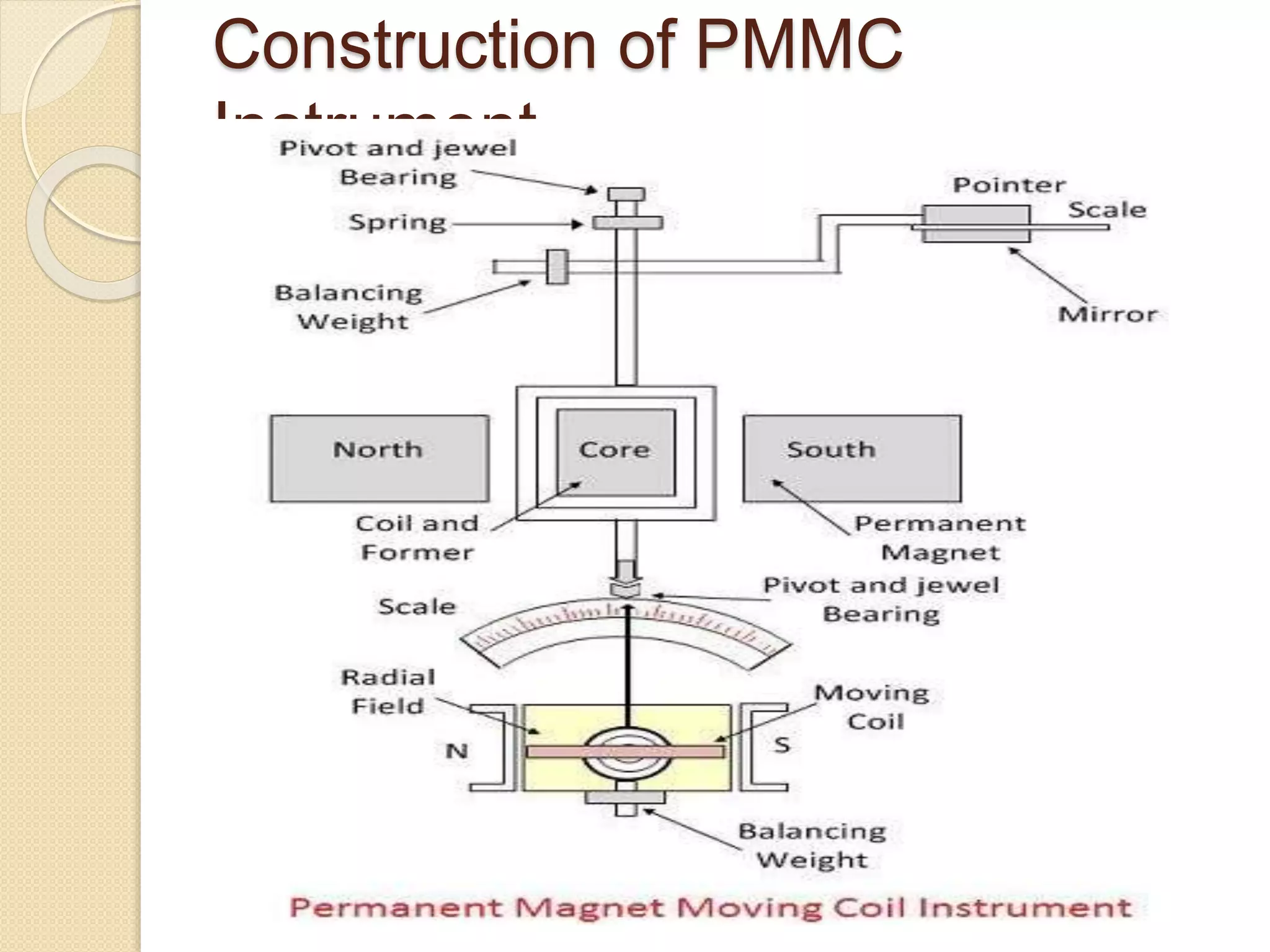
Construction of PMMC
Instrument
Construction
 PMMC Instrument consists of the following given component for its proper working.
(1.)Permanent Magnet
 it is a horseshoe permanent magnet that provides magnetic flux. The soft iron pole
piece is used to get uniform flux.
(2.)Magnetic Coil
 it is a movable coil made of thin winding wire and has a few numbers of turns placed
on the rectangular aluminum frame. this frame along with the coil is attached to the
spindle.
(3.)Iron Core
 it is a soft iron core placed in the magnetic field and its function is to minimize the
reluctance effect.
(4)Pointer and Scale
 A light pointer is attached to the spindle which moves over the scale and gives the
reading. Sometimes a mirror is also provided in the instrument for an accurate
reading.
(5.)Spring
 Two Flat spiral spring of phosphor bronze is attached to both sides of the spindle.
The function of the spring is to provide controlling torque and supply electric current
to the coil.
(6.)Jewel
Working Principle of PMMC
 D’Arsonval Movement Principle :
 • An action caused by electromagnetic
deflection, using a coil of wire and a
magnetized field. When current passes through
the coil, a needle is deflected.
 • Whenever electrons flow through a conductor,
a magnetic field proportional to the current is
created. This effect is useful for measuring
current and is employed in many practical
meters.
 • The basic dc meter movement is known as
the D’Arsonval meter movement because it
was first employed by the French scientist,
Jacques Arsene d'Arsonval, in making
electrical measurement.
Why PMMC instrument cannot
be used for AC
 These types of instruments are only used
for measuring the DC quantities as if we
apply AC current to these type of
instruments the direction of current will
be reversed during negative half cycle
and hence the direction of torque will
also be reversed which gives average
value of torque zero. The pointer will not
deflect due to high frequency from its
mean position showing zero reading.
However it can measure the direct current
very accurately.
Applications
 Ammeter:
 Voltmeter:
 Galvanometer:
 Ohm Meter:
Advantages of PMMC Instrument
 The scale of the PMMC instruments is
correctly divided.
 Its range of either voltage or current can be
easily extended by using a suitable shunt.
 Damping force is very effective.
 The PMMC instruments have high accuracy
because of the high torque weight ratio.
 There is no hysteresis loss.
 Power consumption is low.
 The PMMC instruments use shelf shielding
magnet which is useful for the aerospace
applications.
Disadvantage of PMMC
Instrument
 The moving coil instrument can only
be used on D.C supply as the current
reversal produces a torque on the coil.
 It’s very delicate and sometimes uses
an AC circuit with a rectifier.
 It’s costly as compared to moving coil
iron instruments.
 It may show an error due to the loss of
magnetism of the permanent magnet.
Thank You

PMMC INSTRUMENT.pptx

  • 1.
  • 2.
    Introduction  The permanentmagnet moving coil instruments are most accurate type for direct current measurements.  The action of these instruments is based on the motoring principle.  When a current carrying coil is placed in the magnetic field produced by permanent magnet, the coil experiences a force and moves.  As the coil is moving and the magnet is permanent, the instrument is called permanent magnet moving coil instrument.  This basic principle is called D’Arsonval principle.  The amount of force experienced by the coil is proportional to the current passing through the coil.
  • 3.
  • 4.
    Construction  PMMC Instrumentconsists of the following given component for its proper working. (1.)Permanent Magnet  it is a horseshoe permanent magnet that provides magnetic flux. The soft iron pole piece is used to get uniform flux. (2.)Magnetic Coil  it is a movable coil made of thin winding wire and has a few numbers of turns placed on the rectangular aluminum frame. this frame along with the coil is attached to the spindle. (3.)Iron Core  it is a soft iron core placed in the magnetic field and its function is to minimize the reluctance effect. (4)Pointer and Scale  A light pointer is attached to the spindle which moves over the scale and gives the reading. Sometimes a mirror is also provided in the instrument for an accurate reading. (5.)Spring  Two Flat spiral spring of phosphor bronze is attached to both sides of the spindle. The function of the spring is to provide controlling torque and supply electric current to the coil. (6.)Jewel
  • 5.
    Working Principle ofPMMC  D’Arsonval Movement Principle :  • An action caused by electromagnetic deflection, using a coil of wire and a magnetized field. When current passes through the coil, a needle is deflected.  • Whenever electrons flow through a conductor, a magnetic field proportional to the current is created. This effect is useful for measuring current and is employed in many practical meters.  • The basic dc meter movement is known as the D’Arsonval meter movement because it was first employed by the French scientist, Jacques Arsene d'Arsonval, in making electrical measurement.
  • 6.
    Why PMMC instrumentcannot be used for AC  These types of instruments are only used for measuring the DC quantities as if we apply AC current to these type of instruments the direction of current will be reversed during negative half cycle and hence the direction of torque will also be reversed which gives average value of torque zero. The pointer will not deflect due to high frequency from its mean position showing zero reading. However it can measure the direct current very accurately.
  • 7.
  • 8.
    Advantages of PMMCInstrument  The scale of the PMMC instruments is correctly divided.  Its range of either voltage or current can be easily extended by using a suitable shunt.  Damping force is very effective.  The PMMC instruments have high accuracy because of the high torque weight ratio.  There is no hysteresis loss.  Power consumption is low.  The PMMC instruments use shelf shielding magnet which is useful for the aerospace applications.
  • 9.
    Disadvantage of PMMC Instrument The moving coil instrument can only be used on D.C supply as the current reversal produces a torque on the coil.  It’s very delicate and sometimes uses an AC circuit with a rectifier.  It’s costly as compared to moving coil iron instruments.  It may show an error due to the loss of magnetism of the permanent magnet.
  • 10.