MATRUSRI ENGINEERING COLLEGE
DEPARTMENT OF ELECTRICAL AND ELECTRONICS
ENGINEERING
SUBJECT NAME: Energy meters
FACULTY NAME: Dr.N.KALPANA
MATRUSRI
ENGINEERING COLLEGE
SYLLABUS
UNIT I - Instruments
Indicating, Recording and Integrating instruments, Ammeter, Voltmeter, Expression
for torque of moving coil, moving iron, Dynamometer, induction and electrostatic
instruments. Extension of range of instruments, Wattmeter Torque expression for
dynamometer instruments, Reactive power measurement.
UNIT II Meters:
Energy meters, single phase and 3-phase, Driving torque and braking torque
equations, Errors and testing compensation, Maximum demand indicator, Power
factor meters, Frequency meters, Electrical resonance and Weston type of synchro
scope.
UNIT III Bridge Methods and transducers:
Measurement of inductance, capacitance and resistance using Bridges, Maxwell’s,
Hay’s. bridge, Anderson, Wein, Desauty’s, Schering’s bridges, Kelvin’s double bridge,
Megger, Loss of charge method, Wagners earthing device, Transducers - Analog and
digital transducers, Strain gauges and Hall effect transducers.
UNIT IV Magnetic Measurements and instrument transformers:
Ballistic galvanometer, Calibration by Hibbert’ s magnetic standard flux meter, Lloyd-
Fischer square for measuring iron loss, Determination of B-H curve and Hysteresis
loop using CRO, Instrument transformers – Current and potential transformers, ratio
and phase angle errors of CT’s and PT’s.
UNIT V Potentiometers:
Crompton’s DC and AC polar and coordinate types, Applications, Measurements of
impedance, Calibration and ammeter voltmeter and wattmeters. Use of oscilloscope in
frequency, phase and amplitude measurements
MATRUSRI
ENGINEERING COLLEGE
MATRUSRI
ENGINEERING COLLEGE
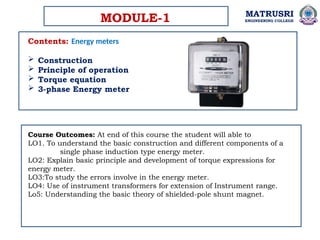
Contents: Energy meters
 Construction
 Principle of operation
 Torque equation
 3-phase Energy meter
Course Outcomes: At end of this course the student will able to
LO1. To understand the basic construction and different components of a
single phase induction type energy meter.
LO2: Explain basic principle and development of torque expressions for
energy meter.
LO3:To study the errors involve in the energy meter.
LO4: Use of instrument transformers for extension of Instrument range.
Lo5: Understanding the basic theory of shielded-pole shunt magnet.
MODULE-1
MATRUSRI
ENGINEERING COLLEGE
• Electrical energy is the product of power (P) and time (t) of
how long the power is consumed or spend.
W= P*t
Unit of measurement : Kilowatt hour
Kilowatt-hour: The amount of energy consumed by one kilowatt load over the
period of one hour .
What Is electrical energy?
MATRUSRI
ENGINEERING COLLEGE
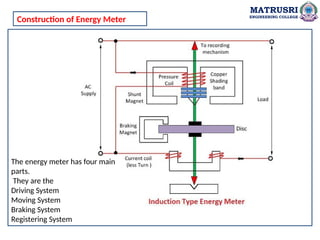
Construction of Energy Meter
The energy meter has four main
parts.
They are the
Driving System
Moving System
Braking System
Registering System
MATRUSRI
ENGINEERING COLLEGE
MATRUSRI
ENGINEERING COLLEGE
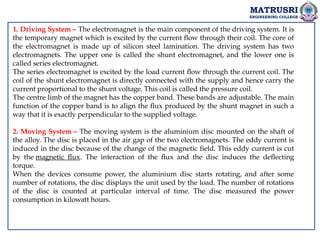
1. Driving System – The electromagnet is the main component of the driving system. It is
the temporary magnet which is excited by the current flow through their coil. The core of
the electromagnet is made up of silicon steel lamination. The driving system has two
electromagnets. The upper one is called the shunt electromagnet, and the lower one is
called series electromagnet.
The series electromagnet is excited by the load current flow through the current coil. The
coil of the shunt electromagnet is directly connected with the supply and hence carry the
current proportional to the shunt voltage. This coil is called the pressure coil.
The centre limb of the magnet has the copper band. These bands are adjustable. The main
function of the copper band is to align the flux produced by the shunt magnet in such a
way that it is exactly perpendicular to the supplied voltage.
2. Moving System – The moving system is the aluminium disc mounted on the shaft of
the alloy. The disc is placed in the air gap of the two electromagnets. The eddy current is
induced in the disc because of the change of the magnetic field. This eddy current is cut
by the magnetic flux. The interaction of the flux and the disc induces the deflecting
torque.
When the devices consume power, the aluminium disc starts rotating, and after some
number of rotations, the disc displays the unit used by the load. The number of rotations
of the disc is counted at particular interval of time. The disc measured the power
consumption in kilowatt hours.
MATRUSRI
ENGINEERING COLLEGE
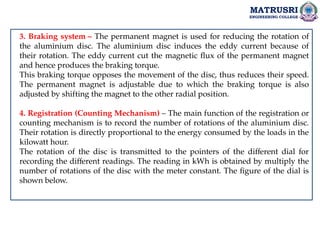
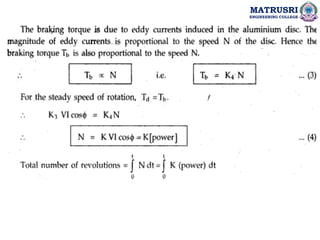
3. Braking system – The permanent magnet is used for reducing the rotation of
the aluminium disc. The aluminium disc induces the eddy current because of
their rotation. The eddy current cut the magnetic flux of the permanent magnet
and hence produces the braking torque.
This braking torque opposes the movement of the disc, thus reduces their speed.
The permanent magnet is adjustable due to which the braking torque is also
adjusted by shifting the magnet to the other radial position.
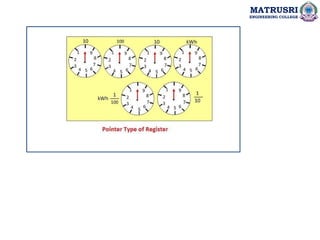
4. Registration (Counting Mechanism) – The main function of the registration or
counting mechanism is to record the number of rotations of the aluminium disc.
Their rotation is directly proportional to the energy consumed by the loads in the
kilowatt hour.
The rotation of the disc is transmitted to the pointers of the different dial for
recording the different readings. The reading in kWh is obtained by multiply the
number of rotations of the disc with the meter constant. The figure of the dial is
shown below.
MATRUSRI
ENGINEERING COLLEGE
MATRUSRI
ENGINEERING COLLEGE
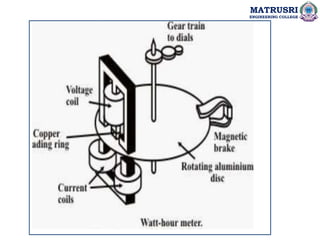
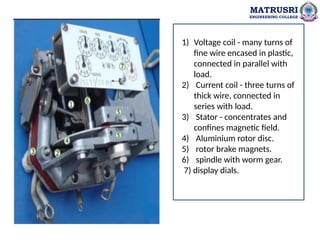
1) Voltage coil - many turns of
fine wire encased in plastic,
connected in parallel with
load.
2) Current coil - three turns of
thick wire, connected in
series with load.
3) Stator - concentrates and
confines magnetic field.
4) Aluminium rotor disc.
5) rotor brake magnets.
6) spindle with worm gear.
7) display dials.
MATRUSRI
ENGINEERING COLLEGE
The energy meter has the aluminum disc whose rotation determines the power
consumption of the load. The disc is placed between the air gap of the series and shunt
electromagnet. The shunt magnet has the pressure coil, and the series magnet has the
current coil.
The pressure coil creates the magnetic field because of the supply voltage, and the
current coil produces it because of the current.
The field induces by the voltage coil is lagging by 90º on the magnetic field of the current
coil because of which eddy current induced in the disc. The interaction of the eddy
current and the magnetic field causes torque, which exerts a force on the disc. Thus, the
disc starts rotating.
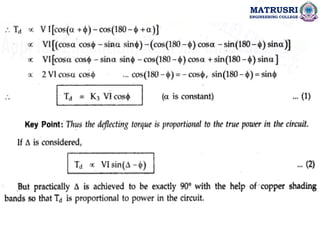
The force on the disc is proportional to the current and voltage of the coil. The
permanent magnet controls Their rotation. The permanent magnet opposes the
movement of the disc and equalises it on the power consumption. The cyclometer
counts the rotation of the disc.
Working of the Energy Meter
MATRUSRI
ENGINEERING COLLEGE
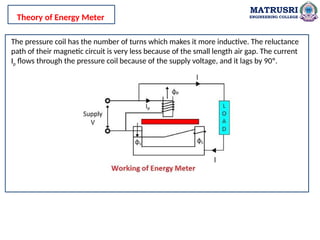
The pressure coil has the number of turns which makes it more inductive. The reluctance
path of their magnetic circuit is very less because of the small length air gap. The current
Ip flows through the pressure coil because of the supply voltage, and it lags by 90º.
Theory of Energy Meter
MATRUSRI
ENGINEERING COLLEGE
The Ip produces the two Φp which is again divided into Φp1 and Φp2.
The major portion of the flux Φp1 passes through the side gap because of low
reluctance.
The flux Φp2 goes through the disc and induces the driving torque which
rotates the aluminium disc.
The flux Φp is proportional to the applied voltage, and it is lagged by an angle
of 90º.
The flux is alternating and hence induces an eddy current Iep in the disc.
The load current passes through the current coil induces the flux Φs.
This flux causes the eddy current Ies on the disc.
The eddy current Ies interacts with the flux Φp, and
the eddy current Iep interacts with Φs to produce the another torque.
These torques are opposite in direction, and the net torque is the difference
between these two.
MATRUSRI
ENGINEERING COLLEGE
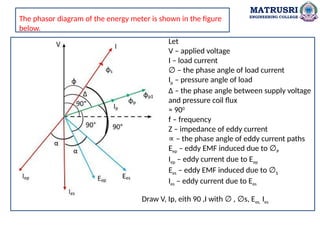
The phasor diagram of the energy meter is shown in the figure
below.
Let
V – applied voltage
I – load current
– the phase angle of load current
∅
Ip – pressure angle of load
Δ – the phase angle between supply voltage
and pressure coil flux
≈ 900
f – frequency
Z – impedance of eddy current
– the phase angle of eddy current paths
∝
Eep – eddy EMF induced due to ∅P
Iep – eddy current due to Eep
Ees – eddy EMF induced due to ∅S
Ies – eddy current due to Ees
Draw V, Ip, eith 90 ,I with , s, E
∅ ∅ es, Ies
MATRUSRI
ENGINEERING COLLEGE
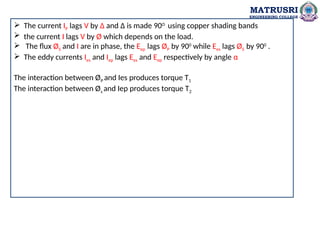
 The current IP lags V by Δ and Δ is made 90O
using copper shading bands
 the current I lags V by Ø which depends on the load.
 The flux ØS and I are in phase, the Eep lags ØP by 900
while Ees lags ØS by 900
.
 The eddy currents Ies and Iep lags Ees and Eep respectively by angle α
The interaction between ØP and Ies produces torque T1
The interaction between Øs and Iep produces torque T2
MATRUSRI
ENGINEERING COLLEGE
MATRUSRI
ENGINEERING COLLEGE
MATRUSRI
ENGINEERING COLLEGE
Errors and their Adjustments in 1Φ energy meter
rrors in the energy meter:
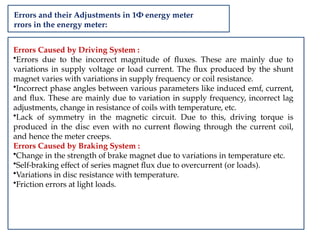
Errors Caused by Driving System :
•Errors due to the incorrect magnitude of fluxes. These are mainly due to
variations in supply voltage or load current. The flux produced by the shunt
magnet varies with variations in supply frequency or coil resistance.
•Incorrect phase angles between various parameters like induced emf, current,
and flux. These are mainly due to variation in supply frequency, incorrect lag
adjustments, change in resistance of coils with temperature, etc.
•Lack of symmetry in the magnetic circuit. Due to this, driving torque is
produced in the disc even with no current flowing through the current coil,
and hence the meter creeps.
Errors Caused by Braking System :
•Change in the strength of brake magnet due to variations in temperature etc.
•Self-braking effect of series magnet flux due to overcurrent (or loads).
•Variations in disc resistance with temperature.
•Friction errors at light loads.
Assuming the supply voltage and frequency constant, the induction type energy
may have the following errors:
i Speed error:
Due to the incorrect position of the brake magnet, the braking torque is not
correctly developed. This can be tested when meter runs at its full load current
alternatively on loads of unity power factor and a low lagging power factor. The
speed can be adjusted to the correct value by varying the position of the braking
magnet towards the centre of the disc or away from the centre and the shielding
loop. If the meter runs fast on inductive load and correctly on non-inductive load,
the shielding loop must be moved towards the disc. On the other hand, if the
meter runs slow on non-inductive load, the brake magnet must be moved
towards the center of the disc.
ii Meter phase error:
An error due to incorrect adjustment of the position of shading band results an
incorrect phase displacement between the magnetic flux and the supply voltage
(not in quadrature). This is tested with 0.5 p.f. load at the rated load condition. By
adjusting the position of the copper shading band in the central limb of the shunt
magnet this error can be eliminated.
Errors in the energy meter:
Errors and their Adjustments in 1-Φ energy meter
Errors in the energy meter:
Phase Error: It is necessary that the energy meter should give correct reading
on all power factors, which is only possible when the field setup by shunt
magnet lags behind the applied voltage by 90o
. But the flux due to shunt
magnet does not lag behind the applied voltage exactly by 90o
because of
winding resistance and iron losses.
Adjustment: The flux in the shunt magnet can be made to lag behind the
supply voltage by exactly 90o
by adjusting the position of shading band (or
shading ring or shading coil) placed round the lower part of the control limb
of the shunt magnet.
This adjustment is known as lag adjustment or power factor
adjustment (or power factor compensator).
Speed Error: Sometimes the speed of the meter is either fast or slow,
resulting in the wrong recording of energy consumption.
Adjustment: An error in the speed of the meter when tested on non-
inductive load can be eliminated by correctly adjusting the position of the
brake magnet.
Movement of the brake magnet in the direction of the spindle will reduce the
braking torque and vice-versa.
Errors and their Adjustments in 1Φ energy meter
Errors in the energy meter:
Friction Compensation (or) Friction Error: Frictional forces at the rotor bearings and in the
counting (or register) mechanism cause noticeable error especially at light loads. At light
loads, the torque due to friction adds considerably to the braking torque on the disc rotor.
Since, friction torque is not proportional to the speed but is roughly constant it can cause
considerable error in meter reading.
Adjustment: This error can be reduced to an unimportant level by making the ration of the
shunt magnet flux Φ2
and series magnet flux Φ1
large with the help of two shading rings (or
shading bonds). These bonds embrace the flux contained in the two outer limb of the shunt
magnet and thus eddy currents are induced in them which cause a phase displacement
between the enclosed flux and the main gap flux. As a result, a small driving torque is exerted
on the disc rotor, this torque being adjusted by variation of the positions of these bands to
compensate for friction in the instrument. Correctness of friction compensation is achieved by
running the meter at high load of about 8 to 10% of full load when the disc should rotate
correctly. Over compensation leads to creep. This adjustment is known as light load adjustment.
Temperature Error: The error due to variation in temperature are very small, because the
various effects produced tend to neutralise one another.
The resistance of the disc of the potential coil and characteristics of magnetic circuit and the
strength of break magnet are affected by the changes in temperature. Therefore, great care is
exercised in the design of the meter to eliminate the errors due to temperature variations.
Errors and their Adjustments in 1Φ energy meter
rrors in the energy meter:
Temperature Error: The error due to variation in temperature are
very small, because the various effects produced tend to neutralise
one another.
The resistance of the disc of the potential coil and characteristics of
magnetic circuit and the strength of break magnet are affected by the
changes in temperature. Therefore, great care is exercised in the
design of the meter to eliminate the errors due to temperature
variations.
Frequency Variations: The meter is designed to give minimum error
at a particular frequency (generally 50 Hz). If the supply frequency
changes, the reactance of the coils also changes, resulting in a small
error. Fortunately, this is not of much significance because commercial
frequencies are held within close limits.
Voltage Variations: The error due to variation voltage is very small
(usually 0.2% to 0.3%). This can be eliminated by the proper design of
the magnetic circuit of the shunt magnet.
Errors and their Adjustments in 1Φ energy meter
rrors in the energy meter:
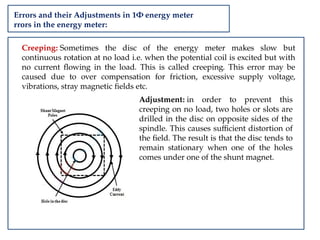
Creeping: Sometimes the disc of the energy meter makes slow but
continuous rotation at no load i.e. when the potential coil is excited but with
no current flowing in the load. This is called creeping. This error may be
caused due to over compensation for friction, excessive supply voltage,
vibrations, stray magnetic fields etc.
Adjustment: in order to prevent this
creeping on no load, two holes or slots are
drilled in the disc on opposite sides of the
spindle. This causes sufficient distortion of
the field. The result is that the disc tends to
remain stationary when one of the holes
comes under one of the shunt magnet.
Errors and their Adjustments in 1Φ energy meter
rrors in the energy meter:
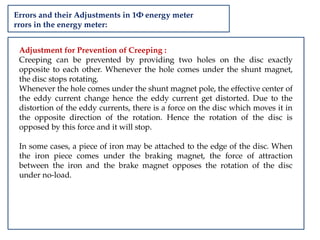
Adjustment for Prevention of Creeping :
Creeping can be prevented by providing two holes on the disc exactly
opposite to each other. Whenever the hole comes under the shunt magnet,
the disc stops rotating.
Whenever the hole comes under the shunt magnet pole, the effective center of
the eddy current change hence the eddy current get distorted. Due to the
distortion of the eddy currents, there is a force on the disc which moves it in
the opposite direction of the rotation. Hence the rotation of the disc is
opposed by this force and it will stop.
In some cases, a piece of iron may be attached to the edge of the disc. When
the iron piece comes under the braking magnet, the force of attraction
between the iron and the brake magnet opposes the rotation of the disc
under no-load.
Errors and their Adjustments in 1Φ energy meter
rrors in the energy meter:
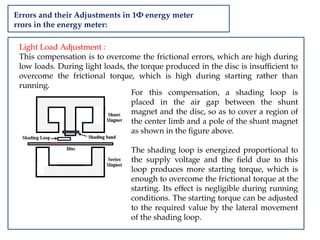
Light Load Adjustment :
This compensation is to overcome the frictional errors, which are high during
low loads. During light loads, the torque produced in the disc is insufficient to
overcome the frictional torque, which is high during starting rather than
running.
For this compensation, a shading loop is
placed in the air gap between the shunt
magnet and the disc, so as to cover a region of
the center limb and a pole of the shunt magnet
as shown in the figure above.
The shading loop is energized proportional to
the supply voltage and the field due to this
loop produces more starting torque, which is
enough to overcome the frictional torque at the
starting. Its effect is negligible during running
conditions. The starting torque can be adjusted
to the required value by the lateral movement
of the shading loop.
Errors and their Adjustments in 1Φ energy meter
rrors in the energy meter:
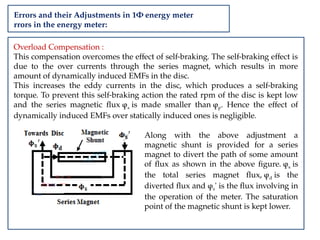
Overload Compensation :
This compensation overcomes the effect of self-braking. The self-braking effect is
due to the over currents through the series magnet, which results in more
amount of dynamically induced EMFs in the disc.
This increases the eddy currents in the disc, which produces a self-braking
torque. To prevent this self-braking action the rated rpm of the disc is kept low
and the series magnetic flux φs is made smaller than φp. Hence the effect of
dynamically induced EMFs over statically induced ones is negligible.
Along with the above adjustment a
magnetic shunt is provided for a series
magnet to divert the path of some amount
of flux as shown in the above figure. φs is
the total series magnet flux, φd is the
diverted flux and φs' is the flux involving in
the operation of the meter. The saturation
point of the magnetic shunt is kept lower.
Errors and their Adjustments in 1Φ energy meter
rrors in the energy meter:
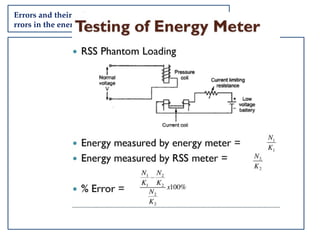
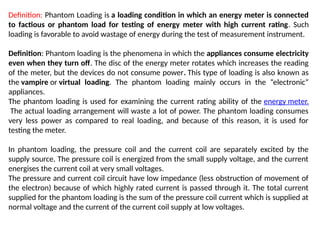
Definition: Phantom Loading is a loading condition in which an energy meter is connected
to factious or phantom load for testing of energy meter with high current rating. Such
loading is favorable to avoid wastage of energy during the test of measurement instrument.
Definition: Phantom loading is the phenomena in which the appliances consume electricity
even when they turn off. The disc of the energy meter rotates which increases the reading
of the meter, but the devices do not consume power. This type of loading is also known as
the vampire or virtual loading. The phantom loading mainly occurs in the “electronic”
appliances.
The phantom loading is used for examining the current rating ability of the energy meter.
The actual loading arrangement will waste a lot of power. The phantom loading consumes
very less power as compared to real loading, and because of this reason, it is used for
testing the meter.
In phantom loading, the pressure coil and the current coil are separately excited by the
supply source. The pressure coil is energized from the small supply voltage, and the current
energises the current coil at very small voltages.
The pressure and current coil circuit have low impedance (less obstruction of movement of
the electron) because of which highly rated current is passed through it. The total current
supplied for the phantom loading is the sum of the pressure coil current which is supplied at
normal voltage and the current of the current coil supply at low voltages.
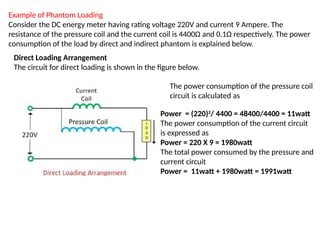
Example of Phantom Loading
Consider the DC energy meter having rating voltage 220V and current 9 Ampere. The
resistance of the pressure coil and the current coil is 4400Ω and 0.1Ω respectively. The power
consumption of the load by direct and indirect phantom is explained below.
The power consumption of the pressure coil
circuit is calculated as
Power = (220)2
/ 4400 = 48400/4400 = 11watt
The power consumption of the current circuit
is expressed as
Power = 220 Χ 9 = 1980watt
The total power consumed by the pressure and
current circuit
Power = 11watt + 1980watt = 1991watt
Direct Loading Arrangement
The circuit for direct loading is shown in the figure below.
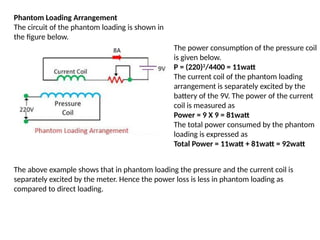
Phantom Loading Arrangement
The circuit of the phantom loading is shown in
the figure below.
The power consumption of the pressure coil
is given below.
P = (220)2
/4400 = 11watt
The current coil of the phantom loading
arrangement is separately excited by the
battery of the 9V. The power of the current
coil is measured as
Power = 9 Χ 9 = 81watt
The total power consumed by the phantom
loading is expressed as
Total Power = 11watt + 81watt = 92watt
The above example shows that in phantom loading the pressure and the current coil is
separately excited by the meter. Hence the power loss is less in phantom loading as
compared to direct loading.
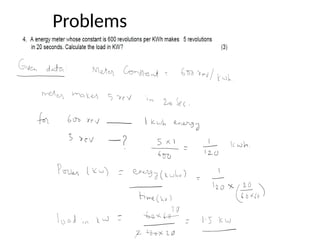
Problems
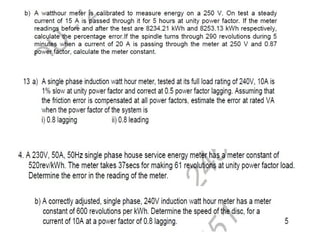
Problems
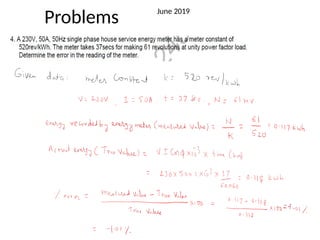
Problems June 2019
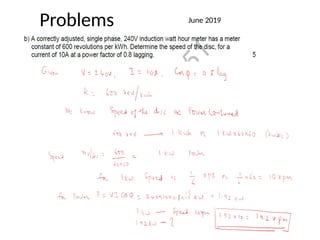
Problems June 2019
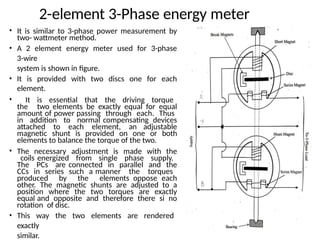
2-element 3-Phase energy meter
• It is similar to 3-phase power measurement by
two- wattmeter method.
• A 2 element energy meter used for 3-phase
3-wire
system is shown in figure.
• It is provided with two discs one for each
element.
• It is essential that the driving torque
the two elements be exactly equal for equal
amount of power passing through each. Thus
in addition to normal compensating devices
attached to each element, an adjustable
magnetic shunt is provided on one or both
elements to balance the torque of the two.
• The necessary adjustment is made with the
coils energized from single phase supply.
The PCs are connected in parallel and the
CCs in series such a manner the torques
produced by the elements oppose each
other. The magnetic shunts are adjusted to a
position where the two torques are exactly
equal and opposite and therefore there si no
rotation of disc.
• This way the two elements are rendered
exactly
similar.

EElectrical Measurements & Instrumentation .single phase Energy meter

  • 1.
    MATRUSRI ENGINEERING COLLEGE DEPARTMENTOF ELECTRICAL AND ELECTRONICS ENGINEERING SUBJECT NAME: Energy meters FACULTY NAME: Dr.N.KALPANA MATRUSRI ENGINEERING COLLEGE
  • 2.
    SYLLABUS UNIT I -Instruments Indicating, Recording and Integrating instruments, Ammeter, Voltmeter, Expression for torque of moving coil, moving iron, Dynamometer, induction and electrostatic instruments. Extension of range of instruments, Wattmeter Torque expression for dynamometer instruments, Reactive power measurement. UNIT II Meters: Energy meters, single phase and 3-phase, Driving torque and braking torque equations, Errors and testing compensation, Maximum demand indicator, Power factor meters, Frequency meters, Electrical resonance and Weston type of synchro scope. UNIT III Bridge Methods and transducers: Measurement of inductance, capacitance and resistance using Bridges, Maxwell’s, Hay’s. bridge, Anderson, Wein, Desauty’s, Schering’s bridges, Kelvin’s double bridge, Megger, Loss of charge method, Wagners earthing device, Transducers - Analog and digital transducers, Strain gauges and Hall effect transducers. UNIT IV Magnetic Measurements and instrument transformers: Ballistic galvanometer, Calibration by Hibbert’ s magnetic standard flux meter, Lloyd- Fischer square for measuring iron loss, Determination of B-H curve and Hysteresis loop using CRO, Instrument transformers – Current and potential transformers, ratio and phase angle errors of CT’s and PT’s. UNIT V Potentiometers: Crompton’s DC and AC polar and coordinate types, Applications, Measurements of impedance, Calibration and ammeter voltmeter and wattmeters. Use of oscilloscope in frequency, phase and amplitude measurements MATRUSRI ENGINEERING COLLEGE
  • 3.
    MATRUSRI ENGINEERING COLLEGE Contents: Energymeters  Construction  Principle of operation  Torque equation  3-phase Energy meter Course Outcomes: At end of this course the student will able to LO1. To understand the basic construction and different components of a single phase induction type energy meter. LO2: Explain basic principle and development of torque expressions for energy meter. LO3:To study the errors involve in the energy meter. LO4: Use of instrument transformers for extension of Instrument range. Lo5: Understanding the basic theory of shielded-pole shunt magnet. MODULE-1
  • 4.
    MATRUSRI ENGINEERING COLLEGE • Electricalenergy is the product of power (P) and time (t) of how long the power is consumed or spend. W= P*t Unit of measurement : Kilowatt hour Kilowatt-hour: The amount of energy consumed by one kilowatt load over the period of one hour . What Is electrical energy?
  • 5.
    MATRUSRI ENGINEERING COLLEGE Construction ofEnergy Meter The energy meter has four main parts. They are the Driving System Moving System Braking System Registering System
  • 6.
  • 7.
    MATRUSRI ENGINEERING COLLEGE 1. DrivingSystem – The electromagnet is the main component of the driving system. It is the temporary magnet which is excited by the current flow through their coil. The core of the electromagnet is made up of silicon steel lamination. The driving system has two electromagnets. The upper one is called the shunt electromagnet, and the lower one is called series electromagnet. The series electromagnet is excited by the load current flow through the current coil. The coil of the shunt electromagnet is directly connected with the supply and hence carry the current proportional to the shunt voltage. This coil is called the pressure coil. The centre limb of the magnet has the copper band. These bands are adjustable. The main function of the copper band is to align the flux produced by the shunt magnet in such a way that it is exactly perpendicular to the supplied voltage. 2. Moving System – The moving system is the aluminium disc mounted on the shaft of the alloy. The disc is placed in the air gap of the two electromagnets. The eddy current is induced in the disc because of the change of the magnetic field. This eddy current is cut by the magnetic flux. The interaction of the flux and the disc induces the deflecting torque. When the devices consume power, the aluminium disc starts rotating, and after some number of rotations, the disc displays the unit used by the load. The number of rotations of the disc is counted at particular interval of time. The disc measured the power consumption in kilowatt hours.
  • 8.
    MATRUSRI ENGINEERING COLLEGE 3. Brakingsystem – The permanent magnet is used for reducing the rotation of the aluminium disc. The aluminium disc induces the eddy current because of their rotation. The eddy current cut the magnetic flux of the permanent magnet and hence produces the braking torque. This braking torque opposes the movement of the disc, thus reduces their speed. The permanent magnet is adjustable due to which the braking torque is also adjusted by shifting the magnet to the other radial position. 4. Registration (Counting Mechanism) – The main function of the registration or counting mechanism is to record the number of rotations of the aluminium disc. Their rotation is directly proportional to the energy consumed by the loads in the kilowatt hour. The rotation of the disc is transmitted to the pointers of the different dial for recording the different readings. The reading in kWh is obtained by multiply the number of rotations of the disc with the meter constant. The figure of the dial is shown below.
  • 9.
  • 10.
    MATRUSRI ENGINEERING COLLEGE 1) Voltagecoil - many turns of fine wire encased in plastic, connected in parallel with load. 2) Current coil - three turns of thick wire, connected in series with load. 3) Stator - concentrates and confines magnetic field. 4) Aluminium rotor disc. 5) rotor brake magnets. 6) spindle with worm gear. 7) display dials.
  • 11.
    MATRUSRI ENGINEERING COLLEGE The energymeter has the aluminum disc whose rotation determines the power consumption of the load. The disc is placed between the air gap of the series and shunt electromagnet. The shunt magnet has the pressure coil, and the series magnet has the current coil. The pressure coil creates the magnetic field because of the supply voltage, and the current coil produces it because of the current. The field induces by the voltage coil is lagging by 90º on the magnetic field of the current coil because of which eddy current induced in the disc. The interaction of the eddy current and the magnetic field causes torque, which exerts a force on the disc. Thus, the disc starts rotating. The force on the disc is proportional to the current and voltage of the coil. The permanent magnet controls Their rotation. The permanent magnet opposes the movement of the disc and equalises it on the power consumption. The cyclometer counts the rotation of the disc. Working of the Energy Meter
  • 12.
    MATRUSRI ENGINEERING COLLEGE The pressurecoil has the number of turns which makes it more inductive. The reluctance path of their magnetic circuit is very less because of the small length air gap. The current Ip flows through the pressure coil because of the supply voltage, and it lags by 90º. Theory of Energy Meter
  • 13.
    MATRUSRI ENGINEERING COLLEGE The Ipproduces the two Φp which is again divided into Φp1 and Φp2. The major portion of the flux Φp1 passes through the side gap because of low reluctance. The flux Φp2 goes through the disc and induces the driving torque which rotates the aluminium disc. The flux Φp is proportional to the applied voltage, and it is lagged by an angle of 90º. The flux is alternating and hence induces an eddy current Iep in the disc. The load current passes through the current coil induces the flux Φs. This flux causes the eddy current Ies on the disc. The eddy current Ies interacts with the flux Φp, and the eddy current Iep interacts with Φs to produce the another torque. These torques are opposite in direction, and the net torque is the difference between these two.
  • 14.
    MATRUSRI ENGINEERING COLLEGE The phasordiagram of the energy meter is shown in the figure below. Let V – applied voltage I – load current – the phase angle of load current ∅ Ip – pressure angle of load Δ – the phase angle between supply voltage and pressure coil flux ≈ 900 f – frequency Z – impedance of eddy current – the phase angle of eddy current paths ∝ Eep – eddy EMF induced due to ∅P Iep – eddy current due to Eep Ees – eddy EMF induced due to ∅S Ies – eddy current due to Ees Draw V, Ip, eith 90 ,I with , s, E ∅ ∅ es, Ies
  • 15.
    MATRUSRI ENGINEERING COLLEGE  Thecurrent IP lags V by Δ and Δ is made 90O using copper shading bands  the current I lags V by Ø which depends on the load.  The flux ØS and I are in phase, the Eep lags ØP by 900 while Ees lags ØS by 900 .  The eddy currents Ies and Iep lags Ees and Eep respectively by angle α The interaction between ØP and Ies produces torque T1 The interaction between Øs and Iep produces torque T2
  • 16.
  • 18.
  • 19.
  • 20.
    Errors and theirAdjustments in 1Φ energy meter rrors in the energy meter: Errors Caused by Driving System : •Errors due to the incorrect magnitude of fluxes. These are mainly due to variations in supply voltage or load current. The flux produced by the shunt magnet varies with variations in supply frequency or coil resistance. •Incorrect phase angles between various parameters like induced emf, current, and flux. These are mainly due to variation in supply frequency, incorrect lag adjustments, change in resistance of coils with temperature, etc. •Lack of symmetry in the magnetic circuit. Due to this, driving torque is produced in the disc even with no current flowing through the current coil, and hence the meter creeps. Errors Caused by Braking System : •Change in the strength of brake magnet due to variations in temperature etc. •Self-braking effect of series magnet flux due to overcurrent (or loads). •Variations in disc resistance with temperature. •Friction errors at light loads.
  • 21.
    Assuming the supplyvoltage and frequency constant, the induction type energy may have the following errors: i Speed error: Due to the incorrect position of the brake magnet, the braking torque is not correctly developed. This can be tested when meter runs at its full load current alternatively on loads of unity power factor and a low lagging power factor. The speed can be adjusted to the correct value by varying the position of the braking magnet towards the centre of the disc or away from the centre and the shielding loop. If the meter runs fast on inductive load and correctly on non-inductive load, the shielding loop must be moved towards the disc. On the other hand, if the meter runs slow on non-inductive load, the brake magnet must be moved towards the center of the disc. ii Meter phase error: An error due to incorrect adjustment of the position of shading band results an incorrect phase displacement between the magnetic flux and the supply voltage (not in quadrature). This is tested with 0.5 p.f. load at the rated load condition. By adjusting the position of the copper shading band in the central limb of the shunt magnet this error can be eliminated. Errors in the energy meter:
  • 22.
    Errors and theirAdjustments in 1-Φ energy meter Errors in the energy meter: Phase Error: It is necessary that the energy meter should give correct reading on all power factors, which is only possible when the field setup by shunt magnet lags behind the applied voltage by 90o . But the flux due to shunt magnet does not lag behind the applied voltage exactly by 90o because of winding resistance and iron losses. Adjustment: The flux in the shunt magnet can be made to lag behind the supply voltage by exactly 90o by adjusting the position of shading band (or shading ring or shading coil) placed round the lower part of the control limb of the shunt magnet. This adjustment is known as lag adjustment or power factor adjustment (or power factor compensator). Speed Error: Sometimes the speed of the meter is either fast or slow, resulting in the wrong recording of energy consumption. Adjustment: An error in the speed of the meter when tested on non- inductive load can be eliminated by correctly adjusting the position of the brake magnet. Movement of the brake magnet in the direction of the spindle will reduce the braking torque and vice-versa.
  • 23.
    Errors and theirAdjustments in 1Φ energy meter Errors in the energy meter: Friction Compensation (or) Friction Error: Frictional forces at the rotor bearings and in the counting (or register) mechanism cause noticeable error especially at light loads. At light loads, the torque due to friction adds considerably to the braking torque on the disc rotor. Since, friction torque is not proportional to the speed but is roughly constant it can cause considerable error in meter reading. Adjustment: This error can be reduced to an unimportant level by making the ration of the shunt magnet flux Φ2 and series magnet flux Φ1 large with the help of two shading rings (or shading bonds). These bonds embrace the flux contained in the two outer limb of the shunt magnet and thus eddy currents are induced in them which cause a phase displacement between the enclosed flux and the main gap flux. As a result, a small driving torque is exerted on the disc rotor, this torque being adjusted by variation of the positions of these bands to compensate for friction in the instrument. Correctness of friction compensation is achieved by running the meter at high load of about 8 to 10% of full load when the disc should rotate correctly. Over compensation leads to creep. This adjustment is known as light load adjustment. Temperature Error: The error due to variation in temperature are very small, because the various effects produced tend to neutralise one another. The resistance of the disc of the potential coil and characteristics of magnetic circuit and the strength of break magnet are affected by the changes in temperature. Therefore, great care is exercised in the design of the meter to eliminate the errors due to temperature variations.
  • 24.
    Errors and theirAdjustments in 1Φ energy meter rrors in the energy meter: Temperature Error: The error due to variation in temperature are very small, because the various effects produced tend to neutralise one another. The resistance of the disc of the potential coil and characteristics of magnetic circuit and the strength of break magnet are affected by the changes in temperature. Therefore, great care is exercised in the design of the meter to eliminate the errors due to temperature variations. Frequency Variations: The meter is designed to give minimum error at a particular frequency (generally 50 Hz). If the supply frequency changes, the reactance of the coils also changes, resulting in a small error. Fortunately, this is not of much significance because commercial frequencies are held within close limits. Voltage Variations: The error due to variation voltage is very small (usually 0.2% to 0.3%). This can be eliminated by the proper design of the magnetic circuit of the shunt magnet.
  • 25.
    Errors and theirAdjustments in 1Φ energy meter rrors in the energy meter: Creeping: Sometimes the disc of the energy meter makes slow but continuous rotation at no load i.e. when the potential coil is excited but with no current flowing in the load. This is called creeping. This error may be caused due to over compensation for friction, excessive supply voltage, vibrations, stray magnetic fields etc. Adjustment: in order to prevent this creeping on no load, two holes or slots are drilled in the disc on opposite sides of the spindle. This causes sufficient distortion of the field. The result is that the disc tends to remain stationary when one of the holes comes under one of the shunt magnet.
  • 26.
    Errors and theirAdjustments in 1Φ energy meter rrors in the energy meter: Adjustment for Prevention of Creeping : Creeping can be prevented by providing two holes on the disc exactly opposite to each other. Whenever the hole comes under the shunt magnet, the disc stops rotating. Whenever the hole comes under the shunt magnet pole, the effective center of the eddy current change hence the eddy current get distorted. Due to the distortion of the eddy currents, there is a force on the disc which moves it in the opposite direction of the rotation. Hence the rotation of the disc is opposed by this force and it will stop. In some cases, a piece of iron may be attached to the edge of the disc. When the iron piece comes under the braking magnet, the force of attraction between the iron and the brake magnet opposes the rotation of the disc under no-load.
  • 27.
    Errors and theirAdjustments in 1Φ energy meter rrors in the energy meter: Light Load Adjustment : This compensation is to overcome the frictional errors, which are high during low loads. During light loads, the torque produced in the disc is insufficient to overcome the frictional torque, which is high during starting rather than running. For this compensation, a shading loop is placed in the air gap between the shunt magnet and the disc, so as to cover a region of the center limb and a pole of the shunt magnet as shown in the figure above. The shading loop is energized proportional to the supply voltage and the field due to this loop produces more starting torque, which is enough to overcome the frictional torque at the starting. Its effect is negligible during running conditions. The starting torque can be adjusted to the required value by the lateral movement of the shading loop.
  • 28.
    Errors and theirAdjustments in 1Φ energy meter rrors in the energy meter: Overload Compensation : This compensation overcomes the effect of self-braking. The self-braking effect is due to the over currents through the series magnet, which results in more amount of dynamically induced EMFs in the disc. This increases the eddy currents in the disc, which produces a self-braking torque. To prevent this self-braking action the rated rpm of the disc is kept low and the series magnetic flux φs is made smaller than φp. Hence the effect of dynamically induced EMFs over statically induced ones is negligible. Along with the above adjustment a magnetic shunt is provided for a series magnet to divert the path of some amount of flux as shown in the above figure. φs is the total series magnet flux, φd is the diverted flux and φs' is the flux involving in the operation of the meter. The saturation point of the magnetic shunt is kept lower.
  • 29.
    Errors and theirAdjustments in 1Φ energy meter rrors in the energy meter:
  • 30.
    Definition: Phantom Loadingis a loading condition in which an energy meter is connected to factious or phantom load for testing of energy meter with high current rating. Such loading is favorable to avoid wastage of energy during the test of measurement instrument. Definition: Phantom loading is the phenomena in which the appliances consume electricity even when they turn off. The disc of the energy meter rotates which increases the reading of the meter, but the devices do not consume power. This type of loading is also known as the vampire or virtual loading. The phantom loading mainly occurs in the “electronic” appliances. The phantom loading is used for examining the current rating ability of the energy meter. The actual loading arrangement will waste a lot of power. The phantom loading consumes very less power as compared to real loading, and because of this reason, it is used for testing the meter. In phantom loading, the pressure coil and the current coil are separately excited by the supply source. The pressure coil is energized from the small supply voltage, and the current energises the current coil at very small voltages. The pressure and current coil circuit have low impedance (less obstruction of movement of the electron) because of which highly rated current is passed through it. The total current supplied for the phantom loading is the sum of the pressure coil current which is supplied at normal voltage and the current of the current coil supply at low voltages.
  • 31.
    Example of PhantomLoading Consider the DC energy meter having rating voltage 220V and current 9 Ampere. The resistance of the pressure coil and the current coil is 4400Ω and 0.1Ω respectively. The power consumption of the load by direct and indirect phantom is explained below. The power consumption of the pressure coil circuit is calculated as Power = (220)2 / 4400 = 48400/4400 = 11watt The power consumption of the current circuit is expressed as Power = 220 Χ 9 = 1980watt The total power consumed by the pressure and current circuit Power = 11watt + 1980watt = 1991watt Direct Loading Arrangement The circuit for direct loading is shown in the figure below.
  • 32.
    Phantom Loading Arrangement Thecircuit of the phantom loading is shown in the figure below. The power consumption of the pressure coil is given below. P = (220)2 /4400 = 11watt The current coil of the phantom loading arrangement is separately excited by the battery of the 9V. The power of the current coil is measured as Power = 9 Χ 9 = 81watt The total power consumed by the phantom loading is expressed as Total Power = 11watt + 81watt = 92watt The above example shows that in phantom loading the pressure and the current coil is separately excited by the meter. Hence the power loss is less in phantom loading as compared to direct loading.
  • 33.
  • 34.
  • 35.
  • 36.
  • 38.
    2-element 3-Phase energymeter • It is similar to 3-phase power measurement by two- wattmeter method. • A 2 element energy meter used for 3-phase 3-wire system is shown in figure. • It is provided with two discs one for each element. • It is essential that the driving torque the two elements be exactly equal for equal amount of power passing through each. Thus in addition to normal compensating devices attached to each element, an adjustable magnetic shunt is provided on one or both elements to balance the torque of the two. • The necessary adjustment is made with the coils energized from single phase supply. The PCs are connected in parallel and the CCs in series such a manner the torques produced by the elements oppose each other. The magnetic shunts are adjusted to a position where the two torques are exactly equal and opposite and therefore there si no rotation of disc. • This way the two elements are rendered exactly similar.