Downloaded 43 times


![Prof. E.J. Corey [Chemistry Nobel prize
winner-1990] in 1978 introduced Chiral
auxiliary…
with chiral 8-phenylmenthol.
(−)-8-Phenylmenthol](https://image.slidesharecdn.com/chiralauxiliaryss-180926132931/85/Chiral-auxiliary-3-320.jpg)




![Substrate
[Achiral]
Chiral
Auxiliary
Chiral
Auxiliary
Substrate
[Achiral]
Chiral
Auxiliary
Reaction to form new
Chiral Compound
Chiral
Auxiliary
Product
[Chiral]
Product
Diastreo-selective
reaction
Step-1
Step-2
Recycling of Chiral Auxiliary](https://image.slidesharecdn.com/chiralauxiliaryss-180926132931/85/Chiral-auxiliary-13-320.jpg)
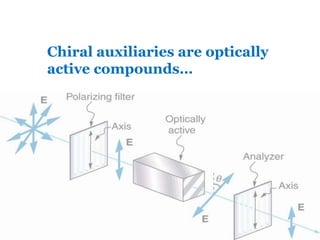




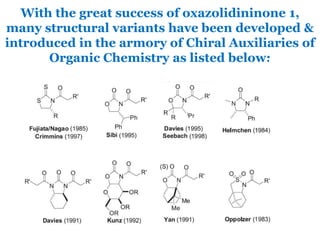


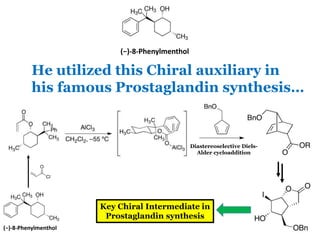
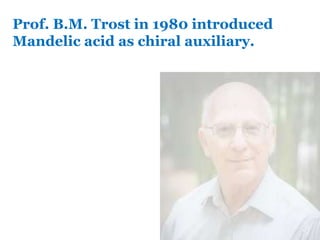
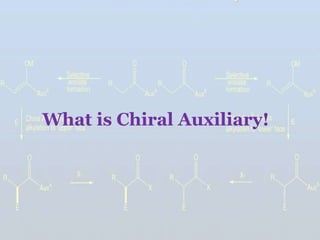
Prof. Corey introduced the chiral auxiliary (-)-8-phenylmenthol in 1978. He used it in his famous prostaglandin synthesis. Prof. Trost then introduced mandelic acid as a chiral auxiliary in 1980. In 1985, Prof. Whitesell introduced an alternative, (1R,2S)-trans-2-phenyl-1-cyclohexanol, since preparing menthol compounds is difficult. A chiral auxiliary is a temporary, optically active compound incorporated into a synthesis to control stereochemistry and selectively form one stereoisomer over the other. Important examples include Evans' oxazolidinones and their use in asymmetric alkylations.


![CHEMISTRY OF PEPTIDES [M.PHARM, M.SC, BSC, B.PHARM]](https://cdn.slidesharecdn.com/ss_thumbnails/45-191219080659-thumbnail.jpg?width=640&height=640&fit=bounds)


