Electric current is the rate of flow of charges 
I= 
Q 
t 
I=Electric current ; Q=charge ;t=time 
Electric current is measured in amperes 
1Ampere= 1coulomb/1second; A=C/S 
One ampere is the current through a wire, if 
charge flows at the rate of 1coulomb/second 
Charge of an electron=1.6× 10¯19 c 
Icoulomb= charge of 6.25×10¹⁸ coulombs
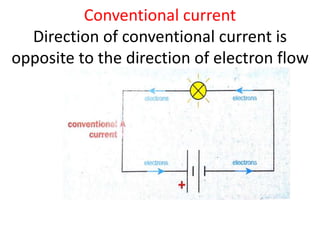
Conventional current 
Direction of conventional current is 
opposite to the direction of electron flow
The drift velocity is the average velocity that a 
particle, such as an electron, attains due to an 
electric field. 
V= 
I 
nAe 
Where ,v=drift velocity I= current 
n= free electrons per m³ 
A= cross sectional area 
e= charge of electron
The potential difference between two points is the 
electrical potential energy transferred to other forms, 
per coulomb of charge that passes between the two 
points. 
Potential difference is measured in volts 
Define 1 volt 
V=W/Q; v=1volt if W=1joule and Q=1coulomb 
The p.d between two points is 1volt if 1joule of 
electrical energy is transferred when 1 coulomb of 
charge flows between the two points
ENERGY TRANSFERRED
RESISTANCE 
RESISTANCE is the opposition to the flow of 
electrons 
Tungsten filament has more resistance .But 
copper wire has less resistance. Why? 
The electrons make many collisions with the 
tungsten ions as they move through the 
filament. But electrons move more easily 
through Cu wire as they make fewer collisions
Ohm’s Law 
The current (I) flowing through a wire is directly 
proportional to the p.d between its two ends if 
the temperature remains constant.
Q)Define resistance 
The resistance of a conductor is the ratio of the 
potential difference applied across it to the 
current passing through it. 
Unit of resistance- Ohms 
Q)Define 1 ohm 
R=V/I ;R=1ohm if V=1volt and I= 1Ampere 
The resistance of a wire is 1ohm if a current of 
1Ampere flows through it when the p.d 
between its two ends is 1volt.
How to measure the resistance of a 
wire?
CURRENT-VOLTAGE CHARACTERISTICS 
• Graph is a straight line 
• I is directly proportional to V. 
• V/I is a constant 
• The wire has constant resistance
FILAMENT LAMP 
• V is not proportional to I 
• V/I is not a constant but 
increases with current. 
• V/I=R increases with current 
• As the current rises the tungsten 
filament gets hotter and 
resistance of the lamp rises 
• The graph is symmetrical for both 
positive and negative voltages
DIODE 
• Diode conducts only when it 
is forward biased. 
• When reversed biased, there 
is no current
• In the forward direction the 
current increases very rapidly 
• The forward biased diode has 
very low resistance 
• There is no current when the 
voltage is applied in the 
reverse direction. 
• Reverse diode has very high 
resistance.
EFFECT OF TEMPERATURE ON RESISTANCE 
1. METALS : As temperature rises, the resistance of metals 
increases because the ions vibrate faster with greater amplitude 
and it is more difficult for electrons to pass through the lattice. 
Metals have +ve temperature coefficient 
2. INSULATOR: Resistance decreases with temperature. 
insulators have few free electrons available for conduction at room 
temperature. At high temperatures some electrons gain enough 
Energy to escape from their atoms and the insulator is able to 
Conduct. 
They have –ve temperature coefficient
3. SEMICONDUCTORS: Resistance decreases with 
Increase in temperature. At low temperatures, semiconductors are 
Poor conductors. As temperature rises, more and more electrons 
Break free to make it a better conductor. 
It has –ve temperature coefficient. 
Eg: Thermistor
RESISTIVITY 
1. R α l 
R α 1/A 
=> R α l/A 
=> R = ℓ l/A 
Where ℓ is a constant . This is equal to the resistivity of the 
Material 
Unit: Ohm meter (Ωm)
ℓ = R x A/l 
Resistivity is defined as numerically equal to the 
resistance of a sample of the material of unit length 
and unit area of cross-section.

Les 1 current and charge_12

  • 2.
    Electric current isthe rate of flow of charges I= Q t I=Electric current ; Q=charge ;t=time Electric current is measured in amperes 1Ampere= 1coulomb/1second; A=C/S One ampere is the current through a wire, if charge flows at the rate of 1coulomb/second Charge of an electron=1.6× 10¯19 c Icoulomb= charge of 6.25×10¹⁸ coulombs
  • 3.
    Conventional current Directionof conventional current is opposite to the direction of electron flow
  • 4.
    The drift velocityis the average velocity that a particle, such as an electron, attains due to an electric field. V= I nAe Where ,v=drift velocity I= current n= free electrons per m³ A= cross sectional area e= charge of electron
  • 5.
    The potential differencebetween two points is the electrical potential energy transferred to other forms, per coulomb of charge that passes between the two points. Potential difference is measured in volts Define 1 volt V=W/Q; v=1volt if W=1joule and Q=1coulomb The p.d between two points is 1volt if 1joule of electrical energy is transferred when 1 coulomb of charge flows between the two points
  • 8.
  • 9.
    RESISTANCE RESISTANCE isthe opposition to the flow of electrons Tungsten filament has more resistance .But copper wire has less resistance. Why? The electrons make many collisions with the tungsten ions as they move through the filament. But electrons move more easily through Cu wire as they make fewer collisions
  • 10.
    Ohm’s Law Thecurrent (I) flowing through a wire is directly proportional to the p.d between its two ends if the temperature remains constant.
  • 11.
    Q)Define resistance Theresistance of a conductor is the ratio of the potential difference applied across it to the current passing through it. Unit of resistance- Ohms Q)Define 1 ohm R=V/I ;R=1ohm if V=1volt and I= 1Ampere The resistance of a wire is 1ohm if a current of 1Ampere flows through it when the p.d between its two ends is 1volt.
  • 13.
    How to measurethe resistance of a wire?
  • 14.
    CURRENT-VOLTAGE CHARACTERISTICS •Graph is a straight line • I is directly proportional to V. • V/I is a constant • The wire has constant resistance
  • 15.
    FILAMENT LAMP •V is not proportional to I • V/I is not a constant but increases with current. • V/I=R increases with current • As the current rises the tungsten filament gets hotter and resistance of the lamp rises • The graph is symmetrical for both positive and negative voltages
  • 16.
    DIODE • Diodeconducts only when it is forward biased. • When reversed biased, there is no current
  • 17.
    • In theforward direction the current increases very rapidly • The forward biased diode has very low resistance • There is no current when the voltage is applied in the reverse direction. • Reverse diode has very high resistance.
  • 18.
    EFFECT OF TEMPERATUREON RESISTANCE 1. METALS : As temperature rises, the resistance of metals increases because the ions vibrate faster with greater amplitude and it is more difficult for electrons to pass through the lattice. Metals have +ve temperature coefficient 2. INSULATOR: Resistance decreases with temperature. insulators have few free electrons available for conduction at room temperature. At high temperatures some electrons gain enough Energy to escape from their atoms and the insulator is able to Conduct. They have –ve temperature coefficient
  • 19.
    3. SEMICONDUCTORS: Resistancedecreases with Increase in temperature. At low temperatures, semiconductors are Poor conductors. As temperature rises, more and more electrons Break free to make it a better conductor. It has –ve temperature coefficient. Eg: Thermistor
  • 20.
    RESISTIVITY 1. Rα l R α 1/A => R α l/A => R = ℓ l/A Where ℓ is a constant . This is equal to the resistivity of the Material Unit: Ohm meter (Ωm)
  • 21.
    ℓ = Rx A/l Resistivity is defined as numerically equal to the resistance of a sample of the material of unit length and unit area of cross-section.