Type of Wiring
devices
Electrical Technology series
Learning Objective:
At the end of this session, you will be able to:
 Identify types and usage of electrical wiring
devices and consumable items
Introduction
According to the National Electrical Code
(NEC), a device is a unit of an electrical system
that is intended to carry, not to utilize electric
energy.
Types of Wiring Devices
This covers a wide assortment of system
components that include, but not limited to the
following:
• Conductors
• Switches
• Receptacles
• Contactors
• Relays
Conductor
A substance or body capable of transmitting
electricity.
 Bare conductor
 Covered conductor
 Insulated conductor
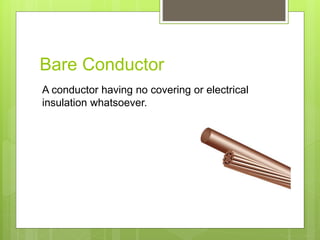
Bare Conductor
A conductor having no covering or electrical
insulation whatsoever.
Covered conductor
A conductor encased within material of
composition or thickness that is not recognized
by this code as electrical insulation.
Insulated conductor
A conductor encased within material of
composition and thickness that is recognized by
this code as electrical insulation.
Switch
Switch is a device for making, breaking, or
rearranging the connections of an electric
circuit.
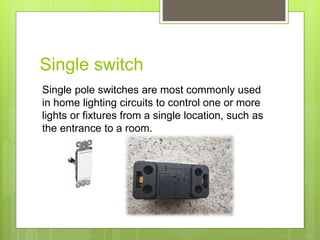
Single switch
Single pole switches are most commonly used
in home lighting circuits to control one or more
lights or fixtures from a single location, such as
the entrance to a room.
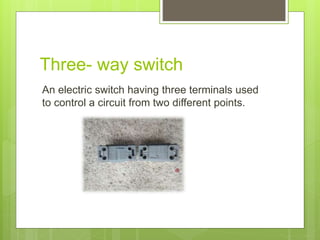
Three- way switch
An electric switch having three terminals used
to control a circuit from two different points.
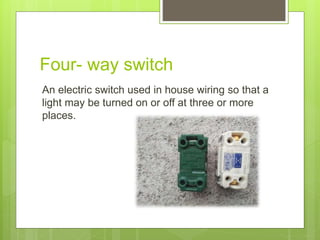
Four- way switch
An electric switch used in house wiring so that a
light may be turned on or off at three or more
places.
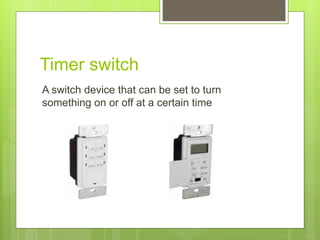
Timer switch
A switch device that can be set to turn
something on or off at a certain time
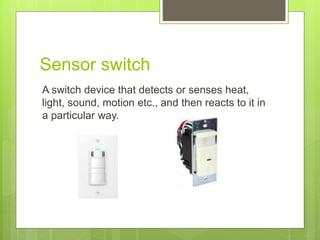
Sensor switch
A switch device that detects or senses heat,
light, sound, motion etc., and then reacts to it in
a particular way.
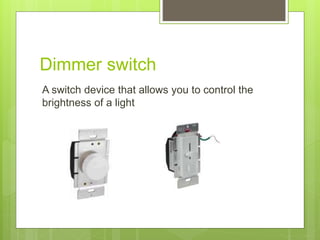
Dimmer switch
A switch device that allows you to control the
brightness of a light
Receptacles
Receptacles is a contacting device installed at
an outlet for connection externally by means of
a plug and flexible cord.
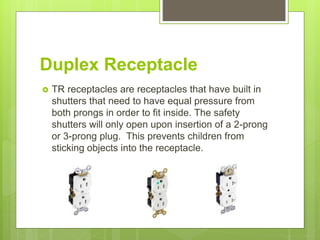
Duplex Receptacle
 TR receptacles are receptacles that have built in
shutters that need to have equal pressure from
both prongs in order to fit inside. The safety
shutters will only open upon insertion of a 2-prong
or 3-prong plug. This prevents children from
sticking objects into the receptacle.
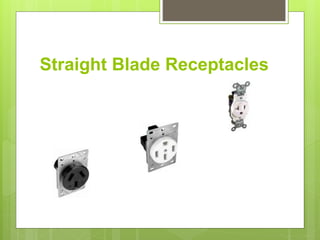
Straight Blade Receptacles
straight blade receptacles
 Cover the full range of residential, hospital,
industrial, construction, and commercial
grades to meet any application. Choose from
decorator or traditional styles, multiple colors,
tamper resistant solutions and weather
resistant products for exterior installations.
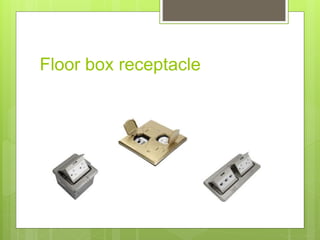
Floor box receptacle
floor box receptacles
 An electrical outlet set flush with a floor are
the ideal solution for convenience for your
residential and commercial electrical needs.
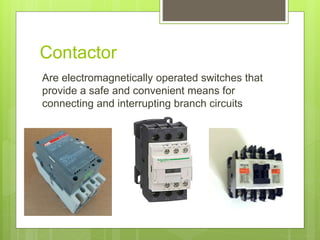
Contactor
Are electromagnetically operated switches that
provide a safe and convenient means for
connecting and interrupting branch circuits
Relay
Are used as auxiliary devices to switch control
circuits and large motor starter and contactor
coils, and to control small loads such as small
motors, solenoids, electric heaters, pilot lights,
audible signal devices, and other relays.
How to select wiring devices?
1. Select one recognized industry
manufacturer.
2. Look for a project with a multi- year warranty.
3. Make sure that there is an easy and clear
way to contact the manufacturer support.
4. Check for a connected equipment damage
warranty.
How to select wiring devices?
5. Always ask for manufacturer’s manual.
6. Select wiring devices which are well-made
and durable.
7. Select materials that are easy to use and
install.
8. Select wiring devices according to the job
requirements.
Wiring devices

  • 1.
  • 2.
    Learning Objective: At theend of this session, you will be able to:  Identify types and usage of electrical wiring devices and consumable items
  • 3.
    Introduction According to theNational Electrical Code (NEC), a device is a unit of an electrical system that is intended to carry, not to utilize electric energy.
  • 4.
    Types of WiringDevices This covers a wide assortment of system components that include, but not limited to the following: • Conductors • Switches • Receptacles • Contactors • Relays
  • 5.
    Conductor A substance orbody capable of transmitting electricity.  Bare conductor  Covered conductor  Insulated conductor
  • 6.
    Bare Conductor A conductorhaving no covering or electrical insulation whatsoever.
  • 7.
    Covered conductor A conductorencased within material of composition or thickness that is not recognized by this code as electrical insulation.
  • 8.
    Insulated conductor A conductorencased within material of composition and thickness that is recognized by this code as electrical insulation.
  • 9.
    Switch Switch is adevice for making, breaking, or rearranging the connections of an electric circuit.
  • 10.
    Single switch Single poleswitches are most commonly used in home lighting circuits to control one or more lights or fixtures from a single location, such as the entrance to a room.
  • 11.
    Three- way switch Anelectric switch having three terminals used to control a circuit from two different points.
  • 12.
    Four- way switch Anelectric switch used in house wiring so that a light may be turned on or off at three or more places.
  • 13.
    Timer switch A switchdevice that can be set to turn something on or off at a certain time
  • 14.
    Sensor switch A switchdevice that detects or senses heat, light, sound, motion etc., and then reacts to it in a particular way.
  • 15.
    Dimmer switch A switchdevice that allows you to control the brightness of a light
  • 16.
    Receptacles Receptacles is acontacting device installed at an outlet for connection externally by means of a plug and flexible cord.
  • 17.
    Duplex Receptacle  TRreceptacles are receptacles that have built in shutters that need to have equal pressure from both prongs in order to fit inside. The safety shutters will only open upon insertion of a 2-prong or 3-prong plug. This prevents children from sticking objects into the receptacle.
  • 18.
  • 19.
    straight blade receptacles Cover the full range of residential, hospital, industrial, construction, and commercial grades to meet any application. Choose from decorator or traditional styles, multiple colors, tamper resistant solutions and weather resistant products for exterior installations.
  • 20.
  • 21.
    floor box receptacles An electrical outlet set flush with a floor are the ideal solution for convenience for your residential and commercial electrical needs.
  • 22.
    Contactor Are electromagnetically operatedswitches that provide a safe and convenient means for connecting and interrupting branch circuits
  • 23.
    Relay Are used asauxiliary devices to switch control circuits and large motor starter and contactor coils, and to control small loads such as small motors, solenoids, electric heaters, pilot lights, audible signal devices, and other relays.
  • 24.
    How to selectwiring devices? 1. Select one recognized industry manufacturer. 2. Look for a project with a multi- year warranty. 3. Make sure that there is an easy and clear way to contact the manufacturer support. 4. Check for a connected equipment damage warranty.
  • 25.
    How to selectwiring devices? 5. Always ask for manufacturer’s manual. 6. Select wiring devices which are well-made and durable. 7. Select materials that are easy to use and install. 8. Select wiring devices according to the job requirements.