Fuse, RCB & ELCB
Elements of Electrical
Engineering
Fuse
 A fuse consists of a metal strip or wire fuse
element, of small cross-section compared to
the circuit conductors, mounted between a
pair of electrical terminals, and (usually)
enclosed by a non-combustible housing.
 The fuse is arranged in series to carry all the
current passing through the protected circuit.
 The resistance of the element generates heat
due to the current flow.
 The size and construction of the element is (empirically)
determined so that the heat produced for a normal current
does not cause the element to attain a high temperature.
 If too high a current flows, the element rises to a higher
temperature and either directly melts, or else melts
a soldered joint within the fuse, opening the circuit.
 The fuse element is made of zinc, copper, silver, aluminum, or
alloys to provide stable and predictable characteristics.
 The fuse element may be surrounded by air, or by materials
intended to speed the quenching of the arc. Silica sand or
non-conducting liquids may be used.
 in 1847, Breguet recommended use of reduced-
section conductors to protect telegraph stations
from lightning strikes; by melting, the smaller wires
would protect apparatus and wiring inside the
building.
 A variety of wire or foil fusible elements were in
use to protect telegraph cables and lighting
installations as early as 1864.
 A fuse was patented by Thomas Edison in 1890 as
part of his electric distribution system.
 Fuses come in a vast array of sizes and styles to serve in
many applications, manufactured in standardized package
layouts to make them easily interchangeable. Fuse bodies
may be made of ceramic, glass, plastic, fiberglass, molded
mica laminates, or molded compressed fiber depending on
application and voltage class.
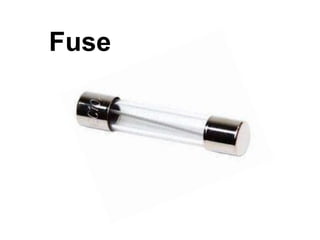
 Cartridge (ferrule) fuses have a cylindrical body terminated
with metal end caps.
 Some cartridge fuses are manufactured with end caps of
different sizes to prevent accidental insertion of the wrong fuse
rating in a holder, giving them a bottle shape.
Fuses for low voltage power circuits may
have bolted blade or tag terminals which
are secured by screws to a fuse holder.
Some blade-type terminals are held by
spring clips. Blade type fuses often require
the use of a special purpose extractor tool
to remove them from the fuse holder.
RCB
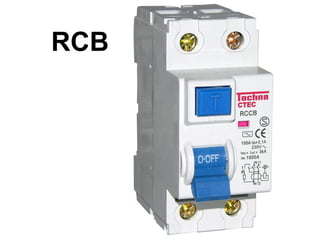
 RCDs are designed to disconnect the
circuit if there is a leakage current.
 By detecting small leakage
currents (typically 5–30 mill amperes)
and disconnecting quickly enough (<300
ms)
 The device pictured is designed to be wired
in-line in an appliance power cord.
 It is rated to carry a maximum current of
13 amperes and is designed to trip on a
leakage current of 30 mA.
 This is an active RCD; that is, it latches
electrically and therefore trips on power
failure, a useful feature for equipment that
could be dangerous on unexpected re-
energisation.
 Some early RCDs were entirely
electromechanical and relied on finely
balanced sprung over-centre mechanisms
driven directly from the current transformer.
 As these are hard to manufacture to the
required accuracy, and prone to drift in
sensitivity both from pivot wear and
lubricant dry-out, the electronically
amplified type with a more robust solenoid
part as illustrated are now dominant.
Cross Section of RCB
 The incoming supply and the neutral conductors are
connected to the terminals at (1) and the outgoing load
conductors are connected to the terminals at (2).
 The earth conductor (not shown) is connected through
from supply to load uninterrupted. When the reset button
(3) is pressed the contacts ((4) and hidden behind (5)
close, allowing current to pass. The solenoid(5) keeps the
contacts closed when the reset button is released.
 The sense coil (6) is a differential current transformer which
surrounds (but is not electrically connected to) the live
and neutral conductors.
 In normal operation, all the current down the live
conductor returns up the neutral conductor.
 This difference causes a current in the sense coil (6) which
is picked up by the sense circuitry (7).
 The sense circuitry then removes power from the solenoid
(5) and the contacts (4) are forced apart by a spring,
cutting off the electricity supply to the appliance.
 The device is designed so that the current is interrupted in
milliseconds, greatly reducing the chances of a
dangerous electric shock being received.
 The test button (8) allows the correct operation of the
device to be verified by passing a small current through
the orange test wire (9). This simulates a fault by creating
an imbalance in the sense coil
 The currents in the two conductors are therefore
equal and opposite and cancel each other out.
 Any fault to earth (for example caused by a person
touching a live component in the attached
appliance) causes some of the current to take a
different return path which means there is an
imbalance (difference) in the current in the two
conductors (single phase case), or, more generally, a
nonzero sum of currents from among various
conductors (for example, three phase conductors
and one neutral conductor).
 A residual-current circuit breaker cannot
remove all risk of electric shock or fire. In
particular, an RCD alone will not detect
overload conditions, phase to neutral short
circuits or phase-to-phase short circuits.
 It cannot protect against electric shock
where current flows through a person from
phase to neutral or phase to phase.
 Residual-current and over current
protection may be combined in one
device for installation into the service
panel; this device is known as a GFCI
breaker (Ground Fault Circuit Interrupter)
in the USA and Canada, and as an
RCBO (residual-current circuit breaker
with overload protection) in Europe. In
the US, RCBOs are more expensive than
RCD outlets.
ELCB
 An Earth Leakage Circuit Breaker (ELCB) is a safety
device used in electrical installations with high earth
impedance to prevent shock. It detects small stray
voltages on the metal enclosures of electrical
equipment, and interrupts the circuit if a dangerous
voltage is detected.
 Once widely used, more recent installations instead
use residual current circuit breakers which instead
detect leakage current directly.
 The main purpose of earth leakage protectors is to
prevent injury to humans and animals due to electric
shock.
 An ELCB is a specialized type of latching relay that has a
building's incoming mains power connected through
its switching contacts so that the ELCB disconnects the
power in an earth leakage (unsafe) condition.
 The ELCB detects fault currents from live to the earth
(ground) wire within the installation it protects.
 If sufficient voltage appears across the ELCB's sense coil, it
will switch off the power, and remain off until manually
reset.
 A voltage-sensing ELCB does not sense fault currents from
live to any other earthed body.
 There are two types of ELCB:
-voltage operated
-current operated.
 ELCBs have one advantage over RCDs: they
are less sensitive to fault conditions, and
therefore have fewer nuisance trips. (This does
not mean they always do, as practical
performance depends on installation details
and the discrimination enhancing filtering in
the ELCB.)
 Therefore by electrically separating cable
armour from the cable circuit protective
conductor, an ELCB can be arranged to
protect against cable damage only, and not
trip on faults in downline installations.
 They do not detect faults that don't pass current through the
CPC to the earth rod.
 They do not allow a single building system to be easily split into
multiple sections with independent fault protection,
because earthing systems are usually bonded to pipe work.
 They may be tripped by external voltages from something
connected to the earthing system such as metal pipes, a TN-
S earth or a TN-C-S combined neutral and earth.
 As with RCDs, electrically leaky appliances such as some water
heaters, washing machines and cookers may cause the ELCB to
trip.
 ELCBs introduce additional resistance and an additional point
of failure into the earthling system.
Prepared by …. Class FX students
(Group No. - 5)
1. Akash Ambaliya
2. Brijesh Daraniya
3. Kaushik Dodiya
4. Gopal Gol
5. Neeldeepsinh Jadeja
Thank You…

Mcb, rccb, elcb

  • 1.
    Fuse, RCB &ELCB Elements of Electrical Engineering
  • 2.
  • 3.
     A fuseconsists of a metal strip or wire fuse element, of small cross-section compared to the circuit conductors, mounted between a pair of electrical terminals, and (usually) enclosed by a non-combustible housing.  The fuse is arranged in series to carry all the current passing through the protected circuit.  The resistance of the element generates heat due to the current flow.
  • 4.
     The sizeand construction of the element is (empirically) determined so that the heat produced for a normal current does not cause the element to attain a high temperature.  If too high a current flows, the element rises to a higher temperature and either directly melts, or else melts a soldered joint within the fuse, opening the circuit.  The fuse element is made of zinc, copper, silver, aluminum, or alloys to provide stable and predictable characteristics.  The fuse element may be surrounded by air, or by materials intended to speed the quenching of the arc. Silica sand or non-conducting liquids may be used.
  • 5.
     in 1847,Breguet recommended use of reduced- section conductors to protect telegraph stations from lightning strikes; by melting, the smaller wires would protect apparatus and wiring inside the building.  A variety of wire or foil fusible elements were in use to protect telegraph cables and lighting installations as early as 1864.  A fuse was patented by Thomas Edison in 1890 as part of his electric distribution system.
  • 6.
     Fuses comein a vast array of sizes and styles to serve in many applications, manufactured in standardized package layouts to make them easily interchangeable. Fuse bodies may be made of ceramic, glass, plastic, fiberglass, molded mica laminates, or molded compressed fiber depending on application and voltage class.  Cartridge (ferrule) fuses have a cylindrical body terminated with metal end caps.  Some cartridge fuses are manufactured with end caps of different sizes to prevent accidental insertion of the wrong fuse rating in a holder, giving them a bottle shape.
  • 8.
    Fuses for lowvoltage power circuits may have bolted blade or tag terminals which are secured by screws to a fuse holder. Some blade-type terminals are held by spring clips. Blade type fuses often require the use of a special purpose extractor tool to remove them from the fuse holder.
  • 10.
  • 11.
     RCDs aredesigned to disconnect the circuit if there is a leakage current.  By detecting small leakage currents (typically 5–30 mill amperes) and disconnecting quickly enough (<300 ms)
  • 12.
     The devicepictured is designed to be wired in-line in an appliance power cord.  It is rated to carry a maximum current of 13 amperes and is designed to trip on a leakage current of 30 mA.  This is an active RCD; that is, it latches electrically and therefore trips on power failure, a useful feature for equipment that could be dangerous on unexpected re- energisation.
  • 13.
     Some earlyRCDs were entirely electromechanical and relied on finely balanced sprung over-centre mechanisms driven directly from the current transformer.  As these are hard to manufacture to the required accuracy, and prone to drift in sensitivity both from pivot wear and lubricant dry-out, the electronically amplified type with a more robust solenoid part as illustrated are now dominant.
  • 14.
  • 15.
     The incomingsupply and the neutral conductors are connected to the terminals at (1) and the outgoing load conductors are connected to the terminals at (2).  The earth conductor (not shown) is connected through from supply to load uninterrupted. When the reset button (3) is pressed the contacts ((4) and hidden behind (5) close, allowing current to pass. The solenoid(5) keeps the contacts closed when the reset button is released.  The sense coil (6) is a differential current transformer which surrounds (but is not electrically connected to) the live and neutral conductors.  In normal operation, all the current down the live conductor returns up the neutral conductor.
  • 16.
     This differencecauses a current in the sense coil (6) which is picked up by the sense circuitry (7).  The sense circuitry then removes power from the solenoid (5) and the contacts (4) are forced apart by a spring, cutting off the electricity supply to the appliance.  The device is designed so that the current is interrupted in milliseconds, greatly reducing the chances of a dangerous electric shock being received.  The test button (8) allows the correct operation of the device to be verified by passing a small current through the orange test wire (9). This simulates a fault by creating an imbalance in the sense coil
  • 17.
     The currentsin the two conductors are therefore equal and opposite and cancel each other out.  Any fault to earth (for example caused by a person touching a live component in the attached appliance) causes some of the current to take a different return path which means there is an imbalance (difference) in the current in the two conductors (single phase case), or, more generally, a nonzero sum of currents from among various conductors (for example, three phase conductors and one neutral conductor).
  • 18.
     A residual-currentcircuit breaker cannot remove all risk of electric shock or fire. In particular, an RCD alone will not detect overload conditions, phase to neutral short circuits or phase-to-phase short circuits.  It cannot protect against electric shock where current flows through a person from phase to neutral or phase to phase.
  • 19.
     Residual-current andover current protection may be combined in one device for installation into the service panel; this device is known as a GFCI breaker (Ground Fault Circuit Interrupter) in the USA and Canada, and as an RCBO (residual-current circuit breaker with overload protection) in Europe. In the US, RCBOs are more expensive than RCD outlets.
  • 20.
  • 21.
     An EarthLeakage Circuit Breaker (ELCB) is a safety device used in electrical installations with high earth impedance to prevent shock. It detects small stray voltages on the metal enclosures of electrical equipment, and interrupts the circuit if a dangerous voltage is detected.  Once widely used, more recent installations instead use residual current circuit breakers which instead detect leakage current directly.  The main purpose of earth leakage protectors is to prevent injury to humans and animals due to electric shock.
  • 22.
     An ELCBis a specialized type of latching relay that has a building's incoming mains power connected through its switching contacts so that the ELCB disconnects the power in an earth leakage (unsafe) condition.  The ELCB detects fault currents from live to the earth (ground) wire within the installation it protects.  If sufficient voltage appears across the ELCB's sense coil, it will switch off the power, and remain off until manually reset.  A voltage-sensing ELCB does not sense fault currents from live to any other earthed body.
  • 23.
     There aretwo types of ELCB: -voltage operated -current operated.
  • 26.
     ELCBs haveone advantage over RCDs: they are less sensitive to fault conditions, and therefore have fewer nuisance trips. (This does not mean they always do, as practical performance depends on installation details and the discrimination enhancing filtering in the ELCB.)  Therefore by electrically separating cable armour from the cable circuit protective conductor, an ELCB can be arranged to protect against cable damage only, and not trip on faults in downline installations.
  • 27.
     They donot detect faults that don't pass current through the CPC to the earth rod.  They do not allow a single building system to be easily split into multiple sections with independent fault protection, because earthing systems are usually bonded to pipe work.  They may be tripped by external voltages from something connected to the earthing system such as metal pipes, a TN- S earth or a TN-C-S combined neutral and earth.  As with RCDs, electrically leaky appliances such as some water heaters, washing machines and cookers may cause the ELCB to trip.  ELCBs introduce additional resistance and an additional point of failure into the earthling system.
  • 28.
    Prepared by ….Class FX students (Group No. - 5) 1. Akash Ambaliya 2. Brijesh Daraniya 3. Kaushik Dodiya 4. Gopal Gol 5. Neeldeepsinh Jadeja
  • 29.