Electrical Drawing and 
Schematics 
www.idc-online.com/slideshare Technology TTrraaiinniinngg tthhaatt WWoorrkkss
Drawings – Relevance to engineering 
• Graphics are one of the most effective ways of communicating one's 
ideas as a good recognizable picture reduces ambiguity while 
discussing a project. 
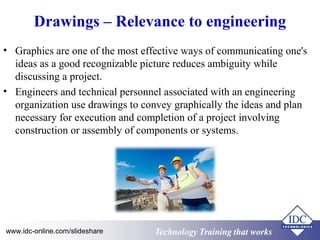
• Engineers and technical personnel associated with an engineering 
organization use drawings to convey graphically the ideas and plan 
necessary for execution and completion of a project involving 
construction or assembly of components or systems. 
www.idc-online.com/slideshare Technology TTrraaiinniinngg tthhaatt WWoorrkkss
Drawings as a tool used at various stages of 
working 
• Tendering stage: Helps in procuring an accurate quote and also helps in avoiding 
future disputes arising out of discrepancies due to lack of information. 
• Design and engineering stage: the drawing helps the engineers work out the 
detailed bill of materials which is further used by the procurement department. 
• Construction or assembly stage: The drawings in this stage help the technical 
personnel at the construction site 
• Operation and maintenance stage: The drawings help in the day to day operation 
and in rectifying any anomalies arising in the system. 
www.idc-online.com/slideshare Technology TTrraaiinniinngg tthhaatt WWoorrkkss
Drawings at the centre of the various activities of an 
engineering organization 
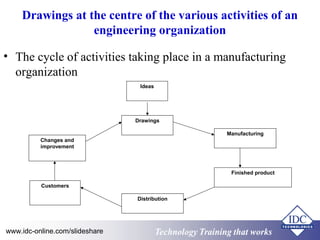
• The cycle of activities taking place in a manufacturing 
organization 
Ideas 
Drawings 
Manufacturing 
Finished product 
Distribution 
Changes and 
improvement 
Customers 
www.idc-online.com/slideshare Technology TTrraaiinniinngg tthhaatt WWoorrkkss
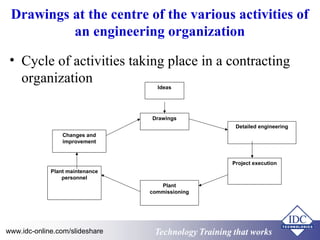
Drawings at the centre of the various activities of 
an engineering organization 
• Cycle of activities taking place in a contracting 
organization 
Ideas 
Drawings 
Detailed engineering 
Project execution 
Plant 
commissioning 
Changes and 
improvement 
Plant maintenance 
personnel 
www.idc-online.com/slideshare Technology TTrraaiinniinngg tthhaatt WWoorrkkss
Standards and their necessity 
• Market growth for new and emerging technologies 
• Reduced development time and cost 
• Sound engineering practices 
• Decreased trading costs and lowered trade barriers 
• Increased product quality and safety 
• Reduced market risks 
• Protection against obsolescence 
www.idc-online.com/slideshare Technology TTrraaiinniinngg tthhaatt WWoorrkkss
Worldwide standards in 
electro-technology 
• IEEE: It is a central source of standardization in traditional and 
emerging fields such as telecommunications, information technology 
and power. 
• National Electrical Manufacturers Association (NEMA): It 
provides a forum for the standardization of electrical equipment, 
enabling consumers to select from a range of safe, effective, and 
compatible electrical products. 
• Association of German Electrical Engineers (VDE): The role of 
the VDE in Germany is comparable to that of the IEEE in the US. Its 
main activity is as a standards organization. 
www.idc-online.com/slideshare Technology TTrraaiinniinngg tthhaatt WWoorrkkss
Worldwide standards in electro-technology 
• International electro-technical Commission (IEC): is the 
leading global organization that prepares and publishes 
international standards for all electrical, electronic and 
related technologies. 
• International Standards Organization (ISO): is a 
network of the national standards institutes of 157 countries, 
on the basis of one member per country. 
www.idc-online.com/slideshare Technology TTrraaiinniinngg tthhaatt WWoorrkkss
Purposes served by different types of drawing 
• Two dimensional drawings: 
Drawings showing key plan and plan/layout of buildings 
Drawings with structural design details 
Machine parts design and fabrication drawings 
Section drawings 
Clearance drawings 
Schematics, wiring diagrams, tables and schedules 
• Three dimensional representations: 
Isometric views 
Perspective views 
Solid and surface models 
www.idc-online.com/slideshare Technology TTrraaiinniinngg tthhaatt WWoorrkkss
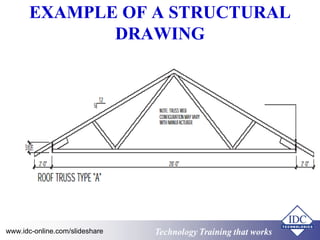
EXAMPLE OF A STRUCTURAL 
DRAWING 
www.idc-online.com/slideshare Technology TTrraaiinniinngg tthhaatt WWoorrkkss
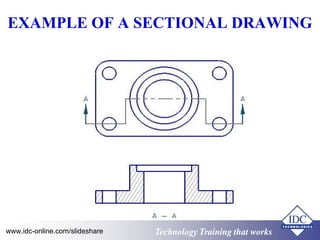
EXAMPLE OF A SECTIONAL DRAWING 
www.idc-online.com/slideshare Technology TTrraaiinniinngg tthhaatt WWoorrkkss
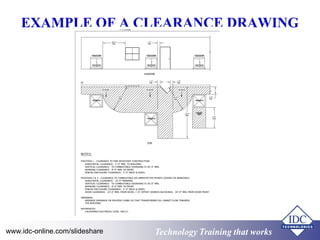
EXAMPLE OF A CLEARANCE DRAWING 
www.idc-online.com/slideshare Technology TTrraaiinniinngg tthhaatt WWoorrkkss
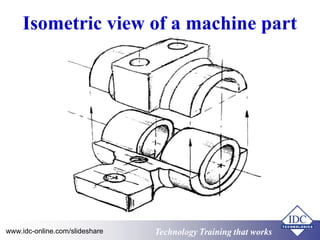
Isometric view of a machine part 
www.idc-online.com/slideshare Technology TTrraaiinniinngg tthhaatt WWoorrkkss
Exploded view of a bearing assembly 
www.idc-online.com/slideshare Technology TTrraaiinniinngg tthhaatt WWoorrkkss
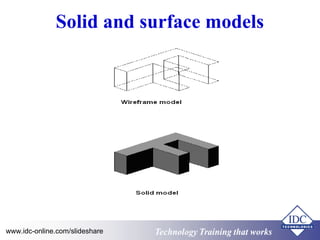
Solid and surface models 
www.idc-online.com/slideshare Technology TTrraaiinniinngg tthhaatt WWoorrkkss
Standards in a drawing office 
• Uniformity of graphical depiction should be 
maintained. 
• Only necessary information to be displayed on the 
drawings. 
• Correct dimensioning should be done. 
• Only standard symbols and abbreviations should 
be used. 
www.idc-online.com/slideshare Technology TTrraaiinniinngg tthhaatt WWoorrkkss
Important standards in the drawing office 
• ISO 128 - Technical drawings – general principles 
• ISO 129 – Technical drawings – dimensioning 
• ISO 216 – Paper sizes 
• ISO 60617 – Graphical symbols for electro-technology 
• ISO 61082 – Preparation of documents used in 
electro-technology 
www.idc-online.com/slideshare Technology TTrraaiinniinngg tthhaatt WWoorrkkss
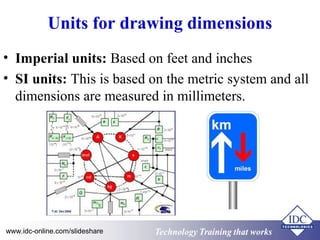
Units for drawing dimensions 
• Imperial units: Based on feet and inches 
• SI units: This is based on the metric system and all 
dimensions are measured in millimeters. 
www.idc-online.com/slideshare Technology TTrraaiinniinngg tthhaatt WWoorrkkss
Rules for using SI units 
• All fractional values must be preceded by a ‘0’ 
(for example, 0.14mm). 
• Neither comma nor spaces are used for values over 
1000. 
www.idc-online.com/slideshare Technology TTrraaiinniinngg tthhaatt WWoorrkkss
Drawing scales 
• All drawings can be classified as either drawings with scale or 
those not drawn to scale. 
• Scale drawings also allow components and systems that are 
too large to be drawn full size to be drawn in a more 
convenient and easy to read size. 
• A very small component can be scaled up, or enlarged, so 
that its details can be seen when drawn on paper. 
• Scale drawings usually present the information used to 
fabricate or construct a component or system. 
• Drawings without a scale usually are intended to present only 
functional information about the component or system. 
www.idc-online.com/slideshare Technology TTrraaiinniinngg tthhaatt WWoorrkkss
Organization of a typical drawing office 
• The drawing office is a subset of the design office and as such the overall 
authority resides with the Resident Engineer and the Project manager. Their 
requirements and decisions are passed on to the drawing office staff via the 
Chief Draughtsman. 
• The chief draughtsman receives all the work coming into the drawing office 
which he examines and distributes to the appropriate section leaders. 
• The section leader is responsible for a team of draughtsmen of different grades. 
When work is completed , the section leader passes the drawings to the 
checking section after which the standards section scrutinizes the drawings to 
ensure that the appropriate standards have been incorporated. 
• Completed work for approval is done by the chief draughtsman. 
www.idc-online.com/slideshare Technology TTrraaiinniinngg tthhaatt WWoorrkkss
Information required for commencement of work 
• Name of the person requesting the work. 
• Name and signature of engineer authorizing work. 
• Respective cost code. 
• Date completed for ‘work required by’ field. 
• Title of plant or work area. 
• Comprehensive work description or title. 
www.idc-online.com/slideshare Technology TTrraaiinniinngg tthhaatt WWoorrkkss
Information required for commencement of work 
• Indicate on the work request information supplied, drawings 
required. 
• Comments or reference 
• Date received by drawing office 
• Chief Draughtsman signature. 
• Draughtsman’s name to whom work is allocated. 
www.idc-online.com/slideshare Technology TTrraaiinniinngg tthhaatt WWoorrkkss
Procedure for printing 
• All prints should be officially requested. 
• Where a job is deemed to be urgent then the Chief 
Draughtsman must prioritize. 
• All other printing should be done on a ‘First come first 
serve basis’. 
• All drawings must be registered in the Master Drawing 
Register. 
• Vendor drawings to be registered with relevant information 
separately. 
www.idc-online.com/slideshare Technology TTrraaiinniinngg tthhaatt WWoorrkkss
Procedure for printing 
• All completed drawings shall be filed in the appropriate 
place in the filing section – this may be a dedicated 
location on the server hard disk or a physical location for 
hard copies. 
• A draughtsman should only have in his possession the 
drawing relevant to the job he is currently working on. All 
other drawings in his possession should be in the form of 
prints or microfilm prints and marked accordingly as 
copies. 
www.idc-online.com/slideshare Technology TTrraaiinniinngg tthhaatt WWoorrkkss
Internal drawing release 
• All drawings issued through the Drawing Office/ Printing Section must be 
formally requested. All drawings issued should be accompanied by a document 
transmittal form which should be signed and returned and filed by the 
originator for record purpose. 
• Controlled Copy of the drawing is released with necessary information 
mentioned in a format called "Change Notice" and distributed to concerned 
department. 
• Change notice format contains all information like the number of changes, issue 
level, reason for change, further course of action (on the previous level 
component) and also indicates the distribution list. 
• Change notice is issued along with a change notice return slip. The user of the 
drawing returns the change notice return slip to the originator indicating that the 
old level drawing has been destroyed. 
www.idc-online.com/slideshare Technology TTrraaiinniinngg tthhaatt WWoorrkkss
Managing multiple copies 
• Based on the change request from other department the drawing is updated and 
released with next change level to the concerned department. 
• Old and new drawings are maintained in the respective files. 
• Multiple copy drawings are issued only to certain departments like Purchase where 
there is a possibility to issue the drawings to various suppliers for different reasons. 
• The change notice contains information about the number of copies distributed and 
it is then the responsibility of the concerned department to control these drawings. 
• Additional copies are issued only on request and is properly controlled. 
www.idc-online.com/slideshare Technology TTrraaiinniinngg tthhaatt WWoorrkkss
Use of CAD and management of CAD drawings 
• Drawings are controlled in a central area of the CAD 
system called as Archive. 
• Drawings in the archive can be viewed by user having 
access to the CAD system. 
• Drawings while under creation should be kept in the private 
area and should be placed in the central archive only after 
proper approvals. 
• Drawings can be removed from the archive for changes as 
per the process and can be placed back in the archive with 
the next level of change. 
www.idc-online.com/slideshare Technology TTrraaiinniinngg tthhaatt WWoorrkkss
DO YOU WANT TO KNOW MORE? 
If you are interested in further training or information, 
please visit: 
http://idc-online.com/slideshare 
www.idc-online.com/slideshare Technology TTrraaiinniinngg tthhaatt WWoorrkkss

Electrical Drawings and Schematics

  • 1.
    Electrical Drawing and Schematics www.idc-online.com/slideshare Technology TTrraaiinniinngg tthhaatt WWoorrkkss
  • 2.
    Drawings – Relevanceto engineering • Graphics are one of the most effective ways of communicating one's ideas as a good recognizable picture reduces ambiguity while discussing a project. • Engineers and technical personnel associated with an engineering organization use drawings to convey graphically the ideas and plan necessary for execution and completion of a project involving construction or assembly of components or systems. www.idc-online.com/slideshare Technology TTrraaiinniinngg tthhaatt WWoorrkkss
  • 3.
    Drawings as atool used at various stages of working • Tendering stage: Helps in procuring an accurate quote and also helps in avoiding future disputes arising out of discrepancies due to lack of information. • Design and engineering stage: the drawing helps the engineers work out the detailed bill of materials which is further used by the procurement department. • Construction or assembly stage: The drawings in this stage help the technical personnel at the construction site • Operation and maintenance stage: The drawings help in the day to day operation and in rectifying any anomalies arising in the system. www.idc-online.com/slideshare Technology TTrraaiinniinngg tthhaatt WWoorrkkss
  • 4.
    Drawings at thecentre of the various activities of an engineering organization • The cycle of activities taking place in a manufacturing organization Ideas Drawings Manufacturing Finished product Distribution Changes and improvement Customers www.idc-online.com/slideshare Technology TTrraaiinniinngg tthhaatt WWoorrkkss
  • 5.
    Drawings at thecentre of the various activities of an engineering organization • Cycle of activities taking place in a contracting organization Ideas Drawings Detailed engineering Project execution Plant commissioning Changes and improvement Plant maintenance personnel www.idc-online.com/slideshare Technology TTrraaiinniinngg tthhaatt WWoorrkkss
  • 6.
    Standards and theirnecessity • Market growth for new and emerging technologies • Reduced development time and cost • Sound engineering practices • Decreased trading costs and lowered trade barriers • Increased product quality and safety • Reduced market risks • Protection against obsolescence www.idc-online.com/slideshare Technology TTrraaiinniinngg tthhaatt WWoorrkkss
  • 7.
    Worldwide standards in electro-technology • IEEE: It is a central source of standardization in traditional and emerging fields such as telecommunications, information technology and power. • National Electrical Manufacturers Association (NEMA): It provides a forum for the standardization of electrical equipment, enabling consumers to select from a range of safe, effective, and compatible electrical products. • Association of German Electrical Engineers (VDE): The role of the VDE in Germany is comparable to that of the IEEE in the US. Its main activity is as a standards organization. www.idc-online.com/slideshare Technology TTrraaiinniinngg tthhaatt WWoorrkkss
  • 8.
    Worldwide standards inelectro-technology • International electro-technical Commission (IEC): is the leading global organization that prepares and publishes international standards for all electrical, electronic and related technologies. • International Standards Organization (ISO): is a network of the national standards institutes of 157 countries, on the basis of one member per country. www.idc-online.com/slideshare Technology TTrraaiinniinngg tthhaatt WWoorrkkss
  • 9.
    Purposes served bydifferent types of drawing • Two dimensional drawings: Drawings showing key plan and plan/layout of buildings Drawings with structural design details Machine parts design and fabrication drawings Section drawings Clearance drawings Schematics, wiring diagrams, tables and schedules • Three dimensional representations: Isometric views Perspective views Solid and surface models www.idc-online.com/slideshare Technology TTrraaiinniinngg tthhaatt WWoorrkkss
  • 10.
    EXAMPLE OF ASTRUCTURAL DRAWING www.idc-online.com/slideshare Technology TTrraaiinniinngg tthhaatt WWoorrkkss
  • 11.
    EXAMPLE OF ASECTIONAL DRAWING www.idc-online.com/slideshare Technology TTrraaiinniinngg tthhaatt WWoorrkkss
  • 12.
    EXAMPLE OF ACLEARANCE DRAWING www.idc-online.com/slideshare Technology TTrraaiinniinngg tthhaatt WWoorrkkss
  • 13.
    Isometric view ofa machine part www.idc-online.com/slideshare Technology TTrraaiinniinngg tthhaatt WWoorrkkss
  • 14.
    Exploded view ofa bearing assembly www.idc-online.com/slideshare Technology TTrraaiinniinngg tthhaatt WWoorrkkss
  • 15.
    Solid and surfacemodels www.idc-online.com/slideshare Technology TTrraaiinniinngg tthhaatt WWoorrkkss
  • 16.
    Standards in adrawing office • Uniformity of graphical depiction should be maintained. • Only necessary information to be displayed on the drawings. • Correct dimensioning should be done. • Only standard symbols and abbreviations should be used. www.idc-online.com/slideshare Technology TTrraaiinniinngg tthhaatt WWoorrkkss
  • 17.
    Important standards inthe drawing office • ISO 128 - Technical drawings – general principles • ISO 129 – Technical drawings – dimensioning • ISO 216 – Paper sizes • ISO 60617 – Graphical symbols for electro-technology • ISO 61082 – Preparation of documents used in electro-technology www.idc-online.com/slideshare Technology TTrraaiinniinngg tthhaatt WWoorrkkss
  • 18.
    Units for drawingdimensions • Imperial units: Based on feet and inches • SI units: This is based on the metric system and all dimensions are measured in millimeters. www.idc-online.com/slideshare Technology TTrraaiinniinngg tthhaatt WWoorrkkss
  • 19.
    Rules for usingSI units • All fractional values must be preceded by a ‘0’ (for example, 0.14mm). • Neither comma nor spaces are used for values over 1000. www.idc-online.com/slideshare Technology TTrraaiinniinngg tthhaatt WWoorrkkss
  • 20.
    Drawing scales •All drawings can be classified as either drawings with scale or those not drawn to scale. • Scale drawings also allow components and systems that are too large to be drawn full size to be drawn in a more convenient and easy to read size. • A very small component can be scaled up, or enlarged, so that its details can be seen when drawn on paper. • Scale drawings usually present the information used to fabricate or construct a component or system. • Drawings without a scale usually are intended to present only functional information about the component or system. www.idc-online.com/slideshare Technology TTrraaiinniinngg tthhaatt WWoorrkkss
  • 21.
    Organization of atypical drawing office • The drawing office is a subset of the design office and as such the overall authority resides with the Resident Engineer and the Project manager. Their requirements and decisions are passed on to the drawing office staff via the Chief Draughtsman. • The chief draughtsman receives all the work coming into the drawing office which he examines and distributes to the appropriate section leaders. • The section leader is responsible for a team of draughtsmen of different grades. When work is completed , the section leader passes the drawings to the checking section after which the standards section scrutinizes the drawings to ensure that the appropriate standards have been incorporated. • Completed work for approval is done by the chief draughtsman. www.idc-online.com/slideshare Technology TTrraaiinniinngg tthhaatt WWoorrkkss
  • 22.
    Information required forcommencement of work • Name of the person requesting the work. • Name and signature of engineer authorizing work. • Respective cost code. • Date completed for ‘work required by’ field. • Title of plant or work area. • Comprehensive work description or title. www.idc-online.com/slideshare Technology TTrraaiinniinngg tthhaatt WWoorrkkss
  • 23.
    Information required forcommencement of work • Indicate on the work request information supplied, drawings required. • Comments or reference • Date received by drawing office • Chief Draughtsman signature. • Draughtsman’s name to whom work is allocated. www.idc-online.com/slideshare Technology TTrraaiinniinngg tthhaatt WWoorrkkss
  • 24.
    Procedure for printing • All prints should be officially requested. • Where a job is deemed to be urgent then the Chief Draughtsman must prioritize. • All other printing should be done on a ‘First come first serve basis’. • All drawings must be registered in the Master Drawing Register. • Vendor drawings to be registered with relevant information separately. www.idc-online.com/slideshare Technology TTrraaiinniinngg tthhaatt WWoorrkkss
  • 25.
    Procedure for printing • All completed drawings shall be filed in the appropriate place in the filing section – this may be a dedicated location on the server hard disk or a physical location for hard copies. • A draughtsman should only have in his possession the drawing relevant to the job he is currently working on. All other drawings in his possession should be in the form of prints or microfilm prints and marked accordingly as copies. www.idc-online.com/slideshare Technology TTrraaiinniinngg tthhaatt WWoorrkkss
  • 26.
    Internal drawing release • All drawings issued through the Drawing Office/ Printing Section must be formally requested. All drawings issued should be accompanied by a document transmittal form which should be signed and returned and filed by the originator for record purpose. • Controlled Copy of the drawing is released with necessary information mentioned in a format called "Change Notice" and distributed to concerned department. • Change notice format contains all information like the number of changes, issue level, reason for change, further course of action (on the previous level component) and also indicates the distribution list. • Change notice is issued along with a change notice return slip. The user of the drawing returns the change notice return slip to the originator indicating that the old level drawing has been destroyed. www.idc-online.com/slideshare Technology TTrraaiinniinngg tthhaatt WWoorrkkss
  • 27.
    Managing multiple copies • Based on the change request from other department the drawing is updated and released with next change level to the concerned department. • Old and new drawings are maintained in the respective files. • Multiple copy drawings are issued only to certain departments like Purchase where there is a possibility to issue the drawings to various suppliers for different reasons. • The change notice contains information about the number of copies distributed and it is then the responsibility of the concerned department to control these drawings. • Additional copies are issued only on request and is properly controlled. www.idc-online.com/slideshare Technology TTrraaiinniinngg tthhaatt WWoorrkkss
  • 28.
    Use of CADand management of CAD drawings • Drawings are controlled in a central area of the CAD system called as Archive. • Drawings in the archive can be viewed by user having access to the CAD system. • Drawings while under creation should be kept in the private area and should be placed in the central archive only after proper approvals. • Drawings can be removed from the archive for changes as per the process and can be placed back in the archive with the next level of change. www.idc-online.com/slideshare Technology TTrraaiinniinngg tthhaatt WWoorrkkss
  • 29.
    DO YOU WANTTO KNOW MORE? If you are interested in further training or information, please visit: http://idc-online.com/slideshare www.idc-online.com/slideshare Technology TTrraaiinniinngg tthhaatt WWoorrkkss