1
Electrical symbols By Muhammad
Ahtsham
Muhammad Ahtsham
Electrical Symbols
2
Electrical symbols By Muhammad
Ahtsham
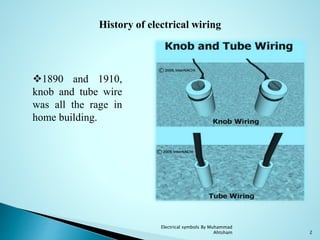
1890 and 1910,
knob and tube wire
was all the rage in
home building.
History of electrical wiring
3
Electrical symbols By Muhammad
Ahtsham
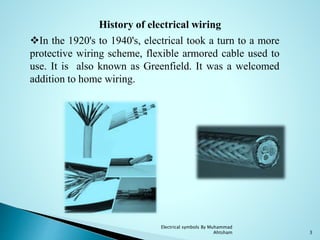
In the 1920's to 1940's, electrical took a turn to a more
protective wiring scheme, flexible armored cable used to
use. It is also known as Greenfield. It was a welcomed
addition to home wiring.
History of electrical wiring
Electrical symbols By Muhammad
Ahtsham 4
History of electrical wiring
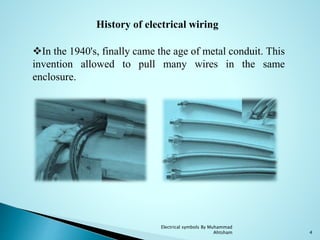
In the 1940's, finally came the age of metal conduit. This
invention allowed to pull many wires in the same
enclosure.
Electrical symbols By Muhammad
Ahtsham 5
History of electrical wiring
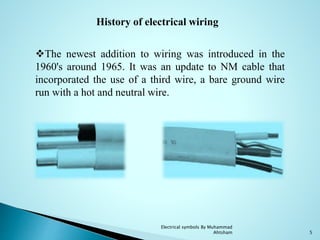
The newest addition to wiring was introduced in the
1960's around 1965. It was an update to NM cable that
incorporated the use of a third wire, a bare ground wire
run with a hot and neutral wire.
Electrical symbols By Muhammad
Ahtsham 6
History of electrical wiring
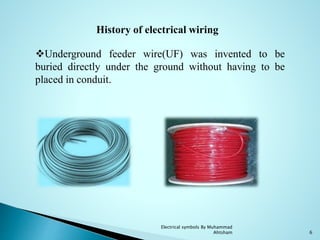
Underground feeder wire(UF) was invented to be
buried directly under the ground without having to be
placed in conduit.
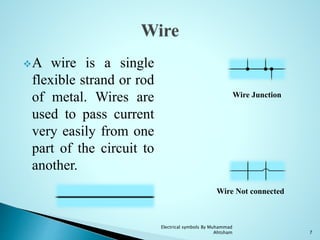
A wire is a single
flexible strand or rod
of metal. Wires are
used to pass current
very easily from one
part of the circuit to
another.
Wire Junction
Wire Not connected
7
Electrical symbols By Muhammad
Ahtsham
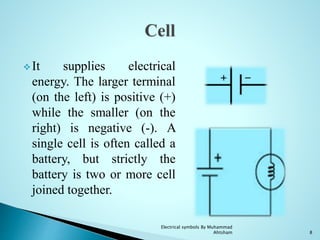
It supplies electrical
energy. The larger terminal
(on the left) is positive (+)
while the smaller (on the
right) is negative (-). A
single cell is often called a
battery, but strictly the
battery is two or more cell
joined together.
8
Electrical symbols By Muhammad
Ahtsham
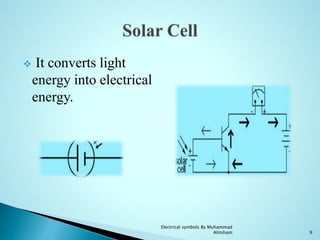
 It converts light
energy into electrical
energy.
9
Electrical symbols By Muhammad
Ahtsham
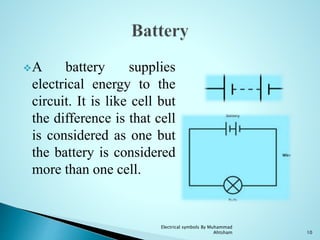
A battery supplies
electrical energy to the
circuit. It is like cell but
the difference is that cell
is considered as one but
the battery is considered
more than one cell.
10
Electrical symbols By Muhammad
Ahtsham
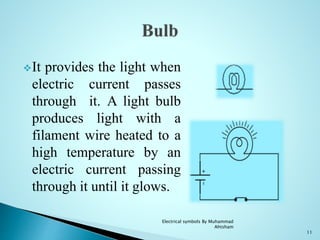
It provides the light when
electric current passes
through it. A light bulb
produces light with a
filament wire heated to a
high temperature by an
electric current passing
through it until it glows.
11
Electrical symbols By Muhammad
Ahtsham
Fuse
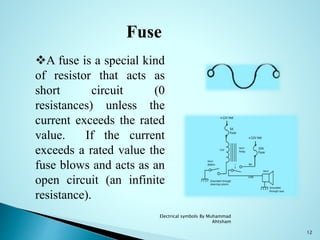
A fuse is a special kind
of resistor that acts as
short circuit (0
resistances) unless the
current exceeds the rated
value. If the current
exceeds a rated value the
fuse blows and acts as an
open circuit (an infinite
resistance).
12
Electrical symbols By Muhammad
Ahtsham
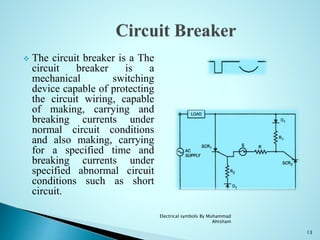
 The circuit breaker is a The
circuit breaker is a
mechanical switching
device capable of protecting
the circuit wiring, capable
of making, carrying and
breaking currents under
normal circuit conditions
and also making, carrying
for a specified time and
breaking currents under
specified abnormal circuit
conditions such as short
circuit.
13
Electrical symbols By Muhammad
Ahtsham
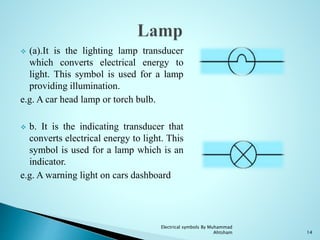
 (a).It is the lighting lamp transducer
which converts electrical energy to
light. This symbol is used for a lamp
providing illumination.
e.g. A car head lamp or torch bulb.
 b. It is the indicating transducer that
converts electrical energy to light. This
symbol is used for a lamp which is an
indicator.
e.g. A warning light on cars dashboard
14
Electrical symbols By Muhammad
Ahtsham
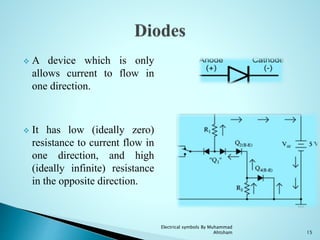
 A device which is only
allows current to flow in
one direction.
 It has low (ideally zero)
resistance to current flow in
one direction, and high
(ideally infinite) resistance
in the opposite direction.
15
Electrical symbols By Muhammad
Ahtsham
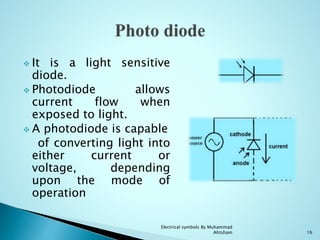
 It is a light sensitive
diode.
 Photodiode allows
current flow when
exposed to light.
 A photodiode is capable
of converting light into
either current or
voltage, depending
upon the mode of
operation
16
Electrical symbols By Muhammad
Ahtsham
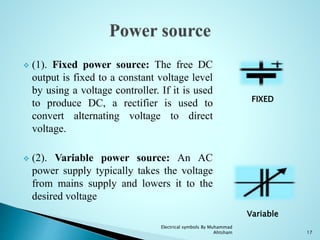
 (1). Fixed power source: The free DC
output is fixed to a constant voltage level
by using a voltage controller. If it is used
to produce DC, a rectifier is used to
convert alternating voltage to direct
voltage.
 (2). Variable power source: An AC
power supply typically takes the voltage
from mains supply and lowers it to the
desired voltage
FIXED
Variable
17
Electrical symbols By Muhammad
Ahtsham
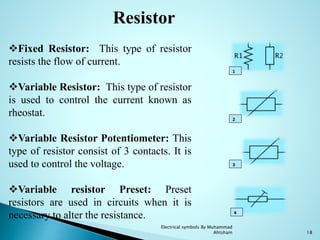
Resistor
Fixed Resistor: This type of resistor
resists the flow of current.
Variable Resistor: This type of resistor
is used to control the current known as
rheostat.
Variable Resistor Potentiometer: This
type of resistor consist of 3 contacts. It is
used to control the voltage.
Variable resistor Preset: Preset
resistors are used in circuits when it is
necessary to alter the resistance.
1
2
3
4
18
Electrical symbols By Muhammad
Ahtsham
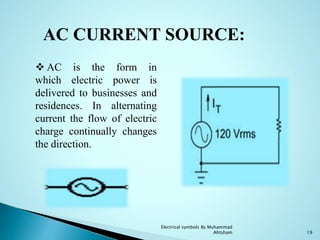
AC CURRENT SOURCE:
 AC is the form in
which electric power is
delivered to businesses and
residences. In alternating
current the flow of electric
charge continually changes
the direction.
19
Electrical symbols By Muhammad
Ahtsham
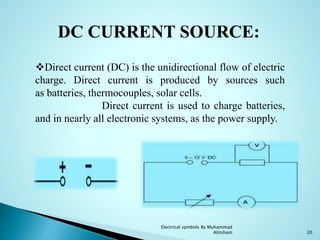
DC CURRENT SOURCE:
Direct current (DC) is the unidirectional flow of electric
charge. Direct current is produced by sources such
as batteries, thermocouples, solar cells.
Direct current is used to charge batteries,
and in nearly all electronic systems, as the power supply.
20
Electrical symbols By Muhammad
Ahtsham
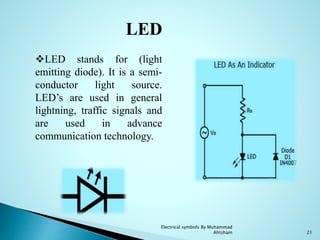
LED
LED stands for (light
emitting diode). It is a semi-
conductor light source.
LED’s are used in general
lightning, traffic signals and
are used in advance
communication technology.
21
Electrical symbols By Muhammad
Ahtsham
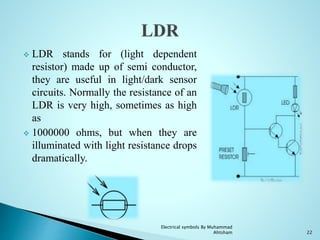
 LDR stands for (light dependent
resistor) made up of semi conductor,
they are useful in light/dark sensor
circuits. Normally the resistance of an
LDR is very high, sometimes as high
as
 1000000 ohms, but when they are
illuminated with light resistance drops
dramatically.
22
Electrical symbols By Muhammad
Ahtsham
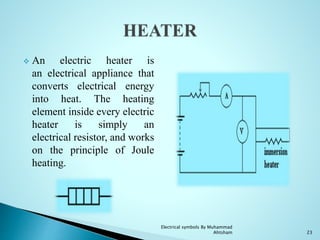
 An electric heater is
an electrical appliance that
converts electrical energy
into heat. The heating
element inside every electric
heater is simply an
electrical resistor, and works
on the principle of Joule
heating.
23
Electrical symbols By Muhammad
Ahtsham
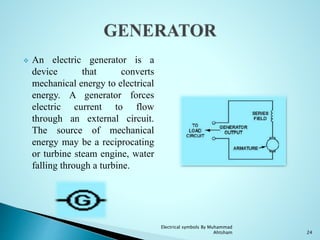
 An electric generator is a
device that converts
mechanical energy to electrical
energy. A generator forces
electric current to flow
through an external circuit.
The source of mechanical
energy may be a reciprocating
or turbine steam engine, water
falling through a turbine.
24
Electrical symbols By Muhammad
Ahtsham
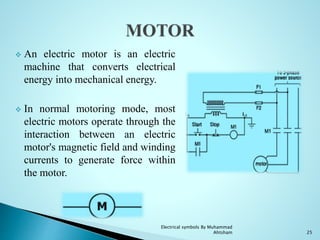
 An electric motor is an electric
machine that converts electrical
energy into mechanical energy.
 In normal motoring mode, most
electric motors operate through the
interaction between an electric
motor's magnetic field and winding
currents to generate force within
the motor.
25
Electrical symbols By Muhammad
Ahtsham
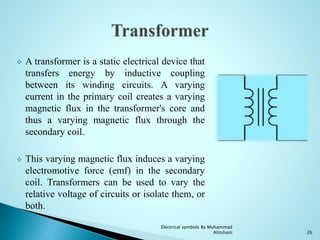
 A transformer is a static electrical device that
transfers energy by inductive coupling
between its winding circuits. A varying
current in the primary coil creates a varying
magnetic flux in the transformer's core and
thus a varying magnetic flux through the
secondary coil.
 This varying magnetic flux induces a varying
electromotive force (emf) in the secondary
coil. Transformers can be used to vary the
relative voltage of circuits or isolate them, or
both.
26
Electrical symbols By Muhammad
Ahtsham
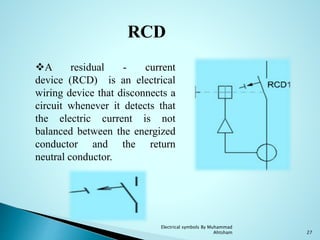
RCD
A residual - current
device (RCD) is an electrical
wiring device that disconnects a
circuit whenever it detects that
the electric current is not
balanced between the energized
conductor and the return
neutral conductor.
27
Electrical symbols By Muhammad
Ahtsham
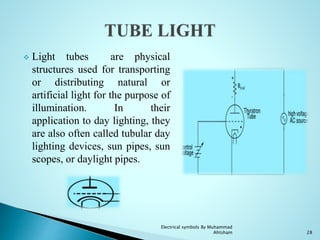
 Light tubes are physical
structures used for transporting
or distributing natural or
artificial light for the purpose of
illumination. In their
application to day lighting, they
are also often called tubular day
lighting devices, sun pipes, sun
scopes, or daylight pipes.
28
Electrical symbols By Muhammad
Ahtsham
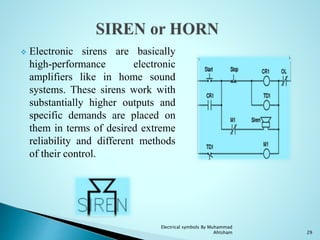
 Electronic sirens are basically
high-performance electronic
amplifiers like in home sound
systems. These sirens work with
substantially higher outputs and
specific demands are placed on
them in terms of desired extreme
reliability and different methods
of their control.
29
Electrical symbols By Muhammad
Ahtsham
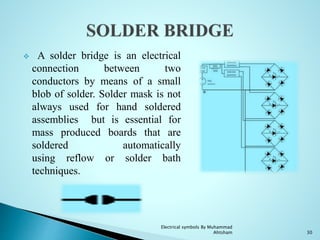
 A solder bridge is an electrical
connection between two
conductors by means of a small
blob of solder. Solder mask is not
always used for hand soldered
assemblies but is essential for
mass produced boards that are
soldered automatically
using reflow or solder bath
techniques.
30
Electrical symbols By Muhammad
Ahtsham
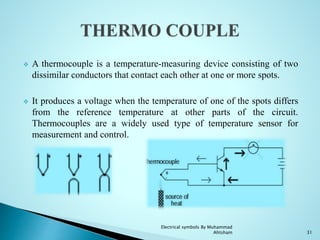
 A thermocouple is a temperature-measuring device consisting of two
dissimilar conductors that contact each other at one or more spots.
 It produces a voltage when the temperature of one of the spots differs
from the reference temperature at other parts of the circuit.
Thermocouples are a widely used type of temperature sensor for
measurement and control.
31
Electrical symbols By Muhammad
Ahtsham
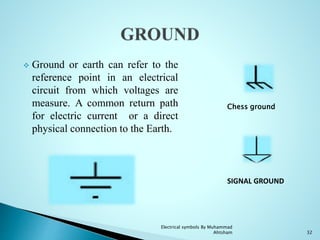
 Ground or earth can refer to the
reference point in an electrical
circuit from which voltages are
measure. A common return path
for electric current or a direct
physical connection to the Earth.
SIGNAL GROUND
32
Electrical symbols By Muhammad
Ahtsham
Chess ground
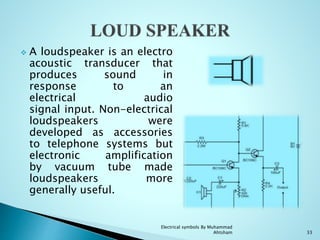
 A loudspeaker is an electro
acoustic transducer that
produces sound in
response to an
electrical audio
signal input. Non-electrical
loudspeakers were
developed as accessories
to telephone systems but
electronic amplification
by vacuum tube made
loudspeakers more
generally useful.
33
Electrical symbols By Muhammad
Ahtsham
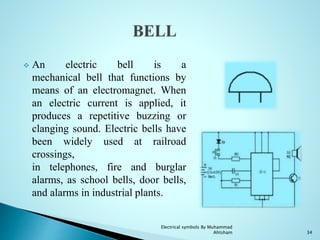
 An electric bell is a
mechanical bell that functions by
means of an electromagnet. When
an electric current is applied, it
produces a repetitive buzzing or
clanging sound. Electric bells have
been widely used at railroad
crossings,
in telephones, fire and burglar
alarms, as school bells, door bells,
and alarms in industrial plants.
34
Electrical symbols By Muhammad
Ahtsham
Switches
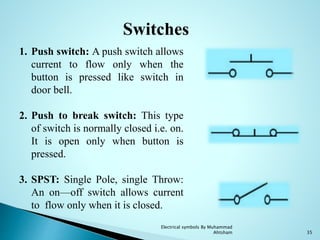
1. Push switch: A push switch allows
current to flow only when the
button is pressed like switch in
door bell.
2. Push to break switch: This type
of switch is normally closed i.e. on.
It is open only when button is
pressed.
3. SPST: Single Pole, single Throw:
An on—off switch allows current
to flow only when it is closed.
35
Electrical symbols By Muhammad
Ahtsham
Switches
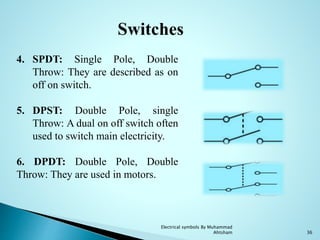
4. SPDT: Single Pole, Double
Throw: They are described as on
off on switch.
5. DPST: Double Pole, single
Throw: A dual on off switch often
used to switch main electricity.
6. DPDT: Double Pole, Double
Throw: They are used in motors.
36
Electrical symbols By Muhammad
Ahtsham
Electrical symbols By Muhammad
Ahtsham 34
Follow Me on Facebook:
https://www.facebook.com/masoompunc
hii856
Follow Me on Twitter: @GBA856
Follow me on Linkedin:
http://www.linkedin.com/profile/view?id
=302219822&authType=name&authToke
n=Mgam&trk=api*a199685*s207772*
Email Id: Mahtshamm856@gmail.com
Contact Details
Electrical symbols By Muhammad
Ahtsham 35

Electrical symbols

  • 1.
    1 Electrical symbols ByMuhammad Ahtsham Muhammad Ahtsham Electrical Symbols
  • 2.
    2 Electrical symbols ByMuhammad Ahtsham 1890 and 1910, knob and tube wire was all the rage in home building. History of electrical wiring
  • 3.
    3 Electrical symbols ByMuhammad Ahtsham In the 1920's to 1940's, electrical took a turn to a more protective wiring scheme, flexible armored cable used to use. It is also known as Greenfield. It was a welcomed addition to home wiring. History of electrical wiring
  • 4.
    Electrical symbols ByMuhammad Ahtsham 4 History of electrical wiring In the 1940's, finally came the age of metal conduit. This invention allowed to pull many wires in the same enclosure.
  • 5.
    Electrical symbols ByMuhammad Ahtsham 5 History of electrical wiring The newest addition to wiring was introduced in the 1960's around 1965. It was an update to NM cable that incorporated the use of a third wire, a bare ground wire run with a hot and neutral wire.
  • 6.
    Electrical symbols ByMuhammad Ahtsham 6 History of electrical wiring Underground feeder wire(UF) was invented to be buried directly under the ground without having to be placed in conduit.
  • 7.
    A wire isa single flexible strand or rod of metal. Wires are used to pass current very easily from one part of the circuit to another. Wire Junction Wire Not connected 7 Electrical symbols By Muhammad Ahtsham
  • 8.
    It supplies electrical energy.The larger terminal (on the left) is positive (+) while the smaller (on the right) is negative (-). A single cell is often called a battery, but strictly the battery is two or more cell joined together. 8 Electrical symbols By Muhammad Ahtsham
  • 9.
     It convertslight energy into electrical energy. 9 Electrical symbols By Muhammad Ahtsham
  • 10.
    A battery supplies electricalenergy to the circuit. It is like cell but the difference is that cell is considered as one but the battery is considered more than one cell. 10 Electrical symbols By Muhammad Ahtsham
  • 11.
    It provides thelight when electric current passes through it. A light bulb produces light with a filament wire heated to a high temperature by an electric current passing through it until it glows. 11 Electrical symbols By Muhammad Ahtsham
  • 12.
    Fuse A fuse isa special kind of resistor that acts as short circuit (0 resistances) unless the current exceeds the rated value. If the current exceeds a rated value the fuse blows and acts as an open circuit (an infinite resistance). 12 Electrical symbols By Muhammad Ahtsham
  • 13.
     The circuitbreaker is a The circuit breaker is a mechanical switching device capable of protecting the circuit wiring, capable of making, carrying and breaking currents under normal circuit conditions and also making, carrying for a specified time and breaking currents under specified abnormal circuit conditions such as short circuit. 13 Electrical symbols By Muhammad Ahtsham
  • 14.
     (a).It isthe lighting lamp transducer which converts electrical energy to light. This symbol is used for a lamp providing illumination. e.g. A car head lamp or torch bulb.  b. It is the indicating transducer that converts electrical energy to light. This symbol is used for a lamp which is an indicator. e.g. A warning light on cars dashboard 14 Electrical symbols By Muhammad Ahtsham
  • 15.
     A devicewhich is only allows current to flow in one direction.  It has low (ideally zero) resistance to current flow in one direction, and high (ideally infinite) resistance in the opposite direction. 15 Electrical symbols By Muhammad Ahtsham
  • 16.
     It isa light sensitive diode.  Photodiode allows current flow when exposed to light.  A photodiode is capable of converting light into either current or voltage, depending upon the mode of operation 16 Electrical symbols By Muhammad Ahtsham
  • 17.
     (1). Fixedpower source: The free DC output is fixed to a constant voltage level by using a voltage controller. If it is used to produce DC, a rectifier is used to convert alternating voltage to direct voltage.  (2). Variable power source: An AC power supply typically takes the voltage from mains supply and lowers it to the desired voltage FIXED Variable 17 Electrical symbols By Muhammad Ahtsham
  • 18.
    Resistor Fixed Resistor: Thistype of resistor resists the flow of current. Variable Resistor: This type of resistor is used to control the current known as rheostat. Variable Resistor Potentiometer: This type of resistor consist of 3 contacts. It is used to control the voltage. Variable resistor Preset: Preset resistors are used in circuits when it is necessary to alter the resistance. 1 2 3 4 18 Electrical symbols By Muhammad Ahtsham
  • 19.
    AC CURRENT SOURCE: AC is the form in which electric power is delivered to businesses and residences. In alternating current the flow of electric charge continually changes the direction. 19 Electrical symbols By Muhammad Ahtsham
  • 20.
    DC CURRENT SOURCE: Directcurrent (DC) is the unidirectional flow of electric charge. Direct current is produced by sources such as batteries, thermocouples, solar cells. Direct current is used to charge batteries, and in nearly all electronic systems, as the power supply. 20 Electrical symbols By Muhammad Ahtsham
  • 21.
    LED LED stands for(light emitting diode). It is a semi- conductor light source. LED’s are used in general lightning, traffic signals and are used in advance communication technology. 21 Electrical symbols By Muhammad Ahtsham
  • 22.
     LDR standsfor (light dependent resistor) made up of semi conductor, they are useful in light/dark sensor circuits. Normally the resistance of an LDR is very high, sometimes as high as  1000000 ohms, but when they are illuminated with light resistance drops dramatically. 22 Electrical symbols By Muhammad Ahtsham
  • 23.
     An electricheater is an electrical appliance that converts electrical energy into heat. The heating element inside every electric heater is simply an electrical resistor, and works on the principle of Joule heating. 23 Electrical symbols By Muhammad Ahtsham
  • 24.
     An electricgenerator is a device that converts mechanical energy to electrical energy. A generator forces electric current to flow through an external circuit. The source of mechanical energy may be a reciprocating or turbine steam engine, water falling through a turbine. 24 Electrical symbols By Muhammad Ahtsham

  • 25.
     An electricmotor is an electric machine that converts electrical energy into mechanical energy.  In normal motoring mode, most electric motors operate through the interaction between an electric motor's magnetic field and winding currents to generate force within the motor. 25 Electrical symbols By Muhammad Ahtsham
  • 26.
     A transformeris a static electrical device that transfers energy by inductive coupling between its winding circuits. A varying current in the primary coil creates a varying magnetic flux in the transformer's core and thus a varying magnetic flux through the secondary coil.  This varying magnetic flux induces a varying electromotive force (emf) in the secondary coil. Transformers can be used to vary the relative voltage of circuits or isolate them, or both. 26 Electrical symbols By Muhammad Ahtsham
  • 27.
    RCD A residual -current device (RCD) is an electrical wiring device that disconnects a circuit whenever it detects that the electric current is not balanced between the energized conductor and the return neutral conductor. 27 Electrical symbols By Muhammad Ahtsham
  • 28.
     Light tubesare physical structures used for transporting or distributing natural or artificial light for the purpose of illumination. In their application to day lighting, they are also often called tubular day lighting devices, sun pipes, sun scopes, or daylight pipes. 28 Electrical symbols By Muhammad Ahtsham
  • 29.
     Electronic sirensare basically high-performance electronic amplifiers like in home sound systems. These sirens work with substantially higher outputs and specific demands are placed on them in terms of desired extreme reliability and different methods of their control. 29 Electrical symbols By Muhammad Ahtsham
  • 30.
     A solderbridge is an electrical connection between two conductors by means of a small blob of solder. Solder mask is not always used for hand soldered assemblies but is essential for mass produced boards that are soldered automatically using reflow or solder bath techniques. 30 Electrical symbols By Muhammad Ahtsham
  • 31.
     A thermocoupleis a temperature-measuring device consisting of two dissimilar conductors that contact each other at one or more spots.  It produces a voltage when the temperature of one of the spots differs from the reference temperature at other parts of the circuit. Thermocouples are a widely used type of temperature sensor for measurement and control. 31 Electrical symbols By Muhammad Ahtsham
  • 32.
     Ground orearth can refer to the reference point in an electrical circuit from which voltages are measure. A common return path for electric current or a direct physical connection to the Earth. SIGNAL GROUND 32 Electrical symbols By Muhammad Ahtsham Chess ground
  • 33.
     A loudspeakeris an electro acoustic transducer that produces sound in response to an electrical audio signal input. Non-electrical loudspeakers were developed as accessories to telephone systems but electronic amplification by vacuum tube made loudspeakers more generally useful. 33 Electrical symbols By Muhammad Ahtsham
  • 34.
     An electricbell is a mechanical bell that functions by means of an electromagnet. When an electric current is applied, it produces a repetitive buzzing or clanging sound. Electric bells have been widely used at railroad crossings, in telephones, fire and burglar alarms, as school bells, door bells, and alarms in industrial plants. 34 Electrical symbols By Muhammad Ahtsham
  • 35.
    Switches 1. Push switch:A push switch allows current to flow only when the button is pressed like switch in door bell. 2. Push to break switch: This type of switch is normally closed i.e. on. It is open only when button is pressed. 3. SPST: Single Pole, single Throw: An on—off switch allows current to flow only when it is closed. 35 Electrical symbols By Muhammad Ahtsham
  • 36.
    Switches 4. SPDT: SinglePole, Double Throw: They are described as on off on switch. 5. DPST: Double Pole, single Throw: A dual on off switch often used to switch main electricity. 6. DPDT: Double Pole, Double Throw: They are used in motors. 36 Electrical symbols By Muhammad Ahtsham
  • 37.
    Electrical symbols ByMuhammad Ahtsham 34 Follow Me on Facebook: https://www.facebook.com/masoompunc hii856 Follow Me on Twitter: @GBA856 Follow me on Linkedin: http://www.linkedin.com/profile/view?id =302219822&authType=name&authToke n=Mgam&trk=api*a199685*s207772* Email Id: Mahtshamm856@gmail.com Contact Details
  • 38.
    Electrical symbols ByMuhammad Ahtsham 35