Presented by:
Sneha J Chouhan (B111207)
Scope of Logistics in Public
Distribution System.
Contents:
1. Introduction to Public Distribution System;
2. People involved in PDS;
3. How PDS works;
4. Operations of PDS;
5. Logistical Management of PDS:
 Procurement,
 Storage,
 Transportation,
 Bulk Allocation,
 Distribution,
 FPS,
 Consumers
6. Conclusion
1. Introduction to PDS:
 Public Distribution System (PDS) is an Indian food
security system.
 The public Distribution System envisages the system of
management of food economy and distribution of foodgrains
at affordable prices.
 Established by the Government of India under Ministry of
Consumer Affairs, Food, and Public Distribution and
managed jointly with state governments in India, it distributes
*subsidized food and non-food items to India's poor.
 Major commodities distributed include staple food
grains, such as wheat, rice, sugar, and kerosene, through a
network of Public distribution shops, also known as Ration
shops established in several states across the country.
*subsidized food: The benefit given by the government in the form of a cash payment
and reduced tax
Introduction to PDS contd..
 India’s Public Distribution System is built around a
network of roughly 4,62,000 ‘Fair Price Shops’, often
referred to as ‘ration shops’, making it one of the biggest
such systems in the world.
 India’s Planning Commission estimates that 160 million
families purchase commodities at ration shops every
year.
 Food Corporation of India, a Government-owned
corporation, procures and maintains the Public
Distribution System.
 The primary Policy objective of the Department of Food
& Public Distribution is to ensure food security for the
country through timely and efficient procurement and
distribution of foodgrains.
2. People Involved in PDS:
 The PDS is not only enormous in terms of its
expenditure and its reach, but also in terms of the
range of agencies involved in its operation.
 These include:
- Agencies of both the central and state
governments,
- Private-sector traders (who run the ration
shops), and
- Representatives of civil society,
 They are appointed by:
-Elected officials
constituted under PDS regulations.
3. How PDS works?
 State-level ministries of food and civil supplies
regulate networks of ration shops within their
jurisdictions, and are thus responsible for
allocating licenses to the private traders who
operate the shops.
 State governments also issue ‘ration cards’ to
their residents (at one time on a nominally
universal basis, but more recently on a ‘targeted’
basis), and determine the quantities to which
consumers are entitled.
 These vary from one commodity to the next.
 The prices are determined by state governments.
4. Operations of PDS:
 Both the central and state governments shared the
responsibility of regulating the PDS.
 Under PDS scheme, each family below the poverty
line is eligible for 35 kg of rice or wheat every
month, while a household above the poverty line is
entitled to 15 kg of foodgrain on a monthly basis.
4. Operations of PDS… contd..
 The Central Government is responsible for
procurement, storage, transportation, and bulk
allocation of food grains.
 State Governments hold the responsibility for
distributing the same to the consumers through the
established network of Fair Price Shops (FPSs).
 State governments are also responsible for
operational responsibilities including:
- Allocation and Identification of families below poverty
line,
- Issue of ration cards,
- Supervision and Monitoring the functioning of FPSs
5. Logistical Management of PDS:
CENTRAL GOVERNMENT
1. Procurement
2. Storage
3. Transportation
4. Bulk Allocation
7. Consumers
5. Distribution
(Done by State Government)
6. Fair Price Shops
(Ration Shops)
1. Procurement
 It is done by the central
government.
 They procure the food
materials from the Food
Corporation of India and the
State Agencies at Minimum
Prices which include
wheat, rice, kerosene and
sugar.
 Other essential commodities
like iodized salt, Palm
oil, candles, Ghee and cloth
etc. have also been
purchased.
2. Storage
 Inadequate storage could lead to wastage of food.
Thus Proper Storage becomes an essential factor in
Logistics Management.
 The Food Corporation of India does the job of storing
the grains.
 There is a regular monitoring mechanism under which
inspections at all levels are carried out to ensure safe
preservations of foodgrains in Food Corporation of India (FCI).
 The steps taken to monitor the warehouse are:
1. Foodgrains are to be stored by adopting proper scientific code
of storage practices.
3. Adequate materials are to be used to prevent entering of
moisture from the floor to the foodgrains.
4. Spraying of insecticides.
5. Effective rat control measures taken in godowns.
6. Regular periodic inspections of stocks.
7. The principle of “First in First Out” (FIFO) is to be followed to
the extent possible so as to avoid longer storage of foodgrains
in godowns.
3. Transportation
 The most common means of
Transporation is:
- Roadways and
- Railways,
• Choice of Transport depends on
volume of foodgrain.
a) Roadways:
 Economical over short distances.
b) Railways:
 High Speed,
 Suitable over Long distances,
 Large carrying capacity,
 Protection,
 Bulky goods
4. Bulk Allocation
 Bulk Allocation is met to all
the locations where the
demand is projected and
divided as per the
projection.
 It plays a very vital role in
placement of the products.
 It gives a huge saving to the
corporation.
 Bulk in excess is kept as an
emergency reserve in case
of uncertainty to avoid last
moment crisis.
5. Distribution
 Distribution is done by the
state governments.
 The foodgrains once
received are monitored
and inspected properly
and then further
distributed to the
Shopkeepers of the
Ration Shops.
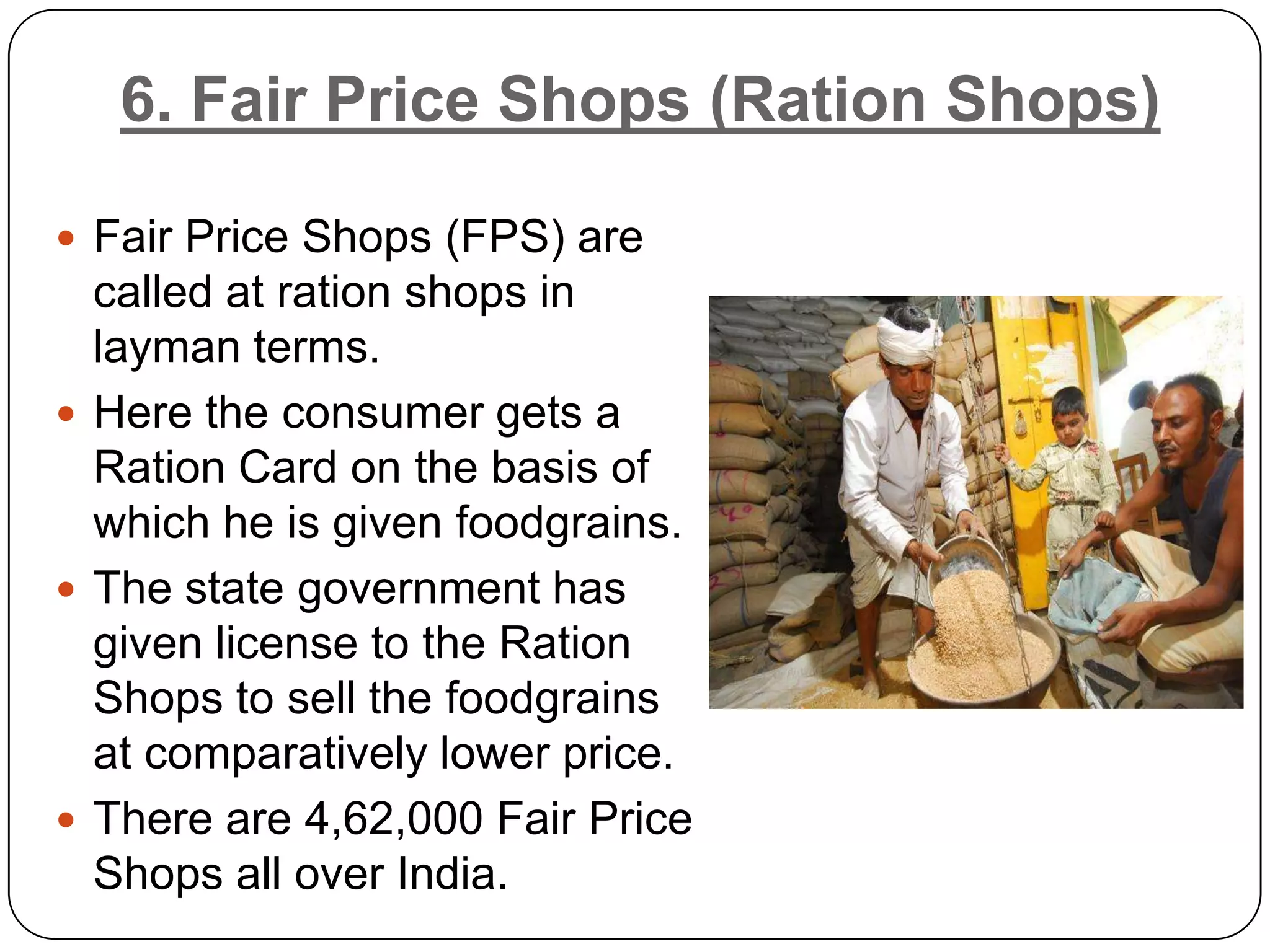
6. Fair Price Shops (Ration Shops)
 Fair Price Shops (FPS) are
called at ration shops in
layman terms.
 Here the consumer gets a
Ration Card on the basis of
which he is given foodgrains.
 The state government has
given license to the Ration
Shops to sell the foodgrains
at comparatively lower price.
 There are 4,62,000 Fair Price
Shops all over India.
7. Consumers
 Consumer are the people who
buy the foodgrains from the
FPS at Minimum Market Price.
 They are availed to purchase
foodgrains only if they own a
ration card.
 Recently Aadhaar (unique
national identity card) can also
be used in PDS to simplify a
number of processes.
 The most frequent consumers
belong to the BPL category.
Which includes Marginal
Farmers, Pottery, Craftsmen
etc.
Conclusion
 The PDS is a critical resource for the food security of
the poor, especially the urban poor, and particularly
women, who manage household food supplies.
 The question thus becomes how to make it serve its
objective – of increasing food availability to the poor –
better than it has.
 It has played a great role in serving the poor people
who earlier died of malnutrition and also those who
could’nt afford got a silver lining in their lives with the
introduction of PDS.
Public Distribution System

Public Distribution System

  • 1.
    Presented by: Sneha JChouhan (B111207) Scope of Logistics in Public Distribution System.
  • 2.
    Contents: 1. Introduction toPublic Distribution System; 2. People involved in PDS; 3. How PDS works; 4. Operations of PDS; 5. Logistical Management of PDS:  Procurement,  Storage,  Transportation,  Bulk Allocation,  Distribution,  FPS,  Consumers 6. Conclusion
  • 3.
    1. Introduction toPDS:  Public Distribution System (PDS) is an Indian food security system.  The public Distribution System envisages the system of management of food economy and distribution of foodgrains at affordable prices.  Established by the Government of India under Ministry of Consumer Affairs, Food, and Public Distribution and managed jointly with state governments in India, it distributes *subsidized food and non-food items to India's poor.  Major commodities distributed include staple food grains, such as wheat, rice, sugar, and kerosene, through a network of Public distribution shops, also known as Ration shops established in several states across the country. *subsidized food: The benefit given by the government in the form of a cash payment and reduced tax
  • 4.
    Introduction to PDScontd..  India’s Public Distribution System is built around a network of roughly 4,62,000 ‘Fair Price Shops’, often referred to as ‘ration shops’, making it one of the biggest such systems in the world.  India’s Planning Commission estimates that 160 million families purchase commodities at ration shops every year.  Food Corporation of India, a Government-owned corporation, procures and maintains the Public Distribution System.  The primary Policy objective of the Department of Food & Public Distribution is to ensure food security for the country through timely and efficient procurement and distribution of foodgrains.
  • 5.
    2. People Involvedin PDS:  The PDS is not only enormous in terms of its expenditure and its reach, but also in terms of the range of agencies involved in its operation.  These include: - Agencies of both the central and state governments, - Private-sector traders (who run the ration shops), and - Representatives of civil society,  They are appointed by: -Elected officials constituted under PDS regulations.
  • 6.
    3. How PDSworks?  State-level ministries of food and civil supplies regulate networks of ration shops within their jurisdictions, and are thus responsible for allocating licenses to the private traders who operate the shops.  State governments also issue ‘ration cards’ to their residents (at one time on a nominally universal basis, but more recently on a ‘targeted’ basis), and determine the quantities to which consumers are entitled.  These vary from one commodity to the next.  The prices are determined by state governments.
  • 7.
    4. Operations ofPDS:  Both the central and state governments shared the responsibility of regulating the PDS.  Under PDS scheme, each family below the poverty line is eligible for 35 kg of rice or wheat every month, while a household above the poverty line is entitled to 15 kg of foodgrain on a monthly basis.
  • 8.
    4. Operations ofPDS… contd..  The Central Government is responsible for procurement, storage, transportation, and bulk allocation of food grains.  State Governments hold the responsibility for distributing the same to the consumers through the established network of Fair Price Shops (FPSs).  State governments are also responsible for operational responsibilities including: - Allocation and Identification of families below poverty line, - Issue of ration cards, - Supervision and Monitoring the functioning of FPSs
  • 9.
    5. Logistical Managementof PDS: CENTRAL GOVERNMENT 1. Procurement 2. Storage 3. Transportation 4. Bulk Allocation 7. Consumers 5. Distribution (Done by State Government) 6. Fair Price Shops (Ration Shops)
  • 10.
    1. Procurement  Itis done by the central government.  They procure the food materials from the Food Corporation of India and the State Agencies at Minimum Prices which include wheat, rice, kerosene and sugar.  Other essential commodities like iodized salt, Palm oil, candles, Ghee and cloth etc. have also been purchased.
  • 11.
    2. Storage  Inadequatestorage could lead to wastage of food. Thus Proper Storage becomes an essential factor in Logistics Management.  The Food Corporation of India does the job of storing the grains.
  • 12.
     There isa regular monitoring mechanism under which inspections at all levels are carried out to ensure safe preservations of foodgrains in Food Corporation of India (FCI).  The steps taken to monitor the warehouse are: 1. Foodgrains are to be stored by adopting proper scientific code of storage practices. 3. Adequate materials are to be used to prevent entering of moisture from the floor to the foodgrains. 4. Spraying of insecticides. 5. Effective rat control measures taken in godowns. 6. Regular periodic inspections of stocks. 7. The principle of “First in First Out” (FIFO) is to be followed to the extent possible so as to avoid longer storage of foodgrains in godowns.
  • 13.
    3. Transportation  Themost common means of Transporation is: - Roadways and - Railways, • Choice of Transport depends on volume of foodgrain. a) Roadways:  Economical over short distances. b) Railways:  High Speed,  Suitable over Long distances,  Large carrying capacity,  Protection,  Bulky goods
  • 14.
    4. Bulk Allocation Bulk Allocation is met to all the locations where the demand is projected and divided as per the projection.  It plays a very vital role in placement of the products.  It gives a huge saving to the corporation.  Bulk in excess is kept as an emergency reserve in case of uncertainty to avoid last moment crisis.
  • 15.
    5. Distribution  Distributionis done by the state governments.  The foodgrains once received are monitored and inspected properly and then further distributed to the Shopkeepers of the Ration Shops.
  • 16.
    6. Fair PriceShops (Ration Shops)  Fair Price Shops (FPS) are called at ration shops in layman terms.  Here the consumer gets a Ration Card on the basis of which he is given foodgrains.  The state government has given license to the Ration Shops to sell the foodgrains at comparatively lower price.  There are 4,62,000 Fair Price Shops all over India.
  • 17.
    7. Consumers  Consumerare the people who buy the foodgrains from the FPS at Minimum Market Price.  They are availed to purchase foodgrains only if they own a ration card.  Recently Aadhaar (unique national identity card) can also be used in PDS to simplify a number of processes.  The most frequent consumers belong to the BPL category. Which includes Marginal Farmers, Pottery, Craftsmen etc.
  • 18.
    Conclusion  The PDSis a critical resource for the food security of the poor, especially the urban poor, and particularly women, who manage household food supplies.  The question thus becomes how to make it serve its objective – of increasing food availability to the poor – better than it has.  It has played a great role in serving the poor people who earlier died of malnutrition and also those who could’nt afford got a silver lining in their lives with the introduction of PDS.