 WORK
 ENERGY
 HOUSE HOLD ELECTRICITY
CONSUMPTION
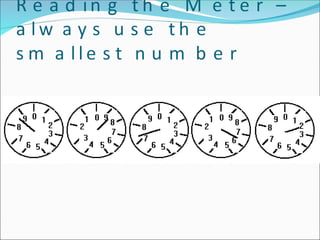
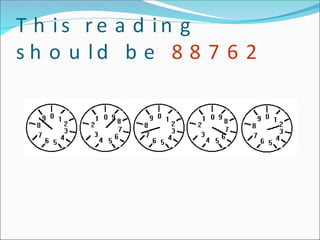
METER READING.
EFFICIENCY.
HOUSEHOLD WIRINGS.
THE SERVICE PANEL.
CIRCUIT BREAKERS.
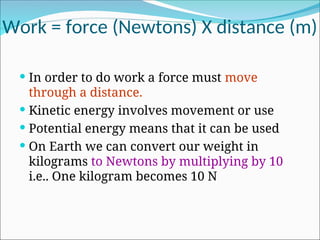
Work = force (Newtons) X distance (m)
 In order to do work a force must move
through a distance.
 Kinetic energy involves movement or use
 Potential energy means that it can be used
 On Earth we can convert our weight in
kilograms to Newtons by multiplying by 10
i.e.. One kilogram becomes 10 N
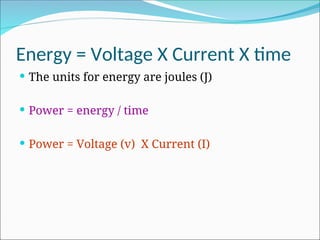
Energy = Voltage X Current X time
 The units for energy are joules (J)
 Power = energy / time
 Power = Voltage (v) X Current (I)
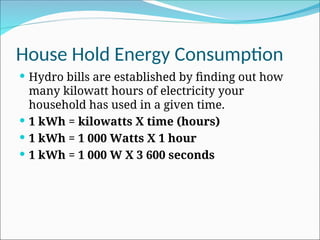
House Hold Energy Consumption
 Hydro bills are established by finding out how
many kilowatt hours of electricity your
household has used in a given time.
 1 kWh = kilowatts X time (hours)
 1 kWh = 1 000 Watts X 1 hour
 1 kWh = 1 000 W X 3 600 seconds
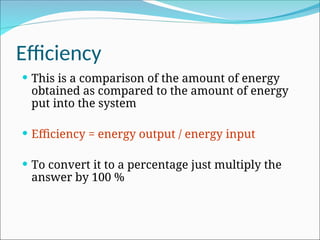
Efficiency
 This is a comparison of the amount of energy
obtained as compared to the amount of energy
put into the system
 Efficiency = energy output / energy input
 To convert it to a percentage just multiply the
answer by 100 %
House Hold Wiring
 House hold circuits are 120 volts and are alternating
current. Appliances are usually connected in
parallel.
 The circuits are polarized. That is, the black wire is
connected in a certain way and the neutral wire is
connected in a certain way.
 Polarized plugs reduce the risk of an electrical shock
by forcing electricity to flow in one general direction
House Hold Wiring
 The wires coming into a house include a black, a
red and a white.
 The black and the red wires are “hot”
 The white wire is neutral – leading to a ground
 The black is rated as being 120 v from the
neutral
 The red is rated as being 120 v from the neutral
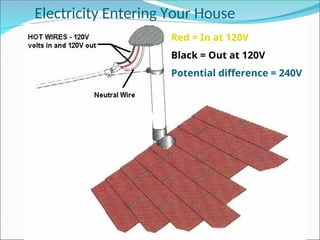
Electricity Entering Your House
Red = In at 120V
Black = Out at 120V
Potential difference = 240V
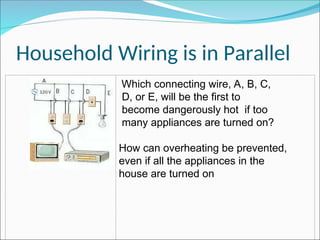
Household Wiring is in Parallel
Which connecting wire, A, B, C,
D, or E, will be the first to
become dangerously hot if too
many appliances are turned on?
How can overheating be prevented,
even if all the appliances in the
house are turned on
Alternating Current Frequency
 In North America, the current alternates back
and forth in what we call cycles per second
 1 cycle/second = 1 Hertz
 Electrical frequency in North America = 60
Hz
The Service Panel
 Since the service panel has black, red, and
white wires, the total voltage is 120 + 120 =
240 volts.
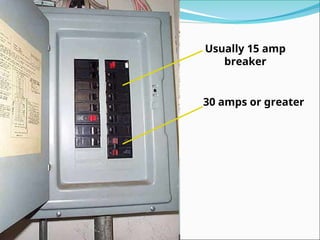
 The service panel usually contains circuit
breakers. The breakers have either a red or a
black wire attached to them.
 The service panel provides electricity for the
branch circuits.
Usually 15 amp
breaker
30 amps or greater
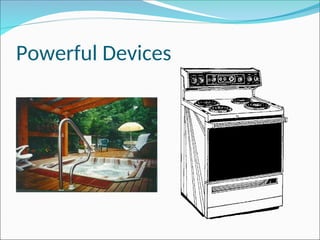
Powerful Devices
The Neutral Wire (White)
 The neutral wire is the ground
 Grounds protect us from electrocution
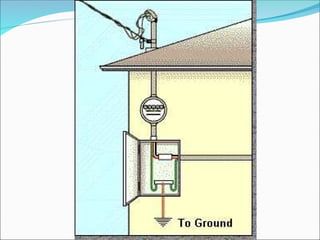
 Service Panel has a ground wire
 3 prong plug – the circular, bottom hole leads to the
ground buried outside.
The Neutral Wire (White)
 The neutral wire is _____________
 Grounds protect us from __________
 Service Panel has a ______________
 3 prong plug – the circular, bottom hole
_________________________________.
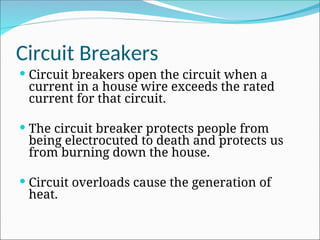
Circuit Breakers
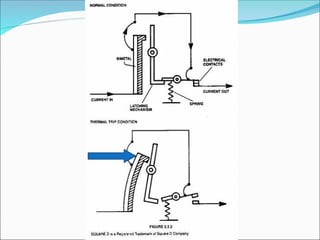
 Circuit breakers open the circuit when a
current in a house wire exceeds the rated
current for that circuit.
 The circuit breaker protects people from
being electrocuted to death and protects us
from burning down the house.
 Circuit overloads cause the generation of
heat.
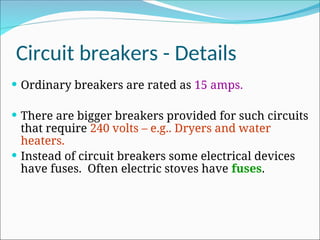
Circuit breakers - Details
 Ordinary breakers are rated as 15 amps.
 There are bigger breakers provided for such circuits
that require 240 volts – e.g.. Dryers and water
heaters.
 Instead of circuit breakers some electrical devices
have fuses. Often electric stoves have fuses.
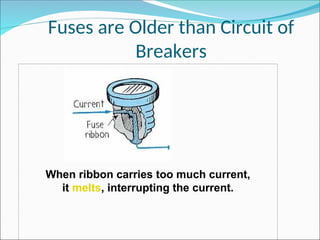
Fuses are Older than Circuit of
Breakers
When ribbon carries too much current,
it melts, interrupting the current.
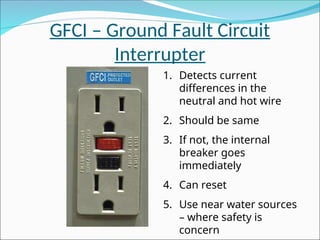
GFCI – Ground Fault Circuit
Interrupter
1. Detects current
differences in the
neutral and hot wire
2. Should be same
3. If not, the internal
breaker goes
immediately
4. Can reset
5. Use near water sources
– where safety is
concern
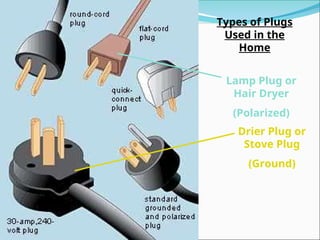
Types of Plugs
Used in the
Home
Drier Plug or
Stove Plug
(Ground)
Lamp Plug or
Hair Dryer
(Polarized)
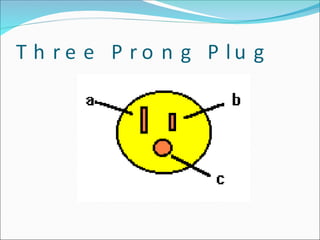
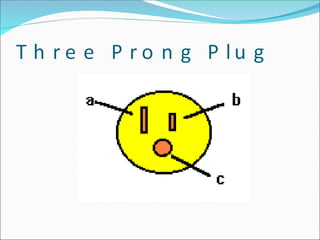
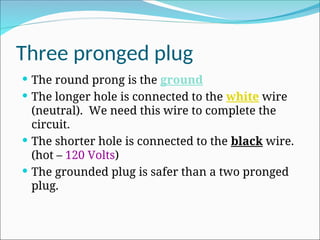
Three pronged plug
 The round prong is the ground
 The longer hole is connected to the white wire
(neutral). We need this wire to complete the
circuit.
 The shorter hole is connected to the black wire.
(hot – 120 Volts)
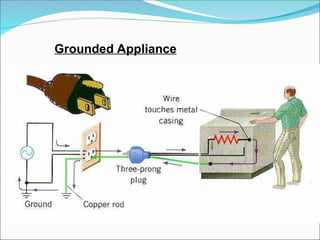
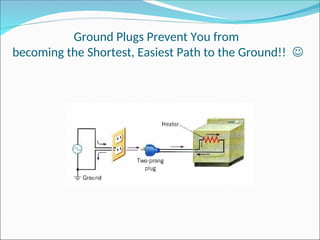
 The grounded plug is safer than a two pronged
plug.
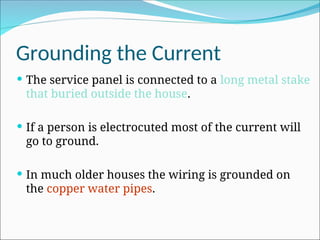
Grounding the Current
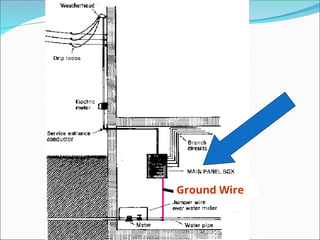
 The service panel is connected to a long metal stake
that buried outside the house.
 If a person is electrocuted most of the current will
go to ground.
 In much older houses the wiring is grounded on
the copper water pipes.
Ground Wire
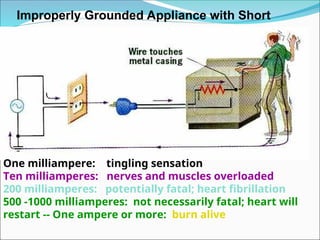
Improperly Grounded Appliance with Short
One milliampere: tingling sensation
Ten milliamperes: nerves and muscles overloaded
200 milliamperes: potentially fatal; heart fibrillation
500 -1000 milliamperes: not necessarily fatal; heart will
restart -- One ampere or more: burn alive
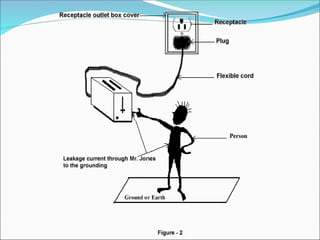
Grounded Appliance
Ground Plugs Prevent You from
becoming the Shortest, Easiest Path to the Ground!! 
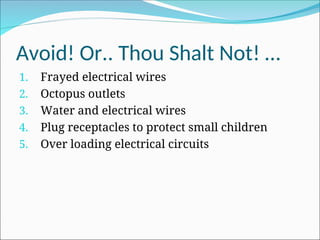
Avoid! Or.. Thou Shalt Not! …
1. Frayed electrical wires
2. Octopus outlets
3. Water and electrical wires
4. Plug receptacles to protect small children
5. Over loading electrical circuits
electricity at home Physics Chapter in School.ppt

electricity at home Physics Chapter in School.ppt

  • 4.
     WORK  ENERGY HOUSE HOLD ELECTRICITY CONSUMPTION
  • 5.
  • 6.
    Work = force(Newtons) X distance (m)  In order to do work a force must move through a distance.  Kinetic energy involves movement or use  Potential energy means that it can be used  On Earth we can convert our weight in kilograms to Newtons by multiplying by 10 i.e.. One kilogram becomes 10 N
  • 7.
    Energy = VoltageX Current X time  The units for energy are joules (J)  Power = energy / time  Power = Voltage (v) X Current (I)
  • 8.
    House Hold EnergyConsumption  Hydro bills are established by finding out how many kilowatt hours of electricity your household has used in a given time.  1 kWh = kilowatts X time (hours)  1 kWh = 1 000 Watts X 1 hour  1 kWh = 1 000 W X 3 600 seconds
  • 11.
    Efficiency  This isa comparison of the amount of energy obtained as compared to the amount of energy put into the system  Efficiency = energy output / energy input  To convert it to a percentage just multiply the answer by 100 %
  • 12.
    House Hold Wiring House hold circuits are 120 volts and are alternating current. Appliances are usually connected in parallel.  The circuits are polarized. That is, the black wire is connected in a certain way and the neutral wire is connected in a certain way.  Polarized plugs reduce the risk of an electrical shock by forcing electricity to flow in one general direction
  • 13.
    House Hold Wiring The wires coming into a house include a black, a red and a white.  The black and the red wires are “hot”  The white wire is neutral – leading to a ground  The black is rated as being 120 v from the neutral  The red is rated as being 120 v from the neutral
  • 14.
    Electricity Entering YourHouse Red = In at 120V Black = Out at 120V Potential difference = 240V
  • 15.
    Household Wiring isin Parallel Which connecting wire, A, B, C, D, or E, will be the first to become dangerously hot if too many appliances are turned on? How can overheating be prevented, even if all the appliances in the house are turned on
  • 16.
    Alternating Current Frequency In North America, the current alternates back and forth in what we call cycles per second  1 cycle/second = 1 Hertz  Electrical frequency in North America = 60 Hz
  • 17.
    The Service Panel Since the service panel has black, red, and white wires, the total voltage is 120 + 120 = 240 volts.  The service panel usually contains circuit breakers. The breakers have either a red or a black wire attached to them.  The service panel provides electricity for the branch circuits.
  • 18.
  • 19.
  • 20.
    The Neutral Wire(White)  The neutral wire is the ground  Grounds protect us from electrocution  Service Panel has a ground wire  3 prong plug – the circular, bottom hole leads to the ground buried outside.
  • 21.
    The Neutral Wire(White)  The neutral wire is _____________  Grounds protect us from __________  Service Panel has a ______________  3 prong plug – the circular, bottom hole _________________________________.
  • 24.
    Circuit Breakers  Circuitbreakers open the circuit when a current in a house wire exceeds the rated current for that circuit.  The circuit breaker protects people from being electrocuted to death and protects us from burning down the house.  Circuit overloads cause the generation of heat.
  • 26.
    Circuit breakers -Details  Ordinary breakers are rated as 15 amps.  There are bigger breakers provided for such circuits that require 240 volts – e.g.. Dryers and water heaters.  Instead of circuit breakers some electrical devices have fuses. Often electric stoves have fuses.
  • 27.
    Fuses are Olderthan Circuit of Breakers When ribbon carries too much current, it melts, interrupting the current.
  • 28.
    GFCI – GroundFault Circuit Interrupter 1. Detects current differences in the neutral and hot wire 2. Should be same 3. If not, the internal breaker goes immediately 4. Can reset 5. Use near water sources – where safety is concern
  • 29.
    Types of Plugs Usedin the Home Drier Plug or Stove Plug (Ground) Lamp Plug or Hair Dryer (Polarized)
  • 31.
    Three pronged plug The round prong is the ground  The longer hole is connected to the white wire (neutral). We need this wire to complete the circuit.  The shorter hole is connected to the black wire. (hot – 120 Volts)  The grounded plug is safer than a two pronged plug.
  • 32.
    Grounding the Current The service panel is connected to a long metal stake that buried outside the house.  If a person is electrocuted most of the current will go to ground.  In much older houses the wiring is grounded on the copper water pipes.
  • 33.
  • 34.
    Improperly Grounded Appliancewith Short One milliampere: tingling sensation Ten milliamperes: nerves and muscles overloaded 200 milliamperes: potentially fatal; heart fibrillation 500 -1000 milliamperes: not necessarily fatal; heart will restart -- One ampere or more: burn alive
  • 36.
  • 37.
    Ground Plugs PreventYou from becoming the Shortest, Easiest Path to the Ground!! 
  • 38.
    Avoid! Or.. ThouShalt Not! … 1. Frayed electrical wires 2. Octopus outlets 3. Water and electrical wires 4. Plug receptacles to protect small children 5. Over loading electrical circuits