Installation, Start-Up and
Service Instructions
SAFETY CONSIDERATIONS
Installing, starting up, and servicing this equipment can
be hazardous due to system pressures, electrical compo-
nents, and equipment location (roofs, elevated structures, etc.).
Only trained, qualified installers and service mechanics
should install, start up, and service this equipment.
Untrained personnel can perform basic maintenance func-
tions, such as cleaning coils. All other operations should be
performed by trained service personnel.
When working on the equipment, observe precautions in
the literature and on tags, stickers, and labels attached to the
equipment.
• Follow all safety codes.
• Wear safety glasses and work gloves.
• Use care in handling, rigging, and setting bulky
equipment.
ELECTRIC SHOCK HAZARD.
Open all remote disconnects before servic-
ing this equipment.
IMPORTANT: This equipment generates, uses, and can
radiate radio frequency energy, and if not installed and
used in accordance with these instructions may cause
radio interference. This equipment has been tested and
found to comply with the limits of a Class A comput-
ing device as defined by FCC (Federal Communica-
tions Commission, U.S.A.) regulations, Subpart J of
Part 15, which are designed to provide reasonable pro-
tection against such interference when operated in a
commercial environment.
CONTENTS
Page
SAFETY CONSIDERATIONS . . . . . . . . . . . . . . . . . . . 1
INTRODUCTION . . . . . . . . . . . . . . . . . . . . . . . . . . . . . . 2
INSTALLATION . . . . . . . . . . . . . . . . . . . . . . . . . . . . . 2-9
Step 1 — Rig and Place the Unit . . . . . . . . . . . . . . 2
• DOMESTIC UNITS
• EXPORT UNITS AND DOMESTIC UNITS WITH
SKIDS
• PLACING UNIT
Step 2 — Check Compressor Mounting . . . . . . . 2
Step 3 — Cooler Fluid and Drain Piping
Connections . . . . . . . . . . . . . . . . . . . . . . . . . . . . . . . 2
• PREPARATION FOR YEAR-ROUND OPERATION
• PREPARATION FOR WINTER SHUTDOWN
Step 4 — Make Electrical Connections . . . . . . . . 8
• FIELD POWER CONNECTIONS
• FIELD CONTROL POWER CONNECTIONS
Page
Step 5 — Install Accessories . . . . . . . . . . . . . . . . . 9
• ELECTRICAL
• LOW-AMBIENT OPERATION
• HOT GAS BYPASS
• MISCELLANEOUS ACCESSORIES
PRE-START-UP . . . . . . . . . . . . . . . . . . . . . . . . . . . . . 9-18
System Check . . . . . . . . . . . . . . . . . . . . . . . . . . . . . . . 9
Quick Test . . . . . . . . . . . . . . . . . . . . . . . . . . . . . . . . . . 13
• QUICK TEST STEPS 1-15: UNIT CONFIGURATION
• QUICK TEST STEPS 16-30: THERMISTORS AND
SET POINT POTENTIOMETERS
• QUICK TEST STEPS 31-42: OUTPUT RELAYS
START-UP AND OPERATION . . . . . . . . . . . . . . . 19-21
Digital Display Action . . . . . . . . . . . . . . . . . . . . . . . 19
Actual Start-Up . . . . . . . . . . . . . . . . . . . . . . . . . . . . . 19
Operating Limitations . . . . . . . . . . . . . . . . . . . . . . . 19
• TEMPERATURES
• VOLTAGE
• MINIMUM FLUID LOOP VOLUME
• FLOW RATE REQUIREMENTS
Operation Sequence . . . . . . . . . . . . . . . . . . . . . . . . 20
• UNITS WITH EXV
• UNITS WITH STANDARD TXV
• LOAD SHED
• TEMPERATURE RESET
• HEAD PRESSURE CONTROL
• REMOTE ON-OFF
• REMOTE ALARM
SERVICE . . . . . . . . . . . . . . . . . . . . . . . . . . . . . . . . . . 21-32
Diagnostics and Troubleshooting . . . . . . . . . . . . 21
Refrigerant Circuit . . . . . . . . . . . . . . . . . . . . . . . . . . 21
• LEAK TESTING
• REFRIGERANT CHARGE
Electronic Components . . . . . . . . . . . . . . . . . . . . . 23
• CONTROL COMPONENTS
• UNIT CONTROL BOX
Compressors . . . . . . . . . . . . . . . . . . . . . . . . . . . . . . . 23
• COMPRESSOR REMOVAL
• OIL CHARGE
Cooler . . . . . . . . . . . . . . . . . . . . . . . . . . . . . . . . . . . . . . 23
• COOLER REMOVAL
• REPLACING COOLER
• SERVICING COOLER
Condenser Coils . . . . . . . . . . . . . . . . . . . . . . . . . . . . 25
• COIL CLEANING
Condenser Fans . . . . . . . . . . . . . . . . . . . . . . . . . . . . 26
• STANDARD CONDENSER FANS
• HIGH STATIC CONDENSER FANS
Refrigerant Feed Components . . . . . . . . . . . . . . . 26
• ELECTRONIC EXPANSION VALVE (EXV)
• THERMOSTATIC EXPANSION VALVE (TXV)
• MOISTURE-LIQUID INDICATOR
• FILTER DRIER
• LIQUID LINE SOLENOID VALVE
• LIQUID LINE SERVICE VALVE
30GT040-070
Flotronic™ Reciprocating Liquid Chillers
50/60 Hz
Manufacturer reserves the right to discontinue, or change at any time, specifications or designs without notice and without incurring obligations.
Book 2
Tab 5c
PC 903 Catalog No. 533-002 Printed in U.S.A. Form 30GT-49SI Pg 1 12-96 Replaces: 30GT-41SI
CONTENTS (cont)
Page
Thermistors . . . . . . . . . . . . . . . . . . . . . . . . . . . . . . . . 30
• LOCATION
• REPLACING THERMISTOR T2
• REPLACING THERMISTORS T1, T5, T6, T7,
AND T8
• THERMISTORS T3 AND T4
• THERMISTOR/TEMPERATURE SENSOR CHECK
Safety Devices . . . . . . . . . . . . . . . . . . . . . . . . . . . . . . 31
• COMPRESSOR PROTECTION
• LOW OIL PRESSURE PROTECTION
• CRANKCASE HEATERS
• COOLER PROTECTION
Relief Devices . . . . . . . . . . . . . . . . . . . . . . . . . . . . . . 32
• HIGH-SIDE PROTECTION
• LOW-SIDE PROTECTION
• COMPRESSOR PROTECTION
Other Safeties . . . . . . . . . . . . . . . . . . . . . . . . . . . . . . 32
START-UP CHECKLIST . . . . . . . . . . . . . . CL-1 to CL-4
INTRODUCTION
These instructions cover installation, start-up and service
of 30GT040-070 Flotronic™ liquid chillers with electronic
controls and units with factory-installed options (FIOPs).
Standard chillers are equipped with electronic expansion
valves (EXVs) and FIOP units have conventional thermo-
static expansion valves (TXVs) and liquid line solenoid valves
(LLSVs). Differences in quick test procedures and operation
sequence should be carefully noted when following these
instructions.
Inspect the unit upon arrival for damage. If damage is found,
file a claim right away with the shipping company. When
considering location for the unit, be sure to consult National
Electrical Code (NEC, U.S.A.) and local code requirements.
Allow sufficient space for airflow, wiring, piping, and ser-
vice. See Fig. 1 and 2. Be sure surface beneath the unit is
level, and is capable of supporting the operating weight of
the unit. See Fig. 3 and Tables 1 and 2.
INSTALLATION
Step 1— Rig and Place the Unit — These units are
designed for overhead rigging. Lifting holes are provided in
frame base channels (see rigging label on unit). Use spreader
bars or frame to keep cables or chains clear of unit sides.
Run cables to a central suspension point so that angle from
horizontal is not less than 45 degrees. Raise and set down
unit carefully. Export units and domestic units with skids are
rigged and placed as described below.
DOMESTIC UNITS — Standard units are shipped without
skids. If overhead rigging is not possible, place chiller on
skid or pad for rolling or dragging. When rolling, use mini-
mum of 3 rollers. When dragging, pull the pad. Do not apply
force to the unit. When in final position, raise from above to
lift unit off the pad.
EXPORT UNITS AND DOMESTIC UNITS WITH SKIDS
— All units are mounted on skids with vertical coil protec-
tion. At the job site, leave unit on the skid until unit is in
final position. While on the skid, the unit can be rolled or
skidded on the floor, with force applied to the skid, not the
unit. When the skid is removed, the unit must be handled by
overhead rigging as described previously. If it is necessary
to remove the skid before the unit is in final position and
unit can be dragged, place unit on a large pad and drag by
the pad. Do not apply force to the unit. When in final po-
sition, raise from above to lift unit off the pad.
PLACING UNIT — Refer to Fig. 1 and 2 for airflow clear-
ances. Provide ample room for servicing and removing cooler,
depending on unit location. Refer to cooler dimensions in
Fig. 1 and 2. For multiple units, allow 8 ft (2440 mm) sepa-
ration between units for airflow and service. Placement area
must be level and strong enough to support operating weight
of unit (see Fig. 3 and Tables 1 and 2). Weights at unit sup-
port points are shown in Fig. 3. Bolt unit securely to pad
when unit is positioned and leveled. Fasteners for mounting
unit are field supplied. Check that unit is mounted levelly to
ensure proper oil return to compressors. If vibration isola-
tors (field supplied) are required for a particular installation,
refer to unit weight distribution in Fig. 3 to aid in proper
selection of isolators.
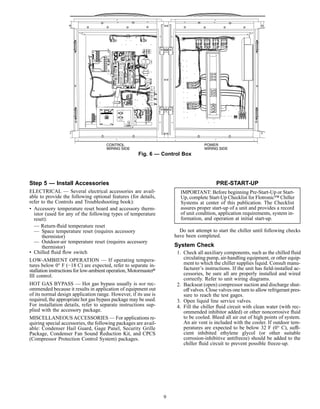
Step 2 — Check Compressor Mounting — All
compressors on 30GT040-070 units are mounted on pans and
are held down by 4 bolts during shipment. After unit is in-
stalled, loosen each of these bolts until the flat washer can
be moved with finger pressure. See Fig. 4 and 5.
Step 3 — Cooler Fluid and Drain Piping Con-
nections — When facing cooler side of unit, inlet (re-
turn) fluid connection is on the right, nearest the control box.
Outlet (supply) fluid connection is on the left. The cooler
has fluid-side victaulic-type connections (follow connection
directions as provided by the coupling manufacturer). If ac-
cessory grilles have been added, holes must be cut in grilles
for field piping and insulation.
Although cooler has an air vent, it is recommended that
field-supplied air vents be installed at the highest point in
the system to facilitate servicing. Field-supplied shut-off valves
should also be installed to facilitate servicing and flow bal-
ancing. Locate valves in return and supply cooler fluid lines
as close to the chiller as possible.
Upon completion of the field piping installation, in areas
where the piping is exposed to 32 F (0° C) or lower ambient
temperatures, freeze-up protection is recommended using in-
hibited ethylene glycol (or other suitable corrosion-inhibitive
antifreeze) and electric heater tapes. Heater tapes should have
a rating for area ambient temperatures, and should be cov-
ered with a suitable thickness of closed-cell insulation. Route
power for the heater tapes from a separate fused disconnect.
Mount the disconnect within sight from the unit as pre-
scribed by local or NEC codes. Identify disconnect as heater
tape power source, with warning that power must not be turned
off except when servicing the unit.
IMPORTANT: Before starting unit, be sure all of the
air has been purged from the system.
A drain connection is located at leaving fluid (supply) end
of cooler. See Fig. 1 and 2.
PREPARATION FOR YEAR-ROUND OPERATION — If
unit is to operate all year round, add sufficient inhibited eth-
ylene glycol (or other suitable corrosion-inhibitive anti-
freeze) to the cooler water to prevent freeze-up under cold
operating conditions. Consult local water authority on char-
acteristics of area water and a recommended inhibitor for
the cooler fluid loop.
2
LEGEND
C — Copper Fins, Copper Tubing
Mtg — Mounting
NOTES:
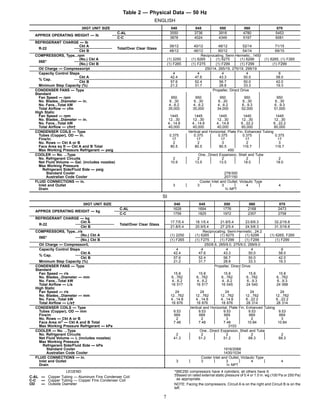
1. Unit must have clearances for airflow as follows:
TOP — Do not restrict in any way.
ENDS — [1524] 5 ft
SIDES — [1829] 6 ft
2. 2.00Љ dia holes are recommended for parallel conductors on 040 and 045
(208/230 V) units.
3. 35⁄8Љ dia hole is recommended for single entry power on 050 (208/230 V)
units.
4. Mounting holes may be used to mount unit to concrete pad. They are not
recommended for spring isolator location.
5. If spring isolators are used, a perimeter support channel between the unit
and the isolators is recommended.
6. Dimensions in [ ] are millimeters.
7. Thru-the-door handles for non-fused disconnect option on 380/415 v and
460 v units only. When unit has non-fused disconnect option, power-side
door opens from right side, NOT left side as shown for standard units.
UNIT 30GT
DIMENSIONS
‘‘A’’ ‘‘B’’ ‘‘C’’ ‘‘D’’
040 3Ј-511⁄16Љ
[1059]
3Ј-1013⁄16Љ
[1189]
4Ј-51⁄2Љ
[1359]
1Ј-111⁄8Љ
[587.5]
040C 3Ј-57⁄8Љ
[1064]
3Ј-11Љ
[1194]
4Ј-51⁄2Љ
[1359]
1Ј-111⁄8Љ
[587.5]
045 3Ј-61⁄16Љ
[1069]
3Ј-1013⁄16Љ
[1189]
5Ј-51⁄2Љ
[1663]
1Ј-53⁄16Љ
[436.6]
045C 3Ј-63⁄16Љ
[1072]
3Ј-11Љ
[1194]
5Ј-51⁄2Љ
[1663]
1Ј-53⁄16Љ
[436.6]
050 3Ј-57⁄8Љ
[1064]
3Ј-11Љ
[1194]
5Ј-51⁄2Љ
[1663]
1Ј-53⁄16Љ
[436.6]
050C
3Ј-6Љ
[1067]
3Ј-113⁄16Љ
[1199]
5Ј-51⁄2Љ
[1663]
1Ј-53⁄16Љ
[436.6]
Fig. 1 — Dimensions, 30GT040-050
FIELD POWER SUPPLY CONNECTIONS
Unit 30GT Voltage Hz Diameter Qty
040,045 208/230 60
35⁄8Љ
[92.0] 1
050 208/230 60
21⁄2Љ
[63.5]
2
040-050 460 60
21⁄2Љ
[63.5]
1
040-050 575 60
21⁄2Љ
[63.5] 1
040-050 380 60
21⁄2Љ
[63.5] 1
040,045 346 50 21⁄2Љ
[63.5] 1
050 346 50 35⁄8Љ
[92.0]
1
040,045 380/415 50
21⁄2Љ
[63.5] 1
050 380/415 50 35⁄8Љ
[92.0] 1
3
LEGEND
C — Copper Fins, Copper Tubing
Mtg — Mounting
NOTES:
1. Dimensions in [ ] are millimeters.
2. Unit must have clearances for airflow as follows:
TOP — Do not restrict in any way.
ENDS — [1524] 5 ft
SIDES — [1829] 6 ft
3. Mounting holes may be used to mount unit to concrete pad. They are not
recommended for spring isolator location.
4. If spring isolators are used, a perimeter support channel between the unit
and the isolators is recommended.
5. Thru-the-door handles for non-fused disconnect option on 380/415 v and
460 v units only. When unit has non-fused disconnect option, power-side
door opens from right side, NOT left side as shown for standard units.
UNIT 30GT
DIMENSIONS
‘‘A’’ ‘‘B’’
060
3Ј-67⁄8Љ
[1090]
4Ј-105⁄16Љ
[1481]
060C
3Ј-7Љ
[1092]
4Ј-109⁄16Љ
[1488]
070
3Ј-6Љ
[1067]
4Ј-101⁄2Љ
[1486]
070C 3Ј-63⁄16Љ
[1072]
4Ј-107⁄8Љ
[1496]
Fig. 2 − Dimensions, 30GT060,070
FIELD POWER SUPPLY CONNECTIONS
Unit 30GT Voltage Hz Diameter Qty
060 208/230 60
21⁄2Љ
[63.5] 2
070 208/230 60
35⁄8Љ
[92.0]
2
060 460 60
21⁄2Љ
[63.5]
1
070 460 60
35⁄8Љ
[92.0] 1
060,070 575 60 21⁄2Љ
[63.5] 1
060,070 380 60 35⁄8Љ
[92.0]
1
060,070 346 50 35⁄8Љ
[92.0]
1
060,070 380/415 50
35⁄8Љ
[92.0]
1
4
Y
D
CONTROL
BOX
A
X
C
B
MOUNTING WEIGHTS*
60 Hz UNITS
30GT
UNIT
SIZE
CONDENSER
COIL†
LB KG
A B C D A B C D
040
C-AL 972 876 807 895 441 397 366 406
C-C 1044 948 879 968 473 430 399 439
045
C-AL 999 895 845 943 453 406 383 428
C-C 1071 967 917 1015 486 438 416 460
050
C-AL 1047 948 884 976 475 430 401 443
C-C 1155 1057 992 1085 524 479 450 492
060
C-AL 1258 1130 1130 1113 570 512 505 562
C-C 1362 1234 1217 1344 618 560 552 609
070
C-AL 1332 1212 1184 1301 604 550 537 590
C-C 1489 1369 1340 1458 675 621 608 661
50 Hz UNITS
30GT
UNIT
SIZE
CONDENSER
COIL†
LB KG
A B C D A B C D
040
C-AL 992 886 808 904 450 402 366 410
C-C 1064 959 880 976 482 435 399 443
045
C-AL 1065 934 812 925 483 424 368 420
C-C 1137 1007 883 998 515 457 401 452
050
C-AL 1074 968 889 986 487 439 403 447
C-C 1182 1076 997 1095 536 488 452 496
060
C-AL 1269 1151 1123 1238 575 522 509 561
C-C 1373 1255 1227 1342 623 569 556 609
070
C-AL 1508 1369 1226 1350 684 621 556 612
C-C 1664 1526 1383 1508 755 692 627 684
LEGEND
C-AL — Copper Tubing, Aluminum Fins
C-C — Copper Tubing, Copper Fins
*Points A, B, C, and D are located in the corners of the unit. See Fig. 1 and 2 for dimensions.
†Contact your local Carrier representative for more information on Epoxy-coated and pre-coated
aluminum fins.
NOTE: If spring isolators are used, a perimeter support channel between the unit and the isolators
is recommended.
RIGGING CENTER OF GRAVITY
30GT
UNIT
SIZE
040 045 050 060 070
in. mm in. mm in. mm in. mm in. mm
X
Dimension
4613⁄16 1189 4613⁄16 1189 47 1194 585⁄16 1481 581⁄2 1486
Y
Dimension 4111⁄16 1059 421⁄16 1069 417⁄8 1064 427⁄8 1090 42 1067
Fig. 3 — Mounting Weights (Approximate)
5
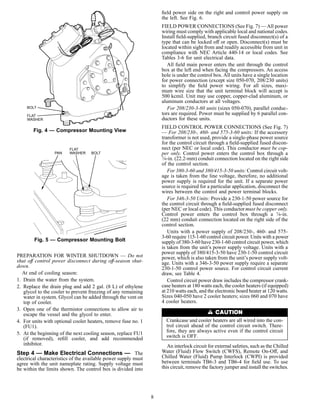
Table 1 — Physical Data — 60 Hz
ENGLISH
30GT UNIT SIZE 040 045 050 060 070
APPROX OPERATING WEIGHT — lb
C-AL 3550 3681 3856 4740 5028
C-C 3838 3969 4289 5157 5656
REFRIGERANT CHARGE — lb
R-22
Ckt A
Total/Over Clear Glass
39/12 40/12 48/12 52/14 70/15
Ckt B 48/12 46/12 60/12 54/14 69/15
COMPRESSORS, Type...rpm Reciprocating, Semi-Hermetic...1750
06E*
(No.) Ckt A (1) 2250 (1) 2250 (1) 6265 (1) 6275 (1) 6299
(No.) Ckt B (1) A250 (1) F265 (1) F275 (1) F299 (1) F299
Oil Charge — Compressor/pt 250/14, 265/19, 275/19, 299/19
Capacity Control Steps 4 4 4 4 4
% Cap.
Ckt A 50.0 42.4 47.6 43.3 50.0
Ckt B 50.0 57.6 52.4 56.7 50.0
Minimum Step Capacity (%) 25.0 21.2 31.7 28.8 33.3
CONDENSER FANS — Type Propeller, Direct Drive
Standard
Fan Speed — rpm 1140 1140 1140 1140 1140
No. Blades...Diameter — in. 4...30 4...30 4...30 4...30 4...30
No. Fans...Total kW 4...6.2 4...6.2 4...6.2 6...9.3 6...9.3
Total Airflow — cfm 35,000 35,000 34,000 52,000 51,000
High Static
Fan Speed — rpm 1750 1750 1750 1750 1750
No. Blades...Diameter — in. 12...30 12...30 12...30 12...30 12...30
No. Fans...Total kW 4...14.8 4...14.8 4...14.8 6...22.2 6...22.2
Total Airflow — cfm† 40,000 40,000 40,000 60,000 60,000
CONDENSER COILS — Type Vertical and Horizontal, Plate Fin, Enhanced Tubing
Tubes (Copper), OD — in. 0.375 0.375 0.375 0.375 0.375
Fins/in. 17 17 17 17 17
No. Rows — Ckt A or B 2 2 3 2 3
Face Area sq ft — Ckt A and B Total 80.5 80.5 80.5 116.7 116.7
Max Working Pressure Refrigerant — psig 450
COOLER — No. ...Type One...Direct Expansion, Shell and Tube
No. Refrigerant Circuits 2 2 2 2 2
Net Fluid Volume — Gal. (includes nozzles) 10.9 13.5 13.5 18.0 18.0
Max Working Pressure
Refrigerant Side/Fluid Side — psig
Standard Cooler 278/300
Australian Code Cooler 207/150
FLUID CONNECTIONS — in. Cooler Inlet and Outlet; Victaulic Type
Inlet and Outlet 3 3 3 4 4
Drain 3⁄4 NPT
SI
30GT UNIT SIZE 040 045 050 060 070
APPROX OPERATING WEIGHT — kg
C-AL 1610 1669 1749 2150 2280
C-C 1741 1800 1945 2339 2565
REFRIGERANT CHARGE — kg
R-22
Ckt A
Total/Over Clear Glass
17.7/5.4 18.1/5.4 21.8/5.4 23.6/6.3 31.7/6.8
Ckt B 21.8/5.4 20.9/5.4 27.2/5.4 24.5/6.3 31.3/6.8
COMPRESSORS, Type...r/s Reciprocating, Semi-Hermetic...29.2
06E*
(No.) Ckt A (1) 2250 (1) 2250 (1) 6265 (1) 6275 (1) 6299
(No.) Ckt B (1) A250 (1) F265 (1) F275 (1) F299 (1) F299
Oil Charge — Compressor/L 250/6.6, 265/9.0, 275/9.0, 299/9.0
Capacity Control Steps 4 4 4 4 4
% Cap.
Ckt A 50.0 42.4 47.6 43.3 50.0
Ckt B 50.0 57.6 52.4 56.7 50.0
Minimum Step Capacity (%) 25.0 21.2 31.7 28.8 33.3
CONDENSER FANS — Type Propeller, Direct Drive
Standard
Fan Speed — r/s 19 19 19 19 19
No. Blades...Diameter — mm 4...762 4...762 4...762 4...762 4...762
No. Fans...Total kW 4...6.2 4...6.2 4...6.2 6...9.3 6...9.3
Total Airflow — L/s 16 517 16 517 16 045 24 540 24 068
High Static
Fan Speed — r/s 29 29 29 29 29
No. Blades...Diameter — mm 12...762 12...762 12...762 12...762 12...762
No. Fans...Total kW 4...14.8 4...14.8 4...14.8 6...22.2 6...22.2
Total Airflow — L/s† 18 876 18 876 18 876 28 314 28 314
CONDENSER COILS — Type Vertical and Horizontal, Plate Fin, Enhanced Tubing
Tubes (Copper), OD — mm 9.53 9.53 9.53 9.53 9.53
Fins/m 669 669 669 669 669
No. Rows — Ckt A or B 2 2 3 2 3
Face Area m2
— Ckt A and B Total 7.48 7.48 7.48 10.84 10.84
Max Working Pressure Refrigerant — kPa 3103
COOLER — No. ...Type One...Direct Expansion, Shell and Tube
No. Refrigerant Circuits 2 2 2 2 2
Net Fluid Volume — L (includes nozzles) 41.3 51.2 51.2 68.3 68.3
Max Working Pressure
Refrigerant Side/Fluid Side — kPa
Standard Cooler 1916/2068
Australian Code Cooler 1430/1034
FLUID CONNECTIONS — in. Cooler Inlet and Outlet; Victaulic Type
Inlet and Outlet 3 3 3 4 4
Drain 3⁄4 NPT
LEGEND
C-AL — Copper Tubing — Aluminum Fins Condenser Coil
C-C — Copper Tubing — Copper Fins Condenser Coil
OD — Outside Diameter
*06E250 compressors have 4 cylinders; all others have 6.
†Based on rated external static pressure of 0.4 or 1.0 in. wg (100 Pa or 250 Pa)
as appropriate.
NOTE: Facing the compressors, Circuit A is on the right and Circuit B is on the
left.
6
Table 2 — Physical Data — 50 Hz
ENGLISH
30GT UNIT SIZE 040 045 050 060 070
APPROX OPERATING WEIGHT — lb
C-AL 3550 3736 3916 4780 5453
C-C 3878 4024 4349 5197 6081
REFRIGERANT CHARGE — lb
R-22
Ckt A
Total/Over Clear Glass
39/12 40/12 48/12 52/14 71/15
Ckt B 48/12 46/12 60/12 54/14 69/15
COMPRESSORS, Type...rpm Reciprocating, Semi-Hermetic...1450
06E*
(No.) Ckt A (1) 2250 (1) 6265 (1) 6275 (1) 6299 (1) 6265, (1) F265
(No.) Ckt B (1) F265 (1) F275 (1) F299 (1) F299 (1) F299
Oil Charge — Compressor/pt 250/14, 265/19, 275/19, 299/19
Capacity Control Steps 4 4 4 4 6
% Cap.
Ckt A 42.4 47.6 43.3 50.0 58.0
Ckt B 57.6 52.4 56.7 50.0 42.0
Minimum Step Capacity (%) 21.2 31.7 28.8 33.3 19.3
CONDENSER FANS — Type Propeller, Direct Drive
Standard
Fan Speed — rpm 950 950 950 950 950
No. Blades...Diameter — in. 6...30 6...30 6...30 6...30 6...30
No. Fans...Total kW 4...6.2 4...6.2 4...6.2 6...9.3 6...9.3
Total Airflow — cfm 35,000 35,000 34,000 52,000 51,000
High Static
Fan Speed — rpm 1445 1445 1445 1445 1445
No. Blades...Diameter — in. 12...30 12...30 12...30 12...30 12...30
No. Fans...Total kW 4...14.8 4...14.8 4...14.8 6...22.2 6...22.2
Total Airflow — cfm† 40,000 40,000 40,000 60,000 60,000
CONDENSER COILS — Type Vertical and Horizontal, Plate Fin, Enhanced Tubing
Tubes (Copper), OD — in. 0.375 0.375 0.375 0.375 0.375
Fins/in. 17 17 17 17 17
No. Rows — Ckt A or B 2 2 3 2 3
Face Area sq ft — Ckt A and B Total 80.5 80.5 80.5 116.7 116.7
Max Working Pressure Refrigerant — psig 450
COOLER — No. ...Type One...Direct Expansion, Shell and Tube
No. Refrigerant Circuits 2 2 2 2 2
Net Fluid Volume — Gal. (includes nozzles) 10.9 13.5 13.5 18.0 18.0
Max Working Pressure
Refrigerant Side/Fluid Side — psig
Standard Cooler 278/300
Australian Code Cooler 207/150
FLUID CONNECTIONS — in. Cooler Inlet and Outlet; Victaulic Type
Inlet and Outlet 3 3 3 4 4
Drain 3⁄4 NPT
SI
30GT UNIT SIZE 040 045 050 060 070
APPROX OPERATING WEIGHT — kg
C-AL 1628 1694 1776 2168 2473
C-C 1759 1825 1972 2357 2758
REFRIGERANT CHARGE — kg
R-22
Ckt A
Total/Over Clear Glass
17.7/5.4 18.1/5.4 21.8/5.4 23.6/6.3 32.2/16.8
Ckt B 21.8/5.4 20.9/5.4 27.2/5.4 24.5/6.3 31.3/16.8
COMPRESSORS, Type...r/s Reciprocating, Semi-Hermetic...24.2
06E*
(No.) Ckt A (1) 2250 (1) 6265 (1) 6275 (1) 6299 (1) 6265, F265
(No.) Ckt B (1) F265 (1) F275 (1) F299 (1) F299 (1) F299
Oil Charge — Compressor/L 250/6.6, 265/9.0, 275/9.0, 299/9.0
Capacity Control Steps 4 4 4 4 6
% Cap.
Ckt A 42.4 47.6 43.3 50.0 58.0
Ckt B 57.6 52.4 56.7 50.0 42.0
Minimum Step Capacity (%) 21.2 31.7 28.8 33.3 19.3
CONDENSER FANS — Type Propeller, Direct Drive
Standard
Fan Speed — r/s 15.8 15.8 15.8 15.8 15.8
No. Blades...Diameter — mm 6...762 6...762 6...762 6...762 6...762
No. Fans...Total kW 4...6.2 4...6.2 4...6.2 6...9.3 6...9.3
Total Airflow — L/s 16 517 16 517 16 045 24 540 24 068
High Static
Fan Speed — r/s 24 24 24 24 24
No. Blades...Diameter — mm 12...762 12...762 12...762 12...762 12...762
No. Fans...Total kW 4...14.8 4...14.8 4...14.8 6...22.2 6...22.2
Total Airflow — L/s† 18 876 18 876 18 876 28 314 28 314
CONDENSER COILS — Type Vertical and Horizontal, Plate Fin, Enhanced Tubing
Tubes (Copper), OD — mm 9.53 9.53 9.53 9.53 9.53
Fins/m 669 669 669 669 669
No. Rows — Ckt A or B 2 2 3 2 3
Face Area m2
— Ckt A and B Total 7.48 7.48 7.48 10.84 10.84
Max Working Pressure Refrigerant — kPa 3103
COOLER — No. ...Type One...Direct Expansion, Shell and Tube
No. Refrigerant Circuits 2 2 2 2 2
Net Fluid Volume — L (includes nozzles) 41.3 51.2 51.2 68.3 68.3
Max Working Pressure
Refrigerant Side/Fluid Side — kPa
Standard Cooler 1916/2068
Australian Code Cooler 1430/1034
FLUID CONNECTIONS — in. Cooler Inlet and Outlet; Victaulic Type
Inlet and Outlet 3 3 3 4 4
Drain 3⁄4 NPT
LEGEND
C-AL — Copper Tubing — Aluminum Fins Condenser Coil
C-C — Copper Tubing — Copper Fins Condenser Coil
OD — Outside Diameter
*06E250 compressors have 4 cylinders; all others have 6.
†Based on rated external static pressure of 0.4 or 1.0 in. wg (100 Pa or 250 Pa)
as appropriate.
NOTE: Facing the compressors, Circuit A is on the right and Circuit B is on the
left.
7
PREPARATION FOR WINTER SHUTDOWN — Do not
shut off control power disconnect during off-season shut-
down.
At end of cooling season:
1. Drain the water from the system.
2. Replace the drain plug and add 2 gal. (8 L) of ethylene
glycol to the cooler to prevent freezing of any remaining
water in system. Glycol can be added through the vent on
top of cooler.
3. Open one of the thermistor connections to allow air to
escape the vessel and the glycol to enter.
4. For units with optional cooler heaters, remove fuse no. 1
(FU1).
5. At the beginning of the next cooling season, replace FU1
(if removed), refill cooler, and add recommended
inhibitor.
Step 4 — Make Electrical Connections — The
electrical characteristics of the available power supply must
agree with the unit nameplate rating. Supply voltage must
be within the limits shown. The control box is divided into
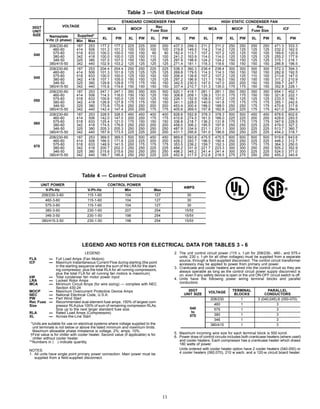
field power side on the right and control power supply on
the left. See Fig. 6.
FIELD POWER CONNECTIONS (See Fig. 7) — All power
wiring must comply with applicable local and national codes.
Install field-supplied, branch circuit fused disconnect(s) of a
type that can be locked off or open. Disconnect(s) must be
located within sight from and readily accessible from unit in
compliance with NEC Article 440-14 or local codes. See
Tables 3-6 for unit electrical data.
All field main power enters the unit through the control
box at the left end when facing the compressors. An access
hole is under the control box. All units have a single location
for power connection (except size 050-070, 208/230 units)
to simplify the field power wiring. For all sizes, maxi-
mum wire size that the unit terminal block will accept is
500 kcmil. Unit may use copper, copper-clad aluminum, or
aluminum conductors at all voltages.
For 208/230-3-60 units (sizes 050-070), parallel conduc-
tors are required. Power must be supplied by 6 parallel con-
ductors for these units.
FIELD CONTROL POWER CONNECTIONS (See Fig. 7)
— For 208/230-, 460- and 575-3-60 units: If the accessory
transformer is not used, provide a single-phase power source
for the control circuit through a field-supplied fused discon-
nect (per NEC or local code). This conductor must be cop-
per only. Control power enters the control box through a
7⁄8-in. (22.2-mm) conduit connection located on the right side
of the control section.
For 380-3-60 and 380/415-3-50 units: Control circuit volt-
age is taken from the line voltage, therefore, no additional
power supply is required for the unit. If a separate power
source is required for a particular application, disconnect the
wires between the control and power terminal blocks.
For 346-3-50 Units: Provide a 230-1-50 power source for
the control circuit through a field-supplied fused disconnect
(per NEC or local code). This conductor must be copper only.
Control power enters the control box through a 7⁄8-in.
(22 mm) conduit connection located on the right side of the
control section.
Units with a power supply of 208/230-, 460- and 575-
3-60 require 115-1-60 control circuit power. Units with a power
supply of 380-3-60 have 230-1-60 control circuit power, which
is taken from the unit’s power supply voltage. Units with a
power supply of 380/415-3-50 have 230-1-50 control circuit
power, which is also taken from the unit’s power supply volt-
age. Units with a 346-3-50 power supply require a separate
230-1-50 control power source. For control circuit current
draw, see Table 4.
Control circuit power draw includes the compressor crank-
case heaters at 180 watts each, the cooler heaters (if equipped)
at 210 watts each, and the electronic board heater at 120 watts.
Sizes 040-050 have 2 cooler heaters; sizes 060 and 070 have
4 cooler heaters.
Crankcase and cooler heaters are all wired into the con-
trol circuit ahead of the control circuit switch. There-
fore, they are always active even if the control circuit
switch is OFF.
An interlock circuit for external safeties, such as the Chilled
Water (Fluid) Flow Switch (CWFS), Remote On-Off, and
Chilled Water (Fluid) Pump Interlock (CWPI) is provided
between terminals TB6-3 and TB6-4 for field use. To use
this circuit, remove the factory jumper and install the switches.
FLAT
WASHER
BOLT
Fig. 4 — Compressor Mounting View
FLAT
WASHER BOLTPAN
Fig. 5 — Compressor Mounting Bolt
8
Step 5 — Install Accessories
ELECTRICAL — Several electrical accessories are avail-
able to provide the following optional features (for details,
refer to the Controls and Troubleshooting book):
• Accessory temperature reset board and accessory therm-
istor (used for any of the following types of temperature
reset):
— Return-fluid temperature reset
— Space temperature reset (requires accessory
thermistor)
— Outdoor-air temperature reset (requires accessory
thermistor)
• Chilled fluid flow switch
LOW-AMBIENT OPERATION — If operating tempera-
tures below 0° F (−18 C) are expected, refer to separate in-
stallation instructions for low-ambient operation, Motormaster௡
III control.
HOT GAS BYPASS — Hot gas bypass usually is not rec-
ommended because it results in application of equipment out
of its normal design application range. However, if its use is
required, the appropriate hot gas bypass package may be used.
For installation details, refer to separate instructions sup-
plied with the accessory package.
MISCELLANEOUSACCESSORIES — For applications re-
quiring special accessories, the following packages are avail-
able: Condenser Hail Guard, Gage Panel, Security Grille
Package, Condenser Fan Sound Reduction Kit, and CPCS
(Compressor Protection Control System) packages.
PRE-START-UP
IMPORTANT: Before beginning Pre-Start-Up or Start-
Up, complete Start-Up Checklist for Flotronic™ Chiller
Systems at center of this publication. The Checklist
assures proper start-up of a unit and provides a record
of unit condition, application requirements, system in-
formation, and operation at initial start-up.
Do not attempt to start the chiller until following checks
have been completed.
System Check
1. Check all auxiliary components, such as the chilled fluid
circulating pump, air-handling equipment, or other equip-
ment to which the chiller supplies liquid. Consult manu-
facturer’s instructions. If the unit has field-installed ac-
cessories, be sure all are properly installed and wired
correctly. Refer to unit wiring diagrams.
2. Backseat (open) compressor suction and discharge shut-
off valves. Close valves one turn to allow refrigerant pres-
sure to reach the test gages.
3. Open liquid line service valves.
4. Fill the chiller fluid circuit with clean water (with rec-
ommended inhibitor added) or other noncorrosive fluid
to be cooled. Bleed all air out of high points of system.
An air vent is included with the cooler. If outdoor tem-
peratures are expected to be below 32 F (0° C), suffi-
cient inhibited ethylene glycol (or other suitable
corrosion-inhibitive antifreeze) should be added to the
chiller fluid circuit to prevent possible freeze-up.
30GT510568 –
FU
SE
F U S E
FU
SE
E6
Fig. 6 — Control Box
9
LEGEND
A — Alarm
CWFS — Chilled Water (Fluid) Flow
Switch
CWPI — Chilled Water (Fluid) Pump
Interlock
GND — Ground
NEC — National Electrical Code, U.S.A.
O.A. — Outdoor Air
TB — Terminal Block
Field Power Wiring
Field Control Wiring
Factory Installed Wiring
NOTES:
1. Factory wiring is in accordance with NEC. Field modifica-
tions or additions must be in compliance with all applicable
codes.
2. Wiring for main field power supply must be rated 75 C mini-
mum. Use copper, copper-clad aluminum, or aluminum con-
ductors for all units.
3. Power for control circuit should be supplied from a separate
source through a field-supplied fused disconnect with 30 amp
maximum protection for 115-v control circuits, 15 amp maxi-
mum protection for 230-v control circuit for a unit with cooler
heaters, and 5 amp maximum for a unit without cooler heat-
ers. Connect control circuit power to terminals 1 and 2 of
TB4. Connect neutral side of supply to terminal 2 of TB4.
Control circuit conductors for all units must be copper only.
4. Terminals 3 and 4 of TB6 are for field connection of remote
ON-OFF control, CWPI, and CWFS. The contacts must be
rated for dry circuit application capable of reliably switching
a 5 vdc, .5 mA. load. Remove jumper between 3 and 4 of
TB6 if remote ON-OFF is installed.
5. The maximum load allowed for the remote alarm circuit is
75 va sealed, 360 va inrush at 115 or 230 v, depending on
model. Remove resistor across terminals 1 and 2 of TB5
when using remote alarm.
6. Dimensions in [ ] are millimeters.
Fig. 7 — Field Wiring
10
Table 3 — Unit Electrical Data
30GT
UNIT
SIZE
VOLTAGE
STANDARD CONDENSER FAN HIGH STATIC CONDENSER FAN
MCA MOCP Rec
Fuse Size
ICF MCA MOCP Rec
Fuse Size
ICF
Nameplate
V-Hz (3 phase)
Supplied*
XL PW XL PW XL PW XL PW XL PW XL PW XL PW XL PW
Min Max
040
208/230-60 187 253 177.2 177.2 225 225 200 200 437.3 299.3 211.2 211.2 250 250 250 250 471.3 333.3
460-60 414 506 101.2 101.2 100 100 100 100 219.8 149.5 114.2 114.2 125 125 125 125 232.2 162.5
575-60 518 633 100.0 100.0 100 100 90 90 162.4 113.7 107.2 107.2 125 125 100 100 169.6 120.9
380-60 342 418 100.0 100.0 125 100 110 100 241.2 163.9 114.0 114.0 125 125 125 125 255.2 177.9
346-50 325 380 107.0 107.0 150 150 125 125 297.9 198.9 124.2 124.2 150 150 125 125 315.1 216.1
380/415-50 342 440 102.9 103.2 125 125 125 125 271.4 181.1 118.3 118.6 150 150 150 150 286.8 196.5
045
208/230-60 187 253 204.4 204.4 250 250 225 225 538.3 360.3 238.4 238.4 300 300 300 300 572.3 394.3
460-60 414 506 101.3 101.6 125 125 125 125 269.8 179.5 114.3 114.3 150 150 150 150 282.8 192.5
575-60 518 633 100.0 100.0 125 100 100 100 206.4 139.8 107.2 107.2 125 125 110 100 213.6 147.0
380-60 342 418 107.1 105.0 150 150 125 125 297.2 196.9 121.1 118.0 150 150 150 150 311.2 210.9
346-50 325 380 129.8 129.8 175 175 150 150 342.5 230.5 147.0 147.0 200 200 150 150 359.7 247.7
380/415-50 342 440 115.9 119.6 150 150 150 150 337.4 210.7 131.3 135.0 175 175 150 150 352.8 226.1
050
208/230-60 187 253 247.1 247.1 350 350 300 300 620.1 418.1 281.1 281.1 350 350 350 350 654.1 452.1
460-60 414 506 114.3 118.0 150 150 125 150 308.8 209.1 128.3 131.0 175 175 150 150 321.8 222.1
575-60 518 633 100.6 100.0 125 100 125 100 226.1 152.9 108.0 107.2 125 125 125 125 233.3 160.1
380-60 342 418 126.9 127.8 175 175 150 150 341.1 228.5 140.9 141.8 175 175 175 175 355.1 242.5
346-50 325 380 170.8 170.8 250 250 200 200 453.4 300.4 188.0 188.0 250 250 175 175 470.6 317.6
380/415-50 342 440 142.4 147.4 200 200 175 175 405.6 269.5 157.8 162.8 225 225 175 175 421.0 284.9
060
208/230-60 187 253 328.5 328.5 450 450 400 400 828.8 552.8 378.3 378.3 500 500 450 450 878.6 602.6
460-60 414 506 142.0 147.0 200 200 175 175 410.6 274.5 161.0 166.0 225 225 200 200 429.6 293.5
575-60 518 633 125.4 121.0 175 150 150 150 336.8 218.7 136.2 131.8 175 175 175 175 347.6 229.5
380-60 342 418 174.5 176.6 250 250 200 200 458.0 306.2 195.5 197.6 250 250 225 225 479.0 327.2
346-50 325 380 205.3 205.3 250 250 250 250 487.9 334.9 231.1 231.1 300 300 225 225 513.7 360.7
380/415-50 342 440 167.9 173.5 225 225 200 200 431.1 295.6 191.0 196.6 250 250 225 225 454.2 318.7
070
208/230-60 187 253 369.5 369.5 500 500 450 450 869.8 593.8 475.5 475.5 600 600 500 500 919.6 643.6
460-60 414 506 166.0 171.6 225 225 200 200 429.2 293.7 196.0 190.4 250 250 225 225 448.2 312.7
575-60 518 633 148.9 141.5 200 175 175 175 353.5 239.2 159.7 152.3 200 200 175 175 364.3 250.0
380-60 342 418 200.7 202.3 250 250 225 225 484.2 331.9 221.7 223.3 300 300 250 250 505.2 352.9
346-50 325 380 215.6 215.6 250 250 250 250 498.2 345.2 241.4 241.4 300 300 225 225 524.0 371.0
380/415-50 342 440 189.7 195.4 250 250 225 225 452.9 317.5 212.8 218.5 275 275 250 250 455.2 340.6
Table 4 — Control Circuit
UNIT POWER CONTROL POWER
AMPS
V-Ph-Hz V-Ph-Hz Min Max
208/230-3-60 115-1-60 104 127 30
460-3-60 115-1-60 104 127 30
575-3-60 115-1-60 104 127 30
380-3-60 230-1-60 207 254 15/5†
346-3-50 230-1-50 198 254 15/5†
380/415-3-50 230-1-50 198 254 15/5†
LEGEND AND NOTES FOR ELECTRICAL DATA FOR TABLES 3 - 6
LEGEND
FLA — Full Load Amps (Fan Motors)
ICF — Maximum Instantaneous Current Flow during starting (the point
in the starting sequence where the sum of the LRA for the start-
ing compressor, plus the total RLA for all running compressors,
plus the total FLA for all running fan motors is maximum)
kW — Total condenser fan motor power input
LRA — Locked Rotor Amps
MCA — Minimum Circuit Amps (for wire sizing) — complies with NEC
Section 430-24
MOCP — Maximum Overcurrent Protective Device Amps
NEC — National Electrical Code, U.S.A.
PW — Part Wind Start
Rec Fuse
Size
— Recommended dual-element fuse amps: 150% of largest com-
pressor RLA plus 100% of sum of remaining compressor RLAs.
Size up to the next larger standard fuse size.
RLA — Rated Load Amps (Compressors)
XL — Across-the-Line Start
*Units are suitable for use on electrical systems where voltage supplied to the
unit terminals is not below or above the listed minimum and maximum limits.
Maximum allowable phase imbalance is voltage, 2%; amps, 10%.
†First value is for chiller with cooler heater. Second value (if applicable) is for
chiller without cooler heater.
**Numbers in ( ) indicate quantity.
NOTES:
1. All units have single point primary power connection. Main power must be
supplied from a field-supplied disconnect.
2. The unit control circuit power (115 v, 1-ph for 208/230-, 460-, and 575-v
units; 230 v, 1-ph for all other voltages) must be supplied from a separate
source, through a field-supplied disconnect. The control circuit transformer
accessory may be applied to power from primary unit power.
3. Crankcase and cooler heaters are wired into the control circuit so they are
always operable as long as the control circuit power supply disconnect is
on, even if any safety device is open or the unit ON-OFF circuit switch is off.
4. Units have the following power wiring terminal blocks and parallel
conductors:
30GT
UNIT SIZE
VOLTAGE
TERMINAL
BLOCKS
PARALLEL
CONDUCTORS
040
to
070
208/230 1 3 (040,045),6 (050-070)
460 1 3
575 1 3
380 1 3
346 1 3
380/415 1 3
5. Maximum incoming wire size for each terminal block is 500 kcmil.
6. Power draw of control circuits includes both crankcase heaters (where used)
and cooler heaters. Each compressor has a crankcase heater which draws
180 watts of power.
Units ordered with cooler heater option have 2 cooler heaters (040-050) or
4 cooler heaters (060,070), 210 w each, and a 120-w circuit board heater.
11
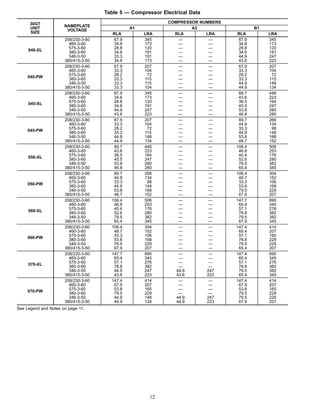
Table 5 — Compressor Electrical Data
30GT
UNIT
SIZE
NAMEPLATE
VOLTAGE
COMPRESSOR NUMBERS
A1 A2 B1
RLA LRA RLA LRA RLA LRA
040-XL
208/230-3-60 67.9 345 — — 67.9 345
460-3-60 34.6 173 — — 34.6 173
575-3-60 28.8 120 — — 28.8 120
380-3-60 34.6 191 — — 34.6 191
346-3-50 33.3 191 — — 44.9 247
380/415-3-50 34.6 173 — — 43.6 223
040-PW
208/230-3-60 67.9 207 — — 67.9 207
460-3-60 33.3 104 — — 33.3 104
575-3-60 28.2 72 — — 28.2 72
380-3-60 33.3 115 — — 33.3 115
346-3-50 33.3 115 — — 44.9 148
380/415-3-50 33.3 104 — — 44.9 134
045-XL
208/230-3-60 67.9 345 — — 89.7 446
460-3-60 34.6 173 — — 43.6 223
575-3-60 28.8 120 — — 36.5 164
380-3-60 34.6 191 — — 45.5 247
346-3-50 44.9 247 — — 53.8 280
380/415-3-50 43.6 223 — — 46.8 280
045-PW
208/230-3-60 67.9 207 — — 89.7 268
460-3-60 33.3 104 — — 44.9 134
575-3-60 28.2 72 — — 33.3 98
380-3-60 33.3 115 — — 44.9 148
346-3-50 44.9 148 — — 53.8 168
380/415-3-50 44.9 134 — — 48.7 152
050-XL
208/230-3-60 89.7 446 — — 106.4 506
460-3-60 43.6 223 — — 46.8 253
575-3-60 36.5 164 — — 40.4 176
380-3-60 45.5 247 — — 52.6 280
346-3-50 53.8 280 — — 79.5 382
380/415-3-50 46.8 280 — — 65.4 345
050-PW
208/230-3-60 89.7 268 — — 106.4 304
460-3-60 44.9 134 — — 48.7 152
575-3-60 33.3 98 — — 33.3 106
380-3-60 44.9 148 — — 53.8 168
346-3-50 53.8 168 — — 79.5 229
380/415-3-50 48.7 152 — — 67.9 207
060-XL
208/230-3-60 106.4 506 — — 147.7 690
460-3-60 46.8 253 — — 65.4 345
575-3-60 40.4 176 — — 57.1 276
380-3-60 52.6 280 — — 78.8 382
346-3-50 79.5 382 — — 79.5 382
380/415-3-50 65.4 345 — — 67.9 345
060-PW
208/230-3-60 106.4 304 — — 147.4 414
460-3-60 48.7 152 — — 65.4 207
575-3-60 33.3 106 — — 57.1 165
380-3-60 53.8 168 — — 78.8 229
346-3-50 79.5 229 — — 79.5 229
380/415-3-50 67.9 207 — — 65.4 207
070-XL
208/230-3-60 147.7 690 — — 147.4 690
460-3-60 65.4 345 — — 65.4 345
575-3-60 57.1 276 — — 57.1 276
380-3-60 78.8 382 — — 78.8 382
346-3-50 44.9 247 44.9 247 79.5 382
380/415-3-50 43.6 223 43.6 223 65.4 345
070-PW
208/230-3-60 147.4 414 — — 147.4 414
460-3-60 67.9 207 — — 67.9 207
575-3-60 53.8 165 — — 53.8 165
380-3-60 79.5 229 — — 79.5 229
346-3-50 44.9 148 44.9 247 79.5 229
380/415-3-50 44.9 134 44.9 223 67.9 207
See Legend and Notes on page 11.
12
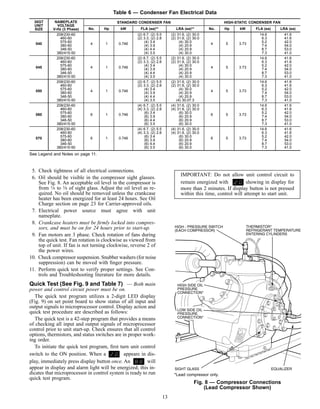
Table 6 — Condenser Fan Electrical Data
30GT
UNIT
SIZE
NAMEPLATE
VOLTAGE
V-Hz (3 Phase)
STANDARD CONDENSER FAN HIGH-STATIC CONDENSER FAN
No. Hp kW FLA (ea)** LRA (ea)** No. Hp kW FLA (ea) LRA (ea)
040
208/230-60
4 1 0.746
(2) 6.7, (2) 5.5 (2) 31.6, (2) 30.0
4 5 3.73
14.6 41.6
460-60 (2) 3.3, (2) 2.8 (2) 31.6, (2) 30.0 6.3 41.6
575-60 (4) 3.4 (4) 30.0 5.2 42.0
380-60 (4) 3.9 (4) 20.9 7.4 54.0
346-50 (4) 4.4 (4) 20.9 8.7 53.0
380/415-50 (4) 3.5 (4) 30.0 7.3 41.0
045
208/230-60
4 1 0.746
(2) 6.7, (2) 5.5 (2) 31.6, (2) 30.0
4 5 3.73
14.6 41.6
460-60 (2) 3.3, (2) 2.8 (2) 31.6, (2) 30.0 6.3 41.6
575-60 (4) 3.4 (4) 30.0 5.2 42.0
380-60 (4) 3.9 (4) 20.9 7.4 54.0
346-50 (4) 4.4 (4) 20.9 8.7 53.0
380/415-50 (4) 3.5 (4) 30.0 7.3 41.0
050
208/230-60
4 1 0.746
(2) 6.7, (2) 5.5 (2) 31.6, (2) 30.0
4 5 3.73
14.6 41.6
460-60 (2) 3.3, (2) 2.8 (2) 31.6, (2) 30.0 6.3 41.6
575-60 (4) 3.4 (4) 30.0 5.2 42.0
380-60 (4) 3.9 (4) 20.9 7.4 54.0
346-50 (4) 4.4 (4) 20.9 8.7 53.0
380/415-50 (4) 3.5 (4) 30.07.3 7.3 41.0
060
208/230-60
6 1 0.746
(4) 6.7, (2) 5.5 (4) 31.6, (2) 30.0
6 5 3.73
14.6 41.6
460-60 (4) 3.3, (2) 2.8 (4) 31.6, (2) 30.0 6.3 41.6
575-60 (6) 3.4 (6) 30.0 5.2 42.0
380-60 (6) 3.9 (6) 20.9 7.4 54.0
346-50 (6) 4.4 (6) 20.9 8.7 53.0
380/415-50 (6) 3.5 (6) 30.0 7.3 41.0
070
208/230-60
6 1 0.746
(4) 6.7, (2) 5.5 (4) 31.6, (2) 30.0
6 5 3.73
14.6 41.6
460-60 (4) 3.3, (2) 2.8 (4) 31.6, (2) 30.0 6.3 41.6
575-60 (6) 3.4 (6) 30.0 5.2 42.0
380-60 (6) 3.9 (6) 20.9 7.4 54.0
346-50 (6) 4.4 (6) 20.9 8.7 53.0
380/415-50 (6) 3.5 (6) 30.0 7.3 41.0
See Legend and Notes on page 11.
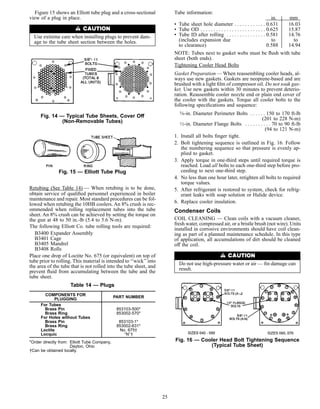
5. Check tightness of all electrical connections.
6. Oil should be visible in the compressor sight glasses.
See Fig. 8. An acceptable oil level in the compressor is
from 1⁄8 to 3⁄8 of sight glass. Adjust the oil level as re-
quired. No oil should be removed unless the crankcase
heater has been energized for at least 24 hours. See Oil
Charge section on page 23 for Carrier-approved oils.
7. Electrical power source must agree with unit
nameplate.
8. Crankcase heaters must be firmly locked into compres-
sors, and must be on for 24 hours prior to start-up.
9. Fan motors are 3 phase. Check rotation of fans during
the quick test. Fan rotation is clockwise as viewed from
top of unit. If fan is not turning clockwise, reverse 2 of
the power wires.
10. Check compressor suspension. Snubber washers (for noise
suppression) can be moved with finger pressure.
11. Perform quick test to verify proper settings. See Con-
trols and Troubleshooting literature for more details.
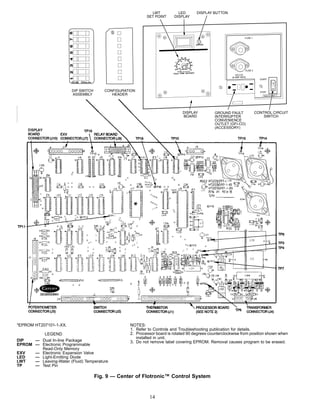
Quick Test (See Fig. 9 and Table 7) — Both main
power and control circuit power must be on.
The quick test program utilizes a 2-digit LED display
(Fig. 9) on set point board to show status of all input and
output signals to microprocessor control. Display action and
quick test procedure are described as follows:
The quick test is a 42-step program that provides a means
of checking all input and output signals of microprocessor
control prior to unit start-up. Check ensures that all control
options, thermistors, and status switches are in proper work-
ing order.
To initiate the quick test program, first turn unit control
switch to the ON position. When a appears in dis-
play, immediately press display button once. An will
appear in display and alarm light will be energized; this in-
dicates that microprocessor in control system is ready to run
quick test program.
IMPORTANT: Do not allow unit control circuit to
remain energized with showing in display for
more than 2 minutes. If display button is not pressed
within this time, control will attempt to start unit.
*Lead compressor only.
Fig. 8 — Compressor Connections
(Lead Compressor Shown)
13
FUSE 1
DISPLAY BUTTON
GROUND FAULT
INTERRUPTER
CONVENIENCE
OUTLET (GFI-CO)
(ACCESSORY)
*EPROM HT207101-1-XX.
LEGEND
DIP — Dual In-line Package
EPROM — Electronic Programmable
Read-Only Memory
EXV — Electronic Expansion Valve
LED — Light-Emitting Diode
LWT — Leaving-Water (Fluid) Temperature
TP — Test Pin
NOTES:
1. Refer to Controls and Troubleshooting publication for details.
2. Processor board is rotated 90 degrees counterclockwise from position shown when
installed in unit.
3. Do not remove label covering EPROM. Removal causes program to be erased.
Fig. 9 — Center of Flotronic™ Control System
14
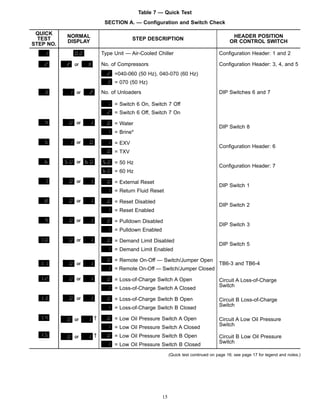
Table 7 — Quick Test
SECTION A. — Configuration and Switch Check
QUICK
NORMAL
DISPLAY
STEP DESCRIPTION HEADER POSITION
OR CONTROL SWITCH
TEST
STEP NO.
Type Unit — Air-Cooled Chiller Configuration Header: 1 and 2
No. of Compressors Configuration Header: 3, 4, and 5
=040-060 (50 Hz), 040-070 (60 Hz)
= 070 (50 Hz)
No. of Unloaders DIP Switches 6 and 7
= Switch 6 On, Switch 7 Off
= Switch 6 Off, Switch 7 On
= Water
DIP Switch 8
= Brine*
= EXV
Configuration Header: 6
= TXV
= 50 Hz
Configuration Header: 7
= 60 Hz
= External Reset
DIP Switch 1
= Return Fluid Reset
= Reset Disabled
DIP Switch 2
= Reset Enabled
= Pulldown Disabled
DIP Switch 3
= Pulldown Enabled
= Demand Limit Disabled
DIP Switch 5
= Demand Limit Enabled
= Remote On-Off — Switch/Jumper Open
TB6-3 and TB6-4
= Remote On-Off — Switch/Jumper Closed
= Loss-of-Charge Switch A Open Circuit A Loss-of-Charge
Switch
= Loss-of-Charge Switch A Closed
= Loss-of-Charge Switch B Open Circuit B Loss-of-Charge
Switch
= Loss-of-Charge Switch B Closed
† = Low Oil Pressure Switch A Open Circuit A Low Oil Pressure
Switch
= Low Oil Pressure Switch A Closed
† = Low Oil Pressure Switch B Open Circuit B Low Oil Pressure
Switch
= Low Oil Pressure Switch B Closed
(Quick test continued on page 16; see page 17 for legend and notes.)
15
Table 7 — Quick Test (cont)
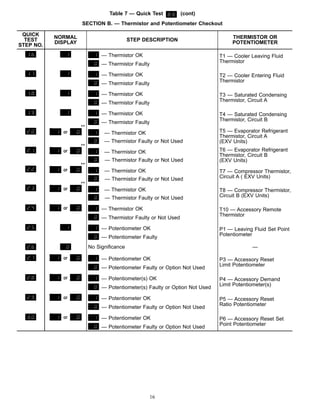
SECTION B. — Thermistor and Potentiometer Checkout
QUICK
NORMAL
DISPLAY
STEP DESCRIPTION THERMISTOR OR
POTENTIOMETER
TEST
STEP NO.
— Thermistor OK T1 — Cooler Leaving Fluid
Thermistor— Thermistor Faulty
— Thermistor OK T2 — Cooler Entering Fluid
Thermistor
— Thermistor Faulty
— Thermistor OK T3 — Saturated Condensing
Thermistor, Circuit A— Thermistor Faulty
— Thermistor OK T4 — Saturated Condensing
Thermistor, Circuit B
— Thermistor Faulty
**
— Thermistor OK T5 — Evaporator Refrigerant
Thermistor, Circuit A
(EXV Units)— Thermistor Faulty or Not Used
**
— Thermistor OK T6 — Evaporator Refrigerant
Thermistor, Circuit B
(EXV Units)— Thermistor Faulty or Not Used
**
— Thermistor OK T7 — Compressor Thermistor,
Circuit A ( EXV Units)— Thermistor Faulty or Not Used
**
— Thermistor OK T8 — Compressor Thermistor,
Circuit B (EXV Units)— Thermistor Faulty or Not Used
— Thermistor OK T10 — Accessory Remote
Thermistor
— Thermistor Faulty or Not Used
— Potentiometer OK P1 — Leaving Fluid Set Point
Potentiometer
— Potentiometer Faulty
No Significance —
— Potentiometer OK P3 — Accessory Reset
Limit Potentiometer
— Potentiometer Faulty or Option Not Used
— Potentiometer(s) OK P4 — Accessory Demand
Limit Potentiometer(s)
— Potentiometer(s) Faulty or Option Not Used
— Potentiometer OK P5 — Accessory Reset
Ratio Potentiometer
— Potentiometer Faulty or Option Not Used
— Potentiometer OK P6 — Accessory Reset Set
Point Potentiometer
— Potentiometer Faulty or Option Not Used
16
Table 7 — Quick Test (cont)
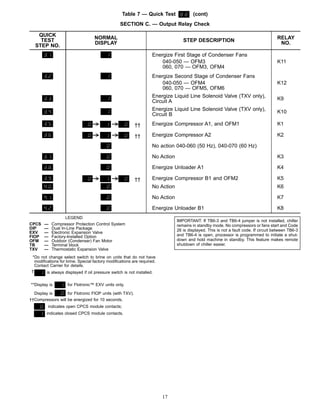
SECTION C. — Output Relay Check
QUICK
NORMAL
DISPLAY
STEP DESCRIPTION RELAY
NO.
TEST
STEP NO.
Energize First Stage of Condenser Fans
040-050 — OFM3 K11
060, 070 — OFM3, OFM4
Energize Second Stage of Condenser Fans
040-050 — OFM4 K12
060, 070 — OFM5, OFM6
Energize Liquid Line Solenoid Valve (TXV only),
Circuit A K9
Energize Liquid Line Solenoid Valve (TXV only),
Circuit B K10
†† Energize Compressor A1, and OFM1 K1
†† Energize Compressor A2 K2
No action 040-060 (50 Hz), 040-070 (60 Hz)
No Action K3
Energize Unloader A1 K4
†† Energize Compressor B1 and OFM2 K5
No Action K6
No Action K7
Energize Unloader B1 K8
LEGEND
CPCS — Compressor Protection Control System
DIP — Dual In-Line Package
EXV — Electronic Expansion Valve
FIOP — Factory-Installed Option
OFM — Outdoor (Condenser) Fan Motor
TB — Terminal block
TXV — Thermostatic Expansion Valve
*Do not change select switch to brine on units that do not have
modifications for brine. Special factory modifications are required.
Contact Carrier for details.
† is always displayed if oil pressure switch is not installed.
**Display is for Flotronic™ EXV units only.
Display is for Flotronic FIOP units (with TXV).
††Compressors will be energized for 10 seconds.
indicates open CPCS module contacts;
indicates closed CPCS module contacts.
IMPORTANT: If TB6-3 and TB6-4 jumper is not installed, chiller
remains in standby mode. No compressors or fans start and Code
26 is displayed. This is not a fault code. If circuit between TB6-3
and TB6-4 is open, processor is programmed to initiate a shut-
down and hold machine in standby. This feature makes remote
shutdown of chiller easier.
17
For each step of the 42-step program, display button must
be pressed twice. On first press, step number is displayed;
second press initiates required action and code, as shown in
Table 7.
NOTE: Step number is a numeral followed by a decimal point
(a 2-digit number has a decimal point after each numeral).
Action code number is one or 2 digits with no decimal point(s).
IMPORTANT: Once quick test is initiated, display but-
ton must be pressed at least once every 10 minutes for
control to remain in quick test mode. If button is not
pressed within this time, control will attempt to start
unit.
To recheck any step in quick test, control must be re-
cycled by turning unit control circuit switch off for a few
seconds, then on again. Restart quick test program as de-
scribed above and proceed through quick test steps. Press
display button twice for each step until step to be rechecked
is reached.
The quick test program is divided into 3 sections as
described below and shown in Table 7. For more detailed
information refer to Controls and Troubleshooting
publication.
QUICK TEST STEPS 1 - 15: UNIT CONFIGURATION —
Microprocessor in unit control system is programmed by 2
switch assemblies located on processor board (Fig. 9). Con-
figuration header is factory set and cannot be changed in the
field. The DIP (dual in-line package) switch assembly con-
tains 8 microswitches that must be set in accordance with
various options and accessories selected. As shipped from
factory, all DIP switches except those controlling pulldown
option (switch no. 3), and compressor unloaders on com-
pressor B1 (switch no. 7) are in OFF position. Switch no. 8
is in OFF position for water units, and in ON position for
brine units. All DIP switches should be checked and set to
proper position for options selected during quick test.
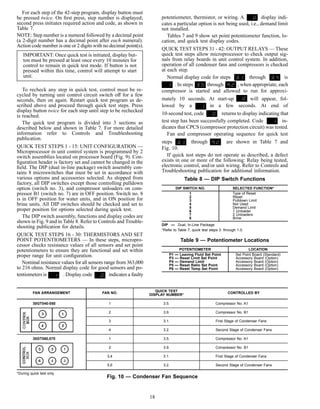
The DIP switch assembly, functions and display codes are
shown in Fig. 9 and in Table 8. Refer to Controls and Trouble-
shooting publication for details.
QUICK TEST STEPS 16 - 30: THERMISTORS AND SET
POINT POTENTIOMETERS — In these steps, micropro-
cessor checks resistance values of all sensors and set point
potentiometers to ensure they are functional and set within
proper range for unit configuration.
Nominal resistance values for all sensors range from 363,000
to 216 ohms. Normal display code for good sensors and po-
tentiometers is . Display code indicates a faulty
potentiometer, thermistor, or wiring. A display indi-
cates a particular option is not being used, i.e., demand limit
not installed.
Tables 7 and 9 show set point potentiometer function, lo-
cation, and quick test display codes.
QUICK TEST STEPS 31 - 42: OUTPUT RELAYS — These
quick test steps allow microprocessor to check output sig-
nals from relay boards in unit control system. In addition,
operation of all condenser fans and compressors is checked
at each step.
Normal display code for steps through is
. In steps through , when appropriate, each
compressor is started and allowed to run for approxi-
mately 10 seconds. At start-up will appear, fol-
lowed by a in a few seconds. At end of
10-second test, code returns to display indicating that
test step has been successfully completed. Code in-
dicates that CPCS (compressor protection circuit) was tested.
Fan and compressor operating sequence for quick test
steps through are shown in Table 7 and
Fig. 10.
If quick test steps do not operate as described, a defect
exists in one or more of the following: Relay being tested,
electronic control, and/or unit wiring. Refer to Controls and
Troubleshooting publication for additional information.
Table 8 — DIP Switch Functions
DIP SWITCH NO. SELECTED FUNCTION*
1 Type of Reset
2 Reset
3 Pulldown Limit
4 Not Used
5 Demand Limit
6 1 Unloader
7 2 Unloaders
8 Brine
DIP — Dual, In-Line Package
*Refer to Table 7, quick test steps 3. through 1.0.
Table 9 — Potentiometer Locations
POTENTIOMETER LOCATION
P1 — Leaving Fluid Set Point Set Point Board (Standard)
P3 — Reset Limit Set Point Accessory Board (Option)
P4 — Demand Limit Accessory Board (Option)
P5 — Reset Ratio Set Point Accessory Board (Option)
P6 — Reset Temp Set Point Accessory Board (Option)
FAN ARRANGEMENT FAN NO.
QUICK TEST
DISPLAY NUMBER* CONTROLLED BY
30GT040-050 1 3.5. Compressor No. A1
2 3.9. Compressor No. B1
3 3.1. First Stage of Condenser Fans
4 3.2. Second Stage of Condenser Fans
30GT060,070 1 3.5. Compressor No. A1
2 3.9. Compressor No. B1
3,4 3.1. First Stage of Condenser Fans
5,6 3.2. Second Stage of Condenser Fans
*During quick test only.
Fig. 10 — Condenser Fan Sequence
18
START-UP AND OPERATION
NOTE: Complete Start-Up Checklist at center of publica-
tion (pages CL-1 to CL-4) prior to starting unit.
Digital Display Action — The electronic control
system uses a 2-digit LED (light-emitting diode) display lo-
cated on display set point board (see Fig. 9) to show opera-
tional information and diagnostic codes.
When control ON-OFF switch is turned to ON position,
display shows for 2 minutes to indicate control is in
initialization mode. Electronic expansion valve (EXV) will
be closed as part of initialization sequence. This does not
occur on FIOP (factory-installed option) units, where a con-
ventional thermostatic expansion valve (TXV) is used.
After a 2-minute period, display turns off and unit is al-
lowed to start. If button is pressed after the has
been removed from display, operational status codes or di-
agnostic information will be shown as long as button is held
in. Code numbers on display will have following
significance:
CODE OPERATIONAL
NUMBER STATUS
0-12 Capacity stage
20-26 Operational information
51-87 Overload information
Under normal operation, only stage number will be dis-
played. If an operational status code or an overload code is
displayed, the display will rotate every 2 seconds and will
display up to 3 numbers. Overload information will take pri-
ority over all other codes. The codes will be stored by the
microprocessor as long as board is energized.
IMPORTANT: The memory is cleared when control
power is removed.
Actual Start-Up — Actual start-up should be done only
under supervision of a qualified refrigeration mechanic.
1. Be sure all service valves are open. The unit is shipped
from the factory with the suction, discharge, and liquid
line service valves closed.
2. Set leaving fluid temperature using LWT setpoint knob
on front of control. No cooling range adjustment is
necessary.
3. If accessory reset boards are used, set potentiometers prop-
erly. Refer to Controls and Troubleshooting book for
details.
4. Start chilled fluid pump.
5. Turn ON-OFF switch to ON position. The display will
read . The machine checks all potentiometers and
thermistors for valid readings. In approximately 2 min-
utes, the reading is no longer displayed, and the
machine is operational.
Allow the unit to operate and confirm that everything is
functioning properly. Check the leaving-fluid tempera-
ture and be sure that it agrees with the set point poten-
tiometer P1. If the temperature setting does not agree, the
set point can be compensated by shifting the control point
slightly. If temperature reset is in effect, the leaving-fluid
temperature may not agree with the set point.
Operating Limitations
TEMPERATURES (See Table 10) — If unit is to be used in
an area with high solar radiation, mounted position should
be such that control box is not exposed to direct solar
radiation. Exposure to direct solar radiation could affect the
temperature switch controlling cooler heaters.
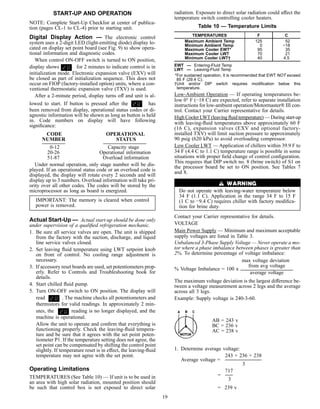
Table 10 — Temperature Limits
TEMPERATURES F C
Maximum Ambient Temp 125 52
Minimum Ambient Temp 0 −18
Maximum Cooler EWT* 95 35
Maximum Cooler LWT 70 21
Minimum Cooler LWT† 40 4.5
EWT — Entering-Fluid Temp
LWT — Leaving-Fluid Temp
*For sustained operation, it is recommended that EWT NOT exceed
85 F (29.4 C).
†Unit and/or DIP switch requires modification below this
temperature.
Low-Ambient Operation — If operating temperatures be-
low 0° F (−18 C) are expected, refer to separate installation
instructions for low-ambient operation/Motormaster® III con-
trol. Contact your Carrier representative for details.
High Cooler LWT(leaving fluid temperature) — During start-up
with leaving-fluid temperatures above approximately 60 F
(16 C), expansion valves (EXV and optional factory-
installed TXV) will limit suction pressure to approximately
90 psig (620 kPa) to avoid overloading compressor.
Low Cooler LWT — Application of chillers within 39.9 F to
34 F (4.4 C to 1.1 C) temperature range is possible in some
situations with proper field change of control configuration.
This requires that DIP switch no. 8 (brine switch) of S1 on
the processor board be set to ON position. See Tables 7
and 8.
Do not operate with leaving-water temperature below
34 F (1.1 C). Application in the range 34 F to 15 F
(1 C to −9.4 C) requires chiller with factory modifica-
tion for brine duty.
Contact your Carrier representative for details.
VOLTAGE
Main Power Supply — Minimum and maximum acceptable
supply voltages are listed in Table 3.
Unbalanced 3-Phase Supply Voltage — Never operate a mo-
tor where a phase imbalance between phases is greater than
2%. To determine percentage of voltage imbalance:
max voltage deviation
from avg voltage
% Voltage Imbalance = 100 x
average voltage
The maximum voltage deviation is the largest difference be-
tween a voltage measurement across 2 legs and the average
across all 3 legs.
Example: Supply voltage is 240-3-60.
AB = 243 v
BC = 236 v
AC = 238 v
1. Determine average voltage:
243 + 236 + 238
Average voltage =
3
717
=
3
= 239 v
19
2. Determine maximum deviation from average voltage:
(AB) 243 - 239 = 4 v
(BC) 239 - 236 = 3 v
(AC) 239 - 238 = 1 v
Maximum deviation is 4 v.
3. Determine % voltage imbalance:
4
% Voltage Imbalance = 100 x
239
= 1.7%
This voltage imbalance is satisfactory as it is below the
maximum allowable of 2%.
IMPORTANT: If the supply voltage phase imbalance
is more than 2%, contact your local electric utility com-
pany immediately. Do not operate unit until imbalance
condition is corrected.
Control Circuit Power— Electronic control includes logic to
detect low control circuit voltage. Acceptable voltage range
is shown in Table 4.
MINIMUM FLUID LOOP VOLUME — To obtain proper
temperature control, loop fluid volume must be at least
3 gallons per ton (3.25 L per kW) of chiller nominal capac-
ity for air conditioning and at least 6 gallons per ton (6.5 L
per kW) for process applications or systems that must op-
erate in low ambients (below 32 F [0° C]). Refer to appli-
cation information in Product Data literature for details.
FLOW RATE REQUIREMENTS — Standard chillers should
be applied with nominal flow rates approximating those listed
in Table 11. Higher or lower flow rates are permissible to
obtain lower or higher temperature rises. Minimum flow rates
must be exceeded to assure turbulent flow and proper heat
transfer in the cooler.
Operation below minimum flow could subject tubes to
frost pinching in tube sheet, resulting in failure of cooler.
Consult application data and job design requirements to
determine flow rate requirements for particular installation.
Table 11 — Nominal and Minimum Cooler
Fluid Flow Rates
30GT
UNIT
SIZE
NOMINAL FLOW
RATE*
MINIMUM FLOW
RATE (See Notes)
Gpm L/s Gpm L/s
040 86 5.43 36.8 2.38
045 101 6.37 37.7 2.38
050 123 7.76 37.7 2.38
060 151 9.53 47.5 3.00
070 173 10.91 47.5 3.00
LEGEND
ARI — Air Conditioning and Refrigeration Institute (U.S.A.)
N — Liters per kW
V — Gallons per ton
*Nominal flow rates required at ARI conditions 44 F (7 C) leaving-
fluid temperature, 54 F (12 C) entering-fluid temperature, 95 F (35 C)
ambient. Fouling factor .00025 ft2
• hr • F/Btu (.000044 m2
• K/W).
NOTES:
1. Minimum flow based on 1.0 fps (0.30 m/s) velocity in cooler with-
out special cooler baffling.
2. Minimum Loop Volumes:
Gallons = V x ARI Cap. (tons)
Liters = N x ARI Cap. (kW)
APPLICATION V N
Normal Air Conditioning 3 3.25
Process Type Cooling 6 to 10 6.5 to 10.8
Low Ambient Unit Operation 6 to 10 6.5 to 10.8
Operation Sequence — During unit off cycle, crank-
case heaters are energized. If ambient temperature is below
36 F (2 C), cooler heaters and a microprocessor board heater
are also energized.
When control ON-OFF switch is turned to ON position,
control first goes through a 2-minute initialization period,
during which the display continuously shows .
Ninety (90) seconds after leaves display, control
begins to bring on compressors. Rate at which compressors
are started depends on leaving chilled fluid temperature and
rate of change of leaving-fluid temperature.
On all units, an automatic lead-lag feature in control sys-
tem determines by random selection either circuit A or B to
start first.
At first call for cooling, microprocessor starts first com-
pressor, deenergizes crankcase heater, and starts one con-
denser fan.
UNITS WITH EXV — The EXV remains closed for 10 sec-
onds to purge cooler and suction line of any liquid refrig-
erant that may have migrated to these areas during off pe-
riod. After 10 seconds, EXV starts to open. As more cooling
is required, control brings on additional stages of capacity.
Loading sequence for compressors is shown in Table 12.
Lag compressor will shut down, and lead compressor will
continue to run.After lag compressor has shut down, the EXV
is signaled to close. Lead compressor remains on until EXV
is less than 600 steps open, and either the saturated suction
temperature is less than 25 F (−4 C) as sensed by thermistor
T5 or T6, or one minute has elapsed.
UNITS WITH STANDARD TXV — Liquid line solenoid
valve is not energized for first 10 seconds of compressor op-
eration. This is called pumpout cycle.
Microprocessor determines how rapidly capacity stages are
added or subtracted, based on deviation from leaving chilled
fluid temperature set point and rate of change of leaving-
fluid temperature. If fluid temperature is very warm and pull-
down option is being used, microprocessor limits rate of
temperature drop of leaving fluid to 1° F (0.56° C) per minute
to avoid high peak kW charges. If the capacity is being lim-
ited by pulldown, the control display shows when
the display button is pressed. Once capacity has been sat-
isfied, the unit starts to shut down.
Lag compressor will be shut down and lead compressor
continues to run for 10 seconds to purge cooler of any
refrigerant.
LOAD SHED — If load shed option is being used, control
limits maximum capacity to load shed input value. Refer to
Controls and Troubleshooting publication for details. If ca-
pacity is limited by a load shed signal, display shows
when display button is pressed.
TEMPERATURE RESET — If temperature reset is being
used, microprocessor adjusts leaving-fluid temperature to ob-
tain greater part-load efficiency. Refer to Controls and Trouble-
shooting book for details. If leaving-fluid temperature is
being reset, display shows when the display button
is pressed.
HEAD PRESSURE CONTROL
Units with EXV — Microprocessor also controls EXV to main-
tain a superheat of 24° to 30° F (13.3° to 16.7° C) entering
compressor cylinders.
20
Table 12 — Capacity Control Steps
30GT
UNIT
SIZE
CONTROL
STEPS
LOADING
SEQUENCE A
LOADING
SEQUENCE B
%
Displace-
ment
(Approx)
Compressors
%
Displace-
ment
(Approx)
Compressors
040
(60 Hz)
A1†
1 25 A1* 25 A1*
2 50 A1 50 A1
3 75 A1*, B1 75 A1*, B1
4 100 A1, B1 100 A1, B1
040
(60 Hz)
A1†, B1**
1 25 A1* 25 B1*
2 50 A1*, B1* 50 A1*, B1*
3 75 A1*, B1 75 A1, B1*
4 100 A1, B1 100 A1, B1
040 (50 Hz)
045 (60 Hz)
A1†
1 22 A1* 22 A1*
2 44 A1 44 A1
3 78 A1*, B1 78 A1*, B1
4 100 A1, B1 100 A1, B1
040 (50 Hz)
045 (60 Hz)
A1†, B1**
1 22 A1* 38 B1*
2 59 A1*, B1* 59 A1*, B1*
3 78 A1*, B1 81 A1, B1*
4 100 A1, B1 100 A1, B1
045 (50 Hz)
050 (60 Hz)
A1†
1 31 A1* 31 A1*
2 46 A1 46 A1
3 85 A1*, B1 85 A1*, B1
4 100 A1, B1 100 A1, B1
045 (50 Hz)
050 (60 Hz)
A1†, B1**
1 31 A1* 36 B1*
2 67 A1*, B1* 66 A1*, B1*
3 85 A1*, B1 85 A1, B1*
4 100 A1, B1 100 A1, B1
050 (50 Hz)
060 (60 Hz)
A1†
1 29 A1* 29 A1*
2 43 A1 43 A1
3 86 A1*, B1 86 A1*, B1
4 100 A1, B1 100 A1, B1
050 (50 Hz)
060 (60 Hz)
A1†, B1**
1 29 A1* 38 B1*
2 67 A1*, B1* 67 A1*, B1*
3 86 A1*, B1 81 A1, B1*
4 100 A1, B1 100 A1, B1
060 (50 Hz)
070 (60 Hz)
A1†
1 33 A1* 33 A1*
2 50 A1 50 A1
3 83 A1*, B1 83 A1*, B1
4 100 A1, B1 100 A1, B1
060 (50 Hz)
070 (60 Hz)
A1†, B1**
1 33 A1* 33 B1*
2 67 A1*, B1* 67 A1*, B1*
3 83 A1*, B1 83 A1, B1*
4 100 A1, B1 100 A1, B1
070
(50 Hz)
A1†
1 19 A1* 19 A1*
2 29 A1 29 A1
3 62 A1*, B1 62 A1*, B1
4 72 A1, B1 72 A1, B1
5 90 A1*, A2, B1 90 A1*, A2, B1
6 100 A1, A2, B1 100 A1, A2, B1
070
(50 Hz)
A1†, B1**
1 19 A1* 29 B1*
2 48 A1*, B1* 48 A1*, B1*
3 62 A1*, B1 57 A1, B1*
4 72 A1, B1 72 A1, B1
5 91 A1*, A2, B1 91 A1*, A2, B1
6 100 A1, A2, B1 100 A1, A2, B1
*Compressor unloaded.
†Compressor unloader, standard.
**Compressor unloader, accessory.
NOTES:
1. The microprocessor has a random number generator that selects loading
sequence A or B, which in turn determines the compressor circuit that is
energized first. This balances operating hours on each circuit over an ex-
tended period of time.
2. If unit operation is anticipated with system load below minimum unloaded
capacity of chiller:
a. Consider using 2 smaller units in place of the larger unit.
b. Increase fluid loop volume to ensure adequate run time (see Applica-
tion Data in Product Data literature).
c. Consider adding accessory hot gas bypass package.
Microprocessor control also cycles condenser fans on and
off to maintain an adequate pressure differential across ex-
pansion valves. Fans are controlled by position of EXV and
saturated condensing temperature thermistors (T3 and T4).
When expansion valve is fully open and superheat is greater
than 40° F (22° C), fan stages are removed; when the valve
is approximately half open, fan stages are added. This al-
lows unit to run at very low condensing temperatures at part
load. Thus chiller has very high part-load EERs (energy ef-
ficiency ratios). Fan sequence is shown in Fig. 10.
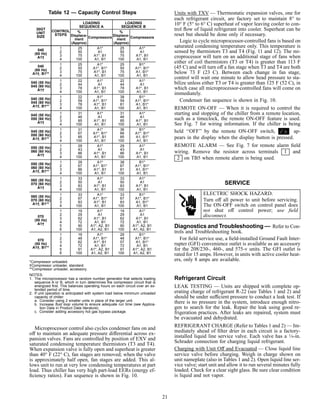
Units with TXV — Thermostatic expansion valves, one for
each refrigerant circuit, are factory set to maintain 8° to
10° F (5° to 6° C) superheat of vapor leaving cooler to con-
trol flow of liquid refrigerant into cooler. Superheat can be
reset but should be done only if necessary.
Logic to cycle microprocessor-controlled fans is based on
saturated condensing temperature only. This temperature is
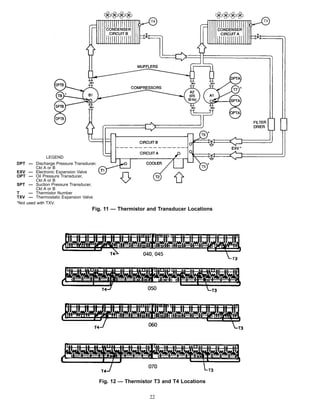
sensed by thermistors T3 and T4 (Fig. 11 and 12). The mi-
croprocessor will turn on an additional stage of fans when
either of coil thermistors (T3 or T4) is greater than 113 F
(45 C) and will turn off a fan stage when T3 and T4 are both
below 73 F (23 C). Between each change in fan stage,
control will wait one minute to allow head pressure to sta-
bilize unless either T3 or T4 is greater than 125 F (52 C), in
which case all microprocessor-controlled fans will come on
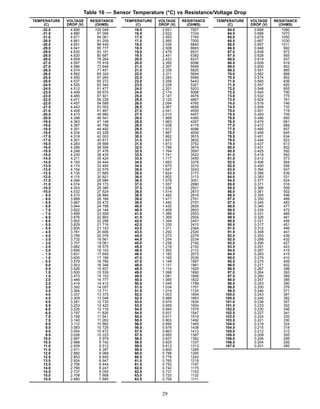
immediately.
Condenser fan sequence is shown in Fig. 10.
REMOTE ON-OFF — When it is required to control the
starting and stopping of the chiller from a remote location,
such as a timeclock, the remote ON-OFF feature is used.
See Fig. 7 for wiring information. If the chiller is being
held ‘‘OFF’’ by the remote ON-OFF switch, ap-
pears in the display when the display button is pressed.
REMOTE ALARM — See Fig. 7 for remote alarm field
wiring. Remove the resistor across terminals 1 and
2 on TB5 when remote alarm is being used.
SERVICE
ELECTRIC SHOCK HAZARD.
Turn off all power to unit before servicing.
The ON-OFF switch on control panel does
not shut off control power; use field
disconnect.
Diagnostics and Troubleshooting — Refer to Con-
trols and Troubleshooting book.
For field service use, a field-installed Ground Fault Inter-
rupter (GFI) convenience outlet is available as an accessory
for the 208/230-, 460-, and 575-v units. The GFI outlet is
rated for 15 amps. However, in units with active cooler heat-
ers, only 8 amps are available.
Refrigerant Circuit
LEAK TESTING — Units are shipped with complete op-
erating charge of refrigerant R-22 (see Tables 1 and 2) and
should be under sufficient pressure to conduct a leak test. If
there is no pressure in the system, introduce enough nitro-
gen to search for the leak. Repair the leak using good re-
frigeration practices. After leaks are repaired, system must
be evacuated and dehydrated.
REFRIGERANT CHARGE (Refer to Tables 1 and 2) — Im-
mediately ahead of filter drier in each circuit is a factory-
installed liquid line service valve. Each valve has a 1⁄4-in.
Schrader connection for charging liquid refrigerant.
Charging with Unit Off and Evacuated — Close liquid line
service valve before charging. Weigh in charge shown on
unit nameplate (also in Tables 1 and 2). Open liquid line ser-
vice valve; start unit and allow it to run several minutes fully
loaded. Check for a clear sight glass. Be sure clear condition
is liquid and not vapor.
21
LEGEND
DPT — Discharge Pressure Transducer,
Ckt A or B
EXV — Electronic Expansion Valve
OPT — Oil Pressure Transducer,
Ckt A or B
SPT — Suction Pressure Transducer,
Ckt A or B
T — Thermistor Number
TXV — Thermostatic Expansion Valve
*Not used with TXV.
Fig. 11 — Thermistor and Transducer Locations
Fig. 12 — Thermistor T3 and T4 Locations
22
Charging with Unit Running — If charge is to be added while
unit is operating, all condenser fans and compressors must
be operating. It may be necessary to block condenser coils
at low ambient temperatures to raise condensing pressure to
approximately 280 psig (1931 kPa) to turn all condenser fans
on. Do not totally block a coil to do this. Partially block all
coils in uniform pattern. Charge each circuit until sight glass
shows clear liquid, then weigh in amount over a clear sight
glass as listed in Tables 1 and 2.
IMPORTANT: When adjusting refrigerant charge, cir-
culate fluid through cooler continuously to prevent freez-
ing and possible damage to the cooler. Do not over-
charge, and never charge liquid into low-pressure side
of system.
Electronic Components
CONTROL COMPONENTS — Unit uses an advanced elec-
tronic control system that normally does not require service.
For details on controls, refer to Controls and Troubleshoot-
ing book.
UNIT CONTROL BOX — Viewed facing compressors, con-
trol box is at left end of unit.All incoming power enters through
box. Control box contains power components and electronic
controls. Outer panels are hinged and latched for easy open-
ing. Remove screws to remove inner panels. Outer panels
can be held open for service and inspection by using door
retainer on each panel. Remove bottom pin from door re-
tainer assembly, swing retainer out horizontally, and engage
pin in one of the retainer ears and the hinge assembly.
Compressors — If lead compressor on either refriger-
ant circuit becomes inoperative for any reason, circuit is locked
off and cannot be operated due to features built into the elec-
tronic control system. Do not attempt to bypass controls to
force compressors to run.
COMPRESSOR REMOVAL — Access to the pump end of
the compressor is from the compressor side of the unit. Ac-
cess to the motor end of the compressor is from the inside
of the unit. All compressors can be removed from the com-
pressor side of the unit.
IMPORTANT: All compressor mounting hardware and
support brackets removed during servicing must be re-
installed prior to start-up.
Following the installation of the new compressor:
Tighten discharge and suction service valves to —
Compressor(s)
20 - 25 ft-lb (27 - 34 N-m) 06E250
80 - 90 ft-lb (109 - 122 N-m) 06E265,275,299
Tighten suction valves to —
80 - 90 ft-lb (109 - 122 N-m) 06E250
90 - 120 ft-lb (122 - 163 N-m) 06E265,275,299
Tighten the following fittings to —
120 in.-lb (13.5 N-m) High-Pressure Switch
120 in.-lb (13.5 N-m) Loss-of-Charge Switch
OIL CHARGE (Refer to Table 13) — All units are factory
charged with oil. Acceptable oil level for each compressor is
from 1⁄8 to 3⁄8 of sight glass (see Fig. 8).
When additional oil or a complete charge is required, use
only Carrier-approved compressor oil.
Approved oils are as follows:
Petroleum Specialties, Inc. — Cryol 150 (factory oil charge)
Texaco, Inc. — Capella WF-32
Witco Chemical Co. — Suniso 3GS
Table 13 — Oil Charge
COMPRESSOR
OIL REQUIRED
Pts L
06E250 14 6.6
06E265 19 9.0
06E275 19 9.0
06E299 19 9.0
Do not reuse drained oil, and do not use any oil that has
been exposed to atmosphere.
Cooler — The cooler is easily accessible from the cooler
side of the unit. The refrigerant feed components are acces-
sible from the control box end of the unit.
COOLER REMOVAL — Cooler can be removed from the
cooler side of the unit as follows:
1. To ensure the refrigerant is in the condenser, follow this
procedure:
a. For 30GT070 (50 Hz) only, open the circuit breaker
and close the discharge valve for the lag compressor
(A2).
Do not close the discharge valve of an operating com-
pressor. Severe damage to the compressor can
result.
b. Close the liquid line service valve for one circuit. Al-
low the lead compressor to pump down that circuit
until it reaches approximately 10 to 15 psig (68.8 to
103.2 kPa).
c. As soon as the system reaches that pressure, shut down
the lead compressor by opening the compressor cir-
cuit breaker, then quickly close the discharge service
valve for that compressor.
d. Repeat the procedure for the other circuit.
Open and tag all electrical disconnects before any
work begins. Keep in mind that cooler is heavy and
both fluid-side and refrigerant-side may be under
pressure.
2. Close the shutoff valves, if installed, in the cooler fluid
lines, and remove the cooler fluid piping.
3. Open the air vent at the top of the cooler, and open the
drain on the bottom of the cooler near the leaving fluid
outlet to drain the cooler. Both the drain and the air
vent are located on the leaving fluid end of cooler. See
Fig. 13.
4. Disconnect the conduit and cooler heater wires, if equipped.
Remove all thermistors from the cooler, being sure to la-
bel all thermistors as they are removed. Thermistor T2 is
immersed directly in the fluid. Thermistors T1, T5, and
T6 are friction-fit, well-type thermistors. See Fig. 13.
5. Remove the insulation on the refrigerant connection end
of the cooler.
6. Unbolt the suction flanges from the cooler head. Save the
bolts.
7. Remove the liquid lines by breaking the silver-soldered
joints at the cooler liquid line nozzles.
8. Remove the screws in the cooler feet. Slide the cooler
slightly to the left to clear the refrigerant tubing. Save all
screws. Remove the cooler carefully.
23
REPLACING COOLER — To replace the cooler:
1. Insert new cooler carefully into place. Reattach the screws
into the cooler feet (using saved screws).
2. Replace the liquid lines and solder at the cooler liquid
line nozzles.
3. Rebolt the suction flanges onto the cooler head using bolts
saved during removal. Use new gaskets for the suction
line flanges. Use compressor oil to aid in gasket sealing,
and tighten the suction flange bolts to 70 to
90 ft-lb (94 to 122 N-m).
NOTE: The suction flange is a 4-bolt pattern. See
Carrier specified parts for replacement part number, if
necessary.
4. Use adhesive, and reinstall the cooler insulation on the
refrigerant connection end of the cooler.
5. Reinstall the thermistors. Refer to Thermistors section on
page 30, and install as follows:
a. Apply pipe sealant to the 1⁄4-in. NPT threads on the
replacement coupling for the fluid side, and install it
in place of the original.
Do not use the packing nut to tighten the coupling.
Damage to the ferrules will result.
b. Reinstall thermistor T1 well, and insert thermistor T1
into well.
c. Install thermistor T2 (entering fluid temperature) so that
it is not touching an internal refrigerant tube, but so
that it is close enough to sense a freeze condition. The
recommended distance is1⁄8 in. (3.2 mm) from the cooler
tube.Tighten the packing nut finger tight, and then tighten
11⁄4 turns more using a back-up wrench.
6. Install the cooler heater and conduit (if equipped), con-
necting the wires as shown in the unit wiring schematic
located on the unit.
7. Close the air vent at the top of the cooler, and close the
drain on the bottom of the cooler near the leaving fluid
outlet. Both the drain and the air vent are located on the
leaving fluid end of the cooler. See Fig. 13.
8. Reconnect the cooler fluid piping, and open the shutoff
valves (if installed). Purge the fluid of all air before start-
ing unit.
9. Open the discharge service valves, close the circuit break-
ers, and open the liquid line service valves for the
compressors.
SERVICING COOLER — When cooler heads and partition
plates are removed, tube sheets are exposed showing ends of
tubes.
Certain tubes in the 10HB coolers cannot be removed.
Eight tubes in the bundle are secured inside the cooler
to the baffles and cannot be removed. These tubes are
marked by a dimple on the tube sheet. See Fig. 14. If
any of these tubes have developed a leak, plug the tube(s)
as described under Tube Plugging section below.
Tube Plugging — A leaky tube can be plugged until retub-
ing can be done. The number of tubes plugged determines
how soon cooler must be retubed. Tubes plugged in the area
of thermistor T2, particularly the tube that thermistor T2 is
adjacent to, will affect unit reliability and performance. Ther-
mistor T2 is used in the freeze protection algorithm for the
controller. If several tubes require plugging, check with your
local Carrier representative to find out how number and lo-
cation can affect unit capacity.
Fig. 13 — Cooler Thermistor Locations
LEGEND
EXV — Electronic Expansion Valve
24
Figure 15 shows an Elliott tube plug and a cross-sectional
view of a plug in place.
Use extreme care when installing plugs to prevent dam-
age to the tube sheet section between the holes.
Retubing (See Table 14) — When retubing is to be done,
obtain service of qualified personnel experienced in boiler
maintenance and repair. Most standard procedures can be fol-
lowed when retubing the 10HB coolers. An 8% crush is rec-
ommended when rolling replacement tubes into the tube
sheet. An 8% crush can be achieved by setting the torque on
the gun at 48 to 50 in.-lb (5.4 to 5.6 N-m).
The following Elliott Co. tube rolling tools are required:
B3400 Expander Assembly
B3401 Cage
B3405 Mandrel
B3408 Rolls
Place one drop of Loctite No. 675 (or equivalent) on top of
tube prior to rolling. This material is intended to ‘‘wick’’into
the area of the tube that is not rolled into the tube sheet, and
prevent fluid from accumulating between the tube and the
tube sheet.
Table 14 — Plugs
COMPONENTS FOR PART NUMBERPLUGGING
For Tubes
Brass Pin 853103-500*
Brass Ring 853002-570*
For Holes without Tubes
Brass Pin 853103-1*
Brass Ring 853002-631*
Loctite No. 675†
Locquic ‘‘N’’†
*Order directly from: Elliott Tube Company,
Dayton, Ohio
†Can be obtained locally.
Tube information:
in. mm
• Tube sheet hole diameter . . . . . . . . . . . . 0.631 16.03
• Tube OD . . . . . . . . . . . . . . . . . . . . . . . . . 0.625 15.87
• Tube ID after rolling . . . . . . . . . . . . . . . 0.581 14.76
(includes expansion due to to
to clearance) 0.588 14.94
NOTE: Tubes next to gasket webs must be flush with tube
sheet (both ends).
Tightening Cooler Head Bolts
Gasket Preparation — When reassembling cooler heads, al-
ways use new gaskets. Gaskets are neoprene-based and are
brushed with a light film of compressor oil. Do not soak gas-
ket. Use new gaskets within 30 minutes to prevent deterio-
ration. Reassemble cooler nozzle end or plain end cover of
the cooler with the gaskets. Torque all cooler bolts to the
following specifications and sequence:
5⁄8-in. Diameter Perimeter Bolts . . . . . . 150 to 170 ft-lb
(201 to 228 N-m)
1⁄2-in. Diameter Flange Bolts . . . . . . . . . . 70 to 90 ft-lb
(94 to 121 N-m)
1. Install all bolts finger tight.
2. Bolt tightening sequence is outlined in Fig. 16. Follow
the numbering sequence so that pressure is evenly ap-
plied to gasket.
3. Apply torque in one-third steps until required torque is
reached. Load all bolts to each one-third step before pro-
ceeding to next one-third step.
4. No less than one hour later, retighten all bolts to required
torque values.
5. After refrigerant is restored to system, check for refrig-
erant leaks with soap solution or Halide device.
6. Replace cooler insulation.
Condenser Coils
COIL CLEANING — Clean coils with a vacuum cleaner,
fresh water, compressed air, or a bristle brush (not wire). Units
installed in corrosive environments should have coil clean-
ing as part of a planned maintenance schedule. In this type
of application, all accumulations of dirt should be cleaned
off the coil.
Do not use high-pressure water or air — fin damage can
result.
Fig. 16 — Cooler Head Bolt Tightening Sequence
(Typical Tube Sheet)
Fig. 14 — Typical Tube Sheets, Cover Off
(Non-Removable Tubes)
Fig. 15 — Elliott Tube Plug
25
Condenser Fans — Each fan is supported by a formed
wire mount bolted to fan deck and covered with a wire guard.
The exposed end of fan motor shaft is protected from weather
by grease. If fan motor must be removed for service or re-
placement, be sure to regrease fan shaft, and reinstall fan
guard.
STANDARD CONDENSER FANS — For proper perfor-
mance, top of fan propeller center should be 7⁄8 in. (22 mm)
below top of venturi on the fan deck for 60 Hz units. For
50 Hz units, distance between top of venturi and top of fan
hub should be 1⁄2 in. (13 mm). Tighten set screws to
15 ± 1 ft-lb (20 ± 1.3 N-m). Figure 17 shows proper position
of mounted fan.
IMPORTANT: Check for proper fan rotation (clock-
wise viewed from above). If necessary to reverse fan
rotation direction, switch any 2 power leads.
HIGH STATIC CONDENSER FANS — If the unit is equipped
with the high static fan option, the fan must be set from the
top of the fan deck to the plastic ring or center of the fan to
a distance of 2.15 in. ± 0.12 in. (54.6 ± 3 mm). This is dif-
ferent from standard fans, since there is no area available to
measure from the top of the orifice ring to the fan hub itself.
See Fig. 18.
IMPORTANT: Check for proper fan rotation (clock-
wise viewed from above). If necessary to reverse fan
rotation direction, switch any 2 power leads.
Refrigerant Feed Components — Each circuit has
all necessary refrigerant controls.
ELECTRONIC EXPANSION VALVE (EXV) — A cutaway
drawing of valve is shown in Fig. 19.
High-pressure liquid refrigerant enters valve through bot-
tom. A series of calibrated slots have been machined in side
of orifice assembly.As refrigerant passes through orifice, pres-
sure drops and refrigerant changes to a 2-phase condition
(liquid and vapor). To control refrigerant flow for different
operating conditions, sleeve moves up and down over ori-
fice and modulates orifice size. Sleeve is moved by a linear
stepper motor. Stepper motor moves in increments and is con-
trolled directly by processor board. As stepper motor rotates,
motion is transferred into linear movement by lead screw.
Through stepper motor and lead screw, 1500 discrete steps
of motion are obtained. The large number of steps and long
stroke results in very accurate control of refrigerant flow. The
valve orifice begins to be exposed at 320 steps. Since there
is not a tight seal with the orifice and the sleeve, the mini-
mum position for operation is 120 steps.
The microprocessor controls the valve. Two thermistor tem-
perature sensors are used to determine superheat. One ther-
mistor is located in the cooler and other is located in the
passage between compressor motor and cylinders. The dif-
ference between the 2 temperatures controls superheat. On
a normal TXV or EXV system, superheat leaving evaporator
is 10° F (5.6° C). Motor then adds approximately 15° to 20° F
(8° to 11° C), resulting in approximately 30° F (16.7° C)
superheat entering cylinders.
Because EXVs are controlled by processor board, it is pos-
sible to track valve position. By this means, head pressure is
controlled and unit is protected against loss of charge and a
faulty valve. During initial start-up, EXV is fully closed. Af-
ter initialization period, valve position is tracked by proces-
sor by constantly observing amount of valve movement.
The EXV is also used to limit cooler saturated suction tem-
perature to 55 F (13 C). This makes it possible for chiller to
start at higher cooler fluid temperatures without overloading
compressor. This is commonly referred to as MOP (maxi-
mum operating pressure).
If it appears that EXV is not properly controlling operat-
ing suction pressure or superheat, there are a number of checks
that can be made using quick test and initialization features
built into the microprocessor control. See the following sec-
tions and Controls and Troubleshooting literature for more
details.
Fig. 19 — Electronic Expansion Valve (EXV)
NOTE: Fan rotation is clockwise as viewed from top of unit.
Fig. 17 — Condenser Fan Adjustment for
Units with Standard Condenser Fans
Fig. 18 — Condenser Fan Adjustment for
Units with High Static Fan Option
26
Follow steps below to diagnose and correct EXV
problems.
Step 1 — Check Processor EXV Outputs — Check EXV out-
put signals at appropriate terminals on J7 terminal strip as
follows:
1. Turn power off.
2. Connect positive test lead of meter to terminal 8 on con-
nector J7 (see Fig. 20).
3. Set meter for approximately 20 vdc.
4. Turn power on, but do not enter quick test mode. For the
first 50 seconds, valve motor windings are alternately en-
ergized to close valve in circuit 1.
5. During this time, connect negative test lead to terminals
9, 10, 11, and 12 in succession. Voltage should rise and
fall at each pin. If it remains constant at a voltage or at
0 v, remove connector and recheck. If problem still ex-
ists, replace processor board. If problem no longer exists,
check EXV.
6. Turn power off and connect positive lead to terminal 1 on
connector J7.
7. Turn power on. After 50 seconds, motor windings in cir-
cuit 2 valve will begin to be energized.
8. During this time, connect negative test lead to terminals
2, 3, 4, and 5. Voltage should rise and fall at each pin. If
it remains constant at a voltage or at 0 v, remove con-
nector and recheck. If problem still exists, replace pro-
cessor board. If there is no longer a problem, check EXV.
Step 2 — Check EXV Wiring — Check wiring to EXVs from
J7 terminal strip on processor board (see Fig. 20).
1. Check color coding and wire connections. Make sure wires
are connected to correct terminals at J7 and EXV plug
connections.
2. Check for continuity and tight connection at all pin
terminals.
3. Check plug connections at J7 and at EXVs. Be sure EXV
connections are not crossed.
Step 3 — Check Resistance of EXV Motor Windings — Re-
move plug at J7 terminal strip and check resistance between
common lead (red wire, terminal D) and remaining leads A,
B, C, and E. Resistance should be 25 ohms ± 2 ohms.
Step 4 — Check Thermistors that Control EXV — Check
thermistors that control processor output voltage pulses to
EXVs. Circuit A thermistors are T5 and T7, and circuit B
thermistors are T6 and T8. Refer to Fig. 11 for location.
1. Use quick test steps 2.0. through 2.3. to determine if ther-
mistors are shorted or open.
2. Check thermistor calibration at a known temperature by
measuring actual resistance and comparing value mea-
sured with values listed in Tables 15 and 16.
3. Make sure that thermistor leads are connected to proper
pin terminals at J1 terminal strip on processor board and
that thermistor probes are located in proper position in
refrigerant circuit (Fig. 11 and 13).
When above checks have been completed, actual opera-
tion of EXV can be checked by using procedures outlined in
Step 5 — Check Operation of the EXV section below. Dur-
ing quick test steps 3.5. and 3.9., each EXV is opened ap-
proximately 500 steps by processor. This quick test feature,
along with initialization mode , can be used to verify
proper valve operation.
Step 5 — Check Operation of the EXV — Use following
procedure to check actual operation of EXVs.
1. Close liquid line service valve for circuit to be checked
and run through appropriate quick test step 3.5. or 3.9. to
pump down low side of system. Repeat quick test step 3
times to ensure all refrigerant has been pumped from low
side and that EXV has been driven fully open (1500 steps
open).
NOTE: Do not use control ON-OFF switch to recycle con-
trol during this step, and be sure to allow compressors to
run full 10 seconds at each step.
2. Turn OFF control circuit switch and compressor circuit
breaker(s). Close compressor service valves and remove
any remaining refrigerant from low side of system.
3. Remove screws holding top cover of EXV. Carefully re-
move top cover, using caution to avoid damage to the O-ring
seal and motor leads. If EXV plug was disconnected dur-
ing this process, reconnect it after the cover is removed.
4. Note position of lead screw (see Fig. 19). If valve has
responded properly to processor signals in Step 5.1 above,
valve should be fully open and lead screw should pro-
trude approximately 1⁄4 in. (6 mm) to 3⁄4 in. (19 mm) above
top of motor.
5. Recycle control by turning control circuit switch to ON
position. This puts control in initialization mode .
During first 100 seconds of initialization mode, each valve
is driven to fully closed position (zero steps open) by pro-
cessor. With cover lifted off EXV valve body, observe
operation of valve motor and lead screw. The motor should
turn in the counterclockwise (CCW) direction and lead
screw should move down into motor hub until valve is
fully closed. Lead screw movement should be smooth and
uniform from fully open to fully closed position.
6. When test has been completed, carefully reassemble
EXV. Be careful not to damage motor or O-ring when
reassembling valve. Open compressor service valves and
close compressor circuit breakers. Open liquid line ser-
vice valve. Turn control circuit switch to ON position,
and allow unit to operate. Verify proper operation of unit.
This process of opening and closing EXV can be repeated
by repeating quick test steps 3.5. or 3.9. and recycling con-
trol as described in proceeding steps. If valve does not op-
erate as described when properly connected to processor and
receiving correct signals, it should be replaced.
If operating problems persist after reassembly, they may
be due to out-of-calibration thermistor(s), or intermittent con-
nections between processor board terminals and EXV plug.
Recheck all wiring connections and voltage signals.EXV — Electronic Expansion Valve
Fig. 20 — Processor Board Connections
27
Table 15 — Sensor Temperature (°F) vs Resistance/Voltage Drop
TEMPERATURE VOLTAGE RESISTANCE
(F) DROP (V) (OHMS)
- 25 4.684 98,010
- 24 4.673 94,707
- 23 4.662 91,522
- 22 4.651 88,449
- 21 4.640 85,485
- 20 4.628 82,627
- 19 4.616 79,871
- 18 4.604 77,212
- 17 4.591 74,648
- 16 4.578 72,175
- 15 4.565 69,790
- 14 4.551 67,490
- 13 4.537 65,272
- 12 4.523 63,133
- 11 4.509 61,070
- 10 4.494 59,081
- 9 4.479 57,162
- 8 4.463 55,311
- 7 4.448 53,526
- 6 4.431 51,804
- 5 4.415 50,143
- 4 4.398 48,541
- 3 4.381 46,996
- 2 4.363 45,505
- 1 4.345 44,066
0 4.327 42,678
1 4.308 41,339
2 4.289 40,047
3 4.270 38,800
4 4.250 37,596
5 4.230 36,435
6 4.209 35,313
7 4.188 34,231
8 4.167 33,185
9 4.145 32,176
10 4.123 31,201
11 4.101 30,260
12 4.078 29,351
13 4.055 28,472
14 4.032 27,624
15 4.008 26,804
16 3.984 26,011
17 3.959 25,245
18 3.934 24,505
19 3.909 23,789
20 3.883 23,096
21 3.858 22,427
22 3.831 21,779
23 3.805 21,153
24 3.778 20,547
25 3.751 19,960
26 3.723 19,392
27 3.696 18,843
28 3.668 18,311
29 3.639 17,796
30 3.611 17,297
31 3.582 16,814
32 3.553 16,346
33 3.523 15,892
34 3.494 15,453
35 3.464 15,027
36 3.434 14,614
37 3.404 14,214
38 3.373 13,826
39 3.343 13,449
40 3.312 13,084
41 3.281 12,730
42 3.250 12,387
43 3.219 12,053
44 3.187 11,730
45 3.156 11,416
46 3.124 11,111
47 3.093 10,816
48 3.061 10,529
49 3.029 10,250
50 2.997 9,979
51 2.965 9,717
52 2.933 9,461
53 2.901 9,213
54 2.869 8,973
55 2.837 8,739
56 2.805 8,511
57 2.772 8,291
58 2.740 8,076
59 2.708 7,868
60 2.676 7,665
61 2.644 7,468
62 2.612 7,277
TEMPERATURE VOLTAGE RESISTANCE
(F) DROP (V) (OHMS)
63 2.581 7,091
64 2.549 6,911
65 2.517 6,735
66 2.486 6,564
67 2.454 6,399
68 2.423 6,237
69 2.391 6,081
70 2.360 5,929
71 2.329 5,781
72 2.299 5,637
73 2.268 5,497
74 2.237 5,361
75 2.207 5,229
76 2.177 5,101
77 2.147 4,976
78 2.117 4,855
79 2.088 4,737
80 2.058 4,622
81 2.029 4,511
82 2.000 4,403
83 1.972 4,298
84 1.943 4,195
85 1.915 4,096
86 1.887 4,000
87 1.859 3,906
88 1.832 3,814
89 1.805 3,726
90 1.778 3,640
91 1.751 3,556
92 1.725 3,474
93 1.699 3,395
94 1.673 3,318
95 1.647 3,243
96 1.622 3,170
97 1.597 3,099
98 1.572 3,031
99 1.548 2,964
100 1.523 2,898
101 1.500 2,835
102 1.476 2,773
103 1.453 2,713
104 1.430 2,655
105 1.407 2,598
106 1.385 2,542
107 1.362 2,488
108 1.341 2,436
109 1.319 2,385
110 1.298 2,335
111 1.277 2,286
112 1.256 2,238
113 1.236 2,192
114 1.216 2,147
115 1.196 2,103
116 1.176 2,060
117 1.157 2,018
118 1.138 1,977
119 1.120 1,937
120 1.101 1,898
121 1.083 1,860
122 1.065 1,822
123 1.048 1,786
124 1.030 1,750
125 1.013 1,715
126 0.997 1,680
127 0.980 1,647
128 0.964 1,614
129 0.948 1,582
130 0.932 1,550
131 0.917 1,519
132 0.902 1,489
133 0.887 1,459
134 0.872 1,430
135 0.857 1,401
136 0.843 1,373
137 0.829 1,345
138 0.815 1,318
139 0.802 1,291
140 0.788 1,265
141 0.775 1,239
142 0.762 1,214
143 0.750 1,189
144 0.737 1,165
145 0.725 1,141
146 0.713 1,118
147 0.701 1,095
148 0.689 1,072
149 0.678 1,050
151 0.655 1,007
TEMPERATURE VOLTAGE RESISTANCE
(F) DROP (V) (OHMS)
152 0.644 986
153 0.634 965
154 0.623 945
155 0.613 925
156 0.602 906
157 0.592 887
158 0.582 868
159 0.573 850
160 0.563 832
161 0.554 815
162 0.545 798
163 0.536 782
164 0.527 765
165 0.518 749
166 0.509 734
167 0.501 719
168 0.493 705
169 0.484 690
170 0.476 677
171 0.468 663
172 0.461 650
173 0.453 638
174 0.446 626
175 0.438 614
176 0.431 602
177 0.424 591
178 0.417 581
179 0.410 570
180 0.403 560
181 0.397 551
182 0.390 542
183 0.384 533
184 0.378 524
185 0.371 516
186 0.365 508
187 0.360 501
188 0.354 494
189 0.348 487
190 0.342 480
191 0.337 473
192 0.332 467
193 0.326 461
194 0.321 456
195 0.316 450
196 0.311 444
197 0.306 439
198 0.301 434
199 0.297 429
200 0.292 424
201 0.288 419
202 0.283 415
203 0.279 410
204 0.274 405
205 0.270 401
206 0.266 396
207 0.262 391
208 0.258 386
209 0.254 382
210 0.250 377
211 0.247 372
212 0.243 366
213 0.239 361
214 0.236 356
215 0.232 350
216 0.229 344
217 0.225 338
218 0.222 332
219 0.219 325
220 0.215 318
221 0.212 311
222 0.209 304
223 0.206 297
224 0.203 289
225 0.200 282
28
Table 16 — Sensor Temperature (°C) vs Resistance/Voltage Drop
TEMPERATURE VOLTAGE RESISTANCE
(C) DROP (V) (OHMS)
-32.0 4.690 100 049
-31.5 4.680 97 006
-31.0 4.671 94 061
-30.5 4.661 91 209
-30.0 4.651 88 449
-29.5 4.641 85 777
-29.0 4.630 83 191
-28.5 4.620 80 687
-28.0 4.609 78 264
-27.5 4.597 75 918
-27.0 4.586 73 648
-26.5 4.574 71 451
-26.0 4.562 69 324
-25.5 4.550 67 265
-25.0 4.537 65 272
-24.5 4.525 63 344
-24.0 4.512 61 477
-23.5 4.499 59 670
-23.0 4.485 57 921
-22.5 4.471 56 228
-22.0 4.457 54 589
-21.5 4.443 53 003
-21.0 4.428 51 467
-20.5 4.413 49 980
-20.0 4.398 48 541
-19.5 4.383 47 148
-19.0 4.367 45 799
-18.5 4.351 44 492
-18.0 4.334 43 228
-17.5 4.318 42 003
-17.0 4.301 40 817
-16.5 4.283 39 668
-16.0 4.266 38 556
-15.5 4.248 37 478
-15.0 4.230 36 435
-14.5 4.211 35 424
-14.0 4.193 34 444
-13.5 4.174 33 495
-13.0 4.154 32 576
-12.5 4.135 31 685
-12.0 4.115 30 821
-11.5 4.094 29 984
-11.0 4.074 29 173
-10.5 4.053 28 386
-10.0 4.032 27 624
- 9.5 4.010 26 884
- 9.0 3.989 26 168
- 8.5 3.967 25 472
- 8.0 3.944 24 798
- 7.5 3.922 24 144
- 7.0 3.899 23 509
- 6.5 3.876 22 893
- 6.0 3.852 22 296
- 5.5 3.829 21 716
- 5.0 3.805 21 153
- 4.5 3.781 20 606
- 4.0 3.756 20 076
- 3.5 3.732 19 561
- 3.0 3.707 19 061
- 2.5 3.682 18 575
- 2.0 3.656 18 103
- 1.5 3.631 17 645
- 1.0 3.605 17 199
- 0.5 3.579 16 766
0.0 3.553 16 346
0.5 3.526 15 937
1.0 3.500 15 539
1.5 3.473 15 153
2.0 3.446 14 777
2.5 3.419 14 412
3.0 3.392 14 057
3.5 3.364 13 711
4.0 3.337 13 375
4.5 3.309 13 048
5.0 3.281 12 730
5.5 3.253 12 420
6.0 3.225 12 119
6.5 3.197 11 826
7.0 3.169 11 541
7.5 3.140 11 263
8.0 3.112 10 992
8.5 3.083 10 729
9.0 3.054 10 472
9.5 3.026 10 223
10.0 2.997 9 979
10.5 2.968 9 742
11.0 2.939 9 512
11.5 2.911 9 287
12.0 2.882 9 068
12.5 2.853 8 855
13.0 2.824 8 647
13.5 2.795 8 444
14.0 2.766 8 247
14.5 2.737 8 055
15.0 2.708 7 868
15.5 2.680 7 685
TEMPERATURE VOLTAGE RESISTANCE
(C) DROP (V) (OHMS)
16.0 2.651 7507
16.5 2.622 7334
17.0 2.593 7165
17.5 2.565 7000
18.0 2.536 6840
18.5 2.508 6683
19.0 2.479 6531
19.5 2.451 6382
20.0 2.423 6237
20.5 2.395 6096
21.0 2.367 5959
21.5 2.339 5825
22.0 2.311 5694
22.5 2.283 5566
23.0 2.256 5442
23.5 2.228 5321
24.0 2.201 5203
24.5 2.174 5088
25.0 2.147 4976
25.5 2.120 4867
26.0 2.094 4760
26.5 2.067 4656
27.0 2.041 4555
27.5 2.015 4457
28.0 1.989 4360
28.5 1.963 4267
29.0 1.938 4175
29.5 1.912 4086
30.0 1.887 4000
30.5 1.862 3915
31.0 1.837 3832
31.5 1.813 3752
32.0 1.789 3674
32.5 1.764 3597
33.0 1.741 3523
33.5 1.717 3450
34.0 1.693 3379
34.5 1.670 3310
35.0 1.647 3243
35.5 1.624 3177
36.0 1.602 3113
36.5 1.579 3051
37.0 1.557 2990
37.5 1.536 2931
38.0 1.514 2873
38.5 1.492 2816
39.0 1.471 2761
39.5 1.450 2707
40.0 1.430 2655
40.5 1.409 2603
41.0 1.389 2553
41.5 1.369 2504
42.0 1.349 2457
42.5 1.330 2410
43.0 1.311 2364
43.5 1.292 2320
44.0 1.273 2276
44.5 1.254 2234
45.0 1.236 2192
45.5 1.218 2152
46.0 1.200 2112
46.5 1.182 2073
47.0 1.165 2035
47.5 1.148 1997
48.0 1.131 1961
48.5 1.114 1925
49.0 1.098 1890
49.5 1.081 1856
50.0 1.065 1822
50.5 1.049 1789
51.0 1.034 1757
51.5 1.019 1725
52.0 1.003 1694
52.5 0.988 1663
53.0 0.974 1634
53.5 0.959 1604
54.0 0.945 1575
54.5 0.931 1547
55.0 0.917 1519
55.5 0.903 1492
56.0 0.890 1465
56.5 0.876 1438
57.0 0.863 1412
57.5 0.850 1387
58.0 0.837 1362
58.5 0.825 1337
59.0 0.812 1313
59.5 0.800 1289
60.0 0.788 1265
60.5 0.776 1242
61.0 0.765 1219
61.5 0.753 1197
62.0 0.742 1175
62.5 0.731 1153
63.0 0.720 1132
63.5 0.709 1111
TEMPERATURE VOLTAGE RESISTANCE
(C) DROP (V) (OHMS)
64.0 0.698 1090
64.5 0.688 1070
65.0 0.678 1050
65.5 0.667 1030
66.0 0.657 1011
66.5 0.648 992
67.0 0.638 973
67.5 0.628 955
68.0 0.619 937
68.5 0.609 919
69.0 0.600 902
69.5 0.591 885
70.0 0.582 868
70.5 0.574 852
71.0 0.565 836
71.5 0.557 820
72.0 0.548 805
72.5 0.540 790
73.0 0.532 775
73.5 0.524 761
74.0 0.516 746
74.5 0.508 733
75.0 0.501 719
75.5 0.493 706
76.0 0.486 693
76.5 0.479 681
77.0 0.472 669
77.5 0.465 657
78.0 0.458 645
78.5 0.451 634
79.0 0.444 623
79.5 0.437 613
80.0 0.431 602
80.5 0.425 592
81.0 0.418 583
81.5 0.412 573
82.0 0.406 564
82.5 0.400 556
83.0 0.394 547
83.5 0.388 539
84.0 0.383 531
84.5 0.377 524
85.0 0.371 516
85.5 0.366 509
86.0 0.361 502
86.5 0.355 496
87.0 0.350 489
87.5 0.345 483
88.0 0.340 477
88.5 0.335 472
89.0 0.331 466
89.5 0.326 461
90.0 0.321 456
90.5 0.317 451
91.0 0.312 446
91.5 0.308 441
92.0 0.303 436
92.5 0.299 432
93.0 0.295 427
93.5 0.291 423
94.0 0.287 419
94.5 0.283 415
95.0 0.279 410
95.5 0.275 406
96.0 0.271 402
96.5 0.267 398
97.0 0.264 393
97.5 0.260 389
98.0 0.257 385
98.5 0.253 380
99.0 0.250 376
99.5 0.246 371
100.0 0.243 367
100.5 0.240 362
101.0 0.236 357
101.5 0.233 352
102.0 0.230 346
102.5 0.227 341
103.0 0.224 335
103.5 0.221 330
104.0 0.218 324
104.5 0.215 318
105.0 0.212 312
105.5 0.209 305
106.0 0.206 299
106.5 0.204 292
107.0 0.201 285
29
Other possible causes of improper refrigerant flow con-
trol could be restrictions in liquid line, plugged filter dri-
er(s), stuck liquid line solenoid valve(s), or restricted meter-
ing slots in the EXV. Formation of ice or frost on lower body
of EXV is one symptom of restricted metering slots. Clean
or replace valve if necessary.
NOTE: Frosting of valve is normal during quick test steps
3.5. and 3.9. and at initial start-up. Frost should dissipate
after a 5- to 10-minute operation of a system that is oper-
ating properly. If valve is to be replaced, wrap valve with a
wet cloth to prevent excessive heat from damaging internal
components. Superheat control built into valve is not
adjustable.
NOTE: The EXV orifice is a screw-in type and may be re-
moved for inspection and cleaning. Once the top cover has
been removed, the EXV motor may be taken out by remov-
ing the 2 cap screws securing motor to valve body. Pull mo-
tor, lead screw, and the slide assembly up off the orifice as-
sembly.Aslot has been cut in top of orifice assembly to facilitate
removal using a large screwdriver. Turn orifice assembly coun-
terclockwise to remove.
When cleaning or reinstalling orifice assembly, be careful
not to damage orifice assembly seals. The bottom seal acts
as a liquid shut-off, replacing a liquid line solenoid valve.
Reassembly of valve is made easier by screwing the slide
and lead screw assembly out of the motor. Align hole in top
of slide with the guide pin in orifice assembly, and gently
push slide and lead screw onto orifice assembly about half
way. Screw motor onto lead screw and secure EXV motor
with cap screws. Be careful not to twist or pull on wires from
EXV motor to valve cover pin connections. Check EXV op-
eration in test steps outlined on page 27.
THERMOSTATIC EXPANSION VALVE (TXV) — The FIOP
chiller is equipped with conventional TXV, one per circuit.
This control system necessitates use of a liquid line solenoid
valve. TXV is factory set to maintain 8° to 10° F (4.4° to
5.6° C) superheat of vapor leaving cooler by controlling flow
of refrigerant into cooler. Superheat can be reset but should
be done only if absolutely necessary.
When TXV is used, thermistors T5, T6, T7, and T8 are
eliminated (see Fig. 11).
TXV also incorporates an MOP feature to limit cooler suc-
tion to 55 F (13 C), making it possible for com-
pressor to start at higher cooler-fluid temperatures without
overloading.
MOISTURE-LIQUID INDICATOR — Clear flow of liquid
refrigerant indicates sufficient charge in system. Bubbles in
the sight glass indicate undercharged system or presence of
noncondensables. Moisture in system measured in parts per
million (ppm), changes color of indicator:
Green — moisture is below 45 ppm
Yellow-green (chartreuse) — 45 to 130 ppm (caution)
Yellow (wet) — above 130 ppm
Change filter drier at first sign of moisture in system.
IMPORTANT: Unit must be in operation at least
12 hours before moisture indicator can give an accu-
rate reading. With unit running, indicating element
must be in contact with liquid refrigerant to give true
reading.
FILTER DRIER — Whenever moisture-liquid indicator shows
presence of moisture, replace filter driers. There is one filter
drier on each circuit.
LIQUID LINE SOLENOID VALVE — All units have a liq-
uid line solenoid valve to prevent liquid refrigerant migra-
tion to low side of system during the off cycle.
LIQUID LINE SERVICE VALVE — This valve is located
immediately ahead of filter drier, and has a 1⁄4-in. Schrader
connection for field charging. In combination with compres-
sor discharge service valve, each circuit can be pumped down
into the high side for servicing.
Thermistors — Electronic control uses 4 to 9 ther-
mistors to sense temperatures used to control the operation
of chiller. See Table 17 for thermistors used.
Table 17 — Temperature Sensors (Thermistors)
SENSOR TEMPERATURE
T1 Cooler Leaving Fluid
T2 Cooler Entering Fluid
T3 Saturated Condensing Temperature — Circuit A
T4 Saturated Condensing Temperature — Circuit B
T5* Evaporator Refrigerant Temperature — Circuit A
T6* Evaporator Refrigerant Temperature — Circuit B
T7* Compressor Return Gas Temperature — Circuit A
T8* Compressor Return Gas Temperature — Circuit B
T10 Remote Temperature Sensor (Accessory)
*Not used on units with thermostatic expansion valve.
All thermistors are identical in their temperature vs re-
sistance and voltage drop performance. Resistances at vari-
ous temperatures are listed in Table 15 or 16.
LOCATION — General locations of thermistor sensors are
shown in Fig. 11.
Cooler Leaving Fluid Sensor (T1) — Sensor T1 is located in
the leaving-fluid nozzle. The probe is in a well immersed in
the fluid. Actual location is shown in Fig. 11 and 13.
Cooler Entering Fluid Sensor (T2) — Sensor T2 is located
in the cooler shell in first baffle space, in close proximity to
tube bundle. The 1⁄4-in. coupling is used (Fig. 21). Actual
location is shown in Fig. 11 and 13.
Saturated Condensing Temperature Sensors (T3 and T4) —
Sensors T3 and T4 are each clamped to outside of a return
bend on condenser coil. Exact locations for all units are shown
in Fig. 11 and 12.
Evaporator Refrigerant Sensors (T5 and T6) — Sensors T5
and T6 are located next to refrigerant inlet in cooler head.
Thermistors are well-type thermistors.Typical location is shown
in Fig. 11 and 13. (Not used on units with TXV.)
Compressor Return Gas Temperature Sensors (T7 and T8)
— Sensors T7 and T8 are located in lead compressor in each
circuit in a suction passage between motor and cylinders above
oil pump. They are well-type thermistors. Location is shown
in Fig. 11. (Not used on units with TXV.)
Remote Sensor (T10) — Sensor T10 is an accessory sensor
and is mounted remotely from unit. It is used for outdoor-air
or space temperature reset.
Sensor T2 is installed directly in the fluid circuit. Re-
lieve all pressure or drain fluid before removing.
To troubleshoot a sensor, refer to separate Controls and
Troubleshooting literature.
REPLACING THERMISTOR T2
1. Remove and discard original sensor and coupling. Do not
disassemble new coupling. Install assembly as received.
2. Apply pipe sealant to 1⁄4-in. NPT threads on replacement
coupling, and install in place of original. Do not use the
packing nut to tighten coupling. Damage to ferrules will
result.
30
3. Thermistor T2 (entering fluid temperature) should not be
touching an internal refrigerant tube, but should be
close enough to sense a freeze condition. Recommended
distance is 1⁄8 in. (3.2 mm) from cooler tube. Tighten pack-
ing nut finger tight to position ferrules, then tighten 11⁄4
turns more using a back-up wrench. Ferrules are now at-
tached to the sensor, which can be withdrawn from cou-
pling for service.
REPLACING THERMISTORS T1, T5, T6, T7, AND T8 —
Add a small amount of thermal conductive grease to ther-
mistor well. Thermistors are friction-fit thermistors, which
must be slipped into receivers located in the cooler leaving
fluid nozzle for T1, in the cooler head for T5 and T6 (EXV
units only), and in the compressor pump end for T7 and T8
(EXV units only).
THERMISTORS T3 AND T4 — These thermistors are lo-
cated on header end of condenser coil. They are clamped on
a return bend.
THERMISTOR/TEMPERATURE SENSOR CHECK — A
high quality digital volt-ohmmeter is required to perform this
check.
1. Connect the digital voltmeter across the appropriate
thermistor terminals at the J1 terminal strip on the pro-
cessor board (see Fig. 22 and Fig. 9). Using the voltage
reading obtained, read the sensor temperature from
Table 15 or 16. To check thermistor accuracy, measure
temperature at probe location with an accurate thermocouple-
type temperature measuring instrument. Insulate thermo-
couple to avoid ambient temperatures from influencing
reading. Temperature measured by thermocouple and tem-
perature determined from thermistor voltage reading should
be close, ± 5° F (3° C) if care was taken in applying ther-
mocouple and taking readings.
2. If a more accurate check is required, unit must be shut
down and thermistor removed and checked at a known
temperature (freezing point or boiling point of water) us-
ing either voltage drop measured across thermistor at
the J1 terminals with unit in quick test mode or
by determining the resistance with chiller shut down and
thermistor disconnected from J1.
Safety Devices — Chillers contain many safety de-
vices and protection logic built into electronic control. Fol-
lowing is a brief summary of major safeties. For complete
details refer to Controls and Troubleshooting literature.
COMPRESSOR PROTECTION
Circuit Breaker — One manual-reset, calibrated-trip, mag-
netic circuit breaker for each compressor protects against over-
current. Do not bypass or increase size of a breaker to cor-
rect problems. Determine cause for trouble and correct before
resetting breaker. Circuit breaker must-trip amps (MTA) are
listed on individual circuit breakers and on unit label
diagrams.
Compressor Protection Board (CPCS) or Control Relay (CR)
— The CPCS or CR is used to control and protect compres-
sors and crankcase heaters. Each provides following
features:
• Compressor contactor control
• Crankcase heater control
• Ground current protection (CPCS only)
• Status communication to processor board
• High-pressure protection
One large relay located on CPCS board (or unit CR) con-
trols crankcase heater and compressor contactor. In addi-
tion, relay provides a set of contacts that microprocessor
monitors to determine operating status of compressor. If pro-
cessor board determines that compressor is not operating prop-
erly through signal contacts, control locks compressor off.
The CPCS contains logic that can detect if current-to-
ground of any winding exceeds 2.5 amps; if so, compressor
shuts down.
A high-pressure switch with a trip pressure of 426 ±
7 psig (2936 ± 48 kPa) is mounted on each compressor; switch
setting is shown in Table 18. Switch is wired in series with
the CPCS or control relay. If switch opens, CPCS relay or
CR opens, processor detects it through signal contacts, and
compressor locks off.
Table 18 — Pressure Switch Settings, psig (kPa)
SWITCH CUTOUT CUT-IN
High Pressure 426 ± 7
(2936 ± 48)
320 ± 20
(2205 ± 138)
Loss-of-Charge 7 (48.2) 22 (151.6)
FLUID-SIDE TEMPERATURE SENSOR (T1) AND
REFRIGERANT TEMPERATURE SENSOR (T5, T6, T7, T8)
FLUID-SIDE TEMPERATURE SENSOR (T2)
NOTE: Dimensions in ( ) are in millimeters.
Fig. 21 — Thermistors (Temperature Sensors)
COMPR — Compressor
*Not used on FIOP (Factory-Installed Option) unit with TXV
(Thermostatic Expansion Valve).
Fig. 22 — Thermistor Connections to J1
Processor Board
31
If any of these switches opens during operation, the com-
pressor stops and the failure is detected by processor when
signal contacts open. On size 070, 50 Hz only, if lead com-
pressor in either circuit is shut down by high-pressure switch,
ground current protection, loss-of-charge switch, or oil pres-
sure switch, both compressors in the circuit (if applicable)
are locked off.
LOW OIL PRESSURE PROTECTION — Lead compressor
in each circuit is equipped with a switch to detect low oil
pressure. Switch is connected directly to processor board.
Switch is set to open at approximately 5 psig (35 kPa) and
to close at 9 psig (62 kPa) maximum. If switch opens when
compressor is running, CR or processor board stops all com-
pressors in circuit. During start-up, switch is bypassed for
2 minutes.
CRANKCASE HEATERS — Each compressor has a
180-w crankcase heater to prevent absorption of liquid re-
frigerant by oil in crankcase when compressor is not run-
ning. Heater power source is auxiliary control power, inde-
pendent of main unit power. This assures compressor protection
even when main unit power disconnect switch is off.
IMPORTANT: Never open any switch or disconnect
that deenergizes crankcase heaters unless unit is being
serviced or is to be shut down for a prolonged period.
After a prolonged shutdown or service, energize crank-
case heaters for 24 hours before starting unit.
COOLER PROTECTION
Freeze Protection — Cooler can be wrapped with heater cables
(optional) as shown in Fig. 23, which are wired through an
ambient temperature switch set at 36 F (2 C). Entire cooler
is covered with closed-cell insulation applied over heater cables.
Heaters plus insulation protect cooler against low ambient
temperature freeze-up to 0° F (−18 C).
IMPORTANT: If unit is installed in an area where am-
bient temperatures fall below 32 F (0° C), it is rec-
ommended that inhibited ethylene glycol or other suit-
able corrosion-inhibitive antifreeze solution be used in
chilled-fluid circuit.
Low Fluid Temperature — Microprocessor is programmed
at the factory to shut chiller down if leaving-fluid tempera-
ture drops below 35 F (1.7 C). When fluid temperature rises
6° F (3.3° C ) above leaving-fluid set point, safety resets and
chiller restarts.
Loss of Fluid Flow Protection — Microprocessor contains
internal logic that protects cooler against loss of cooler flow.
Entering- and leaving-fluid temperature sensors in cooler de-
tect a no-flow condition. Leaving sensor is located in leav-
ing fluid nozzle and entering sensor is located in first cooler
baffle space in close proximity to cooler tubes, as shown in
Fig. 13. When there is no cooler flow and the compressors
start, leaving-fluid temperature does not change. However,
entering-fluid temperature drops rapidly as refrigerant en-
ters cooler. Entering sensor detects this temperature drop and
when entering temperature is 5° F (2.8° C) below leaving
temperature, unit stops and is locked off.
Loss-of-Charge — A pressure switch connected to high side
of each refrigerant circuit protects against total loss-of-
charge. Switch settings are listed in Table 18. If switch is
open, unit cannot start; if it opens during operation, unit locks
out and cannot restart until switch is closed. Low charge is
also monitored by the processor when an EXV is used.
A low charge is detected by monitoring EXV position and
superheat entering the compressor. If EXV is wide open, su-
perheat is greater than 50° F (28° C), and saturated cooler
suction is less than 55 F (13 C), circuit is stopped and locked
off.
Relief Devices — Fusible plugs are located in each cir-
cuit to protect against damage from excessive pressures.
HIGH-SIDE PROTECTION — One device is located be-
tween condenser and filter drier; a second is on filter drier.
These are both designed to relieve on a temperature rise to
approximately 210 F (99 C).
LOW-SIDE PROTECTION — A device is located on suc-
tion line, designed to relieve on a temperature rise to ap-
proximately 170 F (77 C).
COMPRESSOR PROTECTION
Pressure Relief Valves — Valves for unit sizes 040-070,
60 Hz, and 040-060, 50 Hz, are installed in compressors A1
and B1. Valves for unit size 070, 50 Hz are installed in com-
pressors A2 and B1. These valves are designed to relieve at
450 psig (3103 kPa). These valves should not be capped. If
a valve relieves, it should be replaced. If valve is not re-
placed, it may relieve at a lower pressure, or leak due to trapped
dirt from the system, which may prevent resealing.
The pressure relief valves are equipped with a 3⁄8-in. SAE
(Society ofAutomotive Engineers, U.S.A.) flare for field con-
nection. Some local building codes require that relieved gases
be removed. This connection will allow conformance to this
requirement.
Other Safeties — There are several other safeties that
are provided by microprocessor control. For details refer to
Controls and Troubleshooting literature.Fig. 23 — Cooler Heater Cables
Copyright 1996 Carrier Corporation
Manufacturer reserves the right to discontinue, or change at any time, specifications or designs without notice and without incurring obligations.
Book 2
Tab 5c
PC 903 Catalog No. 533-002 Printed in U.S.A. Form 30GT-49SI Pg 32 12-96 Replaces: 30GT-41SI

30 gt040 070-carrier flotronic

  • 1.
    Installation, Start-Up and ServiceInstructions SAFETY CONSIDERATIONS Installing, starting up, and servicing this equipment can be hazardous due to system pressures, electrical compo- nents, and equipment location (roofs, elevated structures, etc.). Only trained, qualified installers and service mechanics should install, start up, and service this equipment. Untrained personnel can perform basic maintenance func- tions, such as cleaning coils. All other operations should be performed by trained service personnel. When working on the equipment, observe precautions in the literature and on tags, stickers, and labels attached to the equipment. • Follow all safety codes. • Wear safety glasses and work gloves. • Use care in handling, rigging, and setting bulky equipment. ELECTRIC SHOCK HAZARD. Open all remote disconnects before servic- ing this equipment. IMPORTANT: This equipment generates, uses, and can radiate radio frequency energy, and if not installed and used in accordance with these instructions may cause radio interference. This equipment has been tested and found to comply with the limits of a Class A comput- ing device as defined by FCC (Federal Communica- tions Commission, U.S.A.) regulations, Subpart J of Part 15, which are designed to provide reasonable pro- tection against such interference when operated in a commercial environment. CONTENTS Page SAFETY CONSIDERATIONS . . . . . . . . . . . . . . . . . . . 1 INTRODUCTION . . . . . . . . . . . . . . . . . . . . . . . . . . . . . . 2 INSTALLATION . . . . . . . . . . . . . . . . . . . . . . . . . . . . . 2-9 Step 1 — Rig and Place the Unit . . . . . . . . . . . . . . 2 • DOMESTIC UNITS • EXPORT UNITS AND DOMESTIC UNITS WITH SKIDS • PLACING UNIT Step 2 — Check Compressor Mounting . . . . . . . 2 Step 3 — Cooler Fluid and Drain Piping Connections . . . . . . . . . . . . . . . . . . . . . . . . . . . . . . . 2 • PREPARATION FOR YEAR-ROUND OPERATION • PREPARATION FOR WINTER SHUTDOWN Step 4 — Make Electrical Connections . . . . . . . . 8 • FIELD POWER CONNECTIONS • FIELD CONTROL POWER CONNECTIONS Page Step 5 — Install Accessories . . . . . . . . . . . . . . . . . 9 • ELECTRICAL • LOW-AMBIENT OPERATION • HOT GAS BYPASS • MISCELLANEOUS ACCESSORIES PRE-START-UP . . . . . . . . . . . . . . . . . . . . . . . . . . . . . 9-18 System Check . . . . . . . . . . . . . . . . . . . . . . . . . . . . . . . 9 Quick Test . . . . . . . . . . . . . . . . . . . . . . . . . . . . . . . . . . 13 • QUICK TEST STEPS 1-15: UNIT CONFIGURATION • QUICK TEST STEPS 16-30: THERMISTORS AND SET POINT POTENTIOMETERS • QUICK TEST STEPS 31-42: OUTPUT RELAYS START-UP AND OPERATION . . . . . . . . . . . . . . . 19-21 Digital Display Action . . . . . . . . . . . . . . . . . . . . . . . 19 Actual Start-Up . . . . . . . . . . . . . . . . . . . . . . . . . . . . . 19 Operating Limitations . . . . . . . . . . . . . . . . . . . . . . . 19 • TEMPERATURES • VOLTAGE • MINIMUM FLUID LOOP VOLUME • FLOW RATE REQUIREMENTS Operation Sequence . . . . . . . . . . . . . . . . . . . . . . . . 20 • UNITS WITH EXV • UNITS WITH STANDARD TXV • LOAD SHED • TEMPERATURE RESET • HEAD PRESSURE CONTROL • REMOTE ON-OFF • REMOTE ALARM SERVICE . . . . . . . . . . . . . . . . . . . . . . . . . . . . . . . . . . 21-32 Diagnostics and Troubleshooting . . . . . . . . . . . . 21 Refrigerant Circuit . . . . . . . . . . . . . . . . . . . . . . . . . . 21 • LEAK TESTING • REFRIGERANT CHARGE Electronic Components . . . . . . . . . . . . . . . . . . . . . 23 • CONTROL COMPONENTS • UNIT CONTROL BOX Compressors . . . . . . . . . . . . . . . . . . . . . . . . . . . . . . . 23 • COMPRESSOR REMOVAL • OIL CHARGE Cooler . . . . . . . . . . . . . . . . . . . . . . . . . . . . . . . . . . . . . . 23 • COOLER REMOVAL • REPLACING COOLER • SERVICING COOLER Condenser Coils . . . . . . . . . . . . . . . . . . . . . . . . . . . . 25 • COIL CLEANING Condenser Fans . . . . . . . . . . . . . . . . . . . . . . . . . . . . 26 • STANDARD CONDENSER FANS • HIGH STATIC CONDENSER FANS Refrigerant Feed Components . . . . . . . . . . . . . . . 26 • ELECTRONIC EXPANSION VALVE (EXV) • THERMOSTATIC EXPANSION VALVE (TXV) • MOISTURE-LIQUID INDICATOR • FILTER DRIER • LIQUID LINE SOLENOID VALVE • LIQUID LINE SERVICE VALVE 30GT040-070 Flotronic™ Reciprocating Liquid Chillers 50/60 Hz Manufacturer reserves the right to discontinue, or change at any time, specifications or designs without notice and without incurring obligations. Book 2 Tab 5c PC 903 Catalog No. 533-002 Printed in U.S.A. Form 30GT-49SI Pg 1 12-96 Replaces: 30GT-41SI
  • 2.
    CONTENTS (cont) Page Thermistors .. . . . . . . . . . . . . . . . . . . . . . . . . . . . . . . 30 • LOCATION • REPLACING THERMISTOR T2 • REPLACING THERMISTORS T1, T5, T6, T7, AND T8 • THERMISTORS T3 AND T4 • THERMISTOR/TEMPERATURE SENSOR CHECK Safety Devices . . . . . . . . . . . . . . . . . . . . . . . . . . . . . . 31 • COMPRESSOR PROTECTION • LOW OIL PRESSURE PROTECTION • CRANKCASE HEATERS • COOLER PROTECTION Relief Devices . . . . . . . . . . . . . . . . . . . . . . . . . . . . . . 32 • HIGH-SIDE PROTECTION • LOW-SIDE PROTECTION • COMPRESSOR PROTECTION Other Safeties . . . . . . . . . . . . . . . . . . . . . . . . . . . . . . 32 START-UP CHECKLIST . . . . . . . . . . . . . . CL-1 to CL-4 INTRODUCTION These instructions cover installation, start-up and service of 30GT040-070 Flotronic™ liquid chillers with electronic controls and units with factory-installed options (FIOPs). Standard chillers are equipped with electronic expansion valves (EXVs) and FIOP units have conventional thermo- static expansion valves (TXVs) and liquid line solenoid valves (LLSVs). Differences in quick test procedures and operation sequence should be carefully noted when following these instructions. Inspect the unit upon arrival for damage. If damage is found, file a claim right away with the shipping company. When considering location for the unit, be sure to consult National Electrical Code (NEC, U.S.A.) and local code requirements. Allow sufficient space for airflow, wiring, piping, and ser- vice. See Fig. 1 and 2. Be sure surface beneath the unit is level, and is capable of supporting the operating weight of the unit. See Fig. 3 and Tables 1 and 2. INSTALLATION Step 1— Rig and Place the Unit — These units are designed for overhead rigging. Lifting holes are provided in frame base channels (see rigging label on unit). Use spreader bars or frame to keep cables or chains clear of unit sides. Run cables to a central suspension point so that angle from horizontal is not less than 45 degrees. Raise and set down unit carefully. Export units and domestic units with skids are rigged and placed as described below. DOMESTIC UNITS — Standard units are shipped without skids. If overhead rigging is not possible, place chiller on skid or pad for rolling or dragging. When rolling, use mini- mum of 3 rollers. When dragging, pull the pad. Do not apply force to the unit. When in final position, raise from above to lift unit off the pad. EXPORT UNITS AND DOMESTIC UNITS WITH SKIDS — All units are mounted on skids with vertical coil protec- tion. At the job site, leave unit on the skid until unit is in final position. While on the skid, the unit can be rolled or skidded on the floor, with force applied to the skid, not the unit. When the skid is removed, the unit must be handled by overhead rigging as described previously. If it is necessary to remove the skid before the unit is in final position and unit can be dragged, place unit on a large pad and drag by the pad. Do not apply force to the unit. When in final po- sition, raise from above to lift unit off the pad. PLACING UNIT — Refer to Fig. 1 and 2 for airflow clear- ances. Provide ample room for servicing and removing cooler, depending on unit location. Refer to cooler dimensions in Fig. 1 and 2. For multiple units, allow 8 ft (2440 mm) sepa- ration between units for airflow and service. Placement area must be level and strong enough to support operating weight of unit (see Fig. 3 and Tables 1 and 2). Weights at unit sup- port points are shown in Fig. 3. Bolt unit securely to pad when unit is positioned and leveled. Fasteners for mounting unit are field supplied. Check that unit is mounted levelly to ensure proper oil return to compressors. If vibration isola- tors (field supplied) are required for a particular installation, refer to unit weight distribution in Fig. 3 to aid in proper selection of isolators. Step 2 — Check Compressor Mounting — All compressors on 30GT040-070 units are mounted on pans and are held down by 4 bolts during shipment. After unit is in- stalled, loosen each of these bolts until the flat washer can be moved with finger pressure. See Fig. 4 and 5. Step 3 — Cooler Fluid and Drain Piping Con- nections — When facing cooler side of unit, inlet (re- turn) fluid connection is on the right, nearest the control box. Outlet (supply) fluid connection is on the left. The cooler has fluid-side victaulic-type connections (follow connection directions as provided by the coupling manufacturer). If ac- cessory grilles have been added, holes must be cut in grilles for field piping and insulation. Although cooler has an air vent, it is recommended that field-supplied air vents be installed at the highest point in the system to facilitate servicing. Field-supplied shut-off valves should also be installed to facilitate servicing and flow bal- ancing. Locate valves in return and supply cooler fluid lines as close to the chiller as possible. Upon completion of the field piping installation, in areas where the piping is exposed to 32 F (0° C) or lower ambient temperatures, freeze-up protection is recommended using in- hibited ethylene glycol (or other suitable corrosion-inhibitive antifreeze) and electric heater tapes. Heater tapes should have a rating for area ambient temperatures, and should be cov- ered with a suitable thickness of closed-cell insulation. Route power for the heater tapes from a separate fused disconnect. Mount the disconnect within sight from the unit as pre- scribed by local or NEC codes. Identify disconnect as heater tape power source, with warning that power must not be turned off except when servicing the unit. IMPORTANT: Before starting unit, be sure all of the air has been purged from the system. A drain connection is located at leaving fluid (supply) end of cooler. See Fig. 1 and 2. PREPARATION FOR YEAR-ROUND OPERATION — If unit is to operate all year round, add sufficient inhibited eth- ylene glycol (or other suitable corrosion-inhibitive anti- freeze) to the cooler water to prevent freeze-up under cold operating conditions. Consult local water authority on char- acteristics of area water and a recommended inhibitor for the cooler fluid loop. 2
  • 3.
    LEGEND C — CopperFins, Copper Tubing Mtg — Mounting NOTES: 1. Unit must have clearances for airflow as follows: TOP — Do not restrict in any way. ENDS — [1524] 5 ft SIDES — [1829] 6 ft 2. 2.00Љ dia holes are recommended for parallel conductors on 040 and 045 (208/230 V) units. 3. 35⁄8Љ dia hole is recommended for single entry power on 050 (208/230 V) units. 4. Mounting holes may be used to mount unit to concrete pad. They are not recommended for spring isolator location. 5. If spring isolators are used, a perimeter support channel between the unit and the isolators is recommended. 6. Dimensions in [ ] are millimeters. 7. Thru-the-door handles for non-fused disconnect option on 380/415 v and 460 v units only. When unit has non-fused disconnect option, power-side door opens from right side, NOT left side as shown for standard units. UNIT 30GT DIMENSIONS ‘‘A’’ ‘‘B’’ ‘‘C’’ ‘‘D’’ 040 3Ј-511⁄16Љ [1059] 3Ј-1013⁄16Љ [1189] 4Ј-51⁄2Љ [1359] 1Ј-111⁄8Љ [587.5] 040C 3Ј-57⁄8Љ [1064] 3Ј-11Љ [1194] 4Ј-51⁄2Љ [1359] 1Ј-111⁄8Љ [587.5] 045 3Ј-61⁄16Љ [1069] 3Ј-1013⁄16Љ [1189] 5Ј-51⁄2Љ [1663] 1Ј-53⁄16Љ [436.6] 045C 3Ј-63⁄16Љ [1072] 3Ј-11Љ [1194] 5Ј-51⁄2Љ [1663] 1Ј-53⁄16Љ [436.6] 050 3Ј-57⁄8Љ [1064] 3Ј-11Љ [1194] 5Ј-51⁄2Љ [1663] 1Ј-53⁄16Љ [436.6] 050C 3Ј-6Љ [1067] 3Ј-113⁄16Љ [1199] 5Ј-51⁄2Љ [1663] 1Ј-53⁄16Љ [436.6] Fig. 1 — Dimensions, 30GT040-050 FIELD POWER SUPPLY CONNECTIONS Unit 30GT Voltage Hz Diameter Qty 040,045 208/230 60 35⁄8Љ [92.0] 1 050 208/230 60 21⁄2Љ [63.5] 2 040-050 460 60 21⁄2Љ [63.5] 1 040-050 575 60 21⁄2Љ [63.5] 1 040-050 380 60 21⁄2Љ [63.5] 1 040,045 346 50 21⁄2Љ [63.5] 1 050 346 50 35⁄8Љ [92.0] 1 040,045 380/415 50 21⁄2Љ [63.5] 1 050 380/415 50 35⁄8Љ [92.0] 1 3
  • 4.
    LEGEND C — CopperFins, Copper Tubing Mtg — Mounting NOTES: 1. Dimensions in [ ] are millimeters. 2. Unit must have clearances for airflow as follows: TOP — Do not restrict in any way. ENDS — [1524] 5 ft SIDES — [1829] 6 ft 3. Mounting holes may be used to mount unit to concrete pad. They are not recommended for spring isolator location. 4. If spring isolators are used, a perimeter support channel between the unit and the isolators is recommended. 5. Thru-the-door handles for non-fused disconnect option on 380/415 v and 460 v units only. When unit has non-fused disconnect option, power-side door opens from right side, NOT left side as shown for standard units. UNIT 30GT DIMENSIONS ‘‘A’’ ‘‘B’’ 060 3Ј-67⁄8Љ [1090] 4Ј-105⁄16Љ [1481] 060C 3Ј-7Љ [1092] 4Ј-109⁄16Љ [1488] 070 3Ј-6Љ [1067] 4Ј-101⁄2Љ [1486] 070C 3Ј-63⁄16Љ [1072] 4Ј-107⁄8Љ [1496] Fig. 2 − Dimensions, 30GT060,070 FIELD POWER SUPPLY CONNECTIONS Unit 30GT Voltage Hz Diameter Qty 060 208/230 60 21⁄2Љ [63.5] 2 070 208/230 60 35⁄8Љ [92.0] 2 060 460 60 21⁄2Љ [63.5] 1 070 460 60 35⁄8Љ [92.0] 1 060,070 575 60 21⁄2Љ [63.5] 1 060,070 380 60 35⁄8Љ [92.0] 1 060,070 346 50 35⁄8Љ [92.0] 1 060,070 380/415 50 35⁄8Љ [92.0] 1 4
  • 5.
    Y D CONTROL BOX A X C B MOUNTING WEIGHTS* 60 HzUNITS 30GT UNIT SIZE CONDENSER COIL† LB KG A B C D A B C D 040 C-AL 972 876 807 895 441 397 366 406 C-C 1044 948 879 968 473 430 399 439 045 C-AL 999 895 845 943 453 406 383 428 C-C 1071 967 917 1015 486 438 416 460 050 C-AL 1047 948 884 976 475 430 401 443 C-C 1155 1057 992 1085 524 479 450 492 060 C-AL 1258 1130 1130 1113 570 512 505 562 C-C 1362 1234 1217 1344 618 560 552 609 070 C-AL 1332 1212 1184 1301 604 550 537 590 C-C 1489 1369 1340 1458 675 621 608 661 50 Hz UNITS 30GT UNIT SIZE CONDENSER COIL† LB KG A B C D A B C D 040 C-AL 992 886 808 904 450 402 366 410 C-C 1064 959 880 976 482 435 399 443 045 C-AL 1065 934 812 925 483 424 368 420 C-C 1137 1007 883 998 515 457 401 452 050 C-AL 1074 968 889 986 487 439 403 447 C-C 1182 1076 997 1095 536 488 452 496 060 C-AL 1269 1151 1123 1238 575 522 509 561 C-C 1373 1255 1227 1342 623 569 556 609 070 C-AL 1508 1369 1226 1350 684 621 556 612 C-C 1664 1526 1383 1508 755 692 627 684 LEGEND C-AL — Copper Tubing, Aluminum Fins C-C — Copper Tubing, Copper Fins *Points A, B, C, and D are located in the corners of the unit. See Fig. 1 and 2 for dimensions. †Contact your local Carrier representative for more information on Epoxy-coated and pre-coated aluminum fins. NOTE: If spring isolators are used, a perimeter support channel between the unit and the isolators is recommended. RIGGING CENTER OF GRAVITY 30GT UNIT SIZE 040 045 050 060 070 in. mm in. mm in. mm in. mm in. mm X Dimension 4613⁄16 1189 4613⁄16 1189 47 1194 585⁄16 1481 581⁄2 1486 Y Dimension 4111⁄16 1059 421⁄16 1069 417⁄8 1064 427⁄8 1090 42 1067 Fig. 3 — Mounting Weights (Approximate) 5
  • 6.
    Table 1 —Physical Data — 60 Hz ENGLISH 30GT UNIT SIZE 040 045 050 060 070 APPROX OPERATING WEIGHT — lb C-AL 3550 3681 3856 4740 5028 C-C 3838 3969 4289 5157 5656 REFRIGERANT CHARGE — lb R-22 Ckt A Total/Over Clear Glass 39/12 40/12 48/12 52/14 70/15 Ckt B 48/12 46/12 60/12 54/14 69/15 COMPRESSORS, Type...rpm Reciprocating, Semi-Hermetic...1750 06E* (No.) Ckt A (1) 2250 (1) 2250 (1) 6265 (1) 6275 (1) 6299 (No.) Ckt B (1) A250 (1) F265 (1) F275 (1) F299 (1) F299 Oil Charge — Compressor/pt 250/14, 265/19, 275/19, 299/19 Capacity Control Steps 4 4 4 4 4 % Cap. Ckt A 50.0 42.4 47.6 43.3 50.0 Ckt B 50.0 57.6 52.4 56.7 50.0 Minimum Step Capacity (%) 25.0 21.2 31.7 28.8 33.3 CONDENSER FANS — Type Propeller, Direct Drive Standard Fan Speed — rpm 1140 1140 1140 1140 1140 No. Blades...Diameter — in. 4...30 4...30 4...30 4...30 4...30 No. Fans...Total kW 4...6.2 4...6.2 4...6.2 6...9.3 6...9.3 Total Airflow — cfm 35,000 35,000 34,000 52,000 51,000 High Static Fan Speed — rpm 1750 1750 1750 1750 1750 No. Blades...Diameter — in. 12...30 12...30 12...30 12...30 12...30 No. Fans...Total kW 4...14.8 4...14.8 4...14.8 6...22.2 6...22.2 Total Airflow — cfm† 40,000 40,000 40,000 60,000 60,000 CONDENSER COILS — Type Vertical and Horizontal, Plate Fin, Enhanced Tubing Tubes (Copper), OD — in. 0.375 0.375 0.375 0.375 0.375 Fins/in. 17 17 17 17 17 No. Rows — Ckt A or B 2 2 3 2 3 Face Area sq ft — Ckt A and B Total 80.5 80.5 80.5 116.7 116.7 Max Working Pressure Refrigerant — psig 450 COOLER — No. ...Type One...Direct Expansion, Shell and Tube No. Refrigerant Circuits 2 2 2 2 2 Net Fluid Volume — Gal. (includes nozzles) 10.9 13.5 13.5 18.0 18.0 Max Working Pressure Refrigerant Side/Fluid Side — psig Standard Cooler 278/300 Australian Code Cooler 207/150 FLUID CONNECTIONS — in. Cooler Inlet and Outlet; Victaulic Type Inlet and Outlet 3 3 3 4 4 Drain 3⁄4 NPT SI 30GT UNIT SIZE 040 045 050 060 070 APPROX OPERATING WEIGHT — kg C-AL 1610 1669 1749 2150 2280 C-C 1741 1800 1945 2339 2565 REFRIGERANT CHARGE — kg R-22 Ckt A Total/Over Clear Glass 17.7/5.4 18.1/5.4 21.8/5.4 23.6/6.3 31.7/6.8 Ckt B 21.8/5.4 20.9/5.4 27.2/5.4 24.5/6.3 31.3/6.8 COMPRESSORS, Type...r/s Reciprocating, Semi-Hermetic...29.2 06E* (No.) Ckt A (1) 2250 (1) 2250 (1) 6265 (1) 6275 (1) 6299 (No.) Ckt B (1) A250 (1) F265 (1) F275 (1) F299 (1) F299 Oil Charge — Compressor/L 250/6.6, 265/9.0, 275/9.0, 299/9.0 Capacity Control Steps 4 4 4 4 4 % Cap. Ckt A 50.0 42.4 47.6 43.3 50.0 Ckt B 50.0 57.6 52.4 56.7 50.0 Minimum Step Capacity (%) 25.0 21.2 31.7 28.8 33.3 CONDENSER FANS — Type Propeller, Direct Drive Standard Fan Speed — r/s 19 19 19 19 19 No. Blades...Diameter — mm 4...762 4...762 4...762 4...762 4...762 No. Fans...Total kW 4...6.2 4...6.2 4...6.2 6...9.3 6...9.3 Total Airflow — L/s 16 517 16 517 16 045 24 540 24 068 High Static Fan Speed — r/s 29 29 29 29 29 No. Blades...Diameter — mm 12...762 12...762 12...762 12...762 12...762 No. Fans...Total kW 4...14.8 4...14.8 4...14.8 6...22.2 6...22.2 Total Airflow — L/s† 18 876 18 876 18 876 28 314 28 314 CONDENSER COILS — Type Vertical and Horizontal, Plate Fin, Enhanced Tubing Tubes (Copper), OD — mm 9.53 9.53 9.53 9.53 9.53 Fins/m 669 669 669 669 669 No. Rows — Ckt A or B 2 2 3 2 3 Face Area m2 — Ckt A and B Total 7.48 7.48 7.48 10.84 10.84 Max Working Pressure Refrigerant — kPa 3103 COOLER — No. ...Type One...Direct Expansion, Shell and Tube No. Refrigerant Circuits 2 2 2 2 2 Net Fluid Volume — L (includes nozzles) 41.3 51.2 51.2 68.3 68.3 Max Working Pressure Refrigerant Side/Fluid Side — kPa Standard Cooler 1916/2068 Australian Code Cooler 1430/1034 FLUID CONNECTIONS — in. Cooler Inlet and Outlet; Victaulic Type Inlet and Outlet 3 3 3 4 4 Drain 3⁄4 NPT LEGEND C-AL — Copper Tubing — Aluminum Fins Condenser Coil C-C — Copper Tubing — Copper Fins Condenser Coil OD — Outside Diameter *06E250 compressors have 4 cylinders; all others have 6. †Based on rated external static pressure of 0.4 or 1.0 in. wg (100 Pa or 250 Pa) as appropriate. NOTE: Facing the compressors, Circuit A is on the right and Circuit B is on the left. 6
  • 7.
    Table 2 —Physical Data — 50 Hz ENGLISH 30GT UNIT SIZE 040 045 050 060 070 APPROX OPERATING WEIGHT — lb C-AL 3550 3736 3916 4780 5453 C-C 3878 4024 4349 5197 6081 REFRIGERANT CHARGE — lb R-22 Ckt A Total/Over Clear Glass 39/12 40/12 48/12 52/14 71/15 Ckt B 48/12 46/12 60/12 54/14 69/15 COMPRESSORS, Type...rpm Reciprocating, Semi-Hermetic...1450 06E* (No.) Ckt A (1) 2250 (1) 6265 (1) 6275 (1) 6299 (1) 6265, (1) F265 (No.) Ckt B (1) F265 (1) F275 (1) F299 (1) F299 (1) F299 Oil Charge — Compressor/pt 250/14, 265/19, 275/19, 299/19 Capacity Control Steps 4 4 4 4 6 % Cap. Ckt A 42.4 47.6 43.3 50.0 58.0 Ckt B 57.6 52.4 56.7 50.0 42.0 Minimum Step Capacity (%) 21.2 31.7 28.8 33.3 19.3 CONDENSER FANS — Type Propeller, Direct Drive Standard Fan Speed — rpm 950 950 950 950 950 No. Blades...Diameter — in. 6...30 6...30 6...30 6...30 6...30 No. Fans...Total kW 4...6.2 4...6.2 4...6.2 6...9.3 6...9.3 Total Airflow — cfm 35,000 35,000 34,000 52,000 51,000 High Static Fan Speed — rpm 1445 1445 1445 1445 1445 No. Blades...Diameter — in. 12...30 12...30 12...30 12...30 12...30 No. Fans...Total kW 4...14.8 4...14.8 4...14.8 6...22.2 6...22.2 Total Airflow — cfm† 40,000 40,000 40,000 60,000 60,000 CONDENSER COILS — Type Vertical and Horizontal, Plate Fin, Enhanced Tubing Tubes (Copper), OD — in. 0.375 0.375 0.375 0.375 0.375 Fins/in. 17 17 17 17 17 No. Rows — Ckt A or B 2 2 3 2 3 Face Area sq ft — Ckt A and B Total 80.5 80.5 80.5 116.7 116.7 Max Working Pressure Refrigerant — psig 450 COOLER — No. ...Type One...Direct Expansion, Shell and Tube No. Refrigerant Circuits 2 2 2 2 2 Net Fluid Volume — Gal. (includes nozzles) 10.9 13.5 13.5 18.0 18.0 Max Working Pressure Refrigerant Side/Fluid Side — psig Standard Cooler 278/300 Australian Code Cooler 207/150 FLUID CONNECTIONS — in. Cooler Inlet and Outlet; Victaulic Type Inlet and Outlet 3 3 3 4 4 Drain 3⁄4 NPT SI 30GT UNIT SIZE 040 045 050 060 070 APPROX OPERATING WEIGHT — kg C-AL 1628 1694 1776 2168 2473 C-C 1759 1825 1972 2357 2758 REFRIGERANT CHARGE — kg R-22 Ckt A Total/Over Clear Glass 17.7/5.4 18.1/5.4 21.8/5.4 23.6/6.3 32.2/16.8 Ckt B 21.8/5.4 20.9/5.4 27.2/5.4 24.5/6.3 31.3/16.8 COMPRESSORS, Type...r/s Reciprocating, Semi-Hermetic...24.2 06E* (No.) Ckt A (1) 2250 (1) 6265 (1) 6275 (1) 6299 (1) 6265, F265 (No.) Ckt B (1) F265 (1) F275 (1) F299 (1) F299 (1) F299 Oil Charge — Compressor/L 250/6.6, 265/9.0, 275/9.0, 299/9.0 Capacity Control Steps 4 4 4 4 6 % Cap. Ckt A 42.4 47.6 43.3 50.0 58.0 Ckt B 57.6 52.4 56.7 50.0 42.0 Minimum Step Capacity (%) 21.2 31.7 28.8 33.3 19.3 CONDENSER FANS — Type Propeller, Direct Drive Standard Fan Speed — r/s 15.8 15.8 15.8 15.8 15.8 No. Blades...Diameter — mm 6...762 6...762 6...762 6...762 6...762 No. Fans...Total kW 4...6.2 4...6.2 4...6.2 6...9.3 6...9.3 Total Airflow — L/s 16 517 16 517 16 045 24 540 24 068 High Static Fan Speed — r/s 24 24 24 24 24 No. Blades...Diameter — mm 12...762 12...762 12...762 12...762 12...762 No. Fans...Total kW 4...14.8 4...14.8 4...14.8 6...22.2 6...22.2 Total Airflow — L/s† 18 876 18 876 18 876 28 314 28 314 CONDENSER COILS — Type Vertical and Horizontal, Plate Fin, Enhanced Tubing Tubes (Copper), OD — mm 9.53 9.53 9.53 9.53 9.53 Fins/m 669 669 669 669 669 No. Rows — Ckt A or B 2 2 3 2 3 Face Area m2 — Ckt A and B Total 7.48 7.48 7.48 10.84 10.84 Max Working Pressure Refrigerant — kPa 3103 COOLER — No. ...Type One...Direct Expansion, Shell and Tube No. Refrigerant Circuits 2 2 2 2 2 Net Fluid Volume — L (includes nozzles) 41.3 51.2 51.2 68.3 68.3 Max Working Pressure Refrigerant Side/Fluid Side — kPa Standard Cooler 1916/2068 Australian Code Cooler 1430/1034 FLUID CONNECTIONS — in. Cooler Inlet and Outlet; Victaulic Type Inlet and Outlet 3 3 3 4 4 Drain 3⁄4 NPT LEGEND C-AL — Copper Tubing — Aluminum Fins Condenser Coil C-C — Copper Tubing — Copper Fins Condenser Coil OD — Outside Diameter *06E250 compressors have 4 cylinders; all others have 6. †Based on rated external static pressure of 0.4 or 1.0 in. wg (100 Pa or 250 Pa) as appropriate. NOTE: Facing the compressors, Circuit A is on the right and Circuit B is on the left. 7
  • 8.
    PREPARATION FOR WINTERSHUTDOWN — Do not shut off control power disconnect during off-season shut- down. At end of cooling season: 1. Drain the water from the system. 2. Replace the drain plug and add 2 gal. (8 L) of ethylene glycol to the cooler to prevent freezing of any remaining water in system. Glycol can be added through the vent on top of cooler. 3. Open one of the thermistor connections to allow air to escape the vessel and the glycol to enter. 4. For units with optional cooler heaters, remove fuse no. 1 (FU1). 5. At the beginning of the next cooling season, replace FU1 (if removed), refill cooler, and add recommended inhibitor. Step 4 — Make Electrical Connections — The electrical characteristics of the available power supply must agree with the unit nameplate rating. Supply voltage must be within the limits shown. The control box is divided into field power side on the right and control power supply on the left. See Fig. 6. FIELD POWER CONNECTIONS (See Fig. 7) — All power wiring must comply with applicable local and national codes. Install field-supplied, branch circuit fused disconnect(s) of a type that can be locked off or open. Disconnect(s) must be located within sight from and readily accessible from unit in compliance with NEC Article 440-14 or local codes. See Tables 3-6 for unit electrical data. All field main power enters the unit through the control box at the left end when facing the compressors. An access hole is under the control box. All units have a single location for power connection (except size 050-070, 208/230 units) to simplify the field power wiring. For all sizes, maxi- mum wire size that the unit terminal block will accept is 500 kcmil. Unit may use copper, copper-clad aluminum, or aluminum conductors at all voltages. For 208/230-3-60 units (sizes 050-070), parallel conduc- tors are required. Power must be supplied by 6 parallel con- ductors for these units. FIELD CONTROL POWER CONNECTIONS (See Fig. 7) — For 208/230-, 460- and 575-3-60 units: If the accessory transformer is not used, provide a single-phase power source for the control circuit through a field-supplied fused discon- nect (per NEC or local code). This conductor must be cop- per only. Control power enters the control box through a 7⁄8-in. (22.2-mm) conduit connection located on the right side of the control section. For 380-3-60 and 380/415-3-50 units: Control circuit volt- age is taken from the line voltage, therefore, no additional power supply is required for the unit. If a separate power source is required for a particular application, disconnect the wires between the control and power terminal blocks. For 346-3-50 Units: Provide a 230-1-50 power source for the control circuit through a field-supplied fused disconnect (per NEC or local code). This conductor must be copper only. Control power enters the control box through a 7⁄8-in. (22 mm) conduit connection located on the right side of the control section. Units with a power supply of 208/230-, 460- and 575- 3-60 require 115-1-60 control circuit power. Units with a power supply of 380-3-60 have 230-1-60 control circuit power, which is taken from the unit’s power supply voltage. Units with a power supply of 380/415-3-50 have 230-1-50 control circuit power, which is also taken from the unit’s power supply volt- age. Units with a 346-3-50 power supply require a separate 230-1-50 control power source. For control circuit current draw, see Table 4. Control circuit power draw includes the compressor crank- case heaters at 180 watts each, the cooler heaters (if equipped) at 210 watts each, and the electronic board heater at 120 watts. Sizes 040-050 have 2 cooler heaters; sizes 060 and 070 have 4 cooler heaters. Crankcase and cooler heaters are all wired into the con- trol circuit ahead of the control circuit switch. There- fore, they are always active even if the control circuit switch is OFF. An interlock circuit for external safeties, such as the Chilled Water (Fluid) Flow Switch (CWFS), Remote On-Off, and Chilled Water (Fluid) Pump Interlock (CWPI) is provided between terminals TB6-3 and TB6-4 for field use. To use this circuit, remove the factory jumper and install the switches. FLAT WASHER BOLT Fig. 4 — Compressor Mounting View FLAT WASHER BOLTPAN Fig. 5 — Compressor Mounting Bolt 8
  • 9.
    Step 5 —Install Accessories ELECTRICAL — Several electrical accessories are avail- able to provide the following optional features (for details, refer to the Controls and Troubleshooting book): • Accessory temperature reset board and accessory therm- istor (used for any of the following types of temperature reset): — Return-fluid temperature reset — Space temperature reset (requires accessory thermistor) — Outdoor-air temperature reset (requires accessory thermistor) • Chilled fluid flow switch LOW-AMBIENT OPERATION — If operating tempera- tures below 0° F (−18 C) are expected, refer to separate in- stallation instructions for low-ambient operation, Motormaster௡ III control. HOT GAS BYPASS — Hot gas bypass usually is not rec- ommended because it results in application of equipment out of its normal design application range. However, if its use is required, the appropriate hot gas bypass package may be used. For installation details, refer to separate instructions sup- plied with the accessory package. MISCELLANEOUSACCESSORIES — For applications re- quiring special accessories, the following packages are avail- able: Condenser Hail Guard, Gage Panel, Security Grille Package, Condenser Fan Sound Reduction Kit, and CPCS (Compressor Protection Control System) packages. PRE-START-UP IMPORTANT: Before beginning Pre-Start-Up or Start- Up, complete Start-Up Checklist for Flotronic™ Chiller Systems at center of this publication. The Checklist assures proper start-up of a unit and provides a record of unit condition, application requirements, system in- formation, and operation at initial start-up. Do not attempt to start the chiller until following checks have been completed. System Check 1. Check all auxiliary components, such as the chilled fluid circulating pump, air-handling equipment, or other equip- ment to which the chiller supplies liquid. Consult manu- facturer’s instructions. If the unit has field-installed ac- cessories, be sure all are properly installed and wired correctly. Refer to unit wiring diagrams. 2. Backseat (open) compressor suction and discharge shut- off valves. Close valves one turn to allow refrigerant pres- sure to reach the test gages. 3. Open liquid line service valves. 4. Fill the chiller fluid circuit with clean water (with rec- ommended inhibitor added) or other noncorrosive fluid to be cooled. Bleed all air out of high points of system. An air vent is included with the cooler. If outdoor tem- peratures are expected to be below 32 F (0° C), suffi- cient inhibited ethylene glycol (or other suitable corrosion-inhibitive antifreeze) should be added to the chiller fluid circuit to prevent possible freeze-up. 30GT510568 – FU SE F U S E FU SE E6 Fig. 6 — Control Box 9
  • 10.
    LEGEND A — Alarm CWFS— Chilled Water (Fluid) Flow Switch CWPI — Chilled Water (Fluid) Pump Interlock GND — Ground NEC — National Electrical Code, U.S.A. O.A. — Outdoor Air TB — Terminal Block Field Power Wiring Field Control Wiring Factory Installed Wiring NOTES: 1. Factory wiring is in accordance with NEC. Field modifica- tions or additions must be in compliance with all applicable codes. 2. Wiring for main field power supply must be rated 75 C mini- mum. Use copper, copper-clad aluminum, or aluminum con- ductors for all units. 3. Power for control circuit should be supplied from a separate source through a field-supplied fused disconnect with 30 amp maximum protection for 115-v control circuits, 15 amp maxi- mum protection for 230-v control circuit for a unit with cooler heaters, and 5 amp maximum for a unit without cooler heat- ers. Connect control circuit power to terminals 1 and 2 of TB4. Connect neutral side of supply to terminal 2 of TB4. Control circuit conductors for all units must be copper only. 4. Terminals 3 and 4 of TB6 are for field connection of remote ON-OFF control, CWPI, and CWFS. The contacts must be rated for dry circuit application capable of reliably switching a 5 vdc, .5 mA. load. Remove jumper between 3 and 4 of TB6 if remote ON-OFF is installed. 5. The maximum load allowed for the remote alarm circuit is 75 va sealed, 360 va inrush at 115 or 230 v, depending on model. Remove resistor across terminals 1 and 2 of TB5 when using remote alarm. 6. Dimensions in [ ] are millimeters. Fig. 7 — Field Wiring 10
  • 11.
    Table 3 —Unit Electrical Data 30GT UNIT SIZE VOLTAGE STANDARD CONDENSER FAN HIGH STATIC CONDENSER FAN MCA MOCP Rec Fuse Size ICF MCA MOCP Rec Fuse Size ICF Nameplate V-Hz (3 phase) Supplied* XL PW XL PW XL PW XL PW XL PW XL PW XL PW XL PW Min Max 040 208/230-60 187 253 177.2 177.2 225 225 200 200 437.3 299.3 211.2 211.2 250 250 250 250 471.3 333.3 460-60 414 506 101.2 101.2 100 100 100 100 219.8 149.5 114.2 114.2 125 125 125 125 232.2 162.5 575-60 518 633 100.0 100.0 100 100 90 90 162.4 113.7 107.2 107.2 125 125 100 100 169.6 120.9 380-60 342 418 100.0 100.0 125 100 110 100 241.2 163.9 114.0 114.0 125 125 125 125 255.2 177.9 346-50 325 380 107.0 107.0 150 150 125 125 297.9 198.9 124.2 124.2 150 150 125 125 315.1 216.1 380/415-50 342 440 102.9 103.2 125 125 125 125 271.4 181.1 118.3 118.6 150 150 150 150 286.8 196.5 045 208/230-60 187 253 204.4 204.4 250 250 225 225 538.3 360.3 238.4 238.4 300 300 300 300 572.3 394.3 460-60 414 506 101.3 101.6 125 125 125 125 269.8 179.5 114.3 114.3 150 150 150 150 282.8 192.5 575-60 518 633 100.0 100.0 125 100 100 100 206.4 139.8 107.2 107.2 125 125 110 100 213.6 147.0 380-60 342 418 107.1 105.0 150 150 125 125 297.2 196.9 121.1 118.0 150 150 150 150 311.2 210.9 346-50 325 380 129.8 129.8 175 175 150 150 342.5 230.5 147.0 147.0 200 200 150 150 359.7 247.7 380/415-50 342 440 115.9 119.6 150 150 150 150 337.4 210.7 131.3 135.0 175 175 150 150 352.8 226.1 050 208/230-60 187 253 247.1 247.1 350 350 300 300 620.1 418.1 281.1 281.1 350 350 350 350 654.1 452.1 460-60 414 506 114.3 118.0 150 150 125 150 308.8 209.1 128.3 131.0 175 175 150 150 321.8 222.1 575-60 518 633 100.6 100.0 125 100 125 100 226.1 152.9 108.0 107.2 125 125 125 125 233.3 160.1 380-60 342 418 126.9 127.8 175 175 150 150 341.1 228.5 140.9 141.8 175 175 175 175 355.1 242.5 346-50 325 380 170.8 170.8 250 250 200 200 453.4 300.4 188.0 188.0 250 250 175 175 470.6 317.6 380/415-50 342 440 142.4 147.4 200 200 175 175 405.6 269.5 157.8 162.8 225 225 175 175 421.0 284.9 060 208/230-60 187 253 328.5 328.5 450 450 400 400 828.8 552.8 378.3 378.3 500 500 450 450 878.6 602.6 460-60 414 506 142.0 147.0 200 200 175 175 410.6 274.5 161.0 166.0 225 225 200 200 429.6 293.5 575-60 518 633 125.4 121.0 175 150 150 150 336.8 218.7 136.2 131.8 175 175 175 175 347.6 229.5 380-60 342 418 174.5 176.6 250 250 200 200 458.0 306.2 195.5 197.6 250 250 225 225 479.0 327.2 346-50 325 380 205.3 205.3 250 250 250 250 487.9 334.9 231.1 231.1 300 300 225 225 513.7 360.7 380/415-50 342 440 167.9 173.5 225 225 200 200 431.1 295.6 191.0 196.6 250 250 225 225 454.2 318.7 070 208/230-60 187 253 369.5 369.5 500 500 450 450 869.8 593.8 475.5 475.5 600 600 500 500 919.6 643.6 460-60 414 506 166.0 171.6 225 225 200 200 429.2 293.7 196.0 190.4 250 250 225 225 448.2 312.7 575-60 518 633 148.9 141.5 200 175 175 175 353.5 239.2 159.7 152.3 200 200 175 175 364.3 250.0 380-60 342 418 200.7 202.3 250 250 225 225 484.2 331.9 221.7 223.3 300 300 250 250 505.2 352.9 346-50 325 380 215.6 215.6 250 250 250 250 498.2 345.2 241.4 241.4 300 300 225 225 524.0 371.0 380/415-50 342 440 189.7 195.4 250 250 225 225 452.9 317.5 212.8 218.5 275 275 250 250 455.2 340.6 Table 4 — Control Circuit UNIT POWER CONTROL POWER AMPS V-Ph-Hz V-Ph-Hz Min Max 208/230-3-60 115-1-60 104 127 30 460-3-60 115-1-60 104 127 30 575-3-60 115-1-60 104 127 30 380-3-60 230-1-60 207 254 15/5† 346-3-50 230-1-50 198 254 15/5† 380/415-3-50 230-1-50 198 254 15/5† LEGEND AND NOTES FOR ELECTRICAL DATA FOR TABLES 3 - 6 LEGEND FLA — Full Load Amps (Fan Motors) ICF — Maximum Instantaneous Current Flow during starting (the point in the starting sequence where the sum of the LRA for the start- ing compressor, plus the total RLA for all running compressors, plus the total FLA for all running fan motors is maximum) kW — Total condenser fan motor power input LRA — Locked Rotor Amps MCA — Minimum Circuit Amps (for wire sizing) — complies with NEC Section 430-24 MOCP — Maximum Overcurrent Protective Device Amps NEC — National Electrical Code, U.S.A. PW — Part Wind Start Rec Fuse Size — Recommended dual-element fuse amps: 150% of largest com- pressor RLA plus 100% of sum of remaining compressor RLAs. Size up to the next larger standard fuse size. RLA — Rated Load Amps (Compressors) XL — Across-the-Line Start *Units are suitable for use on electrical systems where voltage supplied to the unit terminals is not below or above the listed minimum and maximum limits. Maximum allowable phase imbalance is voltage, 2%; amps, 10%. †First value is for chiller with cooler heater. Second value (if applicable) is for chiller without cooler heater. **Numbers in ( ) indicate quantity. NOTES: 1. All units have single point primary power connection. Main power must be supplied from a field-supplied disconnect. 2. The unit control circuit power (115 v, 1-ph for 208/230-, 460-, and 575-v units; 230 v, 1-ph for all other voltages) must be supplied from a separate source, through a field-supplied disconnect. The control circuit transformer accessory may be applied to power from primary unit power. 3. Crankcase and cooler heaters are wired into the control circuit so they are always operable as long as the control circuit power supply disconnect is on, even if any safety device is open or the unit ON-OFF circuit switch is off. 4. Units have the following power wiring terminal blocks and parallel conductors: 30GT UNIT SIZE VOLTAGE TERMINAL BLOCKS PARALLEL CONDUCTORS 040 to 070 208/230 1 3 (040,045),6 (050-070) 460 1 3 575 1 3 380 1 3 346 1 3 380/415 1 3 5. Maximum incoming wire size for each terminal block is 500 kcmil. 6. Power draw of control circuits includes both crankcase heaters (where used) and cooler heaters. Each compressor has a crankcase heater which draws 180 watts of power. Units ordered with cooler heater option have 2 cooler heaters (040-050) or 4 cooler heaters (060,070), 210 w each, and a 120-w circuit board heater. 11
  • 12.
    Table 5 —Compressor Electrical Data 30GT UNIT SIZE NAMEPLATE VOLTAGE COMPRESSOR NUMBERS A1 A2 B1 RLA LRA RLA LRA RLA LRA 040-XL 208/230-3-60 67.9 345 — — 67.9 345 460-3-60 34.6 173 — — 34.6 173 575-3-60 28.8 120 — — 28.8 120 380-3-60 34.6 191 — — 34.6 191 346-3-50 33.3 191 — — 44.9 247 380/415-3-50 34.6 173 — — 43.6 223 040-PW 208/230-3-60 67.9 207 — — 67.9 207 460-3-60 33.3 104 — — 33.3 104 575-3-60 28.2 72 — — 28.2 72 380-3-60 33.3 115 — — 33.3 115 346-3-50 33.3 115 — — 44.9 148 380/415-3-50 33.3 104 — — 44.9 134 045-XL 208/230-3-60 67.9 345 — — 89.7 446 460-3-60 34.6 173 — — 43.6 223 575-3-60 28.8 120 — — 36.5 164 380-3-60 34.6 191 — — 45.5 247 346-3-50 44.9 247 — — 53.8 280 380/415-3-50 43.6 223 — — 46.8 280 045-PW 208/230-3-60 67.9 207 — — 89.7 268 460-3-60 33.3 104 — — 44.9 134 575-3-60 28.2 72 — — 33.3 98 380-3-60 33.3 115 — — 44.9 148 346-3-50 44.9 148 — — 53.8 168 380/415-3-50 44.9 134 — — 48.7 152 050-XL 208/230-3-60 89.7 446 — — 106.4 506 460-3-60 43.6 223 — — 46.8 253 575-3-60 36.5 164 — — 40.4 176 380-3-60 45.5 247 — — 52.6 280 346-3-50 53.8 280 — — 79.5 382 380/415-3-50 46.8 280 — — 65.4 345 050-PW 208/230-3-60 89.7 268 — — 106.4 304 460-3-60 44.9 134 — — 48.7 152 575-3-60 33.3 98 — — 33.3 106 380-3-60 44.9 148 — — 53.8 168 346-3-50 53.8 168 — — 79.5 229 380/415-3-50 48.7 152 — — 67.9 207 060-XL 208/230-3-60 106.4 506 — — 147.7 690 460-3-60 46.8 253 — — 65.4 345 575-3-60 40.4 176 — — 57.1 276 380-3-60 52.6 280 — — 78.8 382 346-3-50 79.5 382 — — 79.5 382 380/415-3-50 65.4 345 — — 67.9 345 060-PW 208/230-3-60 106.4 304 — — 147.4 414 460-3-60 48.7 152 — — 65.4 207 575-3-60 33.3 106 — — 57.1 165 380-3-60 53.8 168 — — 78.8 229 346-3-50 79.5 229 — — 79.5 229 380/415-3-50 67.9 207 — — 65.4 207 070-XL 208/230-3-60 147.7 690 — — 147.4 690 460-3-60 65.4 345 — — 65.4 345 575-3-60 57.1 276 — — 57.1 276 380-3-60 78.8 382 — — 78.8 382 346-3-50 44.9 247 44.9 247 79.5 382 380/415-3-50 43.6 223 43.6 223 65.4 345 070-PW 208/230-3-60 147.4 414 — — 147.4 414 460-3-60 67.9 207 — — 67.9 207 575-3-60 53.8 165 — — 53.8 165 380-3-60 79.5 229 — — 79.5 229 346-3-50 44.9 148 44.9 247 79.5 229 380/415-3-50 44.9 134 44.9 223 67.9 207 See Legend and Notes on page 11. 12
  • 13.
    Table 6 —Condenser Fan Electrical Data 30GT UNIT SIZE NAMEPLATE VOLTAGE V-Hz (3 Phase) STANDARD CONDENSER FAN HIGH-STATIC CONDENSER FAN No. Hp kW FLA (ea)** LRA (ea)** No. Hp kW FLA (ea) LRA (ea) 040 208/230-60 4 1 0.746 (2) 6.7, (2) 5.5 (2) 31.6, (2) 30.0 4 5 3.73 14.6 41.6 460-60 (2) 3.3, (2) 2.8 (2) 31.6, (2) 30.0 6.3 41.6 575-60 (4) 3.4 (4) 30.0 5.2 42.0 380-60 (4) 3.9 (4) 20.9 7.4 54.0 346-50 (4) 4.4 (4) 20.9 8.7 53.0 380/415-50 (4) 3.5 (4) 30.0 7.3 41.0 045 208/230-60 4 1 0.746 (2) 6.7, (2) 5.5 (2) 31.6, (2) 30.0 4 5 3.73 14.6 41.6 460-60 (2) 3.3, (2) 2.8 (2) 31.6, (2) 30.0 6.3 41.6 575-60 (4) 3.4 (4) 30.0 5.2 42.0 380-60 (4) 3.9 (4) 20.9 7.4 54.0 346-50 (4) 4.4 (4) 20.9 8.7 53.0 380/415-50 (4) 3.5 (4) 30.0 7.3 41.0 050 208/230-60 4 1 0.746 (2) 6.7, (2) 5.5 (2) 31.6, (2) 30.0 4 5 3.73 14.6 41.6 460-60 (2) 3.3, (2) 2.8 (2) 31.6, (2) 30.0 6.3 41.6 575-60 (4) 3.4 (4) 30.0 5.2 42.0 380-60 (4) 3.9 (4) 20.9 7.4 54.0 346-50 (4) 4.4 (4) 20.9 8.7 53.0 380/415-50 (4) 3.5 (4) 30.07.3 7.3 41.0 060 208/230-60 6 1 0.746 (4) 6.7, (2) 5.5 (4) 31.6, (2) 30.0 6 5 3.73 14.6 41.6 460-60 (4) 3.3, (2) 2.8 (4) 31.6, (2) 30.0 6.3 41.6 575-60 (6) 3.4 (6) 30.0 5.2 42.0 380-60 (6) 3.9 (6) 20.9 7.4 54.0 346-50 (6) 4.4 (6) 20.9 8.7 53.0 380/415-50 (6) 3.5 (6) 30.0 7.3 41.0 070 208/230-60 6 1 0.746 (4) 6.7, (2) 5.5 (4) 31.6, (2) 30.0 6 5 3.73 14.6 41.6 460-60 (4) 3.3, (2) 2.8 (4) 31.6, (2) 30.0 6.3 41.6 575-60 (6) 3.4 (6) 30.0 5.2 42.0 380-60 (6) 3.9 (6) 20.9 7.4 54.0 346-50 (6) 4.4 (6) 20.9 8.7 53.0 380/415-50 (6) 3.5 (6) 30.0 7.3 41.0 See Legend and Notes on page 11. 5. Check tightness of all electrical connections. 6. Oil should be visible in the compressor sight glasses. See Fig. 8. An acceptable oil level in the compressor is from 1⁄8 to 3⁄8 of sight glass. Adjust the oil level as re- quired. No oil should be removed unless the crankcase heater has been energized for at least 24 hours. See Oil Charge section on page 23 for Carrier-approved oils. 7. Electrical power source must agree with unit nameplate. 8. Crankcase heaters must be firmly locked into compres- sors, and must be on for 24 hours prior to start-up. 9. Fan motors are 3 phase. Check rotation of fans during the quick test. Fan rotation is clockwise as viewed from top of unit. If fan is not turning clockwise, reverse 2 of the power wires. 10. Check compressor suspension. Snubber washers (for noise suppression) can be moved with finger pressure. 11. Perform quick test to verify proper settings. See Con- trols and Troubleshooting literature for more details. Quick Test (See Fig. 9 and Table 7) — Both main power and control circuit power must be on. The quick test program utilizes a 2-digit LED display (Fig. 9) on set point board to show status of all input and output signals to microprocessor control. Display action and quick test procedure are described as follows: The quick test is a 42-step program that provides a means of checking all input and output signals of microprocessor control prior to unit start-up. Check ensures that all control options, thermistors, and status switches are in proper work- ing order. To initiate the quick test program, first turn unit control switch to the ON position. When a appears in dis- play, immediately press display button once. An will appear in display and alarm light will be energized; this in- dicates that microprocessor in control system is ready to run quick test program. IMPORTANT: Do not allow unit control circuit to remain energized with showing in display for more than 2 minutes. If display button is not pressed within this time, control will attempt to start unit. *Lead compressor only. Fig. 8 — Compressor Connections (Lead Compressor Shown) 13
  • 14.
    FUSE 1 DISPLAY BUTTON GROUNDFAULT INTERRUPTER CONVENIENCE OUTLET (GFI-CO) (ACCESSORY) *EPROM HT207101-1-XX. LEGEND DIP — Dual In-line Package EPROM — Electronic Programmable Read-Only Memory EXV — Electronic Expansion Valve LED — Light-Emitting Diode LWT — Leaving-Water (Fluid) Temperature TP — Test Pin NOTES: 1. Refer to Controls and Troubleshooting publication for details. 2. Processor board is rotated 90 degrees counterclockwise from position shown when installed in unit. 3. Do not remove label covering EPROM. Removal causes program to be erased. Fig. 9 — Center of Flotronic™ Control System 14
  • 15.
    Table 7 —Quick Test SECTION A. — Configuration and Switch Check QUICK NORMAL DISPLAY STEP DESCRIPTION HEADER POSITION OR CONTROL SWITCH TEST STEP NO. Type Unit — Air-Cooled Chiller Configuration Header: 1 and 2 No. of Compressors Configuration Header: 3, 4, and 5 =040-060 (50 Hz), 040-070 (60 Hz) = 070 (50 Hz) No. of Unloaders DIP Switches 6 and 7 = Switch 6 On, Switch 7 Off = Switch 6 Off, Switch 7 On = Water DIP Switch 8 = Brine* = EXV Configuration Header: 6 = TXV = 50 Hz Configuration Header: 7 = 60 Hz = External Reset DIP Switch 1 = Return Fluid Reset = Reset Disabled DIP Switch 2 = Reset Enabled = Pulldown Disabled DIP Switch 3 = Pulldown Enabled = Demand Limit Disabled DIP Switch 5 = Demand Limit Enabled = Remote On-Off — Switch/Jumper Open TB6-3 and TB6-4 = Remote On-Off — Switch/Jumper Closed = Loss-of-Charge Switch A Open Circuit A Loss-of-Charge Switch = Loss-of-Charge Switch A Closed = Loss-of-Charge Switch B Open Circuit B Loss-of-Charge Switch = Loss-of-Charge Switch B Closed † = Low Oil Pressure Switch A Open Circuit A Low Oil Pressure Switch = Low Oil Pressure Switch A Closed † = Low Oil Pressure Switch B Open Circuit B Low Oil Pressure Switch = Low Oil Pressure Switch B Closed (Quick test continued on page 16; see page 17 for legend and notes.) 15
  • 16.
    Table 7 —Quick Test (cont) SECTION B. — Thermistor and Potentiometer Checkout QUICK NORMAL DISPLAY STEP DESCRIPTION THERMISTOR OR POTENTIOMETER TEST STEP NO. — Thermistor OK T1 — Cooler Leaving Fluid Thermistor— Thermistor Faulty — Thermistor OK T2 — Cooler Entering Fluid Thermistor — Thermistor Faulty — Thermistor OK T3 — Saturated Condensing Thermistor, Circuit A— Thermistor Faulty — Thermistor OK T4 — Saturated Condensing Thermistor, Circuit B — Thermistor Faulty ** — Thermistor OK T5 — Evaporator Refrigerant Thermistor, Circuit A (EXV Units)— Thermistor Faulty or Not Used ** — Thermistor OK T6 — Evaporator Refrigerant Thermistor, Circuit B (EXV Units)— Thermistor Faulty or Not Used ** — Thermistor OK T7 — Compressor Thermistor, Circuit A ( EXV Units)— Thermistor Faulty or Not Used ** — Thermistor OK T8 — Compressor Thermistor, Circuit B (EXV Units)— Thermistor Faulty or Not Used — Thermistor OK T10 — Accessory Remote Thermistor — Thermistor Faulty or Not Used — Potentiometer OK P1 — Leaving Fluid Set Point Potentiometer — Potentiometer Faulty No Significance — — Potentiometer OK P3 — Accessory Reset Limit Potentiometer — Potentiometer Faulty or Option Not Used — Potentiometer(s) OK P4 — Accessory Demand Limit Potentiometer(s) — Potentiometer(s) Faulty or Option Not Used — Potentiometer OK P5 — Accessory Reset Ratio Potentiometer — Potentiometer Faulty or Option Not Used — Potentiometer OK P6 — Accessory Reset Set Point Potentiometer — Potentiometer Faulty or Option Not Used 16
  • 17.
    Table 7 —Quick Test (cont) SECTION C. — Output Relay Check QUICK NORMAL DISPLAY STEP DESCRIPTION RELAY NO. TEST STEP NO. Energize First Stage of Condenser Fans 040-050 — OFM3 K11 060, 070 — OFM3, OFM4 Energize Second Stage of Condenser Fans 040-050 — OFM4 K12 060, 070 — OFM5, OFM6 Energize Liquid Line Solenoid Valve (TXV only), Circuit A K9 Energize Liquid Line Solenoid Valve (TXV only), Circuit B K10 †† Energize Compressor A1, and OFM1 K1 †† Energize Compressor A2 K2 No action 040-060 (50 Hz), 040-070 (60 Hz) No Action K3 Energize Unloader A1 K4 †† Energize Compressor B1 and OFM2 K5 No Action K6 No Action K7 Energize Unloader B1 K8 LEGEND CPCS — Compressor Protection Control System DIP — Dual In-Line Package EXV — Electronic Expansion Valve FIOP — Factory-Installed Option OFM — Outdoor (Condenser) Fan Motor TB — Terminal block TXV — Thermostatic Expansion Valve *Do not change select switch to brine on units that do not have modifications for brine. Special factory modifications are required. Contact Carrier for details. † is always displayed if oil pressure switch is not installed. **Display is for Flotronic™ EXV units only. Display is for Flotronic FIOP units (with TXV). ††Compressors will be energized for 10 seconds. indicates open CPCS module contacts; indicates closed CPCS module contacts. IMPORTANT: If TB6-3 and TB6-4 jumper is not installed, chiller remains in standby mode. No compressors or fans start and Code 26 is displayed. This is not a fault code. If circuit between TB6-3 and TB6-4 is open, processor is programmed to initiate a shut- down and hold machine in standby. This feature makes remote shutdown of chiller easier. 17
  • 18.
    For each stepof the 42-step program, display button must be pressed twice. On first press, step number is displayed; second press initiates required action and code, as shown in Table 7. NOTE: Step number is a numeral followed by a decimal point (a 2-digit number has a decimal point after each numeral). Action code number is one or 2 digits with no decimal point(s). IMPORTANT: Once quick test is initiated, display but- ton must be pressed at least once every 10 minutes for control to remain in quick test mode. If button is not pressed within this time, control will attempt to start unit. To recheck any step in quick test, control must be re- cycled by turning unit control circuit switch off for a few seconds, then on again. Restart quick test program as de- scribed above and proceed through quick test steps. Press display button twice for each step until step to be rechecked is reached. The quick test program is divided into 3 sections as described below and shown in Table 7. For more detailed information refer to Controls and Troubleshooting publication. QUICK TEST STEPS 1 - 15: UNIT CONFIGURATION — Microprocessor in unit control system is programmed by 2 switch assemblies located on processor board (Fig. 9). Con- figuration header is factory set and cannot be changed in the field. The DIP (dual in-line package) switch assembly con- tains 8 microswitches that must be set in accordance with various options and accessories selected. As shipped from factory, all DIP switches except those controlling pulldown option (switch no. 3), and compressor unloaders on com- pressor B1 (switch no. 7) are in OFF position. Switch no. 8 is in OFF position for water units, and in ON position for brine units. All DIP switches should be checked and set to proper position for options selected during quick test. The DIP switch assembly, functions and display codes are shown in Fig. 9 and in Table 8. Refer to Controls and Trouble- shooting publication for details. QUICK TEST STEPS 16 - 30: THERMISTORS AND SET POINT POTENTIOMETERS — In these steps, micropro- cessor checks resistance values of all sensors and set point potentiometers to ensure they are functional and set within proper range for unit configuration. Nominal resistance values for all sensors range from 363,000 to 216 ohms. Normal display code for good sensors and po- tentiometers is . Display code indicates a faulty potentiometer, thermistor, or wiring. A display indi- cates a particular option is not being used, i.e., demand limit not installed. Tables 7 and 9 show set point potentiometer function, lo- cation, and quick test display codes. QUICK TEST STEPS 31 - 42: OUTPUT RELAYS — These quick test steps allow microprocessor to check output sig- nals from relay boards in unit control system. In addition, operation of all condenser fans and compressors is checked at each step. Normal display code for steps through is . In steps through , when appropriate, each compressor is started and allowed to run for approxi- mately 10 seconds. At start-up will appear, fol- lowed by a in a few seconds. At end of 10-second test, code returns to display indicating that test step has been successfully completed. Code in- dicates that CPCS (compressor protection circuit) was tested. Fan and compressor operating sequence for quick test steps through are shown in Table 7 and Fig. 10. If quick test steps do not operate as described, a defect exists in one or more of the following: Relay being tested, electronic control, and/or unit wiring. Refer to Controls and Troubleshooting publication for additional information. Table 8 — DIP Switch Functions DIP SWITCH NO. SELECTED FUNCTION* 1 Type of Reset 2 Reset 3 Pulldown Limit 4 Not Used 5 Demand Limit 6 1 Unloader 7 2 Unloaders 8 Brine DIP — Dual, In-Line Package *Refer to Table 7, quick test steps 3. through 1.0. Table 9 — Potentiometer Locations POTENTIOMETER LOCATION P1 — Leaving Fluid Set Point Set Point Board (Standard) P3 — Reset Limit Set Point Accessory Board (Option) P4 — Demand Limit Accessory Board (Option) P5 — Reset Ratio Set Point Accessory Board (Option) P6 — Reset Temp Set Point Accessory Board (Option) FAN ARRANGEMENT FAN NO. QUICK TEST DISPLAY NUMBER* CONTROLLED BY 30GT040-050 1 3.5. Compressor No. A1 2 3.9. Compressor No. B1 3 3.1. First Stage of Condenser Fans 4 3.2. Second Stage of Condenser Fans 30GT060,070 1 3.5. Compressor No. A1 2 3.9. Compressor No. B1 3,4 3.1. First Stage of Condenser Fans 5,6 3.2. Second Stage of Condenser Fans *During quick test only. Fig. 10 — Condenser Fan Sequence 18
  • 19.
    START-UP AND OPERATION NOTE:Complete Start-Up Checklist at center of publica- tion (pages CL-1 to CL-4) prior to starting unit. Digital Display Action — The electronic control system uses a 2-digit LED (light-emitting diode) display lo- cated on display set point board (see Fig. 9) to show opera- tional information and diagnostic codes. When control ON-OFF switch is turned to ON position, display shows for 2 minutes to indicate control is in initialization mode. Electronic expansion valve (EXV) will be closed as part of initialization sequence. This does not occur on FIOP (factory-installed option) units, where a con- ventional thermostatic expansion valve (TXV) is used. After a 2-minute period, display turns off and unit is al- lowed to start. If button is pressed after the has been removed from display, operational status codes or di- agnostic information will be shown as long as button is held in. Code numbers on display will have following significance: CODE OPERATIONAL NUMBER STATUS 0-12 Capacity stage 20-26 Operational information 51-87 Overload information Under normal operation, only stage number will be dis- played. If an operational status code or an overload code is displayed, the display will rotate every 2 seconds and will display up to 3 numbers. Overload information will take pri- ority over all other codes. The codes will be stored by the microprocessor as long as board is energized. IMPORTANT: The memory is cleared when control power is removed. Actual Start-Up — Actual start-up should be done only under supervision of a qualified refrigeration mechanic. 1. Be sure all service valves are open. The unit is shipped from the factory with the suction, discharge, and liquid line service valves closed. 2. Set leaving fluid temperature using LWT setpoint knob on front of control. No cooling range adjustment is necessary. 3. If accessory reset boards are used, set potentiometers prop- erly. Refer to Controls and Troubleshooting book for details. 4. Start chilled fluid pump. 5. Turn ON-OFF switch to ON position. The display will read . The machine checks all potentiometers and thermistors for valid readings. In approximately 2 min- utes, the reading is no longer displayed, and the machine is operational. Allow the unit to operate and confirm that everything is functioning properly. Check the leaving-fluid tempera- ture and be sure that it agrees with the set point poten- tiometer P1. If the temperature setting does not agree, the set point can be compensated by shifting the control point slightly. If temperature reset is in effect, the leaving-fluid temperature may not agree with the set point. Operating Limitations TEMPERATURES (See Table 10) — If unit is to be used in an area with high solar radiation, mounted position should be such that control box is not exposed to direct solar radiation. Exposure to direct solar radiation could affect the temperature switch controlling cooler heaters. Table 10 — Temperature Limits TEMPERATURES F C Maximum Ambient Temp 125 52 Minimum Ambient Temp 0 −18 Maximum Cooler EWT* 95 35 Maximum Cooler LWT 70 21 Minimum Cooler LWT† 40 4.5 EWT — Entering-Fluid Temp LWT — Leaving-Fluid Temp *For sustained operation, it is recommended that EWT NOT exceed 85 F (29.4 C). †Unit and/or DIP switch requires modification below this temperature. Low-Ambient Operation — If operating temperatures be- low 0° F (−18 C) are expected, refer to separate installation instructions for low-ambient operation/Motormaster® III con- trol. Contact your Carrier representative for details. High Cooler LWT(leaving fluid temperature) — During start-up with leaving-fluid temperatures above approximately 60 F (16 C), expansion valves (EXV and optional factory- installed TXV) will limit suction pressure to approximately 90 psig (620 kPa) to avoid overloading compressor. Low Cooler LWT — Application of chillers within 39.9 F to 34 F (4.4 C to 1.1 C) temperature range is possible in some situations with proper field change of control configuration. This requires that DIP switch no. 8 (brine switch) of S1 on the processor board be set to ON position. See Tables 7 and 8. Do not operate with leaving-water temperature below 34 F (1.1 C). Application in the range 34 F to 15 F (1 C to −9.4 C) requires chiller with factory modifica- tion for brine duty. Contact your Carrier representative for details. VOLTAGE Main Power Supply — Minimum and maximum acceptable supply voltages are listed in Table 3. Unbalanced 3-Phase Supply Voltage — Never operate a mo- tor where a phase imbalance between phases is greater than 2%. To determine percentage of voltage imbalance: max voltage deviation from avg voltage % Voltage Imbalance = 100 x average voltage The maximum voltage deviation is the largest difference be- tween a voltage measurement across 2 legs and the average across all 3 legs. Example: Supply voltage is 240-3-60. AB = 243 v BC = 236 v AC = 238 v 1. Determine average voltage: 243 + 236 + 238 Average voltage = 3 717 = 3 = 239 v 19
  • 20.
    2. Determine maximumdeviation from average voltage: (AB) 243 - 239 = 4 v (BC) 239 - 236 = 3 v (AC) 239 - 238 = 1 v Maximum deviation is 4 v. 3. Determine % voltage imbalance: 4 % Voltage Imbalance = 100 x 239 = 1.7% This voltage imbalance is satisfactory as it is below the maximum allowable of 2%. IMPORTANT: If the supply voltage phase imbalance is more than 2%, contact your local electric utility com- pany immediately. Do not operate unit until imbalance condition is corrected. Control Circuit Power— Electronic control includes logic to detect low control circuit voltage. Acceptable voltage range is shown in Table 4. MINIMUM FLUID LOOP VOLUME — To obtain proper temperature control, loop fluid volume must be at least 3 gallons per ton (3.25 L per kW) of chiller nominal capac- ity for air conditioning and at least 6 gallons per ton (6.5 L per kW) for process applications or systems that must op- erate in low ambients (below 32 F [0° C]). Refer to appli- cation information in Product Data literature for details. FLOW RATE REQUIREMENTS — Standard chillers should be applied with nominal flow rates approximating those listed in Table 11. Higher or lower flow rates are permissible to obtain lower or higher temperature rises. Minimum flow rates must be exceeded to assure turbulent flow and proper heat transfer in the cooler. Operation below minimum flow could subject tubes to frost pinching in tube sheet, resulting in failure of cooler. Consult application data and job design requirements to determine flow rate requirements for particular installation. Table 11 — Nominal and Minimum Cooler Fluid Flow Rates 30GT UNIT SIZE NOMINAL FLOW RATE* MINIMUM FLOW RATE (See Notes) Gpm L/s Gpm L/s 040 86 5.43 36.8 2.38 045 101 6.37 37.7 2.38 050 123 7.76 37.7 2.38 060 151 9.53 47.5 3.00 070 173 10.91 47.5 3.00 LEGEND ARI — Air Conditioning and Refrigeration Institute (U.S.A.) N — Liters per kW V — Gallons per ton *Nominal flow rates required at ARI conditions 44 F (7 C) leaving- fluid temperature, 54 F (12 C) entering-fluid temperature, 95 F (35 C) ambient. Fouling factor .00025 ft2 • hr • F/Btu (.000044 m2 • K/W). NOTES: 1. Minimum flow based on 1.0 fps (0.30 m/s) velocity in cooler with- out special cooler baffling. 2. Minimum Loop Volumes: Gallons = V x ARI Cap. (tons) Liters = N x ARI Cap. (kW) APPLICATION V N Normal Air Conditioning 3 3.25 Process Type Cooling 6 to 10 6.5 to 10.8 Low Ambient Unit Operation 6 to 10 6.5 to 10.8 Operation Sequence — During unit off cycle, crank- case heaters are energized. If ambient temperature is below 36 F (2 C), cooler heaters and a microprocessor board heater are also energized. When control ON-OFF switch is turned to ON position, control first goes through a 2-minute initialization period, during which the display continuously shows . Ninety (90) seconds after leaves display, control begins to bring on compressors. Rate at which compressors are started depends on leaving chilled fluid temperature and rate of change of leaving-fluid temperature. On all units, an automatic lead-lag feature in control sys- tem determines by random selection either circuit A or B to start first. At first call for cooling, microprocessor starts first com- pressor, deenergizes crankcase heater, and starts one con- denser fan. UNITS WITH EXV — The EXV remains closed for 10 sec- onds to purge cooler and suction line of any liquid refrig- erant that may have migrated to these areas during off pe- riod. After 10 seconds, EXV starts to open. As more cooling is required, control brings on additional stages of capacity. Loading sequence for compressors is shown in Table 12. Lag compressor will shut down, and lead compressor will continue to run.After lag compressor has shut down, the EXV is signaled to close. Lead compressor remains on until EXV is less than 600 steps open, and either the saturated suction temperature is less than 25 F (−4 C) as sensed by thermistor T5 or T6, or one minute has elapsed. UNITS WITH STANDARD TXV — Liquid line solenoid valve is not energized for first 10 seconds of compressor op- eration. This is called pumpout cycle. Microprocessor determines how rapidly capacity stages are added or subtracted, based on deviation from leaving chilled fluid temperature set point and rate of change of leaving- fluid temperature. If fluid temperature is very warm and pull- down option is being used, microprocessor limits rate of temperature drop of leaving fluid to 1° F (0.56° C) per minute to avoid high peak kW charges. If the capacity is being lim- ited by pulldown, the control display shows when the display button is pressed. Once capacity has been sat- isfied, the unit starts to shut down. Lag compressor will be shut down and lead compressor continues to run for 10 seconds to purge cooler of any refrigerant. LOAD SHED — If load shed option is being used, control limits maximum capacity to load shed input value. Refer to Controls and Troubleshooting publication for details. If ca- pacity is limited by a load shed signal, display shows when display button is pressed. TEMPERATURE RESET — If temperature reset is being used, microprocessor adjusts leaving-fluid temperature to ob- tain greater part-load efficiency. Refer to Controls and Trouble- shooting book for details. If leaving-fluid temperature is being reset, display shows when the display button is pressed. HEAD PRESSURE CONTROL Units with EXV — Microprocessor also controls EXV to main- tain a superheat of 24° to 30° F (13.3° to 16.7° C) entering compressor cylinders. 20
  • 21.
    Table 12 —Capacity Control Steps 30GT UNIT SIZE CONTROL STEPS LOADING SEQUENCE A LOADING SEQUENCE B % Displace- ment (Approx) Compressors % Displace- ment (Approx) Compressors 040 (60 Hz) A1† 1 25 A1* 25 A1* 2 50 A1 50 A1 3 75 A1*, B1 75 A1*, B1 4 100 A1, B1 100 A1, B1 040 (60 Hz) A1†, B1** 1 25 A1* 25 B1* 2 50 A1*, B1* 50 A1*, B1* 3 75 A1*, B1 75 A1, B1* 4 100 A1, B1 100 A1, B1 040 (50 Hz) 045 (60 Hz) A1† 1 22 A1* 22 A1* 2 44 A1 44 A1 3 78 A1*, B1 78 A1*, B1 4 100 A1, B1 100 A1, B1 040 (50 Hz) 045 (60 Hz) A1†, B1** 1 22 A1* 38 B1* 2 59 A1*, B1* 59 A1*, B1* 3 78 A1*, B1 81 A1, B1* 4 100 A1, B1 100 A1, B1 045 (50 Hz) 050 (60 Hz) A1† 1 31 A1* 31 A1* 2 46 A1 46 A1 3 85 A1*, B1 85 A1*, B1 4 100 A1, B1 100 A1, B1 045 (50 Hz) 050 (60 Hz) A1†, B1** 1 31 A1* 36 B1* 2 67 A1*, B1* 66 A1*, B1* 3 85 A1*, B1 85 A1, B1* 4 100 A1, B1 100 A1, B1 050 (50 Hz) 060 (60 Hz) A1† 1 29 A1* 29 A1* 2 43 A1 43 A1 3 86 A1*, B1 86 A1*, B1 4 100 A1, B1 100 A1, B1 050 (50 Hz) 060 (60 Hz) A1†, B1** 1 29 A1* 38 B1* 2 67 A1*, B1* 67 A1*, B1* 3 86 A1*, B1 81 A1, B1* 4 100 A1, B1 100 A1, B1 060 (50 Hz) 070 (60 Hz) A1† 1 33 A1* 33 A1* 2 50 A1 50 A1 3 83 A1*, B1 83 A1*, B1 4 100 A1, B1 100 A1, B1 060 (50 Hz) 070 (60 Hz) A1†, B1** 1 33 A1* 33 B1* 2 67 A1*, B1* 67 A1*, B1* 3 83 A1*, B1 83 A1, B1* 4 100 A1, B1 100 A1, B1 070 (50 Hz) A1† 1 19 A1* 19 A1* 2 29 A1 29 A1 3 62 A1*, B1 62 A1*, B1 4 72 A1, B1 72 A1, B1 5 90 A1*, A2, B1 90 A1*, A2, B1 6 100 A1, A2, B1 100 A1, A2, B1 070 (50 Hz) A1†, B1** 1 19 A1* 29 B1* 2 48 A1*, B1* 48 A1*, B1* 3 62 A1*, B1 57 A1, B1* 4 72 A1, B1 72 A1, B1 5 91 A1*, A2, B1 91 A1*, A2, B1 6 100 A1, A2, B1 100 A1, A2, B1 *Compressor unloaded. †Compressor unloader, standard. **Compressor unloader, accessory. NOTES: 1. The microprocessor has a random number generator that selects loading sequence A or B, which in turn determines the compressor circuit that is energized first. This balances operating hours on each circuit over an ex- tended period of time. 2. If unit operation is anticipated with system load below minimum unloaded capacity of chiller: a. Consider using 2 smaller units in place of the larger unit. b. Increase fluid loop volume to ensure adequate run time (see Applica- tion Data in Product Data literature). c. Consider adding accessory hot gas bypass package. Microprocessor control also cycles condenser fans on and off to maintain an adequate pressure differential across ex- pansion valves. Fans are controlled by position of EXV and saturated condensing temperature thermistors (T3 and T4). When expansion valve is fully open and superheat is greater than 40° F (22° C), fan stages are removed; when the valve is approximately half open, fan stages are added. This al- lows unit to run at very low condensing temperatures at part load. Thus chiller has very high part-load EERs (energy ef- ficiency ratios). Fan sequence is shown in Fig. 10. Units with TXV — Thermostatic expansion valves, one for each refrigerant circuit, are factory set to maintain 8° to 10° F (5° to 6° C) superheat of vapor leaving cooler to con- trol flow of liquid refrigerant into cooler. Superheat can be reset but should be done only if necessary. Logic to cycle microprocessor-controlled fans is based on saturated condensing temperature only. This temperature is sensed by thermistors T3 and T4 (Fig. 11 and 12). The mi- croprocessor will turn on an additional stage of fans when either of coil thermistors (T3 or T4) is greater than 113 F (45 C) and will turn off a fan stage when T3 and T4 are both below 73 F (23 C). Between each change in fan stage, control will wait one minute to allow head pressure to sta- bilize unless either T3 or T4 is greater than 125 F (52 C), in which case all microprocessor-controlled fans will come on immediately. Condenser fan sequence is shown in Fig. 10. REMOTE ON-OFF — When it is required to control the starting and stopping of the chiller from a remote location, such as a timeclock, the remote ON-OFF feature is used. See Fig. 7 for wiring information. If the chiller is being held ‘‘OFF’’ by the remote ON-OFF switch, ap- pears in the display when the display button is pressed. REMOTE ALARM — See Fig. 7 for remote alarm field wiring. Remove the resistor across terminals 1 and 2 on TB5 when remote alarm is being used. SERVICE ELECTRIC SHOCK HAZARD. Turn off all power to unit before servicing. The ON-OFF switch on control panel does not shut off control power; use field disconnect. Diagnostics and Troubleshooting — Refer to Con- trols and Troubleshooting book. For field service use, a field-installed Ground Fault Inter- rupter (GFI) convenience outlet is available as an accessory for the 208/230-, 460-, and 575-v units. The GFI outlet is rated for 15 amps. However, in units with active cooler heat- ers, only 8 amps are available. Refrigerant Circuit LEAK TESTING — Units are shipped with complete op- erating charge of refrigerant R-22 (see Tables 1 and 2) and should be under sufficient pressure to conduct a leak test. If there is no pressure in the system, introduce enough nitro- gen to search for the leak. Repair the leak using good re- frigeration practices. After leaks are repaired, system must be evacuated and dehydrated. REFRIGERANT CHARGE (Refer to Tables 1 and 2) — Im- mediately ahead of filter drier in each circuit is a factory- installed liquid line service valve. Each valve has a 1⁄4-in. Schrader connection for charging liquid refrigerant. Charging with Unit Off and Evacuated — Close liquid line service valve before charging. Weigh in charge shown on unit nameplate (also in Tables 1 and 2). Open liquid line ser- vice valve; start unit and allow it to run several minutes fully loaded. Check for a clear sight glass. Be sure clear condition is liquid and not vapor. 21
  • 22.
    LEGEND DPT — DischargePressure Transducer, Ckt A or B EXV — Electronic Expansion Valve OPT — Oil Pressure Transducer, Ckt A or B SPT — Suction Pressure Transducer, Ckt A or B T — Thermistor Number TXV — Thermostatic Expansion Valve *Not used with TXV. Fig. 11 — Thermistor and Transducer Locations Fig. 12 — Thermistor T3 and T4 Locations 22
  • 23.
    Charging with UnitRunning — If charge is to be added while unit is operating, all condenser fans and compressors must be operating. It may be necessary to block condenser coils at low ambient temperatures to raise condensing pressure to approximately 280 psig (1931 kPa) to turn all condenser fans on. Do not totally block a coil to do this. Partially block all coils in uniform pattern. Charge each circuit until sight glass shows clear liquid, then weigh in amount over a clear sight glass as listed in Tables 1 and 2. IMPORTANT: When adjusting refrigerant charge, cir- culate fluid through cooler continuously to prevent freez- ing and possible damage to the cooler. Do not over- charge, and never charge liquid into low-pressure side of system. Electronic Components CONTROL COMPONENTS — Unit uses an advanced elec- tronic control system that normally does not require service. For details on controls, refer to Controls and Troubleshoot- ing book. UNIT CONTROL BOX — Viewed facing compressors, con- trol box is at left end of unit.All incoming power enters through box. Control box contains power components and electronic controls. Outer panels are hinged and latched for easy open- ing. Remove screws to remove inner panels. Outer panels can be held open for service and inspection by using door retainer on each panel. Remove bottom pin from door re- tainer assembly, swing retainer out horizontally, and engage pin in one of the retainer ears and the hinge assembly. Compressors — If lead compressor on either refriger- ant circuit becomes inoperative for any reason, circuit is locked off and cannot be operated due to features built into the elec- tronic control system. Do not attempt to bypass controls to force compressors to run. COMPRESSOR REMOVAL — Access to the pump end of the compressor is from the compressor side of the unit. Ac- cess to the motor end of the compressor is from the inside of the unit. All compressors can be removed from the com- pressor side of the unit. IMPORTANT: All compressor mounting hardware and support brackets removed during servicing must be re- installed prior to start-up. Following the installation of the new compressor: Tighten discharge and suction service valves to — Compressor(s) 20 - 25 ft-lb (27 - 34 N-m) 06E250 80 - 90 ft-lb (109 - 122 N-m) 06E265,275,299 Tighten suction valves to — 80 - 90 ft-lb (109 - 122 N-m) 06E250 90 - 120 ft-lb (122 - 163 N-m) 06E265,275,299 Tighten the following fittings to — 120 in.-lb (13.5 N-m) High-Pressure Switch 120 in.-lb (13.5 N-m) Loss-of-Charge Switch OIL CHARGE (Refer to Table 13) — All units are factory charged with oil. Acceptable oil level for each compressor is from 1⁄8 to 3⁄8 of sight glass (see Fig. 8). When additional oil or a complete charge is required, use only Carrier-approved compressor oil. Approved oils are as follows: Petroleum Specialties, Inc. — Cryol 150 (factory oil charge) Texaco, Inc. — Capella WF-32 Witco Chemical Co. — Suniso 3GS Table 13 — Oil Charge COMPRESSOR OIL REQUIRED Pts L 06E250 14 6.6 06E265 19 9.0 06E275 19 9.0 06E299 19 9.0 Do not reuse drained oil, and do not use any oil that has been exposed to atmosphere. Cooler — The cooler is easily accessible from the cooler side of the unit. The refrigerant feed components are acces- sible from the control box end of the unit. COOLER REMOVAL — Cooler can be removed from the cooler side of the unit as follows: 1. To ensure the refrigerant is in the condenser, follow this procedure: a. For 30GT070 (50 Hz) only, open the circuit breaker and close the discharge valve for the lag compressor (A2). Do not close the discharge valve of an operating com- pressor. Severe damage to the compressor can result. b. Close the liquid line service valve for one circuit. Al- low the lead compressor to pump down that circuit until it reaches approximately 10 to 15 psig (68.8 to 103.2 kPa). c. As soon as the system reaches that pressure, shut down the lead compressor by opening the compressor cir- cuit breaker, then quickly close the discharge service valve for that compressor. d. Repeat the procedure for the other circuit. Open and tag all electrical disconnects before any work begins. Keep in mind that cooler is heavy and both fluid-side and refrigerant-side may be under pressure. 2. Close the shutoff valves, if installed, in the cooler fluid lines, and remove the cooler fluid piping. 3. Open the air vent at the top of the cooler, and open the drain on the bottom of the cooler near the leaving fluid outlet to drain the cooler. Both the drain and the air vent are located on the leaving fluid end of cooler. See Fig. 13. 4. Disconnect the conduit and cooler heater wires, if equipped. Remove all thermistors from the cooler, being sure to la- bel all thermistors as they are removed. Thermistor T2 is immersed directly in the fluid. Thermistors T1, T5, and T6 are friction-fit, well-type thermistors. See Fig. 13. 5. Remove the insulation on the refrigerant connection end of the cooler. 6. Unbolt the suction flanges from the cooler head. Save the bolts. 7. Remove the liquid lines by breaking the silver-soldered joints at the cooler liquid line nozzles. 8. Remove the screws in the cooler feet. Slide the cooler slightly to the left to clear the refrigerant tubing. Save all screws. Remove the cooler carefully. 23
  • 24.
    REPLACING COOLER —To replace the cooler: 1. Insert new cooler carefully into place. Reattach the screws into the cooler feet (using saved screws). 2. Replace the liquid lines and solder at the cooler liquid line nozzles. 3. Rebolt the suction flanges onto the cooler head using bolts saved during removal. Use new gaskets for the suction line flanges. Use compressor oil to aid in gasket sealing, and tighten the suction flange bolts to 70 to 90 ft-lb (94 to 122 N-m). NOTE: The suction flange is a 4-bolt pattern. See Carrier specified parts for replacement part number, if necessary. 4. Use adhesive, and reinstall the cooler insulation on the refrigerant connection end of the cooler. 5. Reinstall the thermistors. Refer to Thermistors section on page 30, and install as follows: a. Apply pipe sealant to the 1⁄4-in. NPT threads on the replacement coupling for the fluid side, and install it in place of the original. Do not use the packing nut to tighten the coupling. Damage to the ferrules will result. b. Reinstall thermistor T1 well, and insert thermistor T1 into well. c. Install thermistor T2 (entering fluid temperature) so that it is not touching an internal refrigerant tube, but so that it is close enough to sense a freeze condition. The recommended distance is1⁄8 in. (3.2 mm) from the cooler tube.Tighten the packing nut finger tight, and then tighten 11⁄4 turns more using a back-up wrench. 6. Install the cooler heater and conduit (if equipped), con- necting the wires as shown in the unit wiring schematic located on the unit. 7. Close the air vent at the top of the cooler, and close the drain on the bottom of the cooler near the leaving fluid outlet. Both the drain and the air vent are located on the leaving fluid end of the cooler. See Fig. 13. 8. Reconnect the cooler fluid piping, and open the shutoff valves (if installed). Purge the fluid of all air before start- ing unit. 9. Open the discharge service valves, close the circuit break- ers, and open the liquid line service valves for the compressors. SERVICING COOLER — When cooler heads and partition plates are removed, tube sheets are exposed showing ends of tubes. Certain tubes in the 10HB coolers cannot be removed. Eight tubes in the bundle are secured inside the cooler to the baffles and cannot be removed. These tubes are marked by a dimple on the tube sheet. See Fig. 14. If any of these tubes have developed a leak, plug the tube(s) as described under Tube Plugging section below. Tube Plugging — A leaky tube can be plugged until retub- ing can be done. The number of tubes plugged determines how soon cooler must be retubed. Tubes plugged in the area of thermistor T2, particularly the tube that thermistor T2 is adjacent to, will affect unit reliability and performance. Ther- mistor T2 is used in the freeze protection algorithm for the controller. If several tubes require plugging, check with your local Carrier representative to find out how number and lo- cation can affect unit capacity. Fig. 13 — Cooler Thermistor Locations LEGEND EXV — Electronic Expansion Valve 24
  • 25.
    Figure 15 showsan Elliott tube plug and a cross-sectional view of a plug in place. Use extreme care when installing plugs to prevent dam- age to the tube sheet section between the holes. Retubing (See Table 14) — When retubing is to be done, obtain service of qualified personnel experienced in boiler maintenance and repair. Most standard procedures can be fol- lowed when retubing the 10HB coolers. An 8% crush is rec- ommended when rolling replacement tubes into the tube sheet. An 8% crush can be achieved by setting the torque on the gun at 48 to 50 in.-lb (5.4 to 5.6 N-m). The following Elliott Co. tube rolling tools are required: B3400 Expander Assembly B3401 Cage B3405 Mandrel B3408 Rolls Place one drop of Loctite No. 675 (or equivalent) on top of tube prior to rolling. This material is intended to ‘‘wick’’into the area of the tube that is not rolled into the tube sheet, and prevent fluid from accumulating between the tube and the tube sheet. Table 14 — Plugs COMPONENTS FOR PART NUMBERPLUGGING For Tubes Brass Pin 853103-500* Brass Ring 853002-570* For Holes without Tubes Brass Pin 853103-1* Brass Ring 853002-631* Loctite No. 675† Locquic ‘‘N’’† *Order directly from: Elliott Tube Company, Dayton, Ohio †Can be obtained locally. Tube information: in. mm • Tube sheet hole diameter . . . . . . . . . . . . 0.631 16.03 • Tube OD . . . . . . . . . . . . . . . . . . . . . . . . . 0.625 15.87 • Tube ID after rolling . . . . . . . . . . . . . . . 0.581 14.76 (includes expansion due to to to clearance) 0.588 14.94 NOTE: Tubes next to gasket webs must be flush with tube sheet (both ends). Tightening Cooler Head Bolts Gasket Preparation — When reassembling cooler heads, al- ways use new gaskets. Gaskets are neoprene-based and are brushed with a light film of compressor oil. Do not soak gas- ket. Use new gaskets within 30 minutes to prevent deterio- ration. Reassemble cooler nozzle end or plain end cover of the cooler with the gaskets. Torque all cooler bolts to the following specifications and sequence: 5⁄8-in. Diameter Perimeter Bolts . . . . . . 150 to 170 ft-lb (201 to 228 N-m) 1⁄2-in. Diameter Flange Bolts . . . . . . . . . . 70 to 90 ft-lb (94 to 121 N-m) 1. Install all bolts finger tight. 2. Bolt tightening sequence is outlined in Fig. 16. Follow the numbering sequence so that pressure is evenly ap- plied to gasket. 3. Apply torque in one-third steps until required torque is reached. Load all bolts to each one-third step before pro- ceeding to next one-third step. 4. No less than one hour later, retighten all bolts to required torque values. 5. After refrigerant is restored to system, check for refrig- erant leaks with soap solution or Halide device. 6. Replace cooler insulation. Condenser Coils COIL CLEANING — Clean coils with a vacuum cleaner, fresh water, compressed air, or a bristle brush (not wire). Units installed in corrosive environments should have coil clean- ing as part of a planned maintenance schedule. In this type of application, all accumulations of dirt should be cleaned off the coil. Do not use high-pressure water or air — fin damage can result. Fig. 16 — Cooler Head Bolt Tightening Sequence (Typical Tube Sheet) Fig. 14 — Typical Tube Sheets, Cover Off (Non-Removable Tubes) Fig. 15 — Elliott Tube Plug 25
  • 26.
    Condenser Fans —Each fan is supported by a formed wire mount bolted to fan deck and covered with a wire guard. The exposed end of fan motor shaft is protected from weather by grease. If fan motor must be removed for service or re- placement, be sure to regrease fan shaft, and reinstall fan guard. STANDARD CONDENSER FANS — For proper perfor- mance, top of fan propeller center should be 7⁄8 in. (22 mm) below top of venturi on the fan deck for 60 Hz units. For 50 Hz units, distance between top of venturi and top of fan hub should be 1⁄2 in. (13 mm). Tighten set screws to 15 ± 1 ft-lb (20 ± 1.3 N-m). Figure 17 shows proper position of mounted fan. IMPORTANT: Check for proper fan rotation (clock- wise viewed from above). If necessary to reverse fan rotation direction, switch any 2 power leads. HIGH STATIC CONDENSER FANS — If the unit is equipped with the high static fan option, the fan must be set from the top of the fan deck to the plastic ring or center of the fan to a distance of 2.15 in. ± 0.12 in. (54.6 ± 3 mm). This is dif- ferent from standard fans, since there is no area available to measure from the top of the orifice ring to the fan hub itself. See Fig. 18. IMPORTANT: Check for proper fan rotation (clock- wise viewed from above). If necessary to reverse fan rotation direction, switch any 2 power leads. Refrigerant Feed Components — Each circuit has all necessary refrigerant controls. ELECTRONIC EXPANSION VALVE (EXV) — A cutaway drawing of valve is shown in Fig. 19. High-pressure liquid refrigerant enters valve through bot- tom. A series of calibrated slots have been machined in side of orifice assembly.As refrigerant passes through orifice, pres- sure drops and refrigerant changes to a 2-phase condition (liquid and vapor). To control refrigerant flow for different operating conditions, sleeve moves up and down over ori- fice and modulates orifice size. Sleeve is moved by a linear stepper motor. Stepper motor moves in increments and is con- trolled directly by processor board. As stepper motor rotates, motion is transferred into linear movement by lead screw. Through stepper motor and lead screw, 1500 discrete steps of motion are obtained. The large number of steps and long stroke results in very accurate control of refrigerant flow. The valve orifice begins to be exposed at 320 steps. Since there is not a tight seal with the orifice and the sleeve, the mini- mum position for operation is 120 steps. The microprocessor controls the valve. Two thermistor tem- perature sensors are used to determine superheat. One ther- mistor is located in the cooler and other is located in the passage between compressor motor and cylinders. The dif- ference between the 2 temperatures controls superheat. On a normal TXV or EXV system, superheat leaving evaporator is 10° F (5.6° C). Motor then adds approximately 15° to 20° F (8° to 11° C), resulting in approximately 30° F (16.7° C) superheat entering cylinders. Because EXVs are controlled by processor board, it is pos- sible to track valve position. By this means, head pressure is controlled and unit is protected against loss of charge and a faulty valve. During initial start-up, EXV is fully closed. Af- ter initialization period, valve position is tracked by proces- sor by constantly observing amount of valve movement. The EXV is also used to limit cooler saturated suction tem- perature to 55 F (13 C). This makes it possible for chiller to start at higher cooler fluid temperatures without overloading compressor. This is commonly referred to as MOP (maxi- mum operating pressure). If it appears that EXV is not properly controlling operat- ing suction pressure or superheat, there are a number of checks that can be made using quick test and initialization features built into the microprocessor control. See the following sec- tions and Controls and Troubleshooting literature for more details. Fig. 19 — Electronic Expansion Valve (EXV) NOTE: Fan rotation is clockwise as viewed from top of unit. Fig. 17 — Condenser Fan Adjustment for Units with Standard Condenser Fans Fig. 18 — Condenser Fan Adjustment for Units with High Static Fan Option 26
  • 27.
    Follow steps belowto diagnose and correct EXV problems. Step 1 — Check Processor EXV Outputs — Check EXV out- put signals at appropriate terminals on J7 terminal strip as follows: 1. Turn power off. 2. Connect positive test lead of meter to terminal 8 on con- nector J7 (see Fig. 20). 3. Set meter for approximately 20 vdc. 4. Turn power on, but do not enter quick test mode. For the first 50 seconds, valve motor windings are alternately en- ergized to close valve in circuit 1. 5. During this time, connect negative test lead to terminals 9, 10, 11, and 12 in succession. Voltage should rise and fall at each pin. If it remains constant at a voltage or at 0 v, remove connector and recheck. If problem still ex- ists, replace processor board. If problem no longer exists, check EXV. 6. Turn power off and connect positive lead to terminal 1 on connector J7. 7. Turn power on. After 50 seconds, motor windings in cir- cuit 2 valve will begin to be energized. 8. During this time, connect negative test lead to terminals 2, 3, 4, and 5. Voltage should rise and fall at each pin. If it remains constant at a voltage or at 0 v, remove con- nector and recheck. If problem still exists, replace pro- cessor board. If there is no longer a problem, check EXV. Step 2 — Check EXV Wiring — Check wiring to EXVs from J7 terminal strip on processor board (see Fig. 20). 1. Check color coding and wire connections. Make sure wires are connected to correct terminals at J7 and EXV plug connections. 2. Check for continuity and tight connection at all pin terminals. 3. Check plug connections at J7 and at EXVs. Be sure EXV connections are not crossed. Step 3 — Check Resistance of EXV Motor Windings — Re- move plug at J7 terminal strip and check resistance between common lead (red wire, terminal D) and remaining leads A, B, C, and E. Resistance should be 25 ohms ± 2 ohms. Step 4 — Check Thermistors that Control EXV — Check thermistors that control processor output voltage pulses to EXVs. Circuit A thermistors are T5 and T7, and circuit B thermistors are T6 and T8. Refer to Fig. 11 for location. 1. Use quick test steps 2.0. through 2.3. to determine if ther- mistors are shorted or open. 2. Check thermistor calibration at a known temperature by measuring actual resistance and comparing value mea- sured with values listed in Tables 15 and 16. 3. Make sure that thermistor leads are connected to proper pin terminals at J1 terminal strip on processor board and that thermistor probes are located in proper position in refrigerant circuit (Fig. 11 and 13). When above checks have been completed, actual opera- tion of EXV can be checked by using procedures outlined in Step 5 — Check Operation of the EXV section below. Dur- ing quick test steps 3.5. and 3.9., each EXV is opened ap- proximately 500 steps by processor. This quick test feature, along with initialization mode , can be used to verify proper valve operation. Step 5 — Check Operation of the EXV — Use following procedure to check actual operation of EXVs. 1. Close liquid line service valve for circuit to be checked and run through appropriate quick test step 3.5. or 3.9. to pump down low side of system. Repeat quick test step 3 times to ensure all refrigerant has been pumped from low side and that EXV has been driven fully open (1500 steps open). NOTE: Do not use control ON-OFF switch to recycle con- trol during this step, and be sure to allow compressors to run full 10 seconds at each step. 2. Turn OFF control circuit switch and compressor circuit breaker(s). Close compressor service valves and remove any remaining refrigerant from low side of system. 3. Remove screws holding top cover of EXV. Carefully re- move top cover, using caution to avoid damage to the O-ring seal and motor leads. If EXV plug was disconnected dur- ing this process, reconnect it after the cover is removed. 4. Note position of lead screw (see Fig. 19). If valve has responded properly to processor signals in Step 5.1 above, valve should be fully open and lead screw should pro- trude approximately 1⁄4 in. (6 mm) to 3⁄4 in. (19 mm) above top of motor. 5. Recycle control by turning control circuit switch to ON position. This puts control in initialization mode . During first 100 seconds of initialization mode, each valve is driven to fully closed position (zero steps open) by pro- cessor. With cover lifted off EXV valve body, observe operation of valve motor and lead screw. The motor should turn in the counterclockwise (CCW) direction and lead screw should move down into motor hub until valve is fully closed. Lead screw movement should be smooth and uniform from fully open to fully closed position. 6. When test has been completed, carefully reassemble EXV. Be careful not to damage motor or O-ring when reassembling valve. Open compressor service valves and close compressor circuit breakers. Open liquid line ser- vice valve. Turn control circuit switch to ON position, and allow unit to operate. Verify proper operation of unit. This process of opening and closing EXV can be repeated by repeating quick test steps 3.5. or 3.9. and recycling con- trol as described in proceeding steps. If valve does not op- erate as described when properly connected to processor and receiving correct signals, it should be replaced. If operating problems persist after reassembly, they may be due to out-of-calibration thermistor(s), or intermittent con- nections between processor board terminals and EXV plug. Recheck all wiring connections and voltage signals.EXV — Electronic Expansion Valve Fig. 20 — Processor Board Connections 27
  • 28.
    Table 15 —Sensor Temperature (°F) vs Resistance/Voltage Drop TEMPERATURE VOLTAGE RESISTANCE (F) DROP (V) (OHMS) - 25 4.684 98,010 - 24 4.673 94,707 - 23 4.662 91,522 - 22 4.651 88,449 - 21 4.640 85,485 - 20 4.628 82,627 - 19 4.616 79,871 - 18 4.604 77,212 - 17 4.591 74,648 - 16 4.578 72,175 - 15 4.565 69,790 - 14 4.551 67,490 - 13 4.537 65,272 - 12 4.523 63,133 - 11 4.509 61,070 - 10 4.494 59,081 - 9 4.479 57,162 - 8 4.463 55,311 - 7 4.448 53,526 - 6 4.431 51,804 - 5 4.415 50,143 - 4 4.398 48,541 - 3 4.381 46,996 - 2 4.363 45,505 - 1 4.345 44,066 0 4.327 42,678 1 4.308 41,339 2 4.289 40,047 3 4.270 38,800 4 4.250 37,596 5 4.230 36,435 6 4.209 35,313 7 4.188 34,231 8 4.167 33,185 9 4.145 32,176 10 4.123 31,201 11 4.101 30,260 12 4.078 29,351 13 4.055 28,472 14 4.032 27,624 15 4.008 26,804 16 3.984 26,011 17 3.959 25,245 18 3.934 24,505 19 3.909 23,789 20 3.883 23,096 21 3.858 22,427 22 3.831 21,779 23 3.805 21,153 24 3.778 20,547 25 3.751 19,960 26 3.723 19,392 27 3.696 18,843 28 3.668 18,311 29 3.639 17,796 30 3.611 17,297 31 3.582 16,814 32 3.553 16,346 33 3.523 15,892 34 3.494 15,453 35 3.464 15,027 36 3.434 14,614 37 3.404 14,214 38 3.373 13,826 39 3.343 13,449 40 3.312 13,084 41 3.281 12,730 42 3.250 12,387 43 3.219 12,053 44 3.187 11,730 45 3.156 11,416 46 3.124 11,111 47 3.093 10,816 48 3.061 10,529 49 3.029 10,250 50 2.997 9,979 51 2.965 9,717 52 2.933 9,461 53 2.901 9,213 54 2.869 8,973 55 2.837 8,739 56 2.805 8,511 57 2.772 8,291 58 2.740 8,076 59 2.708 7,868 60 2.676 7,665 61 2.644 7,468 62 2.612 7,277 TEMPERATURE VOLTAGE RESISTANCE (F) DROP (V) (OHMS) 63 2.581 7,091 64 2.549 6,911 65 2.517 6,735 66 2.486 6,564 67 2.454 6,399 68 2.423 6,237 69 2.391 6,081 70 2.360 5,929 71 2.329 5,781 72 2.299 5,637 73 2.268 5,497 74 2.237 5,361 75 2.207 5,229 76 2.177 5,101 77 2.147 4,976 78 2.117 4,855 79 2.088 4,737 80 2.058 4,622 81 2.029 4,511 82 2.000 4,403 83 1.972 4,298 84 1.943 4,195 85 1.915 4,096 86 1.887 4,000 87 1.859 3,906 88 1.832 3,814 89 1.805 3,726 90 1.778 3,640 91 1.751 3,556 92 1.725 3,474 93 1.699 3,395 94 1.673 3,318 95 1.647 3,243 96 1.622 3,170 97 1.597 3,099 98 1.572 3,031 99 1.548 2,964 100 1.523 2,898 101 1.500 2,835 102 1.476 2,773 103 1.453 2,713 104 1.430 2,655 105 1.407 2,598 106 1.385 2,542 107 1.362 2,488 108 1.341 2,436 109 1.319 2,385 110 1.298 2,335 111 1.277 2,286 112 1.256 2,238 113 1.236 2,192 114 1.216 2,147 115 1.196 2,103 116 1.176 2,060 117 1.157 2,018 118 1.138 1,977 119 1.120 1,937 120 1.101 1,898 121 1.083 1,860 122 1.065 1,822 123 1.048 1,786 124 1.030 1,750 125 1.013 1,715 126 0.997 1,680 127 0.980 1,647 128 0.964 1,614 129 0.948 1,582 130 0.932 1,550 131 0.917 1,519 132 0.902 1,489 133 0.887 1,459 134 0.872 1,430 135 0.857 1,401 136 0.843 1,373 137 0.829 1,345 138 0.815 1,318 139 0.802 1,291 140 0.788 1,265 141 0.775 1,239 142 0.762 1,214 143 0.750 1,189 144 0.737 1,165 145 0.725 1,141 146 0.713 1,118 147 0.701 1,095 148 0.689 1,072 149 0.678 1,050 151 0.655 1,007 TEMPERATURE VOLTAGE RESISTANCE (F) DROP (V) (OHMS) 152 0.644 986 153 0.634 965 154 0.623 945 155 0.613 925 156 0.602 906 157 0.592 887 158 0.582 868 159 0.573 850 160 0.563 832 161 0.554 815 162 0.545 798 163 0.536 782 164 0.527 765 165 0.518 749 166 0.509 734 167 0.501 719 168 0.493 705 169 0.484 690 170 0.476 677 171 0.468 663 172 0.461 650 173 0.453 638 174 0.446 626 175 0.438 614 176 0.431 602 177 0.424 591 178 0.417 581 179 0.410 570 180 0.403 560 181 0.397 551 182 0.390 542 183 0.384 533 184 0.378 524 185 0.371 516 186 0.365 508 187 0.360 501 188 0.354 494 189 0.348 487 190 0.342 480 191 0.337 473 192 0.332 467 193 0.326 461 194 0.321 456 195 0.316 450 196 0.311 444 197 0.306 439 198 0.301 434 199 0.297 429 200 0.292 424 201 0.288 419 202 0.283 415 203 0.279 410 204 0.274 405 205 0.270 401 206 0.266 396 207 0.262 391 208 0.258 386 209 0.254 382 210 0.250 377 211 0.247 372 212 0.243 366 213 0.239 361 214 0.236 356 215 0.232 350 216 0.229 344 217 0.225 338 218 0.222 332 219 0.219 325 220 0.215 318 221 0.212 311 222 0.209 304 223 0.206 297 224 0.203 289 225 0.200 282 28
  • 29.
    Table 16 —Sensor Temperature (°C) vs Resistance/Voltage Drop TEMPERATURE VOLTAGE RESISTANCE (C) DROP (V) (OHMS) -32.0 4.690 100 049 -31.5 4.680 97 006 -31.0 4.671 94 061 -30.5 4.661 91 209 -30.0 4.651 88 449 -29.5 4.641 85 777 -29.0 4.630 83 191 -28.5 4.620 80 687 -28.0 4.609 78 264 -27.5 4.597 75 918 -27.0 4.586 73 648 -26.5 4.574 71 451 -26.0 4.562 69 324 -25.5 4.550 67 265 -25.0 4.537 65 272 -24.5 4.525 63 344 -24.0 4.512 61 477 -23.5 4.499 59 670 -23.0 4.485 57 921 -22.5 4.471 56 228 -22.0 4.457 54 589 -21.5 4.443 53 003 -21.0 4.428 51 467 -20.5 4.413 49 980 -20.0 4.398 48 541 -19.5 4.383 47 148 -19.0 4.367 45 799 -18.5 4.351 44 492 -18.0 4.334 43 228 -17.5 4.318 42 003 -17.0 4.301 40 817 -16.5 4.283 39 668 -16.0 4.266 38 556 -15.5 4.248 37 478 -15.0 4.230 36 435 -14.5 4.211 35 424 -14.0 4.193 34 444 -13.5 4.174 33 495 -13.0 4.154 32 576 -12.5 4.135 31 685 -12.0 4.115 30 821 -11.5 4.094 29 984 -11.0 4.074 29 173 -10.5 4.053 28 386 -10.0 4.032 27 624 - 9.5 4.010 26 884 - 9.0 3.989 26 168 - 8.5 3.967 25 472 - 8.0 3.944 24 798 - 7.5 3.922 24 144 - 7.0 3.899 23 509 - 6.5 3.876 22 893 - 6.0 3.852 22 296 - 5.5 3.829 21 716 - 5.0 3.805 21 153 - 4.5 3.781 20 606 - 4.0 3.756 20 076 - 3.5 3.732 19 561 - 3.0 3.707 19 061 - 2.5 3.682 18 575 - 2.0 3.656 18 103 - 1.5 3.631 17 645 - 1.0 3.605 17 199 - 0.5 3.579 16 766 0.0 3.553 16 346 0.5 3.526 15 937 1.0 3.500 15 539 1.5 3.473 15 153 2.0 3.446 14 777 2.5 3.419 14 412 3.0 3.392 14 057 3.5 3.364 13 711 4.0 3.337 13 375 4.5 3.309 13 048 5.0 3.281 12 730 5.5 3.253 12 420 6.0 3.225 12 119 6.5 3.197 11 826 7.0 3.169 11 541 7.5 3.140 11 263 8.0 3.112 10 992 8.5 3.083 10 729 9.0 3.054 10 472 9.5 3.026 10 223 10.0 2.997 9 979 10.5 2.968 9 742 11.0 2.939 9 512 11.5 2.911 9 287 12.0 2.882 9 068 12.5 2.853 8 855 13.0 2.824 8 647 13.5 2.795 8 444 14.0 2.766 8 247 14.5 2.737 8 055 15.0 2.708 7 868 15.5 2.680 7 685 TEMPERATURE VOLTAGE RESISTANCE (C) DROP (V) (OHMS) 16.0 2.651 7507 16.5 2.622 7334 17.0 2.593 7165 17.5 2.565 7000 18.0 2.536 6840 18.5 2.508 6683 19.0 2.479 6531 19.5 2.451 6382 20.0 2.423 6237 20.5 2.395 6096 21.0 2.367 5959 21.5 2.339 5825 22.0 2.311 5694 22.5 2.283 5566 23.0 2.256 5442 23.5 2.228 5321 24.0 2.201 5203 24.5 2.174 5088 25.0 2.147 4976 25.5 2.120 4867 26.0 2.094 4760 26.5 2.067 4656 27.0 2.041 4555 27.5 2.015 4457 28.0 1.989 4360 28.5 1.963 4267 29.0 1.938 4175 29.5 1.912 4086 30.0 1.887 4000 30.5 1.862 3915 31.0 1.837 3832 31.5 1.813 3752 32.0 1.789 3674 32.5 1.764 3597 33.0 1.741 3523 33.5 1.717 3450 34.0 1.693 3379 34.5 1.670 3310 35.0 1.647 3243 35.5 1.624 3177 36.0 1.602 3113 36.5 1.579 3051 37.0 1.557 2990 37.5 1.536 2931 38.0 1.514 2873 38.5 1.492 2816 39.0 1.471 2761 39.5 1.450 2707 40.0 1.430 2655 40.5 1.409 2603 41.0 1.389 2553 41.5 1.369 2504 42.0 1.349 2457 42.5 1.330 2410 43.0 1.311 2364 43.5 1.292 2320 44.0 1.273 2276 44.5 1.254 2234 45.0 1.236 2192 45.5 1.218 2152 46.0 1.200 2112 46.5 1.182 2073 47.0 1.165 2035 47.5 1.148 1997 48.0 1.131 1961 48.5 1.114 1925 49.0 1.098 1890 49.5 1.081 1856 50.0 1.065 1822 50.5 1.049 1789 51.0 1.034 1757 51.5 1.019 1725 52.0 1.003 1694 52.5 0.988 1663 53.0 0.974 1634 53.5 0.959 1604 54.0 0.945 1575 54.5 0.931 1547 55.0 0.917 1519 55.5 0.903 1492 56.0 0.890 1465 56.5 0.876 1438 57.0 0.863 1412 57.5 0.850 1387 58.0 0.837 1362 58.5 0.825 1337 59.0 0.812 1313 59.5 0.800 1289 60.0 0.788 1265 60.5 0.776 1242 61.0 0.765 1219 61.5 0.753 1197 62.0 0.742 1175 62.5 0.731 1153 63.0 0.720 1132 63.5 0.709 1111 TEMPERATURE VOLTAGE RESISTANCE (C) DROP (V) (OHMS) 64.0 0.698 1090 64.5 0.688 1070 65.0 0.678 1050 65.5 0.667 1030 66.0 0.657 1011 66.5 0.648 992 67.0 0.638 973 67.5 0.628 955 68.0 0.619 937 68.5 0.609 919 69.0 0.600 902 69.5 0.591 885 70.0 0.582 868 70.5 0.574 852 71.0 0.565 836 71.5 0.557 820 72.0 0.548 805 72.5 0.540 790 73.0 0.532 775 73.5 0.524 761 74.0 0.516 746 74.5 0.508 733 75.0 0.501 719 75.5 0.493 706 76.0 0.486 693 76.5 0.479 681 77.0 0.472 669 77.5 0.465 657 78.0 0.458 645 78.5 0.451 634 79.0 0.444 623 79.5 0.437 613 80.0 0.431 602 80.5 0.425 592 81.0 0.418 583 81.5 0.412 573 82.0 0.406 564 82.5 0.400 556 83.0 0.394 547 83.5 0.388 539 84.0 0.383 531 84.5 0.377 524 85.0 0.371 516 85.5 0.366 509 86.0 0.361 502 86.5 0.355 496 87.0 0.350 489 87.5 0.345 483 88.0 0.340 477 88.5 0.335 472 89.0 0.331 466 89.5 0.326 461 90.0 0.321 456 90.5 0.317 451 91.0 0.312 446 91.5 0.308 441 92.0 0.303 436 92.5 0.299 432 93.0 0.295 427 93.5 0.291 423 94.0 0.287 419 94.5 0.283 415 95.0 0.279 410 95.5 0.275 406 96.0 0.271 402 96.5 0.267 398 97.0 0.264 393 97.5 0.260 389 98.0 0.257 385 98.5 0.253 380 99.0 0.250 376 99.5 0.246 371 100.0 0.243 367 100.5 0.240 362 101.0 0.236 357 101.5 0.233 352 102.0 0.230 346 102.5 0.227 341 103.0 0.224 335 103.5 0.221 330 104.0 0.218 324 104.5 0.215 318 105.0 0.212 312 105.5 0.209 305 106.0 0.206 299 106.5 0.204 292 107.0 0.201 285 29
  • 30.
    Other possible causesof improper refrigerant flow con- trol could be restrictions in liquid line, plugged filter dri- er(s), stuck liquid line solenoid valve(s), or restricted meter- ing slots in the EXV. Formation of ice or frost on lower body of EXV is one symptom of restricted metering slots. Clean or replace valve if necessary. NOTE: Frosting of valve is normal during quick test steps 3.5. and 3.9. and at initial start-up. Frost should dissipate after a 5- to 10-minute operation of a system that is oper- ating properly. If valve is to be replaced, wrap valve with a wet cloth to prevent excessive heat from damaging internal components. Superheat control built into valve is not adjustable. NOTE: The EXV orifice is a screw-in type and may be re- moved for inspection and cleaning. Once the top cover has been removed, the EXV motor may be taken out by remov- ing the 2 cap screws securing motor to valve body. Pull mo- tor, lead screw, and the slide assembly up off the orifice as- sembly.Aslot has been cut in top of orifice assembly to facilitate removal using a large screwdriver. Turn orifice assembly coun- terclockwise to remove. When cleaning or reinstalling orifice assembly, be careful not to damage orifice assembly seals. The bottom seal acts as a liquid shut-off, replacing a liquid line solenoid valve. Reassembly of valve is made easier by screwing the slide and lead screw assembly out of the motor. Align hole in top of slide with the guide pin in orifice assembly, and gently push slide and lead screw onto orifice assembly about half way. Screw motor onto lead screw and secure EXV motor with cap screws. Be careful not to twist or pull on wires from EXV motor to valve cover pin connections. Check EXV op- eration in test steps outlined on page 27. THERMOSTATIC EXPANSION VALVE (TXV) — The FIOP chiller is equipped with conventional TXV, one per circuit. This control system necessitates use of a liquid line solenoid valve. TXV is factory set to maintain 8° to 10° F (4.4° to 5.6° C) superheat of vapor leaving cooler by controlling flow of refrigerant into cooler. Superheat can be reset but should be done only if absolutely necessary. When TXV is used, thermistors T5, T6, T7, and T8 are eliminated (see Fig. 11). TXV also incorporates an MOP feature to limit cooler suc- tion to 55 F (13 C), making it possible for com- pressor to start at higher cooler-fluid temperatures without overloading. MOISTURE-LIQUID INDICATOR — Clear flow of liquid refrigerant indicates sufficient charge in system. Bubbles in the sight glass indicate undercharged system or presence of noncondensables. Moisture in system measured in parts per million (ppm), changes color of indicator: Green — moisture is below 45 ppm Yellow-green (chartreuse) — 45 to 130 ppm (caution) Yellow (wet) — above 130 ppm Change filter drier at first sign of moisture in system. IMPORTANT: Unit must be in operation at least 12 hours before moisture indicator can give an accu- rate reading. With unit running, indicating element must be in contact with liquid refrigerant to give true reading. FILTER DRIER — Whenever moisture-liquid indicator shows presence of moisture, replace filter driers. There is one filter drier on each circuit. LIQUID LINE SOLENOID VALVE — All units have a liq- uid line solenoid valve to prevent liquid refrigerant migra- tion to low side of system during the off cycle. LIQUID LINE SERVICE VALVE — This valve is located immediately ahead of filter drier, and has a 1⁄4-in. Schrader connection for field charging. In combination with compres- sor discharge service valve, each circuit can be pumped down into the high side for servicing. Thermistors — Electronic control uses 4 to 9 ther- mistors to sense temperatures used to control the operation of chiller. See Table 17 for thermistors used. Table 17 — Temperature Sensors (Thermistors) SENSOR TEMPERATURE T1 Cooler Leaving Fluid T2 Cooler Entering Fluid T3 Saturated Condensing Temperature — Circuit A T4 Saturated Condensing Temperature — Circuit B T5* Evaporator Refrigerant Temperature — Circuit A T6* Evaporator Refrigerant Temperature — Circuit B T7* Compressor Return Gas Temperature — Circuit A T8* Compressor Return Gas Temperature — Circuit B T10 Remote Temperature Sensor (Accessory) *Not used on units with thermostatic expansion valve. All thermistors are identical in their temperature vs re- sistance and voltage drop performance. Resistances at vari- ous temperatures are listed in Table 15 or 16. LOCATION — General locations of thermistor sensors are shown in Fig. 11. Cooler Leaving Fluid Sensor (T1) — Sensor T1 is located in the leaving-fluid nozzle. The probe is in a well immersed in the fluid. Actual location is shown in Fig. 11 and 13. Cooler Entering Fluid Sensor (T2) — Sensor T2 is located in the cooler shell in first baffle space, in close proximity to tube bundle. The 1⁄4-in. coupling is used (Fig. 21). Actual location is shown in Fig. 11 and 13. Saturated Condensing Temperature Sensors (T3 and T4) — Sensors T3 and T4 are each clamped to outside of a return bend on condenser coil. Exact locations for all units are shown in Fig. 11 and 12. Evaporator Refrigerant Sensors (T5 and T6) — Sensors T5 and T6 are located next to refrigerant inlet in cooler head. Thermistors are well-type thermistors.Typical location is shown in Fig. 11 and 13. (Not used on units with TXV.) Compressor Return Gas Temperature Sensors (T7 and T8) — Sensors T7 and T8 are located in lead compressor in each circuit in a suction passage between motor and cylinders above oil pump. They are well-type thermistors. Location is shown in Fig. 11. (Not used on units with TXV.) Remote Sensor (T10) — Sensor T10 is an accessory sensor and is mounted remotely from unit. It is used for outdoor-air or space temperature reset. Sensor T2 is installed directly in the fluid circuit. Re- lieve all pressure or drain fluid before removing. To troubleshoot a sensor, refer to separate Controls and Troubleshooting literature. REPLACING THERMISTOR T2 1. Remove and discard original sensor and coupling. Do not disassemble new coupling. Install assembly as received. 2. Apply pipe sealant to 1⁄4-in. NPT threads on replacement coupling, and install in place of original. Do not use the packing nut to tighten coupling. Damage to ferrules will result. 30
  • 31.
    3. Thermistor T2(entering fluid temperature) should not be touching an internal refrigerant tube, but should be close enough to sense a freeze condition. Recommended distance is 1⁄8 in. (3.2 mm) from cooler tube. Tighten pack- ing nut finger tight to position ferrules, then tighten 11⁄4 turns more using a back-up wrench. Ferrules are now at- tached to the sensor, which can be withdrawn from cou- pling for service. REPLACING THERMISTORS T1, T5, T6, T7, AND T8 — Add a small amount of thermal conductive grease to ther- mistor well. Thermistors are friction-fit thermistors, which must be slipped into receivers located in the cooler leaving fluid nozzle for T1, in the cooler head for T5 and T6 (EXV units only), and in the compressor pump end for T7 and T8 (EXV units only). THERMISTORS T3 AND T4 — These thermistors are lo- cated on header end of condenser coil. They are clamped on a return bend. THERMISTOR/TEMPERATURE SENSOR CHECK — A high quality digital volt-ohmmeter is required to perform this check. 1. Connect the digital voltmeter across the appropriate thermistor terminals at the J1 terminal strip on the pro- cessor board (see Fig. 22 and Fig. 9). Using the voltage reading obtained, read the sensor temperature from Table 15 or 16. To check thermistor accuracy, measure temperature at probe location with an accurate thermocouple- type temperature measuring instrument. Insulate thermo- couple to avoid ambient temperatures from influencing reading. Temperature measured by thermocouple and tem- perature determined from thermistor voltage reading should be close, ± 5° F (3° C) if care was taken in applying ther- mocouple and taking readings. 2. If a more accurate check is required, unit must be shut down and thermistor removed and checked at a known temperature (freezing point or boiling point of water) us- ing either voltage drop measured across thermistor at the J1 terminals with unit in quick test mode or by determining the resistance with chiller shut down and thermistor disconnected from J1. Safety Devices — Chillers contain many safety de- vices and protection logic built into electronic control. Fol- lowing is a brief summary of major safeties. For complete details refer to Controls and Troubleshooting literature. COMPRESSOR PROTECTION Circuit Breaker — One manual-reset, calibrated-trip, mag- netic circuit breaker for each compressor protects against over- current. Do not bypass or increase size of a breaker to cor- rect problems. Determine cause for trouble and correct before resetting breaker. Circuit breaker must-trip amps (MTA) are listed on individual circuit breakers and on unit label diagrams. Compressor Protection Board (CPCS) or Control Relay (CR) — The CPCS or CR is used to control and protect compres- sors and crankcase heaters. Each provides following features: • Compressor contactor control • Crankcase heater control • Ground current protection (CPCS only) • Status communication to processor board • High-pressure protection One large relay located on CPCS board (or unit CR) con- trols crankcase heater and compressor contactor. In addi- tion, relay provides a set of contacts that microprocessor monitors to determine operating status of compressor. If pro- cessor board determines that compressor is not operating prop- erly through signal contacts, control locks compressor off. The CPCS contains logic that can detect if current-to- ground of any winding exceeds 2.5 amps; if so, compressor shuts down. A high-pressure switch with a trip pressure of 426 ± 7 psig (2936 ± 48 kPa) is mounted on each compressor; switch setting is shown in Table 18. Switch is wired in series with the CPCS or control relay. If switch opens, CPCS relay or CR opens, processor detects it through signal contacts, and compressor locks off. Table 18 — Pressure Switch Settings, psig (kPa) SWITCH CUTOUT CUT-IN High Pressure 426 ± 7 (2936 ± 48) 320 ± 20 (2205 ± 138) Loss-of-Charge 7 (48.2) 22 (151.6) FLUID-SIDE TEMPERATURE SENSOR (T1) AND REFRIGERANT TEMPERATURE SENSOR (T5, T6, T7, T8) FLUID-SIDE TEMPERATURE SENSOR (T2) NOTE: Dimensions in ( ) are in millimeters. Fig. 21 — Thermistors (Temperature Sensors) COMPR — Compressor *Not used on FIOP (Factory-Installed Option) unit with TXV (Thermostatic Expansion Valve). Fig. 22 — Thermistor Connections to J1 Processor Board 31
  • 32.
    If any ofthese switches opens during operation, the com- pressor stops and the failure is detected by processor when signal contacts open. On size 070, 50 Hz only, if lead com- pressor in either circuit is shut down by high-pressure switch, ground current protection, loss-of-charge switch, or oil pres- sure switch, both compressors in the circuit (if applicable) are locked off. LOW OIL PRESSURE PROTECTION — Lead compressor in each circuit is equipped with a switch to detect low oil pressure. Switch is connected directly to processor board. Switch is set to open at approximately 5 psig (35 kPa) and to close at 9 psig (62 kPa) maximum. If switch opens when compressor is running, CR or processor board stops all com- pressors in circuit. During start-up, switch is bypassed for 2 minutes. CRANKCASE HEATERS — Each compressor has a 180-w crankcase heater to prevent absorption of liquid re- frigerant by oil in crankcase when compressor is not run- ning. Heater power source is auxiliary control power, inde- pendent of main unit power. This assures compressor protection even when main unit power disconnect switch is off. IMPORTANT: Never open any switch or disconnect that deenergizes crankcase heaters unless unit is being serviced or is to be shut down for a prolonged period. After a prolonged shutdown or service, energize crank- case heaters for 24 hours before starting unit. COOLER PROTECTION Freeze Protection — Cooler can be wrapped with heater cables (optional) as shown in Fig. 23, which are wired through an ambient temperature switch set at 36 F (2 C). Entire cooler is covered with closed-cell insulation applied over heater cables. Heaters plus insulation protect cooler against low ambient temperature freeze-up to 0° F (−18 C). IMPORTANT: If unit is installed in an area where am- bient temperatures fall below 32 F (0° C), it is rec- ommended that inhibited ethylene glycol or other suit- able corrosion-inhibitive antifreeze solution be used in chilled-fluid circuit. Low Fluid Temperature — Microprocessor is programmed at the factory to shut chiller down if leaving-fluid tempera- ture drops below 35 F (1.7 C). When fluid temperature rises 6° F (3.3° C ) above leaving-fluid set point, safety resets and chiller restarts. Loss of Fluid Flow Protection — Microprocessor contains internal logic that protects cooler against loss of cooler flow. Entering- and leaving-fluid temperature sensors in cooler de- tect a no-flow condition. Leaving sensor is located in leav- ing fluid nozzle and entering sensor is located in first cooler baffle space in close proximity to cooler tubes, as shown in Fig. 13. When there is no cooler flow and the compressors start, leaving-fluid temperature does not change. However, entering-fluid temperature drops rapidly as refrigerant en- ters cooler. Entering sensor detects this temperature drop and when entering temperature is 5° F (2.8° C) below leaving temperature, unit stops and is locked off. Loss-of-Charge — A pressure switch connected to high side of each refrigerant circuit protects against total loss-of- charge. Switch settings are listed in Table 18. If switch is open, unit cannot start; if it opens during operation, unit locks out and cannot restart until switch is closed. Low charge is also monitored by the processor when an EXV is used. A low charge is detected by monitoring EXV position and superheat entering the compressor. If EXV is wide open, su- perheat is greater than 50° F (28° C), and saturated cooler suction is less than 55 F (13 C), circuit is stopped and locked off. Relief Devices — Fusible plugs are located in each cir- cuit to protect against damage from excessive pressures. HIGH-SIDE PROTECTION — One device is located be- tween condenser and filter drier; a second is on filter drier. These are both designed to relieve on a temperature rise to approximately 210 F (99 C). LOW-SIDE PROTECTION — A device is located on suc- tion line, designed to relieve on a temperature rise to ap- proximately 170 F (77 C). COMPRESSOR PROTECTION Pressure Relief Valves — Valves for unit sizes 040-070, 60 Hz, and 040-060, 50 Hz, are installed in compressors A1 and B1. Valves for unit size 070, 50 Hz are installed in com- pressors A2 and B1. These valves are designed to relieve at 450 psig (3103 kPa). These valves should not be capped. If a valve relieves, it should be replaced. If valve is not re- placed, it may relieve at a lower pressure, or leak due to trapped dirt from the system, which may prevent resealing. The pressure relief valves are equipped with a 3⁄8-in. SAE (Society ofAutomotive Engineers, U.S.A.) flare for field con- nection. Some local building codes require that relieved gases be removed. This connection will allow conformance to this requirement. Other Safeties — There are several other safeties that are provided by microprocessor control. For details refer to Controls and Troubleshooting literature.Fig. 23 — Cooler Heater Cables Copyright 1996 Carrier Corporation Manufacturer reserves the right to discontinue, or change at any time, specifications or designs without notice and without incurring obligations. Book 2 Tab 5c PC 903 Catalog No. 533-002 Printed in U.S.A. Form 30GT-49SI Pg 32 12-96 Replaces: 30GT-41SI