Domestic Electrical Systems Core source of energy in modern developed societies
Overview of unit What is electricity? What is an electrical circuit? How is electricity generated? How is electricity distributed? Domestic electrical systems Safety
What is electricity? Nobody  really  knows what it is, but they can describe its actions All matter consists of particles which can have one of three  charges Neutral (effectively no charge) Positive (+ve) Negative (-ve) Like charges repel each other, opposite charges attract each other
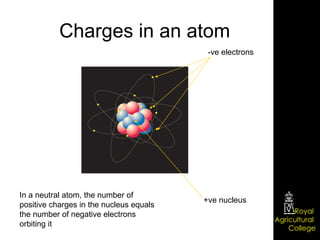
Charges in an atom -ve electrons +ve nucleus In a neutral atom, the number of positive charges in the nucleus equals the number of negative electrons orbiting it
Electrical potential If two bodies have different electrical charges, an  electrical potential  exists between them If those two bodies are linked by a conductor, the –ve electrons will flow from the –ve  source  to the +ve  sink This flow of electrons is an  electrical current  and it is a form of energy
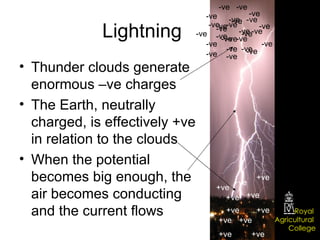
Lightning  Thunder clouds generate enormous –ve charges The Earth, neutrally charged, is effectively +ve in relation to the clouds When the potential becomes big enough, the air becomes conducting and the current flows -ve -ve -ve -ve -ve -ve -ve -ve -ve -ve +ve +ve +ve +ve +ve +ve +ve +ve +ve +ve +ve -ve -ve -ve -ve -ve -ve -ve -ve -ve -ve -ve -ve -ve -ve -ve -ve -ve -ve -ve -ve
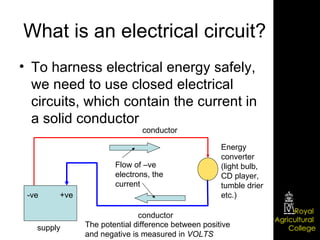
What is an electrical circuit? To harness electrical energy safely, we need to use closed electrical circuits, which contain the current in a solid conductor -ve +ve supply Energy converter (light bulb, CD player, tumble drier etc.) conductor conductor The potential difference between positive and negative is measured in  VOLTS Flow of –ve electrons, the current
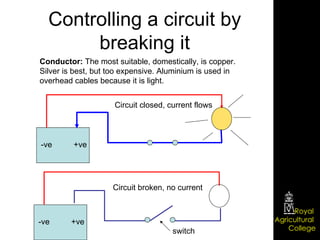
Controlling a circuit by breaking it -ve +ve Conductor:  The most suitable, domestically, is copper. Silver is best, but too expensive. Aluminium is used in overhead cables because it is light. -ve +ve Circuit closed, current flows Circuit broken, no current switch
Units of electricity The potential difference (think of it like pressure in water) is measured in volts – V The current (think of it like the quantity of water flowing through a pipe) is measured in amps – A The power (ability to do work) is measured in watts – W  W = VA ; A = W/V ; V = W/A
Domestic electricity In UK: domestic current is 13A voltage is 240V Max power from a domestic socket is  W=VA  13x240=3120 or about 3kW If you plug in a power tool requiring say 5kW, what happens?
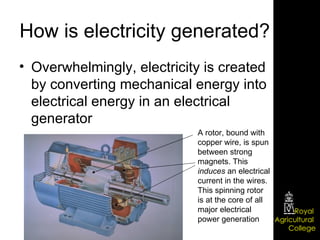
How is electricity generated? Overwhelmingly, electricity is created by converting mechanical energy into electrical energy in an electrical generator A rotor, bound with copper wire, is spun between strong magnets. This  induces  an electrical current in the wires. This spinning rotor is at the core of all major electrical power generation
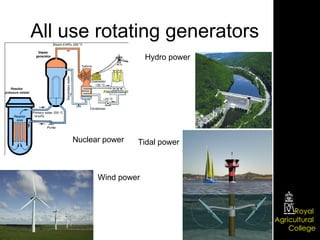
All use rotating generators Hydro power Nuclear power Tidal power Wind power
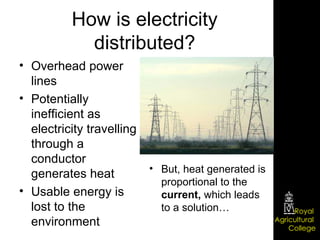
How is electricity distributed? Overhead power lines Potentially inefficient as electricity travelling through a conductor generates heat Usable energy is lost to the environment But, heat generated is proportional to the  current,  which leads to a solution…
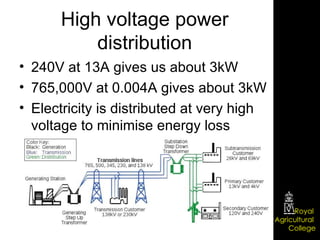
High voltage power distribution 240V at 13A gives us about 3kW 765,000V at 0.004A gives about 3kW Electricity is distributed at very high voltage to minimise energy loss
AC~DC The steady current from a battery is a direct current, DC. Efficient, but difficult to use in large installations Voltage level is changed most efficiently in a solid state transformer if the current is alternating current, AC All distribution and supply of electrical power is AC
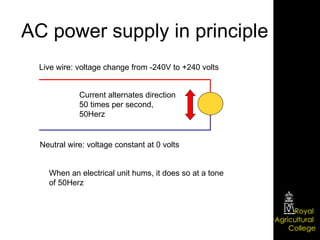
AC power supply in principle Live wire: voltage change from -240V to +240 volts Neutral wire: voltage constant at 0 volts Current alternates direction 50 times per second, 50Herz When an electrical unit hums, it does so at a tone of 50Herz
Domestic electrical systems UK domestic electrical power supply:  13A, 240V, 50Hz Some special sockets (e.g. electric cooker outlets, electric showers) are rated at 15A and use different, round pin plugs and separate protected circuits Power outlets rated at 13A Lighting outlets rated at 5A
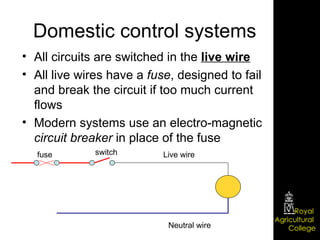
Domestic control systems All circuits are switched in the  live wire All live wires have a  fuse , designed to fail and break the circuit if too much current flows Modern systems use an electro-magnetic  circuit breaker  in place of the fuse Live wire Neutral wire fuse switch
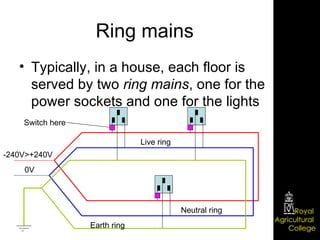
Ring mains Typically, in a house, each floor is served by two  ring mains , one for the power sockets and one for the lights Switch here Live ring Neutral ring Earth ring -240V>+240V 0V
Safety Insulation Fuses and circuit breakers Earthing Double insulation
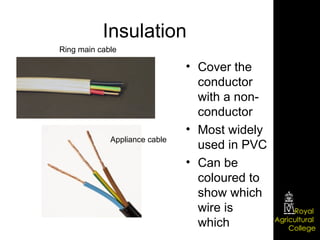
Insulation Cover the conductor with a non-conductor Most widely used in PVC Can be coloured to show which wire is which Ring main cable Appliance cable
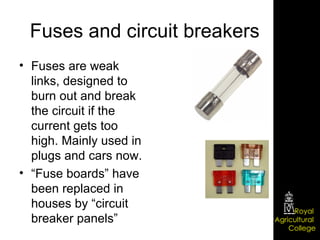
Fuses and circuit breakers Fuses are weak links, designed to burn out and break the circuit if the current gets too high. Mainly used in plugs and cars now. “ Fuse boards” have been replaced in houses by “circuit breaker panels”
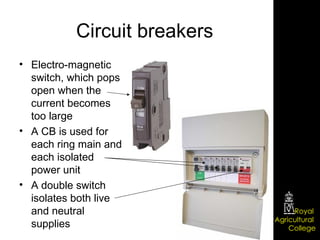
Circuit breakers Electro-magnetic switch, which pops open when the current becomes too large A CB is used for each ring main and each isolated power unit A double switch isolates both live and neutral supplies
Earthing Fundamental safety feature Any conducting external part of an appliance must be connected to an Earth wire, e.g. the metal case of a CD player This Earth wire is connected to a copper conductor buried in the ground
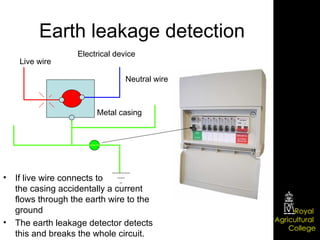
Earth leakage detection  If live wire connects to  the casing accidentally a current flows through the earth wire to the ground The earth leakage detector detects this and breaks the whole circuit. Metal casing Neutral wire Live wire Electrical device
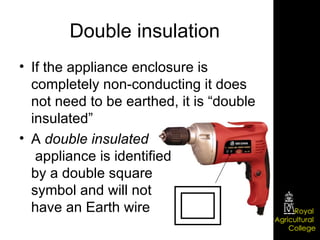
Double insulation If the appliance enclosure is completely non-conducting it does not need to be earthed, it is “double insulated” A  double insulated  appliance is identified  by a double square  symbol and will not  have an Earth wire
Regulation of electrical systems BS 7671 (The IEE Wiring Regulations) currently in the 17 th  edition, published by the Institution of Engineering and Technology Building Regulations Part P “Electrical safety Always get electrical circuits checked by a qualified electrical engineer. Don’t  rely on visual inspection.

Domestic electrical systems

  • 1.
    Domestic Electrical SystemsCore source of energy in modern developed societies
  • 2.
    Overview of unitWhat is electricity? What is an electrical circuit? How is electricity generated? How is electricity distributed? Domestic electrical systems Safety
  • 3.
    What is electricity?Nobody really knows what it is, but they can describe its actions All matter consists of particles which can have one of three charges Neutral (effectively no charge) Positive (+ve) Negative (-ve) Like charges repel each other, opposite charges attract each other
  • 4.
    Charges in anatom -ve electrons +ve nucleus In a neutral atom, the number of positive charges in the nucleus equals the number of negative electrons orbiting it
  • 5.
    Electrical potential Iftwo bodies have different electrical charges, an electrical potential exists between them If those two bodies are linked by a conductor, the –ve electrons will flow from the –ve source to the +ve sink This flow of electrons is an electrical current and it is a form of energy
  • 6.
    Lightning Thunderclouds generate enormous –ve charges The Earth, neutrally charged, is effectively +ve in relation to the clouds When the potential becomes big enough, the air becomes conducting and the current flows -ve -ve -ve -ve -ve -ve -ve -ve -ve -ve +ve +ve +ve +ve +ve +ve +ve +ve +ve +ve +ve -ve -ve -ve -ve -ve -ve -ve -ve -ve -ve -ve -ve -ve -ve -ve -ve -ve -ve -ve -ve
  • 7.
    What is anelectrical circuit? To harness electrical energy safely, we need to use closed electrical circuits, which contain the current in a solid conductor -ve +ve supply Energy converter (light bulb, CD player, tumble drier etc.) conductor conductor The potential difference between positive and negative is measured in VOLTS Flow of –ve electrons, the current
  • 8.
    Controlling a circuitby breaking it -ve +ve Conductor: The most suitable, domestically, is copper. Silver is best, but too expensive. Aluminium is used in overhead cables because it is light. -ve +ve Circuit closed, current flows Circuit broken, no current switch
  • 9.
    Units of electricityThe potential difference (think of it like pressure in water) is measured in volts – V The current (think of it like the quantity of water flowing through a pipe) is measured in amps – A The power (ability to do work) is measured in watts – W W = VA ; A = W/V ; V = W/A
  • 10.
    Domestic electricity InUK: domestic current is 13A voltage is 240V Max power from a domestic socket is W=VA 13x240=3120 or about 3kW If you plug in a power tool requiring say 5kW, what happens?
  • 11.
    How is electricitygenerated? Overwhelmingly, electricity is created by converting mechanical energy into electrical energy in an electrical generator A rotor, bound with copper wire, is spun between strong magnets. This induces an electrical current in the wires. This spinning rotor is at the core of all major electrical power generation
  • 12.
    All use rotatinggenerators Hydro power Nuclear power Tidal power Wind power
  • 13.
    How is electricitydistributed? Overhead power lines Potentially inefficient as electricity travelling through a conductor generates heat Usable energy is lost to the environment But, heat generated is proportional to the current, which leads to a solution…
  • 14.
    High voltage powerdistribution 240V at 13A gives us about 3kW 765,000V at 0.004A gives about 3kW Electricity is distributed at very high voltage to minimise energy loss
  • 15.
    AC~DC The steadycurrent from a battery is a direct current, DC. Efficient, but difficult to use in large installations Voltage level is changed most efficiently in a solid state transformer if the current is alternating current, AC All distribution and supply of electrical power is AC
  • 16.
    AC power supplyin principle Live wire: voltage change from -240V to +240 volts Neutral wire: voltage constant at 0 volts Current alternates direction 50 times per second, 50Herz When an electrical unit hums, it does so at a tone of 50Herz
  • 17.
    Domestic electrical systemsUK domestic electrical power supply: 13A, 240V, 50Hz Some special sockets (e.g. electric cooker outlets, electric showers) are rated at 15A and use different, round pin plugs and separate protected circuits Power outlets rated at 13A Lighting outlets rated at 5A
  • 18.
    Domestic control systemsAll circuits are switched in the live wire All live wires have a fuse , designed to fail and break the circuit if too much current flows Modern systems use an electro-magnetic circuit breaker in place of the fuse Live wire Neutral wire fuse switch
  • 19.
    Ring mains Typically,in a house, each floor is served by two ring mains , one for the power sockets and one for the lights Switch here Live ring Neutral ring Earth ring -240V>+240V 0V
  • 20.
    Safety Insulation Fusesand circuit breakers Earthing Double insulation
  • 21.
    Insulation Cover theconductor with a non-conductor Most widely used in PVC Can be coloured to show which wire is which Ring main cable Appliance cable
  • 22.
    Fuses and circuitbreakers Fuses are weak links, designed to burn out and break the circuit if the current gets too high. Mainly used in plugs and cars now. “ Fuse boards” have been replaced in houses by “circuit breaker panels”
  • 23.
    Circuit breakers Electro-magneticswitch, which pops open when the current becomes too large A CB is used for each ring main and each isolated power unit A double switch isolates both live and neutral supplies
  • 24.
    Earthing Fundamental safetyfeature Any conducting external part of an appliance must be connected to an Earth wire, e.g. the metal case of a CD player This Earth wire is connected to a copper conductor buried in the ground
  • 25.
    Earth leakage detection If live wire connects to the casing accidentally a current flows through the earth wire to the ground The earth leakage detector detects this and breaks the whole circuit. Metal casing Neutral wire Live wire Electrical device
  • 26.
    Double insulation Ifthe appliance enclosure is completely non-conducting it does not need to be earthed, it is “double insulated” A double insulated appliance is identified by a double square symbol and will not have an Earth wire
  • 27.
    Regulation of electricalsystems BS 7671 (The IEE Wiring Regulations) currently in the 17 th edition, published by the Institution of Engineering and Technology Building Regulations Part P “Electrical safety Always get electrical circuits checked by a qualified electrical engineer. Don’t rely on visual inspection.