© 2006 Cisco Systems, Inc. All rights reserved. Cisco ConfidentialBCMSN 7 - 1 1© 2006 Cisco Systems, Inc. All rights reserved. Cisco ConfidentialBCMSN 7 - 1 1
Understanding Layer
3 Redundancy
Edgardo Scrimaglia – CCIE
Edgardo.scrimaglia@gmail.com
© 2006 Cisco Systems, Inc. All rights reserved. Cisco ConfidentialBCMSN 7 - 1 2
Objectives
Upon completing this lesson, you will be able to meet these
objectives:
 Describe routing issues in connection to redundancy
 Explain the router redundancy process and what happens
when a failover occurs
 Identify HSRP and VRRP as Layer 3 redundancy protocols
 Configure basic HSRP
 Describe the idea behind HSRP interface tracking
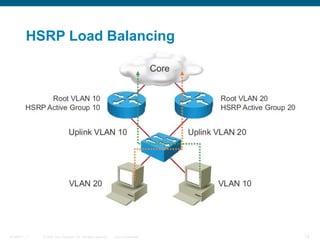
 Describe the idea behind HSRP load balancing
 Identify GLBP as a load-balancing redundancy protocol
© 2006 Cisco Systems, Inc. All rights reserved. Cisco ConfidentialBCMSN 7 - 1 3
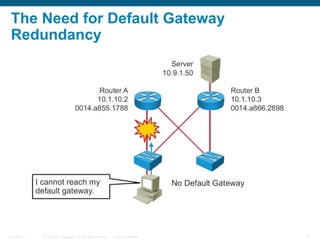
The Need for Default Gateway
Redundancy
© 2006 Cisco Systems, Inc. All rights reserved. Cisco ConfidentialBCMSN 7 - 1 4
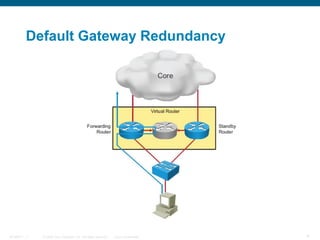
Default Gateway Redundancy
© 2006 Cisco Systems, Inc. All rights reserved. Cisco ConfidentialBCMSN 7 - 1 5
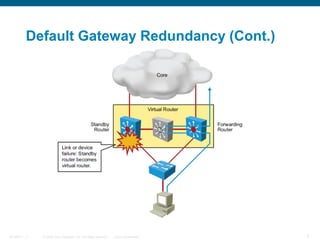
Default Gateway Redundancy (Cont.)
© 2006 Cisco Systems, Inc. All rights reserved. Cisco ConfidentialBCMSN 7 - 1 6
HSRP
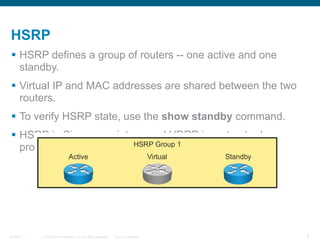
 HSRP defines a group of routers -- one active and one
standby.
 Virtual IP and MAC addresses are shared between the two
routers.
 To verify HSRP state, use the show standby command.
 HSRP is Cisco proprietary, and VRRP is a standard
protocol.
© 2006 Cisco Systems, Inc. All rights reserved. Cisco ConfidentialBCMSN 7 - 1 7
HSRP (Cont.)
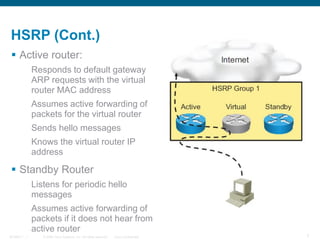
 Active router:
Responds to default gateway
ARP requests with the virtual
router MAC address
Assumes active forwarding of
packets for the virtual router
Sends hello messages
Knows the virtual router IP
address
 Standby Router
Listens for periodic hello
messages
Assumes active forwarding of
packets if it does not hear from
active router
© 2006 Cisco Systems, Inc. All rights reserved. Cisco ConfidentialBCMSN 7 - 1 8
Configuring HSRP
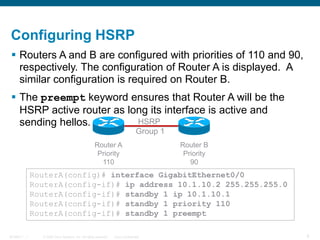
 Routers A and B are configured with priorities of 110 and 90,
respectively. The configuration of Router A is displayed. A
similar configuration is required on Router B.
 The preempt keyword ensures that Router A will be the
HSRP active router as long its interface is active and
sending hellos.
RouterA(config)# interface GigabitEthernet0/0
RouterA(config-if)# ip address 10.1.10.2 255.255.255.0
RouterA(config-if)# standby 1 ip 10.1.10.1
RouterA(config-if)# standby 1 priority 110
RouterA(config-if)# standby 1 preempt
Router A
Priority
110
Router B
Priority
90
HSRP
Group 1
© 2006 Cisco Systems, Inc. All rights reserved. Cisco ConfidentialBCMSN 7 - 1 9
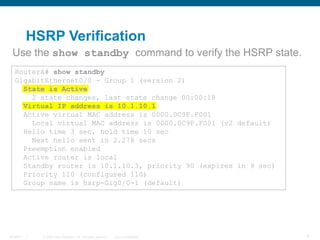
HSRP Verification
Use the show standby command to verify the HSRP state.
RouterA# show standby
GigabitEthernet0/0 - Group 1 (version 2)
State is Active
2 state changes, last state change 00:00:18
Virtual IP address is 10.1.10.1
Active virtual MAC address is 0000.0C9F.F001
Local virtual MAC address is 0000.0C9F.F001 (v2 default)
Hello time 3 sec, hold time 10 sec
Next hello sent in 2.278 secs
Preemption enabled
Active router is local
Standby router is 10.1.10.3, priority 90 (expires in 9 sec)
Priority 110 (configured 110)
Group name is hsrp-Gig0/0-1 (default)
© 2006 Cisco Systems, Inc. All rights reserved. Cisco ConfidentialBCMSN 7 - 1 10
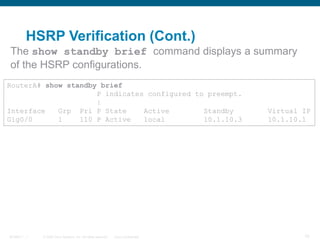
HSRP Verification (Cont.)
The show standby brief command displays a summary
of the HSRP configurations.
RouterA# show standby brief
P indicates configured to preempt.
|
Interface Grp Pri P State Active Standby Virtual IP
Gig0/0 1 110 P Active local 10.1.10.3 10.1.10.1
© 2006 Cisco Systems, Inc. All rights reserved. Cisco ConfidentialBCMSN 7 - 1 11
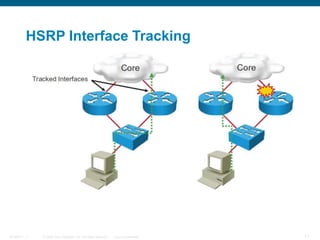
HSRP Interface Tracking
© 2006 Cisco Systems, Inc. All rights reserved. Cisco ConfidentialBCMSN 7 - 1 12
HSRP Load Balancing
© 2006 Cisco Systems, Inc. All rights reserved. Cisco ConfidentialBCMSN 7 - 1 13
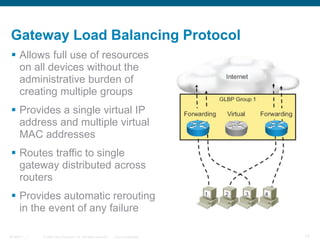
Gateway Load Balancing Protocol
 Allows full use of resources
on all devices without the
administrative burden of
creating multiple groups
 Provides a single virtual IP
address and multiple virtual
MAC addresses
 Routes traffic to single
gateway distributed across
routers
 Provides automatic rerouting
in the event of any failure
© 2006 Cisco Systems, Inc. All rights reserved. Cisco ConfidentialBCMSN 7 - 1 14
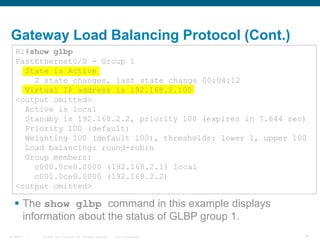
Gateway Load Balancing Protocol (Cont.)
 The show glbp command in this example displays
information about the status of GLBP group 1.
R1#show glbp
FastEthernet0/0 - Group 1
State is Active
2 state changes, last state change 00:04:12
Virtual IP address is 192.168.2.100
<output omitted>
Active is local
Standby is 192.168.2.2, priority 100 (expires in 7.644 sec)
Priority 100 (default)
Weighting 100 (default 100), thresholds: lower 1, upper 100
Load balancing: round-robin
Group members:
c000.0ce0.0000 (192.168.2.1) local
c001.0ce0.0000 (192.168.2.2)
<output omitted>
© 2006 Cisco Systems, Inc. All rights reserved. Cisco ConfidentialBCMSN 7 - 1 15
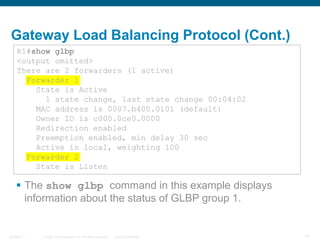
Gateway Load Balancing Protocol (Cont.)
 The show glbp command in this example displays
information about the status of GLBP group 1.
R1#show glbp
<output omitted>
There are 2 forwarders (1 active)
Forwarder 1
State is Active
1 state change, last state change 00:04:02
MAC address is 0007.b400.0101 (default)
Owner ID is c000.0ce0.0000
Redirection enabled
Preemption enabled, min delay 30 sec
Active is local, weighting 100
Forwarder 2
State is Listen
© 2006 Cisco Systems, Inc. All rights reserved. Cisco ConfidentialBCMSN 7 - 1 16
Summary
 End devices are typically configured with a single default
gateway IP address that does not change when the network
topology changes.
 Redundancy protocols provide a mechanism for determining
which router should take the active role in forwarding traffic
and determining when that role must be taken over by a
standby router.
 HSRP defines a standby group of routers, with one router as
the active router. VRRP is standard protocol that provides a
similar function.
 GLBP is a Cisco proprietary solution to allow automatic
selection and simultaneous use of multiple available
gateways in addition to automatic failover between those
gateways.

Layer 3 redundancy hsrp

  • 1.
    © 2006 CiscoSystems, Inc. All rights reserved. Cisco ConfidentialBCMSN 7 - 1 1© 2006 Cisco Systems, Inc. All rights reserved. Cisco ConfidentialBCMSN 7 - 1 1 Understanding Layer 3 Redundancy Edgardo Scrimaglia – CCIE Edgardo.scrimaglia@gmail.com
  • 2.
    © 2006 CiscoSystems, Inc. All rights reserved. Cisco ConfidentialBCMSN 7 - 1 2 Objectives Upon completing this lesson, you will be able to meet these objectives:  Describe routing issues in connection to redundancy  Explain the router redundancy process and what happens when a failover occurs  Identify HSRP and VRRP as Layer 3 redundancy protocols  Configure basic HSRP  Describe the idea behind HSRP interface tracking  Describe the idea behind HSRP load balancing  Identify GLBP as a load-balancing redundancy protocol
  • 3.
    © 2006 CiscoSystems, Inc. All rights reserved. Cisco ConfidentialBCMSN 7 - 1 3 The Need for Default Gateway Redundancy
  • 4.
    © 2006 CiscoSystems, Inc. All rights reserved. Cisco ConfidentialBCMSN 7 - 1 4 Default Gateway Redundancy
  • 5.
    © 2006 CiscoSystems, Inc. All rights reserved. Cisco ConfidentialBCMSN 7 - 1 5 Default Gateway Redundancy (Cont.)
  • 6.
    © 2006 CiscoSystems, Inc. All rights reserved. Cisco ConfidentialBCMSN 7 - 1 6 HSRP  HSRP defines a group of routers -- one active and one standby.  Virtual IP and MAC addresses are shared between the two routers.  To verify HSRP state, use the show standby command.  HSRP is Cisco proprietary, and VRRP is a standard protocol.
  • 7.
    © 2006 CiscoSystems, Inc. All rights reserved. Cisco ConfidentialBCMSN 7 - 1 7 HSRP (Cont.)  Active router: Responds to default gateway ARP requests with the virtual router MAC address Assumes active forwarding of packets for the virtual router Sends hello messages Knows the virtual router IP address  Standby Router Listens for periodic hello messages Assumes active forwarding of packets if it does not hear from active router
  • 8.
    © 2006 CiscoSystems, Inc. All rights reserved. Cisco ConfidentialBCMSN 7 - 1 8 Configuring HSRP  Routers A and B are configured with priorities of 110 and 90, respectively. The configuration of Router A is displayed. A similar configuration is required on Router B.  The preempt keyword ensures that Router A will be the HSRP active router as long its interface is active and sending hellos. RouterA(config)# interface GigabitEthernet0/0 RouterA(config-if)# ip address 10.1.10.2 255.255.255.0 RouterA(config-if)# standby 1 ip 10.1.10.1 RouterA(config-if)# standby 1 priority 110 RouterA(config-if)# standby 1 preempt Router A Priority 110 Router B Priority 90 HSRP Group 1
  • 9.
    © 2006 CiscoSystems, Inc. All rights reserved. Cisco ConfidentialBCMSN 7 - 1 9 HSRP Verification Use the show standby command to verify the HSRP state. RouterA# show standby GigabitEthernet0/0 - Group 1 (version 2) State is Active 2 state changes, last state change 00:00:18 Virtual IP address is 10.1.10.1 Active virtual MAC address is 0000.0C9F.F001 Local virtual MAC address is 0000.0C9F.F001 (v2 default) Hello time 3 sec, hold time 10 sec Next hello sent in 2.278 secs Preemption enabled Active router is local Standby router is 10.1.10.3, priority 90 (expires in 9 sec) Priority 110 (configured 110) Group name is hsrp-Gig0/0-1 (default)
  • 10.
    © 2006 CiscoSystems, Inc. All rights reserved. Cisco ConfidentialBCMSN 7 - 1 10 HSRP Verification (Cont.) The show standby brief command displays a summary of the HSRP configurations. RouterA# show standby brief P indicates configured to preempt. | Interface Grp Pri P State Active Standby Virtual IP Gig0/0 1 110 P Active local 10.1.10.3 10.1.10.1
  • 11.
    © 2006 CiscoSystems, Inc. All rights reserved. Cisco ConfidentialBCMSN 7 - 1 11 HSRP Interface Tracking
  • 12.
    © 2006 CiscoSystems, Inc. All rights reserved. Cisco ConfidentialBCMSN 7 - 1 12 HSRP Load Balancing
  • 13.
    © 2006 CiscoSystems, Inc. All rights reserved. Cisco ConfidentialBCMSN 7 - 1 13 Gateway Load Balancing Protocol  Allows full use of resources on all devices without the administrative burden of creating multiple groups  Provides a single virtual IP address and multiple virtual MAC addresses  Routes traffic to single gateway distributed across routers  Provides automatic rerouting in the event of any failure
  • 14.
    © 2006 CiscoSystems, Inc. All rights reserved. Cisco ConfidentialBCMSN 7 - 1 14 Gateway Load Balancing Protocol (Cont.)  The show glbp command in this example displays information about the status of GLBP group 1. R1#show glbp FastEthernet0/0 - Group 1 State is Active 2 state changes, last state change 00:04:12 Virtual IP address is 192.168.2.100 <output omitted> Active is local Standby is 192.168.2.2, priority 100 (expires in 7.644 sec) Priority 100 (default) Weighting 100 (default 100), thresholds: lower 1, upper 100 Load balancing: round-robin Group members: c000.0ce0.0000 (192.168.2.1) local c001.0ce0.0000 (192.168.2.2) <output omitted>
  • 15.
    © 2006 CiscoSystems, Inc. All rights reserved. Cisco ConfidentialBCMSN 7 - 1 15 Gateway Load Balancing Protocol (Cont.)  The show glbp command in this example displays information about the status of GLBP group 1. R1#show glbp <output omitted> There are 2 forwarders (1 active) Forwarder 1 State is Active 1 state change, last state change 00:04:02 MAC address is 0007.b400.0101 (default) Owner ID is c000.0ce0.0000 Redirection enabled Preemption enabled, min delay 30 sec Active is local, weighting 100 Forwarder 2 State is Listen
  • 16.
    © 2006 CiscoSystems, Inc. All rights reserved. Cisco ConfidentialBCMSN 7 - 1 16 Summary  End devices are typically configured with a single default gateway IP address that does not change when the network topology changes.  Redundancy protocols provide a mechanism for determining which router should take the active role in forwarding traffic and determining when that role must be taken over by a standby router.  HSRP defines a standby group of routers, with one router as the active router. VRRP is standard protocol that provides a similar function.  GLBP is a Cisco proprietary solution to allow automatic selection and simultaneous use of multiple available gateways in addition to automatic failover between those gateways.