Routing basics/CEF
May 4, 2016
Dmitry Figol
CCIE R&S #53592
dmitry@dmfigol.me
Intro to routing and switching
Routing
• Finding the optimal way towards destination
Switching
• Moving packet between interfaces
2
Packet forwarding
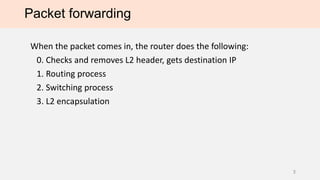
When the packet comes in, the router does the following:
0. Checks and removes L2 header, gets destination IP
1. Routing process
2. Switching process
3. L2 encapsulation
3
Routing process
• Find the longest match based on destination IP in routing
table (RIB)
• The goal is to find outgoing interface and Next Hop IP
address (if applicable)
4
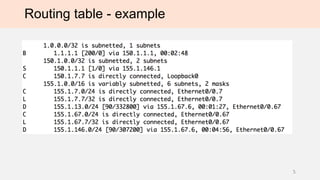
Routing table - example
5
Routing table (cont.)
• Recursive Lookup
• Contains useless information for forwarding:
• For example, Administrative Distance and Metric
• Single lookup has linear complexity O(n)
• Stored in RAM
• Verification: show ip route [ip-address [mask]]
6
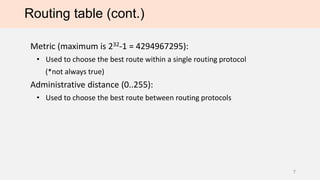
Routing table (cont.)
Metric (maximum is 232-1 = 4294967295):
• Used to choose the best route within a single routing protocol
(*not always true)
Administrative distance (0..255):
• Used to choose the best route between routing protocols
7
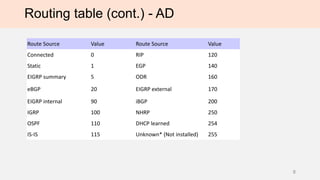
Routing table (cont.) - AD
8
Route Source Value
Connected 0
Static 1
EIGRP summary 5
eBGP 20
EIGRP internal 90
IGRP 100
OSPF 110
IS-IS 115
Route Source Value
RIP 120
EGP 140
ODR 160
EIGRP external 170
iBGP 200
NHRP 250
DHCP learned 254
Unknown* (Not installed) 255
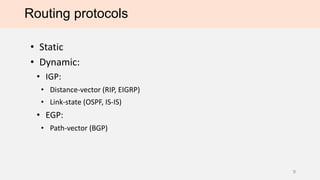
Routing protocols
• Static
• Dynamic:
• IGP:
• Distance-vector(RIP, EIGRP)
• Link-state (OSPF, IS-IS)
• EGP:
• Path-vector (BGP)
9
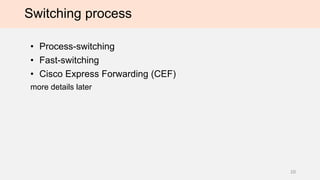
Switching process
• Process-switching
• Fast-switching
• Cisco Express Forwarding (CEF)
10
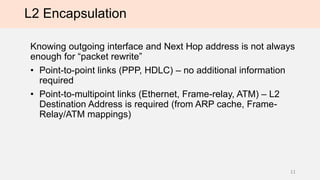
L2 Encapsulation
Knowing outgoing interface and Next Hop address is not always
enough for “packet rewrite”
• Point-to-point links (PPP, HDLC) – no additional information
required
• Point-to-multipoint links (Ethernet, Frame-relay, ATM) – L2
Destination Address is required (from ARP cache, Frame-
Relay/ATM mappings)
11
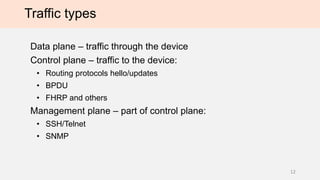
Traffic types
Data plane – traffic through the device
Control plane – traffic to the device:
• Routing protocols hello/updates
• BPDU
• FHRP and others
Management plane – part of control plane:
• SSH/Telnet
• SNMP
12
Processors: CPU and ASIC
• Central processing unit (CPU) is the brains of the network device
• Handles control plane
• Can do anything
• Can’t do packet forwarding with high throughput*
*Note: DPDK project enables x86 multi-core processors to forward 200+ Gbps
13
Processors: CPU and ASIC
• Application specific integrated circuit (ASIC) is circuit with
transistors
• Very fast, but dumb
• Designed specifically to move packets
• Expensive
• Not possible to program new features
• Responsible for data plane
14
Memory: RAM, CAM and TCAM
Random Access Memory (RAM) is the most common type of memory
• Value is accessed by pointer (memory address)
• Cheap
15
Memory: RAM, CAM and TCAM
Content-addressable memory (CAM)
• Value is accessed by a key, not a pointer
• Very fast
• Expensive
• High power consumption
• O(1) constant time lookup
• Used in switches for MAC address table
16
Memory: RAM, CAM and TCAM
Ternary Content-addressable memory (TCAM)
• Value is accessed by a key, which consists of not only “0” and “1”,
but also “don’t care” bits.
• Very expensive
• High power consumption
• O(1) constant time lookup!
• Used for next-hop lookup (CEF table), ACL (security and QoS)
17
Process-switching
• Recursive lookup is performed by CPU in RIB
• There is special process responsible for process-switching “IP Input”
• The following traffic is process-switched:
• Control plane
• Locally generated (not all)
• No L2 adjacency information
• ACL logging
18
Fast-switching
• First packet for source-destination IP pair is process-switched
• IP pair and corresponding encapsulation information is added
to the cache
• Following packets are forwarding based on the entry in cache
• Deprecated
19
Cisco Express Forwarding (CEF)
The idea is to precompute and optimize information in RIB:
• Resolve recursive lookup and get rid of useless information
• Add pointer to pre-built L2 header in Adjacency table
The new table is called Forwarding Information Base (FIB) or CEF table:
• Contains prefix, NH, outgoing interface, pointer to L2 header
• Stored in DRAM [O(1) using 256-way mtrie data structure] and TCAM
[if exists, also O(1), but much faster]
The lookup is done during the interrupt (process scheduling is not
required)
20
CEF (cont.)
Verification:
show ip cef [ip-address [mask]] [detail] [internal]
Shows NH, outgoing interface, MPLS labels (if applicable)
Internal keyword shows pointer to Adjacency entry and hash buckets
Disable CEF:
(config)# no ip cef
21
CEF – Adjacency table
• CEF process takes information from all L3-to-L2 mappings and builds
L2 header
• Adjacency table contains NH, interface, associated L2 Header
• Stored in RAM
• Pitfall: CEF process does not allow adjacency to age out
(clear arp won’t delete ARP entry if it can be revalidated)
• Verification:
show adjacency [detail]
22
CEF – Adjacency types
• Cache
• Glean
• Receive
• Punt
• Null
• Discard
• Drop
23
CEF on hardware-based platforms
• CEF basically allows to forward traffic without CPU
• Depending on platform there can be zero, one or more ASICs.
• The same applies for TCAM
• All L3 switches have TCAM, only some routers have it
• That’s why generally speaking L3 switches forward traffic faster than routers
• TCAM stores not only FIB, but ACL and QoS rules, the allocation is
predefined though
• On some platforms you can change allocation profile
24
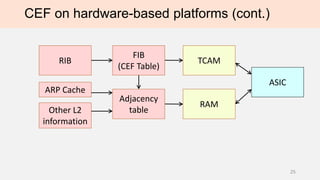
CEF on hardware-based platforms (cont.)
25
RIB
ARP Cache
Other L2
information
FIB
(CEF Table)
Adjacency
table
TCAM
RAM
ASIC
CEF – Load balancing
• Routing protocols can install several routes for the same prefix
• How will CEF decide where to send packet?
• CEF is doing load-balancing per-flow
• By default, it takes source-destination IP pair, feeds it to the
hashing algorithm, returns the number of the bucket
• Buckets are allocated automatically per NH, depending on the
traffic share count in RIB
26
CEF – Load balancing (cont.)
Verification:
show ip cef [ip [mask]] internal – shows NH-to-bucket distribution
show ip cef exact-route src-ip dst-ip – shows NH and interface for
source/destination IP pair
Change load balancing method (not recommended):
(config-if)# ip load-sharing per-packet
27
CEF polarization
• Hash algorithm is deterministic, meaning that for the same
source/destination IP pair the bucket (outgoing link) is the same.
• Result is that some links can be underutilized (especially if we have
chain of routers with ECMP).
• One possible solution is to include L4 ports in hashing (if
supported):
(config)# ip cef load-sharing algorithm include-ports [source
[destination]]
28
Static Routing
• The way to install an entry in RIB manually
• Usually overrides entries installed via dynamic routing protocols
• Advantage: gives full control over path selection in your network
• Main disadvantage: huge administrative burden
• Syntax:
(config)# ip route prefix mask [NH-IP | interface [NH-IP]] [distance]
[track track]
• Verification:
# show ip route [static]
29
Static Routing (cont.)
There are three different ways to configure where the traffic should
go for specific prefix:
• By specifying next-hop IP address
• By specifying outgoing interface
• By specifying both
30
Static Routing to next-hop
• Recursive lookup is required to find outgoing interface
• On multipoint interfaces resolution of next-hop IP address is
required (ARP cache, Frame Relay/ATM mapping)
• Static route is installed into RIB only if recursive lookup is
successful (outgoing interface was found)
• It will stay in RIB even if next-hop is covered only by valid default route
31
Static Routing to outgoing interface
• Recursive lookup is not required because we know outgoing
interface
• On point-to-point interface we can send the packet right away
• On multipoint interface first we need to find L2 address for
destination IP
• For every new destination IP addressin the packet we will install entry in ARP
cache
• It can still work if Proxy Arp is enabled (which is enabled by default in IOS)
• Static route is installed into RIB only if line protocol (for outgoing interface) is
up
• Use only for point-to-point interfaces!
32
Static Routing to outgoing interface and NH
• Recursive lookup is not required because we know outgoing
interface
• On point-to-point interface we can send the packet right away
• On multipoint interface first we need to find L2 address for next-
hop IP address
• Static route is installed into RIB only if line protocol of outgoing
interface is up
33
Floating static routes
• Floating static route is a route that has AD higher than default and
is not installed into RIB under normal operation, because there is
another preferred path
• Once primary path fails floating static route can be installed
• For example:
• Primary static default route with AD 1 and tracking (based on IP SLA) or BFD
• Secondary static default route with AD 2 or higher
• Once tracking object/BFD goes down, primary route is deleted from RIB and secondary
route is installed
34
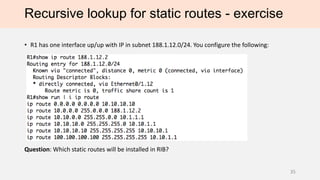
Recursive lookup for static routes - exercise
• R1 has one interface up/up with IP in subnet 188.1.12.0/24.You configurethe following:
Question: Which static routes will be installed in RIB?
35
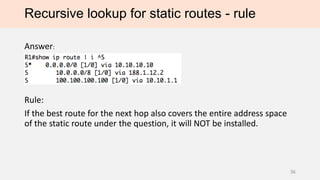
Recursive lookup for static routes - rule
Answer:
Rule:
If the best route for the next hop also covers the entire address space
of the static route under the question, it will NOT be installed.
36
Additional Resources
• Inside Cisco IOS Software Architecture (Russ White) book
• IP Routing FAQ
• Switching Paths
• Load Balancing with CEF
• Troubleshooting load balancing with CEF
• CAM vs TCAM
• CEF polarization
37
Questions?
38

Routing basics/CEF

  • 1.
    Routing basics/CEF May 4,2016 Dmitry Figol CCIE R&S #53592 dmitry@dmfigol.me
  • 2.
    Intro to routingand switching Routing • Finding the optimal way towards destination Switching • Moving packet between interfaces 2
  • 3.
    Packet forwarding When thepacket comes in, the router does the following: 0. Checks and removes L2 header, gets destination IP 1. Routing process 2. Switching process 3. L2 encapsulation 3
  • 4.
    Routing process • Findthe longest match based on destination IP in routing table (RIB) • The goal is to find outgoing interface and Next Hop IP address (if applicable) 4
  • 5.
    Routing table -example 5
  • 6.
    Routing table (cont.) •Recursive Lookup • Contains useless information for forwarding: • For example, Administrative Distance and Metric • Single lookup has linear complexity O(n) • Stored in RAM • Verification: show ip route [ip-address [mask]] 6
  • 7.
    Routing table (cont.) Metric(maximum is 232-1 = 4294967295): • Used to choose the best route within a single routing protocol (*not always true) Administrative distance (0..255): • Used to choose the best route between routing protocols 7
  • 8.
    Routing table (cont.)- AD 8 Route Source Value Connected 0 Static 1 EIGRP summary 5 eBGP 20 EIGRP internal 90 IGRP 100 OSPF 110 IS-IS 115 Route Source Value RIP 120 EGP 140 ODR 160 EIGRP external 170 iBGP 200 NHRP 250 DHCP learned 254 Unknown* (Not installed) 255
  • 9.
    Routing protocols • Static •Dynamic: • IGP: • Distance-vector(RIP, EIGRP) • Link-state (OSPF, IS-IS) • EGP: • Path-vector (BGP) 9
  • 10.
    Switching process • Process-switching •Fast-switching • Cisco Express Forwarding (CEF) 10
  • 11.
    L2 Encapsulation Knowing outgoinginterface and Next Hop address is not always enough for “packet rewrite” • Point-to-point links (PPP, HDLC) – no additional information required • Point-to-multipoint links (Ethernet, Frame-relay, ATM) – L2 Destination Address is required (from ARP cache, Frame- Relay/ATM mappings) 11
  • 12.
    Traffic types Data plane– traffic through the device Control plane – traffic to the device: • Routing protocols hello/updates • BPDU • FHRP and others Management plane – part of control plane: • SSH/Telnet • SNMP 12
  • 13.
    Processors: CPU andASIC • Central processing unit (CPU) is the brains of the network device • Handles control plane • Can do anything • Can’t do packet forwarding with high throughput* *Note: DPDK project enables x86 multi-core processors to forward 200+ Gbps 13
  • 14.
    Processors: CPU andASIC • Application specific integrated circuit (ASIC) is circuit with transistors • Very fast, but dumb • Designed specifically to move packets • Expensive • Not possible to program new features • Responsible for data plane 14
  • 15.
    Memory: RAM, CAMand TCAM Random Access Memory (RAM) is the most common type of memory • Value is accessed by pointer (memory address) • Cheap 15
  • 16.
    Memory: RAM, CAMand TCAM Content-addressable memory (CAM) • Value is accessed by a key, not a pointer • Very fast • Expensive • High power consumption • O(1) constant time lookup • Used in switches for MAC address table 16
  • 17.
    Memory: RAM, CAMand TCAM Ternary Content-addressable memory (TCAM) • Value is accessed by a key, which consists of not only “0” and “1”, but also “don’t care” bits. • Very expensive • High power consumption • O(1) constant time lookup! • Used for next-hop lookup (CEF table), ACL (security and QoS) 17
  • 18.
    Process-switching • Recursive lookupis performed by CPU in RIB • There is special process responsible for process-switching “IP Input” • The following traffic is process-switched: • Control plane • Locally generated (not all) • No L2 adjacency information • ACL logging 18
  • 19.
    Fast-switching • First packetfor source-destination IP pair is process-switched • IP pair and corresponding encapsulation information is added to the cache • Following packets are forwarding based on the entry in cache • Deprecated 19
  • 20.
    Cisco Express Forwarding(CEF) The idea is to precompute and optimize information in RIB: • Resolve recursive lookup and get rid of useless information • Add pointer to pre-built L2 header in Adjacency table The new table is called Forwarding Information Base (FIB) or CEF table: • Contains prefix, NH, outgoing interface, pointer to L2 header • Stored in DRAM [O(1) using 256-way mtrie data structure] and TCAM [if exists, also O(1), but much faster] The lookup is done during the interrupt (process scheduling is not required) 20
  • 21.
    CEF (cont.) Verification: show ipcef [ip-address [mask]] [detail] [internal] Shows NH, outgoing interface, MPLS labels (if applicable) Internal keyword shows pointer to Adjacency entry and hash buckets Disable CEF: (config)# no ip cef 21
  • 22.
    CEF – Adjacencytable • CEF process takes information from all L3-to-L2 mappings and builds L2 header • Adjacency table contains NH, interface, associated L2 Header • Stored in RAM • Pitfall: CEF process does not allow adjacency to age out (clear arp won’t delete ARP entry if it can be revalidated) • Verification: show adjacency [detail] 22
  • 23.
    CEF – Adjacencytypes • Cache • Glean • Receive • Punt • Null • Discard • Drop 23
  • 24.
    CEF on hardware-basedplatforms • CEF basically allows to forward traffic without CPU • Depending on platform there can be zero, one or more ASICs. • The same applies for TCAM • All L3 switches have TCAM, only some routers have it • That’s why generally speaking L3 switches forward traffic faster than routers • TCAM stores not only FIB, but ACL and QoS rules, the allocation is predefined though • On some platforms you can change allocation profile 24
  • 25.
    CEF on hardware-basedplatforms (cont.) 25 RIB ARP Cache Other L2 information FIB (CEF Table) Adjacency table TCAM RAM ASIC
  • 26.
    CEF – Loadbalancing • Routing protocols can install several routes for the same prefix • How will CEF decide where to send packet? • CEF is doing load-balancing per-flow • By default, it takes source-destination IP pair, feeds it to the hashing algorithm, returns the number of the bucket • Buckets are allocated automatically per NH, depending on the traffic share count in RIB 26
  • 27.
    CEF – Loadbalancing (cont.) Verification: show ip cef [ip [mask]] internal – shows NH-to-bucket distribution show ip cef exact-route src-ip dst-ip – shows NH and interface for source/destination IP pair Change load balancing method (not recommended): (config-if)# ip load-sharing per-packet 27
  • 28.
    CEF polarization • Hashalgorithm is deterministic, meaning that for the same source/destination IP pair the bucket (outgoing link) is the same. • Result is that some links can be underutilized (especially if we have chain of routers with ECMP). • One possible solution is to include L4 ports in hashing (if supported): (config)# ip cef load-sharing algorithm include-ports [source [destination]] 28
  • 29.
    Static Routing • Theway to install an entry in RIB manually • Usually overrides entries installed via dynamic routing protocols • Advantage: gives full control over path selection in your network • Main disadvantage: huge administrative burden • Syntax: (config)# ip route prefix mask [NH-IP | interface [NH-IP]] [distance] [track track] • Verification: # show ip route [static] 29
  • 30.
    Static Routing (cont.) Thereare three different ways to configure where the traffic should go for specific prefix: • By specifying next-hop IP address • By specifying outgoing interface • By specifying both 30
  • 31.
    Static Routing tonext-hop • Recursive lookup is required to find outgoing interface • On multipoint interfaces resolution of next-hop IP address is required (ARP cache, Frame Relay/ATM mapping) • Static route is installed into RIB only if recursive lookup is successful (outgoing interface was found) • It will stay in RIB even if next-hop is covered only by valid default route 31
  • 32.
    Static Routing tooutgoing interface • Recursive lookup is not required because we know outgoing interface • On point-to-point interface we can send the packet right away • On multipoint interface first we need to find L2 address for destination IP • For every new destination IP addressin the packet we will install entry in ARP cache • It can still work if Proxy Arp is enabled (which is enabled by default in IOS) • Static route is installed into RIB only if line protocol (for outgoing interface) is up • Use only for point-to-point interfaces! 32
  • 33.
    Static Routing tooutgoing interface and NH • Recursive lookup is not required because we know outgoing interface • On point-to-point interface we can send the packet right away • On multipoint interface first we need to find L2 address for next- hop IP address • Static route is installed into RIB only if line protocol of outgoing interface is up 33
  • 34.
    Floating static routes •Floating static route is a route that has AD higher than default and is not installed into RIB under normal operation, because there is another preferred path • Once primary path fails floating static route can be installed • For example: • Primary static default route with AD 1 and tracking (based on IP SLA) or BFD • Secondary static default route with AD 2 or higher • Once tracking object/BFD goes down, primary route is deleted from RIB and secondary route is installed 34
  • 35.
    Recursive lookup forstatic routes - exercise • R1 has one interface up/up with IP in subnet 188.1.12.0/24.You configurethe following: Question: Which static routes will be installed in RIB? 35
  • 36.
    Recursive lookup forstatic routes - rule Answer: Rule: If the best route for the next hop also covers the entire address space of the static route under the question, it will NOT be installed. 36
  • 37.
    Additional Resources • InsideCisco IOS Software Architecture (Russ White) book • IP Routing FAQ • Switching Paths • Load Balancing with CEF • Troubleshooting load balancing with CEF • CAM vs TCAM • CEF polarization 37
  • 38.