A Presentation
on
EIGRP
(Enhanced Interior Gateway Routing Protocol )
Submitted by
NUTAN SINGH
Roll No. 25
1
EIGRP
 Routing protocols
 EIGRP Overview
 IGRP v/s EIGRP
 Key technologies
 Packet types
 EIGRP DUAL
 Metric Calculation
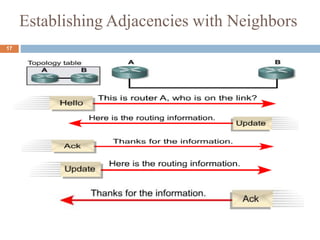
 Establishing Adjacencies with Neighbors
 EIGRP Functions
 Advantages of EIGRP
 Conclusion
 References
2
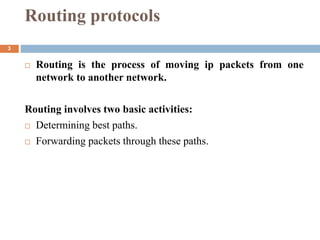
Routing protocols
 Routing is the process of moving ip packets from one
network to another network.
Routing involves two basic activities:
 Determining best paths.
 Forwarding packets through these paths.
3
EIGRP Overview
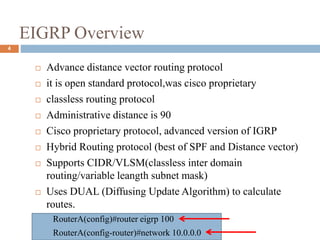
 Advance distance vector routing protocol
 it is open standard protocol,was cisco proprietary
 classless routing protocol
 Administrative distance is 90
 Cisco proprietary protocol, advanced version of IGRP
 Hybrid Routing protocol (best of SPF and Distance vector)
 Supports CIDR/VLSM(classless inter domain
routing/variable leangth subnet mask)
 Uses DUAL (Diffusing Update Algorithm) to calculate
routes.
RouterA(config)#router eigrp 100
RouterA(config-router)#network 10.0.0.0
4
EIGRP vs. IGRP
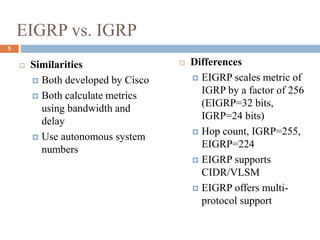
 Similarities
 Both developed by Cisco
 Both calculate metrics
using bandwidth and
delay
 Use autonomous system
numbers
 Differences
 EIGRP scales metric of
IGRP by a factor of 256
(EIGRP=32 bits,
IGRP=24 bits)
 Hop count, IGRP=255,
EIGRP=224
 EIGRP supports
CIDR/VLSM
 EIGRP offers multi-
protocol support
5
IGRP v/s EIGRP
IGRP EIGRP
Classful Routing Protocol Classless Routing Protocol
• VLSM, CIDR
bandwidth =
(10,000,000/bandwidth kbps)
delay = delay/10
24 bit metric for bandwidth and
delay
bandwidth =
(10,000,000/bandwidth kbps) * 256
delay = (delay/10) * 256
32 bit metric for bandwidth and
delay
No differentiation between
internal and external routes.
Outside routes (redistributed) are
tagged as external routes.
Automatic redistribution between IGRP and EIGRP as long as “AS”
numbers are the same.
6
Key technologies
 There are three routing table are:
 Neighbor table
 Topology table
 Routing table
7
Neighbor Table
• Contains information about directly connected neighbors.
• Hold time information received from HELLO packets
determine if route is still accessible or route changes need to
be made.
• HELLO packets are send every 5 seconds
• Number of packets waiting to be sent.
8
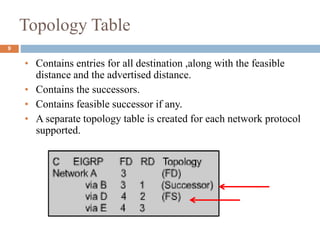
Topology Table
• Contains entries for all destination ,along with the feasible
distance and the advertised distance.
• Contains the successors.
• Contains feasible successor if any.
• A separate topology table is created for each network protocol
supported.
9
Routing table
 Entries with the best path for each destination from the
topology table are moved into the routing table.
10
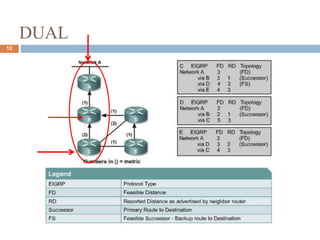
EIGRP Terminology
 Feasible distance:
feasible distance(FD) is the metric of the best route to a
destination,including the lacal link distance.
feasible distance = advertised distance + local link
distance(of the best path)
 Advertise distance:
the distance of a route as advertised by the neighbour. It does
not include the local link distance.
 Successor:
the neighbour with best distance to the destination.
 Feasible successor:
the neighbour with second best distance to
thendestination,which meets the criteria advertised distance
should be less then the feasible distance.
11
DUAL
12
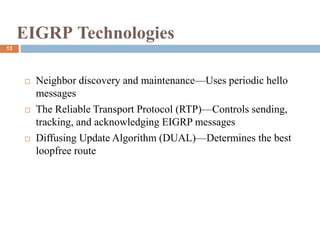
EIGRP Technologies
 Neighbor discovery and maintenance—Uses periodic hello
messages
 The Reliable Transport Protocol (RTP)—Controls sending,
tracking, and acknowledging EIGRP messages
 Diffusing Update Algorithm (DUAL)—Determines the best
loopfree route
13
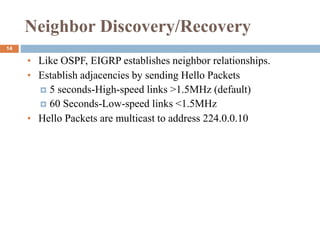
Neighbor Discovery/Recovery
• Like OSPF, EIGRP establishes neighbor relationships.
• Establish adjacencies by sending Hello Packets
 5 seconds-High-speed links >1.5MHz (default)
 60 Seconds-Low-speed links <1.5MHz
• Hello Packets are multicast to address 224.0.0.10
14
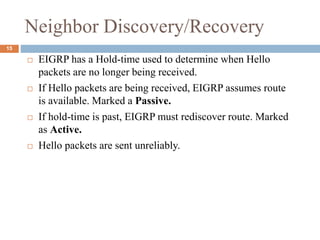
Neighbor Discovery/Recovery
 EIGRP has a Hold-time used to determine when Hello
packets are no longer being received.
 If Hello packets are being received, EIGRP assumes route
is available. Marked a Passive.
 If hold-time is past, EIGRP must rediscover route. Marked
as Active.
 Hello packets are sent unreliably.
15
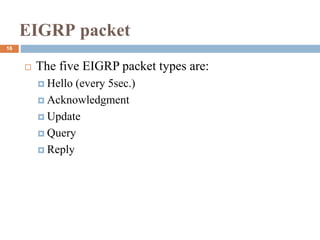
EIGRP packet
 The five EIGRP packet types are:
 Hello (every 5sec.)
 Acknowledgment
 Update
 Query
 Reply
16
Establishing Adjacencies with Neighbors
17
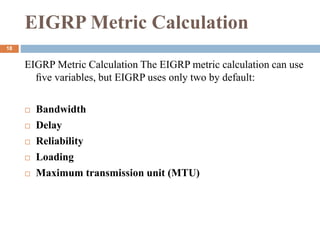
EIGRP Metric Calculation
EIGRP Metric Calculation The EIGRP metric calculation can use
five variables, but EIGRP uses only two by default:
 Bandwidth
 Delay
 Reliability
 Loading
 Maximum transmission unit (MTU)
18
Metric calculation
metric = (K1 * bandwidth) + [(K2 * bandwidth) / (256 –
load)] + (K3 * delay)
If these K values are equal to their defaults, the formula
becomes
K1=K3=1, K2=K4=K5=0
metric = (1 * bandwidth) + [(0 * bandwidth) / (256 – load)] +
(1 * delay) * [K5 / (reliability + K4)]
 metric = bandwidth + [0] + delay
 metric = bandwidth + delay
The EIGRP metric value ranges from 1 to 4,294,967,296
19
Other EIGRP Functions
 EIGRP supports auto-summarisation and manual
summerisation.
 EIGRP support unequal-cost load-balancing.
 EIGRP support passive-interface
20
EIGRP summarisation
 EIGRP supports summarisation at any location in the
internetwork.
 By default EIGRP has auto-summarization enabled.
 Summarize the routes that are advertised through classfull
network boundaries.
 EIGRP support manual summary also.
 Manual summary should be configured interface level.
21
EIGRP unequal-cost load-balancing
 supports equal & unequal cost load balancing(default 4 paths
& maximum 16 equal or unequal path)
 To configure unequal cost load balancing,next available paths
should be feasible successors.
 Unequal cost load balancing can be configured by using
”variance”
 Default variance value is 1(equal cost load belencing)
22
EIGRP passive-interface
 The interface can be configured as passive for stoping the
hello send over the interface.
 The interface cannot send any hello over the interface.but it
can receive hellos.
23
Advantages
• Rapid convergence-DUAL provides Loop-free operation
with all routers being updated at same time.
• Efficient use of bandwidth-Sends Partial-Bounded updates
only to those routers who need updates.
• Supports multiple protocols-IP, IPX and AppleTalk are
supported through Protocol-dependant Modules, PDM’s.
Modules can change but EIGRP can stay the same.
24
Conclusion
The protocol designed by cisco system as a proprietary
protocol.available only on cisco routers.it’s designed towork
on top of layer 3.it’s a best routing protocol for advanced
distance-vector routing protocol that is used on a computer
network to help automate routing decisions and configuration.
25
Referencess
 https://www.wikipedia.com/EIGRP
 https://drive.google.com/about
 https://www.CCNP CISCO.com/eigrp protocol
26
THANKS

Enhanced Interior Gateway Routing Protocol (EIGRP) || NETWORK PROTOCOL

  • 1.
    A Presentation on EIGRP (Enhanced InteriorGateway Routing Protocol ) Submitted by NUTAN SINGH Roll No. 25 1
  • 2.
    EIGRP  Routing protocols EIGRP Overview  IGRP v/s EIGRP  Key technologies  Packet types  EIGRP DUAL  Metric Calculation  Establishing Adjacencies with Neighbors  EIGRP Functions  Advantages of EIGRP  Conclusion  References 2
  • 3.
    Routing protocols  Routingis the process of moving ip packets from one network to another network. Routing involves two basic activities:  Determining best paths.  Forwarding packets through these paths. 3
  • 4.
    EIGRP Overview  Advancedistance vector routing protocol  it is open standard protocol,was cisco proprietary  classless routing protocol  Administrative distance is 90  Cisco proprietary protocol, advanced version of IGRP  Hybrid Routing protocol (best of SPF and Distance vector)  Supports CIDR/VLSM(classless inter domain routing/variable leangth subnet mask)  Uses DUAL (Diffusing Update Algorithm) to calculate routes. RouterA(config)#router eigrp 100 RouterA(config-router)#network 10.0.0.0 4
  • 5.
    EIGRP vs. IGRP Similarities  Both developed by Cisco  Both calculate metrics using bandwidth and delay  Use autonomous system numbers  Differences  EIGRP scales metric of IGRP by a factor of 256 (EIGRP=32 bits, IGRP=24 bits)  Hop count, IGRP=255, EIGRP=224  EIGRP supports CIDR/VLSM  EIGRP offers multi- protocol support 5
  • 6.
    IGRP v/s EIGRP IGRPEIGRP Classful Routing Protocol Classless Routing Protocol • VLSM, CIDR bandwidth = (10,000,000/bandwidth kbps) delay = delay/10 24 bit metric for bandwidth and delay bandwidth = (10,000,000/bandwidth kbps) * 256 delay = (delay/10) * 256 32 bit metric for bandwidth and delay No differentiation between internal and external routes. Outside routes (redistributed) are tagged as external routes. Automatic redistribution between IGRP and EIGRP as long as “AS” numbers are the same. 6
  • 7.
    Key technologies  Thereare three routing table are:  Neighbor table  Topology table  Routing table 7
  • 8.
    Neighbor Table • Containsinformation about directly connected neighbors. • Hold time information received from HELLO packets determine if route is still accessible or route changes need to be made. • HELLO packets are send every 5 seconds • Number of packets waiting to be sent. 8
  • 9.
    Topology Table • Containsentries for all destination ,along with the feasible distance and the advertised distance. • Contains the successors. • Contains feasible successor if any. • A separate topology table is created for each network protocol supported. 9
  • 10.
    Routing table  Entrieswith the best path for each destination from the topology table are moved into the routing table. 10
  • 11.
    EIGRP Terminology  Feasibledistance: feasible distance(FD) is the metric of the best route to a destination,including the lacal link distance. feasible distance = advertised distance + local link distance(of the best path)  Advertise distance: the distance of a route as advertised by the neighbour. It does not include the local link distance.  Successor: the neighbour with best distance to the destination.  Feasible successor: the neighbour with second best distance to thendestination,which meets the criteria advertised distance should be less then the feasible distance. 11
  • 12.
  • 13.
    EIGRP Technologies  Neighbordiscovery and maintenance—Uses periodic hello messages  The Reliable Transport Protocol (RTP)—Controls sending, tracking, and acknowledging EIGRP messages  Diffusing Update Algorithm (DUAL)—Determines the best loopfree route 13
  • 14.
    Neighbor Discovery/Recovery • LikeOSPF, EIGRP establishes neighbor relationships. • Establish adjacencies by sending Hello Packets  5 seconds-High-speed links >1.5MHz (default)  60 Seconds-Low-speed links <1.5MHz • Hello Packets are multicast to address 224.0.0.10 14
  • 15.
    Neighbor Discovery/Recovery  EIGRPhas a Hold-time used to determine when Hello packets are no longer being received.  If Hello packets are being received, EIGRP assumes route is available. Marked a Passive.  If hold-time is past, EIGRP must rediscover route. Marked as Active.  Hello packets are sent unreliably. 15
  • 16.
    EIGRP packet  Thefive EIGRP packet types are:  Hello (every 5sec.)  Acknowledgment  Update  Query  Reply 16
  • 17.
  • 18.
    EIGRP Metric Calculation EIGRPMetric Calculation The EIGRP metric calculation can use five variables, but EIGRP uses only two by default:  Bandwidth  Delay  Reliability  Loading  Maximum transmission unit (MTU) 18
  • 19.
    Metric calculation metric =(K1 * bandwidth) + [(K2 * bandwidth) / (256 – load)] + (K3 * delay) If these K values are equal to their defaults, the formula becomes K1=K3=1, K2=K4=K5=0 metric = (1 * bandwidth) + [(0 * bandwidth) / (256 – load)] + (1 * delay) * [K5 / (reliability + K4)]  metric = bandwidth + [0] + delay  metric = bandwidth + delay The EIGRP metric value ranges from 1 to 4,294,967,296 19
  • 20.
    Other EIGRP Functions EIGRP supports auto-summarisation and manual summerisation.  EIGRP support unequal-cost load-balancing.  EIGRP support passive-interface 20
  • 21.
    EIGRP summarisation  EIGRPsupports summarisation at any location in the internetwork.  By default EIGRP has auto-summarization enabled.  Summarize the routes that are advertised through classfull network boundaries.  EIGRP support manual summary also.  Manual summary should be configured interface level. 21
  • 22.
    EIGRP unequal-cost load-balancing supports equal & unequal cost load balancing(default 4 paths & maximum 16 equal or unequal path)  To configure unequal cost load balancing,next available paths should be feasible successors.  Unequal cost load balancing can be configured by using ”variance”  Default variance value is 1(equal cost load belencing) 22
  • 23.
    EIGRP passive-interface  Theinterface can be configured as passive for stoping the hello send over the interface.  The interface cannot send any hello over the interface.but it can receive hellos. 23
  • 24.
    Advantages • Rapid convergence-DUALprovides Loop-free operation with all routers being updated at same time. • Efficient use of bandwidth-Sends Partial-Bounded updates only to those routers who need updates. • Supports multiple protocols-IP, IPX and AppleTalk are supported through Protocol-dependant Modules, PDM’s. Modules can change but EIGRP can stay the same. 24
  • 25.
    Conclusion The protocol designedby cisco system as a proprietary protocol.available only on cisco routers.it’s designed towork on top of layer 3.it’s a best routing protocol for advanced distance-vector routing protocol that is used on a computer network to help automate routing decisions and configuration. 25
  • 26.
  • 27.