info@AVAnetworks.com.ar
Transitions
Mechanism
IPv6 to IPv4
12/09/2012 1
Edgardo Scrimaglia
CCIE
edgardo.scrimaglia@avanetworks.com.ar
info@AVAnetworks.com.ar
Objetives
• Describe transition mechanisms used by IPv6 network traffic to transit
IPv4 networks.
• Describe how IPv6-over-IPv4 encapsulation (tunneling) works.
• Describe how NAT-PT works.
• Explain how to express IPv4 addresses in IPv6 format.
12/09/2012 2
info@AVAnetworks.com.ar
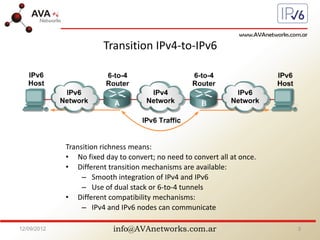
Transition IPv4-to-IPv6
Transition richness means:
• No fixed day to convert; no need to convert all at once.
• Different transition mechanisms are available:
– Smooth integration of IPv4 and IPv6
– Use of dual stack or 6-to-4 tunnels
• Different compatibility mechanisms:
– IPv4 and IPv6 nodes can communicate
12/09/2012 3
info@AVAnetworks.com.ar
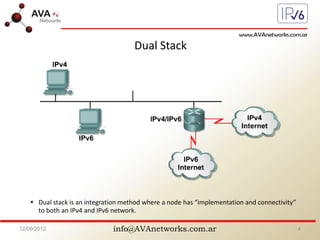
 Dual stack is an integration method where a node has “implementation and connectivity”
to both an IPv4 and IPv6 network.
Dual Stack
12/09/2012 4
info@AVAnetworks.com.ar
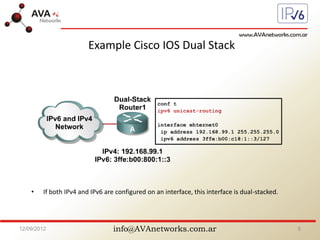
Example Cisco IOS Dual Stack
• If both IPv4 and IPv6 are configured on an interface, this interface is dual-stacked.
12/09/2012 5
info@AVAnetworks.com.ar
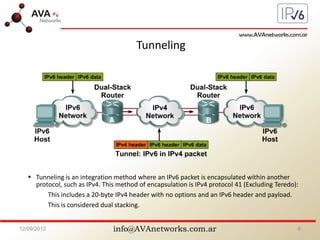
Tunneling
 Tunneling is an integration method where an IPv6 packet is encapsulated within another
protocol, such as IPv4. This method of encapsulation is IPv4 protocol 41 (Excluding Teredo):
This includes a 20-byte IPv4 header with no options and an IPv6 header and payload.
This is considered dual stacking.
12/09/2012 6
info@AVAnetworks.com.ar
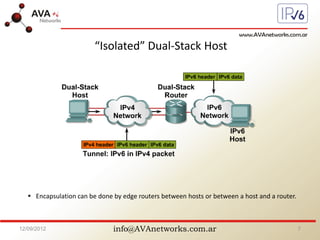
“Isolated” Dual-Stack Host
 Encapsulation can be done by edge routers between hosts or between a host and a router.
12/09/2012 7
info@AVAnetworks.com.ar
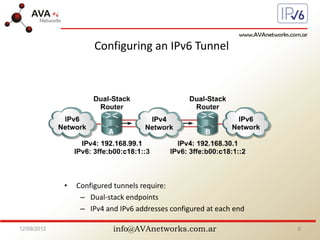
Configuring an IPv6 Tunnel
• Configured tunnels require:
– Dual-stack endpoints
– IPv4 and IPv6 addresses configured at each end
12/09/2012 8
info@AVAnetworks.com.ar
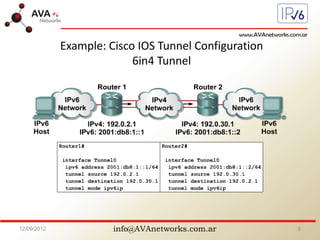
Example: Cisco IOS Tunnel Configuration
6in4 Tunnel
12/09/2012 9
info@AVAnetworks.com.ar
Configuring static routes for 6-to-4 tunnels
A 6-to-4 tunnel establishes a transient link between IPv6
domains which are connected by an IPv4 backbone
• Create a tunnel interface
• Set tunnel mode with the tunnel mode ipv6ip 6to4
command
• Create an IPv6 specific address
• Set the source interface for the tunnel
• Configure an Ipv6 static route
12/09/2012 10
info@AVAnetworks.com.ar
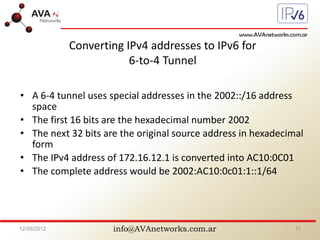
Converting IPv4 addresses to IPv6 for
6-to-4 Tunnel
• A 6-4 tunnel uses special addresses in the 2002::/16 address
space
• The first 16 bits are the hexadecimal number 2002
• The next 32 bits are the original source address in hexadecimal
form
• The IPv4 address of 172.16.12.1 is converted into AC10:0C01
• The complete address would be 2002:AC10:0c01:1::1/64
12/09/2012 11
info@AVAnetworks.com.ar
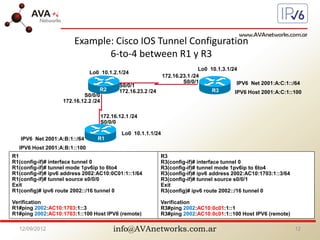
Example: Cisco IOS Tunnel Configuration
6-to-4 between R1 y R3
R1
R2 R3
Lo0 10.1.2.1/24
Lo0 10.1.3.1/24
Lo0 10.1.1.1/24
172.16.12.1 /24
S0/0/0
S0/0/0
172.16.12.2 /24
S0/0/1
172.16.23.2 /24
172.16.23.1 /24
S0/0/1
R1
R1(config-if)# interface tunnel 0
R1(config-if)# tunnel mode 1pv6ip to 6to4
R1(config-if)# ipv6 address 2002:AC10:0C01:1::1/64
R1(config-if)# tunnel source s0/0/0
Exit
R1(config)# ipv6 route 2002::/16 tunnel 0
Verification
R1#ping 2002:AC10:1703:1::3
R1#ping 2002:AC10:1703:1::100 Host IPV6 (remote)
R3
R3(config-if)# interface tunnel 0
R3(config-if)# tunnel mode 1pv6ip to 6to4
R3(config-if)# ipv6 address 2002:AC10:1703:1::3/64
R3(config-if)# tunnel source s0/0/1
Exit
R3(config)# ipv6 route 2002::/16 tunnel 0
Verification
R3#ping 2002:AC10:0c01:1::1
R3#ping 2002:AC10:0c01:1::100 Host IPV6 (remote)
12/09/2012 12
IPV6 Net 2001:A:C:1::/64
IPV6 Host 2001:A:C:1::100
IPV6 Net 2001:A:B:1::/64
IPV6 Host 2001:A:B:1::100
info@AVAnetworks.com.ar
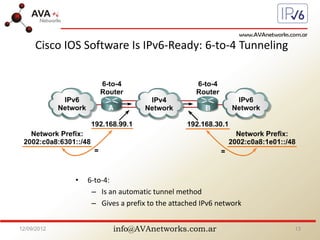
Cisco IOS Software Is IPv6-Ready: 6-to-4 Tunneling
• 6-to-4:
– Is an automatic tunnel method
– Gives a prefix to the attached IPv6 network
12/09/2012 13
info@AVAnetworks.com.ar
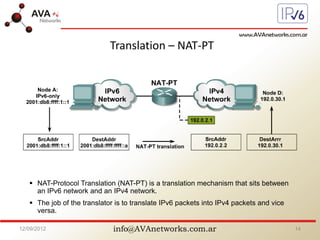
 NAT-Protocol Translation (NAT-PT) is a translation mechanism that sits between
an IPv6 network and an IPv4 network.
 The job of the translator is to translate IPv6 packets into IPv4 packets and vice
versa.
Translation – NAT-PT
12/09/2012 14
info@AVAnetworks.com.ar
Self Check
1. What are the 2 most common techniques to transition
from IPv4 to IPv6?
2. How does a dual-stack node choose which stack to use for
a particular traffic flow?
3. How is a router interface “dual-stacked”?
4. What is tunneling?
5. What is the job of the translator in a NAT-PT topology?
12/09/2012 15
info@AVAnetworks.com.ar
Resumen
• The two most common techniques to transition from IPv4
to IPv6 are dual stack and IPv6-to-IPv4 (6-to-4) tunnels.
• Tunneling IPv6 traffic over an IPv4 network requires one
edge router to encapsulate the IPv6 packet inside an IPv4
packet and another router to de-encapsulate it.
• Transition methods from IPv4 to IPv6 include dual-stack
operation, protocol translation, and 6-to-4 tunnels.
12/09/2012 16
info@AVAnetworks.com.ar
Q & A!!
12/09/2012 17
info@AVAnetworks.com.ar
Resources
• Tunneling IPv6 through an IPv4 Network (Configuration Example)
– http://cisco.com/en/US/partner/tech/tk872/technologies_configuration_example09
186a00800b49a5.shtml
• Implementing Tunneling for IPv6
– http://cisco.com/en/US/partner/products/sw/iosswrel/ps5187/products_configurati
on_guide_chapter09186a00801d6604.html
• Cisco IOS IPv6 Configuration Library
– http://cisco.com/en/US/partner/products/sw/iosswrel/ps5187/products_configurati
on_guide_book09186a00801d65f9.html
• Network Address Translator-Protocol Translator Technical Notes
– http://www.cisco.com/en/US/products/ps6553/products_data_sheet09186a008011
ff51.html
12/09/2012 18

Mecanismos de transicion pv6

  • 1.
    info@AVAnetworks.com.ar Transitions Mechanism IPv6 to IPv4 12/09/20121 Edgardo Scrimaglia CCIE edgardo.scrimaglia@avanetworks.com.ar
  • 2.
    info@AVAnetworks.com.ar Objetives • Describe transitionmechanisms used by IPv6 network traffic to transit IPv4 networks. • Describe how IPv6-over-IPv4 encapsulation (tunneling) works. • Describe how NAT-PT works. • Explain how to express IPv4 addresses in IPv6 format. 12/09/2012 2
  • 3.
    info@AVAnetworks.com.ar Transition IPv4-to-IPv6 Transition richnessmeans: • No fixed day to convert; no need to convert all at once. • Different transition mechanisms are available: – Smooth integration of IPv4 and IPv6 – Use of dual stack or 6-to-4 tunnels • Different compatibility mechanisms: – IPv4 and IPv6 nodes can communicate 12/09/2012 3
  • 4.
    info@AVAnetworks.com.ar  Dual stackis an integration method where a node has “implementation and connectivity” to both an IPv4 and IPv6 network. Dual Stack 12/09/2012 4
  • 5.
    info@AVAnetworks.com.ar Example Cisco IOSDual Stack • If both IPv4 and IPv6 are configured on an interface, this interface is dual-stacked. 12/09/2012 5
  • 6.
    info@AVAnetworks.com.ar Tunneling  Tunneling isan integration method where an IPv6 packet is encapsulated within another protocol, such as IPv4. This method of encapsulation is IPv4 protocol 41 (Excluding Teredo): This includes a 20-byte IPv4 header with no options and an IPv6 header and payload. This is considered dual stacking. 12/09/2012 6
  • 7.
    info@AVAnetworks.com.ar “Isolated” Dual-Stack Host Encapsulation can be done by edge routers between hosts or between a host and a router. 12/09/2012 7
  • 8.
    info@AVAnetworks.com.ar Configuring an IPv6Tunnel • Configured tunnels require: – Dual-stack endpoints – IPv4 and IPv6 addresses configured at each end 12/09/2012 8
  • 9.
    info@AVAnetworks.com.ar Example: Cisco IOSTunnel Configuration 6in4 Tunnel 12/09/2012 9
  • 10.
    info@AVAnetworks.com.ar Configuring static routesfor 6-to-4 tunnels A 6-to-4 tunnel establishes a transient link between IPv6 domains which are connected by an IPv4 backbone • Create a tunnel interface • Set tunnel mode with the tunnel mode ipv6ip 6to4 command • Create an IPv6 specific address • Set the source interface for the tunnel • Configure an Ipv6 static route 12/09/2012 10
  • 11.
    info@AVAnetworks.com.ar Converting IPv4 addressesto IPv6 for 6-to-4 Tunnel • A 6-4 tunnel uses special addresses in the 2002::/16 address space • The first 16 bits are the hexadecimal number 2002 • The next 32 bits are the original source address in hexadecimal form • The IPv4 address of 172.16.12.1 is converted into AC10:0C01 • The complete address would be 2002:AC10:0c01:1::1/64 12/09/2012 11
  • 12.
    info@AVAnetworks.com.ar Example: Cisco IOSTunnel Configuration 6-to-4 between R1 y R3 R1 R2 R3 Lo0 10.1.2.1/24 Lo0 10.1.3.1/24 Lo0 10.1.1.1/24 172.16.12.1 /24 S0/0/0 S0/0/0 172.16.12.2 /24 S0/0/1 172.16.23.2 /24 172.16.23.1 /24 S0/0/1 R1 R1(config-if)# interface tunnel 0 R1(config-if)# tunnel mode 1pv6ip to 6to4 R1(config-if)# ipv6 address 2002:AC10:0C01:1::1/64 R1(config-if)# tunnel source s0/0/0 Exit R1(config)# ipv6 route 2002::/16 tunnel 0 Verification R1#ping 2002:AC10:1703:1::3 R1#ping 2002:AC10:1703:1::100 Host IPV6 (remote) R3 R3(config-if)# interface tunnel 0 R3(config-if)# tunnel mode 1pv6ip to 6to4 R3(config-if)# ipv6 address 2002:AC10:1703:1::3/64 R3(config-if)# tunnel source s0/0/1 Exit R3(config)# ipv6 route 2002::/16 tunnel 0 Verification R3#ping 2002:AC10:0c01:1::1 R3#ping 2002:AC10:0c01:1::100 Host IPV6 (remote) 12/09/2012 12 IPV6 Net 2001:A:C:1::/64 IPV6 Host 2001:A:C:1::100 IPV6 Net 2001:A:B:1::/64 IPV6 Host 2001:A:B:1::100
  • 13.
    info@AVAnetworks.com.ar Cisco IOS SoftwareIs IPv6-Ready: 6-to-4 Tunneling • 6-to-4: – Is an automatic tunnel method – Gives a prefix to the attached IPv6 network 12/09/2012 13
  • 14.
    info@AVAnetworks.com.ar  NAT-Protocol Translation(NAT-PT) is a translation mechanism that sits between an IPv6 network and an IPv4 network.  The job of the translator is to translate IPv6 packets into IPv4 packets and vice versa. Translation – NAT-PT 12/09/2012 14
  • 15.
    info@AVAnetworks.com.ar Self Check 1. Whatare the 2 most common techniques to transition from IPv4 to IPv6? 2. How does a dual-stack node choose which stack to use for a particular traffic flow? 3. How is a router interface “dual-stacked”? 4. What is tunneling? 5. What is the job of the translator in a NAT-PT topology? 12/09/2012 15
  • 16.
    info@AVAnetworks.com.ar Resumen • The twomost common techniques to transition from IPv4 to IPv6 are dual stack and IPv6-to-IPv4 (6-to-4) tunnels. • Tunneling IPv6 traffic over an IPv4 network requires one edge router to encapsulate the IPv6 packet inside an IPv4 packet and another router to de-encapsulate it. • Transition methods from IPv4 to IPv6 include dual-stack operation, protocol translation, and 6-to-4 tunnels. 12/09/2012 16
  • 17.
  • 18.
    info@AVAnetworks.com.ar Resources • Tunneling IPv6through an IPv4 Network (Configuration Example) – http://cisco.com/en/US/partner/tech/tk872/technologies_configuration_example09 186a00800b49a5.shtml • Implementing Tunneling for IPv6 – http://cisco.com/en/US/partner/products/sw/iosswrel/ps5187/products_configurati on_guide_chapter09186a00801d6604.html • Cisco IOS IPv6 Configuration Library – http://cisco.com/en/US/partner/products/sw/iosswrel/ps5187/products_configurati on_guide_book09186a00801d65f9.html • Network Address Translator-Protocol Translator Technical Notes – http://www.cisco.com/en/US/products/ps6553/products_data_sheet09186a008011 ff51.html 12/09/2012 18