ENVIRONMENTAL IMPACT ASSESSMENT
Process & Stages
Environment Impact Assessment
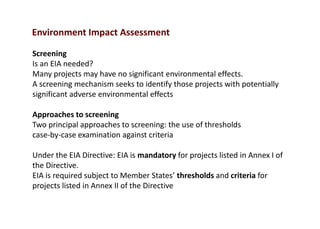
Screening
Is an EIA needed?
Many projects may have no significant environmental effects.
A screening mechanism seeks to identify those projects with potentially
significant adverse environmental effects
Approaches to screening
Two principal approaches to screening: the use of thresholds
case-by-case examination against criteria
Under the EIA Directive: EIA is mandatory for projects listed in Annex I of
the Directive.
EIA is required subject to Member States’ thresholds and criteria for
projects listed in Annex II of the Directive
Scoping
The scope of an EIA is the issues and impacts it addresses
Scoping is the process of deciding which of a project’s possible
alternatives and impacts should be addressed in the EIA
An EIA should focus only on the significant issues and impacts
20 Scoping
Scoping is carried out in discussions between the developer, the
competent authority, relevant agencies and, ideally, the public
Effective scoping enables limited resources to be allocated to best
effect (i.e. through investigation of only the most significant
impacts)
Scoping is not mandatory under the EIA Directive
Environment Impact Assessment
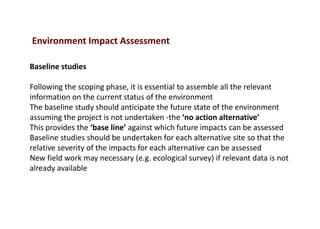
Baseline studies
Following the scoping phase, it is essential to assemble all the relevant
information on the current status of the environment
The baseline study should anticipate the future state of the environment
assuming the project is not undertaken -the ‘no action alternative’
This provides the ‘base line’ against which future impacts can be assessed
Baseline studies should be undertaken for each alternative site so that the
relative severity of the impacts for each alternative can be assessed
New field work may necessary (e.g. ecological survey) if relevant data is not
already available
Environment Impact Assessment
Alternatives
EIA is ideally undertaken for a project and its alternatives (e.g. different
locations, scales, designs)
Alternatives are the ‘raw material’ of EIA
EIAs which fail to consider alternatives are cause of failures for projects
Impact assessment
Impact assessment involves evaluating the significance of the impacts
identified
Significance can be determined through professional judgment, reference to
regulations etc.
Potential for bias in determining what is significant
The conclusions of the impact assessment can ultimately be used by
decision-makers when determining the fate of the project application
Environment Impact Assessment
Mitigation
Negative impacts on the environment identified during the EIA can be
alleviated through mitigation measures
The mitigation hierarchy: Avoid -Reduce -Remedy -Compensate -
Enhance
Impacts remaining after mitigation are known as residual impacts
The legislation obstructs the proper process of design development
Environment Impact Assessment
EIA preparation / review
The Environmental Impact Assessment (EIA)is a formal document which
includes information on the development and information relating to
screening, scoping, baseline studies, alternatives etc.
Common requirement to include a non-technical summary
Once complete, the EIA is submitted to the competent authority (along with
the planning application)
The EIA is often reviewed(either formally or informally by experts)
The review enables the competent authority to decide whether the EIA is
adequate, accurate and unbiased
Environment Impact Assessment
Public consultation
The EIA Directive provides for public consultation on the application for
development and the EIA
Post Project Monitoring
Monitoring should determine:
The accuracy of the original predictions
the degree of deviation from the predictions
the possible reasons for any deviations
the extent to which mitigation measures have achieved their objectives
EIA Review & Procedures
T h a n k Y o u

Eia stages

  • 1.
  • 2.
    Environment Impact Assessment Screening Isan EIA needed? Many projects may have no significant environmental effects. A screening mechanism seeks to identify those projects with potentially significant adverse environmental effects Approaches to screening Two principal approaches to screening: the use of thresholds case-by-case examination against criteria Under the EIA Directive: EIA is mandatory for projects listed in Annex I of the Directive. EIA is required subject to Member States’ thresholds and criteria for projects listed in Annex II of the Directive
  • 3.
    Scoping The scope ofan EIA is the issues and impacts it addresses Scoping is the process of deciding which of a project’s possible alternatives and impacts should be addressed in the EIA An EIA should focus only on the significant issues and impacts 20 Scoping Scoping is carried out in discussions between the developer, the competent authority, relevant agencies and, ideally, the public Effective scoping enables limited resources to be allocated to best effect (i.e. through investigation of only the most significant impacts) Scoping is not mandatory under the EIA Directive Environment Impact Assessment
  • 4.
    Baseline studies Following thescoping phase, it is essential to assemble all the relevant information on the current status of the environment The baseline study should anticipate the future state of the environment assuming the project is not undertaken -the ‘no action alternative’ This provides the ‘base line’ against which future impacts can be assessed Baseline studies should be undertaken for each alternative site so that the relative severity of the impacts for each alternative can be assessed New field work may necessary (e.g. ecological survey) if relevant data is not already available Environment Impact Assessment
  • 5.
    Environment Impact Assessment Alternatives EIAis ideally undertaken for a project and its alternatives (e.g. different locations, scales, designs) Alternatives are the ‘raw material’ of EIA EIAs which fail to consider alternatives are cause of failures for projects Impact assessment Impact assessment involves evaluating the significance of the impacts identified Significance can be determined through professional judgment, reference to regulations etc. Potential for bias in determining what is significant The conclusions of the impact assessment can ultimately be used by decision-makers when determining the fate of the project application
  • 6.
    Environment Impact Assessment Mitigation Negativeimpacts on the environment identified during the EIA can be alleviated through mitigation measures The mitigation hierarchy: Avoid -Reduce -Remedy -Compensate - Enhance Impacts remaining after mitigation are known as residual impacts The legislation obstructs the proper process of design development
  • 7.
    Environment Impact Assessment EIApreparation / review The Environmental Impact Assessment (EIA)is a formal document which includes information on the development and information relating to screening, scoping, baseline studies, alternatives etc. Common requirement to include a non-technical summary Once complete, the EIA is submitted to the competent authority (along with the planning application) The EIA is often reviewed(either formally or informally by experts) The review enables the competent authority to decide whether the EIA is adequate, accurate and unbiased
  • 8.
    Environment Impact Assessment Publicconsultation The EIA Directive provides for public consultation on the application for development and the EIA Post Project Monitoring Monitoring should determine: The accuracy of the original predictions the degree of deviation from the predictions the possible reasons for any deviations the extent to which mitigation measures have achieved their objectives EIA Review & Procedures
  • 9.
    T h an k Y o u