What is EnvironmentalImpact Assessment (EIA)?
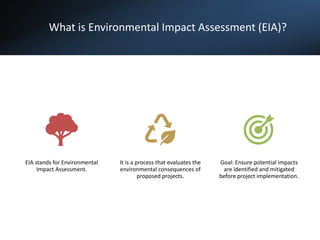
EIA stands for Environmental
Impact Assessment.
It is a process that evaluates the
environmental consequences of
proposed projects.
Goal: Ensure potential impacts
are identified and mitigated
before project implementation.
3.
EIA in Full– Key Steps
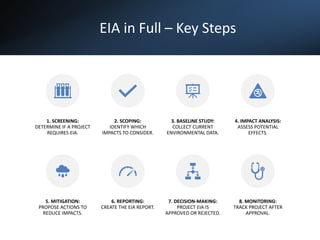
1. SCREENING:
DETERMINE IF A PROJECT
REQUIRES EIA.
2. SCOPING:
IDENTIFY WHICH
IMPACTS TO CONSIDER.
3. BASELINE STUDY:
COLLECT CURRENT
ENVIRONMENTAL DATA.
4. IMPACT ANALYSIS:
ASSESS POTENTIAL
EFFECTS.
5. MITIGATION:
PROPOSE ACTIONS TO
REDUCE IMPACTS.
6. REPORTING:
CREATE THE EIA REPORT.
7. DECISION-MAKING:
PROJECT EIA IS
APPROVED OR REJECTED.
8. MONITORING:
TRACK PROJECT AFTER
APPROVAL.
4.
Legal and RegulatoryFramework
• EIA is supported by national laws and international regulations.
• Examples:
– EU: EIA Directive 2014/52/EU
– USA: National Environmental Policy Act (NEPA)
– India: Environmental Protection Act, 1986
• Compliance with EIA regulations is mandatory for many project
types.
• Projects may be subject to more than one type of EIA regulation,
depending on the region
5.
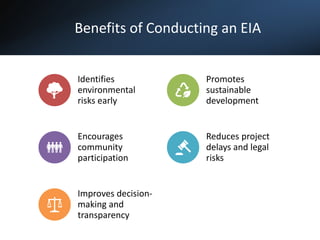
Benefits of Conductingan EIA
Identifies
environmental
risks early
Promotes
sustainable
development
Encourages
community
participation
Reduces project
delays and legal
risks
Improves decision-
making and
transparency
6.
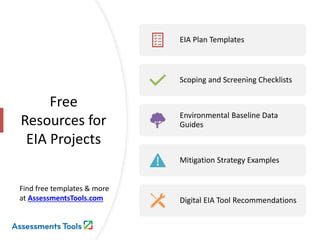
Free
Resources for
EIA Projects
EIAPlan Templates
Scoping and Screening Checklists
Environmental Baseline Data
Guides
Mitigation Strategy Examples
Digital EIA Tool Recommendations
Find free templates & more
at AssessmentsTools.com