e-Governance in India: Focus on Education Sector Emerging issues, challenges and opportunities
What is e-governance? e-Governance is the public sector’s use of information and communication technologies with the aim of improving information and service delivery, encouraging citizen participation in the decision-making process and making government more accountable, transparent and effective.
So what’s new? E-Governance involves new styles of leadership, new ways of debating and deciding policy and investment, new ways of accessing education, new ways of listening to citizens and new ways of organising and delivering information and services.
Goals of e-governance Improve the internal processes of governments  Provide better information and service delivery  Increase government transparency in order to reduce corruption  Reinforce political credibility and accountability  Promote democratic practices through public participation and consultation
Fields of e-governance e-administration - refers to improving of government processes and of the internal workings of the public sector with new ICT-executed information processes.
Fields of e-governance e-services - refers to improved delivery of public services to citizens. Some examples of interactive services are: requests for public documents, requests for legal documents and certificates, issuing permits and licenses.
Fields of e-governance e-democracy - implies greater and more active citizen participation and involvement enabled by ICTs in the decision-making process
Why introduce e-governance? The purpose of implementing e-governance is to enhance good governance. Good governance is generally characterised by participation, transparency and accountability. The recent advances in communication technologies and the Internet provide opportunities to transform the relationship between governments and citizens in a new way, to the achieve good governance goals.
ICT and e-governance? Use of ICT can increase the involvement of citizens in the process of governance at all levels  Advantages for the government involve that the government may provide better service in terms of time, making governance more efficient and more effective. In addition, the transaction costs can be lowered and government services become more accessible.
Application areas Agriculture, power and education are fields where the government makes use of IT to provide services to citizens. The revenue collection department is in the process of using information technology for applications such as income tax.
Stages of e-Government Presence: Numerous web-sites with static content (brochure-ware) Interaction: e-mail and downloadable forms for citizen interaction Transaction: Integrated sites for enabling complete and secure transactions Transformation: Seamless integration of sites for e-democracy or transformation
E-government Maturity Model GMM1: Information access GMM2: Expand access and transactions GMM3: Re-design processes around the customer GMM4: Knowledge based Government
The Objective of e-Governance in education To meet challenges of Accessibility Scalability Relevance Quality Affordability
Accessibility  Reaching out to un-reached areas Low power consumption and rugged devices (e.g., clockwork radio) Access at all times (An always on educational system, not only 180 days a year) Providing access to high quality instruction
Scalability  We have today, isolated pockets of excellence Expansion at high speed often leads to decline in quality Scalability while maintaining quality is the challenge
Moving from a mere lecture to the creation of a learning event It is not enough that a lecture was taken The learning transactions are more important Did learning take place? Did an interest in more learning take place? Did the learner learn how to learn?
Re-structuring and transforming educational processes Customer Relationship management (Learner relationship management) Enterprise resource planning (LMS,LCMS..) Quality and Security Management systems (ISO,CMM,BS7799…) Supply chain management (Global e-sourcing of learning resources and expertise) Learner facilitation system (LFS)
Restructuring education for national delivery Education is about putting teachers and learners together As we evolve into different stages of society, from hunter-gatherer, agricultural, industrial, post-industrial, to knowledge Society, its modes must change Learners may be anywhere and educational service providers could come from everywhere  Re-establishment of the Gurukul system displaced by McCaulay and being currently implemented deploying current and emerging technologies
Factors influencing the future learning environments The convergence in ICT Emergence of the Knowledge economy Developments in educational research
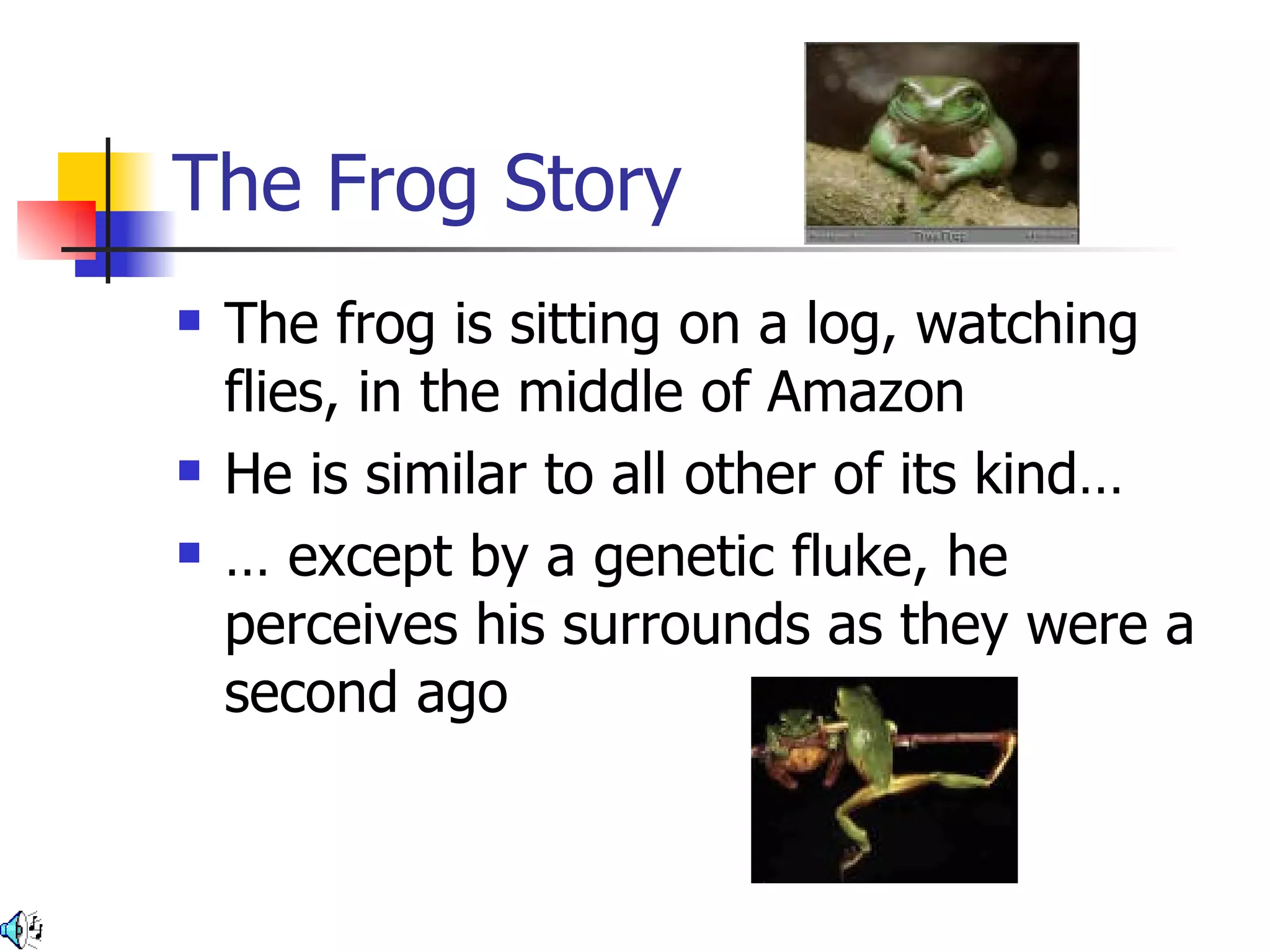
The Frog Story The frog is sitting on a log, watching flies, in the middle of Amazon He is similar to all other of its kind… … except by a genetic fluke, he perceives his surrounds as they were a second ago
The Frog Story So what happens? When the frog sees a fly, within range he lunges out … …  but due to his out of date information … he misses Eventually, weakened by a rarely satiated hunger, the frog dies The others which use most recent data survive
Predecessors of the Knowledge Economy Caveman Stone age Nomadic Hunters Bronze age Iron age Agricultural Society Industrial society Information Society
A snap-shot of the above process  They were all a series of technological shocks But were delivered slowly, often over different generations Now the same generation experiences several changes The expected pace of such shocks in future is too fast for comfort and our ability to cope with changes
Characteristics of a Knowledge Economy The distinction between ’useful’ and ‘useless’ knowledge is very thin What you know is more important than what you have Knowledge moving from the edge to core of business and economics Whom you know is even more important
Aids and Tools in the Knowledge Economy Amplifiers Analysers Synthesisers Simulators Packaging methodologies Distribution schemes Filters
Education as key to creating Intellectual capital Promoting Creativity and innovation Questioning the answers more important than quoting the right traditional answers to age-old questions Perpetual Learning Serendipitous Learning
What time frame ? Coming of the next decade 2005… to  2015 Entering knowledge economy in 2010 Achieving maturity in 2025
Our object is to create winners People who will be able to flourish and thrive in the knowledge economy People who will be able to participate in a democracy and through building global consensus The skills and competencies as well as attitudes and beliefs cannot be the same as that of earlier ages
To be leaders in the knowledge economy… Teachers will play the central role.. following the earlier success of the shopkeepers, traders, contractors, lawyers… We need to be owners and creators of knowledge products not  a mass market  Needs creativity, innovation on a continuous basis and not conformity and repetition
Who flourishes and thrives..? Poor struggling people work for the economy (try to get money for the work that they put in) Flourishers have the economy working for them. (the intellectual capital they create gets them the money)
From one-time learning to perpetual learning One time qualifications for lifelong employment If you started higher, you rose higher Last decade saw a growth of life-long learning,i.e,getting degrees later in life Current and future trends are for perpetual learning
Responding to the emergence of the Knowledge Economy Learning to Know Constructing knowledge Acquiring knowledge Packaging knowledge Preserving knowledge Disseminating knowledge Unlocking commercial value in knowledge
How the dimensions of learning interact Using Knowledge  Meaningfully Extending &  Refining Knowledge Acquiring & integrating  knowledge Habits of Mind Attitude & Perception
The Dark sides of various economies Agricultural: De-forestation Industrial : Pollution and environmental degradation Information : Privacy  (spam, photos, databases) Bio-economy : Ethics  (cloning, eugenics, genetic patenting, bio-engineered foods, certainty about inherited diseases)
Quality Engaging remote learners Attainment of learning objectives Striving to a 6 sigma approach Authenticity of learners Integrity of the certification process Authenticity of transacted contents
  Emerging Learning Models Instructor –Course Relationships Instructor and Course Instructor but no Course No instructor but course No instructor and no course
Affordability  Quality education is getting more expensive A large part of the expense is on under-utilised infra-structure and on highly inefficient and expensive administration Both these costs can be significantly  reduced by efficient deployment of technology and out-sourcing of non-core functions.
Can we apply learning from elsewhere to education models Telecommunication Banking Airlines All have drastically reduced costs by expansion and serving more efficiently
Good governance in corporates Cadbury report Kumar Mangalam Birla report Sarbanes Oxley Act 2002 Companies Act amendment 2004 All emphasise the importance of independent directors on Board level decision making especially audit etc.
Emergence of the Independent Educator Doctors, Engineers, Architects, CA’s , lawyers can all work either within Government, corporate or independently Qualified educationists would work  independently ... as Teachers,quality assessors, curriculum designers, advisors, creators of IP…
How to become a Virtual Teacher Traditional face to face teachers need to be trained in using ICT to enhance their learning experience and to be able to deliver remotely as well Webagogy is evolving and developing and needs to be adopted to become a successful Virtual professor
The STUDYIO STUDY + STUDIO = STUD(YIO) A place well-connected to the Internet as well as a repository of traditional paper based resources A reasonably powerful multi-media computer with digital recording device Some assistance to make it all work in sync during the lecture(presentation)
How can wireless Technologies be used in Education? Challenges Risks Opportunities
Possible Technologies SMS,MMS,IM WAP/Imode 3G Applications Bluetooth Wearable Computers Location Based Services
Educational Applications Truancy:Yishun Town Secondary School,Singapore Examination Results: Institute of Chartered Accountants UK,South Africa Goodluck messages: Bradford University Class schedules,changes etc.: Manila’s De La salle University
Some more educational applications Students Union: Australian National Union of students,National University of Ireland Revision help : BBC for GCSE,Knowsley Council Admission offers ; Australia Children’s nutrition level in canteen food: Singapore
What is MMS? MMS is a messaging service for the mobile environment, standardized by the WAP Forum and the 3rd Generation Partnership Program (3GPP).  Provides automatic, immediate delivery of user-created content from phone to phone. The new MMS technology provides support for email addressing. MMS can contain still images, video and voice or audio clips.  Another advantage of MMS is that the message is sent as a multimedia presentation in a single entry.  MMS is also bearer-independent, and therefore not limited to only GSM or WCDMA networks
Wireless Technologies: Expanding the Range of Options A campus will move from a wired network to wireless technology for a variety of reasons. Perhaps the wired network doesn’t reach every location in a distance learning program, or the campus decides to go wireless to allow students complete mobility. Sometimes geographic barriers necessitate a technology that can literally leap tall buildings in a single bound. Whatever the reason, deciding to go wireless is only the first step. After that, an institution has to research and choose the best wireless solution for a particular campus or system. As with wired networking, the number of variations available in wireless technology is staggering. Here we've surveyed some options that address campus-specific needs, from handheld devices that replace PCs, to single-office Internet connections, to laser transmission that beams data from point to point.
Implementation Alternatives Create everything oneself Network for leveraging other competencies and not keep re-inventing the wheel Choose between bleeding edge, leading edge, established and receding technologies depending upon the context
E-Contact Framework Students are and have been supported by teachers, in  Class Rooms , through  Private Tuition Schools  as well as  Private Tutors
However, in the world of today, where support has become important, the objective is not only to deliver  the courses and offer degrees… BUT…
….deliver the courses backed with value added & customised 24/7 Information, Facilitation & Support, thus providing a truly international experience to the students … be able to;
… The Solution L earner’s  F acilitation  S ervice (LFS) Presented by; Prof. M M Pant
What is LFS ? A Single Window, Facilitation Services for Learners / Students, that …. Presented by; Prof. M M Pant
… Converges all facilitation media  into one single window,  thus presenting  One Point of Contact for the Learner / Student … Presented by; Prof. M M Pant
… Relates to the  objective  of the Learner / Student … And… Presented by; Prof. M M Pant
… Manages the Learner / Student with an e Presented by; Prof. M M Pant
A  breakthrough   in the field of Education … In summary, LFS is; Presented by; Prof. M M Pant
…  with unique combination of  Technology   with Education & Service Presented by; Prof. M M Pant
How will this happen ? The objectives can be fulfilled  by using state-of-the-art  e CRM  &  Call Centre backed services, along with a  back-end secretarial support. Presented by; Prof. M M Pant
Who will benefit ? All Learners / Student, whether at ; School level College level  Professional level Presented by; Prof. M M Pant
Key Features of LFS 3 Digit (136, …)   or Toll free  (1 – 600….)  contact Dedicated team   for operations 24/7   service Web based   support   (Live & Interactive )   Supply chain   management system Phased   implementation plan   (PIP) Presented by; Prof. M M Pant
Highlights….   contd Soft-tested   services Data capturing   mechanisms Data analysis   and Reporting Check & monitoring   system Customised solutions Live person   interactivity Multi city   operations Presented by; Prof. M M Pant
Services Overview Create & Manage a Data Warehouse Carry out Tele-research Provide Detailed Information Service existing students  , Admn., Learning  support & assistance Presented by; Prof. M M Pant
Services Overview Tele-marketing   of offerings Special Events Advice / Counseling Services …  plus many other support services. Basically, you have the technology, and it can be used to our advantage Presented by; Prof. M M Pant
Delivery Methods In-bound Call Centre Services Out-bound Call Centre Services E-mail services (In and Out), including clearing  house operation Presented by; Prof. M M Pant
Delivery Mode…contd Live Chat with resource persons (pre-fixed) Web based support Traditional mail management system Presented by; Prof. M M Pant
Diagrammatic Representation Call / eCRM Centre Voice Call Mail Fax Voice Agent Chat Agent Mail Agent eMail Web Chat Web query Presented by; Prof. M M Pant Back-office
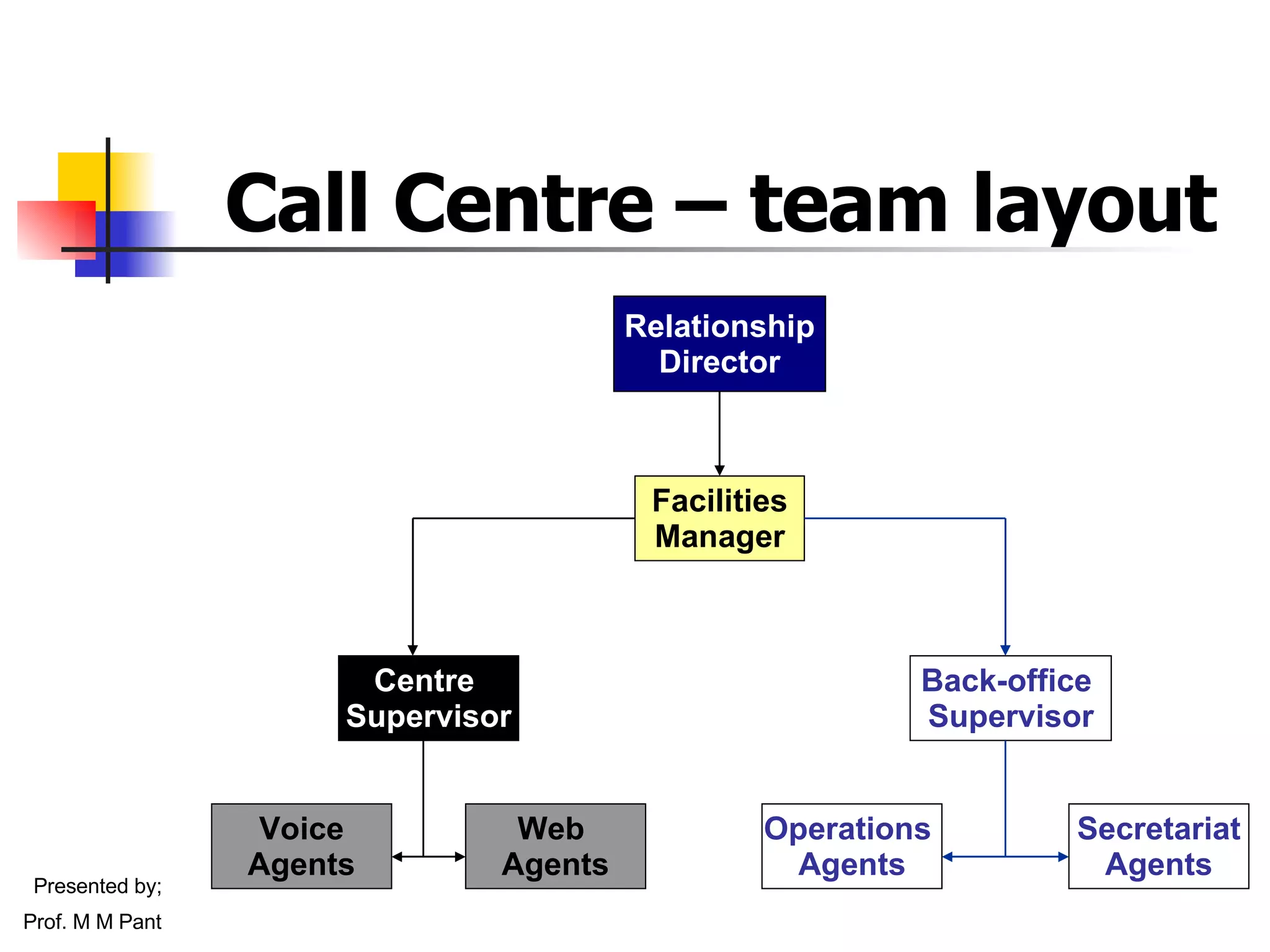
Call Centre – team layout Relationship Director Facilities Manager Centre  Supervisor Back-office  Supervisor Voice Agents Web  Agents Operations  Agents Secretariat Agents Presented by; Prof. M M Pant
…  So, what do we achieve ? … Presented by; Prof. M M Pant
…  A Learner, with a  WOW !  Experience Presented by; Prof. M M Pant
Conclusion: A picture 10 years hence In the past, you had to be born at the right latitude, longitude and time to be fortunate enough to access a quality higher education Higher education in future could include all, irrespective of the above factors Providers and seekers of knowledge are all connected through ‘educational grid’. To draw upon as per demand, and to contribute to as per generation
The biggest brand …. ever This single point of confluence would have a huge brand recognition A single all-India number 16008648 A single web portal  www.indianedu.ac.in Faculty e-mail id’s such as  [email_address] Student life-long id’s (to continue as alumni)  [email_address]
[email_address]

e-governance in context of education

  • 1.
    e-Governance in India:Focus on Education Sector Emerging issues, challenges and opportunities
  • 2.
    What is e-governance?e-Governance is the public sector’s use of information and communication technologies with the aim of improving information and service delivery, encouraging citizen participation in the decision-making process and making government more accountable, transparent and effective.
  • 3.
    So what’s new?E-Governance involves new styles of leadership, new ways of debating and deciding policy and investment, new ways of accessing education, new ways of listening to citizens and new ways of organising and delivering information and services.
  • 4.
    Goals of e-governanceImprove the internal processes of governments Provide better information and service delivery Increase government transparency in order to reduce corruption Reinforce political credibility and accountability Promote democratic practices through public participation and consultation
  • 5.
    Fields of e-governancee-administration - refers to improving of government processes and of the internal workings of the public sector with new ICT-executed information processes.
  • 6.
    Fields of e-governancee-services - refers to improved delivery of public services to citizens. Some examples of interactive services are: requests for public documents, requests for legal documents and certificates, issuing permits and licenses.
  • 7.
    Fields of e-governancee-democracy - implies greater and more active citizen participation and involvement enabled by ICTs in the decision-making process
  • 8.
    Why introduce e-governance?The purpose of implementing e-governance is to enhance good governance. Good governance is generally characterised by participation, transparency and accountability. The recent advances in communication technologies and the Internet provide opportunities to transform the relationship between governments and citizens in a new way, to the achieve good governance goals.
  • 9.
    ICT and e-governance?Use of ICT can increase the involvement of citizens in the process of governance at all levels Advantages for the government involve that the government may provide better service in terms of time, making governance more efficient and more effective. In addition, the transaction costs can be lowered and government services become more accessible.
  • 10.
    Application areas Agriculture,power and education are fields where the government makes use of IT to provide services to citizens. The revenue collection department is in the process of using information technology for applications such as income tax.
  • 11.
    Stages of e-GovernmentPresence: Numerous web-sites with static content (brochure-ware) Interaction: e-mail and downloadable forms for citizen interaction Transaction: Integrated sites for enabling complete and secure transactions Transformation: Seamless integration of sites for e-democracy or transformation
  • 12.
    E-government Maturity ModelGMM1: Information access GMM2: Expand access and transactions GMM3: Re-design processes around the customer GMM4: Knowledge based Government
  • 13.
    The Objective ofe-Governance in education To meet challenges of Accessibility Scalability Relevance Quality Affordability
  • 14.
    Accessibility Reachingout to un-reached areas Low power consumption and rugged devices (e.g., clockwork radio) Access at all times (An always on educational system, not only 180 days a year) Providing access to high quality instruction
  • 15.
    Scalability Wehave today, isolated pockets of excellence Expansion at high speed often leads to decline in quality Scalability while maintaining quality is the challenge
  • 16.
    Moving from amere lecture to the creation of a learning event It is not enough that a lecture was taken The learning transactions are more important Did learning take place? Did an interest in more learning take place? Did the learner learn how to learn?
  • 17.
    Re-structuring and transformingeducational processes Customer Relationship management (Learner relationship management) Enterprise resource planning (LMS,LCMS..) Quality and Security Management systems (ISO,CMM,BS7799…) Supply chain management (Global e-sourcing of learning resources and expertise) Learner facilitation system (LFS)
  • 18.
    Restructuring education fornational delivery Education is about putting teachers and learners together As we evolve into different stages of society, from hunter-gatherer, agricultural, industrial, post-industrial, to knowledge Society, its modes must change Learners may be anywhere and educational service providers could come from everywhere Re-establishment of the Gurukul system displaced by McCaulay and being currently implemented deploying current and emerging technologies
  • 19.
    Factors influencing thefuture learning environments The convergence in ICT Emergence of the Knowledge economy Developments in educational research
  • 20.
    The Frog StoryThe frog is sitting on a log, watching flies, in the middle of Amazon He is similar to all other of its kind… … except by a genetic fluke, he perceives his surrounds as they were a second ago
  • 21.
    The Frog StorySo what happens? When the frog sees a fly, within range he lunges out … … but due to his out of date information … he misses Eventually, weakened by a rarely satiated hunger, the frog dies The others which use most recent data survive
  • 22.
    Predecessors of theKnowledge Economy Caveman Stone age Nomadic Hunters Bronze age Iron age Agricultural Society Industrial society Information Society
  • 23.
    A snap-shot ofthe above process They were all a series of technological shocks But were delivered slowly, often over different generations Now the same generation experiences several changes The expected pace of such shocks in future is too fast for comfort and our ability to cope with changes
  • 24.
    Characteristics of aKnowledge Economy The distinction between ’useful’ and ‘useless’ knowledge is very thin What you know is more important than what you have Knowledge moving from the edge to core of business and economics Whom you know is even more important
  • 25.
    Aids and Toolsin the Knowledge Economy Amplifiers Analysers Synthesisers Simulators Packaging methodologies Distribution schemes Filters
  • 26.
    Education as keyto creating Intellectual capital Promoting Creativity and innovation Questioning the answers more important than quoting the right traditional answers to age-old questions Perpetual Learning Serendipitous Learning
  • 27.
    What time frame? Coming of the next decade 2005… to 2015 Entering knowledge economy in 2010 Achieving maturity in 2025
  • 28.
    Our object isto create winners People who will be able to flourish and thrive in the knowledge economy People who will be able to participate in a democracy and through building global consensus The skills and competencies as well as attitudes and beliefs cannot be the same as that of earlier ages
  • 29.
    To be leadersin the knowledge economy… Teachers will play the central role.. following the earlier success of the shopkeepers, traders, contractors, lawyers… We need to be owners and creators of knowledge products not a mass market Needs creativity, innovation on a continuous basis and not conformity and repetition
  • 30.
    Who flourishes andthrives..? Poor struggling people work for the economy (try to get money for the work that they put in) Flourishers have the economy working for them. (the intellectual capital they create gets them the money)
  • 31.
    From one-time learningto perpetual learning One time qualifications for lifelong employment If you started higher, you rose higher Last decade saw a growth of life-long learning,i.e,getting degrees later in life Current and future trends are for perpetual learning
  • 32.
    Responding to theemergence of the Knowledge Economy Learning to Know Constructing knowledge Acquiring knowledge Packaging knowledge Preserving knowledge Disseminating knowledge Unlocking commercial value in knowledge
  • 33.
    How the dimensionsof learning interact Using Knowledge Meaningfully Extending & Refining Knowledge Acquiring & integrating knowledge Habits of Mind Attitude & Perception
  • 34.
    The Dark sidesof various economies Agricultural: De-forestation Industrial : Pollution and environmental degradation Information : Privacy (spam, photos, databases) Bio-economy : Ethics (cloning, eugenics, genetic patenting, bio-engineered foods, certainty about inherited diseases)
  • 35.
    Quality Engaging remotelearners Attainment of learning objectives Striving to a 6 sigma approach Authenticity of learners Integrity of the certification process Authenticity of transacted contents
  • 36.
    EmergingLearning Models Instructor –Course Relationships Instructor and Course Instructor but no Course No instructor but course No instructor and no course
  • 37.
    Affordability Qualityeducation is getting more expensive A large part of the expense is on under-utilised infra-structure and on highly inefficient and expensive administration Both these costs can be significantly reduced by efficient deployment of technology and out-sourcing of non-core functions.
  • 38.
    Can we applylearning from elsewhere to education models Telecommunication Banking Airlines All have drastically reduced costs by expansion and serving more efficiently
  • 39.
    Good governance incorporates Cadbury report Kumar Mangalam Birla report Sarbanes Oxley Act 2002 Companies Act amendment 2004 All emphasise the importance of independent directors on Board level decision making especially audit etc.
  • 40.
    Emergence of theIndependent Educator Doctors, Engineers, Architects, CA’s , lawyers can all work either within Government, corporate or independently Qualified educationists would work independently ... as Teachers,quality assessors, curriculum designers, advisors, creators of IP…
  • 41.
    How to becomea Virtual Teacher Traditional face to face teachers need to be trained in using ICT to enhance their learning experience and to be able to deliver remotely as well Webagogy is evolving and developing and needs to be adopted to become a successful Virtual professor
  • 42.
    The STUDYIO STUDY+ STUDIO = STUD(YIO) A place well-connected to the Internet as well as a repository of traditional paper based resources A reasonably powerful multi-media computer with digital recording device Some assistance to make it all work in sync during the lecture(presentation)
  • 43.
    How can wirelessTechnologies be used in Education? Challenges Risks Opportunities
  • 44.
    Possible Technologies SMS,MMS,IMWAP/Imode 3G Applications Bluetooth Wearable Computers Location Based Services
  • 45.
    Educational Applications Truancy:YishunTown Secondary School,Singapore Examination Results: Institute of Chartered Accountants UK,South Africa Goodluck messages: Bradford University Class schedules,changes etc.: Manila’s De La salle University
  • 46.
    Some more educationalapplications Students Union: Australian National Union of students,National University of Ireland Revision help : BBC for GCSE,Knowsley Council Admission offers ; Australia Children’s nutrition level in canteen food: Singapore
  • 47.
    What is MMS?MMS is a messaging service for the mobile environment, standardized by the WAP Forum and the 3rd Generation Partnership Program (3GPP). Provides automatic, immediate delivery of user-created content from phone to phone. The new MMS technology provides support for email addressing. MMS can contain still images, video and voice or audio clips. Another advantage of MMS is that the message is sent as a multimedia presentation in a single entry. MMS is also bearer-independent, and therefore not limited to only GSM or WCDMA networks
  • 48.
    Wireless Technologies: Expandingthe Range of Options A campus will move from a wired network to wireless technology for a variety of reasons. Perhaps the wired network doesn’t reach every location in a distance learning program, or the campus decides to go wireless to allow students complete mobility. Sometimes geographic barriers necessitate a technology that can literally leap tall buildings in a single bound. Whatever the reason, deciding to go wireless is only the first step. After that, an institution has to research and choose the best wireless solution for a particular campus or system. As with wired networking, the number of variations available in wireless technology is staggering. Here we've surveyed some options that address campus-specific needs, from handheld devices that replace PCs, to single-office Internet connections, to laser transmission that beams data from point to point.
  • 49.
    Implementation Alternatives Createeverything oneself Network for leveraging other competencies and not keep re-inventing the wheel Choose between bleeding edge, leading edge, established and receding technologies depending upon the context
  • 50.
    E-Contact Framework Studentsare and have been supported by teachers, in Class Rooms , through Private Tuition Schools as well as Private Tutors
  • 51.
    However, in theworld of today, where support has become important, the objective is not only to deliver the courses and offer degrees… BUT…
  • 52.
    ….deliver the coursesbacked with value added & customised 24/7 Information, Facilitation & Support, thus providing a truly international experience to the students … be able to;
  • 53.
    … The SolutionL earner’s F acilitation S ervice (LFS) Presented by; Prof. M M Pant
  • 54.
    What is LFS? A Single Window, Facilitation Services for Learners / Students, that …. Presented by; Prof. M M Pant
  • 55.
    … Converges allfacilitation media into one single window, thus presenting One Point of Contact for the Learner / Student … Presented by; Prof. M M Pant
  • 56.
    … Relates tothe objective of the Learner / Student … And… Presented by; Prof. M M Pant
  • 57.
    … Manages theLearner / Student with an e Presented by; Prof. M M Pant
  • 58.
    A breakthrough in the field of Education … In summary, LFS is; Presented by; Prof. M M Pant
  • 59.
    … withunique combination of Technology with Education & Service Presented by; Prof. M M Pant
  • 60.
    How will thishappen ? The objectives can be fulfilled by using state-of-the-art e CRM & Call Centre backed services, along with a back-end secretarial support. Presented by; Prof. M M Pant
  • 61.
    Who will benefit? All Learners / Student, whether at ; School level College level Professional level Presented by; Prof. M M Pant
  • 62.
    Key Features ofLFS 3 Digit (136, …) or Toll free (1 – 600….) contact Dedicated team for operations 24/7 service Web based support (Live & Interactive ) Supply chain management system Phased implementation plan (PIP) Presented by; Prof. M M Pant
  • 63.
    Highlights…. contd Soft-tested services Data capturing mechanisms Data analysis and Reporting Check & monitoring system Customised solutions Live person interactivity Multi city operations Presented by; Prof. M M Pant
  • 64.
    Services Overview Create& Manage a Data Warehouse Carry out Tele-research Provide Detailed Information Service existing students , Admn., Learning support & assistance Presented by; Prof. M M Pant
  • 65.
    Services Overview Tele-marketing of offerings Special Events Advice / Counseling Services … plus many other support services. Basically, you have the technology, and it can be used to our advantage Presented by; Prof. M M Pant
  • 66.
    Delivery Methods In-boundCall Centre Services Out-bound Call Centre Services E-mail services (In and Out), including clearing house operation Presented by; Prof. M M Pant
  • 67.
    Delivery Mode…contd LiveChat with resource persons (pre-fixed) Web based support Traditional mail management system Presented by; Prof. M M Pant
  • 68.
    Diagrammatic Representation Call/ eCRM Centre Voice Call Mail Fax Voice Agent Chat Agent Mail Agent eMail Web Chat Web query Presented by; Prof. M M Pant Back-office
  • 69.
    Call Centre –team layout Relationship Director Facilities Manager Centre Supervisor Back-office Supervisor Voice Agents Web Agents Operations Agents Secretariat Agents Presented by; Prof. M M Pant
  • 70.
    … So,what do we achieve ? … Presented by; Prof. M M Pant
  • 71.
    … ALearner, with a WOW ! Experience Presented by; Prof. M M Pant
  • 72.
    Conclusion: A picture10 years hence In the past, you had to be born at the right latitude, longitude and time to be fortunate enough to access a quality higher education Higher education in future could include all, irrespective of the above factors Providers and seekers of knowledge are all connected through ‘educational grid’. To draw upon as per demand, and to contribute to as per generation
  • 73.
    The biggest brand…. ever This single point of confluence would have a huge brand recognition A single all-India number 16008648 A single web portal www.indianedu.ac.in Faculty e-mail id’s such as [email_address] Student life-long id’s (to continue as alumni) [email_address]
  • 74.