IDENTIFYING RISKS AND
PREPARING AN ACTION PLAN
FOR E-GOVERNANCE IN INDIA
Submitted To World Bank For The Project Requirements
Fulfillment Of The Mooc Course
Submitted By
Swatantra Kumar Gupta
IN SLIDES AHEAD…
• WHAT IS E-GOVERNANCE?
• WHY IS E-GOVERNANCE NEEDED?
• RISKS TO E-GOVERNANCE
• PREPARING AN ACTION PLAN
• THE ROLE OF THE PRIVATE SECTOR IN MANAGING THE RISKS
• THE ROLE OF INTERNATIONAL COMMUNITIES
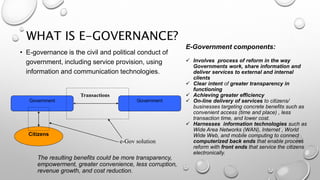
WHAT IS E-GOVERNANCE?
• E-governance is the civil and political conduct of
government, including service provision, using
information and communication technologies.
e-Gov solution
Government Government
Transactions
Citizens
E-Government components:
 Involves process of reform in the way
Governments work, share information and
deliver services to external and internal
clients
 Clear intent of greater transparency in
functioning
 Achieving greater efficiency
 On-line delivery of services to citizens/
businesses targeting concrete benefits such as
convenient access (time and place) , less
transaction time, and lower cost.
 Harnesses information technologies such as
Wide Area Networks (WAN), Internet , World
Wide Web, and mobile computing to connect
computerized back ends that enable process
reform with front ends that service the citizens
electronically.
The resulting benefits could be more transparency,
empowerment, greater convenience, less corruption,
revenue growth, and cost reduction.
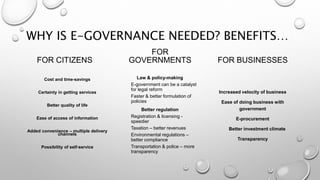
WHY IS E-GOVERNANCE NEEDED? BENEFITS…
FOR CITIZENS
Cost and time-savings
Certainty in getting services
Better quality of life
Ease of access of information
Added convenience – multiple delivery
channels
Possibility of self-service
FOR
GOVERNMENTS
Law & policy-making
E-government can be a catalyst
for legal reform
Faster & better formulation of
policies
Better regulation
Registration & licensing -
speedier
Taxation – better revenues
Environmental regulations –
better compliance
Transportation & police – more
transparency
FOR BUSINESSES
Increased velocity of business
Ease of doing business with
government
E-procurement
Better investment climate
Transparency
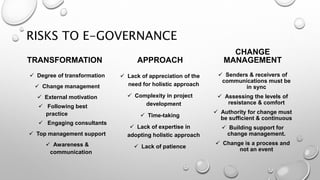
RISKS TO E-GOVERNANCE
TRANSFORMATION
 Degree of transformation
 Change management
 External motivation
 Following best
practice
 Engaging consultants
 Top management support
 Awareness &
communication
APPROACH
 Lack of appreciation of the
need for holistic approach
 Complexity in project
development
 Time-taking
 Lack of expertise in
adopting holistic approach
 Lack of patience
CHANGE
MANAGEMENT
 Senders & receivers of
communications must be
in sync
 Assessing the levels of
resistance & comfort
 Authority for change must
be sufficient & continuous
 Building support for
change management.
 Change is a process and
not an event
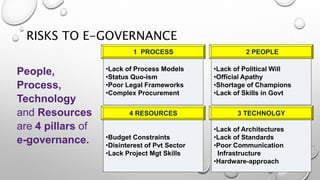
RISKS TO E-GOVERNANCE
•Lack of Process Models
•Status Quo-ism
•Poor Legal Frameworks
•Complex Procurement
1 PROCESS
•Lack of Political Will
•Official Apathy
•Shortage of Champions
•Lack of Skills in Govt
2 PEOPLE
•Lack of Architectures
•Lack of Standards
•Poor Communication
Infrastructure
•Hardware-approach
3 TECHNOLGY
•Budget Constraints
•Disinterest of Pvt Sector
•Lack Project Mgt Skills
4 RESOURCES
People,
Process,
Technology
and Resources
are 4 pillars of
e-governance.
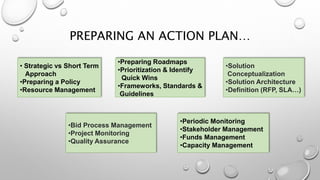
PREPARING AN ACTION PLAN…
• Strategic vs Short Term
Approach
•Preparing a Policy
•Resource Management
•Preparing Roadmaps
•Prioritization & Identify
Quick Wins
•Frameworks, Standards &
Guidelines
•Periodic Monitoring
•Stakeholder Management
•Funds Management
•Capacity Management
•Solution
Conceptualization
•Solution Architecture
•Definition (RFP, SLA…)
•Bid Process Management
•Project Monitoring
•Quality Assurance
THE ROLE OF THE PRIVATE SECTOR IN
MANAGING THE E-GOVERNANCE RISKS
• The Private Sector will most likely be the one to implement the e-governance initiative.
• They are expected to be trusted advisors to the Government.
• They will be able to deliver if the relationship with the government is more of a
partnership rather than a service provider where there is trust and risk sharing willingly.
• The least price may not always be the right solution.
• The project requirements may need to be changed overall if need be during the
implementation phase – the government needs to respect this if the need is justified by
the implementing agency.
THE ROLE OF INTERNATIONAL COMMUNITIES
Communities like World Bank play a instrumental role in:
Providing financial aid for implementation of e-governance projects.
Conceptualizing the solution both at state and national levels.
 Preparation of Detailed Project Reports including “As-Is” and “To-be” Reports.
 In onboarding the system integrators and consultants for the project requirements.
 Identifying the risks and possible solution.
 Tracking the progress of the project implementation
ACKNOWLEDGEMENTS
• http://siteresources.worldbank.org/integovernment/resources/egovprinciplesjs5nov06.ppt
• http://siteresources.worldbank.org/INTEDEVELOPMENT/Resources/559323-
1114798035525/1055531-1114798256329/1055556-1114798371392/Bhatnagar1.ppt
• http://www.cs.northwestern.edu/~agupta/_projects/ibm_internship/eGovernance.ppt

Identifying risks and preparing an action plan for e governance in india

  • 1.
    IDENTIFYING RISKS AND PREPARINGAN ACTION PLAN FOR E-GOVERNANCE IN INDIA Submitted To World Bank For The Project Requirements Fulfillment Of The Mooc Course Submitted By Swatantra Kumar Gupta
  • 2.
    IN SLIDES AHEAD… •WHAT IS E-GOVERNANCE? • WHY IS E-GOVERNANCE NEEDED? • RISKS TO E-GOVERNANCE • PREPARING AN ACTION PLAN • THE ROLE OF THE PRIVATE SECTOR IN MANAGING THE RISKS • THE ROLE OF INTERNATIONAL COMMUNITIES
  • 3.
    WHAT IS E-GOVERNANCE? •E-governance is the civil and political conduct of government, including service provision, using information and communication technologies. e-Gov solution Government Government Transactions Citizens E-Government components:  Involves process of reform in the way Governments work, share information and deliver services to external and internal clients  Clear intent of greater transparency in functioning  Achieving greater efficiency  On-line delivery of services to citizens/ businesses targeting concrete benefits such as convenient access (time and place) , less transaction time, and lower cost.  Harnesses information technologies such as Wide Area Networks (WAN), Internet , World Wide Web, and mobile computing to connect computerized back ends that enable process reform with front ends that service the citizens electronically. The resulting benefits could be more transparency, empowerment, greater convenience, less corruption, revenue growth, and cost reduction.
  • 4.
    WHY IS E-GOVERNANCENEEDED? BENEFITS… FOR CITIZENS Cost and time-savings Certainty in getting services Better quality of life Ease of access of information Added convenience – multiple delivery channels Possibility of self-service FOR GOVERNMENTS Law & policy-making E-government can be a catalyst for legal reform Faster & better formulation of policies Better regulation Registration & licensing - speedier Taxation – better revenues Environmental regulations – better compliance Transportation & police – more transparency FOR BUSINESSES Increased velocity of business Ease of doing business with government E-procurement Better investment climate Transparency
  • 5.
    RISKS TO E-GOVERNANCE TRANSFORMATION Degree of transformation  Change management  External motivation  Following best practice  Engaging consultants  Top management support  Awareness & communication APPROACH  Lack of appreciation of the need for holistic approach  Complexity in project development  Time-taking  Lack of expertise in adopting holistic approach  Lack of patience CHANGE MANAGEMENT  Senders & receivers of communications must be in sync  Assessing the levels of resistance & comfort  Authority for change must be sufficient & continuous  Building support for change management.  Change is a process and not an event
  • 6.
    RISKS TO E-GOVERNANCE •Lackof Process Models •Status Quo-ism •Poor Legal Frameworks •Complex Procurement 1 PROCESS •Lack of Political Will •Official Apathy •Shortage of Champions •Lack of Skills in Govt 2 PEOPLE •Lack of Architectures •Lack of Standards •Poor Communication Infrastructure •Hardware-approach 3 TECHNOLGY •Budget Constraints •Disinterest of Pvt Sector •Lack Project Mgt Skills 4 RESOURCES People, Process, Technology and Resources are 4 pillars of e-governance.
  • 7.
    PREPARING AN ACTIONPLAN… • Strategic vs Short Term Approach •Preparing a Policy •Resource Management •Preparing Roadmaps •Prioritization & Identify Quick Wins •Frameworks, Standards & Guidelines •Periodic Monitoring •Stakeholder Management •Funds Management •Capacity Management •Solution Conceptualization •Solution Architecture •Definition (RFP, SLA…) •Bid Process Management •Project Monitoring •Quality Assurance
  • 8.
    THE ROLE OFTHE PRIVATE SECTOR IN MANAGING THE E-GOVERNANCE RISKS • The Private Sector will most likely be the one to implement the e-governance initiative. • They are expected to be trusted advisors to the Government. • They will be able to deliver if the relationship with the government is more of a partnership rather than a service provider where there is trust and risk sharing willingly. • The least price may not always be the right solution. • The project requirements may need to be changed overall if need be during the implementation phase – the government needs to respect this if the need is justified by the implementing agency.
  • 9.
    THE ROLE OFINTERNATIONAL COMMUNITIES Communities like World Bank play a instrumental role in: Providing financial aid for implementation of e-governance projects. Conceptualizing the solution both at state and national levels.  Preparation of Detailed Project Reports including “As-Is” and “To-be” Reports.  In onboarding the system integrators and consultants for the project requirements.  Identifying the risks and possible solution.  Tracking the progress of the project implementation
  • 10.