Shikha
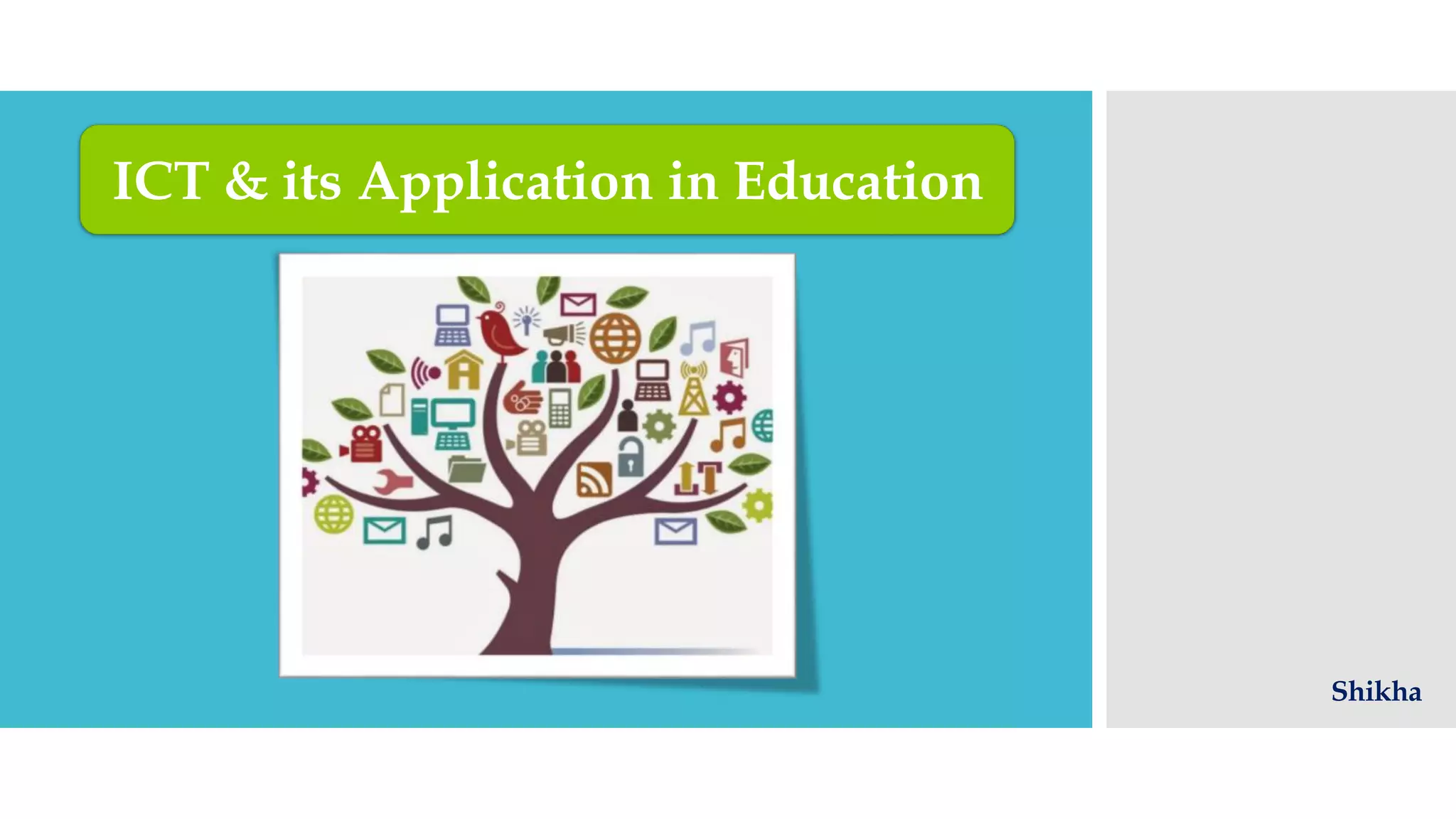
ICT & its Application in Education
Introduction
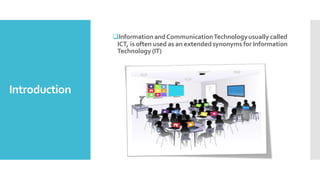
❑InformationandCommunicationTechnologyusually called
ICT, is often used as an extendedsynonyms for Information
Technology(IT)
Tools of ICTs
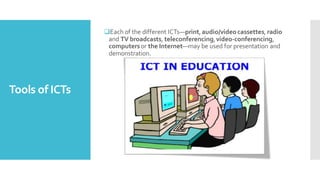
❑Each of the different ICTs—print,audio/video cassettes, radio
and TV broadcasts, teleconferencing,video-conferencing,
computersor the Internet—may be used for presentation and
demonstration.
How have
Internet been
used in
education?
➢Directclass teaching - where broadcast programming substitutes
for teachers on a temporary basis;
➢School Broadcasting - where broadcast programming provide
complementary teaching and learning resources not otherwise
available; and
➢General Educational Programming overCommunity – national
and International stations which provide general and informal
educational opportunities.
Uses
➢The uses of ICTs in education extends beyond equipping
classrooms with computers and an Internet connection.
➢There are a wide variety of ICTs currently available to schools and
universities that can be implemented to enhance students' overall
learning experiences in numerous ways.
➢Those schools and universities that have implemented ICTs
primarily use these technologies to fulfill three objectives.
Three
objectives
➢Increase Networking opportunities-ICTs helps schools to
Connect others schools as well as individual within those schools
to one another
➢Provide Distance Learning- with the advent of ICTs, learning has
become Web-Based.As a result, ICTs have started to replace
correspondence schools.
➢SupplementTraditionalLearning-Oneof the most common uses
of ICTs in education involves students using software programs
such as MicrosoftWord to produce otherwise traditional written
assignment.
Advantages
➢Increased accessedto Resources-Unlike the traditional
classroom that is locked at the end of the school day, ICTs allows
students to access educational resources from anywhere at any
time.
➢Interactive Learning Experience-Many educators deliver
information in the form of lecture. ICTs allows students to access
information through videos, podcasts and a variety of other
interactive media.
➢Students-CenteredLearning-Ina traditional classroom, students
cannot control how lessons are planned. Through the use of ICT
applications now they can control of their learning experience.
Students can decide when class is in session, as well as how the
lesson material will be presented
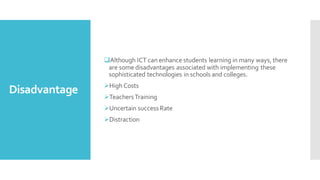
Disadvantage
❑Although ICT can enhance students learning in many ways, there
are some disadvantages associated with implementing these
sophisticated technologies in schools and colleges.
➢High Costs
➢TeachersTraining
➢Uncertain success Rate
➢Distraction
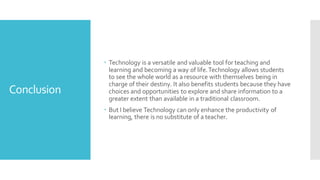
Conclusion
 Technology is a versatile and valuable tool for teaching and
learning and becoming a way of life.Technology allows students
to see the whole world as a resource with themselves being in
charge of their destiny. It also benefits students because they have
choices and opportunities to explore and share information to a
greater extent than available in a traditional classroom.
 But I believe Technology can only enhance the productivity of
learning, there is no substitute of a teacher.
ICTs and its application in Education

ICTs and its application in Education

  • 1.
    Shikha ICT & itsApplication in Education
  • 2.
    Introduction ❑InformationandCommunicationTechnologyusually called ICT, isoften used as an extendedsynonyms for Information Technology(IT)
  • 3.
    Tools of ICTs ❑Eachof the different ICTs—print,audio/video cassettes, radio and TV broadcasts, teleconferencing,video-conferencing, computersor the Internet—may be used for presentation and demonstration.
  • 4.
    How have Internet been usedin education? ➢Directclass teaching - where broadcast programming substitutes for teachers on a temporary basis; ➢School Broadcasting - where broadcast programming provide complementary teaching and learning resources not otherwise available; and ➢General Educational Programming overCommunity – national and International stations which provide general and informal educational opportunities.
  • 5.
    Uses ➢The uses ofICTs in education extends beyond equipping classrooms with computers and an Internet connection. ➢There are a wide variety of ICTs currently available to schools and universities that can be implemented to enhance students' overall learning experiences in numerous ways. ➢Those schools and universities that have implemented ICTs primarily use these technologies to fulfill three objectives.
  • 6.
    Three objectives ➢Increase Networking opportunities-ICTshelps schools to Connect others schools as well as individual within those schools to one another ➢Provide Distance Learning- with the advent of ICTs, learning has become Web-Based.As a result, ICTs have started to replace correspondence schools. ➢SupplementTraditionalLearning-Oneof the most common uses of ICTs in education involves students using software programs such as MicrosoftWord to produce otherwise traditional written assignment.
  • 7.
    Advantages ➢Increased accessedto Resources-Unlikethe traditional classroom that is locked at the end of the school day, ICTs allows students to access educational resources from anywhere at any time. ➢Interactive Learning Experience-Many educators deliver information in the form of lecture. ICTs allows students to access information through videos, podcasts and a variety of other interactive media. ➢Students-CenteredLearning-Ina traditional classroom, students cannot control how lessons are planned. Through the use of ICT applications now they can control of their learning experience. Students can decide when class is in session, as well as how the lesson material will be presented
  • 8.
    Disadvantage ❑Although ICT canenhance students learning in many ways, there are some disadvantages associated with implementing these sophisticated technologies in schools and colleges. ➢High Costs ➢TeachersTraining ➢Uncertain success Rate ➢Distraction
  • 9.
    Conclusion  Technology isa versatile and valuable tool for teaching and learning and becoming a way of life.Technology allows students to see the whole world as a resource with themselves being in charge of their destiny. It also benefits students because they have choices and opportunities to explore and share information to a greater extent than available in a traditional classroom.  But I believe Technology can only enhance the productivity of learning, there is no substitute of a teacher.