I N T E R N A T I O N A L S C H O O L O F T O U R I S M A N D
H O T E L M A N A G E M E N T
K A T H M A N D U , G Y A N E S H W O R
N E P A L
Memos & Other Letter Formats
Group Members
1. Aayush Shahi
2. Alex Gurung
3. Aman Sthapit
4. Bishan Gautam
5. Mingmar Lama
Topics
 Defining Memos
 Objectives
 Differences Among Memos, Letters, and E-mail
 Parts of Memo
 Criteria for Writing Successful Memos
 Effective Memo Checklist
Defining Memo
 Written communications within a business organization are
called memorandums or memos.
 They use a simple format, which is designed to be efficient
and productive, and they do not require the formality of an
inside address, salutation or complimentary closing.
 Memos formats differ from organization to organization.
 Memos can be formal as a business letter and used to
present a report
Objectives of Memos
 Written and read only within a company
 Usually written to inform readers of specific
information.
 You might also write a memo to persuade
others to take action, give feedback on an
issue, or react to a situation. However, most
memos communicate basic information,
such as meeting times or due dates.
 Represent a component of your
interpersonal communication skills within
your work environment
Memo vs. Letters & Emails
1. A letter is a short or long message that is sent by one person to another while a memo is a short
message that is sent by a person to another.
2. A letter is more formal and contains more information while a memo is informal and is very short.
3. A memo is more concise and to the point as compared to a letter.
4. A letter is exchanged between businesses and their clients while a memo is exchanged between
individuals within an organization.
5. A memo usually has a header that states where it is from and who it is intended for while a letter
may or may not have this feature.
6. Email opens with a To, From, Subject Line, Carbon Copy (CC), and in some circumstances a Bcc. A
Memo is quite similar to a Email. It too opens with a To, From, Subject Line but it also has a date
line and no CC or Bcc .
7. A Email then opens with the receivers name to express friendliness and to mark the
beginning of a message. A Memo gets directly to the point and provide ragged line endings
that are not yet justified.
8. A Email always closes with the information from whoever is sending the email. While a
Memo usually omits a closing and never uses a signature.
Memos vs. Letters and E-mail
Characteristic Memos Letters E-mail
Destination Internal External Both
Format Date, To, From,
Subject
Letterhead
address, date,
reader’s address,
salutation, etc.
Subject, From,
Sent, To
Audience Business
colleagues
Vendors and
clients
Multiple readers
Topic High-tech to
low-tech
Low-tech to lay Diverse topics
Tone Informal More formal Usually informal
Enclosures Hard copy
attachments
Additional
information
Computer files,
Web links
Structure 8.5” x 11”
55 lines page
8.5” x 11”
55 lines page
One screen
12-14 lines
Delivery Time Within 3 days 3 days or more Within minutes
Security Company –
work ethics
US Postal --
reliable
May be
tampered with
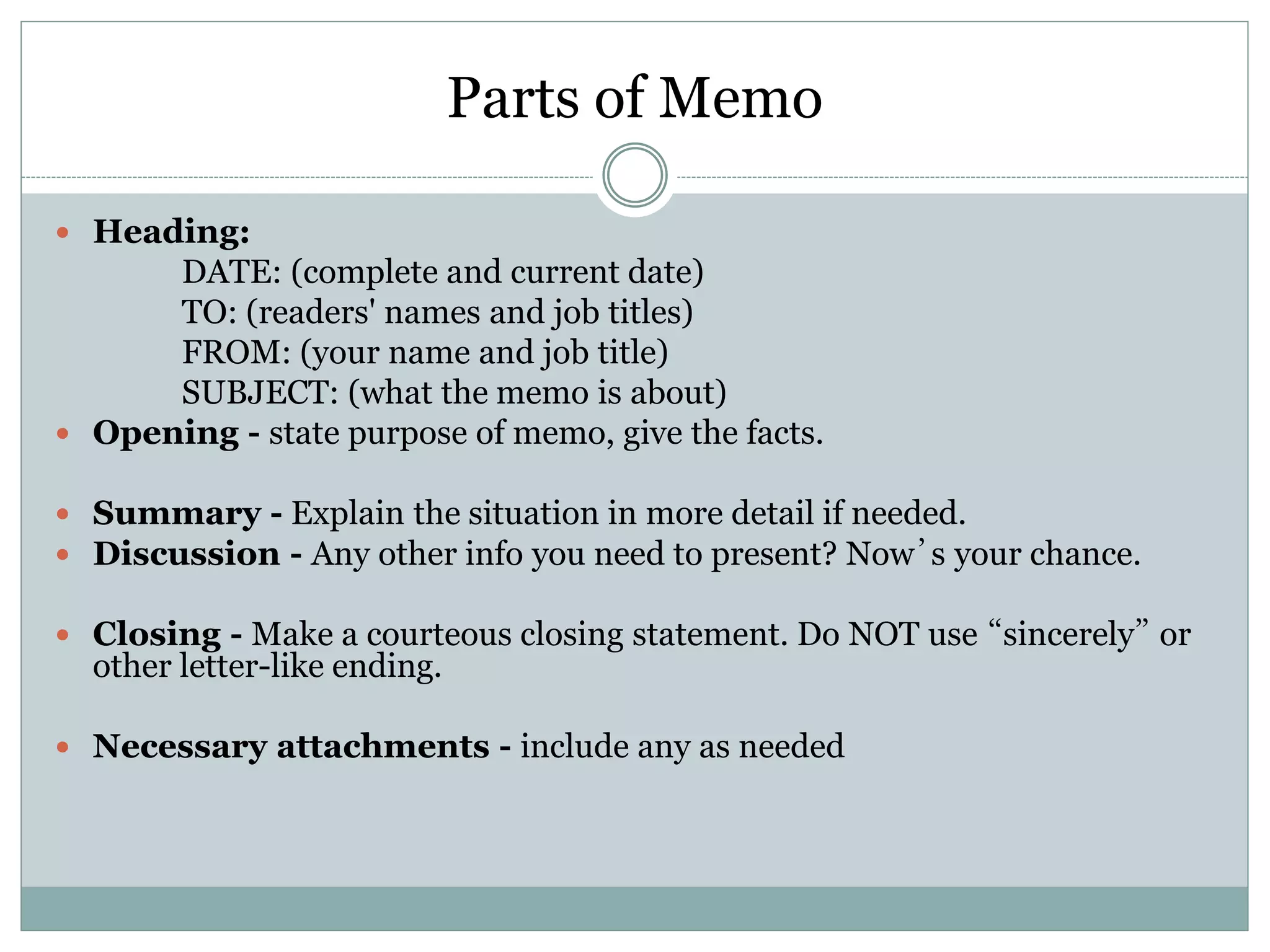
Parts of Memo
 Heading:
DATE: (complete and current date)
TO: (readers' names and job titles)
FROM: (your name and job title)
SUBJECT: (what the memo is about)
 Opening - state purpose of memo, give the facts.
 Summary - Explain the situation in more detail if needed.
 Discussion - Any other info you need to present? Now’s your chance.
 Closing - Make a courteous closing statement. Do NOT use “sincerely” or
other letter-like ending.
 Necessary attachments - include any as needed
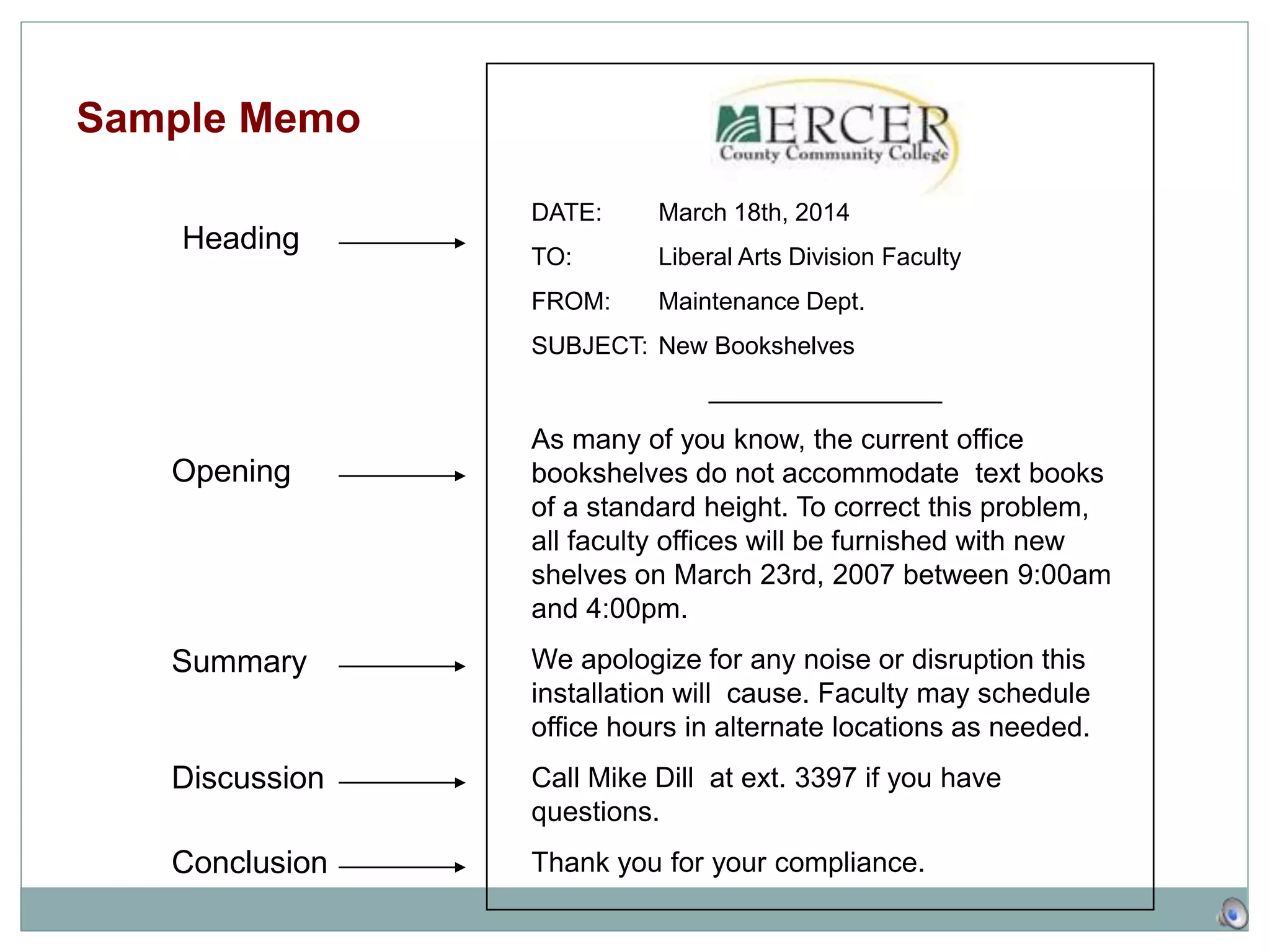
DATE: March 18th, 2014
TO: Liberal Arts Division Faculty
FROM: Maintenance Dept.
SUBJECT: New Bookshelves
_________________
As many of you know, the current office
bookshelves do not accommodate text books
of a standard height. To correct this problem,
all faculty offices will be furnished with new
shelves on March 23rd, 2007 between 9:00am
and 4:00pm.
We apologize for any noise or disruption this
installation will cause. Faculty may schedule
office hours in alternate locations as needed.
Call Mike Dill at ext. 3397 if you have
questions.
Thank you for your compliance.
Sample Memo
Heading
Opening
Summary
Discussion
Conclusion
Guideline for Writing Memos
 Plain Paper : The trend today is to print memos on plain paper since most organization
nowadays uses computers.
 Memos usually have one-inch margins on all four sides, and the writer's initials always
appear next to the name at the top of the memo.
 Position the insertion point approximately 2 inches from the top of the page. Most word
processing programs have a 1-inch top margins
 Double space the guide words in the heading (MEMO TO :, FROM:, DATE:, SUBJECT:)
in all capital letters at the left margin. These guide words are in bold type to make them
stand out from the other text.
 Insert a colon after each heading guide word.
Criteria for Successful Memos
 Introduction
 One or two clear introductory sentences which tell your readers what you want
and why you’re writing
 In the third of our series of quality control meetings this quarter, I’d like to get
together again to determine if improvements have been made.
 Discussion
 Respond to the reporter’s questions (who, what, when , why, where,
how)
 Apply highlighting techniques
 Itemization
 White space
 Boldface type
 Headings
 Columns
 Graphics
Criteria for Successful Memos
 Conclusion
 Complimentary close
 Motivates readers and leaves them happy
 If our quarterly sales continue to improve at this rate, we will double our
sales expectations by 2015. Congratulations!
 Directive close
 Tells your readers exactly what you want them to do next or what your
plans are (dated action)
 Next Wednesday (12/22/00), Mr. Jones will provide each of you a timetable
of events and a summary of accomplishments.
 Audience
 Memos average six readers.
 May use more acronyms and internal abbreviations.
 Provide parenthetical definitions if your usage differs from what most
people will assume.
Criteria for Successful Memos
 Style
 Use simple words, readable sentences, specific detail, and
highlighting techniques.
 Strive for an informal, friendly tone.
 Reflects your interpersonal communication skills.
 Tone is achieved through audience involvement (you usage),
contractions, and positive words.
Effective Memo Checklist
 Use the correct memo format.
 subject line should be correct.
 Your introduction should tell why you are writing and
what you are writing about.
 The body of memo should explain exactly what you want
to say.
 Conclusion tells what’s next and provide a close.
Effective Memo Checklist
 Page layout should be reader friendly
 Writing have to be clear?
 Should answer reporter’s questions.
 Avoid vague words such as some, several, many, few?
 Errors should be eliminated.
END
Thank you,
thank you very
much!

Memo and other letter formats

  • 1.
    I N TE R N A T I O N A L S C H O O L O F T O U R I S M A N D H O T E L M A N A G E M E N T K A T H M A N D U , G Y A N E S H W O R N E P A L Memos & Other Letter Formats
  • 2.
    Group Members 1. AayushShahi 2. Alex Gurung 3. Aman Sthapit 4. Bishan Gautam 5. Mingmar Lama
  • 3.
    Topics  Defining Memos Objectives  Differences Among Memos, Letters, and E-mail  Parts of Memo  Criteria for Writing Successful Memos  Effective Memo Checklist
  • 4.
    Defining Memo  Writtencommunications within a business organization are called memorandums or memos.  They use a simple format, which is designed to be efficient and productive, and they do not require the formality of an inside address, salutation or complimentary closing.  Memos formats differ from organization to organization.  Memos can be formal as a business letter and used to present a report
  • 5.
    Objectives of Memos Written and read only within a company  Usually written to inform readers of specific information.  You might also write a memo to persuade others to take action, give feedback on an issue, or react to a situation. However, most memos communicate basic information, such as meeting times or due dates.  Represent a component of your interpersonal communication skills within your work environment
  • 6.
    Memo vs. Letters& Emails 1. A letter is a short or long message that is sent by one person to another while a memo is a short message that is sent by a person to another. 2. A letter is more formal and contains more information while a memo is informal and is very short. 3. A memo is more concise and to the point as compared to a letter. 4. A letter is exchanged between businesses and their clients while a memo is exchanged between individuals within an organization. 5. A memo usually has a header that states where it is from and who it is intended for while a letter may or may not have this feature. 6. Email opens with a To, From, Subject Line, Carbon Copy (CC), and in some circumstances a Bcc. A Memo is quite similar to a Email. It too opens with a To, From, Subject Line but it also has a date line and no CC or Bcc . 7. A Email then opens with the receivers name to express friendliness and to mark the beginning of a message. A Memo gets directly to the point and provide ragged line endings that are not yet justified. 8. A Email always closes with the information from whoever is sending the email. While a Memo usually omits a closing and never uses a signature.
  • 7.
    Memos vs. Lettersand E-mail Characteristic Memos Letters E-mail Destination Internal External Both Format Date, To, From, Subject Letterhead address, date, reader’s address, salutation, etc. Subject, From, Sent, To Audience Business colleagues Vendors and clients Multiple readers Topic High-tech to low-tech Low-tech to lay Diverse topics Tone Informal More formal Usually informal Enclosures Hard copy attachments Additional information Computer files, Web links Structure 8.5” x 11” 55 lines page 8.5” x 11” 55 lines page One screen 12-14 lines Delivery Time Within 3 days 3 days or more Within minutes Security Company – work ethics US Postal -- reliable May be tampered with
  • 8.
    Parts of Memo Heading: DATE: (complete and current date) TO: (readers' names and job titles) FROM: (your name and job title) SUBJECT: (what the memo is about)  Opening - state purpose of memo, give the facts.  Summary - Explain the situation in more detail if needed.  Discussion - Any other info you need to present? Now’s your chance.  Closing - Make a courteous closing statement. Do NOT use “sincerely” or other letter-like ending.  Necessary attachments - include any as needed
  • 9.
    DATE: March 18th,2014 TO: Liberal Arts Division Faculty FROM: Maintenance Dept. SUBJECT: New Bookshelves _________________ As many of you know, the current office bookshelves do not accommodate text books of a standard height. To correct this problem, all faculty offices will be furnished with new shelves on March 23rd, 2007 between 9:00am and 4:00pm. We apologize for any noise or disruption this installation will cause. Faculty may schedule office hours in alternate locations as needed. Call Mike Dill at ext. 3397 if you have questions. Thank you for your compliance. Sample Memo Heading Opening Summary Discussion Conclusion
  • 10.
    Guideline for WritingMemos  Plain Paper : The trend today is to print memos on plain paper since most organization nowadays uses computers.  Memos usually have one-inch margins on all four sides, and the writer's initials always appear next to the name at the top of the memo.  Position the insertion point approximately 2 inches from the top of the page. Most word processing programs have a 1-inch top margins  Double space the guide words in the heading (MEMO TO :, FROM:, DATE:, SUBJECT:) in all capital letters at the left margin. These guide words are in bold type to make them stand out from the other text.  Insert a colon after each heading guide word.
  • 11.
    Criteria for SuccessfulMemos  Introduction  One or two clear introductory sentences which tell your readers what you want and why you’re writing  In the third of our series of quality control meetings this quarter, I’d like to get together again to determine if improvements have been made.  Discussion  Respond to the reporter’s questions (who, what, when , why, where, how)  Apply highlighting techniques  Itemization  White space  Boldface type  Headings  Columns  Graphics
  • 12.
    Criteria for SuccessfulMemos  Conclusion  Complimentary close  Motivates readers and leaves them happy  If our quarterly sales continue to improve at this rate, we will double our sales expectations by 2015. Congratulations!  Directive close  Tells your readers exactly what you want them to do next or what your plans are (dated action)  Next Wednesday (12/22/00), Mr. Jones will provide each of you a timetable of events and a summary of accomplishments.  Audience  Memos average six readers.  May use more acronyms and internal abbreviations.  Provide parenthetical definitions if your usage differs from what most people will assume.
  • 13.
    Criteria for SuccessfulMemos  Style  Use simple words, readable sentences, specific detail, and highlighting techniques.  Strive for an informal, friendly tone.  Reflects your interpersonal communication skills.  Tone is achieved through audience involvement (you usage), contractions, and positive words.
  • 14.
    Effective Memo Checklist Use the correct memo format.  subject line should be correct.  Your introduction should tell why you are writing and what you are writing about.  The body of memo should explain exactly what you want to say.  Conclusion tells what’s next and provide a close.
  • 15.
    Effective Memo Checklist Page layout should be reader friendly  Writing have to be clear?  Should answer reporter’s questions.  Avoid vague words such as some, several, many, few?  Errors should be eliminated.
  • 16.